
Oracle Critical Security Patch Update August 2026
Released August 2026 · Oracle's advisory ↗ · ← Critical Patch Update, July 2026 · Security Patch Update, September 2026 →
1,021 CVEs in this release, one square each
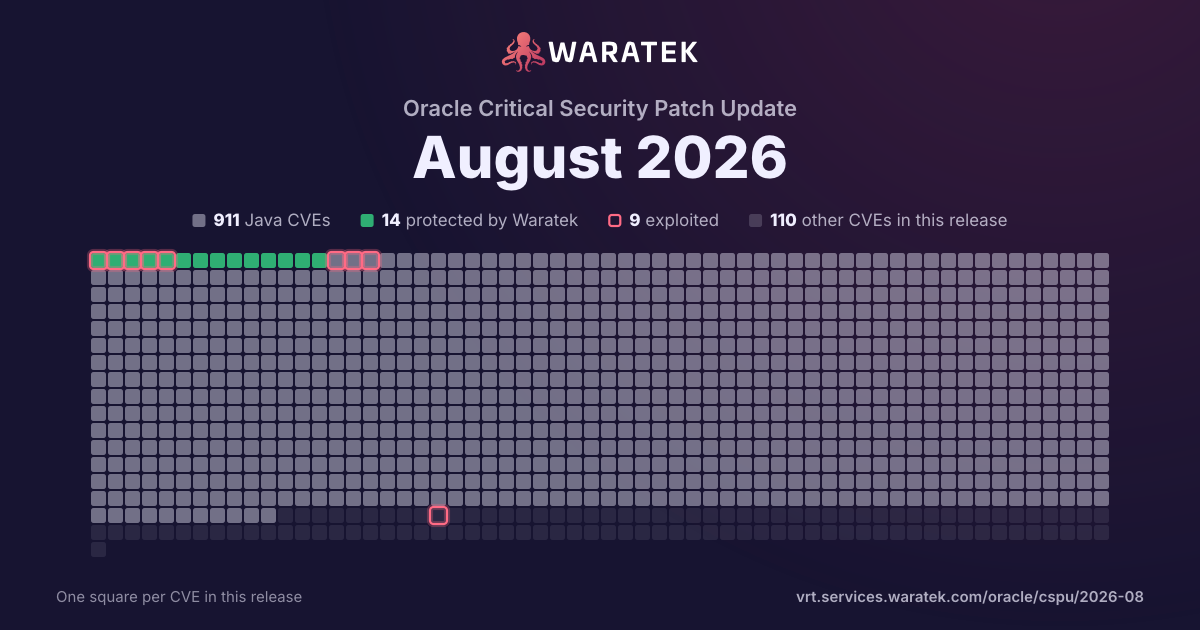
By status
14Protected by Waratek1Rule in development3Mitigation candidate893No exploit published2Outside Waratek scope108Not applicable
9Exploited, marked by the ring
No exploit published. For 847 of them, Oracle's security advisory is the source of public detail.
Protected by Waratek. Waratek RASP can block exploitation of these on systems that have not applied the patch yet.
Overview 9 matches · 5 in Waratek scope · 2 protected · 0 exploited · 0 CISA KEV · 3 public PoC · 1 EPSS ≥ 0.5
9matches
5in Waratek scope55.6%
2protected22.2%
0exploited0.0%
0CISA KEV0.0%
3public PoC33.3%
1EPSS ≥ 0.511.1%
Protected by Waratek
2
22.2%
Rule in development
0
0.0%
Mitigation candidate
1
11.1%
No exploit published
2
22.2%
Outside Waratek scope
0
0.0%
Not applicable
4
44.4%
Withdrawn CVE
0
0.0%
blocked by ARMR today
2
22.2%
partly blocked
0
0.0%
not blocked
7
77.8%
not established
0
0.0%
unrecorded
0
0.0%
Exploited
0
0.0%
Working exploit published
0
0.0%
Proof of concept only
9
100.0%
Forecast only
0
0.0%
No public exploit
0
0.0%
split by
peak 3 / quarter
Q1 221
Protected by Waratek1
Critical1
blocked by ARMR today1
Proof of concept only1
Q2 220
Q3 223
Protected by Waratek1
No exploit published1
Not applicable1
Critical1
High2
blocked by ARMR today1
not blocked2
Proof of concept only3
Q4 220
Q1 230
Q2 230
Q3 230
Q4 230
Q1 241
Mitigation candidate1
High1
not blocked1
Proof of concept only1
Q2 240
Q3 240
Q4 240
Q1 250
Q2 250
Q3 250
Q4 250
Q1 261
Not applicable1
Medium1
not blocked1
Proof of concept only1
Q2 263
No exploit published1
Not applicable2
Critical1
Medium2
not blocked3
Proof of concept only3
Q2 22Q4 22Q2 23Q4 23Q2 24Q4 24Q2 25Q4 25Q2 26
| CVE | Severity | Published▾ | Status | Exploitation | Description |
|---|---|---|---|---|---|
| CVE-2026-41240 | Medium | 2026-04-23 | Not applicable | Proof of concept only | DOMPurify is a DOM-only cross-site scripting sanitizer for HTML, MathML, and SVG. Versions prior to 3.4.0 have an inconsistency between FORBID_TAGS and FORBID_ATTR handling when function-based ADD_TAGS is used. Commit c361baa added an early exit for FORBID_ATTR at line 1214. The same fix was not applied to FORBID_TAGS. At line 1118-1123, when EXTRA_ELEMENT_HANDLING.tagCheck returns true, the short-circuit evaluation skips the FORBID_TAGS check entirely. This allows forbidden elements to survive sanitization with their attributes intact. Version 3.4.0 patches the issue. |
| CVE-2026-41238 | Medium | 2026-04-23 | Not applicable | Proof of concept only | DOMPurify is a DOM-only cross-site scripting sanitizer for HTML, MathML, and SVG. Versions 3.0.1 through 3.3.3 are vulnerable to a prototype pollution-based XSS bypass. When an application uses `DOMPurify.sanitize()` with the default configuration (no `CUSTOM_ELEMENT_HANDLING` option), a prior prototype pollution gadget can inject permissive `tagNameCheck` and `attributeNameCheck` regex values into `Object.prototype`, causing DOMPurify to allow arbitrary custom elements with arbitrary attributes — including event handlers — through sanitization. Version 3.4.0 fixes the issue. |
| CVE-2026-2332 | Critical | 2026-04-14 | No exploit published | Proof of concept only | In Eclipse Jetty, the HTTP/1.1 parser is vulnerable to request smuggling when chunk extensions are used, similar to the "funky chunks" techniques outlined here: * https://w4ke.info/2025/06/18/funky-chunks.html * https://w4ke.info/2025/10/29/funky-chunks-2.html Jetty terminates chunk extension parsing at \r\n inside quoted strings instead of treating this as an error. POST / HTTP/1.1 Host: localhost Transfer-Encoding: chunked 1;ext="val X 0 GET /smuggled HTTP/1.1 ... Note how the chunk extension does not close the double quotes, and it is able to inject a smuggled request. |
| CVE-2026-27171 | Medium | 2026-02-18 | Not applicable | Proof of concept only | zlib before 1.3.2 allows CPU consumption via crc32_combine64 and crc32_combine_gen64 because x2nmodp can do right shifts within a loop that has no termination condition. |
| CVE-2024-20931 | High | 2024-02-17 | Mitigation candidate | Proof of concept only | Vulnerability in the Oracle WebLogic Server product of Oracle Fusion Middleware (component: Core). Supported versions that are affected are 12.2.1.4.0 and 14.1.1.0.0. Easily exploitable vulnerability allows unauthenticated attacker with network access via T3, IIOP to compromise Oracle WebLogic Server. Successful attacks of this vulnerability can result in unauthorized access to critical data or complete access to all Oracle WebLogic Server accessible data. CVSS 3.1 Base Score 7.5 (Confidentiality impacts). CVSS Vector: (CVSS:3.1/AV:N/AC:L/PR:N/UI:N/S:U/C:H/I:N/A:N). |
| CVE-2022-40152 | High | 2022-09-16 | No exploit published | Proof of concept only | Those using Woodstox to parse XML data may be vulnerable to Denial of Service attacks (DOS) if DTD support is enabled. If the parser is running on user supplied input, an attacker may supply content that causes the parser to crash by stackoverflow. This effect may support a denial of service attack. |
| CVE-2022-37434 | Critical | 2022-08-05 | Not applicable | Proof of concept only | zlib through 1.2.12 has a heap-based buffer over-read or buffer overflow in inflate in inflate.c via a large gzip header extra field. NOTE: only applications that call inflateGetHeader are affected. Some common applications bundle the affected zlib source code but may be unable to call inflateGetHeader (e.g., see the nodejs/node reference). |
| CVE-2022-34169 | High | 2022-07-19 | Protected by Waratek | Proof of concept only | The Apache Xalan Java XSLT library is vulnerable to an integer truncation issue when processing malicious XSLT stylesheets. This can be used to corrupt Java class files generated by the internal XSLTC compiler and execute arbitrary Java bytecode. Users are recommended to update to version 2.7.3 or later. Note: Java runtimes (such as OpenJDK) include repackaged copies of Xalan. |
| CVE-2022-23305 | Critical | 2022-01-18 | Protected by Waratek | Proof of concept only | By design, the JDBCAppender in Log4j 1.2.x accepts an SQL statement as a configuration parameter where the values to be inserted are converters from PatternLayout. The message converter, %m, is likely to always be included. This allows attackers to manipulate the SQL by entering crafted strings into input fields or headers of an application that are logged allowing unintended SQL queries to be executed. Note this issue only affects Log4j 1.x when specifically configured to use the JDBCAppender, which is not the default. Beginning in version 2.0-beta8, the JDBCAppender was re-introduced with proper support for parameterized SQL queries and further customization over the columns written to in logs. Apache Log4j 1.2 reached end of life in August 2015. Users should upgrade to Log4j 2 as it addresses numerous other issues from the previous versions. |