
Oracle Critical Security Patch Update August 2026
Released August 2026 · Oracle's advisory ↗ · ← Critical Patch Update, July 2026 · Security Patch Update, September 2026 →
1,021 CVEs in this release, one square each
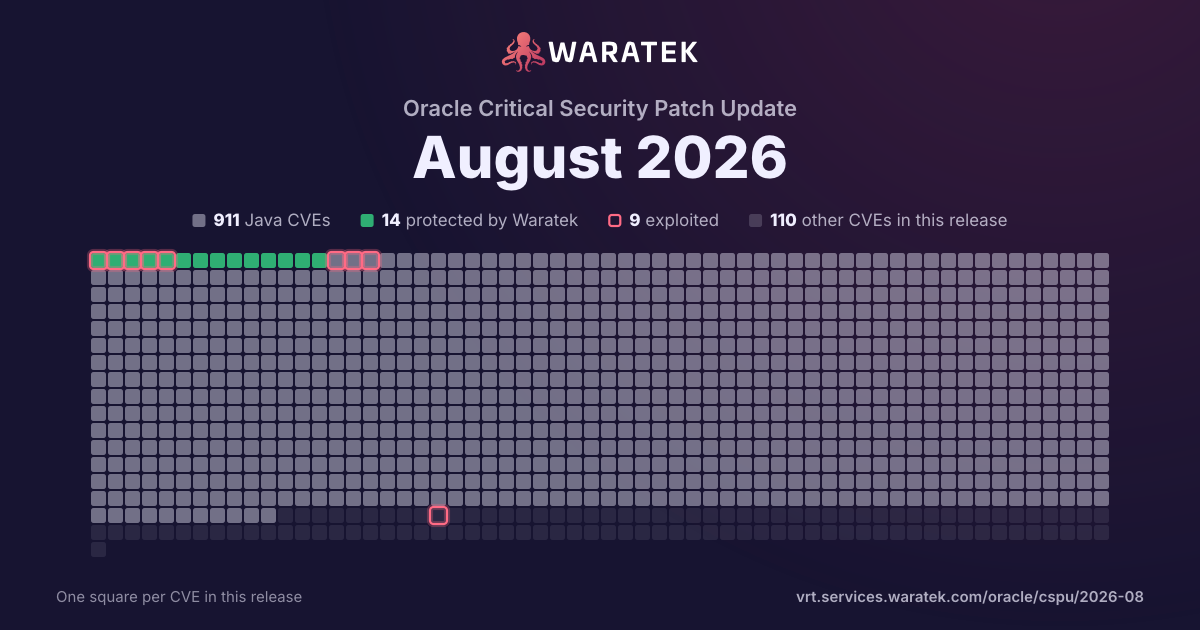
By status
14Protected by Waratek1Rule in development3Mitigation candidate893No exploit published2Outside Waratek scope108Not applicable
9Exploited, marked by the ring
No exploit published. For 847 of them, Oracle's security advisory is the source of public detail.
Protected by Waratek. Waratek RASP can block exploitation of these on systems that have not applied the patch yet.
Overview 254 matches · 0 protected · 0 exploited · 0 CISA KEV · 0 public PoC · 0 EPSS ≥ 0.5
254matches
0protected0.0%
0exploited0.0%
0CISA KEV0.0%
0public PoC0.0%
0EPSS ≥ 0.50.0%
Protected by Waratek
0
0.0%
Rule in development
0
0.0%
Mitigation candidate
0
0.0%
No exploit published
254
100.0%
blocked by ARMR today
0
0.0%
partly blocked
0
0.0%
not blocked
254
100.0%
not established
0
0.0%
unrecorded
0
0.0%
Exploited
0
0.0%
Working exploit published
0
0.0%
Proof of concept only
0
0.0%
Forecast only
0
0.0%
No public exploit
254
100.0%
| CVE | Severity | Published▾ | Status | Exploitation | Description |
|---|---|---|---|---|---|
| CVE-2026-60969 | High | 2026-08-18 | No exploit published | No public exploit | Vulnerability in the Oracle Unified Directory product of Oracle Fusion Middleware (component: OUD Core). Supported versions that are affected are 12.2.1.4.0 and 14.1.2.1.0. Easily exploitable vulnerability allows low privileged attacker with network access via LDAP to compromise Oracle Unified Directory. While the vulnerability is in Oracle Unified Directory, attacks may significantly impact additional products (scope change). Successful attacks of this vulnerability can result in unauthorized access to critical data or complete access to all Oracle Unified Directory accessible data. CVSS 3.1 Base Score 7.7 (Confidentiality impacts). CVSS Vector: (CVSS:3.1/AV:N/AC:L/PR:L/UI:N/S:C/C:H/I:N/A:N). |
| CVE-2026-60961 | High | 2026-08-18 | No exploit published | No public exploit | Vulnerability in the Oracle WebCenter Content product of Oracle Fusion Middleware (component: Content Server). Supported versions that are affected are 12.2.1.4.0 and 14.1.2.0.0. Difficult to exploit vulnerability allows unauthenticated attacker with access to the physical communication segment attached to the hardware where the Oracle WebCenter Content executes to compromise Oracle WebCenter Content. While the vulnerability is in Oracle WebCenter Content, attacks may significantly impact additional products (scope change). Successful attacks of this vulnerability can result in unauthorized creation, deletion or modification access to critical data or all Oracle WebCenter Content accessible data as well as unauthorized access to critical data or complete access to all Oracle WebCenter Content accessible data. CVSS 3.1 Base Score 8.0 (Confidentiality and Integrity impacts). CVSS Vector: (CVSS:3.1/AV:A/AC:H/PR:N/UI:N/S:C/C:H/I:H/A:N). |
| CVE-2026-60958 | Critical | 2026-08-18 | No exploit published | No public exploit | Vulnerability in the Oracle WebCenter Enterprise Capture product of Oracle Fusion Middleware (component: Client Bundle). Supported versions that are affected are 12.2.1.4.0 and 14.1.2.0.0. Easily exploitable vulnerability allows unauthenticated attacker with network access via HTTP to compromise Oracle WebCenter Enterprise Capture. Successful attacks of this vulnerability can result in takeover of Oracle WebCenter Enterprise Capture. CVSS 3.1 Base Score 9.8 (Confidentiality, Integrity and Availability impacts). CVSS Vector: (CVSS:3.1/AV:N/AC:L/PR:N/UI:N/S:U/C:H/I:H/A:H). |
| CVE-2026-60955 | High | 2026-08-18 | No exploit published | No public exploit | Vulnerability in the Oracle WebCenter Content product of Oracle Fusion Middleware (component: Content Server). Supported versions that are affected are 12.2.1.4.0 and 14.1.2.0.0. Easily exploitable vulnerability allows high privileged attacker with network access via HTTP to compromise Oracle WebCenter Content. While the vulnerability is in Oracle WebCenter Content, attacks may significantly impact additional products (scope change). Successful attacks of this vulnerability can result in unauthorized creation, deletion or modification access to critical data or all Oracle WebCenter Content accessible data as well as unauthorized read access to a subset of Oracle WebCenter Content accessible data and unauthorized ability to cause a partial denial of service (partial DOS) of Oracle WebCenter Content. CVSS 3.1 Base Score 8.2 (Confidentiality, Integrity and Availability impacts). CVSS Vector: (CVSS:3.1/AV:N/AC:L/PR:H/UI:N/S:C/C:L/I:H/A:L). |
| CVE-2026-60954 | High | 2026-08-18 | No exploit published | No public exploit | Vulnerability in the Oracle WebCenter Content product of Oracle Fusion Middleware (component: Content Server). Supported versions that are affected are 12.2.1.4.0 and 14.1.2.0.0. Difficult to exploit vulnerability allows unauthenticated attacker with network access via HTTP to compromise Oracle WebCenter Content. While the vulnerability is in Oracle WebCenter Content, attacks may significantly impact additional products (scope change). Successful attacks of this vulnerability can result in unauthorized creation, deletion or modification access to critical data or all Oracle WebCenter Content accessible data as well as unauthorized access to critical data or complete access to all Oracle WebCenter Content accessible data. CVSS 3.1 Base Score 8.7 (Confidentiality and Integrity impacts). CVSS Vector: (CVSS:3.1/AV:N/AC:H/PR:N/UI:N/S:C/C:H/I:H/A:N). |
| CVE-2026-60949 | High | 2026-08-18 | No exploit published | No public exploit | Vulnerability in the Oracle WebCenter Content product of Oracle Fusion Middleware (component: Content Server). Supported versions that are affected are 12.2.1.4.0 and 14.1.2.0.0. Difficult to exploit vulnerability allows low privileged attacker with network access via HTTP to compromise Oracle WebCenter Content. While the vulnerability is in Oracle WebCenter Content, attacks may significantly impact additional products (scope change). Successful attacks of this vulnerability can result in unauthorized access to critical data or complete access to all Oracle WebCenter Content accessible data as well as unauthorized update, insert or delete access to some of Oracle WebCenter Content accessible data. CVSS 3.1 Base Score 7.1 (Confidentiality and Integrity impacts). CVSS Vector: (CVSS:3.1/AV:N/AC:H/PR:L/UI:N/S:C/C:H/I:L/A:N). |
| CVE-2026-60947 | Critical | 2026-08-18 | No exploit published | No public exploit | Vulnerability in the Oracle WebCenter Enterprise Capture product of Oracle Fusion Middleware (component: Client Bundle). Supported versions that are affected are 12.2.1.4.0 and 14.1.2.0.0. Easily exploitable vulnerability allows unauthenticated attacker with network access via RMI to compromise Oracle WebCenter Enterprise Capture. Successful attacks of this vulnerability can result in takeover of Oracle WebCenter Enterprise Capture. CVSS 3.1 Base Score 9.8 (Confidentiality, Integrity and Availability impacts). CVSS Vector: (CVSS:3.1/AV:N/AC:L/PR:N/UI:N/S:U/C:H/I:H/A:H). |
| CVE-2026-60946 | Critical | 2026-08-18 | No exploit published | No public exploit | Vulnerability in the Oracle WebCenter Enterprise Capture product of Oracle Fusion Middleware (component: Client Bundle). Supported versions that are affected are 12.2.1.4.0 and 14.1.2.0.0. Easily exploitable vulnerability allows unauthenticated attacker with network access via RMI to compromise Oracle WebCenter Enterprise Capture. Successful attacks of this vulnerability can result in takeover of Oracle WebCenter Enterprise Capture. CVSS 3.1 Base Score 9.8 (Confidentiality, Integrity and Availability impacts). CVSS Vector: (CVSS:3.1/AV:N/AC:L/PR:N/UI:N/S:U/C:H/I:H/A:H). |
| CVE-2026-60944 | High | 2026-08-18 | No exploit published | No public exploit | Vulnerability in the Oracle WebCenter Content product of Oracle Fusion Middleware (component: Content Server). Supported versions that are affected are 12.2.1.4.0 and 14.1.2.0.0. Easily exploitable vulnerability allows unauthenticated attacker with network access via HTTP to compromise Oracle WebCenter Content. Successful attacks require human interaction from a person other than the attacker and while the vulnerability is in Oracle WebCenter Content, attacks may significantly impact additional products (scope change). Successful attacks of this vulnerability can result in unauthorized access to critical data or complete access to all Oracle WebCenter Content accessible data as well as unauthorized update, insert or delete access to some of Oracle WebCenter Content accessible data. CVSS 3.1 Base Score 8.2 (Confidentiality and Integrity impacts). CVSS Vector: (CVSS:3.1/AV:N/AC:L/PR:N/UI:R/S:C/C:H/I:L/A:N). |
| CVE-2026-60935 | High | 2026-08-18 | No exploit published | No public exploit | Vulnerability in the Oracle WebCenter Content product of Oracle Fusion Middleware (component: Content Server). Supported versions that are affected are 12.2.1.4.0 and 14.1.2.0.0. Difficult to exploit vulnerability allows unauthenticated attacker with network access via HTTP to compromise Oracle WebCenter Content. While the vulnerability is in Oracle WebCenter Content, attacks may significantly impact additional products (scope change). Successful attacks of this vulnerability can result in unauthorized creation, deletion or modification access to critical data or all Oracle WebCenter Content accessible data as well as unauthorized access to critical data or complete access to all Oracle WebCenter Content accessible data. CVSS 3.1 Base Score 8.7 (Confidentiality and Integrity impacts). CVSS Vector: (CVSS:3.1/AV:N/AC:H/PR:N/UI:N/S:C/C:H/I:H/A:N). |
| CVE-2026-60934 | High | 2026-08-18 | No exploit published | No public exploit | Vulnerability in the Oracle WebCenter Content product of Oracle Fusion Middleware (component: Content Server). Supported versions that are affected are 12.2.1.4.0 and 14.1.2.0.0. Difficult to exploit vulnerability allows unauthenticated attacker with network access via HTTP to compromise Oracle WebCenter Content. While the vulnerability is in Oracle WebCenter Content, attacks may significantly impact additional products (scope change). Successful attacks of this vulnerability can result in unauthorized creation, deletion or modification access to critical data or all Oracle WebCenter Content accessible data as well as unauthorized access to critical data or complete access to all Oracle WebCenter Content accessible data. CVSS 3.1 Base Score 8.7 (Confidentiality and Integrity impacts). CVSS Vector: (CVSS:3.1/AV:N/AC:H/PR:N/UI:N/S:C/C:H/I:H/A:N). |
| CVE-2026-60933 | High | 2026-08-18 | No exploit published | No public exploit | Vulnerability in the Oracle WebCenter Content product of Oracle Fusion Middleware (component: Content Server). Supported versions that are affected are 12.2.1.4.0 and 14.1.2.0.0. Difficult to exploit vulnerability allows unauthenticated attacker with network access via HTTP to compromise Oracle WebCenter Content. Successful attacks of this vulnerability can result in unauthorized creation, deletion or modification access to critical data or all Oracle WebCenter Content accessible data as well as unauthorized access to critical data or complete access to all Oracle WebCenter Content accessible data. CVSS 3.1 Base Score 7.4 (Confidentiality and Integrity impacts). CVSS Vector: (CVSS:3.1/AV:N/AC:H/PR:N/UI:N/S:U/C:H/I:H/A:N). |
| CVE-2026-60928 | High | 2026-08-18 | No exploit published | No public exploit | Vulnerability in the Oracle WebCenter Content product of Oracle Fusion Middleware (component: Content Server). The supported version that is affected is 14.1.2.0.0. Easily exploitable vulnerability allows low privileged attacker with logon to the infrastructure where Oracle WebCenter Content executes to compromise Oracle WebCenter Content. While the vulnerability is in Oracle WebCenter Content, attacks may significantly impact additional products (scope change). Successful attacks of this vulnerability can result in unauthorized creation, deletion or modification access to critical data or all Oracle WebCenter Content accessible data as well as unauthorized access to critical data or complete access to all Oracle WebCenter Content accessible data. CVSS 3.1 Base Score 8.4 (Confidentiality and Integrity impacts). CVSS Vector: (CVSS:3.1/AV:L/AC:L/PR:L/UI:N/S:C/C:H/I:H/A:N). |
| CVE-2026-60921 | Critical | 2026-08-18 | No exploit published | No public exploit | Vulnerability in the Oracle WebCenter Enterprise Capture product of Oracle Fusion Middleware (component: Client Bundle). Supported versions that are affected are 12.2.1.4.0 and 14.1.2.0.0. Easily exploitable vulnerability allows unauthenticated attacker with network access via T3, IIOP to compromise Oracle WebCenter Enterprise Capture. Successful attacks of this vulnerability can result in takeover of Oracle WebCenter Enterprise Capture. CVSS 3.1 Base Score 9.8 (Confidentiality, Integrity and Availability impacts). CVSS Vector: (CVSS:3.1/AV:N/AC:L/PR:N/UI:N/S:U/C:H/I:H/A:H). |
| CVE-2026-60916 | Critical | 2026-08-18 | No exploit published | No public exploit | Vulnerability in the Oracle WebCenter Enterprise Capture product of Oracle Fusion Middleware (component: Client Bundle). Supported versions that are affected are 12.2.1.4.0 and 14.1.2.0.0. Easily exploitable vulnerability allows unauthenticated attacker with network access via HTTP to compromise Oracle WebCenter Enterprise Capture. While the vulnerability is in Oracle WebCenter Enterprise Capture, attacks may significantly impact additional products (scope change). Successful attacks of this vulnerability can result in unauthorized creation, deletion or modification access to critical data or all Oracle WebCenter Enterprise Capture accessible data as well as unauthorized read access to a subset of Oracle WebCenter Enterprise Capture accessible data and unauthorized ability to cause a partial denial of service (partial DOS) of Oracle WebCenter Enterprise Capture. CVSS 3.1 Base Score 9.9 (Confidentiality, Integrity and Availability impacts). CVSS Vector: (CVSS:3.1/AV:N/AC:L/PR:N/UI:N/S:C/C:L/I:H/A:L). |
| CVE-2026-60915 | High | 2026-08-18 | No exploit published | No public exploit | Vulnerability in the Helidon product of Oracle Fusion Middleware (component: Imperative Web Server). Supported versions that are affected are 3.0.0-3.2.17 and 4.0.0-4.4.1. Difficult to exploit vulnerability allows unauthenticated attacker with network access via HTTP to compromise Helidon. Successful attacks of this vulnerability can result in unauthorized creation, deletion or modification access to critical data or all Helidon accessible data as well as unauthorized access to critical data or complete access to all Helidon accessible data. CVSS 3.1 Base Score 7.4 (Confidentiality and Integrity impacts). CVSS Vector: (CVSS:3.1/AV:N/AC:H/PR:N/UI:N/S:U/C:H/I:H/A:N). |
| CVE-2026-60914 | High | 2026-08-18 | No exploit published | No public exploit | Vulnerability in the Oracle Unified Directory product of Oracle Fusion Middleware (component: OUD Core). Supported versions that are affected are 12.2.1.4.0 and 14.1.2.1.0. Easily exploitable vulnerability allows unauthenticated attacker with network access via LDAP to compromise Oracle Unified Directory. Successful attacks of this vulnerability can result in unauthorized access to critical data or complete access to all Oracle Unified Directory accessible data. CVSS 3.1 Base Score 7.5 (Confidentiality impacts). CVSS Vector: (CVSS:3.1/AV:N/AC:L/PR:N/UI:N/S:U/C:H/I:N/A:N). |
| CVE-2026-60909 | High | 2026-08-18 | No exploit published | No public exploit | Vulnerability in the Oracle WebCenter Content product of Oracle Fusion Middleware (component: Content Server). Supported versions that are affected are 12.2.1.4.0 and 14.1.2.0.0. Easily exploitable vulnerability allows low privileged attacker with network access via HTTP to compromise Oracle WebCenter Content. Successful attacks require human interaction from a person other than the attacker and while the vulnerability is in Oracle WebCenter Content, attacks may significantly impact additional products (scope change). Successful attacks of this vulnerability can result in unauthorized access to critical data or complete access to all Oracle WebCenter Content accessible data as well as unauthorized update, insert or delete access to some of Oracle WebCenter Content accessible data. CVSS 3.1 Base Score 7.6 (Confidentiality and Integrity impacts). CVSS Vector: (CVSS:3.1/AV:N/AC:L/PR:L/UI:R/S:C/C:H/I:L/A:N). |
| CVE-2026-60906 | High | 2026-08-18 | No exploit published | No public exploit | Vulnerability in the Oracle WebCenter Content product of Oracle Fusion Middleware (component: Content Server). Supported versions that are affected are 12.2.1.4.0 and 14.1.2.0.0. Easily exploitable vulnerability allows unauthenticated attacker with network access via HTTP to compromise Oracle WebCenter Content. Successful attacks of this vulnerability can result in unauthorized access to critical data or complete access to all Oracle WebCenter Content accessible data. CVSS 3.1 Base Score 7.5 (Confidentiality impacts). CVSS Vector: (CVSS:3.1/AV:N/AC:L/PR:N/UI:N/S:U/C:H/I:N/A:N). |
| CVE-2026-60905 | Critical | 2026-08-18 | No exploit published | No public exploit | Vulnerability in the Oracle WebCenter Content product of Oracle Fusion Middleware (component: Content Server). Supported versions that are affected are 12.2.1.4.0 and 14.1.2.0.0. Easily exploitable vulnerability allows unauthenticated attacker with network access via HTTP to compromise Oracle WebCenter Content. Successful attacks require human interaction from a person other than the attacker and while the vulnerability is in Oracle WebCenter Content, attacks may significantly impact additional products (scope change). Successful attacks of this vulnerability can result in unauthorized creation, deletion or modification access to critical data or all Oracle WebCenter Content accessible data as well as unauthorized access to critical data or complete access to all Oracle WebCenter Content accessible data and unauthorized ability to cause a partial denial of service (partial DOS) of Oracle WebCenter Content. CVSS 3.1 Base Score 9.6 (Confidentiality, Integrity and Availability impacts). CVSS Vector: (CVSS:3.1/AV:N/AC:L/PR:N/UI:R/S:C/C:H/I:H/A:L). |
| CVE-2026-60903 | High | 2026-08-18 | No exploit published | No public exploit | Vulnerability in the Oracle WebCenter Content product of Oracle Fusion Middleware (component: Content Server). Supported versions that are affected are 12.2.1.4.0 and 14.1.2.0.0. Difficult to exploit vulnerability allows unauthenticated attacker with network access via HTTP to compromise Oracle WebCenter Content. While the vulnerability is in Oracle WebCenter Content, attacks may significantly impact additional products (scope change). Successful attacks of this vulnerability can result in unauthorized creation, deletion or modification access to critical data or all Oracle WebCenter Content accessible data as well as unauthorized access to critical data or complete access to all Oracle WebCenter Content accessible data. CVSS 3.1 Base Score 8.7 (Confidentiality and Integrity impacts). CVSS Vector: (CVSS:3.1/AV:N/AC:H/PR:N/UI:N/S:C/C:H/I:H/A:N). |
| CVE-2026-60895 | Medium | 2026-08-18 | No exploit published | No public exploit | Vulnerability in the Oracle Unified Directory product of Oracle Fusion Middleware (component: OUD Core). Supported versions that are affected are 12.2.1.4.0 and 14.1.2.1.0. Difficult to exploit vulnerability allows low privileged attacker with network access via LDAP to compromise Oracle Unified Directory. Successful attacks of this vulnerability can result in unauthorized creation, deletion or modification access to critical data or all Oracle Unified Directory accessible data as well as unauthorized access to critical data or complete access to all Oracle Unified Directory accessible data. CVSS 3.1 Base Score 6.8 (Confidentiality and Integrity impacts). CVSS Vector: (CVSS:3.1/AV:N/AC:H/PR:L/UI:N/S:U/C:H/I:H/A:N). |
| CVE-2026-60889 | High | 2026-08-18 | No exploit published | No public exploit | Vulnerability in the Oracle Unified Directory product of Oracle Fusion Middleware (component: OUD Core). Supported versions that are affected are 12.2.1.4.0 and 14.1.2.1.0. Easily exploitable vulnerability allows unauthenticated attacker with network access via LDAP to compromise Oracle Unified Directory. Successful attacks of this vulnerability can result in unauthorized access to critical data or complete access to all Oracle Unified Directory accessible data. CVSS 3.1 Base Score 7.5 (Confidentiality impacts). CVSS Vector: (CVSS:3.1/AV:N/AC:L/PR:N/UI:N/S:U/C:H/I:N/A:N). |
| CVE-2026-60866 | Medium | 2026-08-18 | No exploit published | No public exploit | Vulnerability in the Service Delivery Platform product of Oracle Fusion Middleware (component: Messaging Enabler). The supported version that is affected is 14.1.2.0.0. Easily exploitable vulnerability allows unauthenticated attacker with network access via HTTP to compromise Service Delivery Platform. Successful attacks of this vulnerability can result in unauthorized update, insert or delete access to some of Service Delivery Platform accessible data as well as unauthorized read access to a subset of Service Delivery Platform accessible data. CVSS 3.1 Base Score 6.5 (Confidentiality and Integrity impacts). CVSS Vector: (CVSS:3.1/AV:N/AC:L/PR:N/UI:N/S:U/C:L/I:L/A:N). |
| CVE-2026-60865 | Medium | 2026-08-18 | No exploit published | No public exploit | Vulnerability in the Service Delivery Platform product of Oracle Fusion Middleware (component: Messaging Enabler). Supported versions that are affected are 14.1.2.0.0 and 12.2.1.4.0. Easily exploitable vulnerability allows high privileged attacker with network access via HTTP to compromise Service Delivery Platform. While the vulnerability is in Service Delivery Platform, attacks may significantly impact additional products (scope change). Successful attacks of this vulnerability can result in unauthorized access to critical data or complete access to all Service Delivery Platform accessible data. CVSS 3.1 Base Score 6.8 (Confidentiality impacts). CVSS Vector: (CVSS:3.1/AV:N/AC:L/PR:H/UI:N/S:C/C:H/I:N/A:N). |
| CVE-2026-60861 | Critical | 2026-08-18 | No exploit published | No public exploit | Vulnerability in the Service Delivery Platform product of Oracle Fusion Middleware (component: Messaging Enabler). Supported versions that are affected are 14.1.2.0.0 and 12.2.1.4.0. Easily exploitable vulnerability allows low privileged attacker with network access via Oracle Net to compromise Service Delivery Platform. While the vulnerability is in Service Delivery Platform, attacks may significantly impact additional products (scope change). Successful attacks of this vulnerability can result in unauthorized creation, deletion or modification access to critical data or all Service Delivery Platform accessible data as well as unauthorized access to critical data or complete access to all Service Delivery Platform accessible data. CVSS 3.1 Base Score 9.6 (Confidentiality and Integrity impacts). CVSS Vector: (CVSS:3.1/AV:N/AC:L/PR:L/UI:N/S:C/C:H/I:H/A:N). |
| CVE-2026-60860 | High | 2026-08-18 | No exploit published | No public exploit | Vulnerability in the Service Delivery Platform product of Oracle Fusion Middleware (component: Messaging Enabler). Supported versions that are affected are 14.1.2.0.0 and 12.2.1.4.0. Difficult to exploit vulnerability allows unauthenticated attacker with network access via TCP to compromise Service Delivery Platform. While the vulnerability is in Service Delivery Platform, attacks may significantly impact additional products (scope change). Successful attacks of this vulnerability can result in unauthorized creation, deletion or modification access to critical data or all Service Delivery Platform accessible data and unauthorized ability to cause a hang or frequently repeatable crash (complete DOS) of Service Delivery Platform. CVSS 3.1 Base Score 8.7 (Integrity and Availability impacts). CVSS Vector: (CVSS:3.1/AV:N/AC:H/PR:N/UI:N/S:C/C:N/I:H/A:H). |
| CVE-2026-60853 | Low | 2026-08-18 | No exploit published | No public exploit | Vulnerability in the Helidon product of Oracle Fusion Middleware (component: Imperative Web Server). Supported versions that are affected are 3.0.0-3.2.19. Difficult to exploit vulnerability allows unauthenticated attacker with network access via HTTP to compromise Helidon. Successful attacks of this vulnerability can result in unauthorized read access to a subset of Helidon accessible data. CVSS 3.1 Base Score 3.7 (Confidentiality impacts). CVSS Vector: (CVSS:3.1/AV:N/AC:H/PR:N/UI:N/S:U/C:L/I:N/A:N). |
| CVE-2026-60850 | High | 2026-08-18 | No exploit published | No public exploit | Vulnerability in the Oracle Unified Directory product of Oracle Fusion Middleware (component: OUD Core). Supported versions that are affected are 12.2.1.4.0 and 14.1.2.1.0. Easily exploitable vulnerability allows unauthenticated attacker with network access via LDAP to compromise Oracle Unified Directory. Successful attacks of this vulnerability can result in unauthorized access to critical data or complete access to all Oracle Unified Directory accessible data. CVSS 3.1 Base Score 7.5 (Confidentiality impacts). CVSS Vector: (CVSS:3.1/AV:N/AC:L/PR:N/UI:N/S:U/C:H/I:N/A:N). |
| CVE-2026-60849 | High | 2026-08-18 | No exploit published | No public exploit | Vulnerability in the Oracle Unified Directory product of Oracle Fusion Middleware (component: OUD Core). Supported versions that are affected are 12.2.1.4.0 and 14.1.2.1.0. Difficult to exploit vulnerability allows low privileged attacker with network access via LDAP to compromise Oracle Unified Directory. While the vulnerability is in Oracle Unified Directory, attacks may significantly impact additional products (scope change). Successful attacks of this vulnerability can result in takeover of Oracle Unified Directory. CVSS 3.1 Base Score 8.5 (Confidentiality, Integrity and Availability impacts). CVSS Vector: (CVSS:3.1/AV:N/AC:H/PR:L/UI:N/S:C/C:H/I:H/A:H). |
| CVE-2026-60841 | High | 2026-08-18 | No exploit published | No public exploit | Vulnerability in the Oracle Unified Directory product of Oracle Fusion Middleware (component: OUD Core). Supported versions that are affected are 12.2.1.4.0 and 14.1.2.1.0. Difficult to exploit vulnerability allows low privileged attacker with network access via LDAP to compromise Oracle Unified Directory. While the vulnerability is in Oracle Unified Directory, attacks may significantly impact additional products (scope change). Successful attacks of this vulnerability can result in takeover of Oracle Unified Directory. CVSS 3.1 Base Score 8.5 (Confidentiality, Integrity and Availability impacts). CVSS Vector: (CVSS:3.1/AV:N/AC:H/PR:L/UI:N/S:C/C:H/I:H/A:H). |
| CVE-2026-60737 | Critical | 2026-08-18 | No exploit published | No public exploit | Vulnerability in the Oracle Web Services Manager product of Oracle Fusion Middleware (component: Web Services Security). Supported versions that are affected are 12.2.1.4.0 and 14.1.2.0.0. Easily exploitable vulnerability allows unauthenticated attacker with network access via HTTP to compromise Oracle Web Services Manager. Successful attacks of this vulnerability can result in unauthorized creation, deletion or modification access to critical data or all Oracle Web Services Manager accessible data as well as unauthorized access to critical data or complete access to all Oracle Web Services Manager accessible data. CVSS 3.1 Base Score 9.1 (Confidentiality and Integrity impacts). CVSS Vector: (CVSS:3.1/AV:N/AC:L/PR:N/UI:N/S:U/C:H/I:H/A:N). |
| CVE-2026-60733 | High | 2026-08-18 | No exploit published | No public exploit | Vulnerability in the Oracle WebCenter Portal product of Oracle Fusion Middleware (component: Composer). Supported versions that are affected are 12.2.1.4.0 and 14.1.2.0.0. Difficult to exploit vulnerability allows low privileged attacker with network access via HTTP to compromise Oracle WebCenter Portal. While the vulnerability is in Oracle WebCenter Portal, attacks may significantly impact additional products (scope change). Successful attacks of this vulnerability can result in unauthorized creation, deletion or modification access to critical data or all Oracle WebCenter Portal accessible data as well as unauthorized read access to a subset of Oracle WebCenter Portal accessible data and unauthorized ability to cause a partial denial of service (partial DOS) of Oracle WebCenter Portal. CVSS 3.1 Base Score 7.7 (Confidentiality, Integrity and Availability impacts). CVSS Vector: (CVSS:3.1/AV:N/AC:H/PR:L/UI:N/S:C/C:L/I:H/A:L). |
| CVE-2026-60731 | High | 2026-08-18 | No exploit published | No public exploit | Vulnerability in the Oracle WebCenter Portal product of Oracle Fusion Middleware (component: Composer). Supported versions that are affected are 12.2.1.4.0 and 14.1.2.0.0. Easily exploitable vulnerability allows low privileged attacker with network access via RMI to compromise Oracle WebCenter Portal. Successful attacks of this vulnerability can result in takeover of Oracle WebCenter Portal. CVSS 3.1 Base Score 8.8 (Confidentiality, Integrity and Availability impacts). CVSS Vector: (CVSS:3.1/AV:N/AC:L/PR:L/UI:N/S:U/C:H/I:H/A:H). |
| CVE-2026-60730 | Critical | 2026-08-18 | No exploit published | No public exploit | Vulnerability in the Oracle WebCenter Portal product of Oracle Fusion Middleware (component: Composer). Supported versions that are affected are 12.2.1.4.0 and 14.1.2.0.0. Easily exploitable vulnerability allows low privileged attacker with network access via HTTP to compromise Oracle WebCenter Portal. While the vulnerability is in Oracle WebCenter Portal, attacks may significantly impact additional products (scope change). Successful attacks of this vulnerability can result in takeover of Oracle WebCenter Portal. CVSS 3.1 Base Score 9.9 (Confidentiality, Integrity and Availability impacts). CVSS Vector: (CVSS:3.1/AV:N/AC:L/PR:L/UI:N/S:C/C:H/I:H/A:H). |
| CVE-2026-60729 | High | 2026-08-18 | No exploit published | No public exploit | Vulnerability in the Oracle WebCenter Portal product of Oracle Fusion Middleware (component: Composer). Supported versions that are affected are 12.2.1.4.0 and 14.1.2.0.0. Easily exploitable vulnerability allows low privileged attacker with network access via HTTP to compromise Oracle WebCenter Portal. Successful attacks of this vulnerability can result in takeover of Oracle WebCenter Portal. CVSS 3.1 Base Score 8.8 (Confidentiality, Integrity and Availability impacts). CVSS Vector: (CVSS:3.1/AV:N/AC:L/PR:L/UI:N/S:U/C:H/I:H/A:H). |
| CVE-2026-60728 | Critical | 2026-08-18 | No exploit published | No public exploit | Vulnerability in the Oracle WebCenter Portal product of Oracle Fusion Middleware (component: Portlet Services). Supported versions that are affected are 12.2.1.4.0 and 14.1.2.0.0. Easily exploitable vulnerability allows unauthenticated attacker with network access via HTTP to compromise Oracle WebCenter Portal. Successful attacks of this vulnerability can result in unauthorized access to critical data or complete access to all Oracle WebCenter Portal accessible data and unauthorized ability to cause a hang or frequently repeatable crash (complete DOS) of Oracle WebCenter Portal. CVSS 3.1 Base Score 9.1 (Confidentiality and Availability impacts). CVSS Vector: (CVSS:3.1/AV:N/AC:L/PR:N/UI:N/S:U/C:H/I:N/A:H). |
| CVE-2026-60727 | Critical | 2026-08-18 | No exploit published | No public exploit | Vulnerability in the Oracle Identity Manager product of Oracle Fusion Middleware (component: OIM Legacy UI). Supported versions that are affected are 12.2.1.4.0 and 14.1.2.1.0. Easily exploitable vulnerability allows unauthenticated attacker with network access via HTTP to compromise Oracle Identity Manager. Successful attacks of this vulnerability can result in takeover of Oracle Identity Manager. CVSS 3.1 Base Score 9.8 (Confidentiality, Integrity and Availability impacts). CVSS Vector: (CVSS:3.1/AV:N/AC:L/PR:N/UI:N/S:U/C:H/I:H/A:H). |
| CVE-2026-60726 | High | 2026-08-18 | No exploit published | No public exploit | Vulnerability in the Oracle Access Manager product of Oracle Fusion Middleware (component: Authentication Engine). Supported versions that are affected are 12.2.1.4.0 and 14.1.2.1.0. Easily exploitable vulnerability allows low privileged attacker with network access via HTTP to compromise Oracle Access Manager. Successful attacks of this vulnerability can result in takeover of Oracle Access Manager. CVSS 3.1 Base Score 8.8 (Confidentiality, Integrity and Availability impacts). CVSS Vector: (CVSS:3.1/AV:N/AC:L/PR:L/UI:N/S:U/C:H/I:H/A:H). |
| CVE-2026-60722 | High | 2026-08-18 | No exploit published | No public exploit | Vulnerability in the Oracle Identity Manager product of Oracle Fusion Middleware (component: OIM Legacy UI). Supported versions that are affected are 12.2.1.4.0 and 14.1.2.1.0. Easily exploitable vulnerability allows low privileged attacker with network access via T3, IIOP to compromise Oracle Identity Manager. Successful attacks of this vulnerability can result in takeover of Oracle Identity Manager. CVSS 3.1 Base Score 8.8 (Confidentiality, Integrity and Availability impacts). CVSS Vector: (CVSS:3.1/AV:N/AC:L/PR:L/UI:N/S:U/C:H/I:H/A:H). |
| CVE-2026-60721 | Critical | 2026-08-18 | No exploit published | No public exploit | Vulnerability in the Oracle Identity Manager product of Oracle Fusion Middleware (component: OIM Legacy UI). Supported versions that are affected are 12.2.1.4.0 and 14.1.2.1.0. Easily exploitable vulnerability allows unauthenticated attacker with network access via HTTP to compromise Oracle Identity Manager. Successful attacks of this vulnerability can result in takeover of Oracle Identity Manager. CVSS 3.1 Base Score 9.8 (Confidentiality, Integrity and Availability impacts). CVSS Vector: (CVSS:3.1/AV:N/AC:L/PR:N/UI:N/S:U/C:H/I:H/A:H). |
| CVE-2026-60720 | Critical | 2026-08-18 | No exploit published | No public exploit | Vulnerability in the Oracle Identity Manager product of Oracle Fusion Middleware (component: OIM Legacy UI). Supported versions that are affected are 12.2.1.4.0 and 14.1.2.1.0. Easily exploitable vulnerability allows low privileged attacker with network access via HTTP to compromise Oracle Identity Manager. While the vulnerability is in Oracle Identity Manager, attacks may significantly impact additional products (scope change). Successful attacks of this vulnerability can result in takeover of Oracle Identity Manager. CVSS 3.1 Base Score 9.9 (Confidentiality, Integrity and Availability impacts). CVSS Vector: (CVSS:3.1/AV:N/AC:L/PR:L/UI:N/S:C/C:H/I:H/A:H). |
| CVE-2026-60716 | High | 2026-08-18 | No exploit published | No public exploit | Vulnerability in the Oracle Identity Manager product of Oracle Fusion Middleware (component: OIM Legacy UI). Supported versions that are affected are 12.2.1.4.0 and 14.1.2.1.0. Easily exploitable vulnerability allows low privileged attacker with network access via T3, IIOP to compromise Oracle Identity Manager. Successful attacks of this vulnerability can result in takeover of Oracle Identity Manager. CVSS 3.1 Base Score 8.8 (Confidentiality, Integrity and Availability impacts). CVSS Vector: (CVSS:3.1/AV:N/AC:L/PR:L/UI:N/S:U/C:H/I:H/A:H). |
| CVE-2026-60715 | High | 2026-08-18 | No exploit published | No public exploit | Vulnerability in the Oracle Identity Manager product of Oracle Fusion Middleware (component: OIM Legacy UI). Supported versions that are affected are 12.2.1.4.0 and 14.1.2.1.0. Easily exploitable vulnerability allows low privileged attacker with network access via HTTP to compromise Oracle Identity Manager. Successful attacks of this vulnerability can result in takeover of Oracle Identity Manager. CVSS 3.1 Base Score 8.8 (Confidentiality, Integrity and Availability impacts). CVSS Vector: (CVSS:3.1/AV:N/AC:L/PR:L/UI:N/S:U/C:H/I:H/A:H). |
| CVE-2026-60707 | High | 2026-08-18 | No exploit published | No public exploit | Vulnerability in the Oracle Identity Manager product of Oracle Fusion Middleware (component: Security). Supported versions that are affected are 12.2.1.4.0 and 14.1.2.1.0. Easily exploitable vulnerability allows high privileged attacker with network access via HTTP to compromise Oracle Identity Manager. While the vulnerability is in Oracle Identity Manager, attacks may significantly impact additional products (scope change). Successful attacks of this vulnerability can result in unauthorized creation, deletion or modification access to critical data or all Oracle Identity Manager accessible data as well as unauthorized access to critical data or complete access to all Oracle Identity Manager accessible data. CVSS 3.1 Base Score 8.7 (Confidentiality and Integrity impacts). CVSS Vector: (CVSS:3.1/AV:N/AC:L/PR:H/UI:N/S:C/C:H/I:H/A:N). |
| CVE-2026-60702 | Critical | 2026-08-18 | No exploit published | No public exploit | Vulnerability in the Oracle WebLogic Server product of Oracle Fusion Middleware (component: Core). Supported versions that are affected are 12.2.1.4.0, 14.1.1.0.0, 14.1.2.0.0 and 15.1.1.0.0. Easily exploitable vulnerability allows low privileged attacker with network access via T3, IIOP to compromise Oracle WebLogic Server. While the vulnerability is in Oracle WebLogic Server, attacks may significantly impact additional products (scope change). Successful attacks of this vulnerability can result in takeover of Oracle WebLogic Server. CVSS 3.1 Base Score 9.9 (Confidentiality, Integrity and Availability impacts). CVSS Vector: (CVSS:3.1/AV:N/AC:L/PR:L/UI:N/S:C/C:H/I:H/A:H). |
| CVE-2026-60699 | High | 2026-08-18 | No exploit published | No public exploit | Vulnerability in the Oracle WebLogic Server product of Oracle Fusion Middleware (component: Core). Supported versions that are affected are 12.2.1.4.0, 14.1.1.0.0, 14.1.2.0.0 and 15.1.1.0.0. Easily exploitable vulnerability allows unauthenticated attacker with network access via T3, IIOP to compromise Oracle WebLogic Server. While the vulnerability is in Oracle WebLogic Server, attacks may significantly impact additional products (scope change). Successful attacks of this vulnerability can result in unauthorized access to critical data or complete access to all Oracle WebLogic Server accessible data. CVSS 3.1 Base Score 8.6 (Confidentiality impacts). CVSS Vector: (CVSS:3.1/AV:N/AC:L/PR:N/UI:N/S:C/C:H/I:N/A:N). |
| CVE-2026-60698 | Critical | 2026-08-18 | No exploit published | No public exploit | Vulnerability in the Oracle WebLogic Server product of Oracle Fusion Middleware (component: Core). Supported versions that are affected are 12.2.1.4.0, 14.1.1.0.0, 14.1.2.0.0 and 15.1.1.0.0. Easily exploitable vulnerability allows unauthenticated attacker with network access via IIOP to compromise Oracle WebLogic Server. Successful attacks of this vulnerability can result in takeover of Oracle WebLogic Server. CVSS 3.1 Base Score 9.8 (Confidentiality, Integrity and Availability impacts). CVSS Vector: (CVSS:3.1/AV:N/AC:L/PR:N/UI:N/S:U/C:H/I:H/A:H). |
| CVE-2026-60696 | Critical | 2026-08-18 | No exploit published | No public exploit | Vulnerability in the Oracle WebLogic Server product of Oracle Fusion Middleware (component: Core). Supported versions that are affected are 12.2.1.4.0, 14.1.1.0.0, 14.1.2.0.0 and 15.1.1.0.0. Easily exploitable vulnerability allows unauthenticated attacker with network access via T3, IIOP to compromise Oracle WebLogic Server. Successful attacks of this vulnerability can result in takeover of Oracle WebLogic Server. CVSS 3.1 Base Score 9.8 (Confidentiality, Integrity and Availability impacts). CVSS Vector: (CVSS:3.1/AV:N/AC:L/PR:N/UI:N/S:U/C:H/I:H/A:H). |
| CVE-2026-60680 | High | 2026-08-18 | No exploit published | No public exploit | Vulnerability in the Oracle WebLogic Server product of Oracle Fusion Middleware (component: Core). Supported versions that are affected are 12.2.1.4.0, 14.1.1.0.0, 14.1.2.0.0 and 15.1.1.0.0. Easily exploitable vulnerability allows low privileged attacker with network access via HTTP to compromise Oracle WebLogic Server. Successful attacks of this vulnerability can result in unauthorized creation, deletion or modification access to critical data or all Oracle WebLogic Server accessible data and unauthorized ability to cause a hang or frequently repeatable crash (complete DOS) of Oracle WebLogic Server. CVSS 3.1 Base Score 8.1 (Integrity and Availability impacts). CVSS Vector: (CVSS:3.1/AV:N/AC:L/PR:L/UI:N/S:U/C:N/I:H/A:H). |
| CVE-2026-60679 | High | 2026-08-18 | No exploit published | No public exploit | Vulnerability in the Oracle WebLogic Server product of Oracle Fusion Middleware (component: Core). Supported versions that are affected are 12.2.1.4.0, 14.1.1.0.0, 14.1.2.0.0 and 15.1.1.0.0. Difficult to exploit vulnerability allows low privileged attacker with network access via T3, IIOP to compromise Oracle WebLogic Server. Successful attacks of this vulnerability can result in takeover of Oracle WebLogic Server. CVSS 3.1 Base Score 7.5 (Confidentiality, Integrity and Availability impacts). CVSS Vector: (CVSS:3.1/AV:N/AC:H/PR:L/UI:N/S:U/C:H/I:H/A:H). |
| CVE-2026-60672 | Critical | 2026-08-18 | No exploit published | No public exploit | Vulnerability in the Oracle WebLogic Server product of Oracle Fusion Middleware (component: Core). Supported versions that are affected are 12.2.1.4.0, 14.1.1.0.0, 14.1.2.0.0 and 15.1.1.0.0. Easily exploitable vulnerability allows unauthenticated attacker with network access via T3, IIOP to compromise Oracle WebLogic Server. Successful attacks of this vulnerability can result in takeover of Oracle WebLogic Server. CVSS 3.1 Base Score 9.8 (Confidentiality, Integrity and Availability impacts). CVSS Vector: (CVSS:3.1/AV:N/AC:L/PR:N/UI:N/S:U/C:H/I:H/A:H). |
| CVE-2026-60415 | High | 2026-08-18 | No exploit published | No public exploit | Vulnerability in the Oracle WebLogic Server product of Oracle Fusion Middleware (component: Core). Supported versions that are affected are 12.2.1.4.0, 14.1.1.0.0, 14.1.2.0.0 and 15.1.1.0.0. Difficult to exploit vulnerability allows unauthenticated attacker with network access via T3, IIOP to compromise Oracle WebLogic Server. Successful attacks of this vulnerability can result in takeover of Oracle WebLogic Server. CVSS 3.1 Base Score 8.1 (Confidentiality, Integrity and Availability impacts). CVSS Vector: (CVSS:3.1/AV:N/AC:H/PR:N/UI:N/S:U/C:H/I:H/A:H). |
| CVE-2026-59889 | Medium | 2026-07-14 | No exploit published | No public exploit | jackson-databind contains the general-purpose data-binding functionality and tree-model for Jackson Data Processor. From 2.18.0 until 2.18.9, 2.21.5, 2.22.1, 3.1.5, and 3.2.1, UnwrappedPropertyHandler.processUnwrapped() replays buffered JSON for a @JsonUnwrapped property and calls prop.deserializeAndSet() without a prop.visibleInView(ctxt.getActiveView()) guard, allowing a property annotated with both @JsonView and @JsonUnwrapped to be written from attacker JSON under a less-privileged active view. This issue is fixed in versions 2.18.9, 2.21.5, 2.22.1, 3.1.5, and 3.2.1. |