
Oracle Critical Security Patch Update August 2026
Released August 2026 · Oracle's advisory ↗ · ← Critical Patch Update, July 2026 · Security Patch Update, September 2026 →
1,021 CVEs in this release, one square each
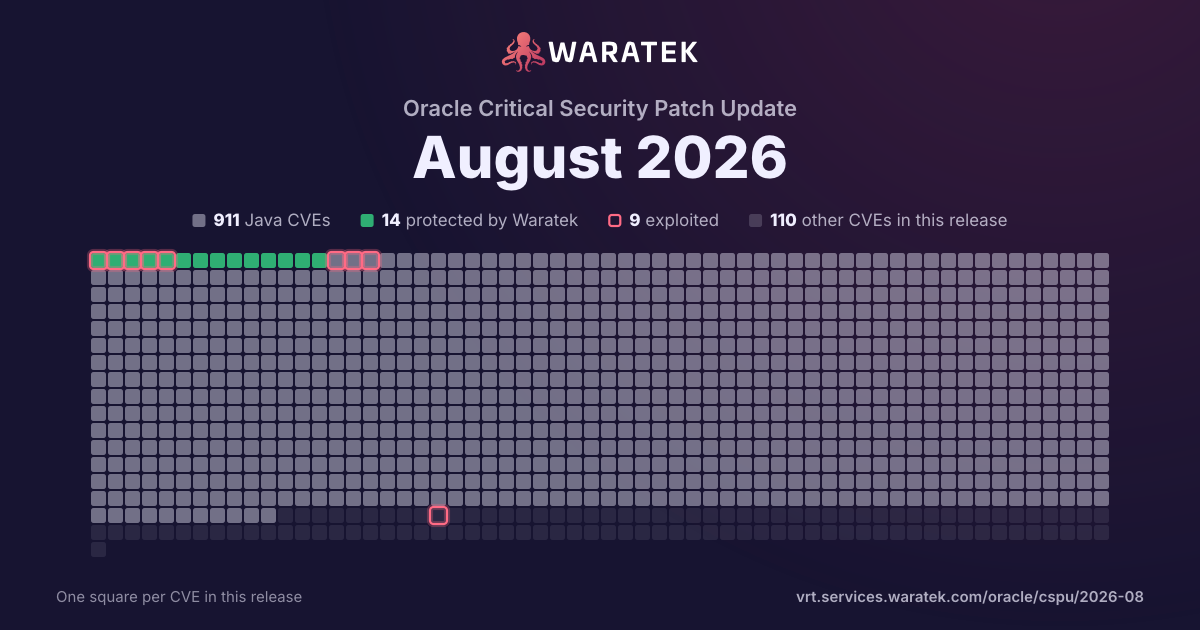
By status
14Protected by Waratek1Rule in development3Mitigation candidate893No exploit published2Outside Waratek scope108Not applicable
9Exploited, marked by the ring
No exploit published. For 847 of them, Oracle's security advisory is the source of public detail.
Protected by Waratek. Waratek RASP can block exploitation of these on systems that have not applied the patch yet.
Overview 269 matches · 1 protected · 0 exploited · 0 CISA KEV · 0 public PoC · 0 EPSS ≥ 0.5
Protected by Waratek
1
0.4%
Rule in development
0
0.0%
Mitigation candidate
0
0.0%
No exploit published
268
99.6%
blocked by ARMR today
1
0.4%
partly blocked
0
0.0%
not blocked
268
99.6%
not established
0
0.0%
unrecorded
0
0.0%
Exploited
0
0.0%
Working exploit published
0
0.0%
Proof of concept only
0
0.0%
Forecast only
0
0.0%
No public exploit
269
100.0%
split by
peak 253 / month
Jun 2615
Protected by Waratek1
No exploit published14
Critical1
High6
Medium8
blocked by ARMR today1
not blocked14
No public exploit15
Jul 261
No exploit published1
Medium1
not blocked1
No public exploit1
Aug 26253
No exploit published253
Critical75
High131
Medium45
Low2
not blocked253
No public exploit253
Jun 26Jul 26Aug 26
| CVE | Severity | Published▾ | Status | Exploitation | Description |
|---|---|---|---|---|---|
| CVE-2026-60969 | High | 2026-08-18 | No exploit published | No public exploit | Vulnerability in the Oracle Unified Directory product of Oracle Fusion Middleware (component: OUD Core). Supported versions that are affected are 12.2.1.4.0 and 14.1.2.1.0. Easily exploitable vulnerability allows low privileged attacker with network access via LDAP to compromise Oracle Unified Directory. While the vulnerability is in Oracle Unified Directory, attacks may significantly impact additional products (scope change). Successful attacks of this vulnerability can result in unauthorized access to critical data or complete access to all Oracle Unified Directory accessible data. CVSS 3.1 Base Score 7.7 (Confidentiality impacts). CVSS Vector: (CVSS:3.1/AV:N/AC:L/PR:L/UI:N/S:C/C:H/I:N/A:N). |
| CVE-2026-60961 | High | 2026-08-18 | No exploit published | No public exploit | Vulnerability in the Oracle WebCenter Content product of Oracle Fusion Middleware (component: Content Server). Supported versions that are affected are 12.2.1.4.0 and 14.1.2.0.0. Difficult to exploit vulnerability allows unauthenticated attacker with access to the physical communication segment attached to the hardware where the Oracle WebCenter Content executes to compromise Oracle WebCenter Content. While the vulnerability is in Oracle WebCenter Content, attacks may significantly impact additional products (scope change). Successful attacks of this vulnerability can result in unauthorized creation, deletion or modification access to critical data or all Oracle WebCenter Content accessible data as well as unauthorized access to critical data or complete access to all Oracle WebCenter Content accessible data. CVSS 3.1 Base Score 8.0 (Confidentiality and Integrity impacts). CVSS Vector: (CVSS:3.1/AV:A/AC:H/PR:N/UI:N/S:C/C:H/I:H/A:N). |
| CVE-2026-60958 | Critical | 2026-08-18 | No exploit published | No public exploit | Vulnerability in the Oracle WebCenter Enterprise Capture product of Oracle Fusion Middleware (component: Client Bundle). Supported versions that are affected are 12.2.1.4.0 and 14.1.2.0.0. Easily exploitable vulnerability allows unauthenticated attacker with network access via HTTP to compromise Oracle WebCenter Enterprise Capture. Successful attacks of this vulnerability can result in takeover of Oracle WebCenter Enterprise Capture. CVSS 3.1 Base Score 9.8 (Confidentiality, Integrity and Availability impacts). CVSS Vector: (CVSS:3.1/AV:N/AC:L/PR:N/UI:N/S:U/C:H/I:H/A:H). |
| CVE-2026-60955 | High | 2026-08-18 | No exploit published | No public exploit | Vulnerability in the Oracle WebCenter Content product of Oracle Fusion Middleware (component: Content Server). Supported versions that are affected are 12.2.1.4.0 and 14.1.2.0.0. Easily exploitable vulnerability allows high privileged attacker with network access via HTTP to compromise Oracle WebCenter Content. While the vulnerability is in Oracle WebCenter Content, attacks may significantly impact additional products (scope change). Successful attacks of this vulnerability can result in unauthorized creation, deletion or modification access to critical data or all Oracle WebCenter Content accessible data as well as unauthorized read access to a subset of Oracle WebCenter Content accessible data and unauthorized ability to cause a partial denial of service (partial DOS) of Oracle WebCenter Content. CVSS 3.1 Base Score 8.2 (Confidentiality, Integrity and Availability impacts). CVSS Vector: (CVSS:3.1/AV:N/AC:L/PR:H/UI:N/S:C/C:L/I:H/A:L). |
| CVE-2026-60954 | High | 2026-08-18 | No exploit published | No public exploit | Vulnerability in the Oracle WebCenter Content product of Oracle Fusion Middleware (component: Content Server). Supported versions that are affected are 12.2.1.4.0 and 14.1.2.0.0. Difficult to exploit vulnerability allows unauthenticated attacker with network access via HTTP to compromise Oracle WebCenter Content. While the vulnerability is in Oracle WebCenter Content, attacks may significantly impact additional products (scope change). Successful attacks of this vulnerability can result in unauthorized creation, deletion or modification access to critical data or all Oracle WebCenter Content accessible data as well as unauthorized access to critical data or complete access to all Oracle WebCenter Content accessible data. CVSS 3.1 Base Score 8.7 (Confidentiality and Integrity impacts). CVSS Vector: (CVSS:3.1/AV:N/AC:H/PR:N/UI:N/S:C/C:H/I:H/A:N). |
| CVE-2026-60949 | High | 2026-08-18 | No exploit published | No public exploit | Vulnerability in the Oracle WebCenter Content product of Oracle Fusion Middleware (component: Content Server). Supported versions that are affected are 12.2.1.4.0 and 14.1.2.0.0. Difficult to exploit vulnerability allows low privileged attacker with network access via HTTP to compromise Oracle WebCenter Content. While the vulnerability is in Oracle WebCenter Content, attacks may significantly impact additional products (scope change). Successful attacks of this vulnerability can result in unauthorized access to critical data or complete access to all Oracle WebCenter Content accessible data as well as unauthorized update, insert or delete access to some of Oracle WebCenter Content accessible data. CVSS 3.1 Base Score 7.1 (Confidentiality and Integrity impacts). CVSS Vector: (CVSS:3.1/AV:N/AC:H/PR:L/UI:N/S:C/C:H/I:L/A:N). |
| CVE-2026-60947 | Critical | 2026-08-18 | No exploit published | No public exploit | Vulnerability in the Oracle WebCenter Enterprise Capture product of Oracle Fusion Middleware (component: Client Bundle). Supported versions that are affected are 12.2.1.4.0 and 14.1.2.0.0. Easily exploitable vulnerability allows unauthenticated attacker with network access via RMI to compromise Oracle WebCenter Enterprise Capture. Successful attacks of this vulnerability can result in takeover of Oracle WebCenter Enterprise Capture. CVSS 3.1 Base Score 9.8 (Confidentiality, Integrity and Availability impacts). CVSS Vector: (CVSS:3.1/AV:N/AC:L/PR:N/UI:N/S:U/C:H/I:H/A:H). |
| CVE-2026-60946 | Critical | 2026-08-18 | No exploit published | No public exploit | Vulnerability in the Oracle WebCenter Enterprise Capture product of Oracle Fusion Middleware (component: Client Bundle). Supported versions that are affected are 12.2.1.4.0 and 14.1.2.0.0. Easily exploitable vulnerability allows unauthenticated attacker with network access via RMI to compromise Oracle WebCenter Enterprise Capture. Successful attacks of this vulnerability can result in takeover of Oracle WebCenter Enterprise Capture. CVSS 3.1 Base Score 9.8 (Confidentiality, Integrity and Availability impacts). CVSS Vector: (CVSS:3.1/AV:N/AC:L/PR:N/UI:N/S:U/C:H/I:H/A:H). |
| CVE-2026-60944 | High | 2026-08-18 | No exploit published | No public exploit | Vulnerability in the Oracle WebCenter Content product of Oracle Fusion Middleware (component: Content Server). Supported versions that are affected are 12.2.1.4.0 and 14.1.2.0.0. Easily exploitable vulnerability allows unauthenticated attacker with network access via HTTP to compromise Oracle WebCenter Content. Successful attacks require human interaction from a person other than the attacker and while the vulnerability is in Oracle WebCenter Content, attacks may significantly impact additional products (scope change). Successful attacks of this vulnerability can result in unauthorized access to critical data or complete access to all Oracle WebCenter Content accessible data as well as unauthorized update, insert or delete access to some of Oracle WebCenter Content accessible data. CVSS 3.1 Base Score 8.2 (Confidentiality and Integrity impacts). CVSS Vector: (CVSS:3.1/AV:N/AC:L/PR:N/UI:R/S:C/C:H/I:L/A:N). |
| CVE-2026-60935 | High | 2026-08-18 | No exploit published | No public exploit | Vulnerability in the Oracle WebCenter Content product of Oracle Fusion Middleware (component: Content Server). Supported versions that are affected are 12.2.1.4.0 and 14.1.2.0.0. Difficult to exploit vulnerability allows unauthenticated attacker with network access via HTTP to compromise Oracle WebCenter Content. While the vulnerability is in Oracle WebCenter Content, attacks may significantly impact additional products (scope change). Successful attacks of this vulnerability can result in unauthorized creation, deletion or modification access to critical data or all Oracle WebCenter Content accessible data as well as unauthorized access to critical data or complete access to all Oracle WebCenter Content accessible data. CVSS 3.1 Base Score 8.7 (Confidentiality and Integrity impacts). CVSS Vector: (CVSS:3.1/AV:N/AC:H/PR:N/UI:N/S:C/C:H/I:H/A:N). |
| CVE-2026-60934 | High | 2026-08-18 | No exploit published | No public exploit | Vulnerability in the Oracle WebCenter Content product of Oracle Fusion Middleware (component: Content Server). Supported versions that are affected are 12.2.1.4.0 and 14.1.2.0.0. Difficult to exploit vulnerability allows unauthenticated attacker with network access via HTTP to compromise Oracle WebCenter Content. While the vulnerability is in Oracle WebCenter Content, attacks may significantly impact additional products (scope change). Successful attacks of this vulnerability can result in unauthorized creation, deletion or modification access to critical data or all Oracle WebCenter Content accessible data as well as unauthorized access to critical data or complete access to all Oracle WebCenter Content accessible data. CVSS 3.1 Base Score 8.7 (Confidentiality and Integrity impacts). CVSS Vector: (CVSS:3.1/AV:N/AC:H/PR:N/UI:N/S:C/C:H/I:H/A:N). |
| CVE-2026-60933 | High | 2026-08-18 | No exploit published | No public exploit | Vulnerability in the Oracle WebCenter Content product of Oracle Fusion Middleware (component: Content Server). Supported versions that are affected are 12.2.1.4.0 and 14.1.2.0.0. Difficult to exploit vulnerability allows unauthenticated attacker with network access via HTTP to compromise Oracle WebCenter Content. Successful attacks of this vulnerability can result in unauthorized creation, deletion or modification access to critical data or all Oracle WebCenter Content accessible data as well as unauthorized access to critical data or complete access to all Oracle WebCenter Content accessible data. CVSS 3.1 Base Score 7.4 (Confidentiality and Integrity impacts). CVSS Vector: (CVSS:3.1/AV:N/AC:H/PR:N/UI:N/S:U/C:H/I:H/A:N). |
| CVE-2026-60928 | High | 2026-08-18 | No exploit published | No public exploit | Vulnerability in the Oracle WebCenter Content product of Oracle Fusion Middleware (component: Content Server). The supported version that is affected is 14.1.2.0.0. Easily exploitable vulnerability allows low privileged attacker with logon to the infrastructure where Oracle WebCenter Content executes to compromise Oracle WebCenter Content. While the vulnerability is in Oracle WebCenter Content, attacks may significantly impact additional products (scope change). Successful attacks of this vulnerability can result in unauthorized creation, deletion or modification access to critical data or all Oracle WebCenter Content accessible data as well as unauthorized access to critical data or complete access to all Oracle WebCenter Content accessible data. CVSS 3.1 Base Score 8.4 (Confidentiality and Integrity impacts). CVSS Vector: (CVSS:3.1/AV:L/AC:L/PR:L/UI:N/S:C/C:H/I:H/A:N). |
| CVE-2026-60921 | Critical | 2026-08-18 | No exploit published | No public exploit | Vulnerability in the Oracle WebCenter Enterprise Capture product of Oracle Fusion Middleware (component: Client Bundle). Supported versions that are affected are 12.2.1.4.0 and 14.1.2.0.0. Easily exploitable vulnerability allows unauthenticated attacker with network access via T3, IIOP to compromise Oracle WebCenter Enterprise Capture. Successful attacks of this vulnerability can result in takeover of Oracle WebCenter Enterprise Capture. CVSS 3.1 Base Score 9.8 (Confidentiality, Integrity and Availability impacts). CVSS Vector: (CVSS:3.1/AV:N/AC:L/PR:N/UI:N/S:U/C:H/I:H/A:H). |
| CVE-2026-60916 | Critical | 2026-08-18 | No exploit published | No public exploit | Vulnerability in the Oracle WebCenter Enterprise Capture product of Oracle Fusion Middleware (component: Client Bundle). Supported versions that are affected are 12.2.1.4.0 and 14.1.2.0.0. Easily exploitable vulnerability allows unauthenticated attacker with network access via HTTP to compromise Oracle WebCenter Enterprise Capture. While the vulnerability is in Oracle WebCenter Enterprise Capture, attacks may significantly impact additional products (scope change). Successful attacks of this vulnerability can result in unauthorized creation, deletion or modification access to critical data or all Oracle WebCenter Enterprise Capture accessible data as well as unauthorized read access to a subset of Oracle WebCenter Enterprise Capture accessible data and unauthorized ability to cause a partial denial of service (partial DOS) of Oracle WebCenter Enterprise Capture. CVSS 3.1 Base Score 9.9 (Confidentiality, Integrity and Availability impacts). CVSS Vector: (CVSS:3.1/AV:N/AC:L/PR:N/UI:N/S:C/C:L/I:H/A:L). |
| CVE-2026-60915 | High | 2026-08-18 | No exploit published | No public exploit | Vulnerability in the Helidon product of Oracle Fusion Middleware (component: Imperative Web Server). Supported versions that are affected are 3.0.0-3.2.17 and 4.0.0-4.4.1. Difficult to exploit vulnerability allows unauthenticated attacker with network access via HTTP to compromise Helidon. Successful attacks of this vulnerability can result in unauthorized creation, deletion or modification access to critical data or all Helidon accessible data as well as unauthorized access to critical data or complete access to all Helidon accessible data. CVSS 3.1 Base Score 7.4 (Confidentiality and Integrity impacts). CVSS Vector: (CVSS:3.1/AV:N/AC:H/PR:N/UI:N/S:U/C:H/I:H/A:N). |
| CVE-2026-60914 | High | 2026-08-18 | No exploit published | No public exploit | Vulnerability in the Oracle Unified Directory product of Oracle Fusion Middleware (component: OUD Core). Supported versions that are affected are 12.2.1.4.0 and 14.1.2.1.0. Easily exploitable vulnerability allows unauthenticated attacker with network access via LDAP to compromise Oracle Unified Directory. Successful attacks of this vulnerability can result in unauthorized access to critical data or complete access to all Oracle Unified Directory accessible data. CVSS 3.1 Base Score 7.5 (Confidentiality impacts). CVSS Vector: (CVSS:3.1/AV:N/AC:L/PR:N/UI:N/S:U/C:H/I:N/A:N). |
| CVE-2026-60909 | High | 2026-08-18 | No exploit published | No public exploit | Vulnerability in the Oracle WebCenter Content product of Oracle Fusion Middleware (component: Content Server). Supported versions that are affected are 12.2.1.4.0 and 14.1.2.0.0. Easily exploitable vulnerability allows low privileged attacker with network access via HTTP to compromise Oracle WebCenter Content. Successful attacks require human interaction from a person other than the attacker and while the vulnerability is in Oracle WebCenter Content, attacks may significantly impact additional products (scope change). Successful attacks of this vulnerability can result in unauthorized access to critical data or complete access to all Oracle WebCenter Content accessible data as well as unauthorized update, insert or delete access to some of Oracle WebCenter Content accessible data. CVSS 3.1 Base Score 7.6 (Confidentiality and Integrity impacts). CVSS Vector: (CVSS:3.1/AV:N/AC:L/PR:L/UI:R/S:C/C:H/I:L/A:N). |
| CVE-2026-60906 | High | 2026-08-18 | No exploit published | No public exploit | Vulnerability in the Oracle WebCenter Content product of Oracle Fusion Middleware (component: Content Server). Supported versions that are affected are 12.2.1.4.0 and 14.1.2.0.0. Easily exploitable vulnerability allows unauthenticated attacker with network access via HTTP to compromise Oracle WebCenter Content. Successful attacks of this vulnerability can result in unauthorized access to critical data or complete access to all Oracle WebCenter Content accessible data. CVSS 3.1 Base Score 7.5 (Confidentiality impacts). CVSS Vector: (CVSS:3.1/AV:N/AC:L/PR:N/UI:N/S:U/C:H/I:N/A:N). |
| CVE-2026-60905 | Critical | 2026-08-18 | No exploit published | No public exploit | Vulnerability in the Oracle WebCenter Content product of Oracle Fusion Middleware (component: Content Server). Supported versions that are affected are 12.2.1.4.0 and 14.1.2.0.0. Easily exploitable vulnerability allows unauthenticated attacker with network access via HTTP to compromise Oracle WebCenter Content. Successful attacks require human interaction from a person other than the attacker and while the vulnerability is in Oracle WebCenter Content, attacks may significantly impact additional products (scope change). Successful attacks of this vulnerability can result in unauthorized creation, deletion or modification access to critical data or all Oracle WebCenter Content accessible data as well as unauthorized access to critical data or complete access to all Oracle WebCenter Content accessible data and unauthorized ability to cause a partial denial of service (partial DOS) of Oracle WebCenter Content. CVSS 3.1 Base Score 9.6 (Confidentiality, Integrity and Availability impacts). CVSS Vector: (CVSS:3.1/AV:N/AC:L/PR:N/UI:R/S:C/C:H/I:H/A:L). |
| CVE-2026-60903 | High | 2026-08-18 | No exploit published | No public exploit | Vulnerability in the Oracle WebCenter Content product of Oracle Fusion Middleware (component: Content Server). Supported versions that are affected are 12.2.1.4.0 and 14.1.2.0.0. Difficult to exploit vulnerability allows unauthenticated attacker with network access via HTTP to compromise Oracle WebCenter Content. While the vulnerability is in Oracle WebCenter Content, attacks may significantly impact additional products (scope change). Successful attacks of this vulnerability can result in unauthorized creation, deletion or modification access to critical data or all Oracle WebCenter Content accessible data as well as unauthorized access to critical data or complete access to all Oracle WebCenter Content accessible data. CVSS 3.1 Base Score 8.7 (Confidentiality and Integrity impacts). CVSS Vector: (CVSS:3.1/AV:N/AC:H/PR:N/UI:N/S:C/C:H/I:H/A:N). |
| CVE-2026-60895 | Medium | 2026-08-18 | No exploit published | No public exploit | Vulnerability in the Oracle Unified Directory product of Oracle Fusion Middleware (component: OUD Core). Supported versions that are affected are 12.2.1.4.0 and 14.1.2.1.0. Difficult to exploit vulnerability allows low privileged attacker with network access via LDAP to compromise Oracle Unified Directory. Successful attacks of this vulnerability can result in unauthorized creation, deletion or modification access to critical data or all Oracle Unified Directory accessible data as well as unauthorized access to critical data or complete access to all Oracle Unified Directory accessible data. CVSS 3.1 Base Score 6.8 (Confidentiality and Integrity impacts). CVSS Vector: (CVSS:3.1/AV:N/AC:H/PR:L/UI:N/S:U/C:H/I:H/A:N). |
| CVE-2026-60889 | High | 2026-08-18 | No exploit published | No public exploit | Vulnerability in the Oracle Unified Directory product of Oracle Fusion Middleware (component: OUD Core). Supported versions that are affected are 12.2.1.4.0 and 14.1.2.1.0. Easily exploitable vulnerability allows unauthenticated attacker with network access via LDAP to compromise Oracle Unified Directory. Successful attacks of this vulnerability can result in unauthorized access to critical data or complete access to all Oracle Unified Directory accessible data. CVSS 3.1 Base Score 7.5 (Confidentiality impacts). CVSS Vector: (CVSS:3.1/AV:N/AC:L/PR:N/UI:N/S:U/C:H/I:N/A:N). |
| CVE-2026-60866 | Medium | 2026-08-18 | No exploit published | No public exploit | Vulnerability in the Service Delivery Platform product of Oracle Fusion Middleware (component: Messaging Enabler). The supported version that is affected is 14.1.2.0.0. Easily exploitable vulnerability allows unauthenticated attacker with network access via HTTP to compromise Service Delivery Platform. Successful attacks of this vulnerability can result in unauthorized update, insert or delete access to some of Service Delivery Platform accessible data as well as unauthorized read access to a subset of Service Delivery Platform accessible data. CVSS 3.1 Base Score 6.5 (Confidentiality and Integrity impacts). CVSS Vector: (CVSS:3.1/AV:N/AC:L/PR:N/UI:N/S:U/C:L/I:L/A:N). |
| CVE-2026-60865 | Medium | 2026-08-18 | No exploit published | No public exploit | Vulnerability in the Service Delivery Platform product of Oracle Fusion Middleware (component: Messaging Enabler). Supported versions that are affected are 14.1.2.0.0 and 12.2.1.4.0. Easily exploitable vulnerability allows high privileged attacker with network access via HTTP to compromise Service Delivery Platform. While the vulnerability is in Service Delivery Platform, attacks may significantly impact additional products (scope change). Successful attacks of this vulnerability can result in unauthorized access to critical data or complete access to all Service Delivery Platform accessible data. CVSS 3.1 Base Score 6.8 (Confidentiality impacts). CVSS Vector: (CVSS:3.1/AV:N/AC:L/PR:H/UI:N/S:C/C:H/I:N/A:N). |
| CVE-2026-60861 | Critical | 2026-08-18 | No exploit published | No public exploit | Vulnerability in the Service Delivery Platform product of Oracle Fusion Middleware (component: Messaging Enabler). Supported versions that are affected are 14.1.2.0.0 and 12.2.1.4.0. Easily exploitable vulnerability allows low privileged attacker with network access via Oracle Net to compromise Service Delivery Platform. While the vulnerability is in Service Delivery Platform, attacks may significantly impact additional products (scope change). Successful attacks of this vulnerability can result in unauthorized creation, deletion or modification access to critical data or all Service Delivery Platform accessible data as well as unauthorized access to critical data or complete access to all Service Delivery Platform accessible data. CVSS 3.1 Base Score 9.6 (Confidentiality and Integrity impacts). CVSS Vector: (CVSS:3.1/AV:N/AC:L/PR:L/UI:N/S:C/C:H/I:H/A:N). |
| CVE-2026-60860 | High | 2026-08-18 | No exploit published | No public exploit | Vulnerability in the Service Delivery Platform product of Oracle Fusion Middleware (component: Messaging Enabler). Supported versions that are affected are 14.1.2.0.0 and 12.2.1.4.0. Difficult to exploit vulnerability allows unauthenticated attacker with network access via TCP to compromise Service Delivery Platform. While the vulnerability is in Service Delivery Platform, attacks may significantly impact additional products (scope change). Successful attacks of this vulnerability can result in unauthorized creation, deletion or modification access to critical data or all Service Delivery Platform accessible data and unauthorized ability to cause a hang or frequently repeatable crash (complete DOS) of Service Delivery Platform. CVSS 3.1 Base Score 8.7 (Integrity and Availability impacts). CVSS Vector: (CVSS:3.1/AV:N/AC:H/PR:N/UI:N/S:C/C:N/I:H/A:H). |
| CVE-2026-60853 | Low | 2026-08-18 | No exploit published | No public exploit | Vulnerability in the Helidon product of Oracle Fusion Middleware (component: Imperative Web Server). Supported versions that are affected are 3.0.0-3.2.19. Difficult to exploit vulnerability allows unauthenticated attacker with network access via HTTP to compromise Helidon. Successful attacks of this vulnerability can result in unauthorized read access to a subset of Helidon accessible data. CVSS 3.1 Base Score 3.7 (Confidentiality impacts). CVSS Vector: (CVSS:3.1/AV:N/AC:H/PR:N/UI:N/S:U/C:L/I:N/A:N). |
| CVE-2026-60850 | High | 2026-08-18 | No exploit published | No public exploit | Vulnerability in the Oracle Unified Directory product of Oracle Fusion Middleware (component: OUD Core). Supported versions that are affected are 12.2.1.4.0 and 14.1.2.1.0. Easily exploitable vulnerability allows unauthenticated attacker with network access via LDAP to compromise Oracle Unified Directory. Successful attacks of this vulnerability can result in unauthorized access to critical data or complete access to all Oracle Unified Directory accessible data. CVSS 3.1 Base Score 7.5 (Confidentiality impacts). CVSS Vector: (CVSS:3.1/AV:N/AC:L/PR:N/UI:N/S:U/C:H/I:N/A:N). |
| CVE-2026-60849 | High | 2026-08-18 | No exploit published | No public exploit | Vulnerability in the Oracle Unified Directory product of Oracle Fusion Middleware (component: OUD Core). Supported versions that are affected are 12.2.1.4.0 and 14.1.2.1.0. Difficult to exploit vulnerability allows low privileged attacker with network access via LDAP to compromise Oracle Unified Directory. While the vulnerability is in Oracle Unified Directory, attacks may significantly impact additional products (scope change). Successful attacks of this vulnerability can result in takeover of Oracle Unified Directory. CVSS 3.1 Base Score 8.5 (Confidentiality, Integrity and Availability impacts). CVSS Vector: (CVSS:3.1/AV:N/AC:H/PR:L/UI:N/S:C/C:H/I:H/A:H). |
| CVE-2026-60841 | High | 2026-08-18 | No exploit published | No public exploit | Vulnerability in the Oracle Unified Directory product of Oracle Fusion Middleware (component: OUD Core). Supported versions that are affected are 12.2.1.4.0 and 14.1.2.1.0. Difficult to exploit vulnerability allows low privileged attacker with network access via LDAP to compromise Oracle Unified Directory. While the vulnerability is in Oracle Unified Directory, attacks may significantly impact additional products (scope change). Successful attacks of this vulnerability can result in takeover of Oracle Unified Directory. CVSS 3.1 Base Score 8.5 (Confidentiality, Integrity and Availability impacts). CVSS Vector: (CVSS:3.1/AV:N/AC:H/PR:L/UI:N/S:C/C:H/I:H/A:H). |
| CVE-2026-60737 | Critical | 2026-08-18 | No exploit published | No public exploit | Vulnerability in the Oracle Web Services Manager product of Oracle Fusion Middleware (component: Web Services Security). Supported versions that are affected are 12.2.1.4.0 and 14.1.2.0.0. Easily exploitable vulnerability allows unauthenticated attacker with network access via HTTP to compromise Oracle Web Services Manager. Successful attacks of this vulnerability can result in unauthorized creation, deletion or modification access to critical data or all Oracle Web Services Manager accessible data as well as unauthorized access to critical data or complete access to all Oracle Web Services Manager accessible data. CVSS 3.1 Base Score 9.1 (Confidentiality and Integrity impacts). CVSS Vector: (CVSS:3.1/AV:N/AC:L/PR:N/UI:N/S:U/C:H/I:H/A:N). |
| CVE-2026-60733 | High | 2026-08-18 | No exploit published | No public exploit | Vulnerability in the Oracle WebCenter Portal product of Oracle Fusion Middleware (component: Composer). Supported versions that are affected are 12.2.1.4.0 and 14.1.2.0.0. Difficult to exploit vulnerability allows low privileged attacker with network access via HTTP to compromise Oracle WebCenter Portal. While the vulnerability is in Oracle WebCenter Portal, attacks may significantly impact additional products (scope change). Successful attacks of this vulnerability can result in unauthorized creation, deletion or modification access to critical data or all Oracle WebCenter Portal accessible data as well as unauthorized read access to a subset of Oracle WebCenter Portal accessible data and unauthorized ability to cause a partial denial of service (partial DOS) of Oracle WebCenter Portal. CVSS 3.1 Base Score 7.7 (Confidentiality, Integrity and Availability impacts). CVSS Vector: (CVSS:3.1/AV:N/AC:H/PR:L/UI:N/S:C/C:L/I:H/A:L). |
| CVE-2026-60731 | High | 2026-08-18 | No exploit published | No public exploit | Vulnerability in the Oracle WebCenter Portal product of Oracle Fusion Middleware (component: Composer). Supported versions that are affected are 12.2.1.4.0 and 14.1.2.0.0. Easily exploitable vulnerability allows low privileged attacker with network access via RMI to compromise Oracle WebCenter Portal. Successful attacks of this vulnerability can result in takeover of Oracle WebCenter Portal. CVSS 3.1 Base Score 8.8 (Confidentiality, Integrity and Availability impacts). CVSS Vector: (CVSS:3.1/AV:N/AC:L/PR:L/UI:N/S:U/C:H/I:H/A:H). |
| CVE-2026-60730 | Critical | 2026-08-18 | No exploit published | No public exploit | Vulnerability in the Oracle WebCenter Portal product of Oracle Fusion Middleware (component: Composer). Supported versions that are affected are 12.2.1.4.0 and 14.1.2.0.0. Easily exploitable vulnerability allows low privileged attacker with network access via HTTP to compromise Oracle WebCenter Portal. While the vulnerability is in Oracle WebCenter Portal, attacks may significantly impact additional products (scope change). Successful attacks of this vulnerability can result in takeover of Oracle WebCenter Portal. CVSS 3.1 Base Score 9.9 (Confidentiality, Integrity and Availability impacts). CVSS Vector: (CVSS:3.1/AV:N/AC:L/PR:L/UI:N/S:C/C:H/I:H/A:H). |
| CVE-2026-60729 | High | 2026-08-18 | No exploit published | No public exploit | Vulnerability in the Oracle WebCenter Portal product of Oracle Fusion Middleware (component: Composer). Supported versions that are affected are 12.2.1.4.0 and 14.1.2.0.0. Easily exploitable vulnerability allows low privileged attacker with network access via HTTP to compromise Oracle WebCenter Portal. Successful attacks of this vulnerability can result in takeover of Oracle WebCenter Portal. CVSS 3.1 Base Score 8.8 (Confidentiality, Integrity and Availability impacts). CVSS Vector: (CVSS:3.1/AV:N/AC:L/PR:L/UI:N/S:U/C:H/I:H/A:H). |
| CVE-2026-60728 | Critical | 2026-08-18 | No exploit published | No public exploit | Vulnerability in the Oracle WebCenter Portal product of Oracle Fusion Middleware (component: Portlet Services). Supported versions that are affected are 12.2.1.4.0 and 14.1.2.0.0. Easily exploitable vulnerability allows unauthenticated attacker with network access via HTTP to compromise Oracle WebCenter Portal. Successful attacks of this vulnerability can result in unauthorized access to critical data or complete access to all Oracle WebCenter Portal accessible data and unauthorized ability to cause a hang or frequently repeatable crash (complete DOS) of Oracle WebCenter Portal. CVSS 3.1 Base Score 9.1 (Confidentiality and Availability impacts). CVSS Vector: (CVSS:3.1/AV:N/AC:L/PR:N/UI:N/S:U/C:H/I:N/A:H). |
| CVE-2026-60727 | Critical | 2026-08-18 | No exploit published | No public exploit | Vulnerability in the Oracle Identity Manager product of Oracle Fusion Middleware (component: OIM Legacy UI). Supported versions that are affected are 12.2.1.4.0 and 14.1.2.1.0. Easily exploitable vulnerability allows unauthenticated attacker with network access via HTTP to compromise Oracle Identity Manager. Successful attacks of this vulnerability can result in takeover of Oracle Identity Manager. CVSS 3.1 Base Score 9.8 (Confidentiality, Integrity and Availability impacts). CVSS Vector: (CVSS:3.1/AV:N/AC:L/PR:N/UI:N/S:U/C:H/I:H/A:H). |
| CVE-2026-60726 | High | 2026-08-18 | No exploit published | No public exploit | Vulnerability in the Oracle Access Manager product of Oracle Fusion Middleware (component: Authentication Engine). Supported versions that are affected are 12.2.1.4.0 and 14.1.2.1.0. Easily exploitable vulnerability allows low privileged attacker with network access via HTTP to compromise Oracle Access Manager. Successful attacks of this vulnerability can result in takeover of Oracle Access Manager. CVSS 3.1 Base Score 8.8 (Confidentiality, Integrity and Availability impacts). CVSS Vector: (CVSS:3.1/AV:N/AC:L/PR:L/UI:N/S:U/C:H/I:H/A:H). |
| CVE-2026-60722 | High | 2026-08-18 | No exploit published | No public exploit | Vulnerability in the Oracle Identity Manager product of Oracle Fusion Middleware (component: OIM Legacy UI). Supported versions that are affected are 12.2.1.4.0 and 14.1.2.1.0. Easily exploitable vulnerability allows low privileged attacker with network access via T3, IIOP to compromise Oracle Identity Manager. Successful attacks of this vulnerability can result in takeover of Oracle Identity Manager. CVSS 3.1 Base Score 8.8 (Confidentiality, Integrity and Availability impacts). CVSS Vector: (CVSS:3.1/AV:N/AC:L/PR:L/UI:N/S:U/C:H/I:H/A:H). |
| CVE-2026-60721 | Critical | 2026-08-18 | No exploit published | No public exploit | Vulnerability in the Oracle Identity Manager product of Oracle Fusion Middleware (component: OIM Legacy UI). Supported versions that are affected are 12.2.1.4.0 and 14.1.2.1.0. Easily exploitable vulnerability allows unauthenticated attacker with network access via HTTP to compromise Oracle Identity Manager. Successful attacks of this vulnerability can result in takeover of Oracle Identity Manager. CVSS 3.1 Base Score 9.8 (Confidentiality, Integrity and Availability impacts). CVSS Vector: (CVSS:3.1/AV:N/AC:L/PR:N/UI:N/S:U/C:H/I:H/A:H). |
| CVE-2026-60720 | Critical | 2026-08-18 | No exploit published | No public exploit | Vulnerability in the Oracle Identity Manager product of Oracle Fusion Middleware (component: OIM Legacy UI). Supported versions that are affected are 12.2.1.4.0 and 14.1.2.1.0. Easily exploitable vulnerability allows low privileged attacker with network access via HTTP to compromise Oracle Identity Manager. While the vulnerability is in Oracle Identity Manager, attacks may significantly impact additional products (scope change). Successful attacks of this vulnerability can result in takeover of Oracle Identity Manager. CVSS 3.1 Base Score 9.9 (Confidentiality, Integrity and Availability impacts). CVSS Vector: (CVSS:3.1/AV:N/AC:L/PR:L/UI:N/S:C/C:H/I:H/A:H). |
| CVE-2026-60716 | High | 2026-08-18 | No exploit published | No public exploit | Vulnerability in the Oracle Identity Manager product of Oracle Fusion Middleware (component: OIM Legacy UI). Supported versions that are affected are 12.2.1.4.0 and 14.1.2.1.0. Easily exploitable vulnerability allows low privileged attacker with network access via T3, IIOP to compromise Oracle Identity Manager. Successful attacks of this vulnerability can result in takeover of Oracle Identity Manager. CVSS 3.1 Base Score 8.8 (Confidentiality, Integrity and Availability impacts). CVSS Vector: (CVSS:3.1/AV:N/AC:L/PR:L/UI:N/S:U/C:H/I:H/A:H). |
| CVE-2026-60715 | High | 2026-08-18 | No exploit published | No public exploit | Vulnerability in the Oracle Identity Manager product of Oracle Fusion Middleware (component: OIM Legacy UI). Supported versions that are affected are 12.2.1.4.0 and 14.1.2.1.0. Easily exploitable vulnerability allows low privileged attacker with network access via HTTP to compromise Oracle Identity Manager. Successful attacks of this vulnerability can result in takeover of Oracle Identity Manager. CVSS 3.1 Base Score 8.8 (Confidentiality, Integrity and Availability impacts). CVSS Vector: (CVSS:3.1/AV:N/AC:L/PR:L/UI:N/S:U/C:H/I:H/A:H). |
| CVE-2026-60707 | High | 2026-08-18 | No exploit published | No public exploit | Vulnerability in the Oracle Identity Manager product of Oracle Fusion Middleware (component: Security). Supported versions that are affected are 12.2.1.4.0 and 14.1.2.1.0. Easily exploitable vulnerability allows high privileged attacker with network access via HTTP to compromise Oracle Identity Manager. While the vulnerability is in Oracle Identity Manager, attacks may significantly impact additional products (scope change). Successful attacks of this vulnerability can result in unauthorized creation, deletion or modification access to critical data or all Oracle Identity Manager accessible data as well as unauthorized access to critical data or complete access to all Oracle Identity Manager accessible data. CVSS 3.1 Base Score 8.7 (Confidentiality and Integrity impacts). CVSS Vector: (CVSS:3.1/AV:N/AC:L/PR:H/UI:N/S:C/C:H/I:H/A:N). |
| CVE-2026-60702 | Critical | 2026-08-18 | No exploit published | No public exploit | Vulnerability in the Oracle WebLogic Server product of Oracle Fusion Middleware (component: Core). Supported versions that are affected are 12.2.1.4.0, 14.1.1.0.0, 14.1.2.0.0 and 15.1.1.0.0. Easily exploitable vulnerability allows low privileged attacker with network access via T3, IIOP to compromise Oracle WebLogic Server. While the vulnerability is in Oracle WebLogic Server, attacks may significantly impact additional products (scope change). Successful attacks of this vulnerability can result in takeover of Oracle WebLogic Server. CVSS 3.1 Base Score 9.9 (Confidentiality, Integrity and Availability impacts). CVSS Vector: (CVSS:3.1/AV:N/AC:L/PR:L/UI:N/S:C/C:H/I:H/A:H). |
| CVE-2026-60699 | High | 2026-08-18 | No exploit published | No public exploit | Vulnerability in the Oracle WebLogic Server product of Oracle Fusion Middleware (component: Core). Supported versions that are affected are 12.2.1.4.0, 14.1.1.0.0, 14.1.2.0.0 and 15.1.1.0.0. Easily exploitable vulnerability allows unauthenticated attacker with network access via T3, IIOP to compromise Oracle WebLogic Server. While the vulnerability is in Oracle WebLogic Server, attacks may significantly impact additional products (scope change). Successful attacks of this vulnerability can result in unauthorized access to critical data or complete access to all Oracle WebLogic Server accessible data. CVSS 3.1 Base Score 8.6 (Confidentiality impacts). CVSS Vector: (CVSS:3.1/AV:N/AC:L/PR:N/UI:N/S:C/C:H/I:N/A:N). |
| CVE-2026-60698 | Critical | 2026-08-18 | No exploit published | No public exploit | Vulnerability in the Oracle WebLogic Server product of Oracle Fusion Middleware (component: Core). Supported versions that are affected are 12.2.1.4.0, 14.1.1.0.0, 14.1.2.0.0 and 15.1.1.0.0. Easily exploitable vulnerability allows unauthenticated attacker with network access via IIOP to compromise Oracle WebLogic Server. Successful attacks of this vulnerability can result in takeover of Oracle WebLogic Server. CVSS 3.1 Base Score 9.8 (Confidentiality, Integrity and Availability impacts). CVSS Vector: (CVSS:3.1/AV:N/AC:L/PR:N/UI:N/S:U/C:H/I:H/A:H). |
| CVE-2026-60696 | Critical | 2026-08-18 | No exploit published | No public exploit | Vulnerability in the Oracle WebLogic Server product of Oracle Fusion Middleware (component: Core). Supported versions that are affected are 12.2.1.4.0, 14.1.1.0.0, 14.1.2.0.0 and 15.1.1.0.0. Easily exploitable vulnerability allows unauthenticated attacker with network access via T3, IIOP to compromise Oracle WebLogic Server. Successful attacks of this vulnerability can result in takeover of Oracle WebLogic Server. CVSS 3.1 Base Score 9.8 (Confidentiality, Integrity and Availability impacts). CVSS Vector: (CVSS:3.1/AV:N/AC:L/PR:N/UI:N/S:U/C:H/I:H/A:H). |
| CVE-2026-60680 | High | 2026-08-18 | No exploit published | No public exploit | Vulnerability in the Oracle WebLogic Server product of Oracle Fusion Middleware (component: Core). Supported versions that are affected are 12.2.1.4.0, 14.1.1.0.0, 14.1.2.0.0 and 15.1.1.0.0. Easily exploitable vulnerability allows low privileged attacker with network access via HTTP to compromise Oracle WebLogic Server. Successful attacks of this vulnerability can result in unauthorized creation, deletion or modification access to critical data or all Oracle WebLogic Server accessible data and unauthorized ability to cause a hang or frequently repeatable crash (complete DOS) of Oracle WebLogic Server. CVSS 3.1 Base Score 8.1 (Integrity and Availability impacts). CVSS Vector: (CVSS:3.1/AV:N/AC:L/PR:L/UI:N/S:U/C:N/I:H/A:H). |
| CVE-2026-60679 | High | 2026-08-18 | No exploit published | No public exploit | Vulnerability in the Oracle WebLogic Server product of Oracle Fusion Middleware (component: Core). Supported versions that are affected are 12.2.1.4.0, 14.1.1.0.0, 14.1.2.0.0 and 15.1.1.0.0. Difficult to exploit vulnerability allows low privileged attacker with network access via T3, IIOP to compromise Oracle WebLogic Server. Successful attacks of this vulnerability can result in takeover of Oracle WebLogic Server. CVSS 3.1 Base Score 7.5 (Confidentiality, Integrity and Availability impacts). CVSS Vector: (CVSS:3.1/AV:N/AC:H/PR:L/UI:N/S:U/C:H/I:H/A:H). |
| CVE-2026-60672 | Critical | 2026-08-18 | No exploit published | No public exploit | Vulnerability in the Oracle WebLogic Server product of Oracle Fusion Middleware (component: Core). Supported versions that are affected are 12.2.1.4.0, 14.1.1.0.0, 14.1.2.0.0 and 15.1.1.0.0. Easily exploitable vulnerability allows unauthenticated attacker with network access via T3, IIOP to compromise Oracle WebLogic Server. Successful attacks of this vulnerability can result in takeover of Oracle WebLogic Server. CVSS 3.1 Base Score 9.8 (Confidentiality, Integrity and Availability impacts). CVSS Vector: (CVSS:3.1/AV:N/AC:L/PR:N/UI:N/S:U/C:H/I:H/A:H). |
| CVE-2026-60415 | High | 2026-08-18 | No exploit published | No public exploit | Vulnerability in the Oracle WebLogic Server product of Oracle Fusion Middleware (component: Core). Supported versions that are affected are 12.2.1.4.0, 14.1.1.0.0, 14.1.2.0.0 and 15.1.1.0.0. Difficult to exploit vulnerability allows unauthenticated attacker with network access via T3, IIOP to compromise Oracle WebLogic Server. Successful attacks of this vulnerability can result in takeover of Oracle WebLogic Server. CVSS 3.1 Base Score 8.1 (Confidentiality, Integrity and Availability impacts). CVSS Vector: (CVSS:3.1/AV:N/AC:H/PR:N/UI:N/S:U/C:H/I:H/A:H). |
| CVE-2026-59889 | Medium | 2026-07-14 | No exploit published | No public exploit | jackson-databind contains the general-purpose data-binding functionality and tree-model for Jackson Data Processor. From 2.18.0 until 2.18.9, 2.21.5, 2.22.1, 3.1.5, and 3.2.1, UnwrappedPropertyHandler.processUnwrapped() replays buffered JSON for a @JsonUnwrapped property and calls prop.deserializeAndSet() without a prop.visibleInView(ctxt.getActiveView()) guard, allowing a property annotated with both @JsonView and @JsonUnwrapped to be written from attacker JSON under a less-privileged active view. This issue is fixed in versions 2.18.9, 2.21.5, 2.22.1, 3.1.5, and 3.2.1. |
| CVE-2026-41855 | Critical | 2026-06-09 | No exploit published | No public exploit | In an untrusted JMS environment, org.springframework.jms.support.converter.MappingJackson2MessageConverter and org.springframework.jms.support.converter.JacksonJsonMessageConverter allow arbitrary class instantiation, which can lead to unauthorized actions via gadget class deserialization. Affected versions: Spring Framework 7.0.0 through 7.0.7; 6.2.0 through 6.2.18; 6.1.0 through 6.1.27; 5.3.0 through 5.3.48. |
| CVE-2026-41854 | Medium | 2026-06-09 | No exploit published | No public exploit | Due to incorrect host parsing, applications that rely on UriComponentsBuilder to parse and validate an externally provided URL string may be exposed to a server-side request forgery (SSRF) attack. Affected versions: Spring Framework 7.0.0 through 7.0.7; 6.2.0 through 6.2.18. |
| CVE-2026-41852 | Medium | 2026-06-09 | No exploit published | No public exploit | A vulnerability in Spring Expression Language (SpEL) evaluation logic allows for arbitrary zero-argument method invocation, even within restricted or read-only contexts, which may allow an attacker to invoke unintended application logic. Affected versions: Spring Framework 7.0.0 through 7.0.7; 6.2.0 through 6.2.18; 6.1.0 through 6.1.27; 5.3.0 through 5.3.48. |
| CVE-2026-41851 | High | 2026-06-09 | No exploit published | No public exploit | Applications which accept user-supplied Spring Expression Language (SpEL) expressions may be vulnerable to a Denial of Service (DoS) attack if the evaluation of a SpEL expression triggers unbounded cache growth. Affected versions: Spring Framework 7.0.0 through 7.0.7; 6.2.0 through 6.2.18; 6.1.0 through 6.1.27; 5.3.0 through 5.3.48. |
| CVE-2026-41850 | High | 2026-06-09 | No exploit published | No public exploit | Applications that evaluate user-supplied Spring Expression Language (SpEL) expressions are vulnerable to an Algorithmic Denial of Service (DoS). By providing a specially crafted expression, an attacker can trigger excessive resource consumption during evaluation, leading to application degradation or unavailability. Affected versions: Spring Framework 7.0.0 through 7.0.7; 6.2.0 through 6.2.18; 6.1.0 through 6.1.27; 5.3.0 through 5.3.48. |
| CVE-2026-41848 | High | 2026-06-09 | No exploit published | No public exploit | Applications may be vulnerable to a Regular Expression Denial of Service (ReDoS) attack if an attacker is able to provide a pattern which is then directly or indirectly supplied to one of the following methods in AntPathMatcher: match(String pattern, String path), matchStart(String pattern, String path), extractUriTemplateVariables(String pattern, String path). Affected versions: Spring Framework 7.0.0 through 7.0.7; 6.2.0 through 6.2.18; 6.1.0 through 6.1.27; 5.3.0 through 5.3.48. |
| CVE-2026-41846 | Medium | 2026-06-09 | No exploit published | No public exploit | Spring MVC applications which accept user-supplied values in the cssClass, cssErrorClass, or cssStyle attributes of JSP form tags allow arbitrary HTML/JavaScript code injection, potentially resulting in a cross-site scripting (XSS) vulnerability. Affected versions: Spring Framework 7.0.0 through 7.0.7; 6.2.0 through 6.2.18; 6.1.0 through 6.1.27; 5.3.0 through 5.3.48. |
| CVE-2026-41845 | High | 2026-06-09 | No exploit published | No public exploit | Due to incorrect escaping, the use of JavaScriptUtils.javaScriptEscape() may lead to JavaScript code injection in the browser, potentially resulting in a cross-site scripting (XSS) vulnerability. Affected versions: Spring Framework 7.0.0 through 7.0.7; 6.2.0 through 6.2.18; 6.1.0 through 6.1.27; 5.3.0 through 5.3.48. |
| CVE-2026-41844 | Medium | 2026-06-09 | No exploit published | No public exploit | A Spring MVC or Spring WebFlux application which configures a mapping for "/**" where the view name is not explicitly specified allows an attacker to craft a link resulting in a 302 redirect to an arbitrary external host via the redirect: prefix. Affected versions: Spring Framework 7.0.0 through 7.0.7; 6.2.0 through 6.2.18; 6.1.0 through 6.1.27; 5.3.0 through 5.3.48. |
| CVE-2026-41843 | Medium | 2026-06-09 | Protected by Waratek | No public exploit | Spring MVC and WebFlux applications are vulnerable to Path Traversal attacks when resolving static resources. Affected versions: Spring Framework 7.0.0 through 7.0.7; 6.2.0 through 6.2.18; 6.1.0 through 6.1.27; 5.3.0 through 5.3.48. |
| CVE-2026-41842 | High | 2026-06-09 | No exploit published | No public exploit | Spring MVC and WebFlux applications are vulnerable to Denial of Service (DoS) attacks when resolving static resources. Affected versions: Spring Framework 7.0.0 through 7.0.7; 6.2.0 through 6.2.18; 6.1.0 through 6.1.27; 5.3.0 through 5.3.48. |
| CVE-2026-41841 | Medium | 2026-06-09 | No exploit published | No public exploit | Spring MVC and WebFlux applications are vulnerable to Information Disclosure attacks when resolving static resources. Affected versions: Spring Framework 7.0.0 through 7.0.7; 6.2.0 through 6.2.18; 6.1.0 through 6.1.27; 5.3.0 through 5.3.48. |
| CVE-2026-41840 | Medium | 2026-06-09 | No exploit published | No public exploit | Spring WebFlux applications are vulnerable to Denial of Service (DoS) attacks when processing multipart requests. Affected versions: Spring Framework 7.0.0 through 7.0.7, 6.2.0 through 6.2.18, 6.1.0 through 6.1.27, 5.3.0 through 5.3.48. |
| CVE-2026-41839 | Medium | 2026-06-09 | No exploit published | No public exploit | A WebFlux application with a compromised subdomain (for example, compromised via cross-site scripting (XSS)) is vulnerable to an escalation attack exchanging a known session ID for that of an authenticated user. Affected versions: Spring Framework 7.0.0 through 7.0.7; 6.2.0 through 6.2.18; 6.1.0 through 6.1.27; 5.3.0 through 5.3.48. |
| CVE-2026-41838 | High | 2026-06-09 | No exploit published | No public exploit | IDs for WebSocket sessions in the spring-websocket module are not cryptographically unpredictable, which may be possible to exploit in combination with inadequate authorization rules. Affected versions: Spring Framework 7.0.0 through 7.0.7; 6.2.0 through 6.2.18; 6.1.0 through 6.1.27; 5.3.0 through 5.3.48. |