
Oracle Critical Security Patch Update May 2026
Released May 2026 · Oracle's advisory ↗ · ← Critical Patch Update, April 2026 · Security Patch Update, June 2026 →
74 CVEs in this release, one square each
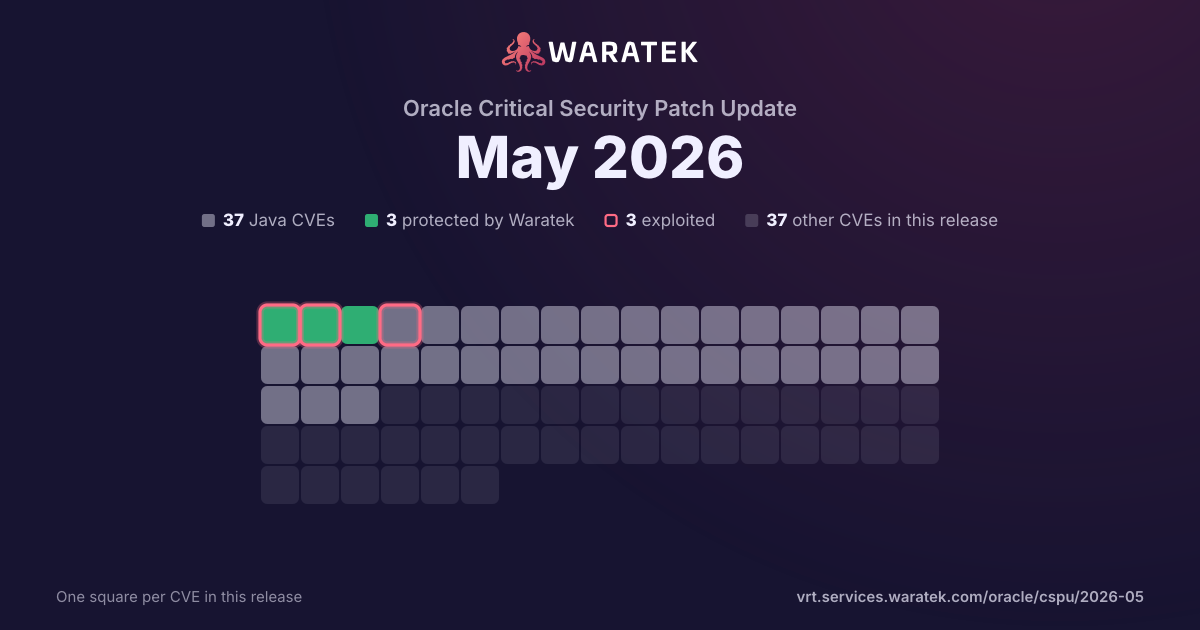
By status
3Protected by Waratek3Mitigation candidate31No exploit published37Not applicable
3Exploited, marked by the ring
No exploit published. For 22 of them, Oracle's security advisory is the source of public detail.
Protected by Waratek. Waratek RASP can block exploitation of these on systems that have not applied the patch yet.
Overview 74 matches · 37 in Waratek scope · 3 protected · 3 exploited · 2 CISA KEV · 4 public PoC · 2 EPSS ≥ 0.5
74matches
37in Waratek scope50.0%
3protected4.1%
3exploited4.1%
2CISA KEV2.7%
4public PoC5.4%
2EPSS ≥ 0.52.7%
Protected by Waratek
3
4.1%
Rule in development
0
0.0%
Mitigation candidate
3
4.1%
No exploit published
31
41.9%
Outside Waratek scope
0
0.0%
Not applicable
37
50.0%
Withdrawn CVE
0
0.0%
blocked by ARMR today
3
4.1%
partly blocked
0
0.0%
not blocked
71
95.9%
not established
0
0.0%
unrecorded
0
0.0%
split by
peak 37 / month
Aug 251
Not applicable1
Medium1
not blocked1
Proof of concept only1
Sep 250
Oct 250
Nov 250
Dec 250
Jan 262
Not applicable2
Critical1
Medium1
not blocked2
Proof of concept only1
No public exploit1
Feb 261
Not applicable1
High1
not blocked1
Proof of concept only1
Mar 262
Mitigation candidate2
High2
not blocked2
No public exploit2
Apr 2631
Protected by Waratek2
Mitigation candidate1
No exploit published9
Not applicable19
Critical3
High7
Medium20
Low1
blocked by ARMR today2
not blocked29
Exploited2
Proof of concept only2
No public exploit27
May 2637
Protected by Waratek1
No exploit published22
Not applicable14
Critical10
High18
Medium9
blocked by ARMR today1
not blocked36
Exploited1
Working exploit published1
No public exploit35
Aug 25Sep 25Oct 25Nov 25Dec 25Jan 26Feb 26Mar 26Apr 26May 26
| CVE | Severity | Published▾ | Status | Exploitation | Description |
|---|---|---|---|---|---|
| CVE-2026-46843 | Medium | 2026-05-28 | No exploit published | No public exploit | Vulnerability in Oracle REST Data Services (component: Core). Supported versions that are affected are 24.2.0-26.1.0. Easily exploitable vulnerability allows unauthenticated attacker with network access via HTTPS to compromise Oracle REST Data Services. Successful attacks of this vulnerability can result in unauthorized ability to cause a partial denial of service (partial DOS) of Oracle REST Data Services. CVSS 3.1 Base Score 5.3 (Availability impacts). CVSS Vector: (CVSS:3.1/AV:N/AC:L/PR:N/UI:N/S:U/C:N/I:N/A:L). |
| CVE-2026-46842 | Medium | 2026-05-28 | No exploit published | No public exploit | Vulnerability in Oracle REST Data Services (component: Core). Supported versions that are affected are 24.2.0-26.1.0. Easily exploitable vulnerability allows unauthenticated attacker with network access via HTTPS to compromise Oracle REST Data Services. Successful attacks of this vulnerability can result in unauthorized update, insert or delete access to some of Oracle REST Data Services accessible data. CVSS 3.1 Base Score 5.3 (Integrity impacts). CVSS Vector: (CVSS:3.1/AV:N/AC:L/PR:N/UI:N/S:U/C:N/I:L/A:N). |
| CVE-2026-46841 | Medium | 2026-05-28 | No exploit published | No public exploit | Vulnerability in Oracle REST Data Services (component: General). Supported versions that are affected are 24.2.0-26.1.0. Easily exploitable vulnerability allows unauthenticated attacker with network access via HTTPS to compromise Oracle REST Data Services. Successful attacks of this vulnerability can result in unauthorized read access to a subset of Oracle REST Data Services accessible data. CVSS 3.1 Base Score 5.3 (Confidentiality impacts). CVSS Vector: (CVSS:3.1/AV:N/AC:L/PR:N/UI:N/S:U/C:L/I:N/A:N). |
| CVE-2026-46840 | Critical | 2026-05-28 | No exploit published | No public exploit | Vulnerability in Oracle REST Data Services (component: Backend-as-a-Service). Supported versions that are affected are 24.2.0-26.1.0. Easily exploitable vulnerability allows unauthenticated attacker with network access via HTTPS to compromise Oracle REST Data Services. While the vulnerability is in Oracle REST Data Services, attacks may significantly impact additional products (scope change). Successful attacks of this vulnerability can result in takeover of Oracle REST Data Services. CVSS 3.1 Base Score 10.0 (Confidentiality, Integrity and Availability impacts). CVSS Vector: (CVSS:3.1/AV:N/AC:L/PR:N/UI:N/S:C/C:H/I:H/A:H). |
| CVE-2026-46839 | Critical | 2026-05-28 | No exploit published | No public exploit | Vulnerability in Oracle REST Data Services (component: Core). Supported versions that are affected are 24.2.0-26.1.0. Easily exploitable vulnerability allows low privileged attacker with network access via HTTPS to compromise Oracle REST Data Services. While the vulnerability is in Oracle REST Data Services, attacks may significantly impact additional products (scope change). Successful attacks of this vulnerability can result in takeover of Oracle REST Data Services. CVSS 3.1 Base Score 9.9 (Confidentiality, Integrity and Availability impacts). CVSS Vector: (CVSS:3.1/AV:N/AC:L/PR:L/UI:N/S:C/C:H/I:H/A:H). |
| CVE-2026-46837 | High | 2026-05-28 | No exploit published | No public exploit | Vulnerability in the Oracle Flow Manufacturing product of Oracle E-Business Suite (component: Security). Supported versions that are affected are 12.2.9-12.2.15. Easily exploitable vulnerability allows low privileged attacker with network access via SQL to compromise Oracle Flow Manufacturing. Successful attacks of this vulnerability can result in takeover of Oracle Flow Manufacturing. CVSS 3.1 Base Score 8.8 (Confidentiality, Integrity and Availability impacts). CVSS Vector: (CVSS:3.1/AV:N/AC:L/PR:L/UI:N/S:U/C:H/I:H/A:H). |
| CVE-2026-46835 | High | 2026-05-28 | Not applicable | No public exploit | Vulnerability in the Net Service component of Oracle Database Server. Supported versions that are affected are 23.4.0-23.26.2. Easily exploitable vulnerability allows unauthenticated attacker with network access via TLS to compromise Net Service. Successful attacks of this vulnerability can result in unauthorized ability to cause a hang or frequently repeatable crash (complete DOS) of Net Service. CVSS 3.1 Base Score 7.5 (Availability impacts). CVSS Vector: (CVSS:3.1/AV:N/AC:L/PR:N/UI:N/S:U/C:N/I:N/A:H). |
| CVE-2026-46834 | High | 2026-05-28 | Not applicable | No public exploit | Vulnerability in the Net Service component of Oracle Database Server. Supported versions that are affected are 23.4.0-23.26.2. Easily exploitable vulnerability allows unauthenticated attacker with network access via TLS to compromise Net Service. Successful attacks of this vulnerability can result in unauthorized ability to cause a hang or frequently repeatable crash (complete DOS) of Net Service. CVSS 3.1 Base Score 7.5 (Availability impacts). CVSS Vector: (CVSS:3.1/AV:N/AC:L/PR:N/UI:N/S:U/C:N/I:N/A:H). |
| CVE-2026-46833 | Critical | 2026-05-28 | Not applicable | No public exploit | Vulnerability in the Net Service component of Oracle Database Server. Supported versions that are affected are 23.4.0-23.26.2. Difficult to exploit vulnerability allows unauthenticated attacker with network access via TLS to compromise Net Service. While the vulnerability is in Net Service, attacks may significantly impact additional products (scope change). Successful attacks of this vulnerability can result in takeover of Net Service. CVSS 3.1 Base Score 9.0 (Confidentiality, Integrity and Availability impacts). CVSS Vector: (CVSS:3.1/AV:N/AC:H/PR:N/UI:N/S:C/C:H/I:H/A:H). |
| CVE-2026-46830 | Medium | 2026-05-28 | No exploit published | No public exploit | Vulnerability in Oracle REST Data Services (component: Mongoapi). Supported versions that are affected are 24.2.0-26.1.0. Easily exploitable vulnerability allows unauthenticated attacker with network access via HTTPS to compromise Oracle REST Data Services. Successful attacks of this vulnerability can result in unauthorized read access to a subset of Oracle REST Data Services accessible data. CVSS 3.1 Base Score 5.3 (Confidentiality impacts). CVSS Vector: (CVSS:3.1/AV:N/AC:L/PR:N/UI:N/S:U/C:L/I:N/A:N). |
| CVE-2026-46829 | High | 2026-05-28 | No exploit published | No public exploit | Vulnerability in Oracle REST Data Services (component: Mongoapi). Supported versions that are affected are 24.2.0-26.1.0. Easily exploitable vulnerability allows unauthenticated attacker with network access via HTTPS to compromise Oracle REST Data Services. Successful attacks of this vulnerability can result in unauthorized ability to cause a hang or frequently repeatable crash (complete DOS) of Oracle REST Data Services. CVSS 3.1 Base Score 7.5 (Availability impacts). CVSS Vector: (CVSS:3.1/AV:N/AC:L/PR:N/UI:N/S:U/C:N/I:N/A:H). |
| CVE-2026-46828 | High | 2026-05-28 | No exploit published | No public exploit | Vulnerability in the Oracle Payroll product of Oracle E-Business Suite (component: Internal Operations). Supported versions that are affected are 12.2.3-12.2.15. Easily exploitable vulnerability allows low privileged attacker with network access via HTTP to compromise Oracle Payroll. Successful attacks of this vulnerability can result in unauthorized creation, deletion or modification access to critical data or all Oracle Payroll accessible data as well as unauthorized access to critical data or complete access to all Oracle Payroll accessible data. CVSS 3.1 Base Score 8.1 (Confidentiality and Integrity impacts). CVSS Vector: (CVSS:3.1/AV:N/AC:L/PR:L/UI:N/S:U/C:H/I:H/A:N). |
| CVE-2026-46827 | High | 2026-05-28 | No exploit published | No public exploit | Vulnerability in the Oracle Payroll product of Oracle E-Business Suite (component: Self Service Manager). Supported versions that are affected are 12.2.3-12.2.15. Easily exploitable vulnerability allows low privileged attacker with network access via HTTP to compromise Oracle Payroll. Successful attacks of this vulnerability can result in takeover of Oracle Payroll. CVSS 3.1 Base Score 8.8 (Confidentiality, Integrity and Availability impacts). CVSS Vector: (CVSS:3.1/AV:N/AC:L/PR:L/UI:N/S:U/C:H/I:H/A:H). |
| CVE-2026-46826 | High | 2026-05-28 | No exploit published | No public exploit | Vulnerability in the Oracle Payroll product of Oracle E-Business Suite (component: Internal Operations). Supported versions that are affected are 12.2.3-12.2.15. Easily exploitable vulnerability allows low privileged attacker with network access via HTTPS to compromise Oracle Payroll. Successful attacks of this vulnerability can result in takeover of Oracle Payroll. CVSS 3.1 Base Score 8.8 (Confidentiality, Integrity and Availability impacts). CVSS Vector: (CVSS:3.1/AV:N/AC:L/PR:L/UI:N/S:U/C:H/I:H/A:H). |
| CVE-2026-46824 | Critical | 2026-05-28 | No exploit published | No public exploit | Vulnerability in the Oracle Universal Work Queue product of Oracle E-Business Suite (component: Work Provider Site Level Administration). Supported versions that are affected are 12.2.3-12.2.15. Easily exploitable vulnerability allows low privileged attacker with network access via HTTP to compromise Oracle Universal Work Queue. While the vulnerability is in Oracle Universal Work Queue, attacks may significantly impact additional products (scope change). Successful attacks of this vulnerability can result in takeover of Oracle Universal Work Queue. CVSS 3.1 Base Score 9.9 (Confidentiality, Integrity and Availability impacts). CVSS Vector: (CVSS:3.1/AV:N/AC:L/PR:L/UI:N/S:C/C:H/I:H/A:H). |
| CVE-2026-46823 | High | 2026-05-28 | No exploit published | No public exploit | Vulnerability in the Oracle Public Sector Financials (International) product of Oracle E-Business Suite (component: Authorization). Supported versions that are affected are 12.2.6-12.2.15. Easily exploitable vulnerability allows low privileged attacker with network access via HTTPS to compromise Oracle Public Sector Financials (International). While the vulnerability is in Oracle Public Sector Financials (International), attacks may significantly impact additional products (scope change). Successful attacks of this vulnerability can result in unauthorized access to critical data or complete access to all Oracle Public Sector Financials (International) accessible data. CVSS 3.1 Base Score 7.7 (Confidentiality impacts). CVSS Vector: (CVSS:3.1/AV:N/AC:L/PR:L/UI:N/S:C/C:H/I:N/A:N). |
| CVE-2026-46822 | Critical | 2026-05-28 | No exploit published | No public exploit | Vulnerability in the Oracle iAssets product of Oracle E-Business Suite (component: Internal Operations). Supported versions that are affected are 12.2.3-12.2.15. Easily exploitable vulnerability allows low privileged attacker with network access via HTTP to compromise Oracle iAssets. While the vulnerability is in Oracle iAssets, attacks may significantly impact additional products (scope change). Successful attacks of this vulnerability can result in takeover of Oracle iAssets. CVSS 3.1 Base Score 9.9 (Confidentiality, Integrity and Availability impacts). CVSS Vector: (CVSS:3.1/AV:N/AC:L/PR:L/UI:N/S:C/C:H/I:H/A:H). |
| CVE-2026-46821 | High | 2026-05-28 | No exploit published | No public exploit | Vulnerability in the Oracle Financials Common Modules product of Oracle E-Business Suite (component: Common Components). Supported versions that are affected are 12.2.3-12.2.15. Easily exploitable vulnerability allows low privileged attacker with network access via HTTP to compromise Oracle Financials Common Modules. While the vulnerability is in Oracle Financials Common Modules, attacks may significantly impact additional products (scope change). Successful attacks of this vulnerability can result in unauthorized access to critical data or complete access to all Oracle Financials Common Modules accessible data. CVSS 3.1 Base Score 7.7 (Confidentiality impacts). CVSS Vector: (CVSS:3.1/AV:N/AC:L/PR:L/UI:N/S:C/C:H/I:N/A:N). |
| CVE-2026-46820 | High | 2026-05-28 | No exploit published | No public exploit | Vulnerability in the Oracle Financials Common Modules product of Oracle E-Business Suite (component: Common Components). Supported versions that are affected are 12.2.3-12.2.15. Easily exploitable vulnerability allows low privileged attacker with network access via HTTP to compromise Oracle Financials Common Modules. While the vulnerability is in Oracle Financials Common Modules, attacks may significantly impact additional products (scope change). Successful attacks of this vulnerability can result in unauthorized access to critical data or complete access to all Oracle Financials Common Modules accessible data as well as unauthorized update, insert or delete access to some of Oracle Financials Common Modules accessible data. CVSS 3.1 Base Score 8.5 (Confidentiality and Integrity impacts). CVSS Vector: (CVSS:3.1/AV:N/AC:L/PR:L/UI:N/S:C/C:H/I:L/A:N). |
| CVE-2026-46819 | Critical | 2026-05-28 | No exploit published | No public exploit | Vulnerability in the Oracle Internet Procurement Connector product of Oracle E-Business Suite (component: Internal Operations). Supported versions that are affected are 12.2.3-12.2.15. Easily exploitable vulnerability allows unauthenticated attacker with network access via HTTP to compromise Oracle Internet Procurement Connector. Successful attacks of this vulnerability can result in unauthorized creation, deletion or modification access to critical data or all Oracle Internet Procurement Connector accessible data as well as unauthorized access to critical data or complete access to all Oracle Internet Procurement Connector accessible data. CVSS 3.1 Base Score 9.1 (Confidentiality and Integrity impacts). CVSS Vector: (CVSS:3.1/AV:N/AC:L/PR:N/UI:N/S:U/C:H/I:H/A:N). |
| CVE-2026-46818 | High | 2026-05-28 | No exploit published | No public exploit | Vulnerability in the Oracle Payments product of Oracle E-Business Suite (component: File Transmission). Supported versions that are affected are 12.2.3-12.2.15. Difficult to exploit vulnerability allows unauthenticated attacker with network access via HTTPS to compromise Oracle Payments. Successful attacks of this vulnerability can result in unauthorized creation, deletion or modification access to critical data or all Oracle Payments accessible data as well as unauthorized access to critical data or complete access to all Oracle Payments accessible data. CVSS 3.1 Base Score 7.4 (Confidentiality and Integrity impacts). CVSS Vector: (CVSS:3.1/AV:N/AC:H/PR:N/UI:N/S:U/C:H/I:H/A:N). |
| CVE-2026-46817 | Critical | 2026-05-28 | Protected by Waratek | Exploited | Vulnerability in the Oracle Payments product of Oracle E-Business Suite (component: File Transmission). Supported versions that are affected are 12.2.3-12.2.15. Easily exploitable vulnerability allows unauthenticated attacker with network access via HTTP to compromise Oracle Payments. Successful attacks of this vulnerability can result in takeover of Oracle Payments. CVSS 3.1 Base Score 9.8 (Confidentiality, Integrity and Availability impacts). CVSS Vector: (CVSS:3.1/AV:N/AC:L/PR:N/UI:N/S:U/C:H/I:H/A:H). |
| CVE-2026-46775 | Critical | 2026-05-28 | No exploit published | No public exploit | Vulnerability in Oracle REST Data Services (component: Core). Supported versions that are affected are 24.2.0-26.1.0. Easily exploitable vulnerability allows low privileged attacker with network access via HTTPS to compromise Oracle REST Data Services. While the vulnerability is in Oracle REST Data Services, attacks may significantly impact additional products (scope change). Successful attacks of this vulnerability can result in takeover of Oracle REST Data Services. CVSS 3.1 Base Score 9.9 (Confidentiality, Integrity and Availability impacts). CVSS Vector: (CVSS:3.1/AV:N/AC:L/PR:L/UI:N/S:C/C:H/I:H/A:H). |
| CVE-2026-35277 | High | 2026-05-28 | No exploit published | No public exploit | Vulnerability in Oracle REST Data Services (component: Core). Supported versions that are affected are 24.2.0-26.1.0. Easily exploitable vulnerability allows low privileged attacker with network access via HTTPS to compromise Oracle REST Data Services. Successful attacks of this vulnerability can result in unauthorized creation, deletion or modification access to critical data or all Oracle REST Data Services accessible data as well as unauthorized access to critical data or complete access to all Oracle REST Data Services accessible data. CVSS 3.1 Base Score 8.1 (Confidentiality and Integrity impacts). CVSS Vector: (CVSS:3.1/AV:N/AC:L/PR:L/UI:N/S:U/C:H/I:H/A:N). |
| CVE-2026-35266 | High | 2026-05-28 | No exploit published | No public exploit | Vulnerability in Oracle REST Data Services (component: Core). Supported versions that are affected are 24.2.0-26.1.0. Difficult to exploit vulnerability allows low privileged attacker with network access via HTTPS to compromise Oracle REST Data Services. Successful attacks require human interaction from a person other than the attacker and while the vulnerability is in Oracle REST Data Services, attacks may significantly impact additional products (scope change). Successful attacks of this vulnerability can result in unauthorized creation, deletion or modification access to critical data or all Oracle REST Data Services accessible data as well as unauthorized access to critical data or complete access to all Oracle REST Data Services accessible data and unauthorized ability to cause a partial denial of service (partial DOS) of Oracle REST Data Services. CVSS 3.1 Base Score 7.9 (Confidentiality, Integrity and Availability impacts). CVSS Vector: (CVSS:3.1/AV:N/AC:H/PR:L/UI:R/S:C/C:H/I:H/A:L). |
| CVE-2026-34311 | Critical | 2026-05-28 | No exploit published | No public exploit | Vulnerability in the Oracle Hospitality OPERA 5 Property Services product of Oracle Hospitality Applications (component: Opera). Supported versions that are affected are 5.6.19.24, 5.6.22, 5.6.25.19, 5.6.27.6 and 5.6.28. Easily exploitable vulnerability allows unauthenticated attacker with network access via HTTP to compromise Oracle Hospitality OPERA 5 Property Services. Successful attacks of this vulnerability can result in takeover of Oracle Hospitality OPERA 5 Property Services. CVSS 3.1 Base Score 9.8 (Confidentiality, Integrity and Availability impacts). CVSS Vector: (CVSS:3.1/AV:N/AC:L/PR:N/UI:N/S:U/C:H/I:H/A:H). |
| CVE-2026-29168 | High | 2026-05-05 | Not applicable | No public exploit | Allocation of Resources Without Limits or Throttling vulnerability in Apache HTTP Server's mod_md via OCSP response data. This issue affects Apache HTTP Server: from 2.4.30 through 2.4.66. Users are recommended to upgrade to version 2.4.67, which fixes the issue. |
| CVE-2026-28780 | Critical | 2026-05-05 | Not applicable | No public exploit | Heap-based Buffer Overflow vulnerability in mod_proxy_ajp of Apache HTTP Server. If mod_proxy_ajp connects to a malicious AJP server this AJP server can send a malicious AJP message back to mod_proxy_ajp and cause it to write 4 attacker controlled bytes after the end of a heap based buffer. This issue affects Apache HTTP Server: through 2.4.66. Users are recommended to upgrade to version 2.4.67, which fixes the issue. |
| CVE-2026-34059 | High | 2026-05-04 | Not applicable | No public exploit | Buffer Over-read vulnerability in Apache HTTP Server. This issue affects Apache HTTP Server: through 2.4.66. Users are recommended to upgrade to version 2.4.67, which fixes the issue. |
| CVE-2026-34032 | Medium | 2026-05-04 | Not applicable | No public exploit | Improper Null Termination, Out-of-bounds Read vulnerability in Apache HTTP Server. This issue affects Apache HTTP Server: through 2.4.66. Users are recommended to upgrade to version 2.4.67, which fixes the issue. |
| CVE-2026-33857 | Medium | 2026-05-04 | Not applicable | No public exploit | Out-of-bounds Read vulnerability in mod_proxy_ajp of Apache HTTP Server. This issue affects Apache HTTP Server: through 2.4.66. Users are recommended to upgrade to version 2.4.67, which fixes the issue. |
| CVE-2026-33523 | Medium | 2026-05-04 | Not applicable | No public exploit | HTTP response splitting vulnerability in multiple Apache HTTP Server modules with untrusted or compromised backend servers. This issue affects Apache HTTP Server: from through 2.4.66. Users are recommended to upgrade to version 2.4.67, which fixes the issue. |
| CVE-2026-33007 | Medium | 2026-05-04 | Not applicable | No public exploit | A NULL pointer dereference in the mod_authn_socache in Apache HTTP Server 2.4.66 and earlier allows an unauthenticated remote user to crash a child process in a caching forward proxy configuration. Users are recommended to upgrade to version 2.4.67, which fixes this issue. |
| CVE-2026-33006 | Medium | 2026-05-04 | Not applicable | No public exploit | A timing attack against mod_auth_digest in Apache HTTP Server 2.4.66 allows a bypass of Digest authentication by a remote attacker. Users are recommended to upgrade to version 2.4.67, which fixes this issue. |
| CVE-2026-29169 | High | 2026-05-04 | Not applicable | No public exploit | A NULL pointer dereference in mod_dav_lock in Apache HTTP Server 2.4.66 and earlier may allow an attacker to crash the server with a malicious request.mod_dav_lock is not used internally by mod_dav or mod_dav_fs. The only known use-case for mod_dav_lock was mod_dav_svn from Apache Subversion earlier than version 1.2.0. Users are recommended to upgrade to version 2.4.66, which fixes this issue, or remove mod_dav_lock. |
| CVE-2026-24072 | High | 2026-05-04 | Not applicable | No public exploit | An escalation of privilege bug in various modules in Apache HTTP 2.4.66 and earlier allows local .htaccess authors to read files with the privileges of the httpd user. Users are recommended to upgrade to version 2.4.67, which fixes this issue. |
| CVE-2026-23918 | High | 2026-05-04 | Not applicable | Working exploit published | Double Free and possible RCE vulnerability in Apache HTTP Server with the HTTP/2 protocol. This issue affects Apache HTTP Server: 2.4.66. Users are recommended to upgrade to version 2.4.67, which fixes the issue. |
| CVE-2026-41044 | High | 2026-04-24 | No exploit published | No public exploit | Improper Input Validation, Improper Control of Generation of Code ('Code Injection') vulnerability in Apache ActiveMQ, Apache ActiveMQ Broker, Apache ActiveMQ All. An authenticated attacker can use the admin web console page to construct a malicious broker name that bypasses name validation to include an xbean binding that can be later used by a VM transport to load a remote Spring XML application. The attacker can then use the DestinationView mbean to send a message to trigger a VM transport creation that will reference this malicious broker name which can lead to loading the malicious Spring XML context file. Because Spring's ResourceXmlApplicationContext instantiates all singleton beans before the BrokerService validates the configuration, arbitrary code execution occurs on the broker's JVM through bean factory methods such as Runtime.exec(). This issue affects Apache ActiveMQ: before 5.19.6, from 6.0.0 before 6.2.5; Apache ActiveMQ Broker: before 5.19.6, from 6.0.0 before 6.2.5; Apache ActiveMQ All: before 5.19.6, from 6.0.0 before 6.2.5. Users are recommended to upgrade to version 6.2.5 or 5.19.6, which fixes the issue. |
| CVE-2026-41043 | Medium | 2026-04-24 | No exploit published | No public exploit | Improper Neutralization of Script-Related HTML Tags in a Web Page (Basic XSS) vulnerability in Apache ActiveMQ, Apache ActiveMQ Web. An authenticated attacker can show malicious content when browsing queues in the web console by overriding the content type to be HTML (instead of XML) and by injecting HTML into a JMS selector field. This issue affects Apache ActiveMQ: before 5.19.6, from 6.0.0 before 6.2.5; Apache ActiveMQ Web: before 5.19.6, from 6.0.0 before 6.2.5. Users are recommended to upgrade to version 6.2.5 or 5.19.6, which fixes the issue. |
| CVE-2026-40466 | High | 2026-04-24 | Mitigation candidate | Exploited | Improper Input Validation, Improper Control of Generation of Code ('Code Injection') vulnerability in Apache ActiveMQ Broker, Apache ActiveMQ All, Apache ActiveMQ. An authenticated attacker may bypass the fix in CVE-2026-34197 by adding a connector using an HTTP Discovery transport via BrokerView.addNetworkConnector or BrokerView.addConnector through Jolokia if the activemq-http module is on the classpath. A malicious HTTP endpoint can return a VM transport through the HTTP URI which will bypass the validation added in CVE-2026-34197. The attacker can then use the VM transport's brokerConfig parameter to load a remote Spring XML application context using ResourceXmlApplicationContext. Because Spring's ResourceXmlApplicationContext instantiates all singleton beans before the BrokerService validates the configuration, arbitrary code execution occurs on the broker's JVM through bean factory methods such as Runtime.exec(). This issue affects Apache ActiveMQ Broker: before 5.19.6, from 6.0.0 before 6.2.5; Apache ActiveMQ All: before 5.19.6, from 6.0.0 before 6.2.5; Apache ActiveMQ: before 5.19.6, from 6.0.0 before 6.2.5. Users are recommended to upgrade to version 5.19.6 or 6.2.5, which fixes the issue. |
| CVE-2026-35240 | Medium | 2026-04-21 | Not applicable | No public exploit | Vulnerability in the MySQL Server product of Oracle MySQL (component: Server: Optimizer). Supported versions that are affected are 8.0.0-8.0.45, 8.4.0-8.4.8 and 9.0.0-9.6.0. Easily exploitable vulnerability allows high privileged attacker with network access via multiple protocols to compromise MySQL Server. Successful attacks of this vulnerability can result in unauthorized ability to cause a hang or frequently repeatable crash (complete DOS) of MySQL Server. CVSS 3.1 Base Score 4.9 (Availability impacts). CVSS Vector: (CVSS:3.1/AV:N/AC:L/PR:H/UI:N/S:U/C:N/I:N/A:H). |
| CVE-2026-35239 | Medium | 2026-04-21 | Not applicable | No public exploit | Vulnerability in the MySQL Server product of Oracle MySQL (component: Server: DML). Supported versions that are affected are 8.0.0-8.0.45, 8.4.0-8.4.8 and 9.0.0-9.6.0. Easily exploitable vulnerability allows high privileged attacker with network access via multiple protocols to compromise MySQL Server. Successful attacks of this vulnerability can result in unauthorized ability to cause a hang or frequently repeatable crash (complete DOS) of MySQL Server. CVSS 3.1 Base Score 4.9 (Availability impacts). CVSS Vector: (CVSS:3.1/AV:N/AC:L/PR:H/UI:N/S:U/C:N/I:N/A:H). |
| CVE-2026-35238 | Medium | 2026-04-21 | Not applicable | No public exploit | Vulnerability in the MySQL Server product of Oracle MySQL (component: InnoDB). Supported versions that are affected are 8.0.0-8.0.45, 8.4.0-8.4.8 and 9.0.0-9.6.0. Easily exploitable vulnerability allows high privileged attacker with network access via multiple protocols to compromise MySQL Server. Successful attacks of this vulnerability can result in unauthorized ability to cause a hang or frequently repeatable crash (complete DOS) of MySQL Server. CVSS 3.1 Base Score 4.9 (Availability impacts). CVSS Vector: (CVSS:3.1/AV:N/AC:L/PR:H/UI:N/S:U/C:N/I:N/A:H). |
| CVE-2026-35237 | Medium | 2026-04-21 | Not applicable | No public exploit | Vulnerability in the MySQL Server product of Oracle MySQL (component: InnoDB). Supported versions that are affected are 8.0.0-8.0.45, 8.4.0-8.4.8 and 9.0.0-9.6.0. Easily exploitable vulnerability allows high privileged attacker with network access via multiple protocols to compromise MySQL Server. Successful attacks of this vulnerability can result in unauthorized ability to cause a hang or frequently repeatable crash (complete DOS) of MySQL Server. CVSS 3.1 Base Score 4.9 (Availability impacts). CVSS Vector: (CVSS:3.1/AV:N/AC:L/PR:H/UI:N/S:U/C:N/I:N/A:H). |
| CVE-2026-35236 | Medium | 2026-04-21 | Not applicable | No public exploit | Vulnerability in the MySQL Server product of Oracle MySQL (component: InnoDB). Supported versions that are affected are 8.0.0-8.0.45, 8.4.0-8.4.8 and 9.0.0-9.6.0. Easily exploitable vulnerability allows high privileged attacker with network access via multiple protocols to compromise MySQL Server. Successful attacks of this vulnerability can result in unauthorized ability to cause a hang or frequently repeatable crash (complete DOS) of MySQL Server. CVSS 3.1 Base Score 4.9 (Availability impacts). CVSS Vector: (CVSS:3.1/AV:N/AC:L/PR:H/UI:N/S:U/C:N/I:N/A:H). |
| CVE-2026-34308 | Medium | 2026-04-21 | Not applicable | No public exploit | Vulnerability in the MySQL Server product of Oracle MySQL (component: Server: JSON). Supported versions that are affected are 8.0.0-8.0.45, 8.4.0-8.4.8 and 9.0.0-9.6.0. Easily exploitable vulnerability allows low privileged attacker with network access via multiple protocols to compromise MySQL Server. Successful attacks of this vulnerability can result in unauthorized ability to cause a hang or frequently repeatable crash (complete DOS) of MySQL Server. CVSS 3.1 Base Score 6.5 (Availability impacts). CVSS Vector: (CVSS:3.1/AV:N/AC:L/PR:L/UI:N/S:U/C:N/I:N/A:H). |
| CVE-2026-34304 | Medium | 2026-04-21 | Not applicable | Proof of concept only | Vulnerability in the MySQL Server product of Oracle MySQL (component: InnoDB). Supported versions that are affected are 8.0.0-8.0.45, 8.4.0-8.4.8 and 9.0.0-9.6.0. Easily exploitable vulnerability allows high privileged attacker with network access via multiple protocols to compromise MySQL Server. Successful attacks of this vulnerability can result in unauthorized ability to cause a hang or frequently repeatable crash (complete DOS) of MySQL Server. CVSS 3.1 Base Score 4.9 (Availability impacts). CVSS Vector: (CVSS:3.1/AV:N/AC:L/PR:H/UI:N/S:U/C:N/I:N/A:H). |
| CVE-2026-34303 | Medium | 2026-04-21 | Not applicable | No public exploit | Vulnerability in the MySQL Server product of Oracle MySQL (component: Server: Optimizer). Supported versions that are affected are 8.0.0-8.0.45, 8.4.0-8.4.8 and 9.0.0-9.6.0. Easily exploitable vulnerability allows low privileged attacker with network access via multiple protocols to compromise MySQL Server. Successful attacks of this vulnerability can result in unauthorized ability to cause a hang or frequently repeatable crash (complete DOS) of MySQL Server. CVSS 3.1 Base Score 6.5 (Availability impacts). CVSS Vector: (CVSS:3.1/AV:N/AC:L/PR:L/UI:N/S:U/C:N/I:N/A:H). |
| CVE-2026-34276 | Medium | 2026-04-21 | Not applicable | No public exploit | Vulnerability in the MySQL Server product of Oracle MySQL (component: Server: Group Replication Plugin). Supported versions that are affected are 8.0.0-8.0.45, 8.4.0-8.4.8 and 9.0.0-9.6.0. Easily exploitable vulnerability allows low privileged attacker with network access via multiple protocols to compromise MySQL Server. Successful attacks of this vulnerability can result in unauthorized ability to cause a hang or frequently repeatable crash (complete DOS) of MySQL Server. CVSS 3.1 Base Score 6.5 (Availability impacts). CVSS Vector: (CVSS:3.1/AV:N/AC:L/PR:L/UI:N/S:U/C:N/I:N/A:H). |
| CVE-2026-34271 | Medium | 2026-04-21 | Not applicable | No public exploit | Vulnerability in the MySQL Server product of Oracle MySQL (component: Server: Group Replication Plugin). Supported versions that are affected are 8.0.0-8.0.45, 8.4.0-8.4.8 and 9.0.0-9.6.0. Easily exploitable vulnerability allows low privileged attacker with network access via multiple protocols to compromise MySQL Server. Successful attacks of this vulnerability can result in unauthorized ability to cause a hang or frequently repeatable crash (complete DOS) of MySQL Server. CVSS 3.1 Base Score 6.5 (Availability impacts). CVSS Vector: (CVSS:3.1/AV:N/AC:L/PR:L/UI:N/S:U/C:N/I:N/A:H). |
| CVE-2026-34270 | Medium | 2026-04-21 | Not applicable | No public exploit | Vulnerability in the MySQL Server product of Oracle MySQL (component: Server: Group Replication Plugin). Supported versions that are affected are 8.0.0-8.0.45, 8.4.0-8.4.8 and 9.0.0-9.6.0. Easily exploitable vulnerability allows low privileged attacker with network access via multiple protocols to compromise MySQL Server. Successful attacks of this vulnerability can result in unauthorized ability to cause a hang or frequently repeatable crash (complete DOS) of MySQL Server. CVSS 3.1 Base Score 6.5 (Availability impacts). CVSS Vector: (CVSS:3.1/AV:N/AC:L/PR:L/UI:N/S:U/C:N/I:N/A:H). |
| CVE-2026-22017 | Medium | 2026-04-21 | Not applicable | No public exploit | Vulnerability in the MySQL Server product of Oracle MySQL (component: Server: Optimizer). Supported versions that are affected are 8.0.0-8.0.45, 8.4.0-8.4.8 and 9.0.0-9.6.0. Easily exploitable vulnerability allows low privileged attacker with network access via multiple protocols to compromise MySQL Server. Successful attacks of this vulnerability can result in unauthorized ability to cause a hang or frequently repeatable crash (complete DOS) of MySQL Server. CVSS 3.1 Base Score 6.5 (Availability impacts). CVSS Vector: (CVSS:3.1/AV:N/AC:L/PR:L/UI:N/S:U/C:N/I:N/A:H). |
| CVE-2026-22015 | Medium | 2026-04-21 | Not applicable | No public exploit | Vulnerability in the MySQL Server product of Oracle MySQL (component: Server: Information Schema). Supported versions that are affected are 8.0.0-8.0.45, 8.4.0-8.4.8 and 9.0.0-9.6.0. Easily exploitable vulnerability allows low privileged attacker with network access via multiple protocols to compromise MySQL Server. Successful attacks of this vulnerability can result in unauthorized read access to a subset of MySQL Server accessible data. CVSS 3.1 Base Score 4.3 (Confidentiality impacts). CVSS Vector: (CVSS:3.1/AV:N/AC:L/PR:L/UI:N/S:U/C:L/I:N/A:N). |
| CVE-2026-22009 | Medium | 2026-04-21 | Not applicable | No public exploit | Vulnerability in the MySQL Server product of Oracle MySQL (component: Server: Optimizer). Supported versions that are affected are 8.0.0-8.0.45, 8.4.0-8.4.8 and 9.0.0-9.6.0. Easily exploitable vulnerability allows low privileged attacker with network access via multiple protocols to compromise MySQL Server. Successful attacks of this vulnerability can result in unauthorized ability to cause a hang or frequently repeatable crash (complete DOS) of MySQL Server. CVSS 3.1 Base Score 6.5 (Availability impacts). CVSS Vector: (CVSS:3.1/AV:N/AC:L/PR:L/UI:N/S:U/C:N/I:N/A:H). |
| CVE-2026-22005 | Medium | 2026-04-21 | Not applicable | No public exploit | Vulnerability in the MySQL Server product of Oracle MySQL (component: Server: Optimizer). Supported versions that are affected are 8.0.0-8.0.45, 8.4.0-8.4.8 and 9.0.0-9.6.0. Easily exploitable vulnerability allows high privileged attacker with network access via multiple protocols to compromise MySQL Server. Successful attacks of this vulnerability can result in unauthorized ability to cause a hang or frequently repeatable crash (complete DOS) of MySQL Server. CVSS 3.1 Base Score 4.9 (Availability impacts). CVSS Vector: (CVSS:3.1/AV:N/AC:L/PR:H/UI:N/S:U/C:N/I:N/A:H). |
| CVE-2026-22004 | Medium | 2026-04-21 | Not applicable | No public exploit | Vulnerability in the MySQL Server product of Oracle MySQL (component: InnoDB). Supported versions that are affected are 8.0.0-8.0.45, 8.4.0-8.4.8 and 9.0.0-9.6.0. Easily exploitable vulnerability allows high privileged attacker with network access via multiple protocols to compromise MySQL Server. Successful attacks of this vulnerability can result in unauthorized ability to cause a hang or frequently repeatable crash (complete DOS) of MySQL Server. CVSS 3.1 Base Score 4.9 (Availability impacts). CVSS Vector: (CVSS:3.1/AV:N/AC:L/PR:H/UI:N/S:U/C:N/I:N/A:H). |
| CVE-2026-22002 | Medium | 2026-04-21 | Not applicable | No public exploit | Vulnerability in the MySQL Server product of Oracle MySQL (component: Server: Optimizer). Supported versions that are affected are 8.0.0-8.0.45, 8.4.0-8.4.8 and 9.0.0-9.6.0. Easily exploitable vulnerability allows high privileged attacker with network access via multiple protocols to compromise MySQL Server. Successful attacks of this vulnerability can result in unauthorized ability to cause a hang or frequently repeatable crash (complete DOS) of MySQL Server. CVSS 3.1 Base Score 4.9 (Availability impacts). CVSS Vector: (CVSS:3.1/AV:N/AC:L/PR:H/UI:N/S:U/C:N/I:N/A:H). |
| CVE-2026-22001 | Low | 2026-04-21 | Not applicable | No public exploit | Vulnerability in the MySQL Server product of Oracle MySQL (component: Server: Information Schema). Supported versions that are affected are 8.0.0-8.0.45, 8.4.0-8.4.8 and 9.0.0-9.6.0. Easily exploitable vulnerability allows high privileged attacker with network access via multiple protocols to compromise MySQL Server. Successful attacks of this vulnerability can result in unauthorized read access to a subset of MySQL Server accessible data. CVSS 3.1 Base Score 2.7 (Confidentiality impacts). CVSS Vector: (CVSS:3.1/AV:N/AC:L/PR:H/UI:N/S:U/C:L/I:N/A:N). |
| CVE-2026-21998 | Medium | 2026-04-21 | Not applicable | No public exploit | Vulnerability in the MySQL Server product of Oracle MySQL (component: Server: Optimizer). Supported versions that are affected are 8.0.0-8.0.45, 8.4.0-8.4.8 and 9.0.0-9.6.0. Easily exploitable vulnerability allows high privileged attacker with network access via multiple protocols to compromise MySQL Server. Successful attacks of this vulnerability can result in unauthorized ability to cause a hang or frequently repeatable crash (complete DOS) of MySQL Server. CVSS 3.1 Base Score 4.9 (Availability impacts). CVSS Vector: (CVSS:3.1/AV:N/AC:L/PR:H/UI:N/S:U/C:N/I:N/A:H). |
| CVE-2026-33557 | Critical | 2026-04-20 | No exploit published | No public exploit | A possible security vulnerability has been identified in Apache Kafka. By default, the broker property `sasl.oauthbearer.jwt.validator.class` is set to `org.apache.kafka.common.security.oauthbearer.DefaultJwtValidator`. It accepts any JWT token without validating its signature, issuer, or audience. An attacker can generate a JWT token from any issuer with the `preferred_username` set to any user, and the broker will accept it. We advise the Kafka users using kafka v4.1.0 or v4.1.1 to set the config `sasl.oauthbearer.jwt.validator.class` to `org.apache.kafka.common.security.oauthbearer.BrokerJwtValidator` explicitly to avoid this vulnerability. Since Kafka v4.1.2 and v4.2.0 and later, the issue is fixed and will correctly validate the JWT token. |
| CVE-2026-2332 | Critical | 2026-04-14 | No exploit published | Proof of concept only | In Eclipse Jetty, the HTTP/1.1 parser is vulnerable to request smuggling when chunk extensions are used, similar to the "funky chunks" techniques outlined here: * https://w4ke.info/2025/06/18/funky-chunks.html * https://w4ke.info/2025/10/29/funky-chunks-2.html Jetty terminates chunk extension parsing at \r\n inside quoted strings instead of treating this as an error. POST / HTTP/1.1 Host: localhost Transfer-Encoding: chunked 1;ext="val X 0 GET /smuggled HTTP/1.1 ... Note how the chunk extension does not close the double quotes, and it is able to inject a smuggled request. |
| CVE-2026-34500 | Medium | 2026-04-09 | No exploit published | No public exploit | CLIENT_CERT authentication does not fail as expected for some scenarios when soft fail is disabled and FFM is used in Apache Tomcat. This issue affects Apache Tomcat: from 11.0.0-M14 through 11.0.20, from 10.1.22 through 10.1.53, from 9.0.92 through 9.0.116. Users are recommended to upgrade to version 11.0.21, 10.1.54 or 9.0.117, which fixes the issue. |
| CVE-2026-34487 | High | 2026-04-09 | No exploit published | No public exploit | Insertion of Sensitive Information into Log File vulnerability in the cloud membership for clustering component of Apache Tomcat exposed the Kubernetes bearer token. This issue affects Apache Tomcat: from 11.0.0-M1 through 11.0.20, from 10.1.0-M1 through 10.1.53, from 9.0.13 through 9.0.116. Users are recommended to upgrade to version 11.0.21, 10.1.54 or 9.0.117, which fix the issue. |
| CVE-2026-34486 | High | 2026-04-09 | Protected by Waratek | Exploited | Missing Encryption of Sensitive Data vulnerability in Apache Tomcat due to the fix for CVE-2026-29146 allowing the bypass of the EncryptInterceptor. This issue affects Apache Tomcat: 11.0.20, 10.1.53, 9.0.116. Users are recommended to upgrade to version 11.0.21, 10.1.54 or 9.0.117, which fix the issue. |
| CVE-2026-34483 | High | 2026-04-09 | No exploit published | No public exploit | Improper Encoding or Escaping of Output vulnerability in the JsonAccessLogValve component of Apache Tomcat. This issue affects Apache Tomcat: from 11.0.0-M1 through 11.0.20, from 10.1.0-M1 through 10.1.53, from 9.0.40 through 9.0.116. Users are recommended to upgrade to version 11.0.21, 10.1.54 or 9.0.117 , which fix the issue. |
| CVE-2026-29145 | Critical | 2026-04-09 | No exploit published | No public exploit | CLIENT_CERT authentication does not fail as expected for some scenarios when soft fail is disabled vulnerability in Apache Tomcat, Apache Tomcat Native. This issue affects Apache Tomcat: from 11.0.0-M1 through 11.0.18, from 10.1.0-M7 through 10.1.52, from 9.0.83 through 9.0.115; Apache Tomcat Native: from 1.1.23 through 1.1.34, from 1.2.0 through 1.2.39, from 1.3.0 through 1.3.6, from 2.0.0 through 2.0.13. Users are recommended to upgrade to version Tomcat Native 1.3.7 or 2.0.14 and Tomcat 11.0.20, 10.1.53 and 9.0.116, which fix the issue. |
| CVE-2026-5795 | High | 2026-04-08 | No exploit published | No public exploit | In Eclipse Jetty, the class JASPIAuthenticator initiates the authentication checks, which set two ThreadLocal variable. Upon returning from the initial checks, there are conditions that cause an early return from the JASPIAuthenticator code without clearing those ThreadLocals. A subsequent request using the same thread inherits the ThreadLocal values, leading to a broken access control and privilege escalation. |
| CVE-2026-35554 | High | 2026-04-07 | Protected by Waratek | No public exploit | A race condition in the Apache Kafka Java producer client’s buffer pool management can cause messages to be silently delivered to incorrect topics. When a produce batch expires due to delivery.timeout.ms while a network request containing that batch is still in flight, the batch’s ByteBuffer is prematurely deallocated and returned to the buffer pool. If a subsequent producer batch—potentially destined for a different topic—reuses this freed buffer before the original network request completes, the buffer contents may become corrupted. This can result in messages being delivered to unintended topics without any error being reported to the producer. Data Confidentiality: Messages intended for one topic may be delivered to a different topic, potentially exposing sensitive data to consumers who have access to the destination topic but not the intended source topic. Data Integrity: Consumers on the receiving topic may encounter unexpected or incompatible messages, leading to deserialization failures, processing errors, and corrupted downstream data. This issue affects Apache Kafka versions ≤ 3.9.1, ≤ 4.0.1, and ≤ 4.1.1. Kafka users are advised to upgrade to 3.9.2, 4.0.2, 4.1.2, 4.2.0, or later to address this vulnerability. |
| CVE-2026-24308 | High | 2026-03-07 | Mitigation candidate | No public exploit | Improper handling of configuration values in ZKConfig in Apache ZooKeeper 3.8.5 and 3.9.4 on all platforms allows an attacker to expose sensitive information stored in client configuration in the client's logfile. Configuration values are exposed at INFO level logging rendering potential production systems affected by the issue. Users are recommended to upgrade to version 3.8.6 or 3.9.5 which fixes this issue. |
| CVE-2026-24281 | High | 2026-03-07 | Mitigation candidate | No public exploit | Hostname verification in Apache ZooKeeper ZKTrustManager falls back to reverse DNS (PTR) when IP SAN validation fails, allowing attackers who control or spoof PTR records to impersonate ZooKeeper servers or clients with a valid certificate for the PTR name. It's important to note that attacker must present a certificate which is trusted by ZKTrustManager which makes the attack vector harder to exploit. Users are recommended to upgrade to version 3.8.6 or 3.9.5, which fixes this issue by introducing a new configuration option to disable reverse DNS lookup in client and quorum protocols. |
| CVE-2026-25646 | High | 2026-02-10 | Not applicable | Proof of concept only | LIBPNG is a reference library for use in applications that read, create, and manipulate PNG (Portable Network Graphics) raster image files. Prior to 1.6.55, an out-of-bounds read vulnerability exists in the png_set_quantize() API function. When the function is called with no histogram and the number of colors in the palette is more than twice the maximum supported by the user's display, certain palettes will cause the function to enter into an infinite loop that reads past the end of an internal heap-allocated buffer. The images that trigger this vulnerability are valid per the PNG specification. This vulnerability is fixed in 1.6.55. |
| CVE-2025-15467 | Critical | 2026-01-27 | Not applicable | Proof of concept only | Issue summary: Parsing CMS AuthEnvelopedData or EnvelopedData message with maliciously crafted AEAD parameters can trigger a stack buffer overflow. Impact summary: A stack buffer overflow may lead to a crash, causing Denial of Service, or potentially remote code execution. When parsing CMS (Auth)EnvelopedData structures that use AEAD ciphers such as AES-GCM, the IV (Initialization Vector) encoded in the ASN.1 parameters is copied into a fixed-size stack buffer without verifying that its length fits the destination. An attacker can supply a crafted CMS message with an oversized IV, causing a stack-based out-of-bounds write before any authentication or tag verification occurs. Applications and services that parse untrusted CMS or PKCS#7 content using AEAD ciphers (e.g., S/MIME (Auth)EnvelopedData with AES-GCM) are vulnerable. Because the overflow occurs prior to authentication, no valid key material is required to trigger it. While exploitability to remote code execution depends on platform and toolchain mitigations, the stack-based write primitive represents a severe risk. The FIPS modules in 3.6, 3.5, 3.4, 3.3 and 3.0 are not affected by this issue, as the CMS implementation is outside the OpenSSL FIPS module boundary. OpenSSL 3.6, 3.5, 3.4, 3.3 and 3.0 are vulnerable to this issue. OpenSSL 1.1.1 and 1.0.2 are not affected by this issue. |
| CVE-2025-14017 | Medium | 2026-01-08 | Not applicable | No public exploit | When doing multi-threaded LDAPS transfers (LDAP over TLS) with libcurl, changing TLS options in one thread would inadvertently change them globally and therefore possibly also affect other concurrently setup transfers. Disabling certificate verification for a specific transfer could unintentionally disable the feature for other threads as well. |
| CVE-2025-58050 | Medium | 2025-08-27 | Not applicable | Proof of concept only | The PCRE2 library is a set of C functions that implement regular expression pattern matching. In version 10.45, a heap-buffer-overflow read vulnerability exists in the PCRE2 regular expression matching engine, specifically within the handling of the (*scs:...) (Scan SubString) verb when combined with (*ACCEPT) in src/pcre2_match.c. This vulnerability may potentially lead to information disclosure if the out-of-bounds data read during the memcmp affects the final match result in a way observable by the attacker. This issue has been resolved in version 10.46. |