
Oracle Critical Security Patch Update May 2026
Released May 2026 · Oracle's advisory ↗ · ← Critical Patch Update, April 2026 · Security Patch Update, June 2026 →
74 CVEs in this release, one square each
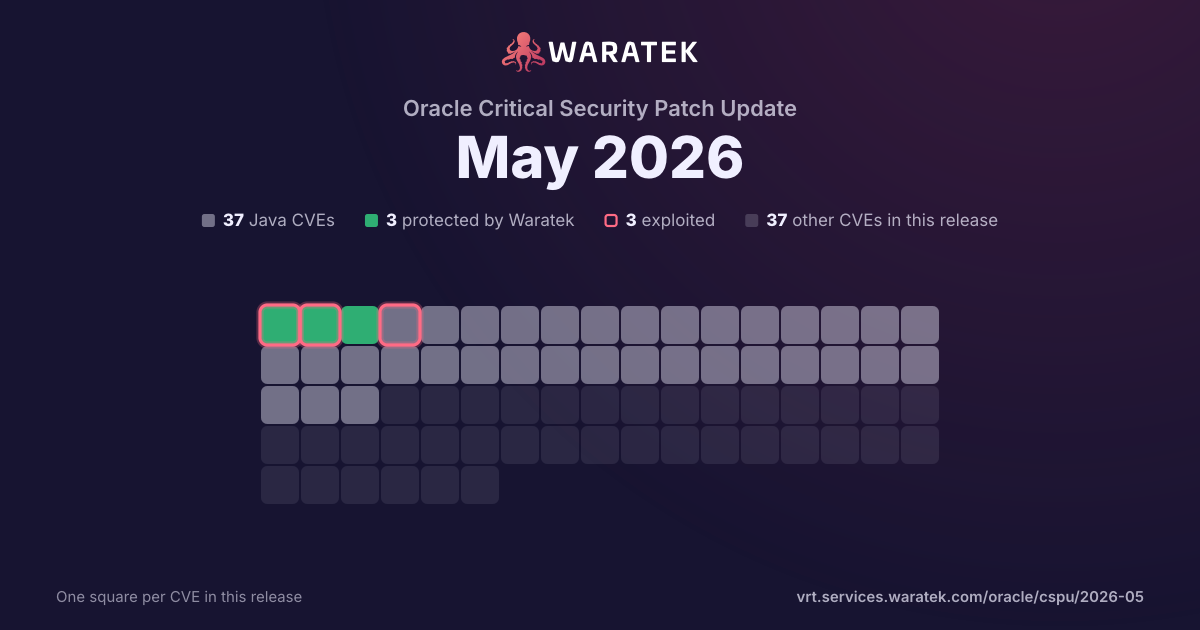
By status
3Protected by Waratek3Mitigation candidate31No exploit published37Not applicable
3Exploited, marked by the ring
No exploit published. For 22 of them, Oracle's security advisory is the source of public detail.
Protected by Waratek. Waratek RASP can block exploitation of these on systems that have not applied the patch yet.
Overview 4 matches · 2 in Waratek scope · 1 protected · 2 exploited · 1 CISA KEV · 2 EPSS ≥ 0.5
Protected by Waratek
1
25.0%
Rule in development
0
0.0%
Mitigation candidate
1
25.0%
No exploit published
0
0.0%
Outside Waratek scope
0
0.0%
Not applicable
2
50.0%
Withdrawn CVE
0
0.0%
blocked by ARMR today
1
25.0%
partly blocked
0
0.0%
not blocked
3
75.0%
not established
0
0.0%
unrecorded
0
0.0%
Exploited
2
50.0%
Working exploit published
1
25.0%
Proof of concept only
1
25.0%
Forecast only
0
0.0%
No public exploit
0
0.0%
split by
peak 2 / month
Jan 26Feb 26Mar 26Apr 26May 26
| CVE | Severity | Published▾ | Status | Exploitation | Description |
|---|---|---|---|---|---|
| CVE-2026-23918 | High | 2026-05-04 | Not applicable | Working exploit published | Double Free and possible RCE vulnerability in Apache HTTP Server with the HTTP/2 protocol. This issue affects Apache HTTP Server: 2.4.66. Users are recommended to upgrade to version 2.4.67, which fixes the issue. |
| CVE-2026-40466 | High | 2026-04-24 | Mitigation candidate | Exploited | Improper Input Validation, Improper Control of Generation of Code ('Code Injection') vulnerability in Apache ActiveMQ Broker, Apache ActiveMQ All, Apache ActiveMQ. An authenticated attacker may bypass the fix in CVE-2026-34197 by adding a connector using an HTTP Discovery transport via BrokerView.addNetworkConnector or BrokerView.addConnector through Jolokia if the activemq-http module is on the classpath. A malicious HTTP endpoint can return a VM transport through the HTTP URI which will bypass the validation added in CVE-2026-34197. The attacker can then use the VM transport's brokerConfig parameter to load a remote Spring XML application context using ResourceXmlApplicationContext. Because Spring's ResourceXmlApplicationContext instantiates all singleton beans before the BrokerService validates the configuration, arbitrary code execution occurs on the broker's JVM through bean factory methods such as Runtime.exec(). This issue affects Apache ActiveMQ Broker: before 5.19.6, from 6.0.0 before 6.2.5; Apache ActiveMQ All: before 5.19.6, from 6.0.0 before 6.2.5; Apache ActiveMQ: before 5.19.6, from 6.0.0 before 6.2.5. Users are recommended to upgrade to version 5.19.6 or 6.2.5, which fixes the issue. |
| CVE-2026-34486 | High | 2026-04-09 | Protected by Waratek | Exploited | Missing Encryption of Sensitive Data vulnerability in Apache Tomcat due to the fix for CVE-2026-29146 allowing the bypass of the EncryptInterceptor. This issue affects Apache Tomcat: 11.0.20, 10.1.53, 9.0.116. Users are recommended to upgrade to version 11.0.21, 10.1.54 or 9.0.117, which fix the issue. |
| CVE-2025-15467 | Critical | 2026-01-27 | Not applicable | Proof of concept only | Issue summary: Parsing CMS AuthEnvelopedData or EnvelopedData message with maliciously crafted AEAD parameters can trigger a stack buffer overflow. Impact summary: A stack buffer overflow may lead to a crash, causing Denial of Service, or potentially remote code execution. When parsing CMS (Auth)EnvelopedData structures that use AEAD ciphers such as AES-GCM, the IV (Initialization Vector) encoded in the ASN.1 parameters is copied into a fixed-size stack buffer without verifying that its length fits the destination. An attacker can supply a crafted CMS message with an oversized IV, causing a stack-based out-of-bounds write before any authentication or tag verification occurs. Applications and services that parse untrusted CMS or PKCS#7 content using AEAD ciphers (e.g., S/MIME (Auth)EnvelopedData with AES-GCM) are vulnerable. Because the overflow occurs prior to authentication, no valid key material is required to trigger it. While exploitability to remote code execution depends on platform and toolchain mitigations, the stack-based write primitive represents a severe risk. The FIPS modules in 3.6, 3.5, 3.4, 3.3 and 3.0 are not affected by this issue, as the CMS implementation is outside the OpenSSL FIPS module boundary. OpenSSL 3.6, 3.5, 3.4, 3.3 and 3.0 are vulnerable to this issue. OpenSSL 1.1.1 and 1.0.2 are not affected by this issue. |