
Oracle Critical Patch Update October 2026
Released October 2026 · Oracle's advisory ↗ · ← Security Patch Update, September 2026 · Security Patch Update, November 2026 →
1,693 CVEs in this release, one square each
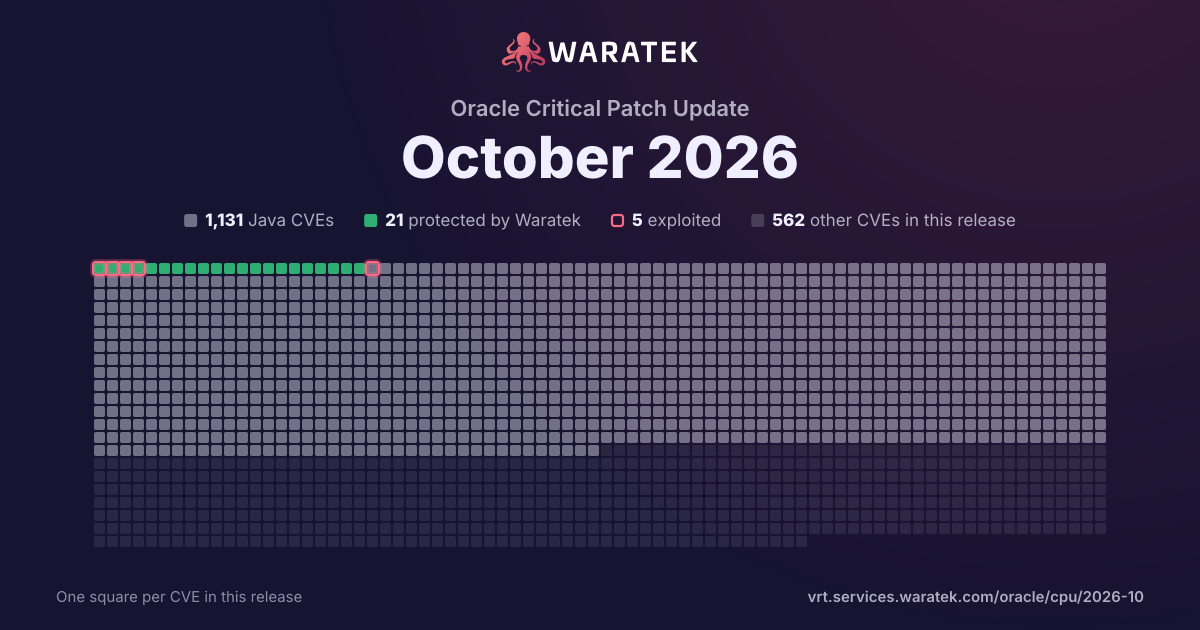
By status
20Protected by Waratek1Mitigation candidate1,112No exploit published11Outside Waratek scope549Not applicable
5Exploited, marked by the ring
No exploit published. For 858 of them, Oracle's security advisory is the source of public detail.
Protected by Waratek. Waratek RASP can block exploitation of these on systems that have not applied the patch yet.
Overview 54 matches · 34 in Waratek scope · 0 protected · 0 exploited · 0 CISA KEV · 0 public PoC · 0 EPSS ≥ 0.5
54matches
34in Waratek scope63.0%
0protected0.0%
0exploited0.0%
0CISA KEV0.0%
0public PoC0.0%
0EPSS ≥ 0.50.0%
Protected by Waratek
0
0.0%
Rule in development
0
0.0%
Mitigation candidate
0
0.0%
No exploit published
34
63.0%
Outside Waratek scope
0
0.0%
Not applicable
20
37.0%
Withdrawn CVE
0
0.0%
blocked by ARMR today
0
0.0%
partly blocked
0
0.0%
not blocked
54
100.0%
not established
0
0.0%
unrecorded
0
0.0%
Exploited
0
0.0%
Working exploit published
0
0.0%
Proof of concept only
13
24.1%
Forecast only
0
0.0%
No public exploit
41
75.9%
| CVE | Severity | Published▾ | Status | Exploitation | Description |
|---|---|---|---|---|---|
| CVE-2026-91777 | High | 2026-09-23 | No exploit published | Proof of concept only | Forward-reference completion for @JsonIdentityInfo object IDs in FasterXML jackson-databind performs a linear scan of the pending-reference accumulator for every resolved ID. The affected paths are CollectionDeserializer.CollectionReferringAccumulator.resolveForwardReference() and the equivalent implementation in MapDeserializer. When a document first creates N unresolved object-ID references in an identity-enabled collection or map and then defines those same IDs in reverse order, completion performs on the order of N * (N + 1) / 2 identity comparisons, so a shallow document whose size grows linearly causes quadratic CPU work during deserialization. The reporter instrumented equals() calls on the ID class and measured exactly 2,003,000 comparisons at N = 2,000, against zero comparisons in the pending-reference lookup path for an equally sized control in which every reference was already resolved. The input requires no deep nesting and no syntactically unusual JSON. Exploitation requires an application that deserializes attacker-influenced JSON into an identity-enabled collection or map. The fix replaces the repeated linear lookup with a keyed pending-reference structure. |
| CVE-2026-91776 | High | 2026-09-23 | No exploit published | Proof of concept only | TypeDeserializerBase._findDeserializer() in FasterXML jackson-databind caches the resolved deserializer under the raw, attacker-supplied type ID. When name-based polymorphism is configured with a fallback, for example @JsonTypeInfo(use = Id.NAME, defaultImpl = ...), every distinct unrecognized type ID resolves to the same fallback deserializer but is retained as its own key in the _deserializers map. That map has no configurable bound and lives for the lifetime of the type deserializer, so an attacker who can repeatedly supply fresh unknown type IDs causes monotonic memory retention across requests. The reporter observed 10,000 retained entries from 10,000 distinct unknown IDs, against a single entry for a control that repeated one unknown ID the same number of times, isolating attacker-controlled key cardinality from request volume. Exploitation requires an application that enables name-based polymorphism with a defaultImpl or equivalent fallback, accepts attacker-influenced type IDs, and reuses a long-lived ObjectMapper across requests. The fix stops caching fallback resolutions for unrecognized IDs and bounds both the number of cached entries and the length of a cacheable type ID. |
| CVE-2026-89425 | High | 2026-09-23 | No exploit published | Proof of concept only | UTF8DataInputJsonParser._reportInvalidToken() in FasterXML jackson-core builds the offending-token text for its error message by appending Java identifier characters to a StringBuilder in a loop that has no upper bound. Unlike the three sibling parser implementations, including UTF8StreamJsonParser, it never consults ErrorReportConfiguration.getMaxErrorTokenLength() (default 256). A malformed token supplied to a parser created through JsonFactory.createParser(DataInput) is therefore accumulated in full. No StreamReadConstraints setting mitigates this: maxDocumentLength cannot be applied to DataInput sources at all, and maxStringLength does not cover this path because the accumulation bypasses ReadConstrainedTextBuffer. The reporter measured a 20,000,109-character exception message from a 20-million-character malformed token on the DataInput path, against 367 characters for identical input on the InputStream path. Scaling the payload drives the StringBuilder, which also incurs byte-to-char expansion and internal array doubling, to many times the raw payload size and can trigger OutOfMemoryError for the whole JVM. UTF8DataInputJsonParser was introduced in 2.8.0 together with createParser(DataInput); releases before 2.8.0 do not contain the affected class. |
| CVE-2026-77422 | High | 2026-09-23 | No exploit published | Proof of concept only | JLine is a Java library for handling console input. From 3.0.0 until 3.30.15 and 4.3.1, the JLine built-in grep command in builtins/src/main/java/org/jline/builtins/PosixCommands.java accepts a user-controlled regular expression in grep(...) and, unless line-regexp mode is used, automatically adds a dot-star prefix and suffix before compiling it with Java's backtracking regular expression engine. The wrapping expands the backtracking search space, so a short nested-quantifier expression evaluated against non-matching input can consume excessive CPU and indefinitely block a command worker, including in remotely exposed shell sessions. This issue is fixed in versions 3.30.15 and 4.3.1. |
| CVE-2026-77421 | Medium | 2026-09-23 | No exploit published | No public exploit | JLine is a Java library for handling console input. From 3.0.0 until 3.30.15 and 4.3.1, the JLine built-in nano editor's regex search mode passes a user-controlled search term from doSearch(String text) in builtins/src/main/java/org/jline/builtins/Nano.java to Java's backtracking regular expression engine without a timeout or backtracking bound. A nested-quantifier expression evaluated against non-matching buffer content can consume excessive CPU and indefinitely block the editor session thread, and remote multi-user deployments can lose a worker thread for each affected session. This issue is fixed in versions 3.30.15 and 4.3.1. |
| CVE-2026-77420 | Medium | 2026-09-23 | No exploit published | Proof of concept only | JLine is a Java library for handling console input. From 3.0.0 until 3.30.15 and 4.3.1, DefaultHistory.matchPatterns(String patterns, String line) in reader/src/main/java/org/jline/reader/impl/history/DefaultHistory.java converts the HISTORY_IGNORE configuration value into a Java regular expression while escaping only part of its syntax, allowing other regex metacharacters to reach the backtracking engine. An attacker who can control application or user configuration can supply a nested-quantifier expression that is reevaluated whenever a command is added to history, consuming excessive CPU and indefinitely blocking the reader thread. This issue is fixed in versions 3.30.15 and 4.3.1. |
| CVE-2026-89407 | High | 2026-09-22 | No exploit published | Proof of concept only | NumberInput.looksLikeValidNumber() in FasterXML jackson-core pre-validates "stringified numbers" with two regular expressions: PATTERN_FLOAT ([+-]?[0-9]*[\.]?[0-9]+([eE][+-]?[0-9]+)?), present since 2.17.0, and PATTERN_FLOAT_TRAILING_DOT, added in 2.17.2. PATTERN_FLOAT places adjacent quantifiers over the same character class -- an optional [0-9]* run, an optional dot, then a required [0-9]+ run -- so input that ultimately fails to match forces Java's backtracking engine to retry every possible split point of the digit run. Matching cost therefore grows with the square of the input length. An attacker who can supply JSON that an application deserializes into a numeric target type reaches this method through jackson-databind's default String-to-number coercion (StdDeserializer and NumberDeserializers for BigDecimal, BigInteger, Double and Float). Because StreamReadConstraints.maxStringLength defaults to 20,000,000 characters, no constraint bounds the input before it reaches the regex. Testing by the reporter confirmed O(n^2) growth across five consecutive input-size doublings, with a single 160,000-character string consuming roughly 74 seconds in one call; a small number of concurrent requests of ordinary body size can therefore exhaust a server's request-handling thread pool. The affected method does not exist before 2.17.0, so 2.16.x and earlier releases are not affected. The fix replaces both regular expressions with a hand-rolled single-pass scan. |
| CVE-2026-91863 | High | 2026-09-21 | No exploit published | No public exploit | A specially crafted WS-Policy document with deeply nested policy elements can bypass Neethi's nesting-depth limit and exhaust the thread stack, crashing the parser (denial of service). Users are recommended to upgrade to version 3.2.4, which fixes this issue. |
| CVE-2026-61674 | Critical | 2026-09-21 | Not applicable | Proof of concept only | Fluent Bit is a fast and lightweight logs, metrics, and traces processor for Linux, BSD, macOS, and Windows. From 0.11.0 until 5.0.8, plugins/out_forward/forward.c secure_forward_pong copies the server-controlled PONG[2] reason into the 32-byte stack buffer msg with memcpy without checking its MessagePack type or length. An attacker who controls or can impersonate an out_forward Secure Forward destination configured with Shared_Key or Empty_Shared_Key can send an oversized reason during the first handshake and overwrite stack control data. Protected builds reliably terminate, while builds without a stack canary or with a disclosure can allow remote code execution as the Fluent Bit process user. When the opt-in --supervisor mode is used, fork-only respawns preserve the canary and address layout, allowing repeated crash-or-survive probes to support code execution on a hardened build; ordinary exec-based or service-manager restarts do not preserve that state. This issue is fixed in version 5.0.8. |
| CVE-2026-78030 | Critical | 2026-09-19 | Not applicable | No public exploit | DBI versions before 1.653 for Perl load arbitrary modules via unvalidated dbm_type and dbm_mldbm attributes in DBD::DBM. DBD::DBM passes the dbm_type and dbm_mldbm connect attributes to require without checking that the value names a module. require treats a path-shaped string as a literal filename and does not consult @INC, so the attribute chooses the file that Perl loads and runs. The MLDBM::Serializer:: prefix that DBD::DBM prepends to dbm_mldbm is not a boundary: only the :: separators are rewritten to /, so a value containing / traverses out of the serializer directory. The value is also assigned to $MLDBM::Serializer, which MLDBM requires the same way when it ties the table. A caller that lets an untrusted party influence either attribute, for example through a DSN fragment or a parameter that selects a storage backend, runs the file-scope code of whatever module the value names. For example, my $dsn = "dbi:DBM:f_dir=/var/db;dbm_type=../../Untrusted.pm" my $dbh = DBI->connect( $dsn ); Note that DBD::Gofer forwards connect attributes to the server side, and DBI::ProxyServer checks only that a DSN starts with a driver prefix. |
| CVE-2026-93579 | Medium | 2026-09-18 | No exploit published | No public exploit | A flaw was found in Netty's HTTP/2 stack. This vulnerability allows a remote attacker to inject prohibited characters, such as NUL, Line Feed, and Carriage Return, into HTTP/2 header field values due to insufficient validation. When these values cross an HTTP/2 to HTTP/1.1 translation boundary, they can be exploited for request smuggling, header injection, or response splitting. This could lead to unauthorized access, data manipulation, or other security bypasses. |
| CVE-2026-93578 | Medium | 2026-09-18 | Not applicable | Proof of concept only | A flaw was found in Netty's Online Certificate Status Protocol (OCSP) Client. The client fails to verify the 'id-kp-OCSPSigning' Extended Key Usage (EKU) in OCSP responder certificates. A remote attacker, holding any valid certificate issued by the same Certificate Authority (CA), can exploit this by forging 'GOOD' OCSP responses for revoked certificates. This bypasses certificate revocation checks, allowing applications using Netty's OCSP Client to accept certificates that should have been revoked, leading to an authorization bypass. |
| CVE-2026-93576 | High | 2026-09-18 | No exploit published | No public exploit | A flaw was found in Netty netty-codec-smtp. The component does not properly validate Carriage Return (CR) and Line Feed (LF) characters in the SMTP command-name field. A remote attacker, if an application routes untrusted input into this field, can embed CR/LF characters to inject arbitrary SMTP commands. This can lead to SMTP command smuggling, allowing for unauthorized email relay or spoofing of sender/recipient addresses. While the impact is significant, the real-world exploitability is considered lower as applications typically do not place user-controlled data in the command-name field. |
| CVE-2026-93575 | High | 2026-09-18 | No exploit published | No public exploit | A flaw was found in Netty's MqttDecoder. An unauthenticated remote attacker can exploit this vulnerability by sending a specially crafted MQTT CONNECT packet. The decoder fails to properly validate the 'Properties Length' against the 'Remaining Length', allowing an attacker to bypass size limits. This leads to excessive memory and CPU consumption, resulting in a denial of service (DoS) due to an OutOfMemoryError. |
| CVE-2026-93574 | Medium | 2026-09-18 | No exploit published | No public exploit | A flaw was found in Netty's `netty-codec-http` component. A remote attacker could exploit this vulnerability by sending a specially crafted HTTP/1.1 chunk-size token that includes post-digit whitespace. This incorrect parsing of the chunk size can lead to HTTP request smuggling. This allows an attacker to bypass security controls or access unauthorized resources in proxy/backend deployments. |
| CVE-2026-93573 | Medium | 2026-09-18 | No exploit published | No public exploit | A flaw was found in Netty's HTTP/1.1 decoder. This vulnerability allows a remote attacker to bypass `Transfer-Encoding` header validation by splitting the `Transfer-Encoding` field across multiple headers, with the last field containing a non-final transfer coding like `gzip` or `deflate`. This bypass can lead to HTTP request smuggling, enabling attackers to bypass security controls, desynchronize request processing, or cause requests to be processed in an unintended context. |
| CVE-2026-93572 | High | 2026-09-18 | No exploit published | No public exploit | A flaw was found in Netty's `RedisArrayAggregator` component. A remote attacker can exploit this vulnerability by sending specially crafted nested Redis (RESP) array headers. This can cause the `RedisArrayAggregator` to eagerly preallocate a large amount of heap memory, leading to heap memory exhaustion and a Denial of Service (DoS) for applications using `RedisDecoder` with `RedisArrayAggregator` on untrusted traffic. |
| CVE-2026-93569 | High | 2026-09-18 | No exploit published | No public exploit | A flaw was found in Netty. A remote unauthenticated attacker can exploit a vulnerability in Netty's HTTP/1 to HTTP/2 conversion process. When an HTTP/1 request includes both an absolute-form request-target and a conflicting Host header, Netty incorrectly prioritizes the Host header for the HTTP/2 :authority field, discarding the original request-target authority. This inconsistency can allow an attacker to bypass security controls in Netty-based proxies or gateways, potentially leading to unauthorized access, cache poisoning, or misrouting of requests. |
| CVE-2026-93568 | High | 2026-09-18 | No exploit published | No public exploit | A flaw was found in Netty. A remote attacker could exploit this vulnerability by sending specially crafted HTTP/2 or HTTP/3 Extended CONNECT requests. Netty's HTTP-object conversion path incorrectly processes these requests as regular HTTP/1.1 CONNECT requests, leading to a loss of critical protocol and path information. This misinterpretation can allow attackers to bypass security policies, such as routing or authorization logic, in applications that rely on Netty for HTTP/2 or HTTP/3 communication, resulting in integrity loss. |
| CVE-2026-93567 | High | 2026-09-18 | No exploit published | No public exploit | A flaw was found in Netty's HTTP/2 codec. When converting HTTP/1 CONNECT requests to HTTP/2, the component incorrectly uses the Host header instead of the CONNECT authority-form request-target for the tunnel authority. A remote attacker can exploit this by supplying a different Host header, leading to a malformed HTTP/2 CONNECT request. This can bypass security controls such as tunnel allow-lists or egress policies, resulting in integrity loss. |
| CVE-2026-93566 | Medium | 2026-09-18 | No exploit published | No public exploit | A flaw was found in Netty. A remote attacker could exploit this by sending a specially crafted HTTP request that includes control characters within the chunk-size line. This bypasses the intended strict validation, allowing the attacker to inject arbitrary HTTP requests. This vulnerability can lead to HTTP request smuggling, potentially resulting in information disclosure or other unauthorized actions. |
| CVE-2026-93565 | High | 2026-09-18 | No exploit published | No public exploit | A flaw was found in Netty RtspDecoder. The `RtspMethods.valueOf()` function incorrectly strips trailing control bytes from method tokens in Real-Time Streaming Protocol (RTSP) requests. A remote attacker can exploit this by sending a specially crafted RTSP request, leading to method-token smuggling. This vulnerability allows an attacker to bypass method-based access controls and can also be used to launder malicious requests through Netty-based RTSP proxies, making them appear legitimate to backend systems. |
| CVE-2026-93564 | High | 2026-09-18 | No exploit published | No public exploit | A flaw was found in Netty. A reference-count leak in the HAProxy PROXY-v2 message decoder allows a remote, unauthenticated attacker to send specially crafted PROXY-protocol v2 headers. This can lead to memory exhaustion, resulting in a Denial of Service (DoS) for the affected system. |
| CVE-2026-93563 | High | 2026-09-18 | No exploit published | No public exploit | A flaw was found in Netty's `SmtpResponseDecoder` component. A remote attacker, acting as a malicious or man-in-the-middle (MITM) SMTP server, could exploit this by sending a specially crafted, unbounded multi-line SMTP response without a terminator. This vulnerability leads to unbounded memory accumulation within the client's Java Virtual Machine (JVM) heap, causing an `OutOfMemoryError` and a denial of service (DoS) due to a process crash. |
| CVE-2026-93561 | Medium | 2026-09-18 | No exploit published | No public exploit | A flaw was found in io.netty/netty-codec-memcache. The Memcache binary protocol codec incorrectly reads `keyLength` and `extrasLength` as signed Java types instead of unsigned, as specified by the protocol. A malicious Memcache server can exploit this type mismatch by sending a specially crafted response. This can lead to frame desynchronization and response smuggling, where one client's data may be inadvertently exposed to another client's response stream in proxy or cache environments. |
| CVE-2026-93560 | High | 2026-09-18 | Not applicable | No public exploit | A flaw was found in the Netty STOMP codec. A remote attacker could send a specially crafted STOMP frame with a content-length header exceeding the maximum integer value. This integer truncation vulnerability could lead to an infinite decode loop, causing a Denial of Service (DoS) by exhausting memory and CPU resources. |
| CVE-2026-93494 | High | 2026-09-18 | No exploit published | No public exploit | A flaw was found in Netty's StompSubframeDecoder component. A remote attacker can exploit this vulnerability by sending a specially crafted STOMP frame body without its terminating null byte. This causes the decoder to allocate a ByteBuf (a buffer for bytes) that is never released, leading to a permanent memory leak. Over time, this uncontrolled memory consumption can result in a Denial of Service (DoS) for the application using the affected STOMP codec. |
| CVE-2026-93493 | Medium | 2026-09-18 | Not applicable | No public exploit | A flaw was found in Netty's `netty-handler-ssl-ocsp` component. A remote attacker can exploit this vulnerability by providing an Online Certificate Status Protocol (OCSP) response that omits the optional `nextUpdate` field. This omission causes the OCSP validation to be silently skipped, leading to applications proceeding with an unvalidated certificate. This can result in a bypass of security controls where certificate validation is expected. |
| CVE-2026-93492 | Medium | 2026-09-18 | No exploit published | No public exploit | A flaw was found in Netty's HTTP/2 HpackEncoder. A remote attacker can exploit this by sending HTTP/2 SETTINGS frames with a very large MAX_HEADER_TABLE_SIZE. This causes the HpackEncoder to store an excessive number of unique headers, leading to increased CPU usage and memory consumption, ultimately resulting in a Denial of Service (DoS). |
| CVE-2026-84501 | Medium | 2026-09-16 | No exploit published | No public exploit | An unauthenticated attacker can inject arbitrary fake log lines into Apache ZooKeeper's operational log by sending a crafted add_auth("ensemble", ...) request containing newline characters (\n). When the ensemble name doesn't match, EnsembleAuthenticationProvider.handleAuthentication() logs the raw, unsanitized name via LOG.warn(). Because SLF4J's {} placeholder preserves embedded newlines, the attacker can forge complete log entries — with arbitrary timestamps, log levels, class names, and messages — that are visually indistinguishable from genuine ZooKeeper log output. This issue affects Apache ZooKeeper: from 3.9.0 through 3.9.5, from 3.8.0 through 3.8.6. Users are recommended to upgrade to version 3.8.7 or 3.9.6, which fixes the issue. |
| CVE-2026-84439 | Medium | 2026-09-16 | No exploit published | No public exploit | When audit logging is enabled (zookeeper.audit.enable=true), an unauthenticated attacker can inject arbitrary fields into Apache ZooKeeper's audit log by sending a digest authentication request with tab characters (\t) embedded in the username. Because the audit log uses tab-separated key=value format, the injected tabs are parsed as legitimate field separators, allowing the attacker to spoof audit results (e.g., injecting result=success), forge operation types, and corrupt forensic evidence. A log injection vulnerability in Apache ZooKeeper allows a client that can call setACL to inject forged key-value fields into zookeeper_audit.log. When audit logging is enabled, the server serializes attacker-controlled digest ACL ids into the acl= audit field without escaping tab characters. Because audit events are emitted as tab-separated key=value records, a crafted ACL id can make one successful setAcl event appear to contain forged fields such as operation=delete and znode=/forged. This undermines the integrity of downstream audit parsing, alerting, and incident response. This issue affects Apache ZooKeeper: from 3.9.0 through 3.9.5, from 3.8.0 through 3.8.6. Users are recommended to upgrade to version 3.9.6 or 3.8.7, which fixes the issue. |
| CVE-2026-79993 | High | 2026-09-16 | No exploit published | No public exploit | The `deleteContainer` opcode (0x14/20) is processed without verifying the caller's ACL permissions, allowing any authenticated client to delete specific znodes in the data tree regardless of the ACL restrictions on the znode or its parent. This opcode is considered internal-only and the official client doesn't have API for it, but a client that can open a plain TCP session on the ZooKeeper client port (2181 by default) - with NO authentication and NO ACL permissions - can delete any empty persistent znode (including regular persistent nodes, container nodes, and TTL nodes) by issuing the raw protocol OpCode deleteContainer (20). The deleteContainer request path completely skips both the session check and the DELETE ACL check that are enforced by the regular delete (OpCode 2) path. This is an authorization bypass / ACL enforcement bug. This issue affects Apache ZooKeeper: from 3.9.0 through 3.9.5, from 3.8.0 through 3.8.6. Users are recommended to upgrade to version 3.9.6 or 3.8.7, which fixes the issue. |
| CVE-2026-59969 | High | 2026-09-16 | No exploit published | No public exploit | Apache ZooKeeper quorum TLS fails to enforce peer hostname verification in FIPS-mode deployments. When sslQuorum=true, zookeeper.fips-mode=true, ssl.quorum.hostnameVerification=true, and ssl.quorum.clientHostnameVerification=true are enabled, the Java SSLSocket quorum path accepts a CA-trusted peer certificate whose SAN does not match the connected host. A malicious or misissued peer certificate can therefore join quorum traffic, participate in leader election, and enter replication flows. Users are recommended to upgrade to version 3.8.7 or 3.9.6, which fixes the issue. |
| CVE-2026-59739 | High | 2026-09-16 | No exploit published | No public exploit | Information disclosure via SetWatches reconnect replay in Apache ZooKeeper due to missing ACL check. An attacker can discover ACL-restricted paths by registering exists-watches on non-existent paths, then reconnecting after the paths are created with restricted ACLs. Issue is caused by incomplete fix for CVE-2024-23944 (ZOOKEEPER-4799). The fix added ACL checking to WatchManager.triggerWatch(). However, DataTree.setWatches() — the SetWatches/SetWatches2 reconnect replay handler — still calls watcher.process(event) with null ACL, bypassing the check entirely. It's important to note that only the path is exposed by this vulnerability, not the data of znode, but since znode path can contain sensitive information like user name or login ID, this issue is potentially critical. Users are recommended to upgrade to version 3.9.6, 3.8.7 which fixes the issue. |
| CVE-2026-68497 | High | 2026-09-11 | No exploit published | Proof of concept only | jackson-databind binds a JSON string to a javax.xml.datatype.Duration or javax.xml.datatype.XMLGregorianCalendar field by passing the raw string verbatim to DatatypeFactory.newDuration(value) or newXMLGregorianCalendar(value) in CoreXMLDeserializers.Std._deserialize. These deserializers are registered by default with no opt-in, so a plain ObjectMapper or JsonMapper with no polymorphic typing and no special configuration reaches this path. The XML Schema lexical grammar permits numeric components of arbitrary length, which the JDK materializes through the native BigInteger(String) and BigDecimal(String) constructors, both quadratic in digit count. Because the digits sit inside a JSON string token rather than a JSON number token, jackson-core's StreamReadConstraints.maxNumberLength guard never applies; jackson's own NumberDeserializers call validateIntegerLength or validateFPLength before parsing a stringified number, but the XML datatype deserializer omits that pre-check. An unauthenticated attacker can therefore submit a single request of a few megabytes, such as a Duration value consisting of the letter P followed by several million digits and the letter Y, and force tens of seconds to several minutes of single-threaded CPU work; a handful of concurrent requests can saturate a server's worker threads. This affects com.fasterxml.jackson.core:jackson-databind from 2.0.0 before 2.18.10, from 2.19.0 before 2.21.6, and from 2.22.0 before 2.22.2, and tools.jackson.core:jackson-databind from 3.0.0 before 3.1.6 and from 3.2.0 before 3.2.2. Users should upgrade to 2.18.10, 2.21.6, 2.22.2, 3.1.6, or 3.2.2. |
| CVE-2026-89044 | Medium | 2026-09-10 | No exploit published | No public exploit | Netty versions 4.1.133.Final through 4.1.137.Final and 4.2.13.Final through 4.2.17.Final fail to properly validate the final transfer coding in the Transfer-Encoding header, allowing attackers to smuggle requests by using malformed encoding declarations. Attackers can split Transfer-Encoding headers across multiple lines or use values like 'chunked, xchunked' to bypass validation and decode messages as chunked when the final coding is not chunked, enabling request smuggling attacks. |
| CVE-2026-84939 | Critical | 2026-09-10 | No exploit published | No public exploit | Path traversal vulnerability in Apache FreeMarker template loading mechanism, if the attacker can specify an arbitrary malformed locale identifier to FreeMarker, and the localized lookup configuration setting is enabled (it's by default enabled). This issue affects Apache FreeMarker from 2.2.0 through 2.3.34. Users are recommended to upgrade to version 2.3.35. Disabling localized lookup in previous versions also mitigates this. Note that even in versions affected by this vulnerability, the files that can be loaded remain restricted by the TemplateLoader that FreeMarker is configured to use. In particular, FileTemplateLoader prevents attempts to traverse outside the baseDir specified in its constructor. Other TemplateLoader implementations may allow access outside their designated base directory, but they are still constrained by the underlying storage mechanism—for example, a loader wrapping a Java class loader can only access resources that the class loader can load, while one wrapping a web application context can only access resources available through that context. |
| CVE-2026-74860 | High | 2026-09-08 | Not applicable | No public exploit | A flaw was found in libxml2 with Python bindings enabled. A remote attacker could exploit this vulnerability by providing a specially crafted XML document containing a Document Type Definition (DTD) with enumerated attribute values. This triggers a double-free error in the SAX attributeDecl callback handler, where a string is freed twice. This flaw can lead to a denial of service (DoS) due to a reproducible crash in Python applications using the libxml2 SAX bindings. |
| CVE-2026-78254 | High | 2026-09-07 | No exploit published | No public exploit | The ftp and scp tasks of Apache Ant can download files from a remote server. A malicious server can provide relative paths that allow it to write outside of the dedicated target directory for the download, making it possible to overwrite files of the attacker's choice using the permissions of the user running Ant in versions prior to Ant 1.10.18. In order to exploit this vulnerability, the server would either have to be malicious or be subject to a machine-in-the-middle attack. Additionally in the case of scp or the ftp task using ftps the server must pass the server identity checks performed by the tasks. For ftp tasks not using ftps a malicious server could act as a machine-in-the-middle to provide malicious files. Starting with Ant 1.10.18 both tasks will prevent writing outside of the destination directory by default. An option is available to disable this behavior in the unlikely case that the old behavior is required by existing build files. Mitigations: Users of scp and ftp (when using ftps) in any version of Ant should not bypass server identity checks. Users of ftp not using ftps should switch to ftps where possible. All users are recommended to upgrade to Apache Ant 1.10.18, which fixes this issue. |
| CVE-2026-86219 | Critical | 2026-09-06 | Not applicable | No public exploit | Authen::SASL::Perl::DIGEST_MD5 versions before 2.2100 for Perl accept replayed authentication responses via unverified nonce in server_step. server_start generates a fresh nonce and sends it in the challenge, and nothing later compares that value against the nonce the client returns. server_step derives the expected digest from the client's own parameters, so a response verifies whenever its digest matches the nonce it carries. The count table it also checks is keyed on the client-supplied nonce and starts empty in each new server object, so a captured first response, carrying `nc=00000001`, passes that too. RFC 2831 defines the nonce in the response as the value the server sent in the preceding challenge. An attacker who observes one successful `qop=auth` exchange can replay the captured response against a later session for the same service, host, realm and user, and authenticate as that user without knowing the password. |
| CVE-2026-19931 | Critical | 2026-09-06 | Not applicable | Proof of concept only | A flaw in libcurl makes it wrongly reuse an HTTP connection setup for a given hostname using Negotiate authentication, when the initial request is done using empty credentials. This can make user B's request get sent over user A's previously authenticated connection. |
| CVE-2026-18924 | Critical | 2026-09-06 | Not applicable | Proof of concept only | A flaw in libcurl's handling of HTTP/2 Server Push streams, when the parent handle is set to share connections with other handles, can lead to use-after-free in the cleanup process. |
| CVE-2026-13608 | High | 2026-09-06 | Not applicable | Proof of concept only | A flaw in the libcurl SASL negotiation for LDAP authentication allows an incomplete handshake sequence to be misinterpreted as a successful cryptographic verification. An attacker executing a Man-in-the-Middle (MITM) attack can inject a premature or shortcut response that bypasses complete peer validation. |
| CVE-2026-86144 | High | 2026-09-05 | Not applicable | No public exploit | In xinclude in libxml2 before 2.15.4, xmlXIncludeProcess and xmlXIncludeProcessTree do not propagate parseFlags. This has security relevance for, for example, the XML_PARSE_NONET flag, if (without it) a custom resource loader accesses the internet and triggers XML external entity injection, SSRF, or a denial of service (e.g., for an attacker-controlled internet resource that is intentionally slow). |
| CVE-2026-86143 | High | 2026-09-05 | Not applicable | No public exploit | In xmlIO in libxml2 before 2.15.4, an inconsistency in xmlOutputWriteCallback and xmlBufUse causes negative lengths to reach write callbacks, aka a lack of a check for integer overflow before calling writecallback. This has security relevance for many types of uses of that length value within a callback. |
| CVE-2026-86142 | High | 2026-09-05 | Not applicable | No public exploit | In libxml2 before 2.15.4, there is a heap-based buffer overflow in xmlXPtrEvalXPtrPart because of xmlXPtrEval xpointer length saturation. |
| CVE-2026-86140 | High | 2026-09-05 | Not applicable | No public exploit | In libxml2 before 2.15.4, xmlSnprintfElements in valid.c has a strcat stack-based buffer overflow. |
| CVE-2026-86138 | High | 2026-09-05 | Not applicable | No public exploit | In libxml2 before 2.15.4, xmlDictAddQString in dict.c has an integer overflow and resultant heap-based buffer overflow. |
| CVE-2026-74994 | Medium | 2026-09-01 | Not applicable | No public exploit | The mod_auth module in OTP's inets httpd server, when configured with dets or mnesia authentication backends and multiple directory configuration blocks, collapses all directory blocks into a single shared user/group namespace. A user added to one protected directory is accepted as valid for all other protected directories on the same server instance. This issue affects OTP from OTP 17.0 before OTP 27.3.4.17, OTP 28.5.0.6, and OTP 29.0.6, corresponding to inets from 5.10 before 9.3.2.7, 9.6.2.3, and 9.7.2. Whether OTP before OTP 17.0, corresponding to inets before 5.10, is affected is unknown. |
| CVE-2026-74835 | High | 2026-09-01 | Not applicable | No public exploit | The inets application HTTP server httpd fails to enforce a configured body-size limit on chunked request. This issue affects OTP from OTP 17.0 before OTP 27.3.4.17, OTP 28.5.0.6, and OTP 29.0.6, corresponding to inets from 5.10 before 9.3.2.7, 9.6.2.3, and 9.7.2. Whether OTP before OTP 17.0, corresponding to inets before 5.10, is affected is unknown. |
| CVE-2026-73812 | High | 2026-09-01 | Not applicable | No public exploit | httpd function check_header/3 rejects duplicate Content-Length (per CVE-2026-23941) but never checks for the TE+CL co-presence that RFC 9112 §6.3 identifies as a probable smuggling attempt. handle_body/3 frames by chunked and silently discards Content-Length. A CL-preferring front-end paired with chunked-preferring inets creates a classic CL.TE front-end/back-end desync. This issue affects OTP from OTP 17.0 before OTP 27.3.4.17, OTP 28.5.0.6, and OTP 29.0.6, corresponding to inets from 5.10 before 9.3.2.7, 9.6.2.3, and 9.7.2. Whether OTP before OTP 17.0, corresponding to inets before 5.10, is affected is unknown. |
| CVE-2026-66357 | High | 2026-09-01 | Not applicable | No public exploit | httpd has never implemented obs-fold (RFC 2616 §2.2 / RFC 7230 §3.2.4 header continuation lines). Every CRLF followed by a non-CRLF octet unconditionally starts a new header. This missing feature became a security concern as the understanding of HTTP request smuggling attacks evolved. This issue affects OTP from OTP 17.0 before OTP 27.3.4.17, OTP 28.5.0.6, and OTP 29.0.6, corresponding to inets from 5.10 before 9.3.2.7, 9.6.2.3, and 9.7.2. Whether OTP before OTP 17.0, corresponding to inets before 5.10, is affected is unknown. |
| CVE-2026-59696 | Medium | 2026-09-01 | Not applicable | No public exploit | Improper Validation of Specified Quantity in Input vulnerability in Erlang/OTP stdlib allows a remote attacker to degrade availability by supplying a URI whose port component is a very long run of digits. uri_string:get_port/1 passes the port substring to binary_to_integer/1 with no length bound, catching only error:badarg, so a syntactically valid port of up to roughly 1.26 million digits converts successfully and costs the calling process hundreds of milliseconds of arbitrary-precision arithmetic. The conversion is reached from every authority-parsing path in uri_string:parse/1, including the host, registered-name, and IPv4 and IPv6 forms. parse/1 is the documented interface for parsing URIs, so any application that parses an attacker-supplied URI is exposed without further configuration. The conversion function is documented to accept integers of any size, so bounding the input is the caller's responsibility. This issue affects OTP from OTP 21.0 before OTP 27.3.4.17, OTP 28.5.0.6, and OTP 29.0.6, corresponding to stdlib from 3.5 before 6.2.2.5, 7.3.0.2, and 8.0.4. |
| CVE-2026-19032 | Medium | 2026-09-01 | No exploit published | Proof of concept only | jackson-databind's deserializer for java.nio.file.Path resolves an attacker-supplied URI without restricting the URI scheme. In JDKFromStringDeserializer.NioPathHelper.deserialize, a string bound from untrusted JSON is passed to new URI(value) and then to Path.of(uri). When that throws FileSystemNotFoundException, the code enumerates ServiceLoader<FileSystemProvider> and calls provider.getPath(uri) on the first provider whose scheme matches the attacker-chosen scheme. Untrusted JSON can therefore select and drive an arbitrary registered FileSystemProvider during readValue under a default JsonMapper, and forces provider class loading at the same time. With only the JDK built-in providers (file, jar/zipfs) present, the resolved path is inert and no mount or network I/O occurs; further impact requires a side-effecting third-party FileSystemProvider on the classpath. This affects com.fasterxml.jackson.core:jackson-databind from 2.8.0 before 2.18.10, from 2.19.0 before 2.21.6, and from 2.22.0 before 2.22.2, and tools.jackson.core:jackson-databind from 3.0.0 before 3.1.6 and from 3.2.0 before 3.2.2. Users should upgrade to 2.18.10, 2.21.6, 2.22.2, 3.1.6, or 3.2.2. Binding java.nio.file.Path from untrusted JSON should be avoided regardless of version. |