
Oracle Critical Patch Update October 2026
Released October 2026 · Oracle's advisory ↗ · ← Security Patch Update, September 2026
1,693 CVEs in this release, one square each
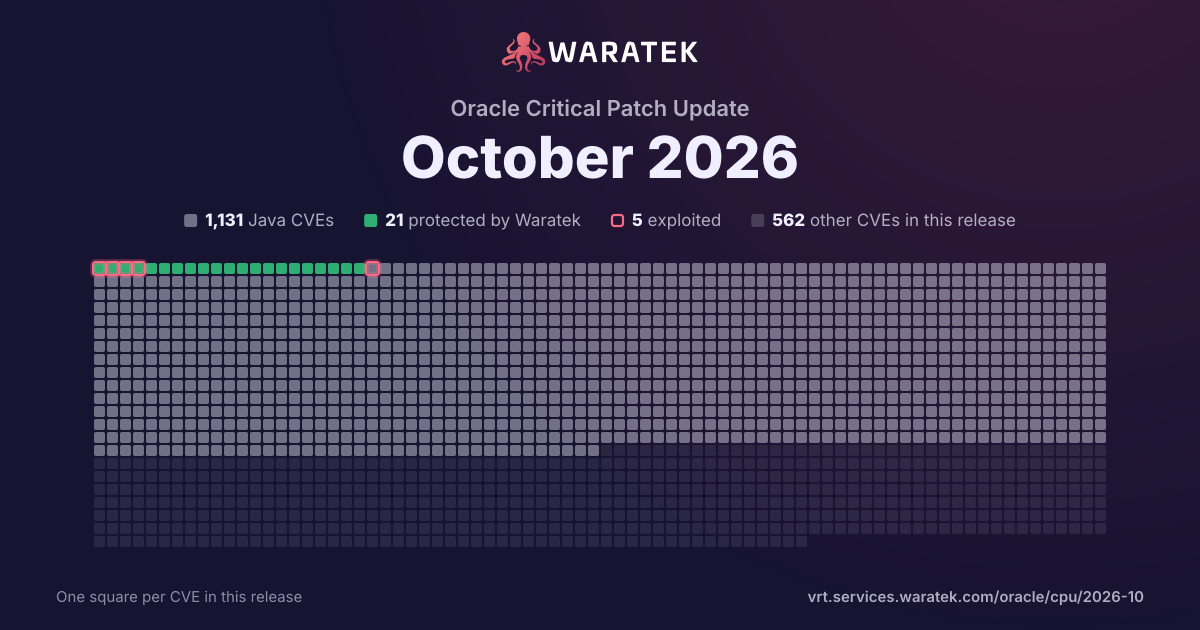
By status
21Protected by Waratek1Mitigation candidate1,109No exploit published13Outside Waratek scope549Not applicable
5Exploited, marked by the ring
No exploit published. For 858 of them, Oracle's security advisory is the source of public detail.
Protected by Waratek. Waratek RASP can block exploitation of these on systems that have not applied the patch yet.
Overview 1,693 matches · 1,131 in Waratek scope · 21 protected · 5 exploited · 3 CISA KEV · 14 public PoC · 8 EPSS ≥ 0.5
1,693matches
1,131in Waratek scope66.8%
21protected1.2%
5exploited0.3%
3CISA KEV0.2%
14public PoC0.8%
8EPSS ≥ 0.50.5%
Protected by Waratek
21
1.2%
Rule in development
0
0.0%
Mitigation candidate
1
0.1%
No exploit published
1,109
65.5%
Outside Waratek scope
13
0.8%
Not applicable
549
32.4%
Withdrawn CVE
0
0.0%
blocked by ARMR today
21
1.2%
partly blocked
0
0.0%
not blocked
1,672
98.8%
not established
0
0.0%
unrecorded
0
0.0%
split by
peak 1,076 / quarter
Q4 211
Not applicable1
Critical1
not blocked1
No public exploit1
Q1 221
Protected by Waratek1
High1
blocked by ARMR today1
No public exploit1
Q2 220
Q3 223
Protected by Waratek1
No exploit published2
High2
Low1
blocked by ARMR today1
not blocked2
Proof of concept only1
No public exploit2
Q4 223
Protected by Waratek2
No exploit published1
Critical3
blocked by ARMR today2
not blocked1
Exploited1
No public exploit2
Q1 236
Not applicable6
Critical1
Medium5
not blocked6
Proof of concept only3
No public exploit3
Q2 235
No exploit published3
Not applicable2
Medium5
not blocked5
Proof of concept only2
No public exploit3
Q3 230
Q4 234
Mitigation candidate1
Not applicable3
High2
Medium1
Low1
not blocked4
Exploited1
Proof of concept only2
No public exploit1
Q1 243
No exploit published2
Outside Waratek scope1
High2
Low1
not blocked3
No public exploit3
Q2 245
Outside Waratek scope1
Not applicable4
High1
Medium4
not blocked5
Working exploit published1
Proof of concept only2
No public exploit2
Q3 242
Not applicable2
Medium1
Low1
not blocked2
No public exploit2
Q4 248
No exploit published3
Outside Waratek scope1
Not applicable4
Critical1
High3
Medium4
not blocked8
Proof of concept only4
No public exploit4
Q1 252
Protected by Waratek1
No exploit published1
Critical1
Medium1
blocked by ARMR today1
not blocked1
Exploited1
Proof of concept only1
Q2 254
Protected by Waratek1
No exploit published2
Not applicable1
High2
Medium2
blocked by ARMR today1
not blocked3
Proof of concept only2
No public exploit2
Q3 257
No exploit published3
Not applicable4
Critical1
High1
Medium5
not blocked7
Proof of concept only1
No public exploit6
Q4 257
No exploit published3
Not applicable4
High3
Medium4
not blocked7
No public exploit7
Q1 2666
Protected by Waratek2
No exploit published9
Not applicable55
Critical9
High20
Medium30
Low7
blocked by ARMR today2
not blocked64
Proof of concept only13
No public exploit53
Q2 26245
Protected by Waratek8
No exploit published84
Outside Waratek scope1
Not applicable152
Critical29
High110
Medium87
Low18
None1
blocked by ARMR today8
not blocked237
Exploited1
Working exploit published1
Proof of concept only29
No public exploit214
Q3 26245
Protected by Waratek3
No exploit published126
Not applicable116
Critical36
High138
Medium68
Low3
blocked by ARMR today3
not blocked242
Proof of concept only45
No public exploit200
Q4 261,076
Protected by Waratek2
No exploit published870
Outside Waratek scope9
Not applicable195
Critical64
High383
Medium538
Low91
blocked by ARMR today2
not blocked1,074
Exploited1
No public exploit1,075
Q4 21Q2 22Q4 22Q2 23Q4 23Q2 24Q4 24Q2 25Q4 25Q2 26Q4 26
| CVE | Severity | Published▾ | Status | Exploitation | Description |
|---|---|---|---|---|---|
| CVE-2026-91399 | Medium | 2026-10-20 | No exploit published | No public exploit | Vulnerability in the Primavera P6 Enterprise Project Portfolio Management product of Oracle Construction and Engineering (component: Web Access). Supported versions that are affected are 21.12.0.0-21.12.21.9, 22.12.0.0-22.12.21.4, 23.12.0-23.12.20, 24.12.0-24.12.16 and 25.12.0-25.12.8. Easily exploitable vulnerability allows low privileged attacker with network access via HTTP to compromise Primavera P6 Enterprise Project Portfolio Management. Successful attacks of this vulnerability can result in unauthorized update, insert or delete access to some of Primavera P6 Enterprise Project Portfolio Management accessible data. CVSS 3.1 Base Score 4.3 (Integrity impacts). CVSS Vector: (CVSS:3.1/AV:N/AC:L/PR:L/UI:N/S:U/C:N/I:L/A:N). |
| CVE-2026-91398 | Medium | 2026-10-20 | No exploit published | No public exploit | Vulnerability in the Oracle Java SE, Oracle GraalVM for JDK, Oracle GraalVM Enterprise Edition product of Oracle Java SE (component: Networking). Supported versions that are affected are Oracle Java SE: 8u503, 8u503-perf, 11.0.32.1, 17.0.20.1, 21.0.12.1, 25.0.4.1, 27; Oracle GraalVM for JDK: 17.0.20.1 and 21.0.12.1; Oracle GraalVM Enterprise Edition: 21.3.19.1.1. Difficult to exploit vulnerability allows unauthenticated attacker with network access via SOCKS5 to compromise Oracle Java SE, Oracle GraalVM for JDK, Oracle GraalVM Enterprise Edition. While the vulnerability is in Oracle Java SE, Oracle GraalVM for JDK, Oracle GraalVM Enterprise Edition, attacks may significantly impact additional products (scope change). Successful attacks of this vulnerability can result in unauthorized creation, deletion or modification access to critical data or all Oracle Java SE, Oracle GraalVM for JDK, Oracle GraalVM Enterprise Edition accessible data. Note: This vulnerability can be exploited by using APIs in the specified Component, e.g., through a web service which supplies data to the APIs. This vulnerability also applies to Java deployments, typically in clients running sandboxed Java Web Start applications or sandboxed Java applets, that load and run untrusted code (e.g., code that comes from the internet) and rely on the Java sandbox for security. CVSS 3.1 Base Score 6.8 (Integrity impacts). CVSS Vector: (CVSS:3.1/AV:N/AC:H/PR:N/UI:N/S:C/C:N/I:H/A:N). |
| CVE-2026-91397 | Low | 2026-10-20 | No exploit published | No public exploit | Vulnerability in the Oracle Java SE, Oracle GraalVM for JDK, Oracle GraalVM Enterprise Edition product of Oracle Java SE (component: Serviceability). Supported versions that are affected are Oracle Java SE: 8u503, 8u503-perf, 11.0.32.1, 17.0.20.1, 21.0.12.1, 25.0.4.1, 27; Oracle GraalVM for JDK: 17.0.20.1 and 21.0.12.1; Oracle GraalVM Enterprise Edition: 21.3.19.1.1. Difficult to exploit vulnerability allows unauthenticated attacker with logon to the infrastructure where Oracle Java SE, Oracle GraalVM for JDK, Oracle GraalVM Enterprise Edition executes to compromise Oracle Java SE, Oracle GraalVM for JDK, Oracle GraalVM Enterprise Edition. Successful attacks require human interaction from a person other than the attacker. Successful attacks of this vulnerability can result in unauthorized update, insert or delete access to some of Oracle Java SE, Oracle GraalVM for JDK, Oracle GraalVM Enterprise Edition accessible data and unauthorized ability to cause a partial denial of service (partial DOS) of Oracle Java SE, Oracle GraalVM for JDK, Oracle GraalVM Enterprise Edition. Note: This vulnerability can be exploited by using APIs in the specified Component, e.g., through a web service which supplies data to the APIs. This vulnerability also applies to Java deployments, typically in clients running sandboxed Java Web Start applications or sandboxed Java applets, that load and run untrusted code (e.g., code that comes from the internet) and rely on the Java sandbox for security. CVSS 3.1 Base Score 3.6 (Integrity and Availability impacts). CVSS Vector: (CVSS:3.1/AV:L/AC:H/PR:N/UI:R/S:U/C:N/I:L/A:L). |
| CVE-2026-91396 | Medium | 2026-10-20 | No exploit published | No public exploit | Vulnerability in the Oracle Java SE, Oracle GraalVM for JDK, Oracle GraalVM Enterprise Edition product of Oracle Java SE (component: Utility). Supported versions that are affected are Oracle Java SE: 8u503, 8u503-perf, 11.0.32.1; Oracle GraalVM for JDK: 17.0.20.1 and 21.0.12.1; Oracle GraalVM Enterprise Edition: 21.3.19.1.1. Easily exploitable vulnerability allows unauthenticated attacker with network access via multiple protocols to compromise Oracle Java SE, Oracle GraalVM for JDK, Oracle GraalVM Enterprise Edition. Successful attacks of this vulnerability can result in unauthorized update, insert or delete access to some of Oracle Java SE, Oracle GraalVM for JDK, Oracle GraalVM Enterprise Edition accessible data and unauthorized ability to cause a partial denial of service (partial DOS) of Oracle Java SE, Oracle GraalVM for JDK, Oracle GraalVM Enterprise Edition. Note: This vulnerability can be exploited by using APIs in the specified Component, e.g., through a web service which supplies data to the APIs. This vulnerability also applies to Java deployments, typically in clients running sandboxed Java Web Start applications or sandboxed Java applets, that load and run untrusted code (e.g., code that comes from the internet) and rely on the Java sandbox for security. CVSS 3.1 Base Score 6.5 (Integrity and Availability impacts). CVSS Vector: (CVSS:3.1/AV:N/AC:L/PR:N/UI:N/S:U/C:N/I:L/A:L). |
| CVE-2026-91395 | Medium | 2026-10-20 | No exploit published | No public exploit | Vulnerability in the Oracle Java SE, Oracle GraalVM for JDK, Oracle GraalVM Enterprise Edition product of Oracle Java SE (component: Utility). Supported versions that are affected are Oracle Java SE: 8u503, 8u503-perf, 11.0.32.1; Oracle GraalVM for JDK: 17.0.20.1 and 21.0.12.1; Oracle GraalVM Enterprise Edition: 21.3.19.1.1. Easily exploitable vulnerability allows unauthenticated attacker with network access via multiple protocols to compromise Oracle Java SE, Oracle GraalVM for JDK, Oracle GraalVM Enterprise Edition. Successful attacks of this vulnerability can result in unauthorized update, insert or delete access to some of Oracle Java SE, Oracle GraalVM for JDK, Oracle GraalVM Enterprise Edition accessible data and unauthorized ability to cause a partial denial of service (partial DOS) of Oracle Java SE, Oracle GraalVM for JDK, Oracle GraalVM Enterprise Edition. Note: This vulnerability can be exploited by using APIs in the specified Component, e.g., through a web service which supplies data to the APIs. This vulnerability also applies to Java deployments, typically in clients running sandboxed Java Web Start applications or sandboxed Java applets, that load and run untrusted code (e.g., code that comes from the internet) and rely on the Java sandbox for security. CVSS 3.1 Base Score 6.5 (Integrity and Availability impacts). CVSS Vector: (CVSS:3.1/AV:N/AC:L/PR:N/UI:N/S:U/C:N/I:L/A:L). |
| CVE-2026-91394 | Medium | 2026-10-20 | No exploit published | No public exploit | Vulnerability in the Oracle Java SE, Oracle GraalVM for JDK product of Oracle Java SE (component: Networking). Supported versions that are affected are Oracle Java SE: 11.0.32.1, 17.0.20.1, 21.0.12.1, 25.0.4.1, 27; Oracle GraalVM for JDK: 17.0.20.1 and 21.0.12.1. Difficult to exploit vulnerability allows unauthenticated attacker with network access via multiple protocols to compromise Oracle Java SE, Oracle GraalVM for JDK. Successful attacks of this vulnerability can result in unauthorized access to critical data or complete access to all Oracle Java SE, Oracle GraalVM for JDK accessible data. Note: This vulnerability can be exploited by using APIs in the specified Component, e.g., through a web service which supplies data to the APIs. This vulnerability also applies to Java deployments, typically in clients running sandboxed Java Web Start applications or sandboxed Java applets, that load and run untrusted code (e.g., code that comes from the internet) and rely on the Java sandbox for security. CVSS 3.1 Base Score 5.9 (Confidentiality impacts). CVSS Vector: (CVSS:3.1/AV:N/AC:H/PR:N/UI:N/S:U/C:H/I:N/A:N). |
| CVE-2026-91393 | Low | 2026-10-20 | No exploit published | No public exploit | Vulnerability in the Siebel CRM End User product of Oracle Siebel CRM (component: Open UI). Supported versions that are affected are 17.0-26.9. Difficult to exploit vulnerability allows unauthenticated attacker with network access via HTTP to compromise Siebel CRM End User. Successful attacks require human interaction from a person other than the attacker. Successful attacks of this vulnerability can result in unauthorized update, insert or delete access to some of Siebel CRM End User accessible data. CVSS 3.1 Base Score 3.1 (Integrity impacts). CVSS Vector: (CVSS:3.1/AV:N/AC:H/PR:N/UI:R/S:U/C:N/I:L/A:N). |
| CVE-2026-91392 | Low | 2026-10-20 | No exploit published | No public exploit | Vulnerability in the Siebel CRM End User product of Oracle Siebel CRM (component: Open UI). Supported versions that are affected are 17.0-26.9. Difficult to exploit vulnerability allows unauthenticated attacker with network access via HTTP to compromise Siebel CRM End User. Successful attacks of this vulnerability can result in unauthorized update, insert or delete access to some of Siebel CRM End User accessible data. CVSS 3.1 Base Score 3.7 (Integrity impacts). CVSS Vector: (CVSS:3.1/AV:N/AC:H/PR:N/UI:N/S:U/C:N/I:L/A:N). |
| CVE-2026-91391 | Low | 2026-10-20 | No exploit published | No public exploit | Vulnerability in the Siebel CRM End User product of Oracle Siebel CRM (component: Open UI). Supported versions that are affected are 17.0-26.9. Difficult to exploit vulnerability allows unauthenticated attacker with network access via HTTP to compromise Siebel CRM End User. Successful attacks of this vulnerability can result in unauthorized read access to a subset of Siebel CRM End User accessible data. CVSS 3.1 Base Score 3.7 (Confidentiality impacts). CVSS Vector: (CVSS:3.1/AV:N/AC:H/PR:N/UI:N/S:U/C:L/I:N/A:N). |
| CVE-2026-91390 | Medium | 2026-10-20 | No exploit published | No public exploit | Vulnerability in the Siebel CRM End User product of Oracle Siebel CRM (component: Open UI). Supported versions that are affected are 17.0-26.9. Easily exploitable vulnerability allows low privileged attacker with network access via HTTP to compromise Siebel CRM End User. Successful attacks require human interaction from a person other than the attacker and while the vulnerability is in Siebel CRM End User, attacks may significantly impact additional products (scope change). Successful attacks of this vulnerability can result in unauthorized update, insert or delete access to some of Siebel CRM End User accessible data as well as unauthorized read access to a subset of Siebel CRM End User accessible data. CVSS 3.1 Base Score 5.4 (Confidentiality and Integrity impacts). CVSS Vector: (CVSS:3.1/AV:N/AC:L/PR:L/UI:R/S:C/C:L/I:L/A:N). |
| CVE-2026-91389 | Medium | 2026-10-20 | No exploit published | No public exploit | Vulnerability in the Siebel CRM End User product of Oracle Siebel CRM (component: Open UI). Supported versions that are affected are 17.0-26.9. Easily exploitable vulnerability allows low privileged attacker with network access via HTTP to compromise Siebel CRM End User. Successful attacks require human interaction from a person other than the attacker and while the vulnerability is in Siebel CRM End User, attacks may significantly impact additional products (scope change). Successful attacks of this vulnerability can result in unauthorized update, insert or delete access to some of Siebel CRM End User accessible data as well as unauthorized read access to a subset of Siebel CRM End User accessible data. CVSS 3.1 Base Score 5.4 (Confidentiality and Integrity impacts). CVSS Vector: (CVSS:3.1/AV:N/AC:L/PR:L/UI:R/S:C/C:L/I:L/A:N). |
| CVE-2026-91388 | Medium | 2026-10-20 | No exploit published | No public exploit | Vulnerability in the Siebel CRM End User product of Oracle Siebel CRM (component: Open UI). Supported versions that are affected are 17.0-26.9. Difficult to exploit vulnerability allows unauthenticated attacker with network access via HTTP to compromise Siebel CRM End User. Successful attacks require human interaction from a person other than the attacker and while the vulnerability is in Siebel CRM End User, attacks may significantly impact additional products (scope change). Successful attacks of this vulnerability can result in unauthorized update, insert or delete access to some of Siebel CRM End User accessible data as well as unauthorized read access to a subset of Siebel CRM End User accessible data. CVSS 3.1 Base Score 4.7 (Confidentiality and Integrity impacts). CVSS Vector: (CVSS:3.1/AV:N/AC:H/PR:N/UI:R/S:C/C:L/I:L/A:N). |
| CVE-2026-91387 | Medium | 2026-10-20 | No exploit published | No public exploit | Vulnerability in the Siebel CRM End User product of Oracle Siebel CRM (component: Open UI). Supported versions that are affected are 17.0-26.9. Easily exploitable vulnerability allows low privileged attacker with network access via HTTP to compromise Siebel CRM End User. Successful attacks of this vulnerability can result in unauthorized update, insert or delete access to some of Siebel CRM End User accessible data as well as unauthorized read access to a subset of Siebel CRM End User accessible data. CVSS 3.1 Base Score 5.4 (Confidentiality and Integrity impacts). CVSS Vector: (CVSS:3.1/AV:N/AC:L/PR:L/UI:N/S:U/C:L/I:L/A:N). |
| CVE-2026-91386 | Medium | 2026-10-20 | No exploit published | No public exploit | Vulnerability in the JD Edwards EnterpriseOne Orchestrator product of Oracle JD Edwards (component: E1 IOT Orchestrator Security). Supported versions that are affected are 9.2.0.0-9.2.26.5. Difficult to exploit vulnerability allows unauthenticated attacker with access to the physical communication segment attached to the hardware where the JD Edwards EnterpriseOne Orchestrator executes to compromise JD Edwards EnterpriseOne Orchestrator. Successful attacks of this vulnerability can result in unauthorized creation, deletion or modification access to critical data or all JD Edwards EnterpriseOne Orchestrator accessible data as well as unauthorized access to critical data or complete access to all JD Edwards EnterpriseOne Orchestrator accessible data. CVSS 3.1 Base Score 6.8 (Confidentiality and Integrity impacts). CVSS Vector: (CVSS:3.1/AV:A/AC:H/PR:N/UI:N/S:U/C:H/I:H/A:N). |
| CVE-2026-91385 | Medium | 2026-10-20 | Outside Waratek scope | No public exploit | Vulnerability in the Oracle Java SE, Oracle JavaFX, Oracle GraalVM Enterprise Edition product of Oracle Java SE (component: JavaFX). Supported versions that are affected are Oracle Java SE: 8u503; Oracle JavaFX: 21.0.12, 25.0.4 and 27; Oracle GraalVM Enterprise Edition: 21.3.19.1.1. Easily exploitable vulnerability allows unauthenticated attacker with network access via multiple protocols to compromise Oracle Java SE, Oracle JavaFX, Oracle GraalVM Enterprise Edition. Successful attacks require human interaction from a person other than the attacker. Successful attacks of this vulnerability can result in unauthorized update, insert or delete access to some of Oracle Java SE, Oracle JavaFX, Oracle GraalVM Enterprise Edition accessible data as well as unauthorized read access to a subset of Oracle Java SE, Oracle JavaFX, Oracle GraalVM Enterprise Edition accessible data. Note: This vulnerability applies to Java deployments, typically in clients running sandboxed Java Web Start applications or sandboxed Java applets, that load and run untrusted code (e.g., code that comes from the internet) and rely on the Java sandbox for security. This vulnerability does not apply to Java deployments, typically in servers, that load and run only trusted code (e.g., code installed by an administrator). CVSS 3.1 Base Score 5.4 (Confidentiality and Integrity impacts). CVSS Vector: (CVSS:3.1/AV:N/AC:L/PR:N/UI:R/S:U/C:L/I:L/A:N). |
| CVE-2026-91384 | Medium | 2026-10-20 | No exploit published | No public exploit | Vulnerability in the JD Edwards EnterpriseOne Tools product of Oracle JD Edwards (component: Web Runtime SEC). Supported versions that are affected are 9.2.0.0-9.2.26.5. Easily exploitable vulnerability allows low privileged attacker with network access via JDENET to compromise JD Edwards EnterpriseOne Tools. Successful attacks of this vulnerability can result in unauthorized access to critical data or complete access to all JD Edwards EnterpriseOne Tools accessible data. CVSS 3.1 Base Score 6.5 (Confidentiality impacts). CVSS Vector: (CVSS:3.1/AV:N/AC:L/PR:L/UI:N/S:U/C:H/I:N/A:N). |
| CVE-2026-91383 | Medium | 2026-10-20 | No exploit published | No public exploit | Vulnerability in the JD Edwards EnterpriseOne Tools product of Oracle JD Edwards (component: Monitoring and Diagnostics SEC). Supported versions that are affected are 9.2.0.0-9.2.26.5. Difficult to exploit vulnerability allows high privileged attacker with network access via HTTP to compromise JD Edwards EnterpriseOne Tools. While the vulnerability is in JD Edwards EnterpriseOne Tools, attacks may significantly impact additional products (scope change). Successful attacks of this vulnerability can result in unauthorized access to critical data or complete access to all JD Edwards EnterpriseOne Tools accessible data as well as unauthorized update, insert or delete access to some of JD Edwards EnterpriseOne Tools accessible data. CVSS 3.1 Base Score 6.6 (Confidentiality and Integrity impacts). CVSS Vector: (CVSS:3.1/AV:N/AC:H/PR:H/UI:N/S:C/C:H/I:L/A:N). |
| CVE-2026-91382 | Medium | 2026-10-20 | No exploit published | No public exploit | Vulnerability in the Oracle Java SE, Oracle GraalVM for JDK, Oracle GraalVM Enterprise Edition product of Oracle Java SE (component: 2D). Supported versions that are affected are Oracle Java SE: 8u503, 8u503-perf, 11.0.32.1, 17.0.20.1; Oracle GraalVM for JDK: 17.0.20.1 and 21.0.12.1; Oracle GraalVM Enterprise Edition: 21.3.19.1.1. Difficult to exploit vulnerability allows unauthenticated attacker with network access via multiple protocols to compromise Oracle Java SE, Oracle GraalVM for JDK, Oracle GraalVM Enterprise Edition. Successful attacks of this vulnerability can result in unauthorized creation, deletion or modification access to critical data or all Oracle Java SE, Oracle GraalVM for JDK, Oracle GraalVM Enterprise Edition accessible data and unauthorized ability to cause a partial denial of service (partial DOS) of Oracle Java SE, Oracle GraalVM for JDK, Oracle GraalVM Enterprise Edition. Note: This vulnerability can be exploited by using APIs in the specified Component, e.g., through a web service which supplies data to the APIs. This vulnerability also applies to Java deployments, typically in clients running sandboxed Java Web Start applications or sandboxed Java applets, that load and run untrusted code (e.g., code that comes from the internet) and rely on the Java sandbox for security. CVSS 3.1 Base Score 6.5 (Integrity and Availability impacts). CVSS Vector: (CVSS:3.1/AV:N/AC:H/PR:N/UI:N/S:U/C:N/I:H/A:L). |
| CVE-2026-91381 | Low | 2026-10-20 | No exploit published | No public exploit | Vulnerability in the Oracle Java SE, Oracle GraalVM Enterprise Edition product of Oracle Java SE (component: 2D). Supported versions that are affected are Oracle Java SE: 8u503 and 8u503-perf; Oracle GraalVM Enterprise Edition: 21.3.19.1.1. Difficult to exploit vulnerability allows unauthenticated attacker with network access via multiple protocols to compromise Oracle Java SE, Oracle GraalVM Enterprise Edition. Successful attacks of this vulnerability can result in unauthorized update, insert or delete access to some of Oracle Java SE, Oracle GraalVM Enterprise Edition accessible data. Note: This vulnerability can be exploited by using APIs in the specified Component, e.g., through a web service which supplies data to the APIs. This vulnerability also applies to Java deployments, typically in clients running sandboxed Java Web Start applications or sandboxed Java applets, that load and run untrusted code (e.g., code that comes from the internet) and rely on the Java sandbox for security. CVSS 3.1 Base Score 3.7 (Integrity impacts). CVSS Vector: (CVSS:3.1/AV:N/AC:H/PR:N/UI:N/S:U/C:N/I:L/A:N). |
| CVE-2026-91380 | Medium | 2026-10-20 | No exploit published | No public exploit | Vulnerability in the Oracle Java SE, Oracle GraalVM for JDK, Oracle GraalVM Enterprise Edition product of Oracle Java SE (component: Utility). Supported versions that are affected are Oracle Java SE: 8u503, 8u503-perf, 11.0.32.1, 17.0.20.1, 21.0.12.1, 25.0.4.1, 27; Oracle GraalVM for JDK: 17.0.20.1 and 21.0.12.1; Oracle GraalVM Enterprise Edition: 21.3.19.1.1. Difficult to exploit vulnerability allows unauthenticated attacker with logon to the infrastructure where Oracle Java SE, Oracle GraalVM for JDK, Oracle GraalVM Enterprise Edition executes to compromise Oracle Java SE, Oracle GraalVM for JDK, Oracle GraalVM Enterprise Edition. Successful attacks of this vulnerability can result in unauthorized update, insert or delete access to some of Oracle Java SE, Oracle GraalVM for JDK, Oracle GraalVM Enterprise Edition accessible data as well as unauthorized read access to a subset of Oracle Java SE, Oracle GraalVM for JDK, Oracle GraalVM Enterprise Edition accessible data. Note: This vulnerability can be exploited by using APIs in the specified Component, e.g., through a web service which supplies data to the APIs. This vulnerability also applies to Java deployments, typically in clients running sandboxed Java Web Start applications or sandboxed Java applets, that load and run untrusted code (e.g., code that comes from the internet) and rely on the Java sandbox for security. CVSS 3.1 Base Score 4.0 (Confidentiality and Integrity impacts). CVSS Vector: (CVSS:3.1/AV:L/AC:H/PR:N/UI:N/S:U/C:L/I:L/A:N). |
| CVE-2026-91379 | Medium | 2026-10-20 | Outside Waratek scope | No public exploit | Vulnerability in the Oracle Java SE, Oracle GraalVM for JDK, Oracle GraalVM Enterprise Edition product of Oracle Java SE (component: JDK tools). Supported versions that are affected are Oracle Java SE: 8u503-perf, 11.0.32.1, 17.0.20.1, 21.0.12.1, 25.0.4.1, 27; Oracle GraalVM for JDK: 17.0.20.1 and 21.0.12.1; Oracle GraalVM Enterprise Edition: 21.3.19.1.1. Difficult to exploit vulnerability allows unauthenticated attacker with logon to the infrastructure where Oracle Java SE, Oracle GraalVM for JDK, Oracle GraalVM Enterprise Edition executes to compromise Oracle Java SE, Oracle GraalVM for JDK, Oracle GraalVM Enterprise Edition. Successful attacks require human interaction from a person other than the attacker. Successful attacks of this vulnerability can result in unauthorized creation, deletion or modification access to critical data or all Oracle Java SE, Oracle GraalVM for JDK, Oracle GraalVM Enterprise Edition accessible data. Note: This vulnerability applies to Java deployments, typically in clients running sandboxed Java Web Start applications or sandboxed Java applets, that load and run untrusted code (e.g., code that comes from the internet) and rely on the Java sandbox for security. This vulnerability does not apply to Java deployments, typically in servers, that load and run only trusted code (e.g., code installed by an administrator). CVSS 3.1 Base Score 4.7 (Integrity impacts). CVSS Vector: (CVSS:3.1/AV:L/AC:H/PR:N/UI:R/S:U/C:N/I:H/A:N). |
| CVE-2026-91378 | Medium | 2026-10-20 | No exploit published | No public exploit | Vulnerability in the Siebel CRM Integration product of Oracle Siebel CRM (component: Open Integration). Supported versions that are affected are 25.12-26.9. Easily exploitable vulnerability allows unauthenticated attacker with network access via HTTP to compromise Siebel CRM Integration. Successful attacks require human interaction from a person other than the attacker and while the vulnerability is in Siebel CRM Integration, attacks may significantly impact additional products (scope change). Successful attacks of this vulnerability can result in unauthorized update, insert or delete access to some of Siebel CRM Integration accessible data as well as unauthorized read access to a subset of Siebel CRM Integration accessible data. CVSS 3.1 Base Score 6.1 (Confidentiality and Integrity impacts). CVSS Vector: (CVSS:3.1/AV:N/AC:L/PR:N/UI:R/S:C/C:L/I:L/A:N). |
| CVE-2026-91377 | High | 2026-10-20 | No exploit published | No public exploit | Vulnerability in the Siebel CRM Integration product of Oracle Siebel CRM (component: Open Integration). Supported versions that are affected are 25.12-26.9. Easily exploitable vulnerability allows unauthenticated attacker with network access via HTTP to compromise Siebel CRM Integration. Successful attacks of this vulnerability can result in unauthorized access to critical data or complete access to all Siebel CRM Integration accessible data. CVSS 3.1 Base Score 7.5 (Confidentiality impacts). CVSS Vector: (CVSS:3.1/AV:N/AC:L/PR:N/UI:N/S:U/C:H/I:N/A:N). |
| CVE-2026-91376 | Medium | 2026-10-20 | No exploit published | No public exploit | Vulnerability in the Primavera P6 Enterprise Project Portfolio Management product of Oracle Construction and Engineering (component: Web Access). Supported versions that are affected are 21.12.0.0-21.12.21.9, 22.12.0.0-22.12.21.4, 23.12.0-23.12.20, 24.12.0-24.12.16 and 25.12.0-25.12.8. Difficult to exploit vulnerability allows low privileged attacker with network access via HTTP to compromise Primavera P6 Enterprise Project Portfolio Management. Successful attacks require human interaction from a person other than the attacker and while the vulnerability is in Primavera P6 Enterprise Project Portfolio Management, attacks may significantly impact additional products (scope change). Successful attacks of this vulnerability can result in unauthorized access to critical data or complete access to all Primavera P6 Enterprise Project Portfolio Management accessible data as well as unauthorized update, insert or delete access to some of Primavera P6 Enterprise Project Portfolio Management accessible data. CVSS 3.1 Base Score 6.5 (Confidentiality and Integrity impacts). CVSS Vector: (CVSS:3.1/AV:N/AC:H/PR:L/UI:R/S:C/C:H/I:L/A:N). |
| CVE-2026-91375 | Medium | 2026-10-20 | No exploit published | No public exploit | Vulnerability in Oracle Java SE (component: Libraries). Supported versions that are affected are Oracle Java SE: 8u503-perf, 11.0.32.1, 17.0.20.1, 21.0.12.1, 25.0.4.1, 27; Oracle GraalVM for JDK: 17.0.20.1 and 21.0.12.1; Oracle GraalVM Enterprise Edition: 21.3.19.1.1. Difficult to exploit vulnerability allows unauthenticated attacker with logon to the infrastructure where Oracle Java SE executes to compromise Oracle Java SE. Successful attacks require human interaction from a person other than the attacker. Successful attacks of this vulnerability can result in unauthorized creation, deletion or modification access to critical data or all Oracle Java SE accessible data. Note: This vulnerability can be exploited by using APIs in the specified Component, e.g., through a web service which supplies data to the APIs. This vulnerability also applies to Java deployments, typically in clients running sandboxed Java Web Start applications or sandboxed Java applets, that load and run untrusted code (e.g., code that comes from the internet) and rely on the Java sandbox for security. CVSS 3.1 Base Score 4.7 (Integrity impacts). CVSS Vector: (CVSS:3.1/AV:L/AC:H/PR:N/UI:R/S:U/C:N/I:H/A:N). |
| CVE-2026-91374 | Medium | 2026-10-20 | No exploit published | No public exploit | Vulnerability in the Oracle Java SE, Oracle GraalVM for JDK, Oracle GraalVM Enterprise Edition product of Oracle Java SE (component: Serviceability). Supported versions that are affected are Oracle Java SE: 8u503, 8u503-perf, 11.0.32.1, 17.0.20.1, 21.0.12.1, 25.0.4.1, 27; Oracle GraalVM for JDK: 17.0.20.1 and 21.0.12.1; Oracle GraalVM Enterprise Edition: 21.3.19.1.1. Difficult to exploit vulnerability allows unauthenticated attacker with network access via multiple protocols to compromise Oracle Java SE, Oracle GraalVM for JDK, Oracle GraalVM Enterprise Edition. Successful attacks of this vulnerability can result in unauthorized update, insert or delete access to some of Oracle Java SE, Oracle GraalVM for JDK, Oracle GraalVM Enterprise Edition accessible data as well as unauthorized read access to a subset of Oracle Java SE, Oracle GraalVM for JDK, Oracle GraalVM Enterprise Edition accessible data. Note: This vulnerability can be exploited by using APIs in the specified Component, e.g., through a web service which supplies data to the APIs. This vulnerability also applies to Java deployments, typically in clients running sandboxed Java Web Start applications or sandboxed Java applets, that load and run untrusted code (e.g., code that comes from the internet) and rely on the Java sandbox for security. CVSS 3.1 Base Score 4.8 (Confidentiality and Integrity impacts). CVSS Vector: (CVSS:3.1/AV:N/AC:H/PR:N/UI:N/S:U/C:L/I:L/A:N). |
| CVE-2026-91373 | Medium | 2026-10-20 | No exploit published | No public exploit | Vulnerability in Oracle Java SE (component: JSSE). Supported versions that are affected are Oracle Java SE: 8u503, 8u503-perf, 11.0.32.1, 17.0.20.1, 21.0.12.1, 25.0.4.1; Oracle GraalVM for JDK: 17.0.20.1 and 21.0.12.1; Oracle GraalVM Enterprise Edition: 21.3.19.1.1. Easily exploitable vulnerability allows unauthenticated attacker with network access via TLS to compromise Oracle Java SE. Successful attacks of this vulnerability can result in unauthorized ability to cause a partial denial of service (partial DOS) of Oracle Java SE. Note: This vulnerability can be exploited by using APIs in the specified Component, e.g., through a web service which supplies data to the APIs. This vulnerability also applies to Java deployments, typically in clients running sandboxed Java Web Start applications or sandboxed Java applets, that load and run untrusted code (e.g., code that comes from the internet) and rely on the Java sandbox for security. CVSS 3.1 Base Score 5.3 (Availability impacts). CVSS Vector: (CVSS:3.1/AV:N/AC:L/PR:N/UI:N/S:U/C:N/I:N/A:L). |
| CVE-2026-91372 | Low | 2026-10-20 | No exploit published | No public exploit | Vulnerability in the Siebel CRM Cloud Applications product of Oracle Siebel CRM (component: Siebel Cloud Manager). Supported versions that are affected are 22.3-26.9. Easily exploitable vulnerability allows low privileged attacker with logon to the infrastructure where Siebel CRM Cloud Applications executes to compromise Siebel CRM Cloud Applications. Successful attacks of this vulnerability can result in unauthorized read access to a subset of Siebel CRM Cloud Applications accessible data. CVSS 3.1 Base Score 3.3 (Confidentiality impacts). CVSS Vector: (CVSS:3.1/AV:L/AC:L/PR:L/UI:N/S:U/C:L/I:N/A:N). |
| CVE-2026-91371 | Medium | 2026-10-20 | No exploit published | No public exploit | Vulnerability in the Siebel CRM Cloud Applications product of Oracle Siebel CRM (component: Siebel Cloud Manager). Supported versions that are affected are 22.3-26.9. Easily exploitable vulnerability allows unauthenticated attacker with network access via HTTP to compromise Siebel CRM Cloud Applications. While the vulnerability is in Siebel CRM Cloud Applications, attacks may significantly impact additional products (scope change). Successful attacks of this vulnerability can result in unauthorized read access to a subset of Siebel CRM Cloud Applications accessible data. CVSS 3.1 Base Score 5.8 (Confidentiality impacts). CVSS Vector: (CVSS:3.1/AV:N/AC:L/PR:N/UI:N/S:C/C:L/I:N/A:N). |
| CVE-2026-91370 | Medium | 2026-10-20 | No exploit published | No public exploit | Vulnerability in the Siebel CRM Cloud Applications product of Oracle Siebel CRM (component: Siebel Cloud Manager). Supported versions that are affected are 22.3-26.9. Easily exploitable vulnerability allows unauthenticated attacker with network access via HTTP to compromise Siebel CRM Cloud Applications. Successful attacks of this vulnerability can result in unauthorized read access to a subset of Siebel CRM Cloud Applications accessible data. CVSS 3.1 Base Score 5.3 (Confidentiality impacts). CVSS Vector: (CVSS:3.1/AV:N/AC:L/PR:N/UI:N/S:U/C:L/I:N/A:N). |
| CVE-2026-91369 | Medium | 2026-10-20 | No exploit published | No public exploit | Vulnerability in the Siebel CRM Cloud Applications product of Oracle Siebel CRM (component: Siebel Cloud Manager). Supported versions that are affected are 22.3-26.9. Difficult to exploit vulnerability allows low privileged attacker with network access via HTTP to compromise Siebel CRM Cloud Applications. Successful attacks of this vulnerability can result in unauthorized creation, deletion or modification access to critical data or all Siebel CRM Cloud Applications accessible data. CVSS 3.1 Base Score 5.3 (Integrity impacts). CVSS Vector: (CVSS:3.1/AV:N/AC:H/PR:L/UI:N/S:U/C:N/I:H/A:N). |
| CVE-2026-91368 | Medium | 2026-10-20 | No exploit published | No public exploit | Vulnerability in the Siebel CRM Cloud Applications product of Oracle Siebel CRM (component: Siebel Cloud Manager). Supported versions that are affected are 22.3-26.9. Difficult to exploit vulnerability allows high privileged attacker with logon to the infrastructure where Siebel CRM Cloud Applications executes to compromise Siebel CRM Cloud Applications. Successful attacks of this vulnerability can result in unauthorized access to critical data or complete access to all Siebel CRM Cloud Applications accessible data. CVSS 3.1 Base Score 4.1 (Confidentiality impacts). CVSS Vector: (CVSS:3.1/AV:L/AC:H/PR:H/UI:N/S:U/C:H/I:N/A:N). |
| CVE-2026-91367 | Medium | 2026-10-20 | No exploit published | No public exploit | Vulnerability in the Siebel CRM Cloud Applications product of Oracle Siebel CRM (component: Siebel Cloud Manager). Supported versions that are affected are 22.3-26.9. Easily exploitable vulnerability allows low privileged attacker with logon to the infrastructure where Siebel CRM Cloud Applications executes to compromise Siebel CRM Cloud Applications. While the vulnerability is in Siebel CRM Cloud Applications, attacks may significantly impact additional products (scope change). Successful attacks of this vulnerability can result in unauthorized access to critical data or complete access to all Siebel CRM Cloud Applications accessible data. CVSS 3.1 Base Score 6.5 (Confidentiality impacts). CVSS Vector: (CVSS:3.1/AV:L/AC:L/PR:L/UI:N/S:C/C:H/I:N/A:N). |
| CVE-2026-91366 | Medium | 2026-10-20 | No exploit published | No public exploit | Vulnerability in the Siebel CRM Cloud Applications product of Oracle Siebel CRM (component: Siebel Cloud Manager). Supported versions that are affected are 22.3-26.9. Difficult to exploit vulnerability allows unauthenticated attacker with access to the physical communication segment attached to the hardware where the Siebel CRM Cloud Applications executes to compromise Siebel CRM Cloud Applications. While the vulnerability is in Siebel CRM Cloud Applications, attacks may significantly impact additional products (scope change). Successful attacks of this vulnerability can result in unauthorized update, insert or delete access to some of Siebel CRM Cloud Applications accessible data as well as unauthorized read access to a subset of Siebel CRM Cloud Applications accessible data. CVSS 3.1 Base Score 4.7 (Confidentiality and Integrity impacts). CVSS Vector: (CVSS:3.1/AV:A/AC:H/PR:N/UI:N/S:C/C:L/I:L/A:N). |
| CVE-2026-91365 | Medium | 2026-10-20 | No exploit published | No public exploit | Vulnerability in the Siebel CRM Cloud Applications product of Oracle Siebel CRM (component: Siebel Cloud Manager). Supported versions that are affected are 22.3-26.9. Difficult to exploit vulnerability allows unauthenticated attacker with access to the physical communication segment attached to the hardware where the Siebel CRM Cloud Applications executes to compromise Siebel CRM Cloud Applications. Successful attacks of this vulnerability can result in unauthorized access to critical data or complete access to all Siebel CRM Cloud Applications accessible data as well as unauthorized update, insert or delete access to some of Siebel CRM Cloud Applications accessible data. CVSS 3.1 Base Score 5.9 (Confidentiality and Integrity impacts). CVSS Vector: (CVSS:3.1/AV:A/AC:H/PR:N/UI:N/S:U/C:H/I:L/A:N). |
| CVE-2026-91364 | Medium | 2026-10-20 | No exploit published | No public exploit | Vulnerability in the Siebel CRM Cloud Applications product of Oracle Siebel CRM (component: Siebel Cloud Manager). Supported versions that are affected are 22.3-26.9. Difficult to exploit vulnerability allows unauthenticated attacker with access to the physical communication segment attached to the hardware where the Siebel CRM Cloud Applications executes to compromise Siebel CRM Cloud Applications. Successful attacks of this vulnerability can result in unauthorized creation, deletion or modification access to critical data or all Siebel CRM Cloud Applications accessible data as well as unauthorized access to critical data or complete access to all Siebel CRM Cloud Applications accessible data. CVSS 3.1 Base Score 6.8 (Confidentiality and Integrity impacts). CVSS Vector: (CVSS:3.1/AV:A/AC:H/PR:N/UI:N/S:U/C:H/I:H/A:N). |
| CVE-2026-91363 | Low | 2026-10-20 | No exploit published | No public exploit | Vulnerability in the Siebel CRM Cloud Applications product of Oracle Siebel CRM (component: Siebel Cloud Manager). Supported versions that are affected are 22.3-26.9. Difficult to exploit vulnerability allows unauthenticated attacker with network access via HTTP to compromise Siebel CRM Cloud Applications. Successful attacks of this vulnerability can result in unauthorized read access to a subset of Siebel CRM Cloud Applications accessible data. CVSS 3.1 Base Score 3.7 (Confidentiality impacts). CVSS Vector: (CVSS:3.1/AV:N/AC:H/PR:N/UI:N/S:U/C:L/I:N/A:N). |
| CVE-2026-91362 | Medium | 2026-10-20 | No exploit published | No public exploit | Vulnerability in the Siebel CRM Cloud Applications product of Oracle Siebel CRM (component: Siebel Cloud Manager). Supported versions that are affected are 22.3-26.9. Easily exploitable vulnerability allows unauthenticated attacker with network access via HTTP to compromise Siebel CRM Cloud Applications. Successful attacks of this vulnerability can result in unauthorized read access to a subset of Siebel CRM Cloud Applications accessible data. CVSS 3.1 Base Score 5.3 (Confidentiality impacts). CVSS Vector: (CVSS:3.1/AV:N/AC:L/PR:N/UI:N/S:U/C:L/I:N/A:N). |
| CVE-2026-91361 | Medium | 2026-10-20 | No exploit published | No public exploit | Vulnerability in the Siebel CRM Cloud Applications product of Oracle Siebel CRM (component: Siebel Cloud Manager). Supported versions that are affected are 22.3-26.9. Easily exploitable vulnerability allows unauthenticated attacker with network access via HTTP to compromise Siebel CRM Cloud Applications. Successful attacks of this vulnerability can result in unauthorized update, insert or delete access to some of Siebel CRM Cloud Applications accessible data. CVSS 3.1 Base Score 5.3 (Integrity impacts). CVSS Vector: (CVSS:3.1/AV:N/AC:L/PR:N/UI:N/S:U/C:N/I:L/A:N). |
| CVE-2026-91360 | Medium | 2026-10-20 | No exploit published | No public exploit | Vulnerability in the Siebel CRM Cloud Applications product of Oracle Siebel CRM (component: Siebel Cloud Manager). Supported versions that are affected are 22.3-26.9. Easily exploitable vulnerability allows low privileged attacker with network access via HTTP to compromise Siebel CRM Cloud Applications. Successful attacks of this vulnerability can result in unauthorized access to critical data or complete access to all Siebel CRM Cloud Applications accessible data. CVSS 3.1 Base Score 6.5 (Confidentiality impacts). CVSS Vector: (CVSS:3.1/AV:N/AC:L/PR:L/UI:N/S:U/C:H/I:N/A:N). |
| CVE-2026-91359 | Medium | 2026-10-20 | No exploit published | No public exploit | Vulnerability in the Siebel CRM Cloud Applications product of Oracle Siebel CRM (component: Siebel Cloud Manager). Supported versions that are affected are 22.3-26.9. Easily exploitable vulnerability allows unauthenticated attacker with network access via HTTP to compromise Siebel CRM Cloud Applications. Successful attacks of this vulnerability can result in unauthorized read access to a subset of Siebel CRM Cloud Applications accessible data. CVSS 3.1 Base Score 5.3 (Confidentiality impacts). CVSS Vector: (CVSS:3.1/AV:N/AC:L/PR:N/UI:N/S:U/C:L/I:N/A:N). |
| CVE-2026-91358 | High | 2026-10-20 | No exploit published | No public exploit | Vulnerability in the Oracle Business Process Management Suite product of Oracle Fusion Middleware (component: Case management Service (11g+)). Supported versions that are affected are 12.2.1.4.0 and 14.1.2.0.0. Easily exploitable vulnerability allows unauthenticated attacker with network access via HTTP to compromise Oracle Business Process Management Suite. Successful attacks of this vulnerability can result in unauthorized access to critical data or complete access to all Oracle Business Process Management Suite accessible data as well as unauthorized update, insert or delete access to some of Oracle Business Process Management Suite accessible data. CVSS 3.1 Base Score 8.2 (Confidentiality and Integrity impacts). CVSS Vector: (CVSS:3.1/AV:N/AC:L/PR:N/UI:N/S:U/C:H/I:L/A:N). |
| CVE-2026-91357 | Medium | 2026-10-20 | No exploit published | No public exploit | Vulnerability in the Oracle Order Management product of Oracle E-Business Suite (component: Transaction Entry). Supported versions that are affected are 12.2.3-12.2.15. Difficult to exploit vulnerability allows low privileged attacker with network access via HTTP to compromise Oracle Order Management. Successful attacks of this vulnerability can result in unauthorized access to critical data or complete access to all Oracle Order Management accessible data. CVSS 3.1 Base Score 5.3 (Confidentiality impacts). CVSS Vector: (CVSS:3.1/AV:N/AC:H/PR:L/UI:N/S:U/C:H/I:N/A:N). |
| CVE-2026-91356 | Medium | 2026-10-20 | No exploit published | No public exploit | Vulnerability in the PeopleSoft Enterprise HCM Global Payroll Switzerland product of Oracle PeopleSoft (component: Global Payroll for Switzerland). The supported version that is affected is 9.2. Easily exploitable vulnerability allows high privileged attacker with logon to the infrastructure where PeopleSoft Enterprise HCM Global Payroll Switzerland executes to compromise PeopleSoft Enterprise HCM Global Payroll Switzerland. Successful attacks of this vulnerability can result in unauthorized update, insert or delete access to some of PeopleSoft Enterprise HCM Global Payroll Switzerland accessible data as well as unauthorized read access to a subset of PeopleSoft Enterprise HCM Global Payroll Switzerland accessible data and unauthorized ability to cause a partial denial of service (partial DOS) of PeopleSoft Enterprise HCM Global Payroll Switzerland. CVSS 3.1 Base Score 4.2 (Confidentiality, Integrity and Availability impacts). CVSS Vector: (CVSS:3.1/AV:L/AC:L/PR:H/UI:N/S:U/C:L/I:L/A:L). |
| CVE-2026-91355 | High | 2026-10-20 | Not applicable | No public exploit | Vulnerability in the Oracle Outside In Technology product of Oracle Fusion Middleware (component: Outside In Clean Content SDK). The supported version that is affected is 8.5.8. Easily exploitable vulnerability allows unauthenticated attacker with logon to the infrastructure where Oracle Outside In Technology executes to compromise Oracle Outside In Technology. Successful attacks of this vulnerability can result in takeover of Oracle Outside In Technology. CVSS 3.1 Base Score 8.4 (Confidentiality, Integrity and Availability impacts). CVSS Vector: (CVSS:3.1/AV:L/AC:L/PR:N/UI:N/S:U/C:H/I:H/A:H). |
| CVE-2026-91354 | Critical | 2026-10-20 | Not applicable | No public exploit | Vulnerability in the Oracle Outside In Technology product of Oracle Fusion Middleware (component: Outside In Clean Content SDK). The supported version that is affected is 8.5.8. Easily exploitable vulnerability allows low privileged attacker with network access via HTTP to compromise Oracle Outside In Technology. While the vulnerability is in Oracle Outside In Technology, attacks may significantly impact additional products (scope change). Successful attacks of this vulnerability can result in takeover of Oracle Outside In Technology. CVSS 3.1 Base Score 9.9 (Confidentiality, Integrity and Availability impacts). CVSS Vector: (CVSS:3.1/AV:N/AC:L/PR:L/UI:N/S:C/C:H/I:H/A:H). |
| CVE-2026-91353 | High | 2026-10-20 | Not applicable | No public exploit | Vulnerability in the Oracle Outside In Technology product of Oracle Fusion Middleware (component: Outside In Clean Content SDK). The supported version that is affected is 8.5.8. Easily exploitable vulnerability allows unauthenticated attacker with network access via HTTP to compromise Oracle Outside In Technology. While the vulnerability is in Oracle Outside In Technology, attacks may significantly impact additional products (scope change). Successful attacks of this vulnerability can result in unauthorized access to critical data or complete access to all Oracle Outside In Technology accessible data. CVSS 3.1 Base Score 8.6 (Confidentiality impacts). CVSS Vector: (CVSS:3.1/AV:N/AC:L/PR:N/UI:N/S:C/C:H/I:N/A:N). |
| CVE-2026-91352 | Medium | 2026-10-20 | Not applicable | No public exploit | Vulnerability in the Oracle Outside In Technology product of Oracle Fusion Middleware (component: Outside In Clean Content SDK). The supported version that is affected is 8.5.8. Easily exploitable vulnerability allows unauthenticated attacker with network access via HTTP to compromise Oracle Outside In Technology. Successful attacks of this vulnerability can result in unauthorized ability to cause a partial denial of service (partial DOS) of Oracle Outside In Technology. CVSS 3.1 Base Score 5.3 (Availability impacts). CVSS Vector: (CVSS:3.1/AV:N/AC:L/PR:N/UI:N/S:U/C:N/I:N/A:L). |
| CVE-2026-91351 | Medium | 2026-10-20 | Not applicable | No public exploit | Vulnerability in the Oracle Outside In Technology product of Oracle Fusion Middleware (component: Outside In Clean Content SDK). The supported version that is affected is 8.5.8. Easily exploitable vulnerability allows low privileged attacker with logon to the infrastructure where Oracle Outside In Technology executes to compromise Oracle Outside In Technology. Successful attacks of this vulnerability can result in unauthorized creation, deletion or modification access to critical data or all Oracle Outside In Technology accessible data and unauthorized ability to cause a partial denial of service (partial DOS) of Oracle Outside In Technology. CVSS 3.1 Base Score 6.1 (Integrity and Availability impacts). CVSS Vector: (CVSS:3.1/AV:L/AC:L/PR:L/UI:N/S:U/C:N/I:H/A:L). |
| CVE-2026-91350 | High | 2026-10-20 | Not applicable | No public exploit | Vulnerability in the Oracle Outside In Technology product of Oracle Fusion Middleware (component: Outside In Clean Content SDK). The supported version that is affected is 8.5.8. Easily exploitable vulnerability allows unauthenticated attacker with network access via HTTP to compromise Oracle Outside In Technology. Successful attacks of this vulnerability can result in unauthorized ability to cause a hang or frequently repeatable crash (complete DOS) of Oracle Outside In Technology. CVSS 3.1 Base Score 7.5 (Availability impacts). CVSS Vector: (CVSS:3.1/AV:N/AC:L/PR:N/UI:N/S:U/C:N/I:N/A:H). |
| CVE-2026-91349 | High | 2026-10-20 | Not applicable | No public exploit | Vulnerability in the Oracle Outside In Technology product of Oracle Fusion Middleware (component: Outside In Clean Content SDK). The supported version that is affected is 8.5.8. Easily exploitable vulnerability allows unauthenticated attacker with network access via HTTP to compromise Oracle Outside In Technology. Successful attacks of this vulnerability can result in unauthorized ability to cause a hang or frequently repeatable crash (complete DOS) of Oracle Outside In Technology. CVSS 3.1 Base Score 7.5 (Availability impacts). CVSS Vector: (CVSS:3.1/AV:N/AC:L/PR:N/UI:N/S:U/C:N/I:N/A:H). |
| CVE-2026-91348 | High | 2026-10-20 | Not applicable | No public exploit | Vulnerability in the Oracle Solaris product of Oracle Systems (component: Utility). Supported versions that are affected are 11.3 and 11.4. Easily exploitable vulnerability allows unauthenticated attacker with logon to the infrastructure where Oracle Solaris executes to compromise Oracle Solaris. Successful attacks of this vulnerability can result in takeover of Oracle Solaris. CVSS 3.1 Base Score 8.4 (Confidentiality, Integrity and Availability impacts). CVSS Vector: (CVSS:3.1/AV:L/AC:L/PR:N/UI:N/S:U/C:H/I:H/A:H). |
| CVE-2026-91347 | High | 2026-10-20 | No exploit published | No public exploit | Vulnerability in the iSupport product of Oracle E-Business Suite (component: Service Requests). Supported versions that are affected are 12.2.3-12.2.15. Easily exploitable vulnerability allows low privileged attacker with network access via HTTP to compromise iSupport. While the vulnerability is in iSupport, attacks may significantly impact additional products (scope change). Successful attacks of this vulnerability can result in unauthorized creation, deletion or modification access to critical data or all iSupport accessible data and unauthorized ability to cause a partial denial of service (partial DOS) of iSupport. CVSS 3.1 Base Score 8.5 (Integrity and Availability impacts). CVSS Vector: (CVSS:3.1/AV:N/AC:L/PR:L/UI:N/S:C/C:N/I:H/A:L). |
| CVE-2026-91346 | High | 2026-10-20 | Not applicable | No public exploit | Vulnerability in the Oracle Outside In Technology product of Oracle Fusion Middleware (component: Outside In Clean Content SDK). The supported version that is affected is 8.5.8. Easily exploitable vulnerability allows unauthenticated attacker with network access via HTTP to compromise Oracle Outside In Technology. Successful attacks require human interaction from a person other than the attacker and while the vulnerability is in Oracle Outside In Technology, attacks may significantly impact additional products (scope change). Successful attacks of this vulnerability can result in unauthorized access to critical data or complete access to all Oracle Outside In Technology accessible data as well as unauthorized update, insert or delete access to some of Oracle Outside In Technology accessible data. CVSS 3.1 Base Score 8.2 (Confidentiality and Integrity impacts). CVSS Vector: (CVSS:3.1/AV:N/AC:L/PR:N/UI:R/S:C/C:H/I:L/A:N). |
| CVE-2026-91345 | High | 2026-10-20 | Not applicable | No public exploit | Vulnerability in the Oracle Outside In Technology product of Oracle Fusion Middleware (component: Outside In Clean Content SDK). The supported version that is affected is 8.5.8. Easily exploitable vulnerability allows unauthenticated attacker with network access via HTTP to compromise Oracle Outside In Technology. Successful attacks of this vulnerability can result in unauthorized ability to cause a hang or frequently repeatable crash (complete DOS) of Oracle Outside In Technology. CVSS 3.1 Base Score 7.5 (Availability impacts). CVSS Vector: (CVSS:3.1/AV:N/AC:L/PR:N/UI:N/S:U/C:N/I:N/A:H). |
| CVE-2026-91344 | High | 2026-10-20 | Not applicable | No public exploit | Vulnerability in the Oracle Outside In Technology product of Oracle Fusion Middleware (component: Outside In Clean Content SDK). The supported version that is affected is 8.5.8. Easily exploitable vulnerability allows unauthenticated attacker with network access via HTTP to compromise Oracle Outside In Technology. Successful attacks of this vulnerability can result in unauthorized ability to cause a hang or frequently repeatable crash (complete DOS) of Oracle Outside In Technology. CVSS 3.1 Base Score 7.5 (Availability impacts). CVSS Vector: (CVSS:3.1/AV:N/AC:L/PR:N/UI:N/S:U/C:N/I:N/A:H). |
| CVE-2026-91343 | High | 2026-10-20 | Not applicable | No public exploit | Vulnerability in the Oracle Outside In Technology product of Oracle Fusion Middleware (component: Outside In Clean Content SDK). The supported version that is affected is 8.5.8. Easily exploitable vulnerability allows unauthenticated attacker with network access via HTTP to compromise Oracle Outside In Technology. While the vulnerability is in Oracle Outside In Technology, attacks may significantly impact additional products (scope change). Successful attacks of this vulnerability can result in unauthorized creation, deletion or modification access to critical data or all Oracle Outside In Technology accessible data. CVSS 3.1 Base Score 8.6 (Integrity impacts). CVSS Vector: (CVSS:3.1/AV:N/AC:L/PR:N/UI:N/S:C/C:N/I:H/A:N). |
| CVE-2026-91342 | High | 2026-10-20 | Not applicable | No public exploit | Vulnerability in the Oracle Outside In Technology product of Oracle Fusion Middleware (component: Outside In Clean Content SDK). The supported version that is affected is 8.5.8. Easily exploitable vulnerability allows unauthenticated attacker with network access via HTTP to compromise Oracle Outside In Technology. Successful attacks require human interaction from a person other than the attacker and while the vulnerability is in Oracle Outside In Technology, attacks may significantly impact additional products (scope change). Successful attacks of this vulnerability can result in unauthorized creation, deletion or modification access to critical data or all Oracle Outside In Technology accessible data as well as unauthorized read access to a subset of Oracle Outside In Technology accessible data. CVSS 3.1 Base Score 8.2 (Confidentiality and Integrity impacts). CVSS Vector: (CVSS:3.1/AV:N/AC:L/PR:N/UI:R/S:C/C:L/I:H/A:N). |
| CVE-2026-91341 | Critical | 2026-10-20 | Not applicable | No public exploit | Vulnerability in the Oracle Outside In Technology product of Oracle Fusion Middleware (component: Outside In Clean Content SDK). The supported version that is affected is 8.5.8. Easily exploitable vulnerability allows unauthenticated attacker with network access via HTTP to compromise Oracle Outside In Technology. Successful attacks of this vulnerability can result in unauthorized creation, deletion or modification access to critical data or all Oracle Outside In Technology accessible data and unauthorized ability to cause a hang or frequently repeatable crash (complete DOS) of Oracle Outside In Technology. CVSS 3.1 Base Score 9.1 (Integrity and Availability impacts). CVSS Vector: (CVSS:3.1/AV:N/AC:L/PR:N/UI:N/S:U/C:N/I:H/A:H). |
| CVE-2026-91340 | High | 2026-10-20 | Not applicable | No public exploit | Vulnerability in the Oracle Outside In Technology product of Oracle Fusion Middleware (component: Outside In Clean Content SDK). The supported version that is affected is 8.5.8. Easily exploitable vulnerability allows low privileged attacker with network access via HTTP to compromise Oracle Outside In Technology. Successful attacks of this vulnerability can result in takeover of Oracle Outside In Technology. CVSS 3.1 Base Score 8.8 (Confidentiality, Integrity and Availability impacts). CVSS Vector: (CVSS:3.1/AV:N/AC:L/PR:L/UI:N/S:U/C:H/I:H/A:H). |
| CVE-2026-91339 | Medium | 2026-10-20 | No exploit published | No public exploit | Vulnerability in the iSupport product of Oracle E-Business Suite (component: Service Requests). Supported versions that are affected are 12.2.3-12.2.15. Easily exploitable vulnerability allows low privileged attacker with network access via HTTP to compromise iSupport. Successful attacks of this vulnerability can result in unauthorized access to critical data or complete access to all iSupport accessible data. CVSS 3.1 Base Score 6.5 (Confidentiality impacts). CVSS Vector: (CVSS:3.1/AV:N/AC:L/PR:L/UI:N/S:U/C:H/I:N/A:N). |
| CVE-2026-91338 | High | 2026-10-20 | No exploit published | No public exploit | Vulnerability in the iSupport product of Oracle E-Business Suite (component: Internal operations). Supported versions that are affected are 12.2.3-12.2.15. Easily exploitable vulnerability allows low privileged attacker with network access via HTTP to compromise iSupport. Successful attacks of this vulnerability can result in unauthorized creation, deletion or modification access to critical data or all iSupport accessible data as well as unauthorized read access to a subset of iSupport accessible data. CVSS 3.1 Base Score 7.1 (Confidentiality and Integrity impacts). CVSS Vector: (CVSS:3.1/AV:N/AC:L/PR:L/UI:N/S:U/C:L/I:H/A:N). |
| CVE-2026-91337 | High | 2026-10-20 | No exploit published | No public exploit | Vulnerability in the iProcurement product of Oracle E-Business Suite (component: Internal operations). Supported versions that are affected are 12.2.3-12.2.15. Difficult to exploit vulnerability allows unauthenticated attacker with network access via HTTPS to compromise iProcurement. Successful attacks of this vulnerability can result in unauthorized creation, deletion or modification access to critical data or all iProcurement accessible data as well as unauthorized access to critical data or complete access to all iProcurement accessible data. CVSS 3.1 Base Score 7.4 (Confidentiality and Integrity impacts). CVSS Vector: (CVSS:3.1/AV:N/AC:H/PR:N/UI:N/S:U/C:H/I:H/A:N). |
| CVE-2026-91336 | Medium | 2026-10-20 | Not applicable | No public exploit | Vulnerability in the Oracle Solaris product of Oracle Systems (component: Utility). The supported version that is affected is 11.4. Easily exploitable vulnerability allows low privileged attacker with logon to the infrastructure where Oracle Solaris executes to compromise Oracle Solaris. While the vulnerability is in Oracle Solaris, attacks may significantly impact additional products (scope change). Successful attacks of this vulnerability can result in unauthorized creation, deletion or modification access to critical data or all Oracle Solaris accessible data. CVSS 3.1 Base Score 6.5 (Integrity impacts). CVSS Vector: (CVSS:3.1/AV:L/AC:L/PR:L/UI:N/S:C/C:N/I:H/A:N). |
| CVE-2026-91335 | Low | 2026-10-20 | Outside Waratek scope | No public exploit | Vulnerability in the Oracle Java SE, Oracle GraalVM for JDK, Oracle GraalVM Enterprise Edition product of Oracle Java SE (component: AWT). Supported versions that are affected are Oracle Java SE: 8u503, 8u503-perf, 11.0.32.1, 17.0.20.1, 21.0.12.1, 25.0.4.1, 27; Oracle GraalVM for JDK: 17.0.20.1 and 21.0.12.1; Oracle GraalVM Enterprise Edition: 21.3.19.1.1. Difficult to exploit vulnerability allows low privileged attacker with network access via multiple protocols to compromise Oracle Java SE, Oracle GraalVM for JDK, Oracle GraalVM Enterprise Edition. Successful attacks require human interaction from a person other than the attacker. Successful attacks of this vulnerability can result in unauthorized read access to a subset of Oracle Java SE, Oracle GraalVM for JDK, Oracle GraalVM Enterprise Edition accessible data. Note: This vulnerability applies to Java deployments, typically in clients running sandboxed Java Web Start applications or sandboxed Java applets, that load and run untrusted code (e.g., code that comes from the internet) and rely on the Java sandbox for security. This vulnerability does not apply to Java deployments, typically in servers, that load and run only trusted code (e.g., code installed by an administrator). CVSS 3.1 Base Score 2.6 (Confidentiality impacts). CVSS Vector: (CVSS:3.1/AV:N/AC:H/PR:L/UI:R/S:U/C:L/I:N/A:N). |
| CVE-2026-91334 | Low | 2026-10-20 | No exploit published | No public exploit | Vulnerability in the Oracle Java SE, Oracle GraalVM for JDK, Oracle GraalVM Enterprise Edition product of Oracle Java SE (component: ImageIO). Supported versions that are affected are Oracle Java SE: 8u503, 8u503-perf, 11.0.32.1, 17.0.20.1, 21.0.12.1, 25.0.4.1, 27; Oracle GraalVM for JDK: 17.0.20.1 and 21.0.12.1; Oracle GraalVM Enterprise Edition: 21.3.19.1.1. Difficult to exploit vulnerability allows unauthenticated attacker with network access via multiple protocols to compromise Oracle Java SE, Oracle GraalVM for JDK, Oracle GraalVM Enterprise Edition. Successful attacks of this vulnerability can result in unauthorized read access to a subset of Oracle Java SE, Oracle GraalVM for JDK, Oracle GraalVM Enterprise Edition accessible data. Note: This vulnerability can be exploited by using APIs in the specified Component, e.g., through a web service which supplies data to the APIs. This vulnerability also applies to Java deployments, typically in clients running sandboxed Java Web Start applications or sandboxed Java applets, that load and run untrusted code (e.g., code that comes from the internet) and rely on the Java sandbox for security. CVSS 3.1 Base Score 3.7 (Confidentiality impacts). CVSS Vector: (CVSS:3.1/AV:N/AC:H/PR:N/UI:N/S:U/C:L/I:N/A:N). |
| CVE-2026-91333 | Low | 2026-10-20 | No exploit published | No public exploit | Vulnerability in Oracle Java SE (component: Security). Supported versions that are affected are Oracle Java SE: 21.0.12.1, 25.0.4.1 and 27. Difficult to exploit vulnerability allows unauthenticated attacker with network access via multiple protocols to compromise Oracle Java SE. Successful attacks of this vulnerability can result in unauthorized update, insert or delete access to some of Oracle Java SE accessible data. Note: This vulnerability can be exploited by using APIs in the specified Component, e.g., through a web service which supplies data to the APIs. This vulnerability also applies to Java deployments, typically in clients running sandboxed Java Web Start applications or sandboxed Java applets, that load and run untrusted code (e.g., code that comes from the internet) and rely on the Java sandbox for security. CVSS 3.1 Base Score 3.7 (Integrity impacts). CVSS Vector: (CVSS:3.1/AV:N/AC:H/PR:N/UI:N/S:U/C:N/I:L/A:N). |
| CVE-2026-91332 | Medium | 2026-10-20 | No exploit published | No public exploit | Vulnerability in Oracle Java SE (component: Networking). Supported versions that are affected are Oracle Java SE: 8u503-perf, 11.0.32.1, 17.0.20.1, 21.0.12.1, 25.0.4.1, 27; Oracle GraalVM for JDK: 17.0.20.1 and 21.0.12.1; Oracle GraalVM Enterprise Edition: 21.3.19.1.1. Easily exploitable vulnerability allows unauthenticated attacker with network access via multiple protocols to compromise Oracle Java SE. Successful attacks of this vulnerability can result in unauthorized update, insert or delete access to some of Oracle Java SE accessible data. Note: This vulnerability can be exploited by using APIs in the specified Component, e.g., through a web service which supplies data to the APIs. This vulnerability also applies to Java deployments, typically in clients running sandboxed Java Web Start applications or sandboxed Java applets, that load and run untrusted code (e.g., code that comes from the internet) and rely on the Java sandbox for security. CVSS 3.1 Base Score 5.3 (Integrity impacts). CVSS Vector: (CVSS:3.1/AV:N/AC:L/PR:N/UI:N/S:U/C:N/I:L/A:N). |
| CVE-2026-91331 | Low | 2026-10-20 | No exploit published | No public exploit | Vulnerability in the PeopleSoft Enterprise CC Common Application Objects product of Oracle PeopleSoft (component: Common Application Objects). The supported version that is affected is 9.2. Easily exploitable vulnerability allows high privileged attacker with network access via HTTP to compromise PeopleSoft Enterprise CC Common Application Objects. Successful attacks of this vulnerability can result in unauthorized update, insert or delete access to some of PeopleSoft Enterprise CC Common Application Objects accessible data as well as unauthorized read access to a subset of PeopleSoft Enterprise CC Common Application Objects accessible data. CVSS 3.1 Base Score 3.8 (Confidentiality and Integrity impacts). CVSS Vector: (CVSS:3.1/AV:N/AC:L/PR:H/UI:N/S:U/C:L/I:L/A:N). |
| CVE-2026-91330 | Low | 2026-10-20 | No exploit published | No public exploit | Vulnerability in the JD Edwards EnterpriseOne Tools product of Oracle JD Edwards (component: Installation Security). Supported versions that are affected are 9.2.0.0-9.2.26.5. Easily exploitable vulnerability allows low privileged attacker with logon to the infrastructure where JD Edwards EnterpriseOne Tools executes to compromise JD Edwards EnterpriseOne Tools. Successful attacks of this vulnerability can result in unauthorized ability to cause a partial denial of service (partial DOS) of JD Edwards EnterpriseOne Tools. CVSS 3.1 Base Score 3.3 (Availability impacts). CVSS Vector: (CVSS:3.1/AV:L/AC:L/PR:L/UI:N/S:U/C:N/I:N/A:L). |
| CVE-2026-91329 | Medium | 2026-10-20 | No exploit published | No public exploit | Vulnerability in the JD Edwards EnterpriseOne Tools product of Oracle JD Edwards (component: Installation Security). Supported versions that are affected are 9.2.0.0-9.2.26.5. Difficult to exploit vulnerability allows unauthenticated attacker with logon to the infrastructure where JD Edwards EnterpriseOne Tools executes to compromise JD Edwards EnterpriseOne Tools. Successful attacks require human interaction from a person other than the attacker. Successful attacks of this vulnerability can result in unauthorized creation, deletion or modification access to critical data or all JD Edwards EnterpriseOne Tools accessible data as well as unauthorized read access to a subset of JD Edwards EnterpriseOne Tools accessible data and unauthorized ability to cause a hang or frequently repeatable crash (complete DOS) of JD Edwards EnterpriseOne Tools. CVSS 3.1 Base Score 6.5 (Confidentiality, Integrity and Availability impacts). CVSS Vector: (CVSS:3.1/AV:L/AC:H/PR:N/UI:R/S:U/C:L/I:H/A:H). |
| CVE-2026-91328 | High | 2026-10-20 | No exploit published | No public exploit | Vulnerability in the JD Edwards EnterpriseOne Tools product of Oracle JD Edwards (component: Deployment SEC). Supported versions that are affected are 9.2.0.0-9.2.26.5. Easily exploitable vulnerability allows unauthenticated attacker with logon to the infrastructure where JD Edwards EnterpriseOne Tools executes to compromise JD Edwards EnterpriseOne Tools. Successful attacks require human interaction from a person other than the attacker. Successful attacks of this vulnerability can result in takeover of JD Edwards EnterpriseOne Tools. CVSS 3.1 Base Score 7.8 (Confidentiality, Integrity and Availability impacts). CVSS Vector: (CVSS:3.1/AV:L/AC:L/PR:N/UI:R/S:U/C:H/I:H/A:H). |
| CVE-2026-91327 | High | 2026-10-20 | No exploit published | No public exploit | Vulnerability in the JD Edwards EnterpriseOne Tools product of Oracle JD Edwards (component: Installation Security). Supported versions that are affected are 9.2.0.0-9.2.26.5. Difficult to exploit vulnerability allows unauthenticated attacker with access to the physical communication segment attached to the hardware where the JD Edwards EnterpriseOne Tools executes to compromise JD Edwards EnterpriseOne Tools. Successful attacks of this vulnerability can result in takeover of JD Edwards EnterpriseOne Tools. CVSS 3.1 Base Score 7.5 (Confidentiality, Integrity and Availability impacts). CVSS Vector: (CVSS:3.1/AV:A/AC:H/PR:N/UI:N/S:U/C:H/I:H/A:H). |
| CVE-2026-91326 | High | 2026-10-20 | No exploit published | No public exploit | Vulnerability in the JD Edwards EnterpriseOne Tools product of Oracle JD Edwards (component: Installation Security). Supported versions that are affected are 9.2.0.0-9.2.26.4. Easily exploitable vulnerability allows unauthenticated attacker with access to the physical communication segment attached to the hardware where the JD Edwards EnterpriseOne Tools executes to compromise JD Edwards EnterpriseOne Tools. Successful attacks require human interaction from a person other than the attacker and while the vulnerability is in JD Edwards EnterpriseOne Tools, attacks may significantly impact additional products (scope change). Successful attacks of this vulnerability can result in takeover of JD Edwards EnterpriseOne Tools. CVSS 3.1 Base Score 8.8 (Confidentiality, Integrity and Availability impacts). CVSS Vector: (CVSS:3.1/AV:A/AC:L/PR:N/UI:R/S:C/C:H/I:H/A:H). |
| CVE-2026-91325 | High | 2026-10-20 | No exploit published | No public exploit | Vulnerability in the JD Edwards EnterpriseOne Tools product of Oracle JD Edwards (component: Installation Security). Supported versions that are affected are 9.2.0.0-9.2.26.5. Easily exploitable vulnerability allows unauthenticated attacker with network access via HTTP to compromise JD Edwards EnterpriseOne Tools. Successful attacks of this vulnerability can result in unauthorized access to critical data or complete access to all JD Edwards EnterpriseOne Tools accessible data. CVSS 3.1 Base Score 7.5 (Confidentiality impacts). CVSS Vector: (CVSS:3.1/AV:N/AC:L/PR:N/UI:N/S:U/C:H/I:N/A:N). |
| CVE-2026-91324 | Medium | 2026-10-20 | Not applicable | No public exploit | Vulnerability in the Oracle Solaris product of Oracle Systems (component: Libraries). The supported version that is affected is 11.4. Difficult to exploit vulnerability allows unauthenticated attacker with logon to the infrastructure where Oracle Solaris executes to compromise Oracle Solaris. Successful attacks require human interaction from a person other than the attacker. Successful attacks of this vulnerability can result in unauthorized ability to cause a hang or frequently repeatable crash (complete DOS) of Oracle Solaris. CVSS 3.1 Base Score 4.7 (Availability impacts). CVSS Vector: (CVSS:3.1/AV:L/AC:H/PR:N/UI:R/S:U/C:N/I:N/A:H). |
| CVE-2026-91323 | Critical | 2026-10-20 | No exploit published | No public exploit | Vulnerability in the Oracle WebLogic Server product of Oracle Fusion Middleware (component: Core). Supported versions that are affected are 12.2.1.4.0, 14.1.1.0.0, 14.1.2.0.0 and 15.1.1.0.0. Easily exploitable vulnerability allows unauthenticated attacker with network access via HTTP to compromise Oracle WebLogic Server. Successful attacks of this vulnerability can result in takeover of Oracle WebLogic Server. CVSS 3.1 Base Score 9.8 (Confidentiality, Integrity and Availability impacts). CVSS Vector: (CVSS:3.1/AV:N/AC:L/PR:N/UI:N/S:U/C:H/I:H/A:H). |
| CVE-2026-91322 | Low | 2026-10-20 | No exploit published | No public exploit | Vulnerability in the Oracle JDeveloper product of Oracle Fusion Middleware (component: Oracle JDeveloper). Supported versions that are affected are 12.2.1.4.0 and 14.1.2.0.0. Easily exploitable vulnerability allows low privileged attacker with logon to the infrastructure where Oracle JDeveloper executes to compromise Oracle JDeveloper. Successful attacks of this vulnerability can result in unauthorized read access to a subset of Oracle JDeveloper accessible data. CVSS 3.1 Base Score 3.3 (Confidentiality impacts). CVSS Vector: (CVSS:3.1/AV:L/AC:L/PR:L/UI:N/S:U/C:L/I:N/A:N). |
| CVE-2026-91321 | High | 2026-10-20 | No exploit published | No public exploit | Vulnerability in the iProcurement product of Oracle E-Business Suite (component: Requisition Management). Supported versions that are affected are 12.2.3-12.2.15. Difficult to exploit vulnerability allows low privileged attacker with network access via HTTP to compromise iProcurement. Successful attacks of this vulnerability can result in takeover of iProcurement. CVSS 3.1 Base Score 7.5 (Confidentiality, Integrity and Availability impacts). CVSS Vector: (CVSS:3.1/AV:N/AC:H/PR:L/UI:N/S:U/C:H/I:H/A:H). |
| CVE-2026-91320 | Medium | 2026-10-20 | No exploit published | No public exploit | Vulnerability in the Oracle JDeveloper product of Oracle Fusion Middleware (component: Oracle JDeveloper). Supported versions that are affected are 12.2.1.4.0 and 14.1.2.0.0. Difficult to exploit vulnerability allows high privileged attacker with logon to the infrastructure where Oracle JDeveloper executes to compromise Oracle JDeveloper. Successful attacks of this vulnerability can result in unauthorized creation, deletion or modification access to critical data or all Oracle JDeveloper accessible data and unauthorized ability to cause a hang or frequently repeatable crash (complete DOS) of Oracle JDeveloper. CVSS 3.1 Base Score 5.7 (Integrity and Availability impacts). CVSS Vector: (CVSS:3.1/AV:L/AC:H/PR:H/UI:N/S:U/C:N/I:H/A:H). |
| CVE-2026-91319 | Medium | 2026-10-20 | No exploit published | No public exploit | Vulnerability in the Oracle JDeveloper product of Oracle Fusion Middleware (component: Java Business Objects). Supported versions that are affected are 12.2.1.4.0 and 14.1.2.0.0. Difficult to exploit vulnerability allows unauthenticated attacker with network access via HTTP to compromise Oracle JDeveloper. Successful attacks of this vulnerability can result in unauthorized creation, deletion or modification access to critical data or all Oracle JDeveloper accessible data. CVSS 3.1 Base Score 5.9 (Integrity impacts). CVSS Vector: (CVSS:3.1/AV:N/AC:H/PR:N/UI:N/S:U/C:N/I:H/A:N). |
| CVE-2026-91318 | Medium | 2026-10-20 | No exploit published | No public exploit | Vulnerability in the Oracle JDeveloper product of Oracle Fusion Middleware (component: Security Framework). Supported versions that are affected are 12.2.1.4.0 and 14.1.2.0.0. Easily exploitable vulnerability allows unauthenticated attacker with network access via HTTP to compromise Oracle JDeveloper. Successful attacks require human interaction from a person other than the attacker. Successful attacks of this vulnerability can result in unauthorized access to critical data or complete access to all Oracle JDeveloper accessible data. CVSS 3.1 Base Score 6.5 (Confidentiality impacts). CVSS Vector: (CVSS:3.1/AV:N/AC:L/PR:N/UI:R/S:U/C:H/I:N/A:N). |
| CVE-2026-91317 | Medium | 2026-10-20 | No exploit published | No public exploit | Vulnerability in the Oracle JDeveloper product of Oracle Fusion Middleware (component: ADF Databinding). Supported versions that are affected are 12.2.1.4.0 and 14.1.2.0.0. Difficult to exploit vulnerability allows low privileged attacker with network access via SOAP to compromise Oracle JDeveloper. Successful attacks of this vulnerability can result in unauthorized access to critical data or complete access to all Oracle JDeveloper accessible data and unauthorized ability to cause a partial denial of service (partial DOS) of Oracle JDeveloper. CVSS 3.1 Base Score 5.9 (Confidentiality and Availability impacts). CVSS Vector: (CVSS:3.1/AV:N/AC:H/PR:L/UI:N/S:U/C:H/I:N/A:L). |
| CVE-2026-91316 | High | 2026-10-20 | No exploit published | No public exploit | Vulnerability in the iProcurement product of Oracle E-Business Suite (component: E-Content Manager Catalog). Supported versions that are affected are 12.2.3-12.2.15. Easily exploitable vulnerability allows high privileged attacker with network access via HTTPS to compromise iProcurement. Successful attacks of this vulnerability can result in takeover of iProcurement. CVSS 3.1 Base Score 7.2 (Confidentiality, Integrity and Availability impacts). CVSS Vector: (CVSS:3.1/AV:N/AC:L/PR:H/UI:N/S:U/C:H/I:H/A:H). |
| CVE-2026-91315 | High | 2026-10-20 | No exploit published | No public exploit | Vulnerability in the JD Edwards EnterpriseOne Tools product of Oracle JD Edwards (component: Installation Security). Supported versions that are affected are 9.2.0.0-9.2.26.5. Easily exploitable vulnerability allows unauthenticated attacker with logon to the infrastructure where JD Edwards EnterpriseOne Tools executes to compromise JD Edwards EnterpriseOne Tools. Successful attacks require human interaction from a person other than the attacker. Successful attacks of this vulnerability can result in takeover of JD Edwards EnterpriseOne Tools. CVSS 3.1 Base Score 7.8 (Confidentiality, Integrity and Availability impacts). CVSS Vector: (CVSS:3.1/AV:L/AC:L/PR:N/UI:R/S:U/C:H/I:H/A:H). |
| CVE-2026-91314 | High | 2026-10-20 | No exploit published | No public exploit | Vulnerability in the JD Edwards EnterpriseOne Tools product of Oracle JD Edwards (component: Installation Security). Supported versions that are affected are 9.2.0.0-9.2.26.5. Easily exploitable vulnerability allows unauthenticated attacker with logon to the infrastructure where JD Edwards EnterpriseOne Tools executes to compromise JD Edwards EnterpriseOne Tools. Successful attacks require human interaction from a person other than the attacker. Successful attacks of this vulnerability can result in takeover of JD Edwards EnterpriseOne Tools. CVSS 3.1 Base Score 7.8 (Confidentiality, Integrity and Availability impacts). CVSS Vector: (CVSS:3.1/AV:L/AC:L/PR:N/UI:R/S:U/C:H/I:H/A:H). |
| CVE-2026-91313 | High | 2026-10-20 | No exploit published | No public exploit | Vulnerability in the JD Edwards EnterpriseOne Tools product of Oracle JD Edwards (component: Installation Security). Supported versions that are affected are 9.2.0.0-9.2.26.4. Difficult to exploit vulnerability allows unauthenticated attacker with network access via HTTP to compromise JD Edwards EnterpriseOne Tools. Successful attacks of this vulnerability can result in takeover of JD Edwards EnterpriseOne Tools. CVSS 3.1 Base Score 8.1 (Confidentiality, Integrity and Availability impacts). CVSS Vector: (CVSS:3.1/AV:N/AC:H/PR:N/UI:N/S:U/C:H/I:H/A:H). |
| CVE-2026-91312 | Medium | 2026-10-20 | No exploit published | No public exploit | Vulnerability in the JD Edwards EnterpriseOne Tools product of Oracle JD Edwards (component: Installation Security). Supported versions that are affected are 9.2.0.0-9.2.26.5. Easily exploitable vulnerability allows low privileged attacker with logon to the infrastructure where JD Edwards EnterpriseOne Tools executes to compromise JD Edwards EnterpriseOne Tools. While the vulnerability is in JD Edwards EnterpriseOne Tools, attacks may significantly impact additional products (scope change). Successful attacks of this vulnerability can result in unauthorized access to critical data or complete access to all JD Edwards EnterpriseOne Tools accessible data. CVSS 3.1 Base Score 6.5 (Confidentiality impacts). CVSS Vector: (CVSS:3.1/AV:L/AC:L/PR:L/UI:N/S:C/C:H/I:N/A:N). |
| CVE-2026-91311 | High | 2026-10-20 | No exploit published | No public exploit | Vulnerability in the JD Edwards EnterpriseOne Tools product of Oracle JD Edwards (component: Installation Security). Supported versions that are affected are 9.2.0.0-9.2.26.5. Easily exploitable vulnerability allows low privileged attacker with logon to the infrastructure where JD Edwards EnterpriseOne Tools executes to compromise JD Edwards EnterpriseOne Tools. Successful attacks of this vulnerability can result in takeover of JD Edwards EnterpriseOne Tools. CVSS 3.1 Base Score 7.8 (Confidentiality, Integrity and Availability impacts). CVSS Vector: (CVSS:3.1/AV:L/AC:L/PR:L/UI:N/S:U/C:H/I:H/A:H). |
| CVE-2026-91310 | High | 2026-10-20 | No exploit published | No public exploit | Vulnerability in the JD Edwards EnterpriseOne Tools product of Oracle JD Edwards (component: Installation SEC). Supported versions that are affected are 9.2.0.0-9.2.26.5. Easily exploitable vulnerability allows low privileged attacker with network access via JDENET to compromise JD Edwards EnterpriseOne Tools. Successful attacks of this vulnerability can result in takeover of JD Edwards EnterpriseOne Tools. CVSS 3.1 Base Score 8.8 (Confidentiality, Integrity and Availability impacts). CVSS Vector: (CVSS:3.1/AV:N/AC:L/PR:L/UI:N/S:U/C:H/I:H/A:H). |
| CVE-2026-91309 | Medium | 2026-10-20 | No exploit published | No public exploit | Vulnerability in the JD Edwards EnterpriseOne Tools product of Oracle JD Edwards (component: Interoperability SEC). Supported versions that are affected are 9.2.0.0-9.2.26.5. Difficult to exploit vulnerability allows unauthenticated attacker with network access via HTTPS to compromise JD Edwards EnterpriseOne Tools. Successful attacks of this vulnerability can result in unauthorized access to critical data or complete access to all JD Edwards EnterpriseOne Tools accessible data. CVSS 3.1 Base Score 5.9 (Confidentiality impacts). CVSS Vector: (CVSS:3.1/AV:N/AC:H/PR:N/UI:N/S:U/C:H/I:N/A:N). |
| CVE-2026-91308 | High | 2026-10-20 | No exploit published | No public exploit | Vulnerability in the JD Edwards EnterpriseOne Tools product of Oracle JD Edwards (component: Installation Security). Supported versions that are affected are 9.2.0.0-9.2.26.5. Easily exploitable vulnerability allows unauthenticated attacker with network access via Oracle Net to compromise JD Edwards EnterpriseOne Tools. Successful attacks of this vulnerability can result in unauthorized access to critical data or complete access to all JD Edwards EnterpriseOne Tools accessible data. CVSS 3.1 Base Score 7.5 (Confidentiality impacts). CVSS Vector: (CVSS:3.1/AV:N/AC:L/PR:N/UI:N/S:U/C:H/I:N/A:N). |
| CVE-2026-91307 | High | 2026-10-20 | No exploit published | No public exploit | Vulnerability in the JD Edwards EnterpriseOne Tools product of Oracle JD Edwards (component: Installation Security). Supported versions that are affected are 9.2.0.0-9.2.26.5. Easily exploitable vulnerability allows unauthenticated attacker with network access via Oracle Net to compromise JD Edwards EnterpriseOne Tools. Successful attacks of this vulnerability can result in unauthorized access to critical data or complete access to all JD Edwards EnterpriseOne Tools accessible data. CVSS 3.1 Base Score 7.5 (Confidentiality impacts). CVSS Vector: (CVSS:3.1/AV:N/AC:L/PR:N/UI:N/S:U/C:H/I:N/A:N). |
| CVE-2026-91306 | High | 2026-10-20 | No exploit published | No public exploit | Vulnerability in the JD Edwards EnterpriseOne Tools product of Oracle JD Edwards (component: Installation Security). Supported versions that are affected are 9.2.0.0-9.2.26.5. Easily exploitable vulnerability allows low privileged attacker with logon to the infrastructure where JD Edwards EnterpriseOne Tools executes to compromise JD Edwards EnterpriseOne Tools. Successful attacks of this vulnerability can result in takeover of JD Edwards EnterpriseOne Tools. CVSS 3.1 Base Score 7.8 (Confidentiality, Integrity and Availability impacts). CVSS Vector: (CVSS:3.1/AV:L/AC:L/PR:L/UI:N/S:U/C:H/I:H/A:H). |
| CVE-2026-91305 | Critical | 2026-10-20 | No exploit published | No public exploit | Vulnerability in the JD Edwards EnterpriseOne Tools product of Oracle JD Edwards (component: Installation Security). Supported versions that are affected are 9.2.0.0-9.2.26.5. Easily exploitable vulnerability allows unauthenticated attacker with network access via HTTPS to compromise JD Edwards EnterpriseOne Tools. Successful attacks of this vulnerability can result in unauthorized creation, deletion or modification access to critical data or all JD Edwards EnterpriseOne Tools accessible data as well as unauthorized access to critical data or complete access to all JD Edwards EnterpriseOne Tools accessible data. CVSS 3.1 Base Score 9.1 (Confidentiality and Integrity impacts). CVSS Vector: (CVSS:3.1/AV:N/AC:L/PR:N/UI:N/S:U/C:H/I:H/A:N). |
| CVE-2026-91304 | High | 2026-10-20 | No exploit published | No public exploit | Vulnerability in the JD Edwards EnterpriseOne Tools product of Oracle JD Edwards (component: Installation Security). Supported versions that are affected are 9.2.0.0-9.2.26.5. Easily exploitable vulnerability allows unauthenticated attacker with logon to the infrastructure where JD Edwards EnterpriseOne Tools executes to compromise JD Edwards EnterpriseOne Tools. Successful attacks require human interaction from a person other than the attacker. Successful attacks of this vulnerability can result in takeover of JD Edwards EnterpriseOne Tools. CVSS 3.1 Base Score 7.8 (Confidentiality, Integrity and Availability impacts). CVSS Vector: (CVSS:3.1/AV:L/AC:L/PR:N/UI:R/S:U/C:H/I:H/A:H). |
| CVE-2026-91303 | High | 2026-10-20 | No exploit published | No public exploit | Vulnerability in the JD Edwards EnterpriseOne Tools product of Oracle JD Edwards (component: Installation Security). Supported versions that are affected are 9.2.0.0-9.2.26.5. Easily exploitable vulnerability allows unauthenticated attacker with network access via HTTP to compromise JD Edwards EnterpriseOne Tools. Successful attacks require human interaction from a person other than the attacker. Successful attacks of this vulnerability can result in takeover of JD Edwards EnterpriseOne Tools. CVSS 3.1 Base Score 8.8 (Confidentiality, Integrity and Availability impacts). CVSS Vector: (CVSS:3.1/AV:N/AC:L/PR:N/UI:R/S:U/C:H/I:H/A:H). |
| CVE-2026-91302 | Low | 2026-10-20 | No exploit published | No public exploit | Vulnerability in the JD Edwards EnterpriseOne Tools product of Oracle JD Edwards (component: Enterprise Infrastructure SEC). Supported versions that are affected are 9.2.0.0-9.2.26.5. Easily exploitable vulnerability allows unauthenticated attacker with logon to the infrastructure where JD Edwards EnterpriseOne Tools executes to compromise JD Edwards EnterpriseOne Tools. Successful attacks require human interaction from a person other than the attacker. Successful attacks of this vulnerability can result in unauthorized ability to cause a partial denial of service (partial DOS) of JD Edwards EnterpriseOne Tools. CVSS 3.1 Base Score 3.3 (Availability impacts). CVSS Vector: (CVSS:3.1/AV:L/AC:L/PR:N/UI:R/S:U/C:N/I:N/A:L). |
| CVE-2026-91301 | Low | 2026-10-20 | No exploit published | No public exploit | Vulnerability in the JD Edwards EnterpriseOne Tools product of Oracle JD Edwards (component: Monitoring and Diagnostics SEC). Supported versions that are affected are 9.2.0.0-9.2.26.5. Difficult to exploit vulnerability allows low privileged attacker with logon to the infrastructure where JD Edwards EnterpriseOne Tools executes to compromise JD Edwards EnterpriseOne Tools. Successful attacks of this vulnerability can result in unauthorized update, insert or delete access to some of JD Edwards EnterpriseOne Tools accessible data and unauthorized ability to cause a partial denial of service (partial DOS) of JD Edwards EnterpriseOne Tools. CVSS 3.1 Base Score 3.6 (Integrity and Availability impacts). CVSS Vector: (CVSS:3.1/AV:L/AC:H/PR:L/UI:N/S:U/C:N/I:L/A:L). |
| CVE-2026-91300 | Low | 2026-10-20 | No exploit published | No public exploit | Vulnerability in the JD Edwards EnterpriseOne Tools product of Oracle JD Edwards (component: Web Runtime SEC). Supported versions that are affected are 9.2.0.0-9.2.26.5. Difficult to exploit vulnerability allows unauthenticated attacker with network access via HTTP to compromise JD Edwards EnterpriseOne Tools. Successful attacks require human interaction from a person other than the attacker. Successful attacks of this vulnerability can result in unauthorized update, insert or delete access to some of JD Edwards EnterpriseOne Tools accessible data. CVSS 3.1 Base Score 3.1 (Integrity impacts). CVSS Vector: (CVSS:3.1/AV:N/AC:H/PR:N/UI:R/S:U/C:N/I:L/A:N). |