
Oracle Critical Patch Update October 2026
Released October 2026 · Oracle's advisory ↗ · ← Security Patch Update, September 2026 · Security Patch Update, November 2026 →
1,693 CVEs in this release, one square each
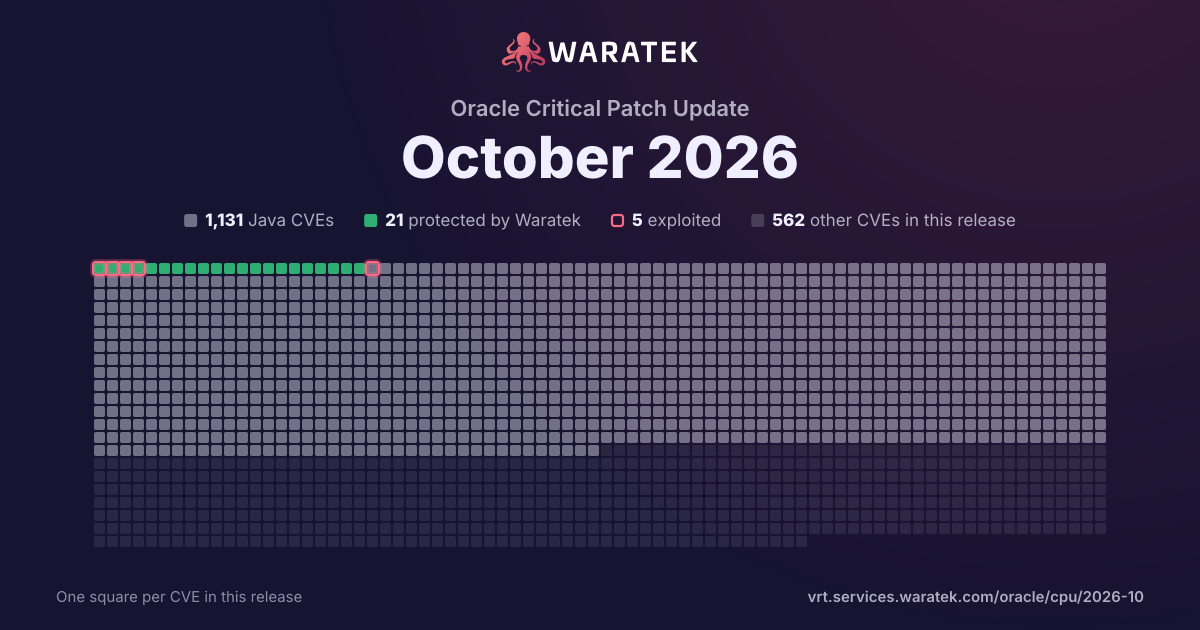
By status
20Protected by Waratek3Mitigation candidate1,109No exploit published12Outside Waratek scope549Not applicable
7Exploited, marked by the ring
No exploit published. For 855 of them, Oracle's security advisory is the source of public detail.
Protected by Waratek. Waratek RASP can block exploitation of these on systems that have not applied the patch yet.
Overview 25 matches · 0 protected · 0 exploited · 0 CISA KEV · 0 public PoC · 0 EPSS ≥ 0.5
25matches
0protected0.0%
0exploited0.0%
0CISA KEV0.0%
0public PoC0.0%
0EPSS ≥ 0.50.0%
Protected by Waratek
0
0.0%
Rule in development
0
0.0%
Mitigation candidate
0
0.0%
No exploit published
25
100.0%
blocked by ARMR today
0
0.0%
partly blocked
0
0.0%
not blocked
25
100.0%
not established
0
0.0%
unrecorded
0
0.0%
Exploited
0
0.0%
Working exploit published
0
0.0%
Proof of concept only
0
0.0%
Forecast only
0
0.0%
No public exploit
25
100.0%
split by
peak 25 / month
Sep 26
| CVE | Severity | Published▾ | Status | Exploitation | Description |
|---|---|---|---|---|---|
| CVE-2026-77421 | Medium | 2026-09-23 | No exploit published | No public exploit | JLine is a Java library for handling console input. From 3.0.0 until 3.30.15 and 4.3.1, the JLine built-in nano editor's regex search mode passes a user-controlled search term from doSearch(String text) in builtins/src/main/java/org/jline/builtins/Nano.java to Java's backtracking regular expression engine without a timeout or backtracking bound. A nested-quantifier expression evaluated against non-matching buffer content can consume excessive CPU and indefinitely block the editor session thread, and remote multi-user deployments can lose a worker thread for each affected session. This issue is fixed in versions 3.30.15 and 4.3.1. |
| CVE-2026-91863 | High | 2026-09-21 | No exploit published | No public exploit | A specially crafted WS-Policy document with deeply nested policy elements can bypass Neethi's nesting-depth limit and exhaust the thread stack, crashing the parser (denial of service). Users are recommended to upgrade to version 3.2.4, which fixes this issue. |
| CVE-2026-93579 | Medium | 2026-09-18 | No exploit published | No public exploit | A flaw was found in Netty's HTTP/2 stack. This vulnerability allows a remote attacker to inject prohibited characters, such as NUL, Line Feed, and Carriage Return, into HTTP/2 header field values due to insufficient validation. When these values cross an HTTP/2 to HTTP/1.1 translation boundary, they can be exploited for request smuggling, header injection, or response splitting. This could lead to unauthorized access, data manipulation, or other security bypasses. |
| CVE-2026-93576 | High | 2026-09-18 | No exploit published | No public exploit | A flaw was found in Netty netty-codec-smtp. The component does not properly validate Carriage Return (CR) and Line Feed (LF) characters in the SMTP command-name field. A remote attacker, if an application routes untrusted input into this field, can embed CR/LF characters to inject arbitrary SMTP commands. This can lead to SMTP command smuggling, allowing for unauthorized email relay or spoofing of sender/recipient addresses. While the impact is significant, the real-world exploitability is considered lower as applications typically do not place user-controlled data in the command-name field. |
| CVE-2026-93575 | High | 2026-09-18 | No exploit published | No public exploit | A flaw was found in Netty's MqttDecoder. An unauthenticated remote attacker can exploit this vulnerability by sending a specially crafted MQTT CONNECT packet. The decoder fails to properly validate the 'Properties Length' against the 'Remaining Length', allowing an attacker to bypass size limits. This leads to excessive memory and CPU consumption, resulting in a denial of service (DoS) due to an OutOfMemoryError. |
| CVE-2026-93574 | Medium | 2026-09-18 | No exploit published | No public exploit | A flaw was found in Netty's `netty-codec-http` component. A remote attacker could exploit this vulnerability by sending a specially crafted HTTP/1.1 chunk-size token that includes post-digit whitespace. This incorrect parsing of the chunk size can lead to HTTP request smuggling. This allows an attacker to bypass security controls or access unauthorized resources in proxy/backend deployments. |
| CVE-2026-93573 | Medium | 2026-09-18 | No exploit published | No public exploit | A flaw was found in Netty's HTTP/1.1 decoder. This vulnerability allows a remote attacker to bypass `Transfer-Encoding` header validation by splitting the `Transfer-Encoding` field across multiple headers, with the last field containing a non-final transfer coding like `gzip` or `deflate`. This bypass can lead to HTTP request smuggling, enabling attackers to bypass security controls, desynchronize request processing, or cause requests to be processed in an unintended context. |
| CVE-2026-93572 | High | 2026-09-18 | No exploit published | No public exploit | A flaw was found in Netty's `RedisArrayAggregator` component. A remote attacker can exploit this vulnerability by sending specially crafted nested Redis (RESP) array headers. This can cause the `RedisArrayAggregator` to eagerly preallocate a large amount of heap memory, leading to heap memory exhaustion and a Denial of Service (DoS) for applications using `RedisDecoder` with `RedisArrayAggregator` on untrusted traffic. |
| CVE-2026-93569 | High | 2026-09-18 | No exploit published | No public exploit | A flaw was found in Netty. A remote unauthenticated attacker can exploit a vulnerability in Netty's HTTP/1 to HTTP/2 conversion process. When an HTTP/1 request includes both an absolute-form request-target and a conflicting Host header, Netty incorrectly prioritizes the Host header for the HTTP/2 :authority field, discarding the original request-target authority. This inconsistency can allow an attacker to bypass security controls in Netty-based proxies or gateways, potentially leading to unauthorized access, cache poisoning, or misrouting of requests. |
| CVE-2026-93568 | High | 2026-09-18 | No exploit published | No public exploit | A flaw was found in Netty. A remote attacker could exploit this vulnerability by sending specially crafted HTTP/2 or HTTP/3 Extended CONNECT requests. Netty's HTTP-object conversion path incorrectly processes these requests as regular HTTP/1.1 CONNECT requests, leading to a loss of critical protocol and path information. This misinterpretation can allow attackers to bypass security policies, such as routing or authorization logic, in applications that rely on Netty for HTTP/2 or HTTP/3 communication, resulting in integrity loss. |
| CVE-2026-93567 | High | 2026-09-18 | No exploit published | No public exploit | A flaw was found in Netty's HTTP/2 codec. When converting HTTP/1 CONNECT requests to HTTP/2, the component incorrectly uses the Host header instead of the CONNECT authority-form request-target for the tunnel authority. A remote attacker can exploit this by supplying a different Host header, leading to a malformed HTTP/2 CONNECT request. This can bypass security controls such as tunnel allow-lists or egress policies, resulting in integrity loss. |
| CVE-2026-93566 | Medium | 2026-09-18 | No exploit published | No public exploit | A flaw was found in Netty. A remote attacker could exploit this by sending a specially crafted HTTP request that includes control characters within the chunk-size line. This bypasses the intended strict validation, allowing the attacker to inject arbitrary HTTP requests. This vulnerability can lead to HTTP request smuggling, potentially resulting in information disclosure or other unauthorized actions. |
| CVE-2026-93565 | High | 2026-09-18 | No exploit published | No public exploit | A flaw was found in Netty RtspDecoder. The `RtspMethods.valueOf()` function incorrectly strips trailing control bytes from method tokens in Real-Time Streaming Protocol (RTSP) requests. A remote attacker can exploit this by sending a specially crafted RTSP request, leading to method-token smuggling. This vulnerability allows an attacker to bypass method-based access controls and can also be used to launder malicious requests through Netty-based RTSP proxies, making them appear legitimate to backend systems. |
| CVE-2026-93564 | High | 2026-09-18 | No exploit published | No public exploit | A flaw was found in Netty. A reference-count leak in the HAProxy PROXY-v2 message decoder allows a remote, unauthenticated attacker to send specially crafted PROXY-protocol v2 headers. This can lead to memory exhaustion, resulting in a Denial of Service (DoS) for the affected system. |
| CVE-2026-93563 | High | 2026-09-18 | No exploit published | No public exploit | A flaw was found in Netty's `SmtpResponseDecoder` component. A remote attacker, acting as a malicious or man-in-the-middle (MITM) SMTP server, could exploit this by sending a specially crafted, unbounded multi-line SMTP response without a terminator. This vulnerability leads to unbounded memory accumulation within the client's Java Virtual Machine (JVM) heap, causing an `OutOfMemoryError` and a denial of service (DoS) due to a process crash. |
| CVE-2026-93561 | Medium | 2026-09-18 | No exploit published | No public exploit | A flaw was found in io.netty/netty-codec-memcache. The Memcache binary protocol codec incorrectly reads `keyLength` and `extrasLength` as signed Java types instead of unsigned, as specified by the protocol. A malicious Memcache server can exploit this type mismatch by sending a specially crafted response. This can lead to frame desynchronization and response smuggling, where one client's data may be inadvertently exposed to another client's response stream in proxy or cache environments. |
| CVE-2026-93494 | High | 2026-09-18 | No exploit published | No public exploit | A flaw was found in Netty's StompSubframeDecoder component. A remote attacker can exploit this vulnerability by sending a specially crafted STOMP frame body without its terminating null byte. This causes the decoder to allocate a ByteBuf (a buffer for bytes) that is never released, leading to a permanent memory leak. Over time, this uncontrolled memory consumption can result in a Denial of Service (DoS) for the application using the affected STOMP codec. |
| CVE-2026-93492 | Medium | 2026-09-18 | No exploit published | No public exploit | A flaw was found in Netty's HTTP/2 HpackEncoder. A remote attacker can exploit this by sending HTTP/2 SETTINGS frames with a very large MAX_HEADER_TABLE_SIZE. This causes the HpackEncoder to store an excessive number of unique headers, leading to increased CPU usage and memory consumption, ultimately resulting in a Denial of Service (DoS). |
| CVE-2026-84501 | Medium | 2026-09-16 | No exploit published | No public exploit | An unauthenticated attacker can inject arbitrary fake log lines into Apache ZooKeeper's operational log by sending a crafted add_auth("ensemble", ...) request containing newline characters (\n). When the ensemble name doesn't match, EnsembleAuthenticationProvider.handleAuthentication() logs the raw, unsanitized name via LOG.warn(). Because SLF4J's {} placeholder preserves embedded newlines, the attacker can forge complete log entries — with arbitrary timestamps, log levels, class names, and messages — that are visually indistinguishable from genuine ZooKeeper log output. This issue affects Apache ZooKeeper: from 3.9.0 through 3.9.5, from 3.8.0 through 3.8.6. Users are recommended to upgrade to version 3.8.7 or 3.9.6, which fixes the issue. |
| CVE-2026-84439 | Medium | 2026-09-16 | No exploit published | No public exploit | When audit logging is enabled (zookeeper.audit.enable=true), an unauthenticated attacker can inject arbitrary fields into Apache ZooKeeper's audit log by sending a digest authentication request with tab characters (\t) embedded in the username. Because the audit log uses tab-separated key=value format, the injected tabs are parsed as legitimate field separators, allowing the attacker to spoof audit results (e.g., injecting result=success), forge operation types, and corrupt forensic evidence. A log injection vulnerability in Apache ZooKeeper allows a client that can call setACL to inject forged key-value fields into zookeeper_audit.log. When audit logging is enabled, the server serializes attacker-controlled digest ACL ids into the acl= audit field without escaping tab characters. Because audit events are emitted as tab-separated key=value records, a crafted ACL id can make one successful setAcl event appear to contain forged fields such as operation=delete and znode=/forged. This undermines the integrity of downstream audit parsing, alerting, and incident response. This issue affects Apache ZooKeeper: from 3.9.0 through 3.9.5, from 3.8.0 through 3.8.6. Users are recommended to upgrade to version 3.9.6 or 3.8.7, which fixes the issue. |
| CVE-2026-79993 | High | 2026-09-16 | No exploit published | No public exploit | The `deleteContainer` opcode (0x14/20) is processed without verifying the caller's ACL permissions, allowing any authenticated client to delete specific znodes in the data tree regardless of the ACL restrictions on the znode or its parent. This opcode is considered internal-only and the official client doesn't have API for it, but a client that can open a plain TCP session on the ZooKeeper client port (2181 by default) - with NO authentication and NO ACL permissions - can delete any empty persistent znode (including regular persistent nodes, container nodes, and TTL nodes) by issuing the raw protocol OpCode deleteContainer (20). The deleteContainer request path completely skips both the session check and the DELETE ACL check that are enforced by the regular delete (OpCode 2) path. This is an authorization bypass / ACL enforcement bug. This issue affects Apache ZooKeeper: from 3.9.0 through 3.9.5, from 3.8.0 through 3.8.6. Users are recommended to upgrade to version 3.9.6 or 3.8.7, which fixes the issue. |
| CVE-2026-59969 | High | 2026-09-16 | No exploit published | No public exploit | Apache ZooKeeper quorum TLS fails to enforce peer hostname verification in FIPS-mode deployments. When sslQuorum=true, zookeeper.fips-mode=true, ssl.quorum.hostnameVerification=true, and ssl.quorum.clientHostnameVerification=true are enabled, the Java SSLSocket quorum path accepts a CA-trusted peer certificate whose SAN does not match the connected host. A malicious or misissued peer certificate can therefore join quorum traffic, participate in leader election, and enter replication flows. Users are recommended to upgrade to version 3.8.7 or 3.9.6, which fixes the issue. |
| CVE-2026-59739 | High | 2026-09-16 | No exploit published | No public exploit | Information disclosure via SetWatches reconnect replay in Apache ZooKeeper due to missing ACL check. An attacker can discover ACL-restricted paths by registering exists-watches on non-existent paths, then reconnecting after the paths are created with restricted ACLs. Issue is caused by incomplete fix for CVE-2024-23944 (ZOOKEEPER-4799). The fix added ACL checking to WatchManager.triggerWatch(). However, DataTree.setWatches() — the SetWatches/SetWatches2 reconnect replay handler — still calls watcher.process(event) with null ACL, bypassing the check entirely. It's important to note that only the path is exposed by this vulnerability, not the data of znode, but since znode path can contain sensitive information like user name or login ID, this issue is potentially critical. Users are recommended to upgrade to version 3.9.6, 3.8.7 which fixes the issue. |
| CVE-2026-89044 | Medium | 2026-09-10 | No exploit published | No public exploit | Netty versions 4.1.133.Final through 4.1.137.Final and 4.2.13.Final through 4.2.17.Final fail to properly validate the final transfer coding in the Transfer-Encoding header, allowing attackers to smuggle requests by using malformed encoding declarations. Attackers can split Transfer-Encoding headers across multiple lines or use values like 'chunked, xchunked' to bypass validation and decode messages as chunked when the final coding is not chunked, enabling request smuggling attacks. |
| CVE-2026-78254 | High | 2026-09-07 | No exploit published | No public exploit | The ftp and scp tasks of Apache Ant can download files from a remote server. A malicious server can provide relative paths that allow it to write outside of the dedicated target directory for the download, making it possible to overwrite files of the attacker's choice using the permissions of the user running Ant in versions prior to Ant 1.10.18. In order to exploit this vulnerability, the server would either have to be malicious or be subject to a machine-in-the-middle attack. Additionally in the case of scp or the ftp task using ftps the server must pass the server identity checks performed by the tasks. For ftp tasks not using ftps a malicious server could act as a machine-in-the-middle to provide malicious files. Starting with Ant 1.10.18 both tasks will prevent writing outside of the destination directory by default. An option is available to disable this behavior in the unlikely case that the old behavior is required by existing build files. Mitigations: Users of scp and ftp (when using ftps) in any version of Ant should not bypass server identity checks. Users of ftp not using ftps should switch to ftps where possible. All users are recommended to upgrade to Apache Ant 1.10.18, which fixes this issue. |