
Oracle Critical Patch Update October 2026
Released October 2026 · Oracle's advisory ↗ · ← Security Patch Update, September 2026 · Security Patch Update, November 2026 →
1,693 CVEs in this release, one square each
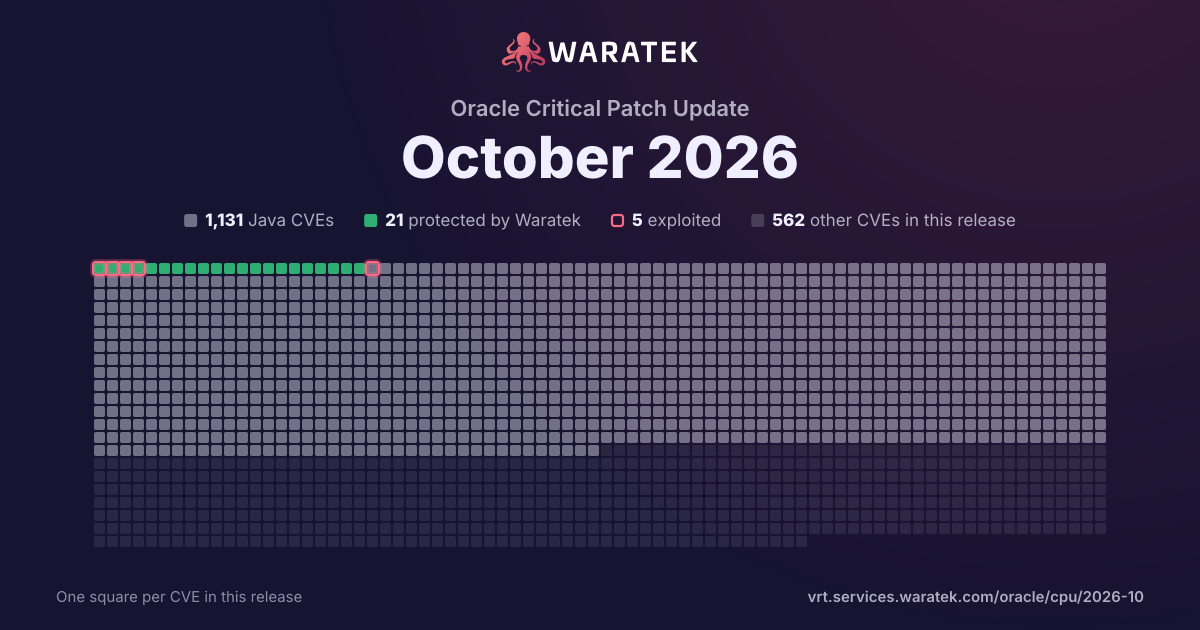
By status
20Protected by Waratek3Mitigation candidate1,109No exploit published12Outside Waratek scope549Not applicable
7Exploited, marked by the ring
No exploit published. For 855 of them, Oracle's security advisory is the source of public detail.
Protected by Waratek. Waratek RASP can block exploitation of these on systems that have not applied the patch yet.
Overview 18 matches · 1 protected · 0 exploited · 0 CISA KEV · 0 public PoC · 0 EPSS ≥ 0.5
Protected by Waratek
1
5.6%
Rule in development
0
0.0%
Mitigation candidate
0
0.0%
No exploit published
17
94.4%
blocked by ARMR today
1
5.6%
partly blocked
0
0.0%
not blocked
17
94.4%
not established
0
0.0%
unrecorded
0
0.0%
Exploited
0
0.0%
Working exploit published
0
0.0%
Proof of concept only
0
0.0%
Forecast only
0
0.0%
No public exploit
18
100.0%
| CVE | Severity | Published▾ | Status | Exploitation | Description |
|---|---|---|---|---|---|
| CVE-2026-45292 | High | 2026-05-28 | No exploit published | No public exploit | opentelemetry-java is the Java implementation of the OpenTelemetry API for recording telemetry, and SDK for managing telemetry recorded by the API. Prior to 1.62.0, a vulnerability affects the baggage propagation implementation in opentelemetry-api and opentelemetry-extension-trace-propagators. Parsing oversized baggage causes unbounded memory allocation and CPU consumption. Because baggage is automatically re-injected into every outgoing request, the effect can fan out to downstream services that never received the original malicious request. This vulnerability is fixed in 1.62.0. |
| CVE-2026-48589 | None | 2026-05-25 | No exploit published | No public exploit | Apache Shiro’s Jakarta EE module used the HTTP Referer header in certain cases to issue redirect after a user login. In affected versions, insufficient validation of this client-controlled value could allow an attacker to influence the redirect target in applications using the Jakarta EE module. This issue affects Apache Shiro from 2.0-alpha to 2.2.0, and 3.0.0-alpha-1, only when using shiro-jakarta-ee integration module. |
| CVE-2026-44598 | Medium | 2026-05-25 | No exploit published | No public exploit | With valid login credentials, URL Redirection to Untrusted Site ('Open Redirect'), Server-Side Request Forgery (SSRF) vulnerability in Apache Shiro. This issue affects Apache Shiro from 2.0-alpha to 2.1.0, and 3.0.0-alpha-1, only when using shiro-jakarta-ee integration module. Users are recommended to upgrade to version 2.1.1, or 3.0.0-alpha-2 or later, which fixes the issue by encrypting the cookie. After successful login, Jakarta EE integration module uses shiroSavedRequest cookie to redirect to a particular web page after login. This cookie was not validated, and can be forged to send a HTTP GET request from the server itself to an arbitrary URL from the cookie. |
| CVE-2026-43828 | Medium | 2026-05-25 | No exploit published | No public exploit | Default configurations of Apache Shiro send sensitive cookies in HTTPS session without 'Secure' attribute. This issue affects Apache Shiro from 1.0 to 2.1.0, and 3.0.0-alpha-1. Users are recommended to upgrade to version 2.1.1, or 3.0.0-alpha-2 or later, which fixes the issue. In the affected versions, Shiro-native session manager, as well as Remember-Me manager sends JSESSIONID and rememberMe cookies without 'secure' attribute by default. |
| CVE-2026-43827 | Medium | 2026-05-25 | No exploit published | No public exploit | Default configurations of Apache Shiro have a session fixation vulnerability. This issue affects Apache Shiro from 1.0 to 2.1.0, and 3.0.0-alpha-1. Users are recommended to upgrade to version 2.1.1, or 3.0.0-alpha-2 or later, which fixes the issue. In the affected versions, when a session already exists, it is not invalidated upon successful login, nor is a new session being generated with a new ID. |
| CVE-2026-44248 | High | 2026-05-13 | No exploit published | No public exploit | Netty is an asynchronous, event-driven network application framework. Prior to 4.2.13.Final and 4.1.133.Final, the MQTT 5 header Properties section is parsed and buffered before any message size limit is applied. Specifically, in MqttDecoder, the decodeVariableHeader() method is called before the bytesRemainingBeforeVariableHeader > maxBytesInMessage check. The decodeVariableHeader() can call other methods which will call decodeProperties(). Effectively, Netty does not apply any limits to the size of the properties being decoded. Additionally, because MqttDecoder extends ReplayingDecoder, Netty will repeatedly re-parse the enormous Properties sections and buffer the bytes in memory, until the entire thing parses to completion. This can cause high resource usage in both CPU and memory. This vulnerability is fixed in 4.2.13.Final and 4.1.133.Final. |
| CVE-2026-42586 | High | 2026-05-13 | No exploit published | No public exploit | Netty is an asynchronous, event-driven network application framework. Prior to 4.2.13.Final and 4.1.133.Final, the Netty Redis codec encoder (RedisEncoder) writes user-controlled string content directly to the network output buffer without validating or sanitizing CRLF (\r\n) characters. Since the Redis Serialization Protocol (RESP) uses CRLF as the command/response delimiter, an attacker who can control the content of a Redis message can inject arbitrary Redis commands or forge fake responses. This vulnerability is fixed in 4.2.13.Final and 4.1.133.Final. |
| CVE-2026-43515 | Critical | 2026-05-12 | No exploit published | No public exploit | Improper Authorization vulnerability when multiple method constraints define an HTTP method for the same extension in Apache Tomcat. This issue affects Apache Tomcat: from 11.0.0-M1 through 11.0.21, from 10.1.0-M1 through 10.1.54, from 9.0.0.M1 through 9.0.117, from 8.5.0 through 8.5.100, from 7.0.0 through 7.0.109. Users are recommended to upgrade to version 11.0.22, 10.1.55 or 9.0.118 which fix the issue. |
| CVE-2026-43514 | Low | 2026-05-12 | No exploit published | No public exploit | Observable Timing Discrepancy vulnerability when comparing AJP secret in Apache Tomcat. This issue affects Apache Tomcat: from 11.0.0-M1 through 11.0.21, from 10.1.0-M1 through 10.1.54, from 9.0.0.M1 through 9.0.117, from 8.5.0 through 8.5.100, from 7.0.0 through 7.0.109. Older unsupported versions may also be affected. Users are recommended to upgrade to version 11.0.22, 10.1.55 or 9.0.118 which fix the issue. |
| CVE-2026-43513 | High | 2026-05-12 | No exploit published | No public exploit | Improper Handling of Case Sensitivity vulnerability in LockOutRealm in Apache Tomcat. This issue affects Apache Tomcat: from 11.0.0-M1 through 11.0.21, from 10.1.0-M1 through 10.1.54, from 9.0.0.M1 through 9.0.117, from 8.5.0 through 8.5.100, from 7.0.0 through 7.0.109. Older unsupported versions may also be affected. Users are recommended to upgrade to version 11.0.22, 10.1.55 or 9.0.118 which fix the issue. |
| CVE-2026-43512 | Critical | 2026-05-12 | No exploit published | No public exploit | DEPRECATED: Authentication Bypass Issues vulnerability in digest authentication in Apache Tomcat. This issue affects Apache Tomcat: from 11.0.0-M1 through 11.0.21, from 10.1.0-M1 through 10.1.54, from 9.0.0.M1 through 9.0.117, from 8.5.0 through 8.5.100, from before 7.0.0. Older unsupported versions any also be affect Users are recommended to upgrade to version 11.0.22, 10.1.55 or 9.0.118 which fix the issue. |
| CVE-2026-42498 | High | 2026-05-12 | No exploit published | No public exploit | Exposure of HTTP Authentication Header to unexpected hosts during WebSocket authentication vulnerability in Apache Tomcat. This issue affects Apache Tomcat: from 11.0.0-M1 through 11.0.21, from 10.1.0-M1 through 10.1.54, from 9.0.2 through 9.0.117, from 8.5.24 through 8.5.100, from 7.0.83 through 7.0.109. Users are recommended to upgrade to version 11.0.22, 10.1.55 or 9.0.118, which fix the issue. |
| CVE-2026-41284 | High | 2026-05-12 | No exploit published | No public exploit | Allocation of Resources Without Limits or Throttling vulnerability in Apache Tomcat. This issue affects Apache Tomcat: from 11.0.0-M1 through 11.0.21, from 10.1.0-M1 through 10.1.54, from 9.0.0.M1 through 9.0.117. Older, unsupported versions may also be affected. Users are recommended to upgrade to version [FIXED_VERSION], which fixes the issue. |
| CVE-2026-43869 | High | 2026-05-05 | No exploit published | No public exploit | Improper Validation of Certificate with Host Mismatch vulnerability in Apache Thrift. This issue affects Apache Thrift: before 0.23.0. Users are recommended to upgrade to version 0.23.0, which fixes the issue. |
| CVE-2026-42778 | Critical | 2026-05-01 | Protected by Waratek | No public exploit | The fix for CVE-2026-41409 was not applied to the 2.1.X and 2.2.X branches. Here was the original issue description: The fix for CVE-2024-52046 in Apache MINA AbstractIoBuffer.getObject() was incomplete. The classname allowlist of classes allowed to be deserialized was applied too late after a static initializer in a class to be read might already have been executed. Affected versions are Apache MINA 2.1.0 <= 2.1.11, and 2.2.0 <= 2.2.6. The problem is resolved in Apache MINA 2.1.12, and 2.2.7 by applying the classname allowlist earlier. Affected are applications using Apache MINA that call IoBuffer.getObject(). Applications using Apache MINA are advised to upgrade The fix for CVE-2024-52046 in Apache MINA AbstractIoBuffer.getObject() was incomplete. The classname allowlist of classes allowed to be deserialized was applied too late after a static initializer in a class to be read might already have been executed. Affected versions are Apache MINA 2.1.0 <= 2.1.110, and 2.2.0 <= 2.2.6. The problem is resolved in Apache MINA 2.1.12, and 2.2.7 by applying the classname allowlist earlier. Affected are applications using Apache MINA that call IoBuffer.getObject(). Applications using Apache MINA are advised to upgrade |
| CVE-2026-42404 | High | 2026-05-01 | No exploit published | No public exploit | Apache Neethi does not impose any restrictions on URIs when manually fetching remote policy references through the PolicyReference API. When an application explicitly calls the API to retrieve a policy from a remote URI, an outbound request is made for arbitrary protocols and internal IP adddresses. From 3.2.2, only http or https URIs are allowed, and link-local/multicast/any-local addresses are forbidden. Users are recommended to upgrade to version 3.2.2, which fixes this issue. |
| CVE-2026-42403 | High | 2026-05-01 | No exploit published | No public exploit | Apache Neethi does not properly detect circular references in policy definitions. When a WS-Policy document contains circular policy references (where Policy A references Policy B which references Policy A), the policy normalization process can enter an infinite loop or cause excessive recursion, leading to a stack overflow or application hang. An attacker can craft malicious policy documents with circular references to cause a Denial of Service condition Users are recommended to upgrade to version 3.2.2, which fixes this issue. |
| CVE-2026-42402 | High | 2026-05-01 | No exploit published | No public exploit | Apache Neethi is vulnerable to a Denial of Service attack through algorithmic complexity in policy normalization. Specially crafted WS-Policy documents can trigger an exponential Cartesian cross-product expansion during the normalization process, causing unbounded memory allocation that exhausts the JVM heap. This occurs when the normalization process generates an excessive number of policy alternatives without bounds, leading to runtime memory exhaustion. Users should upgrade to 3.2.2 which limits the maximum number of normalized policy alternatives. |