
Oracle Critical Patch Update October 2026
Released October 2026 · Oracle's advisory ↗ · ← Security Patch Update, September 2026 · Security Patch Update, November 2026 →
1,693 CVEs in this release, one square each
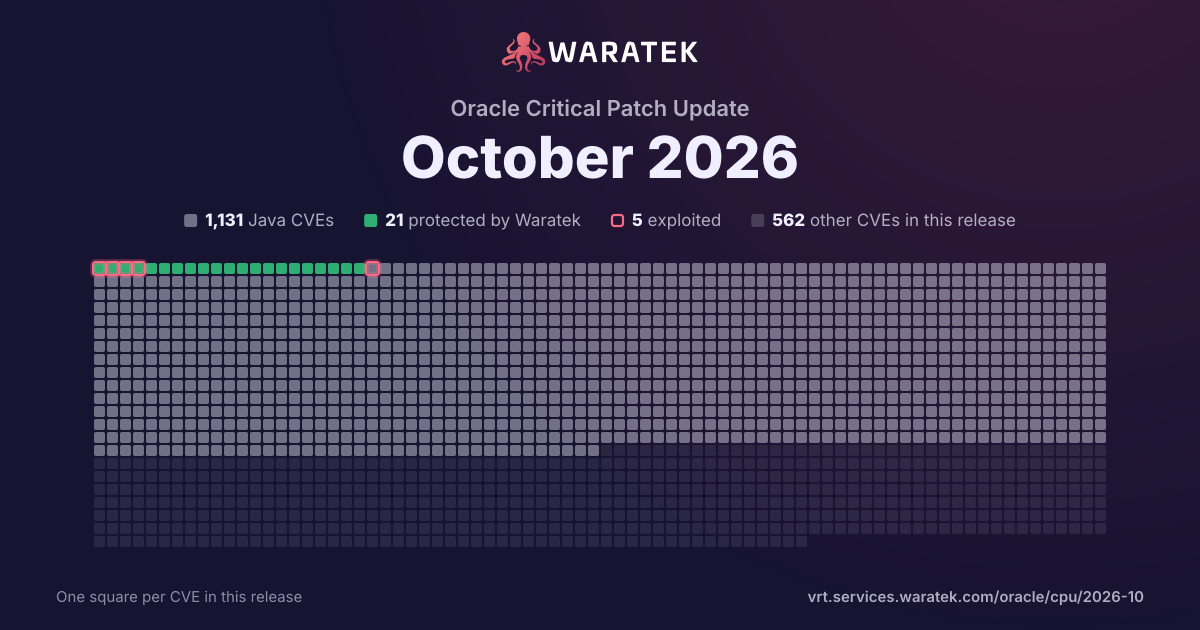
By status
20Protected by Waratek3Mitigation candidate1,109No exploit published12Outside Waratek scope549Not applicable
7Exploited, marked by the ring
No exploit published. For 855 of them, Oracle's security advisory is the source of public detail.
Protected by Waratek. Waratek RASP can block exploitation of these on systems that have not applied the patch yet.
Overview 60 matches · 19 in Waratek scope · 3 protected · 0 exploited · 0 CISA KEV · 8 public PoC · 0 EPSS ≥ 0.5
60matches
19in Waratek scope31.7%
3protected5.0%
0exploited0.0%
0CISA KEV0.0%
8public PoC13.3%
0EPSS ≥ 0.50.0%
Protected by Waratek
3
5.0%
Rule in development
0
0.0%
Mitigation candidate
0
0.0%
No exploit published
16
26.7%
Outside Waratek scope
0
0.0%
Not applicable
41
68.3%
Withdrawn CVE
0
0.0%
blocked by ARMR today
3
5.0%
partly blocked
0
0.0%
not blocked
57
95.0%
not established
0
0.0%
unrecorded
0
0.0%
Exploited
0
0.0%
Working exploit published
0
0.0%
Proof of concept only
60
100.0%
Forecast only
0
0.0%
No public exploit
0
0.0%
split by
peak 29 / quarter
Q3 221
Protected by Waratek1
High1
blocked by ARMR today1
Proof of concept only1
Q4 220
Q1 233
Not applicable3
Medium3
not blocked3
Proof of concept only3
Q2 232
Not applicable2
Medium2
not blocked2
Proof of concept only2
Q3 230
Q4 232
Not applicable2
High1
Medium1
not blocked2
Proof of concept only2
Q1 240
Q2 242
Not applicable2
Medium2
not blocked2
Proof of concept only2
Q3 240
Q4 244
No exploit published1
Not applicable3
High2
Medium2
not blocked4
Proof of concept only4
Q1 251
No exploit published1
Medium1
not blocked1
Proof of concept only1
Q2 252
Protected by Waratek1
No exploit published1
High1
Medium1
blocked by ARMR today1
not blocked1
Proof of concept only2
Q3 251
No exploit published1
Medium1
not blocked1
Proof of concept only1
Q4 250
Q1 2613
No exploit published1
Not applicable12
Critical2
High6
Medium4
Low1
not blocked13
Proof of concept only13
Q2 2629
Protected by Waratek1
No exploit published11
Not applicable17
Critical7
High12
Medium7
Low3
blocked by ARMR today1
not blocked28
Proof of concept only29
Q4 22Q2 23Q4 23Q2 24Q4 24Q2 25Q4 25Q2 26
| CVE | Severity | Published▾ | Status | Exploitation | Description |
|---|---|---|---|---|---|
| CVE-2026-58014 | High | 2026-06-30 | Not applicable | Proof of concept only | A flaw was found in GLib. An off-by-one error can occur in the g_key_file_get_locale_string_list function in the gkeyfile.c file when loading a key file with an empty value. This flaw can cause an out-of-bounds access of 1 byte or a denial of service when the out-of-bounds access crosses a page boundary. |
| CVE-2026-58051 | High | 2026-06-28 | Not applicable | Proof of concept only | libssh2 through 1.11.1 grows its publickey list with SSH2_REALLOC but does not zero-initialize new entries before parsing populates them, so a parse failure reaching the cleanup path leaves libssh2_publickey_list_free operating on an uninitialized entry. A malicious SSH server offering the publickey subsystem can use a malformed response to make cleanup free an uninitialized, attacker-influenceable attrs pointer in a connecting libssh2 client. |
| CVE-2026-54906 | Low | 2026-06-24 | Not applicable | Proof of concept only | concurrent-ruby is a modern concurrency tools for Ruby. Prior to 1.3.7, Concurrent::ReadWriteLock#release_write_lock does not verify that the calling thread acquired the write lock. Any thread with access to the lock object can release an active write lock held by another thread. A second writer can then enter its critical section while the first writer is still running. Concurrent::ReadWriteLock#release_read_lock also decrements the shared counter even when no read lock is held. Calling it on a fresh lock changes the counter from 0 to -1, after which normal read acquisition raises Concurrent::ResourceLimitError. This is a synchronization correctness issue in the public Concurrent::ReadWriteLock API. This vulnerability is fixed in 1.3.7. |
| CVE-2026-54905 | Low | 2026-06-24 | Not applicable | Proof of concept only | concurrent-ruby is a modern concurrency tools for Ruby. Prior to 1.3.7, Concurrent::ReentrantReadWriteLock can incorrectly grant a write lock after one thread acquires the read lock 32,768 times. The lock stores a thread's local read and write hold counts in one integer. The low 15 bits are used for the read hold count, and bit 15 is used as WRITE_LOCK_HELD. After 32,768 reentrant read acquisitions, the local read count crosses into the write-lock bit. try_write_lock then treats the thread as already holding a write lock and returns true without setting the global RUNNING_WRITER bit. This breaks the core mutual-exclusion guarantee: the caller is told it has a write lock, but other threads can still hold or acquire read locks at the same time. This vulnerability is fixed in 1.3.7. |
| CVE-2026-54904 | High | 2026-06-24 | Not applicable | Proof of concept only | concurrent-ruby is a modern concurrency tools for Ruby. Prior to 1.3.7, Concurrent::AtomicReference#update can enter a permanent busy retry loop when the current value is Float::NAN. The issue is caused by the interaction between AtomicReference#update, which retries until compare_and_set(old_value, new_value) succeeds; Numeric compare_and_set, which checks old == old_value before attempting the underlying atomic swap.; and Ruby NaN semantics, where Float::NAN == Float::NAN is always false. As a result, once an AtomicReference contains Float::NAN, calling #update repeatedly evaluates the caller's block and never returns. In services that store externally derived numeric values in an AtomicReference, this can cause CPU exhaustion or permanent request/job hangs. This vulnerability is fixed in 1.3.7. |
| CVE-2026-54512 | High | 2026-06-23 | No exploit published | Proof of concept only | jackson-databind contains the general-purpose data-binding functionality and tree-model for Jackson Data Processor. From 2.10.0 until 2.18.8, 2.21.4, and 3.1.4, jackson-databind's PolymorphicTypeValidator (PTV) is the primary safety mechanism guarding polymorphic deserialization. When polymorphic typing is enabled and a type identifier contains generic parameters (i.e. the type ID string contains <), DatabindContext._resolveAndValidateGeneric() validates only the raw container class name (the substring before <) against the configured PTV. If the container type is approved, the method parses the full canonical type string via TypeFactory.constructFromCanonical() and returns the fully parameterized type without ever validating the nested type arguments against the PTV. The nested type arguments are then resolved, instantiated, and populated as beans during deserialization. An attacker who controls the type ID can therefore place a denied class as a generic type parameter of an allowed container — for example java.util.ArrayList<com.evil.Gadget> when only java.util.ArrayList is allow-listed. The container passes the PTV check; com.evil.Gadget is loaded via Class.forName(name, true, loader), instantiated, and its properties are set from attacker-controlled JSON. This completely bypasses an explicitly configured PTV allow-list. This vulnerability is fixed in 2.18.8, 2.21.4, and 3.1.4. |
| CVE-2026-55200 | Critical | 2026-06-17 | Not applicable | Proof of concept only | libssh2 1.11.1, fixed in commit 97acf3d, contains an out-of-bounds write vulnerability in ssh2_transport_read() that fails to enforce upper bounds on packet_length field. Remote attackers can send crafted SSH packets with excessively large packet_length values to corrupt heap memory and achieve remote code execution. |
| CVE-2026-49975 | High | 2026-06-08 | Not applicable | Proof of concept only | Memory Allocation with Excessive Size Value vulnerability in Apache HTTP Server's mod_http leads to denial of service via malicious HTTP requests. This issue affects Apache HTTP Server: from 2.4.17 through 2.4.67. |
| CVE-2026-42536 | High | 2026-06-08 | Not applicable | Proof of concept only | Heap-based Buffer Overflow vulnerability in Apache HTTP Server with mod_xml2enc, xml2StartParse, and untrusted content This issue affects Apache HTTP Server: from 2.4.0 through 2.4.67. Users are recommended to upgrade to version 2.4.68, which fixes the issue. |
| CVE-2026-7168 | Medium | 2026-05-13 | Not applicable | Proof of concept only | Successfully using libcurl to do a transfer over a specific HTTP proxy (`proxyA`) with **Digest** authentication and then changing the proxy host to a second one (`proxyB`) for a second transfer, reusing the same handle, makes libcurl wrongly pass on the `Proxy-Authorization:` header field meant for `proxyA`, to `proxyB`. |
| CVE-2026-6276 | High | 2026-05-13 | Not applicable | Proof of concept only | Using libcurl, when a custom `Host:` header is first set for an HTTP request and a second request is subsequently done using the same *easy handle* but without the custom `Host:` header set, the second request would use stale information and pass on cookies meant for the first host in the second request. Leak them. |
| CVE-2026-6253 | Medium | 2026-05-13 | Not applicable | Proof of concept only | curl might erroneously pass on credentials for a first proxy to a second proxy. This can happen when the following conditions are true: 1. curl is setup to use specific different proxies for different URL schemes 2. the first proxy needs credentials 3. the second proxy uses no credentials 4. while using the first proxy (using say `http://`), curl is asked to follow a redirect to a URL using another scheme (say `https://`), accessed using a second, different, proxy |
| CVE-2026-5773 | High | 2026-05-13 | Not applicable | Proof of concept only | libcurl might in some circumstances reuse the wrong connection for SMB(S) transfers. libcurl features a pool of recent connections so that subsequent requests can reuse an existing connection to avoid overhead. When reusing a connection a range of criteria must be met. Due to a logical error in the code, a network transfer operation that was requested by an application could wrongfully reuse an existing SMB connection to the same server that was using a different "share" than the new subsequent transfer should. This could in unlucky situations lead to the download of the wrong file or the upload of a file to the wrong place. When this happens, the same credentials are used and the server name is the same. |
| CVE-2026-42587 | High | 2026-05-13 | No exploit published | Proof of concept only | Netty is an asynchronous, event-driven network application framework. Prior to 4.2.13.Final and 4.1.133.Final, HttpContentDecompressor accepts a maxAllocation parameter to limit decompression buffer size and prevent decompression bomb attacks. This limit is correctly enforced for gzip and deflate encodings via ZlibDecoder, but is silently ignored when the content encoding is br (Brotli), zstd, or snappy. An attacker can bypass the configured decompression limit by sending a compressed payload with Content-Encoding: br instead of Content-Encoding: gzip, causing unbounded memory allocation and out-of-memory denial of service. The same vulnerability exists in DelegatingDecompressorFrameListener for HTTP/2 connections. This vulnerability is fixed in 4.2.13.Final and 4.1.133.Final. |
| CVE-2026-42585 | High | 2026-05-13 | No exploit published | Proof of concept only | Netty is an asynchronous, event-driven network application framework. Prior to 4.2.13.Final and 4.1.133.Final, Netty incorrectly parses malformed Transfer-Encoding, enabling request smuggling attacks. This vulnerability is fixed in 4.2.13.Final and 4.1.133.Final. |
| CVE-2026-42584 | Critical | 2026-05-13 | No exploit published | Proof of concept only | Netty is an asynchronous, event-driven network application framework. Prior to 4.2.13.Final and 4.1.133.Final, HttpClientCodec pairs each inbound response with an outbound request by queue.poll() once per response, including for 1xx. If the client pipelines GET then HEAD and the server sends 103, then 200 with GET body, then 200 for HEAD, the queue pairs HEAD with the first 200. The HEAD rule then skips reading that message’s body, so the GET entity bytes stay on the stream and the following 200 is parsed from the wrong offset. This vulnerability is fixed in 4.2.13.Final and 4.1.133.Final. |
| CVE-2026-42583 | High | 2026-05-13 | No exploit published | Proof of concept only | Netty is an asynchronous, event-driven network application framework. Prior to 4.2.13.Final and 4.1.133.Final, Lz4FrameDecoder allocates a ByteBuf of size decompressedLength (up to 32 MB per block) before LZ4 runs. A peer only needs a 21-byte header plus compressedLength payload bytes - 22 bytes if compressedLength == 1 - to force that allocation. This vulnerability is fixed in 4.2.13.Final and 4.1.133.Final. |
| CVE-2026-42581 | Critical | 2026-05-13 | No exploit published | Proof of concept only | Netty is an asynchronous, event-driven network application framework. Prior to 4.2.13.Final and 4.1.133.Final, HttpObjectDecoder strips a conflicting Content-Length header when a request carries both Transfer-Encoding: chunked and Content-Length, but only for HTTP/1.1 messages. The guard is absent for HTTP/1.0. An attacker that sends an HTTP/1.0 request with both headers causes Netty to decode the body as chunked while leaving Content-Length intact in the forwarded HttpMessage. Any downstream proxy or handler that trusts Content-Length over Transfer-Encoding will disagree on message boundaries, enabling request smuggling. This vulnerability is fixed in 4.2.13.Final and 4.1.133.Final. |
| CVE-2026-42580 | Medium | 2026-05-13 | No exploit published | Proof of concept only | Netty is an asynchronous, event-driven network application framework. Prior to 4.2.13.Final and 4.1.133.Final, Netty's chunk size parser silently overflows int, enabling request smuggling attacks. This vulnerability is fixed in 4.2.13.Final and 4.1.133.Final. |
| CVE-2026-42579 | Critical | 2026-05-13 | No exploit published | Proof of concept only | Netty is an asynchronous, event-driven network application framework. Prior to 4.2.13.Final and 4.1.133.Final, Netty's DNS codec does not enforce RFC 1035 domain name constraints during either encoding or decoding. This creates a bidirectional attack surface: malicious DNS responses can exploit the decoder, and user-influenced hostnames can exploit the encoder. This vulnerability is fixed in 4.2.13.Final and 4.1.133.Final. |
| CVE-2026-42578 | Low | 2026-05-13 | No exploit published | Proof of concept only | Netty is an asynchronous, event-driven network application framework. Prior to 4.2.13.Final and 4.1.133.Final, Netty's HttpProxyHandler constructs HTTP CONNECT requests with header validation explicitly disabled. The newInitialMessage() method creates headers using DefaultHttpHeadersFactory.headersFactory().withValidation(false), then adds user-provided outboundHeaders without any CRLF validation. This allows an attacker who can influence the outbound headers to inject arbitrary HTTP headers into the CONNECT request sent to the proxy server. This vulnerability is fixed in 4.2.13.Final and 4.1.133.Final. |
| CVE-2026-41417 | Medium | 2026-05-06 | No exploit published | Proof of concept only | Netty allows request-line validation to be bypassed when a `DefaultHttpRequest` or `DefaultFullHttpRequest` is created first and its URI is later changed via `setUri()`. The constructors reject CRLF and whitespace characters that would break the start-line, but `setUri()` does not apply the same validation. `HttpRequestEncoder` and `RtspEncoder` then write the URI into the request line verbatim. If attacker-controlled input reaches `setUri()`, this enables CRLF injection and insertion of additional HTTP or RTSP requests, leading to HTTP request smuggling or desynchronization on the HTTP side and request injection on the RTSP side. This issue is fixed in versions 4.2.13.Final and 4.1.133.Final. |
| CVE-2026-7598 | Medium | 2026-05-01 | Not applicable | Proof of concept only | A security vulnerability has been detected in libssh2 up to 1.11.1. The impacted element is the function userauth_password of the file src/userauth.c. Such manipulation of the argument username_len/password_len leads to integer overflow. The attack may be launched remotely. The name of the patch is 256d04b60d80bf1190e96b0ad1e91b2174d744b1. A patch should be applied to remediate this issue. |
| CVE-2026-42779 | Critical | 2026-05-01 | Protected by Waratek | Proof of concept only | The fix for CVE-2026-41635 was not applied to the 2.1.X and 2.2.X branches. Here was the original issue description: Apache MINA's AbstractIoBuffer.resolveClass() contains two branches, one of them (for static classes or primitive types) does not check the class at all, bypassing the classname allowlist and allowing arbitrary code to be executed. The fix checks if the class is present in the accepted class filter before calling Class.forName(). Affected versions are Apache MINA 2.1.0 <= 2.1.11, and 2.2.0 <= 2.2.6. The problem is resolved in Apache MINA 2.1.12, and 2.2.7 by applying the classname allowlist earlier. Affected are applications using Apache MINA that call IoBuffer.getObject(). Applications using Apache MINA are advised to upgrade. |
| CVE-2026-41238 | Medium | 2026-04-23 | Not applicable | Proof of concept only | DOMPurify is a DOM-only cross-site scripting sanitizer for HTML, MathML, and SVG. Versions 3.0.1 through 3.3.3 are vulnerable to a prototype pollution-based XSS bypass. When an application uses `DOMPurify.sanitize()` with the default configuration (no `CUSTOM_ELEMENT_HANDLING` option), a prior prototype pollution gadget can inject permissive `tagNameCheck` and `attributeNameCheck` regex values into `Object.prototype`, causing DOMPurify to allow arbitrary custom elements with arbitrary attributes — including event handlers — through sanitization. Version 3.4.0 fixes the issue. |
| CVE-2026-5928 | High | 2026-04-20 | Not applicable | Proof of concept only | Calling the ungetwc function on a FILE stream with wide characters encoded in a character set that has overlaps between its single byte and multi-byte character encodings, in the GNU C Library version 2.43 or earlier, may result in an attempt to read bytes before an allocated buffer, potentially resulting in unintentional disclosure of neighboring data in the heap, or a program crash. A bug in the wide character pushback implementation (_IO_wdefault_pbackfail in libio/wgenops.c) causes ungetwc() to operate on the regular character buffer (fp->_IO_read_ptr) instead of the actual wide-stream read pointer (fp->_wide_data->_IO_read_ptr). The program crash may happen in cases where fp->_IO_read_ptr is not initialized and hence points to NULL. The buffer under-read requires a special situation where the input character encoding is such that there are overlaps between single byte representations and multibyte representations in that encoding, resulting in spurious matches. The spurious match case is not possible in the standard Unicode character sets. |
| CVE-2026-5450 | Critical | 2026-04-20 | Not applicable | Proof of concept only | Calling the scanf family of functions with a %mc (malloc'd character match) in the GNU C Library version 2.7 to version 2.43 with a format width specifier with an explicit width greater than 1024 could result in a one byte heap buffer overflow. |
| CVE-2026-2332 | Critical | 2026-04-14 | No exploit published | Proof of concept only | In Eclipse Jetty, the HTTP/1.1 parser is vulnerable to request smuggling when chunk extensions are used, similar to the "funky chunks" techniques outlined here: * https://w4ke.info/2025/06/18/funky-chunks.html * https://w4ke.info/2025/10/29/funky-chunks-2.html Jetty terminates chunk extension parsing at \r\n inside quoted strings instead of treating this as an error. POST / HTTP/1.1 Host: localhost Transfer-Encoding: chunked 1;ext="val X 0 GET /smuggled HTTP/1.1 ... Note how the chunk extension does not close the double quotes, and it is able to inject a smuggled request. |
| CVE-2026-34835 | Medium | 2026-04-02 | Not applicable | Proof of concept only | Rack is a modular Ruby web server interface. From versions 3.0.0.beta1 to before 3.1.21, and 3.2.0 to before 3.2.6, Rack::Request parses the Host header using an AUTHORITY regular expression that accepts characters not permitted in RFC-compliant hostnames, including /, ?, #, and @. Because req.host returns the full parsed value, applications that validate hosts using naive prefix or suffix checks can be bypassed. This can lead to host header poisoning in applications that use req.host, req.url, or req.base_url for link generation, redirects, or origin validation. This issue has been patched in versions 3.1.21 and 3.2.6. |
| CVE-2026-33941 | High | 2026-03-27 | Not applicable | Proof of concept only | Handlebars provides the power necessary to let users build semantic templates. In versions 4.0.0 through 4.7.8, the Handlebars CLI precompiler (`bin/handlebars` / `lib/precompiler.js`) concatenates user-controlled strings — template file names and several CLI options — directly into the JavaScript it emits, without any escaping or sanitization. An attacker who can influence template filenames or CLI arguments can inject arbitrary JavaScript that executes when the generated bundle is loaded in Node.js or a browser. Version 4.7.9 fixes the issue. Some workarounds are available. First, validate all CLI inputs before invoking the precompiler. Reject filenames and option values that contain characters with JavaScript string-escaping significance (`"`, `'`, `;`, etc.). Second, use a fixed, trusted namespace string passed via a configuration file rather than command-line arguments in automated pipelines. Third, run the precompiler in a sandboxed environment (container with no write access to sensitive paths) to limit the impact of successful exploitation. Fourth, audit template filenames in any repository or package that is consumed by an automated build pipeline. |
| CVE-2026-33940 | High | 2026-03-27 | Not applicable | Proof of concept only | Handlebars provides the power necessary to let users build semantic templates. In versions 4.0.0 through 4.7.8, a crafted object placed in the template context can bypass all conditional guards in `resolvePartial()` and cause `invokePartial()` to return `undefined`. The Handlebars runtime then treats the unresolved partial as a source that needs to be compiled, passing the crafted object to `env.compile()`. Because the object is a valid Handlebars AST containing injected code, the generated JavaScript executes arbitrary commands on the server. The attack requires the adversary to control a value that can be returned by a dynamic partial lookup. Version 4.7.9 fixes the issue. Some workarounds are available. First, use the runtime-only build (`require('handlebars/runtime')`). Without `compile()`, the fallback compilation path in `invokePartial` is unreachable. Second, sanitize context data before rendering: Ensure no value in the context is a non-primitive object that could be passed to a dynamic partial. Third, avoid dynamic partial lookups (`{{> (lookup ...)}}`) when context data is user-controlled. |
| CVE-2026-33939 | High | 2026-03-27 | Not applicable | Proof of concept only | Handlebars provides the power necessary to let users build semantic templates. In versions 4.0.0 through 4.7.8, when a Handlebars template contains decorator syntax referencing an unregistered decorator (e.g. `{{*n}}`), the compiled template calls `lookupProperty(decorators, "n")`, which returns `undefined`. The runtime then immediately invokes the result as a function, causing an unhandled `TypeError: ... is not a function` that crashes the Node.js process. Any application that compiles user-supplied templates without wrapping the call in a `try/catch` is vulnerable to a single-request Denial of Service. Version 4.7.9 fixes the issue. Some workarounds are available. Wrap compilation and rendering in `try/catch`. Validate template input before passing it to `compile()`; reject templates containing decorator syntax (`{{*...}}`) if decorators are not used in your application. Use the pre-compilation workflow; compile templates at build time and serve only pre-compiled templates; do not call `compile()` at request time. |
| CVE-2026-33938 | High | 2026-03-27 | Not applicable | Proof of concept only | Handlebars provides the power necessary to let users build semantic templates. In versions 4.0.0 through 4.7.8, the `@partial-block` special variable is stored in the template data context and is reachable and mutable from within a template via helpers that accept arbitrary objects. When a helper overwrites `@partial-block` with a crafted Handlebars AST, a subsequent invocation of `{{> @partial-block}}` compiles and executes that AST, enabling arbitrary JavaScript execution on the server. Version 4.7.9 fixes the issue. Some workarounds are available. First, use the runtime-only build (`require('handlebars/runtime')`). The `compile()` method is absent, eliminating the vulnerable fallback path. Second, audit registered helpers for any that write arbitrary values to context objects. Helpers should treat context data as read-only. Third, avoid registering helpers from third-party packages (such as `handlebars-helpers`) in contexts where templates or context data can be influenced by untrusted input. |
| CVE-2026-33937 | Critical | 2026-03-27 | Not applicable | Proof of concept only | Handlebars provides the power necessary to let users build semantic templates. In versions 4.0.0 through 4.7.8, `Handlebars.compile()` accepts a pre-parsed AST object in addition to a template string. The `value` field of a `NumberLiteral` AST node is emitted directly into the generated JavaScript without quoting or sanitization. An attacker who can supply a crafted AST to `compile()` can therefore inject and execute arbitrary JavaScript, leading to Remote Code Execution on the server. Version 4.7.9 fixes the issue. Some workarounds are available. Validate input type before calling `Handlebars.compile()`; ensure the argument is always a `string`, never a plain object or JSON-deserialized value. Use the Handlebars runtime-only build (`handlebars/runtime`) on the server if templates are pre-compiled at build time; `compile()` will be unavailable. |
| CVE-2026-33870 | High | 2026-03-27 | No exploit published | Proof of concept only | Netty is an asynchronous, event-driven network application framework. In versions prior to 4.1.132.Final and 4.2.10.Final, Netty incorrectly parses quoted strings in HTTP/1.1 chunked transfer encoding extension values, enabling request smuggling attacks. Versions 4.1.132.Final and 4.2.10.Final fix the issue. |
| CVE-2026-20643 | Medium | 2026-03-17 | Not applicable | Proof of concept only | A cross-origin issue in the Navigation API was addressed with improved input validation. This issue is fixed in Background Security Improvements for iOS, iPadOS, and macOS, Safari 26.4, iOS 18.7.7 and iPadOS 18.7.7, iOS 26.4 and iPadOS 26.4, macOS Tahoe 26.4, visionOS 26.4. Processing maliciously crafted web content may bypass Same Origin Policy. |
| CVE-2026-3805 | High | 2026-03-11 | Not applicable | Proof of concept only | When doing a second SMB request to the same host again, curl would wrongly use a data pointer pointing into already freed memory. |
| CVE-2026-3783 | Medium | 2026-03-11 | Not applicable | Proof of concept only | When an OAuth2 bearer token is used for an HTTP(S) transfer, and that transfer performs a redirect to a second URL, curl could leak that token to the second hostname under some circumstances. If the hostname that the first request is redirected to has information in the used .netrc file, with either of the `machine` or `default` keywords, curl would pass on the bearer token set for the first host also to the second one. |
| CVE-2026-27171 | Medium | 2026-02-18 | Not applicable | Proof of concept only | zlib before 1.3.2 allows CPU consumption via crc32_combine64 and crc32_combine_gen64 because x2nmodp can do right shifts within a loop that has no termination condition. |
| CVE-2025-15467 | Critical | 2026-01-27 | Not applicable | Proof of concept only | Issue summary: Parsing CMS AuthEnvelopedData or EnvelopedData message with maliciously crafted AEAD parameters can trigger a stack buffer overflow. Impact summary: A stack buffer overflow may lead to a crash, causing Denial of Service, or potentially remote code execution. When parsing CMS (Auth)EnvelopedData structures that use AEAD ciphers such as AES-GCM, the IV (Initialization Vector) encoded in the ASN.1 parameters is copied into a fixed-size stack buffer without verifying that its length fits the destination. An attacker can supply a crafted CMS message with an oversized IV, causing a stack-based out-of-bounds write before any authentication or tag verification occurs. Applications and services that parse untrusted CMS or PKCS#7 content using AEAD ciphers (e.g., S/MIME (Auth)EnvelopedData with AES-GCM) are vulnerable. Because the overflow occurs prior to authentication, no valid key material is required to trigger it. While exploitability to remote code execution depends on platform and toolchain mitigations, the stack-based write primitive represents a severe risk. The FIPS modules in 3.6, 3.5, 3.4, 3.3 and 3.0 are not affected by this issue, as the CMS implementation is outside the OpenSSL FIPS module boundary. OpenSSL 3.6, 3.5, 3.4, 3.3 and 3.0 are vulnerable to this issue. OpenSSL 1.1.1 and 1.0.2 are not affected by this issue. |
| CVE-2025-15224 | Low | 2026-01-08 | Not applicable | Proof of concept only | When doing SSH-based transfers using either SCP or SFTP, and asked to do public key authentication, curl would wrongly still ask and authenticate using a locally running SSH agent. |
| CVE-2025-15079 | Medium | 2026-01-08 | Not applicable | Proof of concept only | When doing SSH-based transfers using either SCP or SFTP, and setting the known_hosts file, libcurl could still mistakenly accept connecting to hosts *not present* in the specified file if they were added as recognized in the libssh *global* known_hosts file. |
| CVE-2025-53864 | Medium | 2025-07-11 | No exploit published | Proof of concept only | Connect2id Nimbus JOSE + JWT 10.0.x before 10.0.2 and 9.37.x before 9.37.4 allows a remote attacker to cause a denial of service via a deeply nested JSON object supplied in a JWT claim set, because of uncontrolled recursion. NOTE: this is independent of the Gson 2.11.0 issue because the Connect2id product could have checked the JSON object nesting depth, regardless of what limits (if any) were imposed by Gson. |
| CVE-2025-48734 | High | 2025-05-28 | No exploit published | Proof of concept only | Improper Access Control vulnerability in Apache Commons. A special BeanIntrospector class was added in version 1.9.2. This can be used to stop attackers from using the declared class property of Java enum objects to get access to the classloader. However this protection was not enabled by default. PropertyUtilsBean (and consequently BeanUtilsBean) now disallows declared class level property access by default. Releases 1.11.0 and 2.0.0-M2 address a potential security issue when accessing enum properties in an uncontrolled way. If an application using Commons BeanUtils passes property paths from an external source directly to the getProperty() method of PropertyUtilsBean, an attacker can access the enum’s class loader via the “declaredClass” property available on all Java “enum” objects. Accessing the enum’s “declaredClass” allows remote attackers to access the ClassLoader and execute arbitrary code. The same issue exists with PropertyUtilsBean.getNestedProperty(). Starting in versions 1.11.0 and 2.0.0-M2 a special BeanIntrospector suppresses the “declaredClass” property. Note that this new BeanIntrospector is enabled by default, but you can disable it to regain the old behavior; see section 2.5 of the user's guide and the unit tests. This issue affects Apache Commons BeanUtils 1.x before 1.11.0, and 2.x before 2.0.0-M2.Users of the artifact commons-beanutils:commons-beanutils 1.x are recommended to upgrade to version 1.11.0, which fixes the issue. Users of the artifact org.apache.commons:commons-beanutils2 2.x are recommended to upgrade to version 2.0.0-M2, which fixes the issue. |
| CVE-2025-4949 | Medium | 2025-05-21 | Protected by Waratek | Proof of concept only | In Eclipse JGit versions 7.2.0.202503040940-r and older, the ManifestParser class used by the repo command and the AmazonS3 class used to implement the experimental amazons3 git transport protocol allowing to store git pack files in an Amazon S3 bucket, are vulnerable to XML External Entity (XXE) attacks when parsing XML files. This vulnerability can lead to information disclosure, denial of service, and other security issues. |
| CVE-2025-25193 | Medium | 2025-02-10 | No exploit published | Proof of concept only | Netty, an asynchronous, event-driven network application framework, has a vulnerability in versions up to and including 4.1.118.Final. An unsafe reading of environment file could potentially cause a denial of service in Netty. When loaded on an Windows application, Netty attempts to load a file that does not exist. If an attacker creates such a large file, the Netty application crash. A similar issue was previously reported as CVE-2024-47535. This issue was fixed, but the fix was incomplete in that null-bytes were not counted against the input limit. Commit d1fbda62d3a47835d3fb35db8bd42ecc205a5386 contains an updated fix. |
| CVE-2024-47778 | Medium | 2024-12-12 | Not applicable | Proof of concept only | GStreamer is a library for constructing graphs of media-handling components. An OOB-read vulnerability has been discovered in gst_wavparse_adtl_chunk within gstwavparse.c. This vulnerability arises due to insufficient validation of the size parameter, which can exceed the bounds of the data buffer. As a result, an OOB read occurs in the following while loop. This vulnerability can result in reading up to 4GB of process memory or potentially causing a segmentation fault (SEGV) when accessing invalid memory. This vulnerability is fixed in 1.24.10. |
| CVE-2024-53899 | High | 2024-11-24 | Not applicable | Proof of concept only | virtualenv before 20.26.6 allows command injection through the activation scripts for a virtual environment. Magic template strings are not quoted correctly when replacing. NOTE: this is not the same as CVE-2024-9287. |
| CVE-2024-41311 | High | 2024-10-15 | Not applicable | Proof of concept only | In Libheif 1.17.6, insufficient checks in ImageOverlay::parse() decoding a heif file containing an overlay image with forged offsets can lead to an out-of-bounds read and write. |
| CVE-2024-6763 | Medium | 2024-10-14 | No exploit published | Proof of concept only | Eclipse Jetty is a lightweight, highly scalable, Java-based web server and Servlet engine . It includes a utility class, HttpURI, for URI/URL parsing. The HttpURI class does insufficient validation on the authority segment of a URI. However the behaviour of HttpURI differs from the common browsers in how it handles a URI that would be considered invalid if fully validated against the RRC. Specifically HttpURI and the browser may differ on the value of the host extracted from an invalid URI and thus a combination of Jetty and a vulnerable browser may be vulnerable to a open redirect attack or to a SSRF attack if the URI is used after passing validation checks. |
| CVE-2024-38950 | Medium | 2024-06-26 | Not applicable | Proof of concept only | Heap Buffer Overflow vulnerability in Libde265 v1.0.15 allows attackers to crash the application via crafted payload to __interceptor_memcpy function. |
| CVE-2024-38949 | Medium | 2024-06-26 | Not applicable | Proof of concept only | Heap Buffer Overflow vulnerability in Libde265 v1.0.15 allows attackers to crash the application via crafted payload to display444as420 function at sdl.cc |
| CVE-2023-46218 | Medium | 2023-12-07 | Not applicable | Proof of concept only | This flaw allows a malicious HTTP server to set "super cookies" in curl that are then passed back to more origins than what is otherwise allowed or possible. This allows a site to set cookies that then would get sent to different and unrelated sites and domains. It could do this by exploiting a mixed case flaw in curl's function that verifies a given cookie domain against the Public Suffix List (PSL). For example a cookie could be set with `domain=co.UK` when the URL used a lower case hostname `curl.co.uk`, even though `co.uk` is listed as a PSL domain. |
| CVE-2023-43622 | High | 2023-10-23 | Not applicable | Proof of concept only | An attacker, opening a HTTP/2 connection with an initial window size of 0, was able to block handling of that connection indefinitely in Apache HTTP Server. This could be used to exhaust worker resources in the server, similar to the well known "slow loris" attack pattern. This has been fixed in version 2.4.58, so that such connection are terminated properly after the configured connection timeout. This issue affects Apache HTTP Server: from 2.4.55 through 2.4.57. Users are recommended to upgrade to version 2.4.58, which fixes the issue. |
| CVE-2023-28322 | Medium | 2023-05-26 | Not applicable | Proof of concept only | An information disclosure vulnerability exists in curl <v8.1.0 when doing HTTP(S) transfers, libcurl might erroneously use the read callback (`CURLOPT_READFUNCTION`) to ask for data to send, even when the `CURLOPT_POSTFIELDS` option has been set, if the same handle previously wasused to issue a `PUT` request which used that callback. This flaw may surprise the application and cause it to misbehave and either send off the wrong data or use memory after free or similar in the second transfer. The problem exists in the logic for a reused handle when it is (expected to be) changed from a PUT to a POST. |
| CVE-2023-28321 | Medium | 2023-05-26 | Not applicable | Proof of concept only | An improper certificate validation vulnerability exists in curl <v8.1.0 in the way it supports matching of wildcard patterns when listed as "Subject Alternative Name" in TLS server certificates. curl can be built to use its own name matching function for TLS rather than one provided by a TLS library. This private wildcard matching function would match IDN (International Domain Name) hosts incorrectly and could as a result accept patterns that otherwise should mismatch. IDN hostnames are converted to puny code before used for certificate checks. Puny coded names always start with `xn--` and should not be allowed to pattern match, but the wildcard check in curl could still check for `x*`, which would match even though the IDN name most likely contained nothing even resembling an `x`. |
| CVE-2023-27536 | Medium | 2023-03-30 | Not applicable | Proof of concept only | An authentication bypass vulnerability exists libcurl <8.0.0 in the connection reuse feature which can reuse previously established connections with incorrect user permissions due to a failure to check for changes in the CURLOPT_GSSAPI_DELEGATION option. This vulnerability affects krb5/kerberos/negotiate/GSSAPI transfers and could potentially result in unauthorized access to sensitive information. The safest option is to not reuse connections if the CURLOPT_GSSAPI_DELEGATION option has been changed. |
| CVE-2023-27535 | Medium | 2023-03-30 | Not applicable | Proof of concept only | An authentication bypass vulnerability exists in libcurl <8.0.0 in the FTP connection reuse feature that can result in wrong credentials being used during subsequent transfers. Previously created connections are kept in a connection pool for reuse if they match the current setup. However, certain FTP settings such as CURLOPT_FTP_ACCOUNT, CURLOPT_FTP_ALTERNATIVE_TO_USER, CURLOPT_FTP_SSL_CCC, and CURLOPT_USE_SSL were not included in the configuration match checks, causing them to match too easily. This could lead to libcurl using the wrong credentials when performing a transfer, potentially allowing unauthorized access to sensitive information. |
| CVE-2023-23916 | Medium | 2023-02-23 | Not applicable | Proof of concept only | An allocation of resources without limits or throttling vulnerability exists in curl <v7.88.0 based on the "chained" HTTP compression algorithms, meaning that a server response can be compressed multiple times and potentially with differentalgorithms. The number of acceptable "links" in this "decompression chain" wascapped, but the cap was implemented on a per-header basis allowing a maliciousserver to insert a virtually unlimited number of compression steps simply byusing many headers. The use of such a decompression chain could result in a "malloc bomb", making curl end up spending enormous amounts of allocated heap memory, or trying to and returning out of memory errors. |
| CVE-2022-34169 | High | 2022-07-19 | Protected by Waratek | Proof of concept only | The Apache Xalan Java XSLT library is vulnerable to an integer truncation issue when processing malicious XSLT stylesheets. This can be used to corrupt Java class files generated by the internal XSLTC compiler and execute arbitrary Java bytecode. Users are recommended to update to version 2.7.3 or later. Note: Java runtimes (such as OpenJDK) include repackaged copies of Xalan. |