
Oracle Critical Patch Update October 2026
Released October 2026 · Oracle's advisory ↗ · ← Security Patch Update, September 2026 · Security Patch Update, November 2026 →
1,693 CVEs in this release, one square each
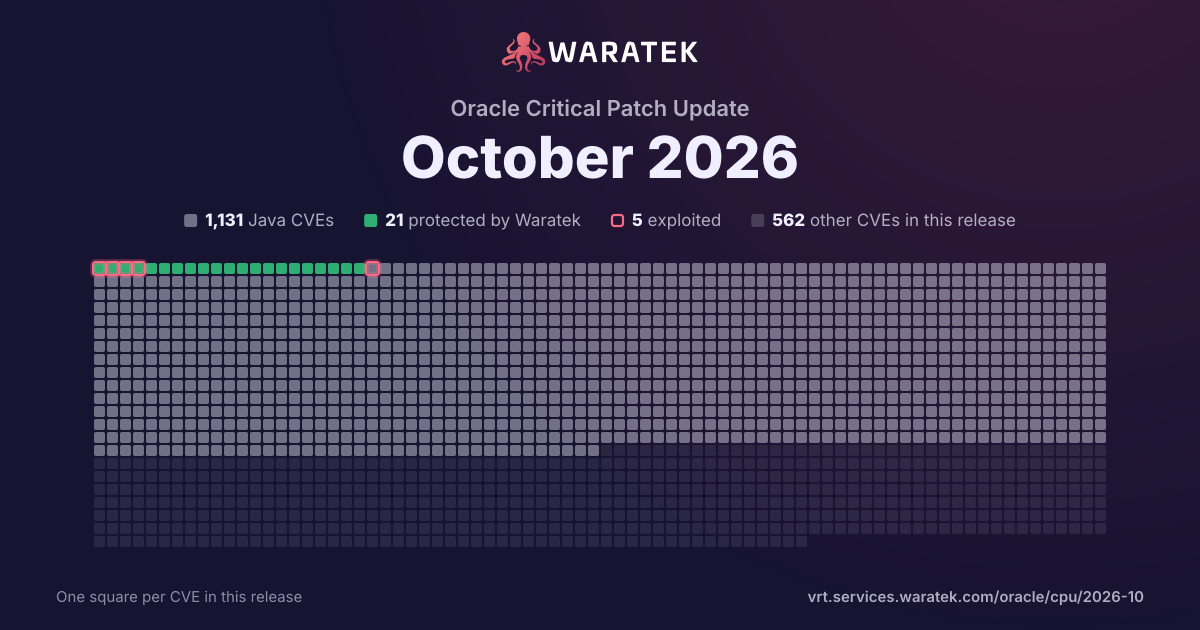
By status
20Protected by Waratek3Mitigation candidate1,109No exploit published12Outside Waratek scope549Not applicable
7Exploited, marked by the ring
No exploit published. For 855 of them, Oracle's security advisory is the source of public detail.
Protected by Waratek. Waratek RASP can block exploitation of these on systems that have not applied the patch yet.
Overview 18 matches · 6 in Waratek scope · 2 protected · 0 exploited · 0 CISA KEV · 1 public PoC · 0 EPSS ≥ 0.5
18matches
6in Waratek scope33.3%
2protected11.1%
0exploited0.0%
0CISA KEV0.0%
1public PoC5.6%
0EPSS ≥ 0.50.0%
Protected by Waratek
2
11.1%
Rule in development
0
0.0%
Mitigation candidate
0
0.0%
No exploit published
4
22.2%
Outside Waratek scope
0
0.0%
Not applicable
12
66.7%
Withdrawn CVE
0
0.0%
blocked by ARMR today
2
11.1%
partly blocked
0
0.0%
not blocked
16
88.9%
not established
0
0.0%
unrecorded
0
0.0%
Exploited
0
0.0%
Working exploit published
0
0.0%
Proof of concept only
18
100.0%
Forecast only
0
0.0%
No public exploit
0
0.0%
split by
peak 4 / quarter
Q3 221
Protected by Waratek1
High1
blocked by ARMR today1
Proof of concept only1
Q4 220
Q1 233
Not applicable3
Medium3
not blocked3
Proof of concept only3
Q2 232
Not applicable2
Medium2
not blocked2
Proof of concept only2
Q3 230
Q4 232
Not applicable2
High1
Medium1
not blocked2
Proof of concept only2
Q1 240
Q2 242
Not applicable2
Medium2
not blocked2
Proof of concept only2
Q3 240
Q4 244
No exploit published1
Not applicable3
High2
Medium2
not blocked4
Proof of concept only4
Q1 251
No exploit published1
Medium1
not blocked1
Proof of concept only1
Q2 252
Protected by Waratek1
No exploit published1
High1
Medium1
blocked by ARMR today1
not blocked1
Proof of concept only2
Q3 251
No exploit published1
Medium1
not blocked1
Proof of concept only1
Q3 22Q1 23Q3 23Q1 24Q3 24Q1 25Q3 25
| CVE | Severity | Published▾ | Status | Exploitation | Description |
|---|---|---|---|---|---|
| CVE-2025-53864 | Medium | 2025-07-11 | No exploit published | Proof of concept only | Connect2id Nimbus JOSE + JWT 10.0.x before 10.0.2 and 9.37.x before 9.37.4 allows a remote attacker to cause a denial of service via a deeply nested JSON object supplied in a JWT claim set, because of uncontrolled recursion. NOTE: this is independent of the Gson 2.11.0 issue because the Connect2id product could have checked the JSON object nesting depth, regardless of what limits (if any) were imposed by Gson. |
| CVE-2025-48734 | High | 2025-05-28 | No exploit published | Proof of concept only | Improper Access Control vulnerability in Apache Commons. A special BeanIntrospector class was added in version 1.9.2. This can be used to stop attackers from using the declared class property of Java enum objects to get access to the classloader. However this protection was not enabled by default. PropertyUtilsBean (and consequently BeanUtilsBean) now disallows declared class level property access by default. Releases 1.11.0 and 2.0.0-M2 address a potential security issue when accessing enum properties in an uncontrolled way. If an application using Commons BeanUtils passes property paths from an external source directly to the getProperty() method of PropertyUtilsBean, an attacker can access the enum’s class loader via the “declaredClass” property available on all Java “enum” objects. Accessing the enum’s “declaredClass” allows remote attackers to access the ClassLoader and execute arbitrary code. The same issue exists with PropertyUtilsBean.getNestedProperty(). Starting in versions 1.11.0 and 2.0.0-M2 a special BeanIntrospector suppresses the “declaredClass” property. Note that this new BeanIntrospector is enabled by default, but you can disable it to regain the old behavior; see section 2.5 of the user's guide and the unit tests. This issue affects Apache Commons BeanUtils 1.x before 1.11.0, and 2.x before 2.0.0-M2.Users of the artifact commons-beanutils:commons-beanutils 1.x are recommended to upgrade to version 1.11.0, which fixes the issue. Users of the artifact org.apache.commons:commons-beanutils2 2.x are recommended to upgrade to version 2.0.0-M2, which fixes the issue. |
| CVE-2025-4949 | Medium | 2025-05-21 | Protected by Waratek | Proof of concept only | In Eclipse JGit versions 7.2.0.202503040940-r and older, the ManifestParser class used by the repo command and the AmazonS3 class used to implement the experimental amazons3 git transport protocol allowing to store git pack files in an Amazon S3 bucket, are vulnerable to XML External Entity (XXE) attacks when parsing XML files. This vulnerability can lead to information disclosure, denial of service, and other security issues. |
| CVE-2025-25193 | Medium | 2025-02-10 | No exploit published | Proof of concept only | Netty, an asynchronous, event-driven network application framework, has a vulnerability in versions up to and including 4.1.118.Final. An unsafe reading of environment file could potentially cause a denial of service in Netty. When loaded on an Windows application, Netty attempts to load a file that does not exist. If an attacker creates such a large file, the Netty application crash. A similar issue was previously reported as CVE-2024-47535. This issue was fixed, but the fix was incomplete in that null-bytes were not counted against the input limit. Commit d1fbda62d3a47835d3fb35db8bd42ecc205a5386 contains an updated fix. |
| CVE-2024-47778 | Medium | 2024-12-12 | Not applicable | Proof of concept only | GStreamer is a library for constructing graphs of media-handling components. An OOB-read vulnerability has been discovered in gst_wavparse_adtl_chunk within gstwavparse.c. This vulnerability arises due to insufficient validation of the size parameter, which can exceed the bounds of the data buffer. As a result, an OOB read occurs in the following while loop. This vulnerability can result in reading up to 4GB of process memory or potentially causing a segmentation fault (SEGV) when accessing invalid memory. This vulnerability is fixed in 1.24.10. |
| CVE-2024-53899 | High | 2024-11-24 | Not applicable | Proof of concept only | virtualenv before 20.26.6 allows command injection through the activation scripts for a virtual environment. Magic template strings are not quoted correctly when replacing. NOTE: this is not the same as CVE-2024-9287. |
| CVE-2024-41311 | High | 2024-10-15 | Not applicable | Proof of concept only | In Libheif 1.17.6, insufficient checks in ImageOverlay::parse() decoding a heif file containing an overlay image with forged offsets can lead to an out-of-bounds read and write. |
| CVE-2024-6763 | Medium | 2024-10-14 | No exploit published | Proof of concept only | Eclipse Jetty is a lightweight, highly scalable, Java-based web server and Servlet engine . It includes a utility class, HttpURI, for URI/URL parsing. The HttpURI class does insufficient validation on the authority segment of a URI. However the behaviour of HttpURI differs from the common browsers in how it handles a URI that would be considered invalid if fully validated against the RRC. Specifically HttpURI and the browser may differ on the value of the host extracted from an invalid URI and thus a combination of Jetty and a vulnerable browser may be vulnerable to a open redirect attack or to a SSRF attack if the URI is used after passing validation checks. |
| CVE-2024-38950 | Medium | 2024-06-26 | Not applicable | Proof of concept only | Heap Buffer Overflow vulnerability in Libde265 v1.0.15 allows attackers to crash the application via crafted payload to __interceptor_memcpy function. |
| CVE-2024-38949 | Medium | 2024-06-26 | Not applicable | Proof of concept only | Heap Buffer Overflow vulnerability in Libde265 v1.0.15 allows attackers to crash the application via crafted payload to display444as420 function at sdl.cc |
| CVE-2023-46218 | Medium | 2023-12-07 | Not applicable | Proof of concept only | This flaw allows a malicious HTTP server to set "super cookies" in curl that are then passed back to more origins than what is otherwise allowed or possible. This allows a site to set cookies that then would get sent to different and unrelated sites and domains. It could do this by exploiting a mixed case flaw in curl's function that verifies a given cookie domain against the Public Suffix List (PSL). For example a cookie could be set with `domain=co.UK` when the URL used a lower case hostname `curl.co.uk`, even though `co.uk` is listed as a PSL domain. |
| CVE-2023-43622 | High | 2023-10-23 | Not applicable | Proof of concept only | An attacker, opening a HTTP/2 connection with an initial window size of 0, was able to block handling of that connection indefinitely in Apache HTTP Server. This could be used to exhaust worker resources in the server, similar to the well known "slow loris" attack pattern. This has been fixed in version 2.4.58, so that such connection are terminated properly after the configured connection timeout. This issue affects Apache HTTP Server: from 2.4.55 through 2.4.57. Users are recommended to upgrade to version 2.4.58, which fixes the issue. |
| CVE-2023-28322 | Medium | 2023-05-26 | Not applicable | Proof of concept only | An information disclosure vulnerability exists in curl <v8.1.0 when doing HTTP(S) transfers, libcurl might erroneously use the read callback (`CURLOPT_READFUNCTION`) to ask for data to send, even when the `CURLOPT_POSTFIELDS` option has been set, if the same handle previously wasused to issue a `PUT` request which used that callback. This flaw may surprise the application and cause it to misbehave and either send off the wrong data or use memory after free or similar in the second transfer. The problem exists in the logic for a reused handle when it is (expected to be) changed from a PUT to a POST. |
| CVE-2023-28321 | Medium | 2023-05-26 | Not applicable | Proof of concept only | An improper certificate validation vulnerability exists in curl <v8.1.0 in the way it supports matching of wildcard patterns when listed as "Subject Alternative Name" in TLS server certificates. curl can be built to use its own name matching function for TLS rather than one provided by a TLS library. This private wildcard matching function would match IDN (International Domain Name) hosts incorrectly and could as a result accept patterns that otherwise should mismatch. IDN hostnames are converted to puny code before used for certificate checks. Puny coded names always start with `xn--` and should not be allowed to pattern match, but the wildcard check in curl could still check for `x*`, which would match even though the IDN name most likely contained nothing even resembling an `x`. |
| CVE-2023-27536 | Medium | 2023-03-30 | Not applicable | Proof of concept only | An authentication bypass vulnerability exists libcurl <8.0.0 in the connection reuse feature which can reuse previously established connections with incorrect user permissions due to a failure to check for changes in the CURLOPT_GSSAPI_DELEGATION option. This vulnerability affects krb5/kerberos/negotiate/GSSAPI transfers and could potentially result in unauthorized access to sensitive information. The safest option is to not reuse connections if the CURLOPT_GSSAPI_DELEGATION option has been changed. |
| CVE-2023-27535 | Medium | 2023-03-30 | Not applicable | Proof of concept only | An authentication bypass vulnerability exists in libcurl <8.0.0 in the FTP connection reuse feature that can result in wrong credentials being used during subsequent transfers. Previously created connections are kept in a connection pool for reuse if they match the current setup. However, certain FTP settings such as CURLOPT_FTP_ACCOUNT, CURLOPT_FTP_ALTERNATIVE_TO_USER, CURLOPT_FTP_SSL_CCC, and CURLOPT_USE_SSL were not included in the configuration match checks, causing them to match too easily. This could lead to libcurl using the wrong credentials when performing a transfer, potentially allowing unauthorized access to sensitive information. |
| CVE-2023-23916 | Medium | 2023-02-23 | Not applicable | Proof of concept only | An allocation of resources without limits or throttling vulnerability exists in curl <v7.88.0 based on the "chained" HTTP compression algorithms, meaning that a server response can be compressed multiple times and potentially with differentalgorithms. The number of acceptable "links" in this "decompression chain" wascapped, but the cap was implemented on a per-header basis allowing a maliciousserver to insert a virtually unlimited number of compression steps simply byusing many headers. The use of such a decompression chain could result in a "malloc bomb", making curl end up spending enormous amounts of allocated heap memory, or trying to and returning out of memory errors. |
| CVE-2022-34169 | High | 2022-07-19 | Protected by Waratek | Proof of concept only | The Apache Xalan Java XSLT library is vulnerable to an integer truncation issue when processing malicious XSLT stylesheets. This can be used to corrupt Java class files generated by the internal XSLTC compiler and execute arbitrary Java bytecode. Users are recommended to update to version 2.7.3 or later. Note: Java runtimes (such as OpenJDK) include repackaged copies of Xalan. |