
Oracle Critical Patch Update October 2026
Released October 2026 · Oracle's advisory ↗ · ← Security Patch Update, September 2026 · Security Patch Update, November 2026 →
1,693 CVEs in this release, one square each
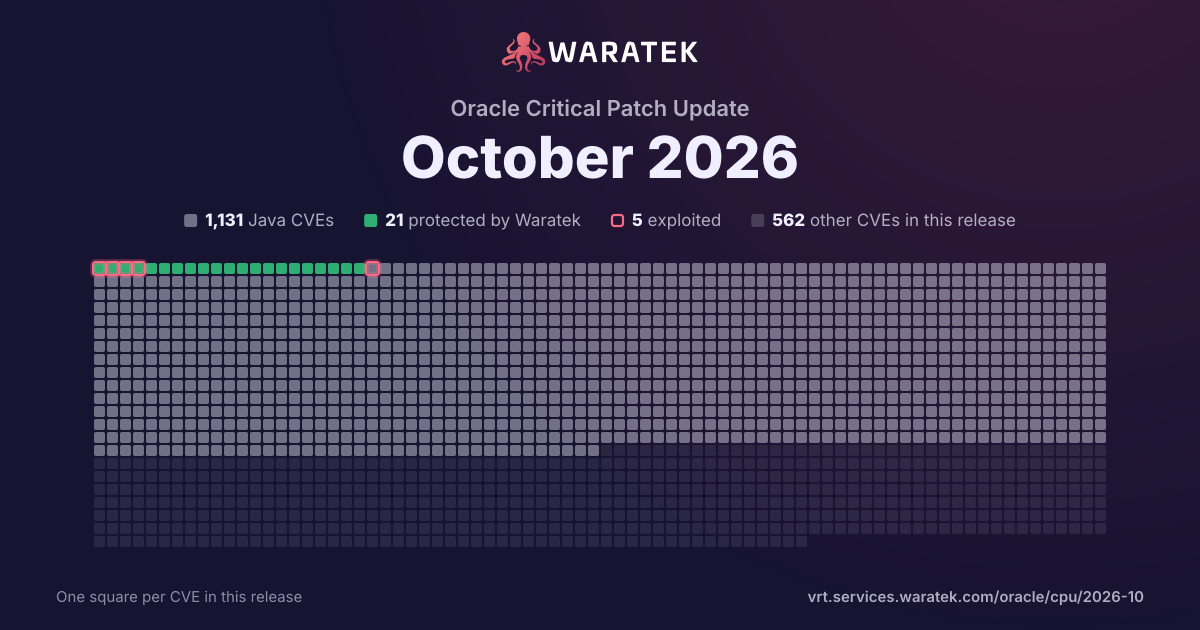
By status
20Protected by Waratek3Mitigation candidate1,109No exploit published12Outside Waratek scope549Not applicable
7Exploited, marked by the ring
No exploit published. For 855 of them, Oracle's security advisory is the source of public detail.
Protected by Waratek. Waratek RASP can block exploitation of these on systems that have not applied the patch yet.
Overview 8 matches · 3 protected · 2 exploited · 1 CISA KEV · 2 public PoC · 2 EPSS ≥ 0.5
Protected by Waratek
3
37.5%
Rule in development
0
0.0%
Mitigation candidate
0
0.0%
No exploit published
5
62.5%
blocked by ARMR today
3
37.5%
partly blocked
0
0.0%
not blocked
5
62.5%
not established
0
0.0%
unrecorded
0
0.0%
Exploited
2
25.0%
Working exploit published
0
0.0%
Proof of concept only
1
12.5%
Forecast only
0
0.0%
No public exploit
5
62.5%
split by
peak 4 / quarter
Q4 221
Protected by Waratek1
Critical1
blocked by ARMR today1
Exploited1
Q1 230
Q2 230
Q3 230
Q4 230
Q1 240
Q2 240
Q3 240
Q4 241
No exploit published1
Critical1
not blocked1
No public exploit1
Q1 251
Protected by Waratek1
Critical1
blocked by ARMR today1
Exploited1
Q2 250
Q3 250
Q4 250
Q1 264
Protected by Waratek1
No exploit published3
Critical4
blocked by ARMR today1
not blocked3
No public exploit4
Q2 261
No exploit published1
Critical1
not blocked1
Proof of concept only1
Q4 22Q2 23Q4 23Q2 24Q4 24Q2 25Q4 25Q2 26
| CVE | Severity | Published▾ | Status | Exploitation | Description |
|---|---|---|---|---|---|
| CVE-2026-2332 | Critical | 2026-04-14 | No exploit published | Proof of concept only | In Eclipse Jetty, the HTTP/1.1 parser is vulnerable to request smuggling when chunk extensions are used, similar to the "funky chunks" techniques outlined here: * https://w4ke.info/2025/06/18/funky-chunks.html * https://w4ke.info/2025/10/29/funky-chunks-2.html Jetty terminates chunk extension parsing at \r\n inside quoted strings instead of treating this as an error. POST / HTTP/1.1 Host: localhost Transfer-Encoding: chunked 1;ext="val X 0 GET /smuggled HTTP/1.1 ... Note how the chunk extension does not close the double quotes, and it is able to inject a smuggled request. |
| CVE-2026-33701 | Critical | 2026-03-27 | Protected by Waratek | No public exploit | OpenTelemetry Java Instrumentation provides OpenTelemetry auto-instrumentation and instrumentation libraries for Java. In versions prior to 2.26.1, the RMI instrumentation registered a custom endpoint that deserialized incoming data without applying serialization filters. On JDK version 16 and earlier, an attacker with network access to a JMX or RMI port on an instrumented JVM could exploit this to potentially achieve remote code execution. All three of the following conditions must be true to exploit this vulnerability: First, OpenTelemetry Java instrumentation is attached as a Java agent (`-javaagent`) on Java 16 or earlier. Second, JMX/RMI port has been explicitly configured via `-Dcom.sun.management.jmxremote.port` and is network-reachable. Third, gadget-chain-compatible library is present on the classpath. This results in arbitrary remote code execution with the privileges of the user running the instrumented JVM. For JDK >= 17, no action is required, but upgrading is strongly encouraged. For JDK < 17, upgrade to version 2.26.1 or later. As a workaround, set the system property `-Dotel.instrumentation.rmi.enabled=false` to disable the RMI integration. |
| CVE-2026-28369 | Critical | 2026-03-27 | No exploit published | No public exploit | A flaw was found in Undertow. When Undertow receives an HTTP request where the first header line starts with one or more spaces, it incorrectly processes the request by stripping these leading spaces. This behavior, which violates HTTP standards, can be exploited by a remote attacker to perform request smuggling. Request smuggling allows an attacker to bypass security mechanisms, access restricted information, or manipulate web caches, potentially leading to unauthorized actions or data exposure. |
| CVE-2026-28368 | Critical | 2026-03-27 | No exploit published | No public exploit | A flaw was found in Undertow. This vulnerability allows a remote attacker to construct specially crafted requests where header names are parsed differently by Undertow compared to upstream proxies. This discrepancy in header interpretation can be exploited to launch request smuggling attacks, potentially bypassing security controls and accessing unauthorized resources. |
| CVE-2026-28367 | Critical | 2026-03-27 | No exploit published | No public exploit | A flaw was found in Undertow. A remote attacker can exploit this vulnerability by sending `\r\r\r` as a header block terminator. This can be used for request smuggling with certain proxy servers, such as older versions of Apache Traffic Server and Google Cloud Classic Application Load Balancer, potentially leading to unauthorized access or manipulation of web requests. |
| CVE-2025-24813 | Critical | 2025-03-10 | Protected by Waratek | Exploited | Path Equivalence: 'file.Name' (Internal Dot) leading to Remote Code Execution and/or Information disclosure and/or malicious content added to uploaded files via write enabled Default Servlet in Apache Tomcat. This issue affects Apache Tomcat: from 11.0.0-M1 through 11.0.2, from 10.1.0-M1 through 10.1.34, from 9.0.0.M1 through 9.0.98. The following versions were EOL at the time the CVE was created but are known to be affected: 8.5.0 though 8.5.100. Other, older, EOL versions may also be affected. If all of the following were true, a malicious user was able to view security sensitive files and/or inject content into those files: - writes enabled for the default servlet (disabled by default) - support for partial PUT (enabled by default) - a target URL for security sensitive uploads that was a sub-directory of a target URL for public uploads - attacker knowledge of the names of security sensitive files being uploaded - the security sensitive files also being uploaded via partial PUT If all of the following were true, a malicious user was able to perform remote code execution: - writes enabled for the default servlet (disabled by default) - support for partial PUT (enabled by default) - application was using Tomcat's file based session persistence with the default storage location - application included a library that may be leveraged in a deserialization attack Users are recommended to upgrade to version 11.0.3, 10.1.35 or 9.0.99, which fixes the issue. |
| CVE-2024-52316 | Critical | 2024-11-18 | No exploit published | No public exploit | Unchecked Error Condition vulnerability in Apache Tomcat. If Tomcat is configured to use a custom Jakarta Authentication (formerly JASPIC) ServerAuthContext component which may throw an exception during the authentication process without explicitly setting an HTTP status to indicate failure, the authentication may not fail, allowing the user to bypass the authentication process. There are no known Jakarta Authentication components that behave in this way. This issue affects Apache Tomcat: from 11.0.0-M1 through 11.0.0-M26, from 10.1.0-M1 through 10.1.30, from 9.0.0-M1 through 9.0.95. The following versions were EOL at the time the CVE was created but are known to be affected: 8.5.0 though 8.5.100. Other EOL versions may also be affected. Users are recommended to upgrade to version 11.0.0, 10.1.31 or 9.0.96, which fix the issue. |
| CVE-2022-1471 | Critical | 2022-12-01 | Protected by Waratek | Exploited | SnakeYaml's Constructor() class does not restrict types which can be instantiated during deserialization. Deserializing yaml content provided by an attacker can lead to remote code execution. We recommend using SnakeYaml's SafeConsturctor when parsing untrusted content to restrict deserialization. We recommend upgrading to version 2.0 and beyond. |