
Oracle Critical Patch Update October 2026
Released October 2026 · Oracle's advisory ↗ · ← Security Patch Update, September 2026 · Security Patch Update, November 2026 →
1,693 CVEs in this release, one square each
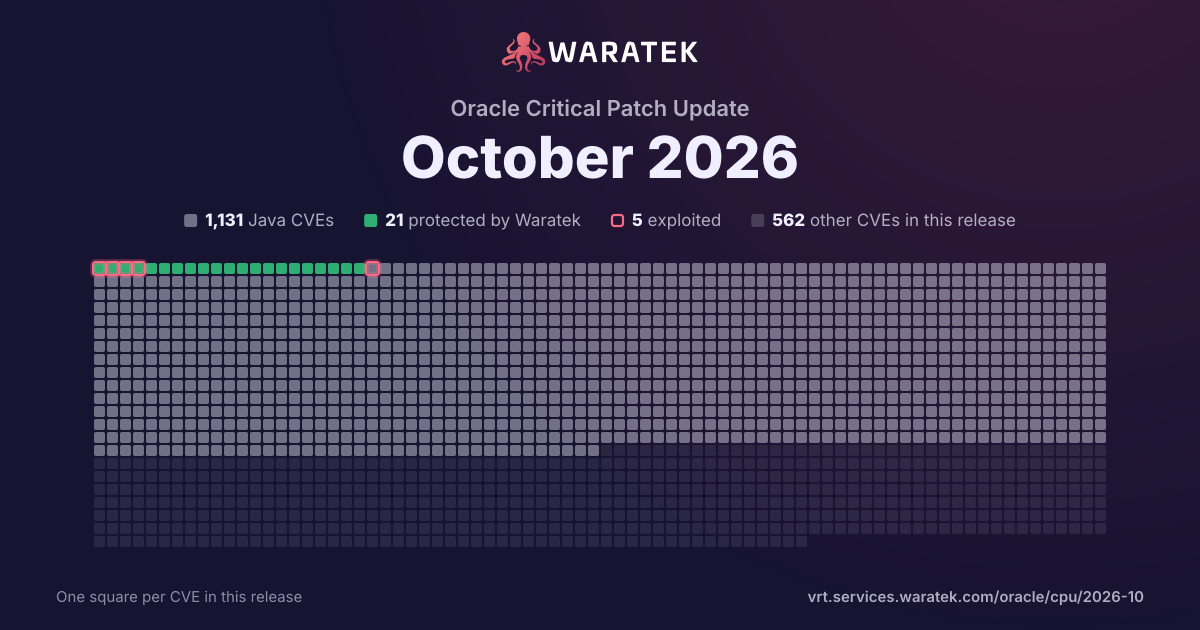
By status
20Protected by Waratek1Mitigation candidate1,111No exploit published12Outside Waratek scope549Not applicable
5Exploited, marked by the ring
No exploit published. For 855 of them, Oracle's security advisory is the source of public detail.
Protected by Waratek. Waratek RASP can block exploitation of these on systems that have not applied the patch yet.
Overview 20 matches · 2 protected · 0 exploited · 0 CISA KEV · 0 public PoC · 0 EPSS ≥ 0.5
Protected by Waratek
2
10.0%
Rule in development
0
0.0%
Mitigation candidate
0
0.0%
No exploit published
18
90.0%
blocked by ARMR today
2
10.0%
partly blocked
0
0.0%
not blocked
18
90.0%
not established
0
0.0%
unrecorded
0
0.0%
Exploited
0
0.0%
Working exploit published
0
0.0%
Proof of concept only
0
0.0%
Forecast only
0
0.0%
No public exploit
20
100.0%
split by
peak 7 / quarter
Q4 241
No exploit published1
Critical1
not blocked1
No public exploit1
Q1 250
Q2 250
Q3 250
Q4 250
Q1 264
Protected by Waratek1
No exploit published3
Critical4
blocked by ARMR today1
not blocked3
No public exploit4
Q2 266
Protected by Waratek1
No exploit published5
Critical6
blocked by ARMR today1
not blocked5
No public exploit6
Q3 267
No exploit published7
Critical7
not blocked7
No public exploit7
Q4 262
No exploit published2
Critical2
not blocked2
No public exploit2
Q4 24Q1 25Q2 25Q3 25Q4 25Q1 26Q2 26Q3 26Q4 26
| CVE | Severity | Published▾ | Status | Exploitation | Description |
|---|---|---|---|---|---|
| CVE-2026-101765 | Critical | 2026-10-20 | No exploit published | No public exploit | Vulnerability in the Oracle Communications Billing and Revenue Management product of Oracle Communications (component: BRM Server). Supported versions that are affected are 15.0.0.0.0, 15.0.1.0.0, 15.1.0.0.0 and 15.2.0.0.0. Easily exploitable vulnerability allows unauthenticated attacker with network access via HTTP to compromise Oracle Communications Billing and Revenue Management. Successful attacks of this vulnerability can result in unauthorized creation, deletion or modification access to critical data or all Oracle Communications Billing and Revenue Management accessible data as well as unauthorized access to critical data or complete access to all Oracle Communications Billing and Revenue Management accessible data. CVSS 3.1 Base Score 9.1 (Confidentiality and Integrity impacts). CVSS Vector: (CVSS:3.1/AV:N/AC:L/PR:N/UI:N/S:U/C:H/I:H/A:N). |
| CVE-2026-101763 | Critical | 2026-10-20 | No exploit published | No public exploit | Vulnerability in the Oracle Communications BRM - Elastic Charging Engine product of Oracle Communications (component: Cloud native deployment). Supported versions that are affected are 15.0.0.0.0, 15.0.1.0.0, 15.1.0.0.0 and 15.2.0.0.0. Easily exploitable vulnerability allows unauthenticated attacker with network access via RMI to compromise Oracle Communications BRM - Elastic Charging Engine. Successful attacks of this vulnerability can result in takeover of Oracle Communications BRM - Elastic Charging Engine. CVSS 3.1 Base Score 9.8 (Confidentiality, Integrity and Availability impacts). CVSS Vector: (CVSS:3.1/AV:N/AC:L/PR:N/UI:N/S:U/C:H/I:H/A:H). |
| CVE-2026-84939 | Critical | 2026-09-10 | No exploit published | No public exploit | Path traversal vulnerability in Apache FreeMarker template loading mechanism, if the attacker can specify an arbitrary malformed locale identifier to FreeMarker, and the localized lookup configuration setting is enabled (it's by default enabled). This issue affects Apache FreeMarker from 2.2.0 through 2.3.34. Users are recommended to upgrade to version 2.3.35. Disabling localized lookup in previous versions also mitigates this. Note that even in versions affected by this vulnerability, the files that can be loaded remain restricted by the TemplateLoader that FreeMarker is configured to use. In particular, FileTemplateLoader prevents attempts to traverse outside the baseDir specified in its constructor. Other TemplateLoader implementations may allow access outside their designated base directory, but they are still constrained by the underlying storage mechanism—for example, a loader wrapping a Java class loader can only access resources that the class loader can load, while one wrapping a web application context can only access resources available through that context. |
| CVE-2026-68525 | Critical | 2026-08-25 | No exploit published | No public exploit | Incorrect Authorization vulnerability in Apache Tomcat's FORM authentication process allows the bypassing of a security constraint that limits user has access to a resource POST but not GET. This issue affects Apache Tomcat: from 11.0.0-M1 through 11.0.24, from 10.1.0-M1 through 10.1.57, from 9.0.0.M1 through 9.0.120. The following versions were EOL at the time the CVE was created but are known to be affected: from 8.5.0 through 8.5.100, from 7.0.0 through 7.0.109. Other unsupported versions may also be affected. Users are recommended to upgrade to version 11.0.25, 10.1.58 or 9.0.121, which fixes the issue. |
| CVE-2026-65905 | Critical | 2026-08-25 | No exploit published | No public exploit | Authentication Bypass by Capture-replay vulnerability in Apache Tomcat's DIGEST authenticator. If, before windowSize requests have been made, a client makes a DIGEST authenticated request with a nonceCount on the upper boundary of the replay window then that request is replayable once only while the associated nonceCount remains within the replay window. This issue affects Apache Tomcat: from 11.0.0-M1 through 11.0.24, from 10.1.0-M1 through 10.1.57, from 9.0.0.M1 through 9.0.120. The following versions were EOL at the time the CVE was created but are known to be affected: from 8.5.0 through 8.5.100, from 7.0.30 through 7.0.109. Other unsupported versions may also be affected. Users are recommended to upgrade to version 11.0.25, 10.1.58 or 9.0.121, which fix the issue. |
| CVE-2026-65182 | Critical | 2026-08-25 | No exploit published | No public exploit | Improper Access Control, Incorrect Authorization vulnerability in Apache Tomcat leads to security constraint bypass if a constraint for a longer path is specified before a more restrictive constraint for a shorter sub-path. This issue affects Apache Tomcat: from 11.0.0-M1 through 11.0.24, from 10.1.0-M1 through 10.1.57, from 9.0.0.M1 through 9.0.120, from 8.5.0 through 8.5.100, from 7.0.0 through 7.0.109. Users are recommended to upgrade to version 11.0.25, 10.1.58, 9.0.121, which fixes the issue. |
| CVE-2026-75595 | Critical | 2026-08-19 | No exploit published | No public exploit | Netty is an asynchronous, event-driven network application framework. Prior to 4.1.137.Fina and 4.2.17.Final, io.netty.handler.ssl.SslClientHelloHandler#decode checks the wrong offset before reading the four-byte TLS handshake header, so a ClientHello whose handshake header spans records can cause an IndexOutOfBoundsException and invoke select(ctx, null). This selects the default SslContext instead of the SNI-specific context. In deployments where per-SNI clientAuth=REQUIRE is the sole mutual TLS gate, the default SslContext uses clientAuth=NONE or clientAuth=OPTIONAL, and no application-layer certificate verification exists, an unauthenticated remote attacker can bypass the protected route's mutual TLS requirement. This issue is fixed in versions 4.1.137.Final and 4.2.17.Final. |
| CVE-2026-8763 | Critical | 2026-08-03 | No exploit published | No public exploit | In Bouncy Castle for Java before 1.85, Name Constraints bypass via trailing dot in rfc822Name and URI. This issue also affects Bouncy Castle for Java LTS before 2.73.12, and Bouncy Castle for Java FIPS (BC-FJA) before bc-fips 1.0.2.7 (1.0.X series), 2.0.2 (2.0.X series) and 2.1.3 (2.1.X series). |
| CVE-2026-59083 | Critical | 2026-07-14 | No exploit published | No public exploit | Improper Handling of URL Encoding (Hex Encoding) vulnerability in Apache Tomcat's rewrite valve allowed security constraint bypass for some configurations. This issue affects Apache Tomcat: from 11.0.0-M1 through 11.0.23, from 10.1.0-M1 through 10.1.56, from 9.0.0.M1 through 9.0.119, from 8.5.0 through 8.5.100. Other versions that have reached end of support may also be affected. Users are recommended to upgrade to version 11.0.24, 10.1.57 or 9.0.120, which fix the issue. |
| CVE-2026-55276 | Critical | 2026-06-29 | No exploit published | No public exploit | Always-Incorrect Control Flow Implementation vulnerability in Apache Tomcat meant that special roles and empty authorisation constraints were not included when the effective web.xml was logged. This issue affects Apache Tomcat: from 11.0.0-M1 through 11.0.22, from 10.1.0-M1 through 10.1.55, from 9.0.0.M1 through 9.0.118, from 8.5.0 through 8.5.100. Other versions that have reached end of support may also be affected. Users are recommended to upgrade to version 11.0.23, 10.1.56 or 9.0.119 which fixes the issue. |
| CVE-2026-53434 | Critical | 2026-06-29 | No exploit published | No public exploit | Detection of Error Condition Without Action vulnerability in Apache Tomcat when configuring CRLs for a FFM based connector. This issue affects Apache Tomcat: from 11.0.0-M1 through 11.0.22, from 10.1.0-M7 through 10.1.55, from 9.0.83 through 9.0.118. Users are recommended to upgrade to version 11.0.23, 10.1.56 or 9.0.119, which fixes the issue. |
| CVE-2026-41855 | Critical | 2026-06-09 | No exploit published | No public exploit | In an untrusted JMS environment, org.springframework.jms.support.converter.MappingJackson2MessageConverter and org.springframework.jms.support.converter.JacksonJsonMessageConverter allow arbitrary class instantiation, which can lead to unauthorized actions via gadget class deserialization. Affected versions: Spring Framework 7.0.0 through 7.0.7; 6.2.0 through 6.2.18; 6.1.0 through 6.1.27; 5.3.0 through 5.3.48. |
| CVE-2026-43515 | Critical | 2026-05-12 | No exploit published | No public exploit | Improper Authorization vulnerability when multiple method constraints define an HTTP method for the same extension in Apache Tomcat. This issue affects Apache Tomcat: from 11.0.0-M1 through 11.0.21, from 10.1.0-M1 through 10.1.54, from 9.0.0.M1 through 9.0.117, from 8.5.0 through 8.5.100, from 7.0.0 through 7.0.109. Users are recommended to upgrade to version 11.0.22, 10.1.55 or 9.0.118 which fix the issue. |
| CVE-2026-43512 | Critical | 2026-05-12 | No exploit published | No public exploit | DEPRECATED: Authentication Bypass Issues vulnerability in digest authentication in Apache Tomcat. This issue affects Apache Tomcat: from 11.0.0-M1 through 11.0.21, from 10.1.0-M1 through 10.1.54, from 9.0.0.M1 through 9.0.117, from 8.5.0 through 8.5.100, from before 7.0.0. Older unsupported versions any also be affect Users are recommended to upgrade to version 11.0.22, 10.1.55 or 9.0.118 which fix the issue. |
| CVE-2026-42778 | Critical | 2026-05-01 | Protected by Waratek | No public exploit | The fix for CVE-2026-41409 was not applied to the 2.1.X and 2.2.X branches. Here was the original issue description: The fix for CVE-2024-52046 in Apache MINA AbstractIoBuffer.getObject() was incomplete. The classname allowlist of classes allowed to be deserialized was applied too late after a static initializer in a class to be read might already have been executed. Affected versions are Apache MINA 2.1.0 <= 2.1.11, and 2.2.0 <= 2.2.6. The problem is resolved in Apache MINA 2.1.12, and 2.2.7 by applying the classname allowlist earlier. Affected are applications using Apache MINA that call IoBuffer.getObject(). Applications using Apache MINA are advised to upgrade The fix for CVE-2024-52046 in Apache MINA AbstractIoBuffer.getObject() was incomplete. The classname allowlist of classes allowed to be deserialized was applied too late after a static initializer in a class to be read might already have been executed. Affected versions are Apache MINA 2.1.0 <= 2.1.110, and 2.2.0 <= 2.2.6. The problem is resolved in Apache MINA 2.1.12, and 2.2.7 by applying the classname allowlist earlier. Affected are applications using Apache MINA that call IoBuffer.getObject(). Applications using Apache MINA are advised to upgrade |
| CVE-2026-33701 | Critical | 2026-03-27 | Protected by Waratek | No public exploit | OpenTelemetry Java Instrumentation provides OpenTelemetry auto-instrumentation and instrumentation libraries for Java. In versions prior to 2.26.1, the RMI instrumentation registered a custom endpoint that deserialized incoming data without applying serialization filters. On JDK version 16 and earlier, an attacker with network access to a JMX or RMI port on an instrumented JVM could exploit this to potentially achieve remote code execution. All three of the following conditions must be true to exploit this vulnerability: First, OpenTelemetry Java instrumentation is attached as a Java agent (`-javaagent`) on Java 16 or earlier. Second, JMX/RMI port has been explicitly configured via `-Dcom.sun.management.jmxremote.port` and is network-reachable. Third, gadget-chain-compatible library is present on the classpath. This results in arbitrary remote code execution with the privileges of the user running the instrumented JVM. For JDK >= 17, no action is required, but upgrading is strongly encouraged. For JDK < 17, upgrade to version 2.26.1 or later. As a workaround, set the system property `-Dotel.instrumentation.rmi.enabled=false` to disable the RMI integration. |
| CVE-2026-28369 | Critical | 2026-03-27 | No exploit published | No public exploit | A flaw was found in Undertow. When Undertow receives an HTTP request where the first header line starts with one or more spaces, it incorrectly processes the request by stripping these leading spaces. This behavior, which violates HTTP standards, can be exploited by a remote attacker to perform request smuggling. Request smuggling allows an attacker to bypass security mechanisms, access restricted information, or manipulate web caches, potentially leading to unauthorized actions or data exposure. |
| CVE-2026-28368 | Critical | 2026-03-27 | No exploit published | No public exploit | A flaw was found in Undertow. This vulnerability allows a remote attacker to construct specially crafted requests where header names are parsed differently by Undertow compared to upstream proxies. This discrepancy in header interpretation can be exploited to launch request smuggling attacks, potentially bypassing security controls and accessing unauthorized resources. |
| CVE-2026-28367 | Critical | 2026-03-27 | No exploit published | No public exploit | A flaw was found in Undertow. A remote attacker can exploit this vulnerability by sending `\r\r\r` as a header block terminator. This can be used for request smuggling with certain proxy servers, such as older versions of Apache Traffic Server and Google Cloud Classic Application Load Balancer, potentially leading to unauthorized access or manipulation of web requests. |
| CVE-2024-52316 | Critical | 2024-11-18 | No exploit published | No public exploit | Unchecked Error Condition vulnerability in Apache Tomcat. If Tomcat is configured to use a custom Jakarta Authentication (formerly JASPIC) ServerAuthContext component which may throw an exception during the authentication process without explicitly setting an HTTP status to indicate failure, the authentication may not fail, allowing the user to bypass the authentication process. There are no known Jakarta Authentication components that behave in this way. This issue affects Apache Tomcat: from 11.0.0-M1 through 11.0.0-M26, from 10.1.0-M1 through 10.1.30, from 9.0.0-M1 through 9.0.95. The following versions were EOL at the time the CVE was created but are known to be affected: 8.5.0 though 8.5.100. Other EOL versions may also be affected. Users are recommended to upgrade to version 11.0.0, 10.1.31 or 9.0.96, which fix the issue. |