
Oracle Critical Patch Update October 2026
Released October 2026 · Oracle's advisory ↗ · ← Security Patch Update, September 2026
1,693 CVEs in this release, one square each
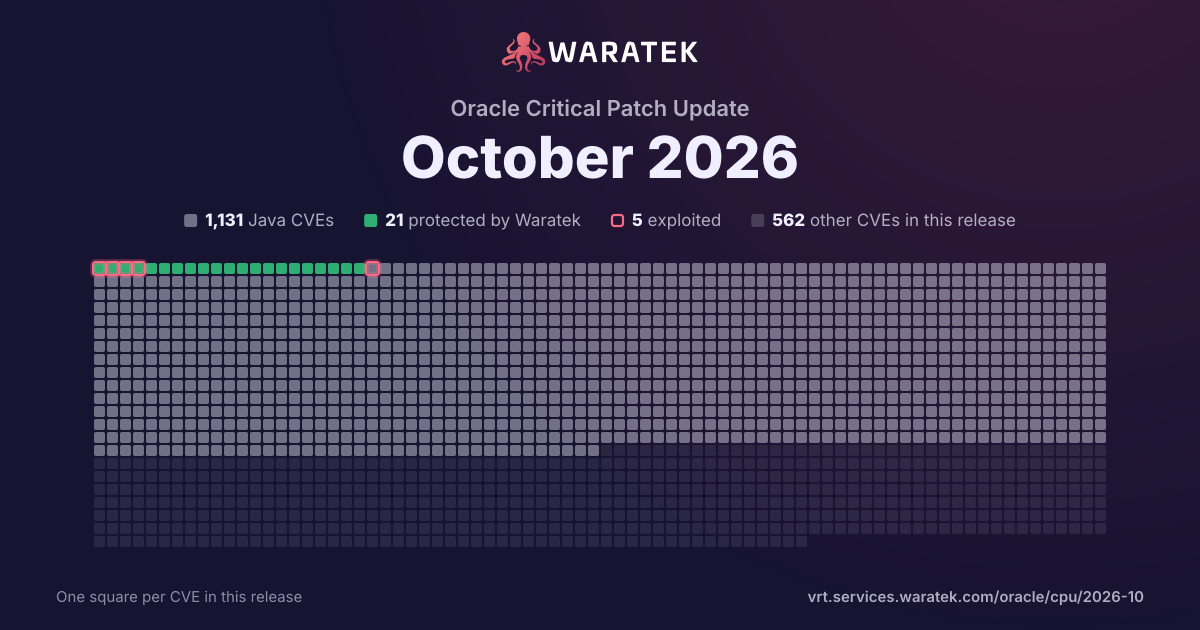
By status
21Protected by Waratek1Mitigation candidate1,109No exploit published13Outside Waratek scope549Not applicable
5Exploited, marked by the ring
No exploit published. For 858 of them, Oracle's security advisory is the source of public detail.
Protected by Waratek. Waratek RASP can block exploitation of these on systems that have not applied the patch yet.
Overview 39 matches · 4 protected · 0 exploited · 0 CISA KEV · 2 public PoC · 1 EPSS ≥ 0.5
Protected by Waratek
4
10.3%
Rule in development
0
0.0%
Mitigation candidate
0
0.0%
No exploit published
35
89.7%
blocked by ARMR today
4
10.3%
partly blocked
0
0.0%
not blocked
35
89.7%
not established
0
0.0%
unrecorded
0
0.0%
Exploited
0
0.0%
Working exploit published
0
0.0%
Proof of concept only
39
100.0%
Forecast only
0
0.0%
No public exploit
0
0.0%
split by
peak 21 / quarter
Q3 221
Protected by Waratek1
High1
blocked by ARMR today1
Proof of concept only1
Q4 220
Q1 230
Q2 230
Q3 230
Q4 230
Q1 240
Q2 240
Q3 240
Q4 240
Q1 251
No exploit published1
Medium1
not blocked1
Proof of concept only1
Q2 252
Protected by Waratek1
No exploit published1
High1
Medium1
blocked by ARMR today1
not blocked1
Proof of concept only2
Q3 251
No exploit published1
Medium1
not blocked1
Proof of concept only1
Q4 250
Q1 261
No exploit published1
High1
not blocked1
Proof of concept only1
Q2 2612
Protected by Waratek1
No exploit published11
Critical5
High4
Medium2
Low1
blocked by ARMR today1
not blocked11
Proof of concept only12
Q3 2621
Protected by Waratek1
No exploit published20
Critical1
High15
Medium5
blocked by ARMR today1
not blocked20
Proof of concept only21
Q3 22Q1 23Q3 23Q1 24Q3 24Q1 25Q3 25Q1 26Q3 26
| CVE | Severity | Published▾ | Status | Exploitation | Description |
|---|---|---|---|---|---|
| CVE-2026-91777 | High | 2026-09-23 | No exploit published | Proof of concept only | Forward-reference completion for @JsonIdentityInfo object IDs in FasterXML jackson-databind performs a linear scan of the pending-reference accumulator for every resolved ID. The affected paths are CollectionDeserializer.CollectionReferringAccumulator.resolveForwardReference() and the equivalent implementation in MapDeserializer. When a document first creates N unresolved object-ID references in an identity-enabled collection or map and then defines those same IDs in reverse order, completion performs on the order of N * (N + 1) / 2 identity comparisons, so a shallow document whose size grows linearly causes quadratic CPU work during deserialization. The reporter instrumented equals() calls on the ID class and measured exactly 2,003,000 comparisons at N = 2,000, against zero comparisons in the pending-reference lookup path for an equally sized control in which every reference was already resolved. The input requires no deep nesting and no syntactically unusual JSON. Exploitation requires an application that deserializes attacker-influenced JSON into an identity-enabled collection or map. The fix replaces the repeated linear lookup with a keyed pending-reference structure. |
| CVE-2026-91776 | High | 2026-09-23 | No exploit published | Proof of concept only | TypeDeserializerBase._findDeserializer() in FasterXML jackson-databind caches the resolved deserializer under the raw, attacker-supplied type ID. When name-based polymorphism is configured with a fallback, for example @JsonTypeInfo(use = Id.NAME, defaultImpl = ...), every distinct unrecognized type ID resolves to the same fallback deserializer but is retained as its own key in the _deserializers map. That map has no configurable bound and lives for the lifetime of the type deserializer, so an attacker who can repeatedly supply fresh unknown type IDs causes monotonic memory retention across requests. The reporter observed 10,000 retained entries from 10,000 distinct unknown IDs, against a single entry for a control that repeated one unknown ID the same number of times, isolating attacker-controlled key cardinality from request volume. Exploitation requires an application that enables name-based polymorphism with a defaultImpl or equivalent fallback, accepts attacker-influenced type IDs, and reuses a long-lived ObjectMapper across requests. The fix stops caching fallback resolutions for unrecognized IDs and bounds both the number of cached entries and the length of a cacheable type ID. |
| CVE-2026-89425 | High | 2026-09-23 | No exploit published | Proof of concept only | UTF8DataInputJsonParser._reportInvalidToken() in FasterXML jackson-core builds the offending-token text for its error message by appending Java identifier characters to a StringBuilder in a loop that has no upper bound. Unlike the three sibling parser implementations, including UTF8StreamJsonParser, it never consults ErrorReportConfiguration.getMaxErrorTokenLength() (default 256). A malformed token supplied to a parser created through JsonFactory.createParser(DataInput) is therefore accumulated in full. No StreamReadConstraints setting mitigates this: maxDocumentLength cannot be applied to DataInput sources at all, and maxStringLength does not cover this path because the accumulation bypasses ReadConstrainedTextBuffer. The reporter measured a 20,000,109-character exception message from a 20-million-character malformed token on the DataInput path, against 367 characters for identical input on the InputStream path. Scaling the payload drives the StringBuilder, which also incurs byte-to-char expansion and internal array doubling, to many times the raw payload size and can trigger OutOfMemoryError for the whole JVM. UTF8DataInputJsonParser was introduced in 2.8.0 together with createParser(DataInput); releases before 2.8.0 do not contain the affected class. |
| CVE-2026-77422 | High | 2026-09-23 | No exploit published | Proof of concept only | JLine is a Java library for handling console input. From 3.0.0 until 3.30.15 and 4.3.1, the JLine built-in grep command in builtins/src/main/java/org/jline/builtins/PosixCommands.java accepts a user-controlled regular expression in grep(...) and, unless line-regexp mode is used, automatically adds a dot-star prefix and suffix before compiling it with Java's backtracking regular expression engine. The wrapping expands the backtracking search space, so a short nested-quantifier expression evaluated against non-matching input can consume excessive CPU and indefinitely block a command worker, including in remotely exposed shell sessions. This issue is fixed in versions 3.30.15 and 4.3.1. |
| CVE-2026-77420 | Medium | 2026-09-23 | No exploit published | Proof of concept only | JLine is a Java library for handling console input. From 3.0.0 until 3.30.15 and 4.3.1, DefaultHistory.matchPatterns(String patterns, String line) in reader/src/main/java/org/jline/reader/impl/history/DefaultHistory.java converts the HISTORY_IGNORE configuration value into a Java regular expression while escaping only part of its syntax, allowing other regex metacharacters to reach the backtracking engine. An attacker who can control application or user configuration can supply a nested-quantifier expression that is reevaluated whenever a command is added to history, consuming excessive CPU and indefinitely blocking the reader thread. This issue is fixed in versions 3.30.15 and 4.3.1. |
| CVE-2026-89407 | High | 2026-09-22 | No exploit published | Proof of concept only | NumberInput.looksLikeValidNumber() in FasterXML jackson-core pre-validates "stringified numbers" with two regular expressions: PATTERN_FLOAT ([+-]?[0-9]*[\.]?[0-9]+([eE][+-]?[0-9]+)?), present since 2.17.0, and PATTERN_FLOAT_TRAILING_DOT, added in 2.17.2. PATTERN_FLOAT places adjacent quantifiers over the same character class -- an optional [0-9]* run, an optional dot, then a required [0-9]+ run -- so input that ultimately fails to match forces Java's backtracking engine to retry every possible split point of the digit run. Matching cost therefore grows with the square of the input length. An attacker who can supply JSON that an application deserializes into a numeric target type reaches this method through jackson-databind's default String-to-number coercion (StdDeserializer and NumberDeserializers for BigDecimal, BigInteger, Double and Float). Because StreamReadConstraints.maxStringLength defaults to 20,000,000 characters, no constraint bounds the input before it reaches the regex. Testing by the reporter confirmed O(n^2) growth across five consecutive input-size doublings, with a single 160,000-character string consuming roughly 74 seconds in one call; a small number of concurrent requests of ordinary body size can therefore exhaust a server's request-handling thread pool. The affected method does not exist before 2.17.0, so 2.16.x and earlier releases are not affected. The fix replaces both regular expressions with a hand-rolled single-pass scan. |
| CVE-2026-68497 | High | 2026-09-11 | No exploit published | Proof of concept only | jackson-databind binds a JSON string to a javax.xml.datatype.Duration or javax.xml.datatype.XMLGregorianCalendar field by passing the raw string verbatim to DatatypeFactory.newDuration(value) or newXMLGregorianCalendar(value) in CoreXMLDeserializers.Std._deserialize. These deserializers are registered by default with no opt-in, so a plain ObjectMapper or JsonMapper with no polymorphic typing and no special configuration reaches this path. The XML Schema lexical grammar permits numeric components of arbitrary length, which the JDK materializes through the native BigInteger(String) and BigDecimal(String) constructors, both quadratic in digit count. Because the digits sit inside a JSON string token rather than a JSON number token, jackson-core's StreamReadConstraints.maxNumberLength guard never applies; jackson's own NumberDeserializers call validateIntegerLength or validateFPLength before parsing a stringified number, but the XML datatype deserializer omits that pre-check. An unauthenticated attacker can therefore submit a single request of a few megabytes, such as a Duration value consisting of the letter P followed by several million digits and the letter Y, and force tens of seconds to several minutes of single-threaded CPU work; a handful of concurrent requests can saturate a server's worker threads. This affects com.fasterxml.jackson.core:jackson-databind from 2.0.0 before 2.18.10, from 2.19.0 before 2.21.6, and from 2.22.0 before 2.22.2, and tools.jackson.core:jackson-databind from 3.0.0 before 3.1.6 and from 3.2.0 before 3.2.2. Users should upgrade to 2.18.10, 2.21.6, 2.22.2, 3.1.6, or 3.2.2. |
| CVE-2026-19032 | Medium | 2026-09-01 | Protected by Waratek | Proof of concept only | jackson-databind's deserializer for java.nio.file.Path resolves an attacker-supplied URI without restricting the URI scheme. In JDKFromStringDeserializer.NioPathHelper.deserialize, a string bound from untrusted JSON is passed to new URI(value) and then to Path.of(uri). When that throws FileSystemNotFoundException, the code enumerates ServiceLoader<FileSystemProvider> and calls provider.getPath(uri) on the first provider whose scheme matches the attacker-chosen scheme. Untrusted JSON can therefore select and drive an arbitrary registered FileSystemProvider during readValue under a default JsonMapper, and forces provider class loading at the same time. With only the JDK built-in providers (file, jar/zipfs) present, the resolved path is inert and no mount or network I/O occurs; further impact requires a side-effecting third-party FileSystemProvider on the classpath. This affects com.fasterxml.jackson.core:jackson-databind from 2.8.0 before 2.18.10, from 2.19.0 before 2.21.6, and from 2.22.0 before 2.22.2, and tools.jackson.core:jackson-databind from 3.0.0 before 3.1.6 and from 3.2.0 before 3.2.2. Users should upgrade to 2.18.10, 2.21.6, 2.22.2, 3.1.6, or 3.2.2. Binding java.nio.file.Path from untrusted JSON should be avoided regardless of version. |
| CVE-2026-68494 | High | 2026-08-04 | No exploit published | Proof of concept only | The fix released in jackson-core 2.18.6 and 2.21.1 for CVE-2026-18401 (GHSA-72hv-8253-57qq, number length constraint bypass in the non-blocking parser) is incomplete. This record covers the remaining bypass. The earlier fix wired validateIntegerLength() into a new _setIntLength() helper and invoked it wherever the integer portion of a number is decided: a terminator byte arrives, a '.' or 'e'/'E' is seen, or input ends inside a fully buffered value. It was not invoked on the attacker-relevant path where the parser runs out of input while still inside the MINOR_NUMBER_INTEGER_DIGITS minor state and returns NOT_AVAILABLE to the caller. As a result, an attacker who streams JSON to a non-blocking parser in many small chunks, without ever sending a terminator byte, keeps the parser inside MINOR_NUMBER_INTEGER_DIGITS indefinitely. _textBuffer.expandCurrentSegment() grows the accumulator on every chunk while validateIntegerLength() is never called. The accumulator is bounded only by maxStringLength (20 MiB by default) rather than by maxNumberLength (1000 by default), an amplification of roughly 20,000x over the documented limit. Because Java char values occupy two bytes, a single connection can be driven to approximately 40 MiB of heap before the validator finally fires when the value completes. The equivalent fraction-path code is correct: _finishFloatFraction() calls _setFractLength() before its NOT_AVAILABLE return. The missing call affects the integer-digit paths in _startPositiveNumber(), _startNegativeNumber() and _finishNumberIntegralPart() in NonBlockingUtf8JsonParserBase. Impact: reactive frameworks such as Spring WebFlux/Reactor, Quarkus, Helidon and Vert.x feed inbound HTTP or gRPC bytes to the async parser as they arrive, which is precisely the chunked-feed shape required. Operators who set StreamReadConstraints.maxNumberLength expecting it to cap memory per number value do not get that guarantee; memory accumulates per concurrent connection and attacker-controlled concurrency can exhaust the JVM heap. The synchronous parsers (UTF8StreamJsonParser, ReaderBasedJsonParser) and the async parser operating on complete input are not affected. Exploitation requires only the ability to stream data to a parsing endpoint; no privileges or user interaction are needed. This issue affects com.fasterxml.jackson.core:jackson-core from version 2.15.0 through 2.18.7, and from 2.19.0 through 2.21.3, and tools.jackson.core:jackson-core from 3.0.0 through 3.1.3. Versions prior to 2.15.0 are not affected, because StreamReadConstraints -- which defines the maxNumberLength setting -- was first introduced in jackson-core 2.15.0, so no such constraint exists to be bypassed in earlier releases. Note that GHSA-r7wm-3cxj-wff9 states the affected 2.x range without a lower bound. The 2.22.x and 3.2.x release lines are not affected: those branches were created after the fix commit landed on 2026-05-21 and therefore contain it from their initial releases (2.22.0, tagged 2026-06-03, and 3.2.0, tagged 2026-06-08). |
| CVE-2026-10050 | High | 2026-08-04 | No exploit published | Proof of concept only | In Eclipse Jetty, the Digest authentication server-side component uses ISO-8859-1 to encode the password as bytes. This was done because the initial specification for HTTP did not specify explicitly a charset, and it was assumed to be ISO-8859-1 for historical reasons. If the password contains characters that cannot be represented in ISO-8859-1, they are silently replaced by `?`. This happens with passwords that contain Chinese, Cyrillic or Greek characters, for example: `αβ123` converts to `??123`. An attacker can send a request with a digest `Authorization` header crafted with a password made of only `?` characters; the server would match any password of the same length that contains non-ISO-8859-1 characters. Recent HTTP Digest [RFC-7616](https://datatracker.ietf.org/doc/html/rfc7616) supports a `charset` parameters that defaults to UTF-8 that allows for correct encoding/decoding of passwords. |
| CVE-2026-59920 | Medium | 2026-07-29 | No exploit published | Proof of concept only | Netty is an asynchronous, event-driven network application framework. In versions prior to 4.1.136.Final and 4.2.16.Final, Netty's STOMP encoder ( StompSubframeEncoder ) does not escape or validate header values in CONNECT and CONNECTED frames, so raw newline ( \n ) characters in a header value are written directly to the wire, allowing an attacker who controls a header value to inject additional STOMP headers. This happens because the encoder intentionally skips escaping for CONNECT/CONNECTED frames per the STOMP 1.2 specification but never rejects the raw newlines, and since a broker parses each line as a separate header, an attacker controlling a value such as a user-supplied login or passcode can overwrite connection parameters or add authentication/role headers to bypass authentication or escalate privileges (the actual impact is broker-dependent). The issue is fixed in versions 4.1.136.Final and 4.2.16.Final. |
| CVE-2026-59919 | Medium | 2026-07-29 | No exploit published | Proof of concept only | Netty is an asynchronous, event-driven network application framework. In versions prior to 4.1.136.Final and 4.2.16.Final, Netty's HAProxy encoder ( HAProxyMessageEncoder ) writes AF_UNIX source and destination socket addresses into the HAProxy V1 text protocol without validating them for CRLF characters, so an attacker who controls an AF_UNIX address can inject \r\n sequences and split the single PROXY header into multiple lines. This is possible because the V1 protocol uses CRLF as its line terminator and, unlike IPv4/IPv6 addresses whose format checks implicitly reject CRLF, AF_UNIX addresses are only validated for length (up to 108 bytes), allowing a forged second PROXY header line that spoofs the client source/destination IP to a downstream server or load balancer. The issue is fixed in versions 4.1.136.Final and 4.2.16.Final. |
| CVE-2026-56822 | High | 2026-07-29 | No exploit published | Proof of concept only | Netty is an asynchronous, event-driven network application framework. Prior to versions 4.1.136.Final and 4.2.16.Final, the OcspServerCertificateValidator forwards the SslHandshakeCompletionEvent before the asynchronous OCSP validation completes. This allows the client's downstream handlers to send sensitive application data (e.g., HTTP requests) to a revoked server before the channel is closed by the OCSP check. n io.netty.handler.ssl.ocsp.OcspServerCertificateValidator#userEventTriggered, when an SslHandshakeCompletionEvent is received, the validator immediately calls ctx.fireUserEventTriggered(evt). It then initiates an asynchronous OCSP query using OcspClient.query. Because the handshake completion event is forwarded immediately, downstream handlers in the client's pipeline are notified that the TLS handshake is successful. They may then begin reading and processing incoming application data or sending outgoing data. If the OCSP response later indicates the server's certificate is REVOKED, the validator closes the channel, but by this time, the client may have already leaked sensitive data to a revoked server or processed malicious responses from it. This issue has been fixed in versions 4.1.136.Final and 4.2.16.Final. |
| CVE-2026-56821 | High | 2026-07-29 | No exploit published | Proof of concept only | Netty is an asynchronous, event-driven network application framework. Prior to versions 4.1.136.Final and 4.2.16.Final, the OcspServerCertificateValidator flags an out-of-date OCSP response but does not stop processing it, so an expired GOOD response is still reported as VALID, letting an on-path attacker replay a stale GOOD response to bypass revocation of a since-revoked certificate. Exploitation can lead to certificate revocation bypass via replay of an expired OCSP response. Any application using OcspServerCertificateValidator is affected; a revoked certificate can be accepted. This issue has been fixed in versions 4.1.136.Final and 4.2.16.Final. |
| CVE-2026-59921 | Medium | 2026-07-28 | No exploit published | Proof of concept only | Netty is an asynchronous, event-driven network application framework. Prior to versions 4.1.136.Final and 4.2.16.Final, HttpPostRequestEncoder constructs multipart HTTP request bodies by directly concatenating user-supplied filenames and field names into Content-Disposition MIME headers without validating or sanitizing CRLF characters (\r\n). Since MIME headers are delimited by CRLF, an attacker who controls the filename can inject arbitrary MIME headers into the multipart body part. The root cause is that neither the encoder nor the FileUpload implementations' setFilename() methods, which only check for null, neutralize CRLF characters before the filename is embedded into the header. This issue has been fixed in versions 4.1.136.Final and 4.2.16.Final. |
| CVE-2026-56820 | Critical | 2026-07-21 | No exploit published | Proof of concept only | Netty is a network application framework for development of protocol servers and clients. In versions 4.2.0.Final through 4.2.15.Final and prior to 4.1.135.Final, `OcspClient` does not validate that the `CertificateID` in an OCSP response matches the requested `CertificateID`, which can lead to replay attack. `OcspClient.validateResponse` accepts a legitimately signed `GOOD` status response for an unrelated certificate issued by the same CA, allowing bypass of revocation checks for another certificate. This issue is fixed in versions 4.1.136.Final and 4.2.16.Final. |
| CVE-2026-56819 | High | 2026-07-21 | No exploit published | Proof of concept only | Netty is a network application framework for development of protocol servers and clients. In versions 4.2.0.Final through 4.2.15.Final and 4.1.0.Final through 4.1.135.Final, a remote unauthenticated peer can leak one direct `ByteBuf` per HTTP/2 `DATA` frame in applications that enable HTTP/2 content decompression via `DelegatingDecompressorFrameListener`. When a `DATA` frame is processed for a stream whose decompressor has already been closed, `Http2Decompressor.decompress(...)` calls `decompressor.writeInbound(data.retain())` and does not release the retained buffer on the error path, eventually exhausting direct memory and crashing the JVM. This issue is fixed in versions 4.1.136.Final and 4.2.16.Final. |
| CVE-2026-55831 | High | 2026-07-21 | No exploit published | Proof of concept only | Netty is a network application framework for development of protocol servers and clients. Prior to 4.1.136.Final and 4.2.16.Final, Netty's SPDY SETTINGS decoder accepts a peer-declared SETTINGS entry count up to the 24-bit frame-length limit and materializes every unique setting ID in `DefaultSpdySettingsFrame`, allowing a remote SPDY/3.1 peer to send a syntactically valid roughly 2 MiB SETTINGS frame that creates 262144 map entries and amplifies network input into heap growth and ordered-map insertion work. This issue is fixed in versions 4.1.136.Final and 4.2.16.Final. |
| CVE-2026-56741 | High | 2026-07-17 | No exploit published | Proof of concept only | JLine is a Java library for handling console input. Prior to 3.30.14, 4.0.16, and 4.2.1, the JLine3 Telnet server remote-telnet module does not apply an upper bound to terminal dimensions received via the Telnet NAWS option, and TelnetIO.handleNAWS() in TelnetIO.java:856-879 reads client-supplied width and height as 16-bit unsigned integers and passes values such as 65535x65535 to setTerminalGeometry(), allowing an unauthenticated remote attacker to repeatedly alternate values and trigger continuous expensive rendering work that causes CPU exhaustion and denial of service. This issue is fixed in versions 3.30.14, 4.0.16, and 4.2.1. |
| CVE-2026-56740 | High | 2026-07-17 | No exploit published | Proof of concept only | JLine is a Java library for handling console input. Prior to 3.30.14, 4.0.16, and 4.2.1, the JLine3 Telnet server remote-telnet module does not limit the number of environment variables a client may inject via the Telnet NEW-ENVIRON option, and TelnetIO.readNEVariables() in TelnetIO.java:1127-1180 stores each variable pair in a HashMap held by ConnectionData, allowing an unauthenticated attacker to flood unique variable pairs before the terminating IAC SE byte and exhaust JVM heap memory with an OutOfMemoryError. This issue is fixed in versions 3.30.14, 4.0.16, and 4.2.1. |
| CVE-2026-44891 | High | 2026-07-17 | No exploit published | Proof of concept only | Netty is a network application framework for development of protocol servers and clients. Prior to 4.1.136.Final and 4.2.16.Final, io.netty.handler.codec.stomp.StompSubframeDecoder fails to limit the total number of headers or their cumulative size per frame, and the maxLineLength parameter only restricts individual header lines. An attacker can send a large number of short headers that are accumulated in memory inside DefaultStompHeadersSubframe until the JVM throws an OutOfMemoryError, causing denial of service for servers exposing a STOMP endpoint based on StompSubframeDecoder. This issue is fixed in versions 4.1.136.Final and 4.2.16.Final. |
| CVE-2026-54512 | High | 2026-06-23 | No exploit published | Proof of concept only | jackson-databind contains the general-purpose data-binding functionality and tree-model for Jackson Data Processor. From 2.10.0 until 2.18.8, 2.21.4, and 3.1.4, jackson-databind's PolymorphicTypeValidator (PTV) is the primary safety mechanism guarding polymorphic deserialization. When polymorphic typing is enabled and a type identifier contains generic parameters (i.e. the type ID string contains <), DatabindContext._resolveAndValidateGeneric() validates only the raw container class name (the substring before <) against the configured PTV. If the container type is approved, the method parses the full canonical type string via TypeFactory.constructFromCanonical() and returns the fully parameterized type without ever validating the nested type arguments against the PTV. The nested type arguments are then resolved, instantiated, and populated as beans during deserialization. An attacker who controls the type ID can therefore place a denied class as a generic type parameter of an allowed container — for example java.util.ArrayList<com.evil.Gadget> when only java.util.ArrayList is allow-listed. The container passes the PTV check; com.evil.Gadget is loaded via Class.forName(name, true, loader), instantiated, and its properties are set from attacker-controlled JSON. This completely bypasses an explicitly configured PTV allow-list. This vulnerability is fixed in 2.18.8, 2.21.4, and 3.1.4. |
| CVE-2026-42587 | High | 2026-05-13 | No exploit published | Proof of concept only | Netty is an asynchronous, event-driven network application framework. Prior to 4.2.13.Final and 4.1.133.Final, HttpContentDecompressor accepts a maxAllocation parameter to limit decompression buffer size and prevent decompression bomb attacks. This limit is correctly enforced for gzip and deflate encodings via ZlibDecoder, but is silently ignored when the content encoding is br (Brotli), zstd, or snappy. An attacker can bypass the configured decompression limit by sending a compressed payload with Content-Encoding: br instead of Content-Encoding: gzip, causing unbounded memory allocation and out-of-memory denial of service. The same vulnerability exists in DelegatingDecompressorFrameListener for HTTP/2 connections. This vulnerability is fixed in 4.2.13.Final and 4.1.133.Final. |
| CVE-2026-42585 | High | 2026-05-13 | No exploit published | Proof of concept only | Netty is an asynchronous, event-driven network application framework. Prior to 4.2.13.Final and 4.1.133.Final, Netty incorrectly parses malformed Transfer-Encoding, enabling request smuggling attacks. This vulnerability is fixed in 4.2.13.Final and 4.1.133.Final. |
| CVE-2026-42584 | Critical | 2026-05-13 | No exploit published | Proof of concept only | Netty is an asynchronous, event-driven network application framework. Prior to 4.2.13.Final and 4.1.133.Final, HttpClientCodec pairs each inbound response with an outbound request by queue.poll() once per response, including for 1xx. If the client pipelines GET then HEAD and the server sends 103, then 200 with GET body, then 200 for HEAD, the queue pairs HEAD with the first 200. The HEAD rule then skips reading that message’s body, so the GET entity bytes stay on the stream and the following 200 is parsed from the wrong offset. This vulnerability is fixed in 4.2.13.Final and 4.1.133.Final. |
| CVE-2026-42583 | High | 2026-05-13 | No exploit published | Proof of concept only | Netty is an asynchronous, event-driven network application framework. Prior to 4.2.13.Final and 4.1.133.Final, Lz4FrameDecoder allocates a ByteBuf of size decompressedLength (up to 32 MB per block) before LZ4 runs. A peer only needs a 21-byte header plus compressedLength payload bytes - 22 bytes if compressedLength == 1 - to force that allocation. This vulnerability is fixed in 4.2.13.Final and 4.1.133.Final. |
| CVE-2026-42581 | Critical | 2026-05-13 | No exploit published | Proof of concept only | Netty is an asynchronous, event-driven network application framework. Prior to 4.2.13.Final and 4.1.133.Final, HttpObjectDecoder strips a conflicting Content-Length header when a request carries both Transfer-Encoding: chunked and Content-Length, but only for HTTP/1.1 messages. The guard is absent for HTTP/1.0. An attacker that sends an HTTP/1.0 request with both headers causes Netty to decode the body as chunked while leaving Content-Length intact in the forwarded HttpMessage. Any downstream proxy or handler that trusts Content-Length over Transfer-Encoding will disagree on message boundaries, enabling request smuggling. This vulnerability is fixed in 4.2.13.Final and 4.1.133.Final. |
| CVE-2026-42580 | Medium | 2026-05-13 | No exploit published | Proof of concept only | Netty is an asynchronous, event-driven network application framework. Prior to 4.2.13.Final and 4.1.133.Final, Netty's chunk size parser silently overflows int, enabling request smuggling attacks. This vulnerability is fixed in 4.2.13.Final and 4.1.133.Final. |
| CVE-2026-42579 | Critical | 2026-05-13 | No exploit published | Proof of concept only | Netty is an asynchronous, event-driven network application framework. Prior to 4.2.13.Final and 4.1.133.Final, Netty's DNS codec does not enforce RFC 1035 domain name constraints during either encoding or decoding. This creates a bidirectional attack surface: malicious DNS responses can exploit the decoder, and user-influenced hostnames can exploit the encoder. This vulnerability is fixed in 4.2.13.Final and 4.1.133.Final. |
| CVE-2026-42578 | Low | 2026-05-13 | No exploit published | Proof of concept only | Netty is an asynchronous, event-driven network application framework. Prior to 4.2.13.Final and 4.1.133.Final, Netty's HttpProxyHandler constructs HTTP CONNECT requests with header validation explicitly disabled. The newInitialMessage() method creates headers using DefaultHttpHeadersFactory.headersFactory().withValidation(false), then adds user-provided outboundHeaders without any CRLF validation. This allows an attacker who can influence the outbound headers to inject arbitrary HTTP headers into the CONNECT request sent to the proxy server. This vulnerability is fixed in 4.2.13.Final and 4.1.133.Final. |
| CVE-2026-41417 | Medium | 2026-05-06 | No exploit published | Proof of concept only | Netty allows request-line validation to be bypassed when a `DefaultHttpRequest` or `DefaultFullHttpRequest` is created first and its URI is later changed via `setUri()`. The constructors reject CRLF and whitespace characters that would break the start-line, but `setUri()` does not apply the same validation. `HttpRequestEncoder` and `RtspEncoder` then write the URI into the request line verbatim. If attacker-controlled input reaches `setUri()`, this enables CRLF injection and insertion of additional HTTP or RTSP requests, leading to HTTP request smuggling or desynchronization on the HTTP side and request injection on the RTSP side. This issue is fixed in versions 4.2.13.Final and 4.1.133.Final. |
| CVE-2026-42779 | Critical | 2026-05-01 | Protected by Waratek | Proof of concept only | The fix for CVE-2026-41635 was not applied to the 2.1.X and 2.2.X branches. Here was the original issue description: Apache MINA's AbstractIoBuffer.resolveClass() contains two branches, one of them (for static classes or primitive types) does not check the class at all, bypassing the classname allowlist and allowing arbitrary code to be executed. The fix checks if the class is present in the accepted class filter before calling Class.forName(). Affected versions are Apache MINA 2.1.0 <= 2.1.11, and 2.2.0 <= 2.2.6. The problem is resolved in Apache MINA 2.1.12, and 2.2.7 by applying the classname allowlist earlier. Affected are applications using Apache MINA that call IoBuffer.getObject(). Applications using Apache MINA are advised to upgrade. |
| CVE-2026-2332 | Critical | 2026-04-14 | No exploit published | Proof of concept only | In Eclipse Jetty, the HTTP/1.1 parser is vulnerable to request smuggling when chunk extensions are used, similar to the "funky chunks" techniques outlined here: * https://w4ke.info/2025/06/18/funky-chunks.html * https://w4ke.info/2025/10/29/funky-chunks-2.html Jetty terminates chunk extension parsing at \r\n inside quoted strings instead of treating this as an error. POST / HTTP/1.1 Host: localhost Transfer-Encoding: chunked 1;ext="val X 0 GET /smuggled HTTP/1.1 ... Note how the chunk extension does not close the double quotes, and it is able to inject a smuggled request. |
| CVE-2026-33870 | High | 2026-03-27 | No exploit published | Proof of concept only | Netty is an asynchronous, event-driven network application framework. In versions prior to 4.1.132.Final and 4.2.10.Final, Netty incorrectly parses quoted strings in HTTP/1.1 chunked transfer encoding extension values, enabling request smuggling attacks. Versions 4.1.132.Final and 4.2.10.Final fix the issue. |
| CVE-2025-53864 | Medium | 2025-07-11 | No exploit published | Proof of concept only | Connect2id Nimbus JOSE + JWT 10.0.x before 10.0.2 and 9.37.x before 9.37.4 allows a remote attacker to cause a denial of service via a deeply nested JSON object supplied in a JWT claim set, because of uncontrolled recursion. NOTE: this is independent of the Gson 2.11.0 issue because the Connect2id product could have checked the JSON object nesting depth, regardless of what limits (if any) were imposed by Gson. |
| CVE-2025-48734 | High | 2025-05-28 | No exploit published | Proof of concept only | Improper Access Control vulnerability in Apache Commons. A special BeanIntrospector class was added in version 1.9.2. This can be used to stop attackers from using the declared class property of Java enum objects to get access to the classloader. However this protection was not enabled by default. PropertyUtilsBean (and consequently BeanUtilsBean) now disallows declared class level property access by default. Releases 1.11.0 and 2.0.0-M2 address a potential security issue when accessing enum properties in an uncontrolled way. If an application using Commons BeanUtils passes property paths from an external source directly to the getProperty() method of PropertyUtilsBean, an attacker can access the enum’s class loader via the “declaredClass” property available on all Java “enum” objects. Accessing the enum’s “declaredClass” allows remote attackers to access the ClassLoader and execute arbitrary code. The same issue exists with PropertyUtilsBean.getNestedProperty(). Starting in versions 1.11.0 and 2.0.0-M2 a special BeanIntrospector suppresses the “declaredClass” property. Note that this new BeanIntrospector is enabled by default, but you can disable it to regain the old behavior; see section 2.5 of the user's guide and the unit tests. This issue affects Apache Commons BeanUtils 1.x before 1.11.0, and 2.x before 2.0.0-M2.Users of the artifact commons-beanutils:commons-beanutils 1.x are recommended to upgrade to version 1.11.0, which fixes the issue. Users of the artifact org.apache.commons:commons-beanutils2 2.x are recommended to upgrade to version 2.0.0-M2, which fixes the issue. |
| CVE-2025-4949 | Medium | 2025-05-21 | Protected by Waratek | Proof of concept only | In Eclipse JGit versions 7.2.0.202503040940-r and older, the ManifestParser class used by the repo command and the AmazonS3 class used to implement the experimental amazons3 git transport protocol allowing to store git pack files in an Amazon S3 bucket, are vulnerable to XML External Entity (XXE) attacks when parsing XML files. This vulnerability can lead to information disclosure, denial of service, and other security issues. |
| CVE-2025-25193 | Medium | 2025-02-10 | No exploit published | Proof of concept only | Netty, an asynchronous, event-driven network application framework, has a vulnerability in versions up to and including 4.1.118.Final. An unsafe reading of environment file could potentially cause a denial of service in Netty. When loaded on an Windows application, Netty attempts to load a file that does not exist. If an attacker creates such a large file, the Netty application crash. A similar issue was previously reported as CVE-2024-47535. This issue was fixed, but the fix was incomplete in that null-bytes were not counted against the input limit. Commit d1fbda62d3a47835d3fb35db8bd42ecc205a5386 contains an updated fix. |
| CVE-2022-34169 | High | 2022-07-19 | Protected by Waratek | Proof of concept only | The Apache Xalan Java XSLT library is vulnerable to an integer truncation issue when processing malicious XSLT stylesheets. This can be used to corrupt Java class files generated by the internal XSLTC compiler and execute arbitrary Java bytecode. Users are recommended to update to version 2.7.3 or later. Note: Java runtimes (such as OpenJDK) include repackaged copies of Xalan. |