
Oracle Critical Patch Update July 2026
Released July 2026 · Oracle's advisory ↗ · ← Security Patch Update, June 2026 · Security Patch Update, August 2026 →
1,433 CVEs in this release, one square each
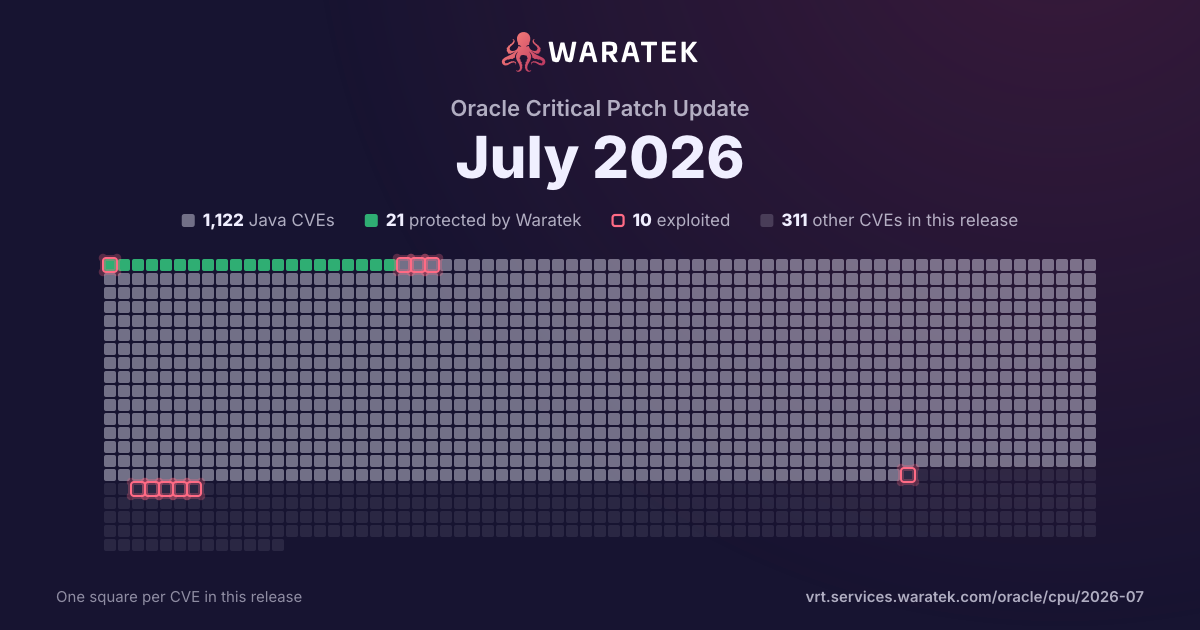
By status
21Protected by Waratek8Mitigation candidate1,093No exploit published16Outside Waratek scope295Not applicable
10Exploited, marked by the ring
No exploit published. For 971 of them, Oracle's security advisory is the source of public detail.
Protected by Waratek. Waratek RASP can block exploitation of these on systems that have not applied the patch yet.
Overview 117 matches · 0 in Waratek scope · 0 protected · 0 exploited · 0 CISA KEV · 0 public PoC · 0 EPSS ≥ 0.5
117matches
0in Waratek scope0.0%
0protected0.0%
0exploited0.0%
0CISA KEV0.0%
0public PoC0.0%
0EPSS ≥ 0.50.0%
Protected by Waratek
0
0.0%
Rule in development
0
0.0%
Mitigation candidate
0
0.0%
No exploit published
0
0.0%
Outside Waratek scope
0
0.0%
Not applicable
117
100.0%
Withdrawn CVE
0
0.0%
blocked by ARMR today
0
0.0%
partly blocked
0
0.0%
not blocked
117
100.0%
not established
0
0.0%
unrecorded
0
0.0%
Exploited
0
0.0%
Working exploit published
0
0.0%
Proof of concept only
8
6.8%
Forecast only
0
0.0%
No public exploit
109
93.2%
split by
peak 68 / quarter
Q4 231
Not applicable1
Medium1
not blocked1
No public exploit1
Q1 240
Q2 244
Not applicable4
Medium4
not blocked4
No public exploit4
Q3 241
Not applicable1
Medium1
not blocked1
No public exploit1
Q4 240
Q1 251
Not applicable1
Medium1
not blocked1
Proof of concept only1
Q2 251
Not applicable1
Medium1
not blocked1
No public exploit1
Q3 259
Not applicable9
Medium9
not blocked9
Proof of concept only4
No public exploit5
Q4 252
Not applicable2
Medium2
not blocked2
Proof of concept only1
No public exploit1
Q1 2614
Not applicable14
Medium14
not blocked14
Proof of concept only2
No public exploit12
Q2 2616
Not applicable16
Medium16
not blocked16
No public exploit16
Q3 2668
Not applicable68
Medium68
not blocked68
No public exploit68
Q4 23Q1 24Q2 24Q3 24Q4 24Q1 25Q2 25Q3 25Q4 25Q1 26Q2 26Q3 26
| CVE | Severity | Published▾ | Status | Exploitation | Description |
|---|---|---|---|---|---|
| CVE-2026-61144 | Medium | 2026-07-21 | Not applicable | No public exploit | Vulnerability in the MySQL Server, MySQL Cluster product of Oracle MySQL (component: Server: Optimizer). Supported versions that are affected are MySQL Server: 9.7.0-9.7.1; MySQL Cluster: 9.7.0-9.7.1. Easily exploitable vulnerability allows high privileged attacker with network access via multiple protocols to compromise MySQL Server, MySQL Cluster. Successful attacks of this vulnerability can result in unauthorized ability to cause a hang or frequently repeatable crash (complete DOS) of MySQL Server, MySQL Cluster. CVSS 3.1 Base Score 4.9 (Availability impacts). CVSS Vector: (CVSS:3.1/AV:N/AC:L/PR:H/UI:N/S:U/C:N/I:N/A:H). |
| CVE-2026-61128 | Medium | 2026-07-21 | Not applicable | No public exploit | Vulnerability in the MySQL Server, MySQL Cluster product of Oracle MySQL (component: Server: Optimizer). Supported versions that are affected are MySQL Server: 9.7.0-9.7.1; MySQL Cluster: 9.7.0-9.7.1. Easily exploitable vulnerability allows high privileged attacker with network access via multiple protocols to compromise MySQL Server, MySQL Cluster. Successful attacks of this vulnerability can result in unauthorized ability to cause a hang or frequently repeatable crash (complete DOS) of MySQL Server, MySQL Cluster. CVSS 3.1 Base Score 4.9 (Availability impacts). CVSS Vector: (CVSS:3.1/AV:N/AC:L/PR:H/UI:N/S:U/C:N/I:N/A:H). |
| CVE-2026-61109 | Medium | 2026-07-21 | Not applicable | No public exploit | Vulnerability in the MySQL Server, MySQL Cluster product of Oracle MySQL (component: Server: JSON). Supported versions that are affected are MySQL Server: 8.4.0-8.4.10, 9.7.0-9.7.1; MySQL Cluster: 8.0.0-8.0.47, 8.4.0-8.4.10 and 9.7.0-9.7.1. Easily exploitable vulnerability allows low privileged attacker with network access via multiple protocols to compromise MySQL Server, MySQL Cluster. Successful attacks of this vulnerability can result in unauthorized ability to cause a hang or frequently repeatable crash (complete DOS) of MySQL Server, MySQL Cluster. CVSS 3.1 Base Score 6.5 (Availability impacts). CVSS Vector: (CVSS:3.1/AV:N/AC:L/PR:L/UI:N/S:U/C:N/I:N/A:H). |
| CVE-2026-61108 | Medium | 2026-07-21 | Not applicable | No public exploit | Vulnerability in the MySQL Server, MySQL Cluster product of Oracle MySQL (component: Server: GIS). Supported versions that are affected are MySQL Server: 9.7.0-9.7.1; MySQL Cluster: 9.7.0-9.7.1. Easily exploitable vulnerability allows low privileged attacker with network access via multiple protocols to compromise MySQL Server, MySQL Cluster. Successful attacks of this vulnerability can result in unauthorized ability to cause a hang or frequently repeatable crash (complete DOS) of MySQL Server, MySQL Cluster. CVSS 3.1 Base Score 6.5 (Availability impacts). CVSS Vector: (CVSS:3.1/AV:N/AC:L/PR:L/UI:N/S:U/C:N/I:N/A:H). |
| CVE-2026-61093 | Medium | 2026-07-21 | Not applicable | No public exploit | Vulnerability in the MySQL Server, MySQL Cluster product of Oracle MySQL (component: Server: Optimizer). Supported versions that are affected are MySQL Server: 9.7.0-9.7.1; MySQL Cluster: 9.7.0-9.7.1. Easily exploitable vulnerability allows low privileged attacker with network access via multiple protocols to compromise MySQL Server, MySQL Cluster. Successful attacks of this vulnerability can result in unauthorized ability to cause a hang or frequently repeatable crash (complete DOS) of MySQL Server, MySQL Cluster. CVSS 3.1 Base Score 6.5 (Availability impacts). CVSS Vector: (CVSS:3.1/AV:N/AC:L/PR:L/UI:N/S:U/C:N/I:N/A:H). |
| CVE-2026-61084 | Medium | 2026-07-21 | Not applicable | No public exploit | Vulnerability in Oracle GoldenGate (component: Libraries). Supported versions that are affected are 19.1.0.0.0-19.30.0.0, 21.3-21.21 and 23.4-23.26.2. Easily exploitable vulnerability allows low privileged attacker with logon to the infrastructure where Oracle GoldenGate executes to compromise Oracle GoldenGate. Successful attacks of this vulnerability can result in unauthorized update, insert or delete access to some of Oracle GoldenGate accessible data as well as unauthorized read access to a subset of Oracle GoldenGate accessible data. CVSS 3.1 Base Score 4.4 (Confidentiality and Integrity impacts). CVSS Vector: (CVSS:3.1/AV:L/AC:L/PR:L/UI:N/S:U/C:L/I:L/A:N). |
| CVE-2026-61082 | Medium | 2026-07-21 | Not applicable | No public exploit | Vulnerability in the MySQL Connectors product of Oracle MySQL (component: Connector/J). Supported versions that are affected are 9.7.0-9.7.1. Easily exploitable vulnerability allows unauthenticated attacker with network access via multiple protocols to compromise MySQL Connectors. Successful attacks require human interaction from a person other than the attacker. Successful attacks of this vulnerability can result in unauthorized access to critical data or complete access to all MySQL Connectors accessible data. CVSS 3.1 Base Score 6.5 (Confidentiality impacts). CVSS Vector: (CVSS:3.1/AV:N/AC:L/PR:N/UI:R/S:U/C:H/I:N/A:N). |
| CVE-2026-61079 | Medium | 2026-07-21 | Not applicable | No public exploit | Vulnerability in Oracle GoldenGate (component: Libraries). Supported versions that are affected are 19.1.0.0.0-19.30.0.0, 21.3-21.21 and 23.4-23.26.2. Difficult to exploit vulnerability allows high privileged attacker with logon to the infrastructure where Oracle GoldenGate executes to compromise Oracle GoldenGate. Successful attacks require human interaction from a person other than the attacker. Successful attacks of this vulnerability can result in unauthorized access to critical data or complete access to all Oracle GoldenGate accessible data as well as unauthorized update, insert or delete access to some of Oracle GoldenGate accessible data and unauthorized ability to cause a hang or frequently repeatable crash (complete DOS) of Oracle GoldenGate. CVSS 3.1 Base Score 5.8 (Confidentiality, Integrity and Availability impacts). CVSS Vector: (CVSS:3.1/AV:L/AC:H/PR:H/UI:R/S:U/C:H/I:L/A:H). |
| CVE-2026-61052 | Medium | 2026-07-21 | Not applicable | No public exploit | Vulnerability in the Oracle Solaris product of Oracle Systems (component: Filesystems). The supported version that is affected is 11.4. Easily exploitable vulnerability allows low privileged attacker with logon to the infrastructure where Oracle Solaris executes to compromise Oracle Solaris. Successful attacks of this vulnerability can result in unauthorized ability to cause a hang or frequently repeatable crash (complete DOS) of Oracle Solaris. CVSS 3.1 Base Score 5.5 (Availability impacts). CVSS Vector: (CVSS:3.1/AV:L/AC:L/PR:L/UI:N/S:U/C:N/I:N/A:H). |
| CVE-2026-60747 | Medium | 2026-07-21 | Not applicable | No public exploit | Vulnerability in the MySQL Server, MySQL Cluster product of Oracle MySQL (component: Server: Replication). Supported versions that are affected are MySQL Server: 8.4.0-8.4.10, 9.7.0-9.7.1; MySQL Cluster: 8.0.0-8.0.47, 8.4.0-8.4.10 and 9.7.0-9.7.1. Easily exploitable vulnerability allows unauthenticated attacker with logon to the infrastructure where MySQL Server, MySQL Cluster executes to compromise MySQL Server, MySQL Cluster. Successful attacks of this vulnerability can result in unauthorized ability to cause a hang or frequently repeatable crash (complete DOS) of MySQL Server, MySQL Cluster. CVSS 3.1 Base Score 6.2 (Availability impacts). CVSS Vector: (CVSS:3.1/AV:L/AC:L/PR:N/UI:N/S:U/C:N/I:N/A:H). |
| CVE-2026-60718 | Medium | 2026-07-21 | Not applicable | No public exploit | Vulnerability in the MySQL Server, MySQL Cluster product of Oracle MySQL (component: Server: JSON). Supported versions that are affected are MySQL Server: 9.7.0-9.7.1; MySQL Cluster: 9.7.0-9.7.1. Easily exploitable vulnerability allows low privileged attacker with network access via multiple protocols to compromise MySQL Server, MySQL Cluster. Successful attacks of this vulnerability can result in unauthorized ability to cause a hang or frequently repeatable crash (complete DOS) of MySQL Server, MySQL Cluster. CVSS 3.1 Base Score 6.5 (Availability impacts). CVSS Vector: (CVSS:3.1/AV:N/AC:L/PR:L/UI:N/S:U/C:N/I:N/A:H). |
| CVE-2026-60630 | Medium | 2026-07-21 | Not applicable | No public exploit | Vulnerability in Oracle APEX (component: Installation). Supported versions that are affected are 24.1, 24.2 and 26.1. Easily exploitable vulnerability allows low privileged attacker with logon to the infrastructure where Oracle APEX executes to compromise Oracle APEX. Successful attacks of this vulnerability can result in unauthorized access to critical data or complete access to all Oracle APEX accessible data. CVSS 3.1 Base Score 5.5 (Confidentiality impacts). CVSS Vector: (CVSS:3.1/AV:L/AC:L/PR:L/UI:N/S:U/C:H/I:N/A:N). |
| CVE-2026-60624 | Medium | 2026-07-21 | Not applicable | No public exploit | Vulnerability in the MySQL Connectors product of Oracle MySQL (component: Connector/J). Supported versions that are affected are 9.7.0-9.7.1. Easily exploitable vulnerability allows unauthenticated attacker with network access via multiple protocols to compromise MySQL Connectors. Successful attacks require human interaction from a person other than the attacker. Successful attacks of this vulnerability can result in unauthorized ability to cause a hang or frequently repeatable crash (complete DOS) of MySQL Connectors. CVSS 3.1 Base Score 6.5 (Availability impacts). CVSS Vector: (CVSS:3.1/AV:N/AC:L/PR:N/UI:R/S:U/C:N/I:N/A:H). |
| CVE-2026-60585 | Medium | 2026-07-21 | Not applicable | No public exploit | Vulnerability in the MySQL Server, MySQL Cluster product of Oracle MySQL (component: Server: Replication). Supported versions that are affected are MySQL Server: 8.4.0-8.4.10, 9.7.0-9.7.1; MySQL Cluster: 8.0.0-8.0.47, 8.4.0-8.4.10 and 9.7.0-9.7.1. Difficult to exploit vulnerability allows high privileged attacker with network access via multiple protocols to compromise MySQL Server, MySQL Cluster. Successful attacks of this vulnerability can result in takeover of MySQL Server, MySQL Cluster. CVSS 3.1 Base Score 6.6 (Confidentiality, Integrity and Availability impacts). CVSS Vector: (CVSS:3.1/AV:N/AC:H/PR:H/UI:N/S:U/C:H/I:H/A:H). |
| CVE-2026-60569 | Medium | 2026-07-21 | Not applicable | No public exploit | Vulnerability in the MySQL Cluster product of Oracle MySQL (component: Cluster: NDB Operator). Supported versions that are affected are 8.0.0-8.0.47, 8.4.0-8.4.10 and 9.7.0-9.7.1. Difficult to exploit vulnerability allows unauthenticated attacker with logon to the infrastructure where MySQL Cluster executes to compromise MySQL Cluster. Successful attacks of this vulnerability can result in unauthorized access to critical data or complete access to all MySQL Cluster accessible data. CVSS 3.1 Base Score 5.1 (Confidentiality impacts). CVSS Vector: (CVSS:3.1/AV:L/AC:H/PR:N/UI:N/S:U/C:H/I:N/A:N). |
| CVE-2026-60411 | Medium | 2026-07-21 | Not applicable | No public exploit | Vulnerability in the TimesTen In-Memory Database product of Oracle TimesTen In-Memory Database (component: ttcserver). The supported version that is affected is 26.1.1.1.0. Easily exploitable vulnerability allows unauthenticated attacker with access to the physical communication segment attached to the hardware where the TimesTen In-Memory Database executes to compromise TimesTen In-Memory Database. Successful attacks of this vulnerability can result in unauthorized ability to cause a hang or frequently repeatable crash (complete DOS) of TimesTen In-Memory Database. CVSS 3.1 Base Score 6.5 (Availability impacts). CVSS Vector: (CVSS:3.1/AV:A/AC:L/PR:N/UI:N/S:U/C:N/I:N/A:H). |
| CVE-2026-60410 | Medium | 2026-07-21 | Not applicable | No public exploit | Vulnerability in the TimesTen In-Memory Database product of Oracle TimesTen In-Memory Database (component: Kubernetes Operator). The supported version that is affected is 26.1.1.1.0. Easily exploitable vulnerability allows low privileged attacker with network access via HTTPS to compromise TimesTen In-Memory Database. Successful attacks of this vulnerability can result in unauthorized ability to cause a partial denial of service (partial DOS) of TimesTen In-Memory Database. CVSS 3.1 Base Score 4.3 (Availability impacts). CVSS Vector: (CVSS:3.1/AV:N/AC:L/PR:L/UI:N/S:U/C:N/I:N/A:L). |
| CVE-2026-60409 | Medium | 2026-07-21 | Not applicable | No public exploit | Vulnerability in the TimesTen In-Memory Database product of Oracle TimesTen In-Memory Database (component: Kubernetes Operator). The supported version that is affected is 26.1.1.1.0. Easily exploitable vulnerability allows high privileged attacker with logon to the infrastructure where TimesTen In-Memory Database executes to compromise TimesTen In-Memory Database. While the vulnerability is in TimesTen In-Memory Database, attacks may significantly impact additional products (scope change). Successful attacks of this vulnerability can result in unauthorized update, insert or delete access to some of TimesTen In-Memory Database accessible data as well as unauthorized read access to a subset of TimesTen In-Memory Database accessible data and unauthorized ability to cause a partial denial of service (partial DOS) of TimesTen In-Memory Database. CVSS 3.1 Base Score 5.7 (Confidentiality, Integrity and Availability impacts). CVSS Vector: (CVSS:3.1/AV:L/AC:L/PR:H/UI:N/S:C/C:L/I:L/A:L). |
| CVE-2026-60408 | Medium | 2026-07-21 | Not applicable | No public exploit | Vulnerability in the TimesTen In-Memory Database product of Oracle TimesTen In-Memory Database (component: Kubernetes Operator). The supported version that is affected is 26.1.1.1.0. Easily exploitable vulnerability allows low privileged attacker with network access via HTTPS to compromise TimesTen In-Memory Database. Successful attacks of this vulnerability can result in unauthorized read access to a subset of TimesTen In-Memory Database accessible data. CVSS 3.1 Base Score 4.3 (Confidentiality impacts). CVSS Vector: (CVSS:3.1/AV:N/AC:L/PR:L/UI:N/S:U/C:L/I:N/A:N). |
| CVE-2026-60407 | Medium | 2026-07-21 | Not applicable | No public exploit | Vulnerability in the TimesTen In-Memory Database product of Oracle TimesTen In-Memory Database (component: Kubernetes Operator). The supported version that is affected is 26.1.1.1.0. Difficult to exploit vulnerability allows low privileged attacker with logon to the infrastructure where TimesTen In-Memory Database executes to compromise TimesTen In-Memory Database. While the vulnerability is in TimesTen In-Memory Database, attacks may significantly impact additional products (scope change). Successful attacks of this vulnerability can result in unauthorized access to critical data or complete access to all TimesTen In-Memory Database accessible data. CVSS 3.1 Base Score 5.6 (Confidentiality impacts). CVSS Vector: (CVSS:3.1/AV:L/AC:H/PR:L/UI:N/S:C/C:H/I:N/A:N). |
| CVE-2026-60406 | Medium | 2026-07-21 | Not applicable | No public exploit | Vulnerability in the TimesTen In-Memory Database product of Oracle TimesTen In-Memory Database (component: Kubernetes Operator). The supported version that is affected is 26.1.1.1.0. Easily exploitable vulnerability allows high privileged attacker with logon to the infrastructure where TimesTen In-Memory Database executes to compromise TimesTen In-Memory Database. Successful attacks of this vulnerability can result in takeover of TimesTen In-Memory Database. CVSS 3.1 Base Score 6.7 (Confidentiality, Integrity and Availability impacts). CVSS Vector: (CVSS:3.1/AV:L/AC:L/PR:H/UI:N/S:U/C:H/I:H/A:H). |
| CVE-2026-60404 | Medium | 2026-07-21 | Not applicable | No public exploit | Vulnerability in the TimesTen In-Memory Database product of Oracle TimesTen In-Memory Database (component: Kubernetes Operator). The supported version that is affected is 26.1.1.1.0. Easily exploitable vulnerability allows low privileged attacker with network access via HTTPS to compromise TimesTen In-Memory Database. Successful attacks of this vulnerability can result in unauthorized ability to cause a hang or frequently repeatable crash (complete DOS) of TimesTen In-Memory Database. CVSS 3.1 Base Score 6.5 (Availability impacts). CVSS Vector: (CVSS:3.1/AV:N/AC:L/PR:L/UI:N/S:U/C:N/I:N/A:H). |
| CVE-2026-60403 | Medium | 2026-07-21 | Not applicable | No public exploit | Vulnerability in the TimesTen In-Memory Database product of Oracle TimesTen In-Memory Database (component: Kubernetes Operator). The supported version that is affected is 26.1.1.1.0. Easily exploitable vulnerability allows low privileged attacker with network access via HTTPS to compromise TimesTen In-Memory Database. Successful attacks of this vulnerability can result in unauthorized ability to cause a hang or frequently repeatable crash (complete DOS) of TimesTen In-Memory Database. CVSS 3.1 Base Score 6.5 (Availability impacts). CVSS Vector: (CVSS:3.1/AV:N/AC:L/PR:L/UI:N/S:U/C:N/I:N/A:H). |
| CVE-2026-60401 | Medium | 2026-07-21 | Not applicable | No public exploit | Vulnerability in the TimesTen In-Memory Database product of Oracle TimesTen In-Memory Database (component: Kubernetes Operator). The supported version that is affected is 26.1.1.1.0. Easily exploitable vulnerability allows low privileged attacker with logon to the infrastructure where TimesTen In-Memory Database executes to compromise TimesTen In-Memory Database. While the vulnerability is in TimesTen In-Memory Database, attacks may significantly impact additional products (scope change). Successful attacks of this vulnerability can result in unauthorized access to critical data or complete access to all TimesTen In-Memory Database accessible data. CVSS 3.1 Base Score 6.5 (Confidentiality impacts). CVSS Vector: (CVSS:3.1/AV:L/AC:L/PR:L/UI:N/S:C/C:H/I:N/A:N). |
| CVE-2026-60399 | Medium | 2026-07-21 | Not applicable | No public exploit | Vulnerability in Oracle GoldenGate (component: Receiver Service Executable). Supported versions that are affected are 19.1.0.0.0-19.30.0.0, 21.3-21.21 and 23.4-23.26.1. Easily exploitable vulnerability allows low privileged attacker with network access via HTTP to compromise Oracle GoldenGate. Successful attacks of this vulnerability can result in unauthorized ability to cause a hang or frequently repeatable crash (complete DOS) of Oracle GoldenGate. CVSS 3.1 Base Score 6.5 (Availability impacts). CVSS Vector: (CVSS:3.1/AV:N/AC:L/PR:L/UI:N/S:U/C:N/I:N/A:H). |
| CVE-2026-60397 | Medium | 2026-07-21 | Not applicable | No public exploit | Vulnerability in Oracle GoldenGate (component: Admin Server Executable). Supported versions that are affected are 19.1.0.0.0-19.30.0.0, 21.3-21.21 and 23.4-23.26.1. Easily exploitable vulnerability allows unauthenticated attacker with access to the physical communication segment attached to the hardware where the Oracle GoldenGate executes to compromise Oracle GoldenGate. Successful attacks of this vulnerability can result in unauthorized ability to cause a partial denial of service (partial DOS) of Oracle GoldenGate. CVSS 3.1 Base Score 4.3 (Availability impacts). CVSS Vector: (CVSS:3.1/AV:A/AC:L/PR:N/UI:N/S:U/C:N/I:N/A:L). |
| CVE-2026-60395 | Medium | 2026-07-21 | Not applicable | No public exploit | Vulnerability in Oracle GoldenGate (component: Admin Server Executable). Supported versions that are affected are 19.1.0.0.0-19.30.0.0, 21.3-21.21 and 23.4-23.26.1. Easily exploitable vulnerability allows low privileged attacker with network access via HTTP to compromise Oracle GoldenGate. Successful attacks of this vulnerability can result in unauthorized read access to a subset of Oracle GoldenGate accessible data. CVSS 3.1 Base Score 4.3 (Confidentiality impacts). CVSS Vector: (CVSS:3.1/AV:N/AC:L/PR:L/UI:N/S:U/C:L/I:N/A:N). |
| CVE-2026-60394 | Medium | 2026-07-21 | Not applicable | No public exploit | Vulnerability in Oracle GoldenGate (component: Admin Server Executable). Supported versions that are affected are 21.3-21.21 and 23.4-23.26.1. Easily exploitable vulnerability allows unauthenticated attacker with network access via HTTPS to compromise Oracle GoldenGate. Successful attacks of this vulnerability can result in unauthorized read access to a subset of Oracle GoldenGate accessible data. CVSS 3.1 Base Score 5.3 (Confidentiality impacts). CVSS Vector: (CVSS:3.1/AV:N/AC:L/PR:N/UI:N/S:U/C:L/I:N/A:N). |
| CVE-2026-60332 | Medium | 2026-07-21 | Not applicable | No public exploit | Vulnerability in the MySQL Server, MySQL Cluster product of Oracle MySQL (component: Server: Group Replication GCS). Supported versions that are affected are MySQL Server: 8.4.0-8.4.10, 9.7.0-9.7.1; MySQL Cluster: 8.0.0-8.0.47, 8.4.0-8.4.10 and 9.7.0-9.7.1. Difficult to exploit vulnerability allows high privileged attacker with logon to the infrastructure where MySQL Server, MySQL Cluster executes to compromise MySQL Server, MySQL Cluster. Successful attacks of this vulnerability can result in takeover of MySQL Server, MySQL Cluster. CVSS 3.1 Base Score 6.4 (Confidentiality, Integrity and Availability impacts). CVSS Vector: (CVSS:3.1/AV:L/AC:H/PR:H/UI:N/S:U/C:H/I:H/A:H). |
| CVE-2026-60331 | Medium | 2026-07-21 | Not applicable | No public exploit | Vulnerability in the MySQL Server, MySQL Cluster product of Oracle MySQL (component: Server: Replication). Supported versions that are affected are MySQL Server: 8.4.0-8.4.10, 9.7.0-9.7.1; MySQL Cluster: 8.0.0-8.0.47, 8.4.0-8.4.10 and 9.7.0-9.7.1. Difficult to exploit vulnerability allows high privileged attacker with logon to the infrastructure where MySQL Server, MySQL Cluster executes to compromise MySQL Server, MySQL Cluster. Successful attacks of this vulnerability can result in takeover of MySQL Server, MySQL Cluster. CVSS 3.1 Base Score 6.4 (Confidentiality, Integrity and Availability impacts). CVSS Vector: (CVSS:3.1/AV:L/AC:H/PR:H/UI:N/S:U/C:H/I:H/A:H). |
| CVE-2026-60324 | Medium | 2026-07-21 | Not applicable | No public exploit | Vulnerability in the MySQL Server, MySQL Cluster product of Oracle MySQL (component: Server: Optimizer). Supported versions that are affected are MySQL Server: 9.7.0-9.7.1; MySQL Cluster: 9.7.0-9.7.1. Easily exploitable vulnerability allows low privileged attacker with network access via multiple protocols to compromise MySQL Server, MySQL Cluster. Successful attacks of this vulnerability can result in unauthorized ability to cause a hang or frequently repeatable crash (complete DOS) of MySQL Server, MySQL Cluster. CVSS 3.1 Base Score 6.5 (Availability impacts). CVSS Vector: (CVSS:3.1/AV:N/AC:L/PR:L/UI:N/S:U/C:N/I:N/A:H). |
| CVE-2026-60311 | Medium | 2026-07-21 | Not applicable | No public exploit | Vulnerability in the MySQL Server, MySQL Cluster product of Oracle MySQL (component: Server: Optimizer). Supported versions that are affected are MySQL Server: 9.0.0-9.7.1; MySQL Cluster: 9.0.0-9.7.1. Easily exploitable vulnerability allows low privileged attacker with network access via multiple protocols to compromise MySQL Server, MySQL Cluster. Successful attacks of this vulnerability can result in unauthorized ability to cause a hang or frequently repeatable crash (complete DOS) of MySQL Server, MySQL Cluster. CVSS 3.1 Base Score 6.5 (Availability impacts). CVSS Vector: (CVSS:3.1/AV:N/AC:L/PR:L/UI:N/S:U/C:N/I:N/A:H). |
| CVE-2026-60195 | Medium | 2026-07-21 | Not applicable | No public exploit | Vulnerability in the MySQL Server, MySQL Cluster product of Oracle MySQL (component: Server: JSON Duality). Supported versions that are affected are MySQL Server: 9.7.0-9.7.1; MySQL Cluster: 9.7.0-9.7.1. Easily exploitable vulnerability allows high privileged attacker with network access via multiple protocols to compromise MySQL Server, MySQL Cluster. Successful attacks of this vulnerability can result in unauthorized ability to cause a hang or frequently repeatable crash (complete DOS) of MySQL Server, MySQL Cluster. CVSS 3.1 Base Score 4.9 (Availability impacts). CVSS Vector: (CVSS:3.1/AV:N/AC:L/PR:H/UI:N/S:U/C:N/I:N/A:H). |
| CVE-2026-60194 | Medium | 2026-07-21 | Not applicable | No public exploit | Vulnerability in the MySQL Server, MySQL Cluster product of Oracle MySQL (component: Server: JSON Duality). Supported versions that are affected are MySQL Server: 9.7.0-9.7.1; MySQL Cluster: 9.7.0-9.7.1. Easily exploitable vulnerability allows high privileged attacker with network access via multiple protocols to compromise MySQL Server, MySQL Cluster. Successful attacks of this vulnerability can result in unauthorized ability to cause a hang or frequently repeatable crash (complete DOS) of MySQL Server, MySQL Cluster. CVSS 3.1 Base Score 4.9 (Availability impacts). CVSS Vector: (CVSS:3.1/AV:N/AC:L/PR:H/UI:N/S:U/C:N/I:N/A:H). |
| CVE-2026-60191 | Medium | 2026-07-21 | Not applicable | No public exploit | Vulnerability in the MySQL Server, MySQL Cluster product of Oracle MySQL (component: Server: Replication). Supported versions that are affected are MySQL Server: 8.4.0-8.4.10, 9.7.0-9.7.1; MySQL Cluster: 8.0.0-8.0.47, 8.4.0-8.4.10 and 9.7.0-9.7.1. Difficult to exploit vulnerability allows high privileged attacker with logon to the infrastructure where MySQL Server, MySQL Cluster executes to compromise MySQL Server, MySQL Cluster. Successful attacks of this vulnerability can result in unauthorized ability to cause a hang or frequently repeatable crash (complete DOS) of MySQL Server, MySQL Cluster. CVSS 3.1 Base Score 4.1 (Availability impacts). CVSS Vector: (CVSS:3.1/AV:L/AC:H/PR:H/UI:N/S:U/C:N/I:N/A:H). |
| CVE-2026-60189 | Medium | 2026-07-21 | Not applicable | No public exploit | Vulnerability in the MySQL Server, MySQL Cluster product of Oracle MySQL (component: Server: Replication). Supported versions that are affected are MySQL Server: 8.4.0-8.4.10, 9.7.0-9.7.1; MySQL Cluster: 8.0.0-8.0.47, 8.4.0-8.4.10 and 9.7.0-9.7.1. Difficult to exploit vulnerability allows high privileged attacker with network access via multiple protocols to compromise MySQL Server, MySQL Cluster. Successful attacks of this vulnerability can result in unauthorized ability to cause a hang or frequently repeatable crash (complete DOS) of MySQL Server, MySQL Cluster. CVSS 3.1 Base Score 4.4 (Availability impacts). CVSS Vector: (CVSS:3.1/AV:N/AC:H/PR:H/UI:N/S:U/C:N/I:N/A:H). |
| CVE-2026-60188 | Medium | 2026-07-21 | Not applicable | No public exploit | Vulnerability in the MySQL Server, MySQL Cluster product of Oracle MySQL (component: Server: Replication). Supported versions that are affected are MySQL Server: 8.4.0-8.4.10, 9.7.0-9.7.1; MySQL Cluster: 8.0.0-8.0.47, 8.4.0-8.4.10 and 9.7.0-9.7.1. Difficult to exploit vulnerability allows high privileged attacker with network access via multiple protocols to compromise MySQL Server, MySQL Cluster. Successful attacks of this vulnerability can result in unauthorized ability to cause a hang or frequently repeatable crash (complete DOS) of MySQL Server, MySQL Cluster. CVSS 3.1 Base Score 4.4 (Availability impacts). CVSS Vector: (CVSS:3.1/AV:N/AC:H/PR:H/UI:N/S:U/C:N/I:N/A:H). |
| CVE-2026-60187 | Medium | 2026-07-21 | Not applicable | No public exploit | Vulnerability in the MySQL Server, MySQL Cluster product of Oracle MySQL (component: Server: Replication). Supported versions that are affected are MySQL Server: 8.4.0-8.4.10, 9.7.0-9.7.1; MySQL Cluster: 8.0.0-8.0.47, 8.4.0-8.4.10 and 9.7.0-9.7.1. Difficult to exploit vulnerability allows high privileged attacker with network access via multiple protocols to compromise MySQL Server, MySQL Cluster. Successful attacks of this vulnerability can result in unauthorized ability to cause a hang or frequently repeatable crash (complete DOS) of MySQL Server, MySQL Cluster. CVSS 3.1 Base Score 4.4 (Availability impacts). CVSS Vector: (CVSS:3.1/AV:N/AC:H/PR:H/UI:N/S:U/C:N/I:N/A:H). |
| CVE-2026-60186 | Medium | 2026-07-21 | Not applicable | No public exploit | Vulnerability in the MySQL Server, MySQL Cluster product of Oracle MySQL (component: Server: Group Replication Plugin). Supported versions that are affected are MySQL Server: 8.4.0-8.4.10, 9.7.0-9.7.1; MySQL Cluster: 8.0.0-8.0.47, 8.4.0-8.4.10 and 9.7.0-9.7.1. Difficult to exploit vulnerability allows high privileged attacker with network access via multiple protocols to compromise MySQL Server, MySQL Cluster. Successful attacks of this vulnerability can result in unauthorized ability to cause a hang or frequently repeatable crash (complete DOS) of MySQL Server, MySQL Cluster. CVSS 3.1 Base Score 4.4 (Availability impacts). CVSS Vector: (CVSS:3.1/AV:N/AC:H/PR:H/UI:N/S:U/C:N/I:N/A:H). |
| CVE-2026-60185 | Medium | 2026-07-21 | Not applicable | No public exploit | Vulnerability in the MySQL Server, MySQL Cluster product of Oracle MySQL (component: Server: Replication). Supported versions that are affected are MySQL Server: 8.4.0-8.4.10, 9.7.0-9.7.1; MySQL Cluster: 8.0.0-8.0.47, 8.4.0-8.4.10 and 9.7.0-9.7.1. Difficult to exploit vulnerability allows high privileged attacker with network access via multiple protocols to compromise MySQL Server, MySQL Cluster. Successful attacks of this vulnerability can result in unauthorized ability to cause a hang or frequently repeatable crash (complete DOS) of MySQL Server, MySQL Cluster. CVSS 3.1 Base Score 4.4 (Availability impacts). CVSS Vector: (CVSS:3.1/AV:N/AC:H/PR:H/UI:N/S:U/C:N/I:N/A:H). |
| CVE-2026-60184 | Medium | 2026-07-21 | Not applicable | No public exploit | Vulnerability in the MySQL Server, MySQL Cluster product of Oracle MySQL (component: Server: Replication). Supported versions that are affected are MySQL Server: 8.4.0-8.4.10, 9.7.0-9.7.1; MySQL Cluster: 8.0.0-8.0.47, 8.4.0-8.4.10 and 9.7.0-9.7.1. Difficult to exploit vulnerability allows high privileged attacker with network access via multiple protocols to compromise MySQL Server, MySQL Cluster. Successful attacks of this vulnerability can result in unauthorized ability to cause a hang or frequently repeatable crash (complete DOS) of MySQL Server, MySQL Cluster. CVSS 3.1 Base Score 4.4 (Availability impacts). CVSS Vector: (CVSS:3.1/AV:N/AC:H/PR:H/UI:N/S:U/C:N/I:N/A:H). |
| CVE-2026-60183 | Medium | 2026-07-21 | Not applicable | No public exploit | Vulnerability in the MySQL Server, MySQL Cluster product of Oracle MySQL (component: Server: Clone Plugin). Supported versions that are affected are MySQL Server: 8.4.0-8.4.10, 9.7.0-9.7.1; MySQL Cluster: 8.0.0-8.0.47, 8.4.0-8.4.10 and 9.7.0-9.7.1. Difficult to exploit vulnerability allows high privileged attacker with logon to the infrastructure where MySQL Server, MySQL Cluster executes to compromise MySQL Server, MySQL Cluster. Successful attacks of this vulnerability can result in takeover of MySQL Server, MySQL Cluster. CVSS 3.1 Base Score 6.4 (Confidentiality, Integrity and Availability impacts). CVSS Vector: (CVSS:3.1/AV:L/AC:H/PR:H/UI:N/S:U/C:H/I:H/A:H). |
| CVE-2026-60182 | Medium | 2026-07-21 | Not applicable | No public exploit | Vulnerability in the MySQL Server, MySQL Cluster product of Oracle MySQL (component: Server: Clone Plugin). Supported versions that are affected are MySQL Server: 8.4.0-8.4.10, 9.7.0-9.7.1; MySQL Cluster: 8.0.0-8.0.47, 8.4.0-8.4.10 and 9.7.0-9.7.1. Difficult to exploit vulnerability allows high privileged attacker with network access via multiple protocols to compromise MySQL Server, MySQL Cluster. Successful attacks of this vulnerability can result in unauthorized ability to cause a hang or frequently repeatable crash (complete DOS) of MySQL Server, MySQL Cluster. CVSS 3.1 Base Score 4.4 (Availability impacts). CVSS Vector: (CVSS:3.1/AV:N/AC:H/PR:H/UI:N/S:U/C:N/I:N/A:H). |
| CVE-2026-60181 | Medium | 2026-07-21 | Not applicable | No public exploit | Vulnerability in the MySQL Server, MySQL Cluster product of Oracle MySQL (component: Server: Configurator). Supported versions that are affected are MySQL Server: 9.7.0-9.7.1; MySQL Cluster: 9.7.0-9.7.1. Difficult to exploit vulnerability allows low privileged attacker with logon to the infrastructure where MySQL Server, MySQL Cluster executes to compromise MySQL Server, MySQL Cluster. Successful attacks require human interaction from a person other than the attacker. Successful attacks of this vulnerability can result in takeover of MySQL Server, MySQL Cluster. CVSS 3.1 Base Score 6.7 (Confidentiality, Integrity and Availability impacts). CVSS Vector: (CVSS:3.1/AV:L/AC:H/PR:L/UI:R/S:U/C:H/I:H/A:H). |
| CVE-2026-60178 | Medium | 2026-07-21 | Not applicable | No public exploit | Vulnerability in the MySQL Server, MySQL Cluster product of Oracle MySQL (component: Server: Clone Plugin). Supported versions that are affected are MySQL Server: 8.4.0-8.4.10, 9.7.0-9.7.1; MySQL Cluster: 8.0.0-8.0.47, 8.4.0-8.4.10 and 9.7.0-9.7.1. Difficult to exploit vulnerability allows high privileged attacker with network access via multiple protocols to compromise MySQL Server, MySQL Cluster. Successful attacks of this vulnerability can result in takeover of MySQL Server, MySQL Cluster. CVSS 3.1 Base Score 6.6 (Confidentiality, Integrity and Availability impacts). CVSS Vector: (CVSS:3.1/AV:N/AC:H/PR:H/UI:N/S:U/C:H/I:H/A:H). |
| CVE-2026-60177 | Medium | 2026-07-21 | Not applicable | No public exploit | Vulnerability in the MySQL Server, MySQL Cluster product of Oracle MySQL (component: Server: Clone Plugin). Supported versions that are affected are MySQL Server: 8.4.0-8.4.10, 9.7.0-9.7.1; MySQL Cluster: 8.0.0-8.0.47, 8.4.0-8.4.10 and 9.7.0-9.7.1. Difficult to exploit vulnerability allows high privileged attacker with network access via multiple protocols to compromise MySQL Server, MySQL Cluster. Successful attacks of this vulnerability can result in unauthorized ability to cause a hang or frequently repeatable crash (complete DOS) of MySQL Server, MySQL Cluster. CVSS 3.1 Base Score 4.4 (Availability impacts). CVSS Vector: (CVSS:3.1/AV:N/AC:H/PR:H/UI:N/S:U/C:N/I:N/A:H). |
| CVE-2026-60174 | Medium | 2026-07-21 | Not applicable | No public exploit | Vulnerability in the MySQL Server, MySQL Cluster product of Oracle MySQL (component: Server: Optimizer). Supported versions that are affected are MySQL Server: 9.7.0-9.7.1; MySQL Cluster: 9.7.0-9.7.1. Easily exploitable vulnerability allows low privileged attacker with network access via multiple protocols to compromise MySQL Server, MySQL Cluster. Successful attacks of this vulnerability can result in unauthorized ability to cause a hang or frequently repeatable crash (complete DOS) of MySQL Server, MySQL Cluster. CVSS 3.1 Base Score 6.5 (Availability impacts). CVSS Vector: (CVSS:3.1/AV:N/AC:L/PR:L/UI:N/S:U/C:N/I:N/A:H). |
| CVE-2026-60171 | Medium | 2026-07-21 | Not applicable | No public exploit | Vulnerability in the MySQL Cluster product of Oracle MySQL (component: Server: Optimizer). Supported versions that are affected are 8.0.0-8.0.47. Easily exploitable vulnerability allows high privileged attacker with network access via multiple protocols to compromise MySQL Cluster. Successful attacks of this vulnerability can result in unauthorized ability to cause a hang or frequently repeatable crash (complete DOS) of MySQL Cluster. CVSS 3.1 Base Score 4.9 (Availability impacts). CVSS Vector: (CVSS:3.1/AV:N/AC:L/PR:H/UI:N/S:U/C:N/I:N/A:H). |
| CVE-2026-60162 | Medium | 2026-07-21 | Not applicable | No public exploit | Vulnerability in the Oracle VM VirtualBox product of Oracle Virtualization (component: Core). The supported version that is affected is 7.2.12. Difficult to exploit vulnerability allows high privileged attacker with logon to the infrastructure where Oracle VM VirtualBox executes to compromise Oracle VM VirtualBox. While the vulnerability is in Oracle VM VirtualBox, attacks may significantly impact additional products (scope change). Successful attacks of this vulnerability can result in unauthorized access to critical data or complete access to all Oracle VM VirtualBox accessible data and unauthorized ability to cause a partial denial of service (partial DOS) of Oracle VM VirtualBox. CVSS 3.1 Base Score 6.1 (Confidentiality and Availability impacts). CVSS Vector: (CVSS:3.1/AV:L/AC:H/PR:H/UI:N/S:C/C:H/I:N/A:L). |
| CVE-2026-60161 | Medium | 2026-07-21 | Not applicable | No public exploit | Vulnerability in the Oracle VM VirtualBox product of Oracle Virtualization (component: Core). The supported version that is affected is 7.2.12. Easily exploitable vulnerability allows unauthenticated attacker with logon to the infrastructure where Oracle VM VirtualBox executes to compromise Oracle VM VirtualBox. Successful attacks require human interaction from a person other than the attacker. Successful attacks of this vulnerability can result in unauthorized ability to cause a hang or frequently repeatable crash (complete DOS) of Oracle VM VirtualBox as well as unauthorized update, insert or delete access to some of Oracle VM VirtualBox accessible data. CVSS 3.1 Base Score 6.1 (Integrity and Availability impacts). CVSS Vector: (CVSS:3.1/AV:L/AC:L/PR:N/UI:R/S:U/C:N/I:L/A:H). |
| CVE-2026-60158 | Medium | 2026-07-21 | Not applicable | No public exploit | Vulnerability in the Oracle VM VirtualBox product of Oracle Virtualization (component: Core). The supported version that is affected is 7.2.12. Difficult to exploit vulnerability allows low privileged attacker with logon to the infrastructure where Oracle VM VirtualBox executes to compromise Oracle VM VirtualBox. While the vulnerability is in Oracle VM VirtualBox, attacks may significantly impact additional products (scope change). Successful attacks of this vulnerability can result in unauthorized creation, deletion or modification access to critical data or all Oracle VM VirtualBox accessible data and unauthorized ability to cause a partial denial of service (partial DOS) of Oracle VM VirtualBox. CVSS 3.1 Base Score 6.4 (Integrity and Availability impacts). CVSS Vector: (CVSS:3.1/AV:L/AC:H/PR:L/UI:N/S:C/C:N/I:H/A:L). |
| CVE-2026-60156 | Medium | 2026-07-21 | Not applicable | No public exploit | Vulnerability in Oracle APEX (component: General). Supported versions that are affected are 24.1, 24.2 and 26.1. Easily exploitable vulnerability allows unauthenticated attacker with network access via HTTP to compromise Oracle APEX. Successful attacks of this vulnerability can result in unauthorized read access to a subset of Oracle APEX accessible data. CVSS 3.1 Base Score 5.3 (Confidentiality impacts). CVSS Vector: (CVSS:3.1/AV:N/AC:L/PR:N/UI:N/S:U/C:L/I:N/A:N). |
| CVE-2026-60145 | Medium | 2026-07-21 | Not applicable | No public exploit | Vulnerability in the MySQL Server, MySQL Cluster product of Oracle MySQL (component: Server: Optimizer). Supported versions that are affected are MySQL Server: 8.4.0-8.4.10, 9.7.0-9.7.1; MySQL Cluster: 8.0.0-8.0.47, 8.4.0-8.4.10 and 9.7.0-9.7.1. Easily exploitable vulnerability allows high privileged attacker with network access via multiple protocols to compromise MySQL Server, MySQL Cluster. Successful attacks of this vulnerability can result in unauthorized ability to cause a hang or frequently repeatable crash (complete DOS) of MySQL Server, MySQL Cluster. CVSS 3.1 Base Score 4.9 (Availability impacts). CVSS Vector: (CVSS:3.1/AV:N/AC:L/PR:H/UI:N/S:U/C:N/I:N/A:H). |
| CVE-2026-47064 | Medium | 2026-07-21 | Not applicable | No public exploit | Vulnerability in the MySQL Server, MySQL Cluster product of Oracle MySQL (component: Server: Optimizer). Supported versions that are affected are MySQL Server: 8.4.0-8.4.10, 9.7.0-9.7.1; MySQL Cluster: 8.0.0-8.0.47, 8.4.0-8.4.10 and 9.7.0-9.7.1. Easily exploitable vulnerability allows low privileged attacker with network access via multiple protocols to compromise MySQL Server, MySQL Cluster. Successful attacks of this vulnerability can result in unauthorized ability to cause a hang or frequently repeatable crash (complete DOS) of MySQL Server, MySQL Cluster. CVSS 3.1 Base Score 6.5 (Availability impacts). CVSS Vector: (CVSS:3.1/AV:N/AC:L/PR:L/UI:N/S:U/C:N/I:N/A:H). |
| CVE-2026-47062 | Medium | 2026-07-21 | Not applicable | No public exploit | Vulnerability in the Oracle VM VirtualBox product of Oracle Virtualization (component: Core). The supported version that is affected is 7.2.12. Easily exploitable vulnerability allows low privileged attacker with logon to the infrastructure where Oracle VM VirtualBox executes to compromise Oracle VM VirtualBox. Successful attacks of this vulnerability can result in unauthorized ability to cause a hang or frequently repeatable crash (complete DOS) of Oracle VM VirtualBox. CVSS 3.1 Base Score 5.5 (Availability impacts). CVSS Vector: (CVSS:3.1/AV:L/AC:L/PR:L/UI:N/S:U/C:N/I:N/A:H). |
| CVE-2026-47061 | Medium | 2026-07-21 | Not applicable | No public exploit | Vulnerability in the JDBC component of Oracle Database Server. Supported versions that are affected are 19.3-19.31, 21.3-21.22 and 23.4.0-23.26.2. Difficult to exploit vulnerability allows unauthenticated attacker with access to the physical communication segment attached to the hardware where the JDBC executes to compromise JDBC. Successful attacks require human interaction from a person other than the attacker and while the vulnerability is in JDBC, attacks may significantly impact additional products (scope change). Successful attacks of this vulnerability can result in unauthorized access to critical data or complete access to all JDBC accessible data. CVSS 3.1 Base Score 5.6 (Confidentiality impacts). CVSS Vector: (CVSS:3.1/AV:A/AC:H/PR:N/UI:R/S:C/C:H/I:N/A:N). |
| CVE-2026-47060 | Medium | 2026-07-21 | Not applicable | No public exploit | Vulnerability in the JDBC component of Oracle Database Server. Supported versions that are affected are 19.3-19.31, 21.3-21.22 and 23.4.0-23.26.2. Easily exploitable vulnerability allows unauthenticated attacker with network access via Oracle Net to compromise JDBC. Successful attacks require human interaction from a person other than the attacker. Successful attacks of this vulnerability can result in unauthorized creation, deletion or modification access to critical data or all JDBC accessible data. CVSS 3.1 Base Score 6.5 (Integrity impacts). CVSS Vector: (CVSS:3.1/AV:N/AC:L/PR:N/UI:R/S:U/C:N/I:H/A:N). |
| CVE-2026-47053 | Medium | 2026-07-21 | Not applicable | No public exploit | Vulnerability in the Oracle VM VirtualBox product of Oracle Virtualization (component: Core). The supported version that is affected is 7.2.12. Easily exploitable vulnerability allows low privileged attacker with logon to the infrastructure where Oracle VM VirtualBox executes to compromise Oracle VM VirtualBox. Successful attacks require human interaction from a person other than the attacker. Successful attacks of this vulnerability can result in unauthorized creation, deletion or modification access to critical data or all Oracle VM VirtualBox accessible data and unauthorized ability to cause a partial denial of service (partial DOS) of Oracle VM VirtualBox. CVSS 3.1 Base Score 5.6 (Integrity and Availability impacts). CVSS Vector: (CVSS:3.1/AV:L/AC:L/PR:L/UI:R/S:U/C:N/I:H/A:L). |
| CVE-2026-47052 | Medium | 2026-07-21 | Not applicable | No public exploit | Vulnerability in the MySQL Server, MySQL Cluster product of Oracle MySQL (component: InnoDB). Supported versions that are affected are MySQL Server: 8.4.0-8.4.10, 9.7.0-9.7.1; MySQL Cluster: 8.0.0-8.0.47, 8.4.0-8.4.10 and 9.7.0-9.7.1. Easily exploitable vulnerability allows high privileged attacker with network access via multiple protocols to compromise MySQL Server, MySQL Cluster. Successful attacks of this vulnerability can result in unauthorized ability to cause a hang or frequently repeatable crash (complete DOS) of MySQL Server, MySQL Cluster. CVSS 3.1 Base Score 4.9 (Availability impacts). CVSS Vector: (CVSS:3.1/AV:N/AC:L/PR:H/UI:N/S:U/C:N/I:N/A:H). |
| CVE-2026-47045 | Medium | 2026-07-21 | Not applicable | No public exploit | Vulnerability in the JDBC component of Oracle Database Server. Supported versions that are affected are 19.3-19.31, 21.3-21.22 and 23.4.0-23.26.2. Easily exploitable vulnerability allows high privileged attacker having None privilege with network access via Oracle Net to compromise JDBC. Successful attacks require human interaction from a person other than the attacker. Successful attacks of this vulnerability can result in takeover of JDBC. CVSS 3.1 Base Score 6.8 (Confidentiality, Integrity and Availability impacts). CVSS Vector: (CVSS:3.1/AV:N/AC:L/PR:H/UI:R/S:U/C:H/I:H/A:H). |
| CVE-2026-47044 | Medium | 2026-07-21 | Not applicable | No public exploit | Vulnerability in the Oracle VM VirtualBox product of Oracle Virtualization (component: Core). The supported version that is affected is 7.2.12. Easily exploitable vulnerability allows low privileged attacker with logon to the infrastructure where Oracle VM VirtualBox executes to compromise Oracle VM VirtualBox. Successful attacks of this vulnerability can result in unauthorized ability to cause a hang or frequently repeatable crash (complete DOS) of Oracle VM VirtualBox. CVSS 3.1 Base Score 5.5 (Availability impacts). CVSS Vector: (CVSS:3.1/AV:L/AC:L/PR:L/UI:N/S:U/C:N/I:N/A:H). |
| CVE-2026-47041 | Medium | 2026-07-21 | Not applicable | No public exploit | Vulnerability in the Oracle VM VirtualBox product of Oracle Virtualization (component: Core). The supported version that is affected is 7.2.12. Easily exploitable vulnerability allows high privileged attacker with logon to the infrastructure where Oracle VM VirtualBox executes to compromise Oracle VM VirtualBox. While the vulnerability is in Oracle VM VirtualBox, attacks may significantly impact additional products (scope change). Successful attacks of this vulnerability can result in unauthorized ability to cause a hang or frequently repeatable crash (complete DOS) of Oracle VM VirtualBox. CVSS 3.1 Base Score 6.0 (Availability impacts). CVSS Vector: (CVSS:3.1/AV:L/AC:L/PR:H/UI:N/S:C/C:N/I:N/A:H). |
| CVE-2026-47039 | Medium | 2026-07-21 | Not applicable | No public exploit | Vulnerability in the Java VM component of Oracle Database Server. Supported versions that are affected are 19.3-19.31, 21.3-21.22 and 23.4.0-23.26.2. Easily exploitable vulnerability allows low privileged attacker having Create Session privilege with network access via Oracle Net to compromise Java VM. Successful attacks of this vulnerability can result in unauthorized creation, deletion or modification access to critical data or all Java VM accessible data. CVSS 3.1 Base Score 6.5 (Integrity impacts). CVSS Vector: (CVSS:3.1/AV:N/AC:L/PR:L/UI:N/S:U/C:N/I:H/A:N). |
| CVE-2026-47023 | Medium | 2026-07-21 | Not applicable | No public exploit | Vulnerability in the MySQL Server, MySQL Cluster product of Oracle MySQL (component: Server: Replication). Supported versions that are affected are MySQL Server: 8.4.0-8.4.10, 9.7.0-9.7.1; MySQL Cluster: 8.0.0-8.0.47, 8.4.0-8.4.10 and 9.7.0-9.7.1. Easily exploitable vulnerability allows high privileged attacker with network access via multiple protocols to compromise MySQL Server, MySQL Cluster. Successful attacks of this vulnerability can result in unauthorized ability to cause a hang or frequently repeatable crash (complete DOS) of MySQL Server, MySQL Cluster. CVSS 3.1 Base Score 4.9 (Availability impacts). CVSS Vector: (CVSS:3.1/AV:N/AC:L/PR:H/UI:N/S:U/C:N/I:N/A:H). |
| CVE-2026-47012 | Medium | 2026-07-21 | Not applicable | No public exploit | Vulnerability in the MySQL Server, MySQL Cluster product of Oracle MySQL (component: Server: Optimizer). Supported versions that are affected are MySQL Server: 8.4.0-8.4.10, 9.7.0-9.7.1; MySQL Cluster: 8.0.0-8.0.47, 8.4.0-8.4.10 and 9.7.0-9.7.1. Difficult to exploit vulnerability allows high privileged attacker with network access via multiple protocols to compromise MySQL Server, MySQL Cluster. Successful attacks of this vulnerability can result in unauthorized ability to cause a hang or frequently repeatable crash (complete DOS) of MySQL Server, MySQL Cluster. CVSS 3.1 Base Score 4.4 (Availability impacts). CVSS Vector: (CVSS:3.1/AV:N/AC:H/PR:H/UI:N/S:U/C:N/I:N/A:H). |
| CVE-2026-47008 | Medium | 2026-07-21 | Not applicable | No public exploit | Vulnerability in the MySQL Server, MySQL Cluster product of Oracle MySQL (component: InnoDB). Supported versions that are affected are MySQL Server: 9.7.0-9.7.1; MySQL Cluster: 9.7.0-9.7.1. Easily exploitable vulnerability allows high privileged attacker with network access via multiple protocols to compromise MySQL Server, MySQL Cluster. Successful attacks of this vulnerability can result in unauthorized ability to cause a hang or frequently repeatable crash (complete DOS) of MySQL Server, MySQL Cluster. CVSS 3.1 Base Score 4.9 (Availability impacts). CVSS Vector: (CVSS:3.1/AV:N/AC:L/PR:H/UI:N/S:U/C:N/I:N/A:H). |
| CVE-2026-46975 | Medium | 2026-07-21 | Not applicable | No public exploit | Vulnerability in the RDBMS component of Oracle Database Server. Supported versions that are affected are 19.3-19.31, 21.3-21.22 and 23.4.0-23.26.2. Easily exploitable vulnerability allows unauthenticated attacker with network access via Oracle Net to compromise RDBMS. While the vulnerability is in RDBMS, attacks may significantly impact additional products (scope change). Successful attacks of this vulnerability can result in unauthorized update, insert or delete access to some of RDBMS accessible data. CVSS 3.1 Base Score 5.8 (Integrity impacts). CVSS Vector: (CVSS:3.1/AV:N/AC:L/PR:N/UI:N/S:C/C:N/I:L/A:N). |
| CVE-2026-46936 | Medium | 2026-07-21 | Not applicable | No public exploit | Vulnerability in the MySQL Server, MySQL Cluster product of Oracle MySQL (component: Server: DDL). Supported versions that are affected are MySQL Server: 8.4.0-8.4.10, 9.7.0-9.7.1; MySQL Cluster: 8.0.0-8.0.47, 8.4.0-8.4.10 and 9.7.0-9.7.1. Difficult to exploit vulnerability allows high privileged attacker with network access via multiple protocols to compromise MySQL Server, MySQL Cluster. Successful attacks of this vulnerability can result in unauthorized ability to cause a hang or frequently repeatable crash (complete DOS) of MySQL Server, MySQL Cluster. CVSS 3.1 Base Score 4.4 (Availability impacts). CVSS Vector: (CVSS:3.1/AV:N/AC:H/PR:H/UI:N/S:U/C:N/I:N/A:H). |
| CVE-2026-54285 | Medium | 2026-06-22 | Not applicable | No public exploit | opentelemetry-js is the OpenTelemetry JavaScript Client. Prior to 2.8.0, W3CBaggagePropagator.extract() in @opentelemetry/core does not enforce size limits when parsing inbound baggage HTTP headers. The W3C Baggage specification recommends a maximum of 8,192 bytes and 180 entries; these limits were only enforced on the outbound (inject()) path, not on the inbound (extract()) path. Parsing oversized baggage causes memory allocation proportional to the header size without any cap. This vulnerability is fixed in 2.8.0. |
| CVE-2026-45446 | Medium | 2026-06-09 | Not applicable | No public exploit | Issue summary: The implementations of AES-SIV (RFC 5297) and AES-GCM-SIV (RFC 8452) mishandle the authentication of AAD (Additional Authenticated Data) with an empty ciphertext allowing a forgery of such messages. Impact summary: An attacker can forge empty messages with arbitrary AAD to the victim's application using these ciphers. AES-SIV (RFC 5297) and AES-GCM-SIV (RFC 8452) are nonce-misuse-resistant AEAD modes: they accept a key, nonce, optional AAD (bytes that are authenticated but not encrypted), and plaintext, and produces ciphertext plus a 16-byte tag. On decrypt, `EVP_DecryptFinal_ex()` is documented to return success only if the tag is verified succesfully. In OpenSSL's provider implementation of these ciphers, the expected tag is computed only when decryption function is invoked with non-empty data. If the caller supplies AAD and then calls `EVP_DecryptFinal_ex()` without invocation of the ciphertext update, which can happen when the received ciphertext length is zero, the tag is never recalculated and still holds its all-zeros value. When AES-GCM-SIV is used, an attacker who sends arbitrary AAD, empty ciphertext, and all-zeros tag passes authentication under any key they do not know, single-shot. When AES-SIV is used, for mounting the attack it's necessary for the application to reuse the decryption context without resetting the key. AES-SIV is implemented since OpenSSL 3.0. AES-GCM-SIV is implemented since OpenSSL 3.2. No protocols implemented in OpenSSL itself (TLS/CMS/PKCS7/HPKE/QUIC) support either AES-GCM-SIV or AES-SIV. To mount an attack, the applications must implement their own protocol and use the EVP interface. Also they must skip the ciphertext update when a message with an empty ciphertext arrives. The FIPS modules in 4.0, 3.6, 3.5, 3.4, and 3.0 are not affected by this issue, as these algorithms are not FIPS approved and the affected code is outside the OpenSSL FIPS module boundary. |
| CVE-2026-42769 | Medium | 2026-06-09 | Not applicable | No public exploit | Issue Summary: An error in the callback used to verify the certificate provided in a Root CA key update Certificate Management Protocol (CMP) message response rendered the certificate validation ineffectual, which could lead to escalation of credentials from the Registration Authority (RA) level to the root Certification Authority (root CA) level. Impact Summary: The Registration Autority could replace the root CA certificate for the CMP clients with an arbitrary root CA certificate. One of the parts of the Certificate Management Protocol (CMP), specified in RFC 9810, is Root Certification Authority (root CA) key Rollover, which is sent by the server in a message with type 'id-it-rootCaKeyUpdate'. As part of these messages, 'newWithOld' certificate, the new root CA certificate signed with the old root CA key, is provided, and verifying its signature is crucial for transferring the trust from the old CA key to the new one. The 'id-it-rootCaKeyUpdate' messages are expected to be processed with OSSL_CMP_get1_rootCaKeyUpdate(), that is expected to verify the 'newWithOld' certificate. A typo in the certificate chain building code led to adding an incorrect certificate ('newWithOld' instead of 'oldRoot') to the certificate chain, rendering the certificate verification process ineffectual (only the issuer name and the algorithm OIDs were verified by other parts of the verification code). An attacker who already has credentials that satisfy the CMP message protection checks can generate a new key pair and use a crafted self-signed certificate in its 'id-it-rootCaKeyUpdate' CMP messages which affected CMP clients would accept as a new trust anchor. Significant preconditions for the attack (having valid RA-level credentials) are the reason the issue was assigned Low severity. The FIPS modules are not affected by this issue, as the affected code is outside the OpenSSL FIPS module boundary. |
| CVE-2026-42767 | Medium | 2026-06-09 | Not applicable | No public exploit | Issue summary: An attacker-controlled CMP (Certificate Management Protocol) server could trigger a NULL pointer dereference in a CMP client application. Impact summary: A NULL pointer dereference causes a crash of the application and a Denial of Service. An attacker controlling a CMP server (or acting as a man-in-the-middle) could craft a CMP response containing a CRMF (Certificate Request Message Format) CertRepMessage with an EncryptedValue structure where the symmAlg field has an algorithm OID but no parameters field. When the OpenSSL CMP client processes this response, the NULL dereference occurs, causing a crash of the CMP client. Applications that process untrusted CMP/CRMF messages may be affected. The FIPS modules in 4.0, 3.6, 3.5, 3.4, and 3.0 are not affected by this issue, as the affected code is outside the OpenSSL FIPS module boundary. |
| CVE-2026-42766 | Medium | 2026-06-09 | Not applicable | No public exploit | Issue summary: A specially crafted password-encrypted CMS message can trigger a NULL pointer dereference during CMS decryption. Impact summary: This NULL pointer dereference leads to an application crash and a Denial of Service. The CMS PasswordRecipientInfo.keyDerivationAlgorithm field is defined as OPTIONAL in the ASN.1 specification and may therefore be absent in specially crafted inputs. During the password-based CMS decryption the OpenSSL CMS implementation dereferences this field without first checking whether it was present. An attacker who supplies such a CMS message to an application performing password-based CMS decryption can trigger an application crash, leading to a Denial of Service. Applications that process password-encrypted CMS messages may be affected. The FIPS modules in 4.0, 3.6, 3.5, 3.4, and 3.0 are not affected by this issue, as the affected code is outside the OpenSSL FIPS module boundary. |
| CVE-2026-44119 | Medium | 2026-06-08 | Not applicable | No public exploit | Improper Privilege Management vulnerability in Apache HTTP Server 2.4.67 and earlier allows local .htaccess authors to read files with the privileges of the httpd user. This issue affects Apache HTTP Server: from through 2.4.67. Users are recommended to upgrade to version 2.4.68, which fixes the issue. |
| CVE-2026-43951 | Medium | 2026-06-08 | Not applicable | No public exploit | Out-of-bounds Read vulnerability in Apache HTTP Server with mod_headers and mod_mime and multiple response languages. This issue affects Apache HTTP Server: from 2.4.0 through 2.4.67. |
| CVE-2026-29170 | Medium | 2026-06-08 | Not applicable | No public exploit | A cross-site scripting vulnerability exists in mod_proxy_ftp's HTML directory list generation in Apache HTTP Server 2.4.67 and earlier when listing FTP directory contents either via forward or reverse proxy configuration. Users are recommended to upgrade to version 2.4.68, which fixes this issue. |
| CVE-2026-41990 | Medium | 2026-04-23 | Not applicable | No public exploit | Libgcrypt before 1.12.2 mishandles Dilithium signing. Writes to a static array lack a bounds check but do not use attacker-controlled data. |
| CVE-2026-41989 | Medium | 2026-04-23 | Not applicable | No public exploit | Libgcrypt before 1.12.2 sometimes allows a heap-based buffer overflow and denial of service via crafted ECDH ciphertext to gcry_pk_decrypt. |
| CVE-2026-40179 | Medium | 2026-04-15 | Not applicable | No public exploit | Prometheus is an open-source monitoring system and time series database. Versions 3.0 through 3.5.1 and 3.6.0 through 3.11.1 have stored cross-site scripting vulnerabilities in multiple components of the Prometheus web UI where metric names and label values are injected into innerHTML without escaping. In both the Mantine UI and old React UI, chart tooltips on the Graph page render metric names containing HTML/JavaScript without sanitization. In the old React UI, the Metric Explorer fuzzy search results use dangerouslySetInnerHTML without escaping, and heatmap cell tooltips interpolate le label values without sanitization. With Prometheus v3.x defaulting to UTF-8 metric and label name validation, characters like <, >, and " are now valid in metric names and labels. An attacker who can inject metrics via a compromised scrape target, remote write, or OTLP receiver endpoint can execute arbitrary JavaScript in the browser of any Prometheus user who views the metric in the Graph UI, potentially enabling configuration exfiltration, data deletion, or Prometheus shutdown depending on enabled flags. This issue has been fixed in versions 3.5.2 and 3.11.2. If developers are unable to immediately update, the following workarounds are recommended: ensure that the remote write receiver (--web.enable-remote-write-receiver) and the OTLP receiver (--web.enable-otlp-receiver) are not exposed to untrusted sources; verify that all scrape targets are trusted and not under attacker control; avoid enabling admin or mutating API endpoints (e.g., --web.enable-admin-api or --web.enable-lifecycle) in environments where untrusted data may be ingested; and refrain from clicking untrusted links, particularly those containing functions such as label_replace, as they may generate poisoned label names and values. |
| CVE-2026-39892 | Medium | 2026-04-08 | Not applicable | No public exploit | cryptography is a package designed to expose cryptographic primitives and recipes to Python developers. From 45.0.0 to before 46.0.7, if a non-contiguous buffer was passed to APIs which accepted Python buffers (e.g. Hash.update()), this could lead to buffer overflows. This vulnerability is fixed in 46.0.7. |
| CVE-2026-34525 | Medium | 2026-04-01 | Not applicable | No public exploit | AIOHTTP is an asynchronous HTTP client/server framework for asyncio and Python. Prior to version 3.13.4, multiple Host headers were allowed in aiohttp. This issue has been patched in version 3.13.4. |
| CVE-2026-34516 | Medium | 2026-04-01 | Not applicable | No public exploit | AIOHTTP is an asynchronous HTTP client/server framework for asyncio and Python. Prior to version 3.13.4, a response with an excessive number of multipart headers may be allowed to use more memory than intended, potentially allowing a DoS vulnerability. This issue has been patched in version 3.13.4. |
| CVE-2026-34515 | Medium | 2026-04-01 | Not applicable | No public exploit | AIOHTTP is an asynchronous HTTP client/server framework for asyncio and Python. Prior to version 3.13.4, on Windows the static resource handler may expose information about a NTLMv2 remote path. This issue has been patched in version 3.13.4. |
| CVE-2026-22815 | Medium | 2026-04-01 | Not applicable | No public exploit | AIOHTTP is an asynchronous HTTP client/server framework for asyncio and Python. Prior to version 3.13.4, insufficient restrictions in header/trailer handling could cause uncapped memory usage. This issue has been patched in version 3.13.4. |
| CVE-2026-2950 | Medium | 2026-03-31 | Not applicable | No public exploit | The _.unset and _.omit functions in Lodash are vulnerable to prototype pollution. The fix for CVE-2025-13465 only guards against string key members, so an attacker can bypass the check by passing array-wrapped path segments. This allows deletion of properties from built-in prototypes such as Object.prototype, Number.prototype, and String.prototype. The issue permits deletion of prototype properties but does not allow overwriting their original behavior. The issue is patched from 4.18.0 to 4.18.1 depending on the package: lodash, lodash-es, and lodash-amd in 4.18.1, and the standalone lodash.unset and lodash.omit packages in 4.18.0. |
| CVE-2026-0967 | Medium | 2026-03-26 | Not applicable | No public exploit | A flaw was found in libssh. A remote attacker, by controlling client configuration files or known_hosts files, could craft specific hostnames that when processed by the `match_pattern()` function can lead to inefficient regular expression backtracking. This can cause timeouts and resource exhaustion, resulting in a Denial of Service (DoS) for the client. |
| CVE-2026-0964 | Medium | 2026-03-26 | Not applicable | No public exploit | A malicious SCP server can send unexpected paths that could make the client application override local files outside of working directory. This could be misused to create malicious executable or configuration files and make the user execute them under specific consequences. This is the same issue as in OpenSSH, tracked as CVE-2019-6111. |
| CVE-2026-2673 | Medium | 2026-03-13 | Not applicable | No public exploit | Issue summary: An OpenSSL TLS 1.3 server may fail to negotiate the expected preferred key exchange group when its key exchange group configuration includes the default by using the 'DEFAULT' keyword. Impact summary: A less preferred key exchange may be used even when a more preferred group is supported by both client and server, if the group was not included among the client's initial predicated keyshares. This will sometimes be the case with the new hybrid post-quantum groups, if the client chooses to defer their use until specifically requested by the server. If an OpenSSL TLS 1.3 server's configuration uses the 'DEFAULT' keyword to interpolate the built-in default group list into its own configuration, perhaps adding or removing specific elements, then an implementation defect causes the 'DEFAULT' list to lose its 'tuple' structure, and all server-supported groups were treated as a single sufficiently secure 'tuple', with the server not sending a Hello Retry Request (HRR) even when a group in a more preferred tuple was mutually supported. As a result, the client and server might fail to negotiate a mutually supported post-quantum key agreement group, such as 'X25519MLKEM768', if the client's configuration results in only 'classical' groups (such as 'X25519' being the only ones in the client's initial keyshare prediction). OpenSSL 3.5 and later support a new syntax for selecting the most preferred TLS 1.3 key agreement group on TLS servers. The old syntax had a single 'flat' list of groups, and treated all the supported groups as sufficiently secure. If any of the keyshares predicted by the client were supported by the server the most preferred among these was selected, even if other groups supported by the client, but not included in the list of predicted keyshares would have been more preferred, if included. The new syntax partitions the groups into distinct 'tuples' of roughly equivalent security. Within each tuple the most preferred group included among the client's predicted keyshares is chosen, but if the client supports a group from a more preferred tuple, but did not predict any corresponding keyshares, the server will ask the client to retry the ClientHello (by issuing a Hello Retry Request or HRR) with the most preferred mutually supported group. The above works as expected when the server's configuration uses the built-in default group list, or explicitly defines its own list by directly defining the various desired groups and group 'tuples'. No OpenSSL FIPS modules are affected by this issue, the code in question lies outside the FIPS boundary. OpenSSL 3.6 and 3.5 are vulnerable to this issue. OpenSSL 3.6 users should upgrade to OpenSSL 3.6.2 once it is released. OpenSSL 3.5 users should upgrade to OpenSSL 3.5.6 once it is released. OpenSSL 3.4, 3.3, 3.0, 1.0.2 and 1.1.1 are not affected by this issue. |
| CVE-2026-0540 | Medium | 2026-03-03 | Not applicable | No public exploit | DOMPurify 3.1.3 through 3.3.1 and 2.5.3 through 2.5.8, fixed in commit 2726c74, contain a cross-site scripting vulnerability that allows attackers to bypass attribute sanitization by exploiting five missing rawtext elements (noscript, xmp, noembed, noframes, iframe) in the SAFE_FOR_XML regex. Attackers can include payloads like </noscript><img src=x onerror=alert(1)> in attribute values to execute JavaScript when sanitized output is placed inside these unprotected rawtext contexts. |
| CVE-2025-15599 | Medium | 2026-03-03 | Not applicable | No public exploit | DOMPurify 3.1.3 through 3.2.6 and 2.5.3 through 2.5.8 contain a cross-site scripting vulnerability that allows attackers to bypass attribute sanitization by exploiting missing textarea rawtext element validation in the SAFE_FOR_XML regex. Attackers can include closing rawtext tags like </textarea> in attribute values to break out of rawtext contexts and execute JavaScript when sanitized output is placed inside rawtext elements. The 3.x branch was fixed in 3.2.7; the 2.x branch was never patched. |
| CVE-2026-23865 | Medium | 2026-03-02 | Not applicable | No public exploit | An integer overflow in the tt_var_load_item_variation_store function of the Freetype library in versions 2.13.2 and 2.13.3 may allow for an out of bounds read operation when parsing HVAR/VVAR/MVAR tables in OpenType variable fonts. This issue is fixed in version 2.14.2. |
| CVE-2026-27171 | Medium | 2026-02-18 | Not applicable | Proof of concept only | zlib before 1.3.2 allows CPU consumption via crc32_combine64 and crc32_combine_gen64 because x2nmodp can do right shifts within a loop that has no termination condition. |
| CVE-2025-55132 | Medium | 2026-01-20 | Not applicable | No public exploit | A flaw in Node.js's permission model allows a file's access and modification timestamps to be changed via `futimes()` even when the process has only read permissions. Unlike `utimes()`, `futimes()` does not apply the expected write-permission checks, which means file metadata can be modified in read-only directories. This behavior could be used to alter timestamps in ways that obscure activity, reducing the reliability of logs. This vulnerability affects users of the permission model on Node.js v20, v22, v24, and v25. |
| CVE-2025-15079 | Medium | 2026-01-08 | Not applicable | Proof of concept only | When doing SSH-based transfers using either SCP or SFTP, and setting the known_hosts file, libcurl could still mistakenly accept connecting to hosts *not present* in the specified file if they were added as recognized in the libssh *global* known_hosts file. |
| CVE-2025-14819 | Medium | 2026-01-08 | Not applicable | No public exploit | When doing TLS related transfers with reused easy or multi handles and altering the `CURLSSLOPT_NO_PARTIALCHAIN` option, libcurl could accidentally reuse a CA store cached in memory for which the partial chain option was reversed. Contrary to the user's wishes and expectations. This could make libcurl find and accept a trust chain that it otherwise would not. |
| CVE-2025-14524 | Medium | 2026-01-08 | Not applicable | No public exploit | When an OAuth2 bearer token is used for an HTTP(S) transfer, and that transfer performs a cross-protocol redirect to a second URL that uses an IMAP, LDAP, POP3 or SMTP scheme, curl might wrongly pass on the bearer token to the new target host. |
| CVE-2025-14017 | Medium | 2026-01-08 | Not applicable | No public exploit | When doing multi-threaded LDAPS transfers (LDAP over TLS) with libcurl, changing TLS options in one thread would inadvertently change them globally and therefore possibly also affect other concurrently setup transfers. Disabling certificate verification for a specific transfer could unintentionally disable the feature for other threads as well. |
| CVE-2025-13034 | Medium | 2026-01-08 | Not applicable | No public exploit | When using `CURLOPT_PINNEDPUBLICKEY` option with libcurl or `--pinnedpubkey` with the curl tool, curl should check the public key of the server certificate to verify the peer. This check was skipped in a certain condition that would then make curl allow the connection without performing the proper check, thus not noticing a possible impostor. To skip this check, the connection had to be done with QUIC with ngtcp2 built to use GnuTLS and the user had to explicitly disable the standard certificate verification. |
| CVE-2025-14177 | Medium | 2025-12-27 | Not applicable | Proof of concept only | In PHP versions:8.1.* before 8.1.34, 8.2.* before 8.2.30, 8.3.* before 8.3.29, 8.4.* before 8.4.16, 8.5.* before 8.5.1, the getimagesize() function may leak uninitialized heap memory into the APPn segments (e.g., APP1) when reading images in multi-chunk mode (such as via php://filter). This occurs due to a bug in php_read_stream_all_chunks() that overwrites the buffer without advancing the pointer, leaving tail bytes uninitialized. This may lead to information disclosure of sensitive heap data and affect the confidentiality of the target server. |
| CVE-2025-68480 | Medium | 2025-12-22 | Not applicable | No public exploit | Marshmallow is a lightweight library for converting complex objects to and from simple Python datatypes. In versions from 3.0.0rc1 to before 3.26.2 and from 4.0.0 to before 4.1.2, Schema.load(data, many=True) is vulnerable to denial of service attacks. A moderately sized request can consume a disproportionate amount of CPU time. This issue has been patched in version 3.26.2 and 4.1.2. |