
WaratekVRT Sign in

Oracle Critical Patch Update July 2026

Released July 2026 · Oracle's advisory ↗ · ← Security Patch Update, June 2026 · Security Patch Update, August 2026 →

1,433 CVEs in this release, one square each
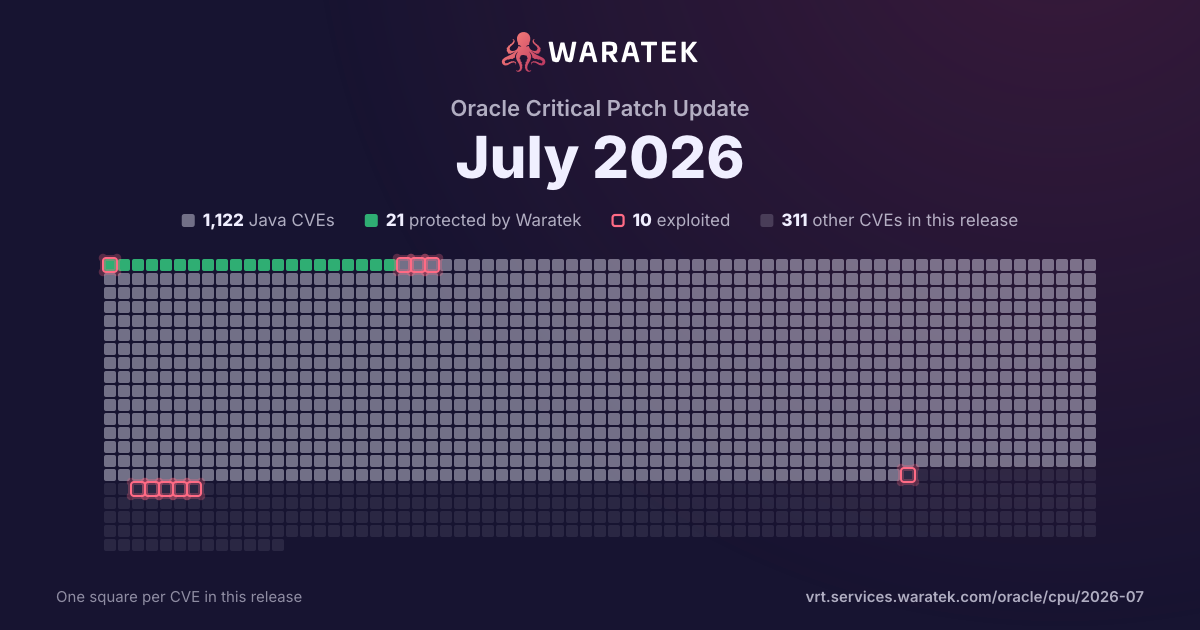
Protected by Waratek, exploitedProtected by WaratekProtected by WaratekProtected by WaratekProtected by WaratekProtected by WaratekProtected by WaratekProtected by WaratekProtected by WaratekProtected by WaratekProtected by WaratekProtected by WaratekProtected by WaratekProtected by WaratekProtected by WaratekProtected by WaratekProtected by WaratekProtected by WaratekProtected by WaratekProtected by WaratekProtected by WaratekMitigation candidate, exploitedMitigation candidate, exploitedMitigation candidate, exploitedMitigation candidateMitigation candidateMitigation candidateMitigation candidateMitigation candidateNo exploit publishedNo exploit publishedNo exploit publishedNo exploit publishedNo exploit publishedNo exploit publishedNo exploit publishedNo exploit publishedNo exploit publishedNo exploit publishedNo exploit publishedNo exploit publishedNo exploit publishedNo exploit publishedNo exploit publishedNo exploit publishedNo exploit publishedNo exploit publishedNo exploit publishedNo exploit publishedNo exploit publishedNo exploit publishedNo exploit publishedNo exploit publishedNo exploit publishedNo exploit publishedNo exploit publishedNo exploit publishedNo exploit publishedNo exploit publishedNo exploit publishedNo exploit publishedNo exploit publishedNo exploit publishedNo exploit publishedNo exploit publishedNo exploit publishedNo exploit publishedNo exploit publishedNo exploit publishedNo exploit publishedNo exploit publishedNo exploit publishedNo exploit publishedNo exploit publishedNo exploit publishedNo exploit publishedNo exploit publishedNo exploit publishedNo exploit publishedNo exploit publishedNo exploit publishedNo exploit publishedNo exploit publishedNo exploit publishedNo exploit publishedNo exploit publishedNo exploit publishedNo exploit publishedNo exploit publishedNo exploit publishedNo exploit publishedNo exploit publishedNo exploit publishedNo exploit publishedNo exploit publishedNo exploit publishedNo exploit publishedNo exploit publishedNo exploit publishedNo exploit publishedNo exploit publishedNo exploit publishedNo exploit publishedNo exploit publishedNo exploit publishedNo exploit publishedNo exploit publishedNo exploit publishedNo exploit publishedNo exploit publishedNo exploit publishedNo exploit publishedNo exploit publishedNo exploit publishedNo exploit publishedNo exploit publishedNo exploit publishedNo exploit publishedNo exploit publishedNo exploit publishedNo exploit publishedNo exploit publishedNo exploit publishedNo exploit publishedNo exploit publishedNo exploit publishedNo exploit publishedNo exploit publishedNo exploit publishedNo exploit publishedNo exploit publishedNo exploit publishedNo exploit publishedNo exploit publishedNo exploit publishedNo exploit publishedNo exploit publishedNo exploit publishedNo exploit publishedNo exploit publishedNo exploit publishedNo exploit publishedNo exploit publishedNo exploit publishedNo exploit publishedNo exploit publishedNo exploit publishedNo exploit publishedNo exploit publishedNo exploit publishedNo exploit publishedNo exploit publishedNo exploit publishedNo exploit publishedNo exploit publishedNo exploit publishedNo exploit publishedNo exploit publishedNo exploit publishedNo exploit publishedNo exploit publishedNo exploit publishedNo exploit publishedNo exploit publishedNo exploit publishedNo exploit publishedNo exploit publishedNo exploit publishedNo exploit publishedNo exploit publishedNo exploit publishedNo exploit publishedNo exploit publishedNo exploit publishedNo exploit publishedNo exploit publishedNo exploit publishedNo exploit publishedNo exploit publishedNo exploit publishedNo exploit publishedNo exploit publishedNo exploit publishedNo exploit publishedNo exploit publishedNo exploit publishedNo exploit publishedNo exploit publishedNo exploit publishedNo exploit publishedNo exploit publishedNo exploit publishedNo exploit publishedNo exploit publishedNo exploit publishedNo exploit publishedNo exploit publishedNo exploit publishedNo exploit publishedNo exploit publishedNo exploit publishedNo exploit publishedNo exploit publishedNo exploit publishedNo exploit publishedNo exploit publishedNo exploit publishedNo exploit publishedNo exploit publishedNo exploit publishedNo exploit publishedNo exploit publishedNo exploit publishedNo exploit publishedNo exploit publishedNo exploit publishedNo exploit publishedNo exploit publishedNo exploit publishedNo exploit publishedNo exploit publishedNo exploit publishedNo exploit publishedNo exploit publishedNo exploit publishedNo exploit publishedNo exploit publishedNo exploit publishedNo exploit publishedNo exploit publishedNo exploit publishedNo exploit publishedNo exploit publishedNo exploit publishedNo exploit publishedNo exploit publishedNo exploit publishedNo exploit publishedNo exploit publishedNo exploit publishedNo exploit publishedNo exploit publishedNo exploit publishedNo exploit publishedNo exploit publishedNo exploit publishedNo exploit publishedNo exploit publishedNo exploit publishedNo exploit publishedNo exploit publishedNo exploit publishedNo exploit publishedNo exploit publishedNo exploit publishedNo exploit publishedNo exploit publishedNo exploit publishedNo exploit publishedNo exploit publishedNo exploit publishedNo exploit publishedNo exploit publishedNo exploit publishedNo exploit publishedNo exploit publishedNo exploit publishedNo exploit publishedNo exploit publishedNo exploit publishedNo exploit publishedNo exploit publishedNo exploit publishedNo exploit publishedNo exploit publishedNo exploit publishedNo exploit publishedNo exploit publishedNo exploit publishedNo exploit publishedNo exploit publishedNo exploit publishedNo exploit publishedNo exploit publishedNo exploit publishedNo exploit publishedNo exploit publishedNo exploit publishedNo exploit publishedNo exploit publishedNo exploit publishedNo exploit publishedNo exploit publishedNo exploit publishedNo exploit publishedNo exploit publishedNo exploit publishedNo exploit publishedNo exploit publishedNo exploit publishedNo exploit publishedNo exploit publishedNo exploit publishedNo exploit publishedNo exploit publishedNo exploit publishedNo exploit publishedNo exploit publishedNo exploit publishedNo exploit publishedNo exploit publishedNo exploit publishedNo exploit publishedNo exploit publishedNo exploit publishedNo exploit publishedNo exploit publishedNo exploit publishedNo exploit publishedNo exploit publishedNo exploit publishedNo exploit publishedNo exploit publishedNo exploit publishedNo exploit publishedNo exploit publishedNo exploit publishedNo exploit publishedNo exploit publishedNo exploit publishedNo exploit publishedNo exploit publishedNo exploit publishedNo exploit publishedNo exploit publishedNo exploit publishedNo exploit publishedNo exploit publishedNo exploit publishedNo exploit publishedNo exploit publishedNo exploit publishedNo exploit publishedNo exploit publishedNo exploit publishedNo exploit publishedNo exploit publishedNo exploit publishedNo exploit publishedNo exploit publishedNo exploit publishedNo exploit publishedNo exploit publishedNo exploit publishedNo exploit publishedNo exploit publishedNo exploit publishedNo exploit publishedNo exploit publishedNo exploit publishedNo exploit publishedNo exploit publishedNo exploit publishedNo exploit publishedNo exploit publishedNo exploit publishedNo exploit publishedNo exploit publishedNo exploit publishedNo exploit publishedNo exploit publishedNo exploit publishedNo exploit publishedNo exploit publishedNo exploit publishedNo exploit publishedNo exploit publishedNo exploit publishedNo exploit publishedNo exploit publishedNo exploit publishedNo exploit publishedNo exploit publishedNo exploit publishedNo exploit publishedNo exploit publishedNo exploit publishedNo exploit publishedNo exploit publishedNo exploit publishedNo exploit publishedNo exploit publishedNo exploit publishedNo exploit publishedNo exploit publishedNo exploit publishedNo exploit publishedNo exploit publishedNo exploit publishedNo exploit publishedNo exploit publishedNo exploit publishedNo exploit publishedNo exploit publishedNo exploit publishedNo exploit publishedNo exploit publishedNo exploit publishedNo exploit publishedNo exploit publishedNo exploit publishedNo exploit publishedNo exploit publishedNo exploit publishedNo exploit publishedNo exploit publishedNo exploit publishedNo exploit publishedNo exploit publishedNo exploit publishedNo exploit publishedNo exploit publishedNo exploit publishedNo exploit publishedNo exploit publishedNo exploit publishedNo exploit publishedNo exploit publishedNo exploit publishedNo exploit publishedNo exploit publishedNo exploit publishedNo exploit publishedNo exploit publishedNo exploit publishedNo exploit publishedNo exploit publishedNo exploit publishedNo exploit publishedNo exploit publishedNo exploit publishedNo exploit publishedNo exploit publishedNo exploit publishedNo exploit publishedNo exploit publishedNo exploit publishedNo exploit publishedNo exploit publishedNo exploit publishedNo exploit publishedNo exploit publishedNo exploit publishedNo exploit publishedNo exploit publishedNo exploit publishedNo exploit publishedNo exploit publishedNo exploit publishedNo exploit publishedNo exploit publishedNo exploit publishedNo exploit publishedNo exploit publishedNo exploit publishedNo exploit publishedNo exploit publishedNo exploit publishedNo exploit publishedNo exploit publishedNo exploit publishedNo exploit publishedNo exploit publishedNo exploit publishedNo exploit publishedNo exploit publishedNo exploit publishedNo exploit publishedNo exploit publishedNo exploit publishedNo exploit publishedNo exploit publishedNo exploit publishedNo exploit publishedNo exploit publishedNo exploit publishedNo exploit publishedNo exploit publishedNo exploit publishedNo exploit publishedNo exploit publishedNo exploit publishedNo exploit publishedNo exploit publishedNo exploit publishedNo exploit publishedNo exploit publishedNo exploit publishedNo exploit publishedNo exploit publishedNo exploit publishedNo exploit publishedNo exploit publishedNo exploit publishedNo exploit publishedNo exploit publishedNo exploit publishedNo exploit publishedNo exploit publishedNo exploit publishedNo exploit publishedNo exploit publishedNo exploit publishedNo exploit publishedNo exploit publishedNo exploit publishedNo exploit publishedNo exploit publishedNo exploit publishedNo exploit publishedNo exploit publishedNo exploit publishedNo exploit publishedNo exploit publishedNo exploit publishedNo exploit publishedNo exploit publishedNo exploit publishedNo exploit publishedNo exploit publishedNo exploit publishedNo exploit publishedNo exploit publishedNo exploit publishedNo exploit publishedNo exploit publishedNo exploit publishedNo exploit publishedNo exploit publishedNo exploit publishedNo exploit publishedNo exploit publishedNo exploit publishedNo exploit publishedNo exploit publishedNo exploit publishedNo exploit publishedNo exploit publishedNo exploit publishedNo exploit publishedNo exploit publishedNo exploit publishedNo exploit publishedNo exploit publishedNo exploit publishedNo exploit publishedNo exploit publishedNo exploit publishedNo exploit publishedNo exploit publishedNo exploit publishedNo exploit publishedNo exploit publishedNo exploit publishedNo exploit publishedNo exploit publishedNo exploit publishedNo exploit publishedNo exploit publishedNo exploit publishedNo exploit publishedNo exploit publishedNo exploit publishedNo exploit publishedNo exploit publishedNo exploit publishedNo exploit publishedNo exploit publishedNo exploit publishedNo exploit publishedNo exploit publishedNo exploit publishedNo exploit publishedNo exploit publishedNo exploit publishedNo exploit publishedNo exploit publishedNo exploit publishedNo exploit publishedNo exploit publishedNo exploit publishedNo exploit publishedNo exploit publishedNo exploit publishedNo exploit publishedNo exploit publishedNo exploit publishedNo exploit publishedNo exploit publishedNo exploit publishedNo exploit publishedNo exploit publishedNo exploit publishedNo exploit publishedNo exploit publishedNo exploit publishedNo exploit publishedNo exploit publishedNo exploit publishedNo exploit publishedNo exploit publishedNo exploit publishedNo exploit publishedNo exploit publishedNo exploit publishedNo exploit publishedNo exploit publishedNo exploit publishedNo exploit publishedNo exploit publishedNo exploit publishedNo exploit publishedNo exploit publishedNo exploit publishedNo exploit publishedNo exploit publishedNo exploit publishedNo exploit publishedNo exploit publishedNo exploit publishedNo exploit publishedNo exploit publishedNo exploit publishedNo exploit publishedNo exploit publishedNo exploit publishedNo exploit publishedNo exploit publishedNo exploit publishedNo exploit publishedNo exploit publishedNo exploit publishedNo exploit publishedNo exploit publishedNo exploit publishedNo exploit publishedNo exploit publishedNo exploit publishedNo exploit publishedNo exploit publishedNo exploit publishedNo exploit publishedNo exploit publishedNo exploit publishedNo exploit publishedNo exploit publishedNo exploit publishedNo exploit publishedNo exploit publishedNo exploit publishedNo exploit publishedNo exploit publishedNo exploit publishedNo exploit publishedNo exploit publishedNo exploit publishedNo exploit publishedNo exploit publishedNo exploit publishedNo exploit publishedNo exploit publishedNo exploit publishedNo exploit publishedNo exploit publishedNo exploit publishedNo exploit publishedNo exploit publishedNo exploit publishedNo exploit publishedNo exploit publishedNo exploit publishedNo exploit publishedNo exploit publishedNo exploit publishedNo exploit publishedNo exploit publishedNo exploit publishedNo exploit publishedNo exploit publishedNo exploit publishedNo exploit publishedNo exploit publishedNo exploit publishedNo exploit publishedNo exploit publishedNo exploit publishedNo exploit publishedNo exploit publishedNo exploit publishedNo exploit publishedNo exploit publishedNo exploit publishedNo exploit publishedNo exploit publishedNo exploit publishedNo exploit publishedNo exploit publishedNo exploit publishedNo exploit publishedNo exploit publishedNo exploit publishedNo exploit publishedNo exploit publishedNo exploit publishedNo exploit publishedNo exploit publishedNo exploit publishedNo exploit publishedNo exploit publishedNo exploit publishedNo exploit publishedNo exploit publishedNo exploit publishedNo exploit publishedNo exploit publishedNo exploit publishedNo exploit publishedNo exploit publishedNo exploit publishedNo exploit publishedNo exploit publishedNo exploit publishedNo exploit publishedNo exploit publishedNo exploit publishedNo exploit publishedNo exploit publishedNo exploit publishedNo exploit publishedNo exploit publishedNo exploit publishedNo exploit publishedNo exploit publishedNo exploit publishedNo exploit publishedNo exploit publishedNo exploit publishedNo exploit publishedNo exploit publishedNo exploit publishedNo exploit publishedNo exploit publishedNo exploit publishedNo exploit publishedNo exploit publishedNo exploit publishedNo exploit publishedNo exploit publishedNo exploit publishedNo exploit publishedNo exploit publishedNo exploit publishedNo exploit publishedNo exploit publishedNo exploit publishedNo exploit publishedNo exploit publishedNo exploit publishedNo exploit publishedNo exploit publishedNo exploit publishedNo exploit publishedNo exploit publishedNo exploit publishedNo exploit publishedNo exploit publishedNo exploit publishedNo exploit publishedNo exploit publishedNo exploit publishedNo exploit publishedNo exploit publishedNo exploit publishedNo exploit publishedNo exploit publishedNo exploit publishedNo exploit publishedNo exploit publishedNo exploit publishedNo exploit publishedNo exploit publishedNo exploit publishedNo exploit publishedNo exploit publishedNo exploit publishedNo exploit publishedNo exploit publishedNo exploit publishedNo exploit publishedNo exploit publishedNo exploit publishedNo exploit publishedNo exploit publishedNo exploit publishedNo exploit publishedNo exploit publishedNo exploit publishedNo exploit publishedNo exploit publishedNo exploit publishedNo exploit publishedNo exploit publishedNo exploit publishedNo exploit publishedNo exploit publishedNo exploit publishedNo exploit publishedNo exploit publishedNo exploit publishedNo exploit publishedNo exploit publishedNo exploit publishedNo exploit publishedNo exploit publishedNo exploit publishedNo exploit publishedNo exploit publishedNo exploit publishedNo exploit publishedNo exploit publishedNo exploit publishedNo exploit publishedNo exploit publishedNo exploit publishedNo exploit publishedNo exploit publishedNo exploit publishedNo exploit publishedNo exploit publishedNo exploit publishedNo exploit publishedNo exploit publishedNo exploit publishedNo exploit publishedNo exploit publishedNo exploit publishedNo exploit publishedNo exploit publishedNo exploit publishedNo exploit publishedNo exploit publishedNo exploit publishedNo exploit publishedNo exploit publishedNo exploit publishedNo exploit publishedNo exploit publishedNo exploit publishedNo exploit publishedNo exploit publishedNo exploit publishedNo exploit publishedNo exploit publishedNo exploit publishedNo exploit publishedNo exploit publishedNo exploit publishedNo exploit publishedNo exploit publishedNo exploit publishedNo exploit publishedNo exploit publishedNo exploit publishedNo exploit publishedNo exploit publishedNo exploit publishedNo exploit publishedNo exploit publishedNo exploit publishedNo exploit publishedNo exploit publishedNo exploit publishedNo exploit publishedNo exploit publishedNo exploit publishedNo exploit publishedNo exploit publishedNo exploit publishedNo exploit publishedNo exploit publishedNo exploit publishedNo exploit publishedNo exploit publishedNo exploit publishedNo exploit publishedNo exploit publishedNo exploit publishedNo exploit publishedNo exploit publishedNo exploit publishedNo exploit publishedNo exploit publishedNo exploit publishedNo exploit publishedNo exploit publishedNo exploit publishedNo exploit publishedNo exploit publishedNo exploit publishedNo exploit publishedNo exploit publishedNo exploit publishedNo exploit publishedNo exploit publishedNo exploit publishedNo exploit publishedNo exploit publishedNo exploit publishedNo exploit publishedNo exploit publishedNo exploit publishedNo exploit publishedNo exploit publishedNo exploit publishedNo exploit publishedNo exploit publishedNo exploit publishedNo exploit publishedNo exploit publishedNo exploit publishedNo exploit publishedNo exploit publishedNo exploit publishedNo exploit publishedNo exploit publishedNo exploit publishedNo exploit publishedNo exploit publishedNo exploit publishedNo exploit publishedNo exploit publishedNo exploit publishedNo exploit publishedNo exploit publishedNo exploit publishedNo exploit publishedNo exploit publishedNo exploit publishedNo exploit publishedNo exploit publishedNo exploit publishedNo exploit publishedNo exploit publishedNo exploit publishedNo exploit publishedNo exploit publishedNo exploit publishedNo exploit publishedNo exploit publishedNo exploit publishedNo exploit publishedNo exploit publishedNo exploit publishedNo exploit publishedNo exploit publishedNo exploit publishedNo exploit publishedNo exploit publishedNo exploit publishedNo exploit publishedNo exploit publishedNo exploit publishedNo exploit publishedNo exploit publishedNo exploit publishedNo exploit publishedNo exploit publishedNo exploit publishedNo exploit publishedNo exploit publishedNo exploit publishedNo exploit publishedNo exploit publishedNo exploit publishedNo exploit publishedNo exploit publishedNo exploit publishedNo exploit publishedNo exploit publishedNo exploit publishedNo exploit publishedNo exploit publishedNo exploit publishedNo exploit publishedNo exploit publishedNo exploit publishedNo exploit publishedNo exploit publishedNo exploit publishedNo exploit publishedNo exploit publishedNo exploit publishedNo exploit publishedNo exploit publishedNo exploit publishedNo exploit publishedNo exploit publishedNo exploit publishedNo exploit publishedNo exploit publishedNo exploit publishedNo exploit publishedNo exploit publishedNo exploit publishedNo exploit publishedNo exploit publishedNo exploit publishedNo exploit publishedNo exploit publishedNo exploit publishedNo exploit publishedNo exploit publishedNo exploit publishedNo exploit publishedNo exploit publishedNo exploit publishedNo exploit publishedNo exploit publishedNo exploit publishedNo exploit publishedNo exploit publishedNo exploit publishedNo exploit publishedNo exploit publishedNo exploit publishedNo exploit publishedNo exploit publishedNo exploit publishedNo exploit publishedNo exploit publishedNo exploit publishedNo exploit publishedNo exploit publishedNo exploit publishedNo exploit publishedNo exploit publishedNo exploit publishedNo exploit publishedNo exploit publishedNo exploit publishedNo exploit publishedNo exploit publishedNo exploit publishedNo exploit publishedNo exploit publishedNo exploit publishedNo exploit publishedNo exploit publishedNo exploit publishedNo exploit publishedNo exploit publishedNo exploit publishedNo exploit publishedNo exploit publishedNo exploit publishedNo exploit publishedNo exploit publishedNo exploit publishedNo exploit publishedNo exploit publishedNo exploit publishedNo exploit publishedNo exploit publishedNo exploit publishedNo exploit publishedNo exploit publishedNo exploit publishedNo exploit publishedNo exploit publishedNo exploit publishedNo exploit publishedNo exploit publishedNo exploit publishedNo exploit publishedNo exploit publishedNo exploit publishedNo exploit publishedNo exploit publishedNo exploit publishedNo exploit publishedNo exploit publishedNo exploit publishedNo exploit publishedNo exploit publishedNo exploit publishedNo exploit publishedNo exploit publishedNo exploit publishedNo exploit publishedNo exploit publishedNo exploit publishedNo exploit publishedNo exploit publishedNo exploit publishedNo exploit publishedNo exploit publishedNo exploit publishedNo exploit publishedNo exploit publishedNo exploit publishedNo exploit publishedNo exploit publishedNo exploit publishedNo exploit publishedNo exploit publishedNo exploit publishedNo exploit publishedNo exploit publishedNo exploit publishedNo exploit publishedNo exploit publishedNo exploit publishedOutside Waratek scope, exploitedOutside Waratek scopeOutside Waratek scopeOutside Waratek scopeOutside Waratek scopeOutside Waratek scopeOutside Waratek scopeOutside Waratek scopeOutside Waratek scopeOutside Waratek scopeOutside Waratek scopeOutside Waratek scopeOutside Waratek scopeOutside Waratek scopeOutside Waratek scopeOutside Waratek scopeNot applicable, exploitedNot applicable, exploitedNot applicable, exploitedNot applicable, exploitedNot applicable, exploitedNot applicableNot applicableNot applicableNot applicableNot applicableNot applicableNot applicableNot applicableNot applicableNot applicableNot applicableNot applicableNot applicableNot applicableNot applicableNot applicableNot applicableNot applicableNot applicableNot applicableNot applicableNot applicableNot applicableNot applicableNot applicableNot applicableNot applicableNot applicableNot applicableNot applicableNot applicableNot applicableNot applicableNot applicableNot applicableNot applicableNot applicableNot applicableNot applicableNot applicableNot applicableNot applicableNot applicableNot applicableNot applicableNot applicableNot applicableNot applicableNot applicableNot applicableNot applicableNot applicableNot applicableNot applicableNot applicableNot applicableNot applicableNot applicableNot applicableNot applicableNot applicableNot applicableNot applicableNot applicableNot applicableNot applicableNot applicableNot applicableNot applicableNot applicableNot applicableNot applicableNot applicableNot applicableNot applicableNot applicableNot applicableNot applicableNot applicableNot applicableNot applicableNot applicableNot applicableNot applicableNot applicableNot applicableNot applicableNot applicableNot applicableNot applicableNot applicableNot applicableNot applicableNot applicableNot applicableNot applicableNot applicableNot applicableNot applicableNot applicableNot applicableNot applicableNot applicableNot applicableNot applicableNot applicableNot applicableNot applicableNot applicableNot applicableNot applicableNot applicableNot applicableNot applicableNot applicableNot applicableNot applicableNot applicableNot applicableNot applicableNot applicableNot applicableNot applicableNot applicableNot applicableNot applicableNot applicableNot applicableNot applicableNot applicableNot applicableNot applicableNot applicableNot applicableNot applicableNot applicableNot applicableNot applicableNot applicableNot applicableNot applicableNot applicableNot applicableNot applicableNot applicableNot applicableNot applicableNot applicableNot applicableNot applicableNot applicableNot applicableNot applicableNot applicableNot applicableNot applicableNot applicableNot applicableNot applicableNot applicableNot applicableNot applicableNot applicableNot applicableNot applicableNot applicableNot applicableNot applicableNot applicableNot applicableNot applicableNot applicableNot applicableNot applicableNot applicableNot applicableNot applicableNot applicableNot applicableNot applicableNot applicableNot applicableNot applicableNot applicableNot applicableNot applicableNot applicableNot applicableNot applicableNot applicableNot applicableNot applicableNot applicableNot applicableNot applicableNot applicableNot applicableNot applicableNot applicableNot applicableNot applicableNot applicableNot applicableNot applicableNot applicableNot applicableNot applicableNot applicableNot applicableNot applicableNot applicableNot applicableNot applicableNot applicableNot applicableNot applicableNot applicableNot applicableNot applicableNot applicableNot applicableNot applicableNot applicableNot applicableNot applicableNot applicableNot applicableNot applicableNot applicableNot applicableNot applicableNot applicableNot applicableNot applicableNot applicableNot applicableNot applicableNot applicableNot applicableNot applicableNot applicableNot applicableNot applicableNot applicableNot applicableNot applicableNot applicableNot applicableNot applicableNot applicableNot applicableNot applicableNot applicableNot applicableNot applicableNot applicableNot applicableNot applicableNot applicableNot applicableNot applicableNot applicableNot applicableNot applicableNot applicableNot applicableNot applicableNot applicableNot applicableNot applicableNot applicableNot applicableNot applicableNot applicableNot applicableNot applicableNot applicableNot applicableNot applicableNot applicableNot applicableNot applicableNot applicableNot applicableNot applicableNot applicableNot applicableNot applicableNot applicableNot applicable
Share this chart Oracle Critical Patch Update July 2026, one square per CVE: 1,122 Java CVEs, 21 protected by Waratek, 10 exploited, 311 other CVEs in this release.

Download the image

By status

No exploit published. For 971 of them, Oracle's security advisory is the source of public detail.

Protected by Waratek. Waratek RASP can block exploitation of these on systems that have not applied the patch yet.

Reset
More filters
Columns
Including CVEs outside Waratek scope✕
Overview 29 matches · 0 in Waratek scope · 0 protected · 2 exploited · 1 CISA KEV · 2 public PoC · 2 EPSS ≥ 0.5
Protected by Waratek 0 0.0% Rule in development 0 0.0% Mitigation candidate 0 0.0% No exploit published 0 0.0% Outside Waratek scope 0 0.0% Not applicable 29 100.0% Withdrawn CVE 0 0.0%
Critical 29 100.0% High 0 0.0% Medium 0 0.0% Low 0 0.0% None 0 0.0% Unknown 0 0.0%
blocked by ARMR today 0 0.0% partly blocked 0 0.0% not blocked 29 100.0% not established 0 0.0% unrecorded 0 0.0%
Exploited 2 6.9% Working exploit published 0 0.0% Proof of concept only 1 3.4% Forecast only 0 0.0% No public exploit 26 89.7%
29 matches Sign in to download these CVEs as CSV or JSON, or to follow them in a feed.
CVE Severity Published▾ Status Exploitation Description
CVE-2026-61211 Critical 2026-07-21 Not applicable No public exploit Vulnerability in the RDBMS component of Oracle Database Server. Supported versions that are affected are 19.3-19.31 and 23.4.0-23.26.2. Easily exploitable vulnerability allows low privileged attacker having Execute DBMS_CLOUD privilege with network access via Oracle Net to compromise RDBMS. While the vulnerability is in RDBMS, attacks may significantly impact additional products (scope change). Successful attacks of this vulnerability can result in takeover of RDBMS. CVSS 3.1 Base Score 9.9 (Confidentiality, Integrity and Availability impacts). CVSS Vector: (CVSS:3.1/AV:N/AC:L/PR:L/UI:N/S:C/C:H/I:H/A:H).
CVE-2026-60438 Critical 2026-07-21 Not applicable No public exploit Vulnerability in the Oracle HTTP Server product of Oracle Fusion Middleware (component: mod_ssl). Supported versions that are affected are 12.2.1.4.0 and 14.1.2.0.0. Easily exploitable vulnerability allows unauthenticated attacker with network access via HTTP to compromise Oracle HTTP Server. Successful attacks of this vulnerability can result in unauthorized creation, deletion or modification access to critical data or all Oracle HTTP Server accessible data as well as unauthorized access to critical data or complete access to all Oracle HTTP Server accessible data. CVSS 3.1 Base Score 9.1 (Confidentiality and Integrity impacts). CVSS Vector: (CVSS:3.1/AV:N/AC:L/PR:N/UI:N/S:U/C:H/I:H/A:N).
CVE-2026-60402 Critical 2026-07-21 Not applicable No public exploit Vulnerability in the TimesTen In-Memory Database product of Oracle TimesTen In-Memory Database (component: Kubernetes Operator). The supported version that is affected is 26.1.1.1.0. Easily exploitable vulnerability allows low privileged attacker with network access via HTTPS to compromise TimesTen In-Memory Database. While the vulnerability is in TimesTen In-Memory Database, attacks may significantly impact additional products (scope change). Successful attacks of this vulnerability can result in takeover of TimesTen In-Memory Database. CVSS 3.1 Base Score 9.9 (Confidentiality, Integrity and Availability impacts). CVSS Vector: (CVSS:3.1/AV:N/AC:L/PR:L/UI:N/S:C/C:H/I:H/A:H).
CVE-2026-60365 Critical 2026-07-21 Not applicable No public exploit Vulnerability in the Oracle Weblogic Server Proxy Plug-in product of Oracle Fusion Middleware (component: WebLogic Server Proxy Plug-In for Third-Party Web Servers). The supported version that is affected is 15.1.1.0.0. Easily exploitable vulnerability allows unauthenticated attacker with network access via HTTP to compromise Oracle Weblogic Server Proxy Plug-in. While the vulnerability is in Oracle Weblogic Server Proxy Plug-in, attacks may significantly impact additional products (scope change). Successful attacks of this vulnerability can result in unauthorized creation, deletion or modification access to critical data or all Oracle Weblogic Server Proxy Plug-in accessible data as well as unauthorized access to critical data or complete access to all Oracle Weblogic Server Proxy Plug-in accessible data. CVSS 3.1 Base Score 10.0 (Confidentiality and Integrity impacts). CVSS Vector: (CVSS:3.1/AV:N/AC:L/PR:N/UI:N/S:C/C:H/I:H/A:N).
CVE-2026-60364 Critical 2026-07-21 Not applicable No public exploit Vulnerability in the Oracle Weblogic Server Proxy Plug-in product of Oracle Fusion Middleware (component: WebLogic Server Proxy Plug-In for Third-Party Web Servers). Supported versions that are affected are 12.2.1.4.0 and 14.1.2.0.0. Easily exploitable vulnerability allows unauthenticated attacker with network access via HTTP to compromise Oracle Weblogic Server Proxy Plug-in. Successful attacks of this vulnerability can result in unauthorized creation, deletion or modification access to critical data or all Oracle Weblogic Server Proxy Plug-in accessible data. CVSS 3.1 Base Score 7.5 (Integrity impacts). CVSS Vector: (CVSS:3.1/AV:N/AC:L/PR:N/UI:N/S:U/C:N/I:H/A:N).
CVE-2026-60363 Critical 2026-07-21 Not applicable No public exploit Vulnerability in the Oracle HTTP Server product of Oracle Fusion Middleware (component: Apache Plugin). Supported versions that are affected are 12.2.1.4.0 and 14.1.2.0.0. Easily exploitable vulnerability allows unauthenticated attacker with network access via HTTP to compromise Oracle HTTP Server. Successful attacks of this vulnerability can result in takeover of Oracle HTTP Server. CVSS 3.1 Base Score 9.8 (Confidentiality, Integrity and Availability impacts). CVSS Vector: (CVSS:3.1/AV:N/AC:L/PR:N/UI:N/S:U/C:H/I:H/A:H).
CVE-2026-60168 Critical 2026-07-21 Not applicable No public exploit Vulnerability in the Oracle Hospitality Simphony product of Oracle Food and Beverage Applications (component: POS). Supported versions that are affected are 19.8-19.8.5, 19.9-19.9.3 and 19.10. Easily exploitable vulnerability allows unauthenticated attacker with network access via HTTP to compromise Oracle Hospitality Simphony. Successful attacks of this vulnerability can result in unauthorized creation, deletion or modification access to critical data or all Oracle Hospitality Simphony accessible data and unauthorized ability to cause a hang or frequently repeatable crash (complete DOS) of Oracle Hospitality Simphony. CVSS 3.1 Base Score 9.1 (Integrity and Availability impacts). CVSS Vector: (CVSS:3.1/AV:N/AC:L/PR:N/UI:N/S:U/C:N/I:H/A:H).
CVE-2026-34182 Critical 2026-06-09 Not applicable No public exploit Issue Summary: Cryptographic Message Services (CMS) processing fails to perform sufficient input validation on the cipher and tag length fields of AuthEnvelopedData containers, leading to various potential compromises. Impact Summary: Attackers making use of these vulnerabilities may achieve key-equivalent functionality for a given CMS recipient and/or bypass integrity validation for a given message. In one use case, an attacker may send a CMS message containing AuthEnvelopedData with the cipher specified as a non-AEAD cipher. OpenSSL erroneously allows this selection, and attempts to decrypt and validate the message. An on-path attacker who captures one legitimate AES-GCM AuthEnvelopedData addressed to the victim can re-emit it with the recipientInfos set left byte-for-byte intact, so the victim's private key still unwraps the genuine CEK (the content-encryption key), but with the inner OID rewritten to AES-256-OFB (Output Feedback Mode, an unauthenticated keystream mode) and with an attacker-chosen IV and ciphertext. The victim initializes AES-256-OFB under the real CEK, never consults the MAC field, and CMS_decrypt() returns success. If the application under attack responds to the attacker with any indicator showing success or failure of the decryption effort, it is possible for the attacker to use this as an oracle to obtain key equivalent functionality for the CEK used for the chosen recipient of the message. In another use case, an attacker can reduce the tag length of the chosen AEAD cipher for a given AuthEnvelopedData container to be a single byte long, allowing an attacker to brute force CMS decryption, producing an integrity bypass for applications that trust CMS_decrypt() to reject modified content. The FIPS modules are not affected by this issue.
CVE-2026-44631 Critical 2026-06-08 Not applicable No public exploit Buffer Underwrite vulnerability in Apache HTTP Server on crafted regular expressions in the configuration. This issue affects Apache HTTP Server: from 2.4.0 through 2.4.67. Users are recommended to upgrade to version 2.4.68, which fixes the issue.
CVE-2026-42535 Critical 2026-06-08 Not applicable No public exploit A path handling issue in mod_dav_fs in Apache 2.4.67 and earlier allows a WebDAV content author to directly manipulate trusted DAV property databases, potentially causing child process crashes. Users are recommended to upgrade to version 2.4.68, which fixes this issue.
CVE-2026-29167 Critical 2026-06-08 Not applicable No public exploit Use After Free vulnerability in Apache HTTP Server with mod_ldap in per-directory configuration This issue affects Apache HTTP Server: from 2.4.0 through 2.4.67. Users are recommended to upgrade to version 2.4.68, which fixes the issue.
CVE-2026-9256 Critical 2026-05-22 Not applicable No public exploit NGINX Plus and NGINX Open Source have a vulnerability in the ngx_http_rewrite_module module. This vulnerability exists when a rewrite directive uses a regex pattern with distinct, overlapping Perl-Compatible Regular Expression (PCRE) captures (for example, ^/((.*))$) and a replacement string that references multiple such captures (for example, $1$2) in a redirect or arguments context. An unauthenticated attacker along with conditions beyond their control can exploit this vulnerability by sending crafted HTTP requests. This may cause a heap buffer overflow in the NGINX worker process leading to a restart. Additionally, attackers can execute code on systems with Address Space Layout Randomization (ASLR) disabled or when the attacker can bypass ASLR. Note: Software versions which have reached End of Technical Support (EoTS) are not evaluated.
CVE-2026-42945 Critical 2026-05-13 Not applicable Exploited NGINX Plus and NGINX Open Source have a vulnerability in the ngx_http_rewrite_module module. This vulnerability exists when the rewrite directive is followed by a rewrite, if, or set directive and an unnamed Perl-Compatible Regular Expression (PCRE) capture (for example, $1, $2) with a replacement string that includes a question mark (?). An unauthenticated attacker along with conditions beyond its control can exploit this vulnerability by sending crafted HTTP requests. This may cause a heap buffer overflow in the NGINX worker process leading to a restart. Additionally, attackers can execute code on systems with Address Space Layout Randomization (ASLR) disabled or when the attacker can bypass ASLR.  Note: Software versions which have reached End of Technical Support (EoTS) are not evaluated.
CVE-2026-31789 Critical 2026-04-07 Not applicable No public exploit Issue summary: Converting an excessively large OCTET STRING value to a hexadecimal string leads to a heap buffer overflow on 32 bit platforms. Impact summary: A heap buffer overflow may lead to a crash or possibly an attacker controlled code execution or other undefined behavior. If an attacker can supply a crafted X.509 certificate with an excessively large OCTET STRING value in extensions such as the Subject Key Identifier (SKID) or Authority Key Identifier (AKID) which are being converted to hex, the size of the buffer needed for the result is calculated as multiplication of the input length by 3. On 32 bit platforms, this multiplication may overflow resulting in the allocation of a smaller buffer and a heap buffer overflow. Applications and services that print or log contents of untrusted X.509 certificates are vulnerable to this issue. As the certificates would have to have sizes of over 1 Gigabyte, printing or logging such certificates is a fairly unlikely operation and only 32 bit platforms are affected, this issue was assigned Low severity. The FIPS modules in 3.6, 3.5, 3.4, 3.3 and 3.0 are not affected by this issue, as the affected code is outside the OpenSSL FIPS module boundary.
CVE-2026-28386 Critical 2026-04-07 Not applicable No public exploit Issue summary: Applications using AES-CFB128 encryption or decryption on systems with AVX-512 and VAES support can trigger an out-of-bounds read of up to 15 bytes when processing partial cipher blocks. Impact summary: This out-of-bounds read may trigger a crash which leads to Denial of Service for an application if the input buffer ends at a memory page boundary and the following page is unmapped. There is no information disclosure as the over-read bytes are not written to output. The vulnerable code path is only reached when processing partial blocks (when a previous call left an incomplete block and the current call provides fewer bytes than needed to complete it). Additionally, the input buffer must be positioned at a page boundary with the following page unmapped. CFB mode is not used in TLS/DTLS protocols, which use CBC, GCM, CCM, or ChaCha20-Poly1305 instead. For these reasons the issue was assessed as Low severity according to our Security Policy. Only x86-64 systems with AVX-512 and VAES instruction support are affected. Other architectures and systems without VAES support use different code paths that are not affected. OpenSSL FIPS module in 3.6 version is affected by this issue.
CVE-2026-31402 Critical 2026-04-03 Not applicable No public exploit In the Linux kernel, the following vulnerability has been resolved: nfsd: fix heap overflow in NFSv4.0 LOCK replay cache The NFSv4.0 replay cache uses a fixed 112-byte inline buffer (rp_ibuf[NFSD4_REPLAY_ISIZE]) to store encoded operation responses. This size was calculated based on OPEN responses and does not account for LOCK denied responses, which include the conflicting lock owner as a variable-length field up to 1024 bytes (NFS4_OPAQUE_LIMIT). When a LOCK operation is denied due to a conflict with an existing lock that has a large owner, nfsd4_encode_operation() copies the full encoded response into the undersized replay buffer via read_bytes_from_xdr_buf() with no bounds check. This results in a slab-out-of-bounds write of up to 944 bytes past the end of the buffer, corrupting adjacent heap memory. This can be triggered remotely by an unauthenticated attacker with two cooperating NFSv4.0 clients: one sets a lock with a large owner string, then the other requests a conflicting lock to provoke the denial. We could fix this by increasing NFSD4_REPLAY_ISIZE to allow for a full opaque, but that would increase the size of every stateowner, when most lockowners are not that large. Instead, fix this by checking the encoded response length against NFSD4_REPLAY_ISIZE before copying into the replay buffer. If the response is too large, set rp_buflen to 0 to skip caching the replay payload. The status is still cached, and the client already received the correct response on the original request.
CVE-2026-4800 Critical 2026-03-31 Not applicable No public exploit The fix for CVE-2021-23337 added validation for the variable option in _.template but did not apply the same validation to options.imports key names, and both paths flow into the same Function() constructor sink. When an application passes untrusted input as options.imports key names, an attacker can inject default-parameter expressions that execute arbitrary code at template compilation time. Additionally, _.template uses assignInWith to merge imports, which enumerates inherited properties via for..in, so if Object.prototype has been polluted by another vector the polluted keys are copied into the imports object and passed to Function(). The issue is fixed in 4.18.1 for lodash, lodash-es, lodash-amd, and lodash.template. As a workaround, do not pass untrusted input as key names in options.imports; use only developer-controlled, static key names.
CVE-2026-5121 Critical 2026-03-30 Not applicable No public exploit A flaw was found in libarchive. On 32-bit systems, an integer overflow vulnerability exists in the zisofs block pointer allocation logic. A remote attacker can exploit this by providing a specially crafted ISO9660 image, which can lead to a heap buffer overflow. This could potentially allow for arbitrary code execution on the affected system.
CVE-2026-4176 Critical 2026-03-29 Not applicable No public exploit Perl versions from 5.9.4 before 5.40.4-RC1, from 5.41.0 before 5.42.2-RC1, from 5.43.0 before 5.43.9 contain a vulnerable version of Compress::Raw::Zlib. Compress::Raw::Zlib is included in the Perl package as a dual-life core module, and is vulnerable to CVE-2026-3381 due to a vendored version of zlib which has several vulnerabilities, including CVE-2026-27171. The bundled Compress::Raw::Zlib was updated to version 2.221 in Perl blead commit c75ae9cc164205e1b6d6dbd57bd2c65c8593fe94.
CVE-2026-4738 Critical 2026-03-24 Not applicable No public exploit Improper Restriction of Operations within the Bounds of a Memory Buffer vulnerability in OSGeo gdal (frmts/zlib/contrib/infback9 modules). This vulnerability is associated with program files inftree9.C‎. This issue affects gdal: before 3.11.0.
CVE-2026-33186 Critical 2026-03-20 Not applicable No public exploit gRPC-Go is the Go language implementation of gRPC. Versions prior to 1.79.3 have an authorization bypass resulting from improper input validation of the HTTP/2 `:path` pseudo-header. The gRPC-Go server was too lenient in its routing logic, accepting requests where the `:path` omitted the mandatory leading slash (e.g., `Service/Method` instead of `/Service/Method`). While the server successfully routed these requests to the correct handler, authorization interceptors (including the official `grpc/authz` package) evaluated the raw, non-canonical path string. Consequently, "deny" rules defined using canonical paths (starting with `/`) failed to match the incoming request, allowing it to bypass the policy if a fallback "allow" rule was present. This affects gRPC-Go servers that use path-based authorization interceptors, such as the official RBAC implementation in `google.golang.org/grpc/authz` or custom interceptors relying on `info.FullMethod` or `grpc.Method(ctx)`; AND that have a security policy contains specific "deny" rules for canonical paths but allows other requests by default (a fallback "allow" rule). The vulnerability is exploitable by an attacker who can send raw HTTP/2 frames with malformed `:path` headers directly to the gRPC server. The fix in version 1.79.3 ensures that any request with a `:path` that does not start with a leading slash is immediately rejected with a `codes.Unimplemented` error, preventing it from reaching authorization interceptors or handlers with a non-canonical path string. While upgrading is the most secure and recommended path, users can mitigate the vulnerability using one of the following methods: Use a validating interceptor (recommended mitigation); infrastructure-level normalization; and/or policy hardening.
CVE-2026-3381 Critical 2026-03-05 Not applicable No public exploit Compress::Raw::Zlib versions through 2.219 for Perl use potentially insecure versions of zlib. Compress::Raw::Zlib includes a copy of the zlib library. Compress::Raw::Zlib version 2.220 includes zlib 1.3.2, which addresses findings fron the 7ASecurity audit of zlib. The includes fixs for CVE-2026-27171.
CVE-2026-21636 Critical 2026-01-20 Not applicable No public exploit A flaw in Node.js's permission model allows Unix Domain Socket (UDS) connections to bypass network restrictions when `--permission` is enabled. Even without `--allow-net`, attacker-controlled inputs (such as URLs or socketPath options) can connect to arbitrary local sockets via net, tls, or undici/fetch. This breaks the intended security boundary of the permission model and enables access to privileged local services, potentially leading to privilege escalation, data exposure, or local code execution. * The issue affects users of the Node.js permission model on version v25. In the moment of this vulnerability, network permissions (`--allow-net`) are still in the experimental phase.
CVE-2025-55130 Critical 2026-01-20 Not applicable No public exploit A flaw in Node.js’s Permissions model allows attackers to bypass `--allow-fs-read` and `--allow-fs-write` restrictions using crafted relative symlink paths. By chaining directories and symlinks, a script granted access only to the current directory can escape the allowed path and read sensitive files. This breaks the expected isolation guarantees and enables arbitrary file read/write, leading to potential system compromise. This vulnerability affects users of the permission model on Node.js v20, v22, v24, and v25.
CVE-2025-14087 Critical 2025-12-10 Not applicable No public exploit A flaw was found in GLib (Gnome Lib). This vulnerability allows a remote attacker to cause heap corruption, leading to a denial of service or potential code execution via a buffer-underflow in the GVariant parser when processing maliciously crafted input strings.
CVE-2025-11953 Critical 2025-11-03 Not applicable Exploited The Metro Development Server, which is opened by the React Native Community CLI, binds to external interfaces by default. The server exposes an endpoint that is vulnerable to OS command injection. This allows unauthenticated network attackers to send a POST request to the server and run arbitrary executables. On Windows, the attackers can also execute arbitrary shell commands with fully controlled arguments.
CVE-2024-48910 Critical 2024-10-31 Not applicable No public exploit DOMPurify is a DOM-only, super-fast, uber-tolerant XSS sanitizer for HTML, MathML and SVG. DOMPurify was vulnerable to prototype pollution. This vulnerability is fixed in 2.4.2.
CVE-2024-47875 Critical 2024-10-11 Not applicable No public exploit DOMPurify is a DOM-only, super-fast, uber-tolerant XSS sanitizer for HTML, MathML and SVG. DOMpurify was vulnerable to nesting-based mXSS. This vulnerability is fixed in 2.5.0 and 3.1.3.
CVE-2022-25315 Critical 2022-02-18 Not applicable Proof of concept only In Expat (aka libexpat) before 2.4.5, there is an integer overflow in storeRawNames.