
Oracle Critical Patch Update July 2026
Released July 2026 · Oracle's advisory ↗ · ← Security Patch Update, June 2026 · Security Patch Update, August 2026 →
1,433 CVEs in this release, one square each
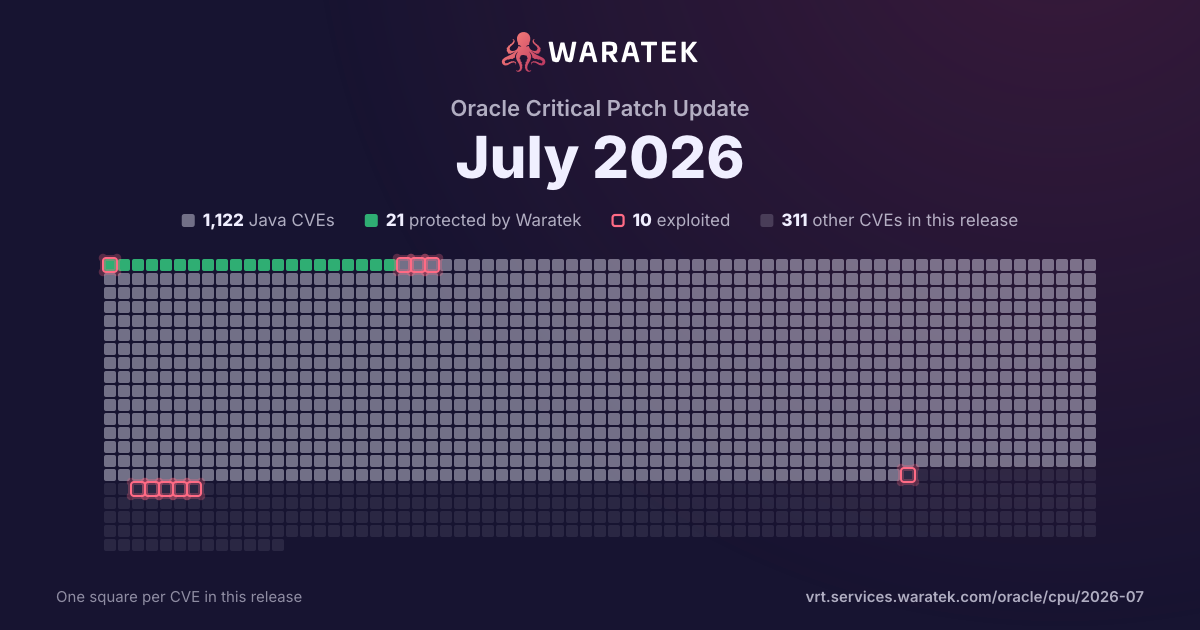
By status
21Protected by Waratek8Mitigation candidate1,095No exploit published13Outside Waratek scope296Not applicable
10Exploited, marked by the ring
No exploit published. For 968 of them, Oracle's security advisory is the source of public detail.
Protected by Waratek. Waratek RASP can block exploitation of these on systems that have not applied the patch yet.
Overview 10 matches · 0 protected · 0 exploited · 0 CISA KEV · 0 public PoC · 0 EPSS ≥ 0.5
10matches
0protected0.0%
0exploited0.0%
0CISA KEV0.0%
0public PoC0.0%
0EPSS ≥ 0.50.0%
Protected by Waratek
0
0.0%
Rule in development
0
0.0%
Mitigation candidate
2
20.0%
No exploit published
8
80.0%
blocked by ARMR today
0
0.0%
partly blocked
0
0.0%
not blocked
10
100.0%
not established
0
0.0%
unrecorded
0
0.0%
Exploited
0
0.0%
Working exploit published
0
0.0%
Proof of concept only
1
10.0%
Forecast only
0
0.0%
No public exploit
9
90.0%
| CVE | Severity | Published▾ | Status | Exploitation | Description |
|---|---|---|---|---|---|
| CVE-2026-33871 | High | 2026-03-27 | No exploit published | No public exploit | Netty is an asynchronous, event-driven network application framework. In versions prior to 4.1.132.Final and 4.2.10.Final, a remote user can trigger a Denial of Service (DoS) against a Netty HTTP/2 server by sending a flood of `CONTINUATION` frames. The server's lack of a limit on the number of `CONTINUATION` frames, combined with a bypass of existing size-based mitigations using zero-byte frames, allows an user to cause excessive CPU consumption with minimal bandwidth, rendering the server unresponsive. Versions 4.1.132.Final and 4.2.10.Final fix the issue. |
| CVE-2026-33870 | High | 2026-03-27 | No exploit published | Proof of concept only | Netty is an asynchronous, event-driven network application framework. In versions prior to 4.1.132.Final and 4.2.10.Final, Netty incorrectly parses quoted strings in HTTP/1.1 chunked transfer encoding extension values, enabling request smuggling attacks. Versions 4.1.132.Final and 4.2.10.Final fix the issue. |
| CVE-2026-22737 | Medium | 2026-03-20 | No exploit published | No public exploit | Use of Java scripting engine enabled (e.g. JRuby, Jython) template views in Spring MVC and Spring WebFlux applications can result in disclosure of content from files outside the configured locations for script template views. This issue affects Spring Framework: from 7.0.0 through 7.0.5, from 6.2.0 through 6.2.16, from 6.1.0 through 6.1.25, from 5.3.0 through 5.3.46. |
| CVE-2026-22735 | Low | 2026-03-20 | No exploit published | No public exploit | Spring MVC and WebFlux applications are vulnerable to stream corruption when using Server-Sent Events (SSE). This issue affects Spring Foundation: from 7.0.0 through 7.0.5, from 6.2.0 through 6.2.16, from 6.1.0 through 6.1.25, from 5.3.0 through 5.3.46. |
| CVE-2026-22732 | Critical | 2026-03-19 | No exploit published | No public exploit | When applications specify HTTP response headers for servlet applications using Spring Security, there is the possibility that the HTTP Headers will not be written. This issue affects Spring Security Servlet applications using lazy (default) writing of HTTP Headers: : from 5.7.0 through 5.7.21, from 5.8.0 through 5.8.23, from 6.3.0 through 6.3.14, from 6.4.0 through 6.4.14, from 6.5.0 through 6.5.8, from 7.0.0 through 7.0.3. |
| CVE-2026-24308 | High | 2026-03-07 | Mitigation candidate | No public exploit | Improper handling of configuration values in ZKConfig in Apache ZooKeeper 3.8.5 and 3.9.4 on all platforms allows an attacker to expose sensitive information stored in client configuration in the client's logfile. Configuration values are exposed at INFO level logging rendering potential production systems affected by the issue. Users are recommended to upgrade to version 3.8.6 or 3.9.5 which fixes this issue. |
| CVE-2026-24281 | High | 2026-03-07 | Mitigation candidate | No public exploit | Hostname verification in Apache ZooKeeper ZKTrustManager falls back to reverse DNS (PTR) when IP SAN validation fails, allowing attackers who control or spoof PTR records to impersonate ZooKeeper servers or clients with a valid certificate for the PTR name. It's important to note that attacker must present a certificate which is trusted by ZKTrustManager which makes the attack vector harder to exploit. Users are recommended to upgrade to version 3.8.6 or 3.9.5, which fixes this issue by introducing a new configuration option to disable reverse DNS lookup in client and quorum protocols. |
| CVE-2026-29062 | High | 2026-03-06 | No exploit published | No public exploit | jackson-core contains core low-level incremental ("streaming") parser and generator abstractions used by Jackson Data Processor. From version 3.0.0 to before version 3.1.0, the UTF8DataInputJsonParser, which is used when parsing from a java.io.DataInput source, bypasses the maxNestingDepth constraint (default: 500) defined in StreamReadConstraints. A similar issue was found in ReaderBasedJsonParser. This allows a user to supply a JSON document with excessive nesting, which can cause a StackOverflowError when the structure is processed, leading to a Denial of Service (DoS). This issue has been patched in version 3.1.0. |
| CVE-2026-1605 | High | 2026-03-05 | No exploit published | No public exploit | In Eclipse Jetty, versions 12.0.0-12.0.31 and 12.1.0-12.0.5, class GzipHandler exposes a vulnerability when a compressed HTTP request, with Content-Encoding: gzip, is processed and the corresponding response is not compressed. This happens because the JDK Inflater is allocated for decompressing the request, but it is not released because the release mechanism is tied to the compressed response. In this case, since the response is not compressed, the release mechanism does not trigger, causing the leak. |
| CVE-2025-11143 | Medium | 2026-03-05 | No exploit published | No public exploit | The Jetty URI parser has some key differences to other common parsers when evaluating invalid or unusual URIs. Differential parsing of URIs in systems using multiple components may result in security by-pass. For example a component that enforces a black list may interpret the URIs differently from one that generates a response. At the very least, differential parsing may divulge implementation details. |