
Oracle Critical Patch Update July 2026
Released July 2026 · Oracle's advisory ↗ · ← Security Patch Update, June 2026 · Security Patch Update, August 2026 →
1,433 CVEs in this release, one square each
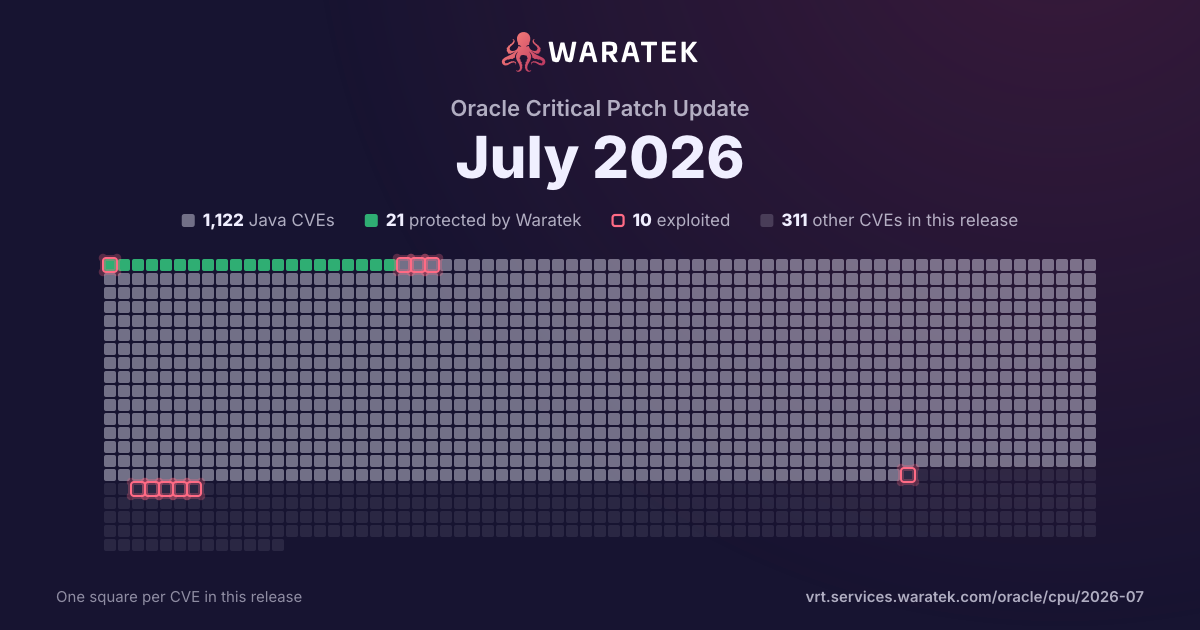
By status
21Protected by Waratek8Mitigation candidate1,093No exploit published16Outside Waratek scope295Not applicable
10Exploited, marked by the ring
No exploit published. For 971 of them, Oracle's security advisory is the source of public detail.
Protected by Waratek. Waratek RASP can block exploitation of these on systems that have not applied the patch yet.
Overview 295 matches · 0 in Waratek scope · 0 protected · 5 exploited · 2 CISA KEV · 9 public PoC · 6 EPSS ≥ 0.5
295matches
0in Waratek scope0.0%
0protected0.0%
5exploited1.7%
2CISA KEV0.7%
9public PoC3.1%
6EPSS ≥ 0.52.0%
Protected by Waratek
0
0.0%
Rule in development
0
0.0%
Mitigation candidate
0
0.0%
No exploit published
0
0.0%
Outside Waratek scope
0
0.0%
Not applicable
295
100.0%
Withdrawn CVE
0
0.0%
blocked by ARMR today
0
0.0%
partly blocked
0
0.0%
not blocked
295
100.0%
not established
0
0.0%
unrecorded
0
0.0%
split by
peak 121 / quarter
Q1 211
Not applicable1
High1
not blocked1
No public exploit1
Q2 210
Q3 210
Q4 210
Q1 221
Not applicable1
Critical1
not blocked1
Proof of concept only1
Q2 221
Not applicable1
High1
not blocked1
No public exploit1
Q3 221
Not applicable1
High1
not blocked1
No public exploit1
Q4 220
Q1 230
Q2 230
Q3 231
Not applicable1
High1
not blocked1
No public exploit1
Q4 231
Not applicable1
Medium1
not blocked1
No public exploit1
Q1 243
Not applicable3
High3
not blocked3
No public exploit3
Q2 246
Not applicable6
High2
Medium4
not blocked6
Proof of concept only2
No public exploit4
Q3 242
Not applicable2
High1
Medium1
not blocked2
No public exploit2
Q4 244
Not applicable4
Critical2
High2
not blocked4
Proof of concept only1
No public exploit3
Q1 254
Not applicable4
High3
Medium1
not blocked4
Proof of concept only2
No public exploit2
Q2 254
Not applicable4
High3
Medium1
not blocked4
No public exploit4
Q3 2521
Not applicable21
High7
Medium9
Low5
not blocked21
Working exploit published1
Proof of concept only8
No public exploit12
Q4 2512
Not applicable12
Critical2
High7
Medium2
Low1
not blocked12
Exploited1
Proof of concept only4
No public exploit7
Q1 2652
Not applicable52
Critical8
High25
Medium14
Low5
not blocked52
Proof of concept only8
No public exploit44
Q2 2660
Not applicable60
Critical9
High27
Medium16
Low8
not blocked60
Exploited4
Proof of concept only2
No public exploit54
Q3 26121
Not applicable121
Critical7
High38
Medium68
Low8
not blocked121
No public exploit121
Q1 21Q3 21Q1 22Q3 22Q1 23Q3 23Q1 24Q3 24Q1 25Q3 25Q1 26Q3 26
| CVE | Severity | Published▾ | Status | Exploitation | Description |
|---|---|---|---|---|---|
| CVE-2026-47062 | Medium | 2026-07-21 | Not applicable | No public exploit | Vulnerability in the Oracle VM VirtualBox product of Oracle Virtualization (component: Core). The supported version that is affected is 7.2.12. Easily exploitable vulnerability allows low privileged attacker with logon to the infrastructure where Oracle VM VirtualBox executes to compromise Oracle VM VirtualBox. Successful attacks of this vulnerability can result in unauthorized ability to cause a hang or frequently repeatable crash (complete DOS) of Oracle VM VirtualBox. CVSS 3.1 Base Score 5.5 (Availability impacts). CVSS Vector: (CVSS:3.1/AV:L/AC:L/PR:L/UI:N/S:U/C:N/I:N/A:H). |
| CVE-2026-47061 | Medium | 2026-07-21 | Not applicable | No public exploit | Vulnerability in the JDBC component of Oracle Database Server. Supported versions that are affected are 19.3-19.31, 21.3-21.22 and 23.4.0-23.26.2. Difficult to exploit vulnerability allows unauthenticated attacker with access to the physical communication segment attached to the hardware where the JDBC executes to compromise JDBC. Successful attacks require human interaction from a person other than the attacker and while the vulnerability is in JDBC, attacks may significantly impact additional products (scope change). Successful attacks of this vulnerability can result in unauthorized access to critical data or complete access to all JDBC accessible data. CVSS 3.1 Base Score 5.6 (Confidentiality impacts). CVSS Vector: (CVSS:3.1/AV:A/AC:H/PR:N/UI:R/S:C/C:H/I:N/A:N). |
| CVE-2026-47060 | Medium | 2026-07-21 | Not applicable | No public exploit | Vulnerability in the JDBC component of Oracle Database Server. Supported versions that are affected are 19.3-19.31, 21.3-21.22 and 23.4.0-23.26.2. Easily exploitable vulnerability allows unauthenticated attacker with network access via Oracle Net to compromise JDBC. Successful attacks require human interaction from a person other than the attacker. Successful attacks of this vulnerability can result in unauthorized creation, deletion or modification access to critical data or all JDBC accessible data. CVSS 3.1 Base Score 6.5 (Integrity impacts). CVSS Vector: (CVSS:3.1/AV:N/AC:L/PR:N/UI:R/S:U/C:N/I:H/A:N). |
| CVE-2026-47055 | Low | 2026-07-21 | Not applicable | No public exploit | Vulnerability in the Oracle VM VirtualBox product of Oracle Virtualization (component: Core). The supported version that is affected is 7.2.12. Easily exploitable vulnerability allows high privileged attacker with logon to the infrastructure where Oracle VM VirtualBox executes to compromise Oracle VM VirtualBox. While the vulnerability is in Oracle VM VirtualBox, attacks may significantly impact additional products (scope change). Successful attacks of this vulnerability can result in unauthorized update, insert or delete access to some of Oracle VM VirtualBox accessible data. CVSS 3.1 Base Score 3.2 (Integrity impacts). CVSS Vector: (CVSS:3.1/AV:L/AC:L/PR:H/UI:N/S:C/C:N/I:L/A:N). |
| CVE-2026-47054 | High | 2026-07-21 | Not applicable | No public exploit | Vulnerability in the Oracle VM VirtualBox product of Oracle Virtualization (component: Core). The supported version that is affected is 7.2.12. Easily exploitable vulnerability allows low privileged attacker with logon to the infrastructure where Oracle VM VirtualBox executes to compromise Oracle VM VirtualBox. Successful attacks of this vulnerability can result in takeover of Oracle VM VirtualBox. Note: This vulnerability applies to Windows host only. CVSS 3.1 Base Score 7.8 (Confidentiality, Integrity and Availability impacts). CVSS Vector: (CVSS:3.1/AV:L/AC:L/PR:L/UI:N/S:U/C:H/I:H/A:H). |
| CVE-2026-47053 | Medium | 2026-07-21 | Not applicable | No public exploit | Vulnerability in the Oracle VM VirtualBox product of Oracle Virtualization (component: Core). The supported version that is affected is 7.2.12. Easily exploitable vulnerability allows low privileged attacker with logon to the infrastructure where Oracle VM VirtualBox executes to compromise Oracle VM VirtualBox. Successful attacks require human interaction from a person other than the attacker. Successful attacks of this vulnerability can result in unauthorized creation, deletion or modification access to critical data or all Oracle VM VirtualBox accessible data and unauthorized ability to cause a partial denial of service (partial DOS) of Oracle VM VirtualBox. CVSS 3.1 Base Score 5.6 (Integrity and Availability impacts). CVSS Vector: (CVSS:3.1/AV:L/AC:L/PR:L/UI:R/S:U/C:N/I:H/A:L). |
| CVE-2026-47052 | Medium | 2026-07-21 | Not applicable | No public exploit | Vulnerability in the MySQL Server, MySQL Cluster product of Oracle MySQL (component: InnoDB). Supported versions that are affected are MySQL Server: 8.4.0-8.4.10, 9.7.0-9.7.1; MySQL Cluster: 8.0.0-8.0.47, 8.4.0-8.4.10 and 9.7.0-9.7.1. Easily exploitable vulnerability allows high privileged attacker with network access via multiple protocols to compromise MySQL Server, MySQL Cluster. Successful attacks of this vulnerability can result in unauthorized ability to cause a hang or frequently repeatable crash (complete DOS) of MySQL Server, MySQL Cluster. CVSS 3.1 Base Score 4.9 (Availability impacts). CVSS Vector: (CVSS:3.1/AV:N/AC:L/PR:H/UI:N/S:U/C:N/I:N/A:H). |
| CVE-2026-47050 | High | 2026-07-21 | Not applicable | No public exploit | Vulnerability in the Oracle VM VirtualBox product of Oracle Virtualization (component: Core). The supported version that is affected is 7.2.8. Easily exploitable vulnerability allows high privileged attacker with logon to the infrastructure where Oracle VM VirtualBox executes to compromise Oracle VM VirtualBox. Successful attacks require human interaction from a person other than the attacker and while the vulnerability is in Oracle VM VirtualBox, attacks may significantly impact additional products (scope change). Successful attacks of this vulnerability can result in unauthorized creation, deletion or modification access to critical data or all Oracle VM VirtualBox accessible data and unauthorized ability to cause a hang or frequently repeatable crash (complete DOS) of Oracle VM VirtualBox. CVSS 3.1 Base Score 7.4 (Integrity and Availability impacts). CVSS Vector: (CVSS:3.1/AV:L/AC:L/PR:H/UI:R/S:C/C:N/I:H/A:H). |
| CVE-2026-47047 | High | 2026-07-21 | Not applicable | No public exploit | Vulnerability in the Oracle VM VirtualBox product of Oracle Virtualization (component: Core). The supported version that is affected is 7.2.12. Easily exploitable vulnerability allows low privileged attacker with logon to the infrastructure where Oracle VM VirtualBox executes to compromise Oracle VM VirtualBox. Successful attacks of this vulnerability can result in takeover of Oracle VM VirtualBox. CVSS 3.1 Base Score 7.8 (Confidentiality, Integrity and Availability impacts). CVSS Vector: (CVSS:3.1/AV:L/AC:L/PR:L/UI:N/S:U/C:H/I:H/A:H). |
| CVE-2026-47046 | High | 2026-07-21 | Not applicable | No public exploit | Vulnerability in the RDBMS component of Oracle Database Server. Supported versions that are affected are 23.4.0-23.26.2. Easily exploitable vulnerability allows unauthenticated attacker with network access via Oracle Net to compromise RDBMS. Successful attacks of this vulnerability can result in unauthorized ability to cause a hang or frequently repeatable crash (complete DOS) of RDBMS as well as unauthorized update, insert or delete access to some of RDBMS accessible data. CVSS 3.1 Base Score 8.2 (Integrity and Availability impacts). CVSS Vector: (CVSS:3.1/AV:N/AC:L/PR:N/UI:N/S:U/C:N/I:L/A:H). |
| CVE-2026-47045 | Medium | 2026-07-21 | Not applicable | No public exploit | Vulnerability in the JDBC component of Oracle Database Server. Supported versions that are affected are 19.3-19.31, 21.3-21.22 and 23.4.0-23.26.2. Easily exploitable vulnerability allows high privileged attacker having None privilege with network access via Oracle Net to compromise JDBC. Successful attacks require human interaction from a person other than the attacker. Successful attacks of this vulnerability can result in takeover of JDBC. CVSS 3.1 Base Score 6.8 (Confidentiality, Integrity and Availability impacts). CVSS Vector: (CVSS:3.1/AV:N/AC:L/PR:H/UI:R/S:U/C:H/I:H/A:H). |
| CVE-2026-47044 | Medium | 2026-07-21 | Not applicable | No public exploit | Vulnerability in the Oracle VM VirtualBox product of Oracle Virtualization (component: Core). The supported version that is affected is 7.2.12. Easily exploitable vulnerability allows low privileged attacker with logon to the infrastructure where Oracle VM VirtualBox executes to compromise Oracle VM VirtualBox. Successful attacks of this vulnerability can result in unauthorized ability to cause a hang or frequently repeatable crash (complete DOS) of Oracle VM VirtualBox. CVSS 3.1 Base Score 5.5 (Availability impacts). CVSS Vector: (CVSS:3.1/AV:L/AC:L/PR:L/UI:N/S:U/C:N/I:N/A:H). |
| CVE-2026-47043 | Low | 2026-07-21 | Not applicable | No public exploit | Vulnerability in the Oracle VM VirtualBox product of Oracle Virtualization (component: Core). The supported version that is affected is 7.2.12. Easily exploitable vulnerability allows high privileged attacker with logon to the infrastructure where Oracle VM VirtualBox executes to compromise Oracle VM VirtualBox. While the vulnerability is in Oracle VM VirtualBox, attacks may significantly impact additional products (scope change). Successful attacks of this vulnerability can result in unauthorized read access to a subset of Oracle VM VirtualBox accessible data. CVSS 3.1 Base Score 3.2 (Confidentiality impacts). CVSS Vector: (CVSS:3.1/AV:L/AC:L/PR:H/UI:N/S:C/C:L/I:N/A:N). |
| CVE-2026-47041 | Medium | 2026-07-21 | Not applicable | No public exploit | Vulnerability in the Oracle VM VirtualBox product of Oracle Virtualization (component: Core). The supported version that is affected is 7.2.12. Easily exploitable vulnerability allows high privileged attacker with logon to the infrastructure where Oracle VM VirtualBox executes to compromise Oracle VM VirtualBox. While the vulnerability is in Oracle VM VirtualBox, attacks may significantly impact additional products (scope change). Successful attacks of this vulnerability can result in unauthorized ability to cause a hang or frequently repeatable crash (complete DOS) of Oracle VM VirtualBox. CVSS 3.1 Base Score 6.0 (Availability impacts). CVSS Vector: (CVSS:3.1/AV:L/AC:L/PR:H/UI:N/S:C/C:N/I:N/A:H). |
| CVE-2026-47039 | Medium | 2026-07-21 | Not applicable | No public exploit | Vulnerability in the Java VM component of Oracle Database Server. Supported versions that are affected are 19.3-19.31, 21.3-21.22 and 23.4.0-23.26.2. Easily exploitable vulnerability allows low privileged attacker having Create Session privilege with network access via Oracle Net to compromise Java VM. Successful attacks of this vulnerability can result in unauthorized creation, deletion or modification access to critical data or all Java VM accessible data. CVSS 3.1 Base Score 6.5 (Integrity impacts). CVSS Vector: (CVSS:3.1/AV:N/AC:L/PR:L/UI:N/S:U/C:N/I:H/A:N). |
| CVE-2026-47038 | Low | 2026-07-21 | Not applicable | No public exploit | Vulnerability in the RDBMS component of Oracle Database Server. Supported versions that are affected are 19.3-19.31, 21.3-21.22 and 23.4.0-23.26.2. Easily exploitable vulnerability allows high privileged attacker having None privilege with network access via Oracle Net to compromise RDBMS. Successful attacks of this vulnerability can result in unauthorized update, insert or delete access to some of RDBMS accessible data. CVSS 3.1 Base Score 2.7 (Integrity impacts). CVSS Vector: (CVSS:3.1/AV:N/AC:L/PR:H/UI:N/S:U/C:N/I:L/A:N). |
| CVE-2026-47023 | Medium | 2026-07-21 | Not applicable | No public exploit | Vulnerability in the MySQL Server, MySQL Cluster product of Oracle MySQL (component: Server: Replication). Supported versions that are affected are MySQL Server: 8.4.0-8.4.10, 9.7.0-9.7.1; MySQL Cluster: 8.0.0-8.0.47, 8.4.0-8.4.10 and 9.7.0-9.7.1. Easily exploitable vulnerability allows high privileged attacker with network access via multiple protocols to compromise MySQL Server, MySQL Cluster. Successful attacks of this vulnerability can result in unauthorized ability to cause a hang or frequently repeatable crash (complete DOS) of MySQL Server, MySQL Cluster. CVSS 3.1 Base Score 4.9 (Availability impacts). CVSS Vector: (CVSS:3.1/AV:N/AC:L/PR:H/UI:N/S:U/C:N/I:N/A:H). |
| CVE-2026-47012 | Medium | 2026-07-21 | Not applicable | No public exploit | Vulnerability in the MySQL Server, MySQL Cluster product of Oracle MySQL (component: Server: Optimizer). Supported versions that are affected are MySQL Server: 8.4.0-8.4.10, 9.7.0-9.7.1; MySQL Cluster: 8.0.0-8.0.47, 8.4.0-8.4.10 and 9.7.0-9.7.1. Difficult to exploit vulnerability allows high privileged attacker with network access via multiple protocols to compromise MySQL Server, MySQL Cluster. Successful attacks of this vulnerability can result in unauthorized ability to cause a hang or frequently repeatable crash (complete DOS) of MySQL Server, MySQL Cluster. CVSS 3.1 Base Score 4.4 (Availability impacts). CVSS Vector: (CVSS:3.1/AV:N/AC:H/PR:H/UI:N/S:U/C:N/I:N/A:H). |
| CVE-2026-47008 | Medium | 2026-07-21 | Not applicable | No public exploit | Vulnerability in the MySQL Server, MySQL Cluster product of Oracle MySQL (component: InnoDB). Supported versions that are affected are MySQL Server: 9.7.0-9.7.1; MySQL Cluster: 9.7.0-9.7.1. Easily exploitable vulnerability allows high privileged attacker with network access via multiple protocols to compromise MySQL Server, MySQL Cluster. Successful attacks of this vulnerability can result in unauthorized ability to cause a hang or frequently repeatable crash (complete DOS) of MySQL Server, MySQL Cluster. CVSS 3.1 Base Score 4.9 (Availability impacts). CVSS Vector: (CVSS:3.1/AV:N/AC:L/PR:H/UI:N/S:U/C:N/I:N/A:H). |
| CVE-2026-46975 | Medium | 2026-07-21 | Not applicable | No public exploit | Vulnerability in the RDBMS component of Oracle Database Server. Supported versions that are affected are 19.3-19.31, 21.3-21.22 and 23.4.0-23.26.2. Easily exploitable vulnerability allows unauthenticated attacker with network access via Oracle Net to compromise RDBMS. While the vulnerability is in RDBMS, attacks may significantly impact additional products (scope change). Successful attacks of this vulnerability can result in unauthorized update, insert or delete access to some of RDBMS accessible data. CVSS 3.1 Base Score 5.8 (Integrity impacts). CVSS Vector: (CVSS:3.1/AV:N/AC:L/PR:N/UI:N/S:C/C:N/I:L/A:N). |
| CVE-2026-46936 | Medium | 2026-07-21 | Not applicable | No public exploit | Vulnerability in the MySQL Server, MySQL Cluster product of Oracle MySQL (component: Server: DDL). Supported versions that are affected are MySQL Server: 8.4.0-8.4.10, 9.7.0-9.7.1; MySQL Cluster: 8.0.0-8.0.47, 8.4.0-8.4.10 and 9.7.0-9.7.1. Difficult to exploit vulnerability allows high privileged attacker with network access via multiple protocols to compromise MySQL Server, MySQL Cluster. Successful attacks of this vulnerability can result in unauthorized ability to cause a hang or frequently repeatable crash (complete DOS) of MySQL Server, MySQL Cluster. CVSS 3.1 Base Score 4.4 (Availability impacts). CVSS Vector: (CVSS:3.1/AV:N/AC:H/PR:H/UI:N/S:U/C:N/I:N/A:H). |
| CVE-2026-54285 | Medium | 2026-06-22 | Not applicable | No public exploit | opentelemetry-js is the OpenTelemetry JavaScript Client. Prior to 2.8.0, W3CBaggagePropagator.extract() in @opentelemetry/core does not enforce size limits when parsing inbound baggage HTTP headers. The W3C Baggage specification recommends a maximum of 8,192 bytes and 180 entries; these limits were only enforced on the outbound (inject()) path, not on the inbound (extract()) path. Parsing oversized baggage causes memory allocation proportional to the header size without any cap. This vulnerability is fixed in 2.8.0. |
| CVE-2026-46863 | High | 2026-06-17 | Not applicable | No public exploit | Vulnerability in the MySQL Server, MySQL Cluster product of Oracle MySQL (component: Server: Connection Handling). Supported versions that are affected are MySQL Server: 8.4.0-8.4.9, 9.0.0-9.7.0; MySQL Cluster: 8.0.11-8.0.46, 8.4.0-8.4.9 and 9.0.0-9.7.0. Easily exploitable vulnerability allows unauthenticated attacker with network access via multiple protocols to compromise MySQL Server, MySQL Cluster. Successful attacks of this vulnerability can result in unauthorized ability to cause a hang or frequently repeatable crash (complete DOS) of MySQL Server, MySQL Cluster. CVSS 3.1 Base Score 7.5 (Availability impacts). CVSS Vector: (CVSS:3.1/AV:N/AC:L/PR:N/UI:N/S:U/C:N/I:N/A:H). |
| CVE-2026-9076 | High | 2026-06-09 | Not applicable | No public exploit | Issue summary: When CMS password-based decryption (RFC 3211 / PWRI key unwrap) processes attacker-supplied CMS data, an attacker-chosen stream-mode KEK cipher can trigger a heap out-of-bounds read in kek_unwrap_key(). Impact summary: A heap buffer over-read may trigger a crash which leads to Denial of Service for an application if the input buffer ends at a memory page boundary and the following page is unmapped. There is no information disclosure as the over-read bytes are not revealed to the attacker. The key unwrapping function performs a check-byte test as specified in the RFC that reads 7 bytes from a heap allocation that is based on the wrapped key length from the message. There is a minimum length check based on the block length of the wrapping cipher. However the cipher is selected from an OID carried in the attacker's PWRI keyEncryptionAlgorithm with no requirement that the cipher be a block cipher. When an attacker selects a stream-mode cipher the guard will be ineffective and the allocated buffer containing the unwrapped key can be too small to fit the check-bytes specified in the RFC and a buffer over-read can happen. Applications calling CMS_decrypt() or CMS_decrypt_set1_password() (equivalently openssl cms -decrypt -pwri_password ...) on untrusted CMS data are vulnerable to this issue. No password knowledge is required: the over-read happens during the unwrap attempt before any authentication succeeds. The over-read is limited to a few bytes and is not written to output, so there is no information disclosure. Triggering a crash requires the allocation to border unmapped memory, which is unlikely with the normal allocator. The FIPS modules are not affected by this issue. |
| CVE-2026-7383 | High | 2026-06-09 | Not applicable | No public exploit | Issue summary: A signed integer overflow when sizing the destination buffer for Unicode output in ASN1_mbstring_ncopy() can lead to a heap buffer overflow. Impact summary: A heap buffer overflow may lead to a crash or possibly attacker controlled code execution or other undefined behaviour. In ASN1_mbstring_copy() and ASN1_mbstring_ncopy() the destination size for Unicode output is computed in a signed int: by left shift of the input character count for BMPSTRING (UTF-16) and UNIVERSALSTRING (UTF-32), and by summing per-character byte counts for UTF8STRING. The calculation overflows when the input reaches around 2^30 characters. In the worst case (UNIVERSALSTRING at 2^30 characters) the size wraps to zero, OPENSSL_malloc(1) is called, and the subsequent character copy writes several gigabytes past the one-byte allocation. X.509 certificate processing routes through ASN1_STRING_set_by_NID(), whose DIRSTRING_TYPE mask excludes UNIVERSALSTRING and whose per-NID size limits cap the input length; no network protocol or certificate-handling path in OpenSSL exercises the overflow. Triggering the bug requires an application that calls ASN1_mbstring_copy() or ASN1_mbstring_ncopy() directly, or registers a custom string type via ASN1_STRING_TABLE_add(), with attacker-controlled input on the order of half a gigabyte or more. For these reasons this issue was assigned Low severity. The FIPS modules in 4.0, 3.6, 3.5, 3.4 and 3.0 are not affected by this issue, as the affected code is outside the OpenSSL FIPS module boundary. |
| CVE-2026-45447 | High | 2026-06-09 | Not applicable | No public exploit | Issue summary: A specially crafted PKCS#7 or S/MIME signed message could trigger a use-after-free during PKCS#7 signature verification. Impact summary: A use-after-free may result in process crashes, heap corruption, or potentially remote code execution. When processing a PKCS#7 or S/MIME signed message, if the SignedData digestAlgorithms field is present as an empty ASN.1 SET, OpenSSL may incorrectly free a caller-owned BIO during PKCS7_verify(). A subsequent use of the BIO by the calling application results in a use-after-free condition. In the common case this occurs when the application later calls BIO_free() on the BIO originally passed to PKCS7_verify(). Depending on allocator behavior and application-specific BIO usage patterns, this may result in a crash or other memory corruption. In some application contexts this may potentially be exploitable for remote code execution. Applications that process PKCS#7 or S/MIME signed messages using OpenSSL PKCS#7 APIs may be affected. Applications using the CMS APIs for this processing are not affected. The FIPS modules in 4.0, 3.6, 3.5, 3.4, and 3.0 are not affected by this issue, as the affected code is outside the OpenSSL FIPS module boundary. |
| CVE-2026-45446 | Medium | 2026-06-09 | Not applicable | No public exploit | Issue summary: The implementations of AES-SIV (RFC 5297) and AES-GCM-SIV (RFC 8452) mishandle the authentication of AAD (Additional Authenticated Data) with an empty ciphertext allowing a forgery of such messages. Impact summary: An attacker can forge empty messages with arbitrary AAD to the victim's application using these ciphers. AES-SIV (RFC 5297) and AES-GCM-SIV (RFC 8452) are nonce-misuse-resistant AEAD modes: they accept a key, nonce, optional AAD (bytes that are authenticated but not encrypted), and plaintext, and produces ciphertext plus a 16-byte tag. On decrypt, `EVP_DecryptFinal_ex()` is documented to return success only if the tag is verified succesfully. In OpenSSL's provider implementation of these ciphers, the expected tag is computed only when decryption function is invoked with non-empty data. If the caller supplies AAD and then calls `EVP_DecryptFinal_ex()` without invocation of the ciphertext update, which can happen when the received ciphertext length is zero, the tag is never recalculated and still holds its all-zeros value. When AES-GCM-SIV is used, an attacker who sends arbitrary AAD, empty ciphertext, and all-zeros tag passes authentication under any key they do not know, single-shot. When AES-SIV is used, for mounting the attack it's necessary for the application to reuse the decryption context without resetting the key. AES-SIV is implemented since OpenSSL 3.0. AES-GCM-SIV is implemented since OpenSSL 3.2. No protocols implemented in OpenSSL itself (TLS/CMS/PKCS7/HPKE/QUIC) support either AES-GCM-SIV or AES-SIV. To mount an attack, the applications must implement their own protocol and use the EVP interface. Also they must skip the ciphertext update when a message with an empty ciphertext arrives. The FIPS modules in 4.0, 3.6, 3.5, 3.4, and 3.0 are not affected by this issue, as these algorithms are not FIPS approved and the affected code is outside the OpenSSL FIPS module boundary. |
| CVE-2026-45445 | High | 2026-06-09 | Not applicable | No public exploit | Issue summary: When an application drives an AES-OCB context through the public EVP_Cipher() one-shot interface, the application-supplied initialisation vector (IV) is silently discarded. Impact summary: Every message encrypted under the same key uses the same effective nonce regardless of the IV supplied by the caller, resulting in (key, nonce) reuse and loss of confidentiality. If the same code path is used to compute the authentication tag, the tag depends only on the (key, IV) pair and not on the plaintext or ciphertext, allowing universal forgery of arbitrary ciphertext from a single captured message. OpenSSL provides two ways to drive a cipher: the documented streaming interface (EVP_CipherUpdate / EVP_CipherFinal_ex) and a lower-level one-shot, EVP_Cipher(), whose documentation explicitly recommends against use by applications in favour of EVP_CipherUpdate() and EVP_CipherFinal_ex(). The OCB provider's streaming handler flushes the application-supplied IV into the OCB context before processing data; the one-shot handler did not. Every call to EVP_Cipher() on an AES-OCB context therefore ran with the all-zero key-derived offset state left by cipher initialisation, regardless of the caller's IV. If EVP_EncryptFinal_ex() is subsequently used to obtain the authentication tag, the deferred IV setup runs at that point and clears the running checksum that should have been accumulated over the plaintext. The resulting tag is a function of (key, IV) only and verifies against any ciphertext produced under the same (key, IV) pair. The OpenSSL SSL/TLS implementation is not affected: AES-OCB is not a TLS cipher suite, and libssl does not call EVP_Cipher() in any case. Applications that drive AES-OCB through the documented streaming AEAD API (EVP_CipherUpdate / EVP_CipherFinal_ex) are not affected. Only applications that combine the AES-OCB cipher with the EVP_Cipher() one-shot API are vulnerable. The FIPS modules in 4.0, 3.6, 3.5, 3.4 and 3.0 are not affected by this issue, as AES-OCB is outside the OpenSSL FIPS module boundary. |
| CVE-2026-42770 | Low | 2026-06-09 | Not applicable | No public exploit | Issue summary: When EVP_PKEY_derive_set_peer() is called with a DHX (X9.42) peer key, the peer key is not properly checked for the subgroup membership. Impact summary: A malicious peer which presents an X9.42 key carrying the victim's p and g parameters, a forged q = r (a small prime factor of the cofactor (p−1)/q_local), and a public value Y of order r can recover the victim's private key after a small number of key exchange attempts. When EVP_PKEY_derive_set_peer() is called with a DHX (X9.42) peer key, the subgroup membership check Y^q ≡ 1 (mod p) is performed using the peer's own q parameter, not the local key's q. The peer's domain parameters are then matched against the domain parameters of the private key, but the value of q is not compared. A malicious peer who presents an X9.42 key carrying the victim's p, g, a forged q = r (a small prime factor of the cofactor), and a public value Y of order r passes all checks. The shared secret then takes only r distinct values, leaking priv mod r. Repeating for each small-prime factor of the cofactor and combining via CRT recovers the full private key (Lim–Lee / small-subgroup-confinement attack). The realistic attack surface is narrow: principally CMP deployments with long-lived RA/CA DHX keys and bespoke enterprise or government applications using X9.42 DHX static keys with interactive protocols and therefore this issue was assigned Low severity. The FIPS modules in 4.0, 3.6, 3.5, 3.4, 3.1.2 and 3.0 are affected by this issue. |
| CVE-2026-42769 | Medium | 2026-06-09 | Not applicable | No public exploit | Issue Summary: An error in the callback used to verify the certificate provided in a Root CA key update Certificate Management Protocol (CMP) message response rendered the certificate validation ineffectual, which could lead to escalation of credentials from the Registration Authority (RA) level to the root Certification Authority (root CA) level. Impact Summary: The Registration Autority could replace the root CA certificate for the CMP clients with an arbitrary root CA certificate. One of the parts of the Certificate Management Protocol (CMP), specified in RFC 9810, is Root Certification Authority (root CA) key Rollover, which is sent by the server in a message with type 'id-it-rootCaKeyUpdate'. As part of these messages, 'newWithOld' certificate, the new root CA certificate signed with the old root CA key, is provided, and verifying its signature is crucial for transferring the trust from the old CA key to the new one. The 'id-it-rootCaKeyUpdate' messages are expected to be processed with OSSL_CMP_get1_rootCaKeyUpdate(), that is expected to verify the 'newWithOld' certificate. A typo in the certificate chain building code led to adding an incorrect certificate ('newWithOld' instead of 'oldRoot') to the certificate chain, rendering the certificate verification process ineffectual (only the issuer name and the algorithm OIDs were verified by other parts of the verification code). An attacker who already has credentials that satisfy the CMP message protection checks can generate a new key pair and use a crafted self-signed certificate in its 'id-it-rootCaKeyUpdate' CMP messages which affected CMP clients would accept as a new trust anchor. Significant preconditions for the attack (having valid RA-level credentials) are the reason the issue was assigned Low severity. The FIPS modules are not affected by this issue, as the affected code is outside the OpenSSL FIPS module boundary. |
| CVE-2026-42768 | Low | 2026-06-09 | Not applicable | No public exploit | Issue summary: The CMS_decrypt and PKCS7_decrypt functions are vulnerable to Bleichenbacher-style attack when an attacker is able to provide the CMS or S/MIME messages and observe the error code and/or decryption output. Impact summary: The Bleichenbacher-style attack allows an attacker to use the victim's vulnerable application as a way to decrypt or sign messages with the victim's private RSA key. The attack is possible in 2 variants. 1. The decryption API (CMS_decrypt(), PKCS7_decrypt()) is used without providing the recipient certificate. In this case OpenSSL iterates over every KeyTransRecipientInfo (KTRI) without stopping at the first success. An attacker who authors a message with two KTRI entries — the first one wrapping a real CEK under the victim's public key, the second with an arbitrary probe ciphertext — obtains opportunity to iterate the 2nd KTRI to get a valid PKCS#1 v1.5 padding if the error code of the application is available. That is a Bleichenbacher oracle (Bleichenbacher, CRYPTO '98): an adaptive-chosen-ciphertext side channel from which the attacker decrypts any RSA ciphertext to the victim's key or forges any PKCS#1 v1.5 signature under it. 2. When the decryption API (CMS_decrypt(), PKCS7_decrypt()) is provided with the recipient certificate, and the recipient is not found, a random key is substituted. An attacker who authors a message and is able to compare both error code and the result of the decryption, can mount a Bleichenbacher oracle. We are not aware of any applications that provide a remote attacker an opportunity to mount an attack described in these scenarios. We consider the existence of such application very unlikely, and for this reason this CVE has been evaluated as Low severity. To avoid these attacks, when RSA PKCS#1 v1.5 Key Transport is in use, the invoked EVP_PKEY_decrypt() will use the implicit rejection mechanism described in draft-irtf-cfrg-rsa-guidance. In previous OpenSSL releases the implicit rejection was explicitly disabled. The implicit rejection mechanism always returns a plaintext value, the symmetric key. This result is deterministic for the ciphertext and the private key. The length of the decryption result can happen to match the length of the key of the symmetric cipher that was used for the content encryption. When a certificate is not provided, the last RecipientInfo producing a key that looks valid will be used. It may cause getting garbage content on decryption. As a proper way to deal with this a recipient certificate has to be provided to identify the particular RecipientInfo for decryption. The FIPS modules in 4.0, 3.6, 3.5, and 3.4 are not affected by this issue, as CMS and S/MIME processing happens outside the OpenSSL FIPS module boundary. |
| CVE-2026-42767 | Medium | 2026-06-09 | Not applicable | No public exploit | Issue summary: An attacker-controlled CMP (Certificate Management Protocol) server could trigger a NULL pointer dereference in a CMP client application. Impact summary: A NULL pointer dereference causes a crash of the application and a Denial of Service. An attacker controlling a CMP server (or acting as a man-in-the-middle) could craft a CMP response containing a CRMF (Certificate Request Message Format) CertRepMessage with an EncryptedValue structure where the symmAlg field has an algorithm OID but no parameters field. When the OpenSSL CMP client processes this response, the NULL dereference occurs, causing a crash of the CMP client. Applications that process untrusted CMP/CRMF messages may be affected. The FIPS modules in 4.0, 3.6, 3.5, 3.4, and 3.0 are not affected by this issue, as the affected code is outside the OpenSSL FIPS module boundary. |
| CVE-2026-42766 | Medium | 2026-06-09 | Not applicable | No public exploit | Issue summary: A specially crafted password-encrypted CMS message can trigger a NULL pointer dereference during CMS decryption. Impact summary: This NULL pointer dereference leads to an application crash and a Denial of Service. The CMS PasswordRecipientInfo.keyDerivationAlgorithm field is defined as OPTIONAL in the ASN.1 specification and may therefore be absent in specially crafted inputs. During the password-based CMS decryption the OpenSSL CMS implementation dereferences this field without first checking whether it was present. An attacker who supplies such a CMS message to an application performing password-based CMS decryption can trigger an application crash, leading to a Denial of Service. Applications that process password-encrypted CMS messages may be affected. The FIPS modules in 4.0, 3.6, 3.5, 3.4, and 3.0 are not affected by this issue, as the affected code is outside the OpenSSL FIPS module boundary. |
| CVE-2026-42764 | High | 2026-06-09 | Not applicable | No public exploit | Issue summary: Receiving a QUIC initial packet with an invalid token may trigger a NULL pointer dereference in the OpenSSL QUIC server with address validation disabled. Impact summary: NULL pointer dereference typically causes abnormal termination of the affected QUIC server process and a Denial of Service. If the address validation is disabled in the OpenSSL QUIC server implementation, an attacker can crash the server by sending an initial packet with an invalid or expired token. By default, the client address validation is enabled in the OpenSSL QUIC server implementation, which makes the default configuration not vulnerable to this issue. However if the SSL_LISTENER_FLAG_NO_VALIDATE is used with the SSL_new_listener() call, the address validation is disabled making the vulnerable code reachable. The FIPS modules in 4.0, 3.6, 3.5, 3.4, and 3.0 are not affected by this issue, as the affected code is outside the OpenSSL FIPS module boundary. |
| CVE-2026-34183 | High | 2026-06-09 | Not applicable | No public exploit | Issue summary: Remote peer may exhaust heap memory of the QUIC server or client by flooding it with packets containing PATH_CHALLENGE frames. Impact summary: A malicious remote peer can cause an unbounded memory allocation which can lead to an abnormal termination of the application acting as a QUIC client or server and a Denial of Service. A remote peer may exhaust heap memory by flooding the local QUIC stack with PATH_CHALLENGE frames. The local QUIC stack allocates a PATH_RESPONSE frame for every PATH_CHALLENGE it receives. The allocated PATH_RESPONSE frame gets freed only when the remote peer acknowledges reception of the PATH_RESPONSE frame which will not be done by a malicious peer. The FIPS modules in 4.0, 3.6, 3.5, 3.4, and 3.0 are not affected by this issue. The QUIC stack is outside of OpenSSL FIPS module boundary. |
| CVE-2026-34182 | Critical | 2026-06-09 | Not applicable | No public exploit | Issue Summary: Cryptographic Message Services (CMS) processing fails to perform sufficient input validation on the cipher and tag length fields of AuthEnvelopedData containers, leading to various potential compromises. Impact Summary: Attackers making use of these vulnerabilities may achieve key-equivalent functionality for a given CMS recipient and/or bypass integrity validation for a given message. In one use case, an attacker may send a CMS message containing AuthEnvelopedData with the cipher specified as a non-AEAD cipher. OpenSSL erroneously allows this selection, and attempts to decrypt and validate the message. An on-path attacker who captures one legitimate AES-GCM AuthEnvelopedData addressed to the victim can re-emit it with the recipientInfos set left byte-for-byte intact, so the victim's private key still unwraps the genuine CEK (the content-encryption key), but with the inner OID rewritten to AES-256-OFB (Output Feedback Mode, an unauthenticated keystream mode) and with an attacker-chosen IV and ciphertext. The victim initializes AES-256-OFB under the real CEK, never consults the MAC field, and CMS_decrypt() returns success. If the application under attack responds to the attacker with any indicator showing success or failure of the decryption effort, it is possible for the attacker to use this as an oracle to obtain key equivalent functionality for the CEK used for the chosen recipient of the message. In another use case, an attacker can reduce the tag length of the chosen AEAD cipher for a given AuthEnvelopedData container to be a single byte long, allowing an attacker to brute force CMS decryption, producing an integrity bypass for applications that trust CMS_decrypt() to reject modified content. The FIPS modules are not affected by this issue. |
| CVE-2026-34181 | High | 2026-06-09 | Not applicable | No public exploit | Issue Summary: The PKCS#12 file processing fails to perform sufficient input validation for files that use Password-Based Message Authentication Code 1 (PBMAC1) integrity mechanism allowing a certificate and private key forgery. Impact Summary: An attacker impersonating a user can cause a service reading PKCS#12 files to accept forged certificates and private keys with a 1 in 256 probability. If a service accepting PKCS#12 files is using passwords for authenticating the received files, the attacker can create unencrypted PKCS#12 files that use PBMAC1 authentication that specifies an HMAC key of only one byte, allowing them to craft a file that will be accepted with a 1 in 256 probability. That would then cause the service to accept a certificate and private key controlled by the attacker. The FIPS modules are not affected by this issue, as the affected code is outside the OpenSSL FIPS module boundary. |
| CVE-2026-34180 | High | 2026-06-09 | Not applicable | No public exploit | Issue summary: Parsing a crafted DER-encoded ASN.1 structure with a primitive element whose content exceeds 2 gigabytes in length may cause a heap buffer over-read on 64-bit Unix and Unix-like platforms. Impact summary: The heap buffer over-read may crash the application (Denial of Service) or to load into the decoded ASN.1 object contents of memory beyond the end of the input buffer. More typically such ASN.1 elements would instead be truncated. An integer truncation in OpenSSL's ASN.1 decoder causes the content length of an ASN.1 primitive element to be mishandled when it exceeds 2 gigabytes. In the worst case the truncated length is treated as a request to scan the binary content for a terminating zero byte, possibly causing OpenSSL to read either less than or beyond the end of the allocated buffer. Applications that pass attacker-supplied data to d2i_X509(), d2i_PKCS7(), or any other d2i_* decoding function are affected. OpenSSL's own command-line tools are not vulnerable, as data read through the BIO layer is checked before it reaches the affected code. The issue only affects 64-bit Unix and Unix-like platforms; 32-bit platforms and 64-bit Windows are not affected. The FIPS modules in 4.0, 3.6, 3.5, 3.4 and 3.0 are not affected by this issue, as the affected code is outside the OpenSSL FIPS module boundary. |
| CVE-2026-49975 | High | 2026-06-08 | Not applicable | Proof of concept only | Memory Allocation with Excessive Size Value vulnerability in Apache HTTP Server's mod_http leads to denial of service via malicious HTTP requests. This issue affects Apache HTTP Server: from 2.4.17 through 2.4.67. |
| CVE-2026-48913 | High | 2026-06-08 | Not applicable | No public exploit | Use After Free vulnerability in Apache HTTP Server module mod_http2 when file handles are already exhausted. This issue affects Apache HTTP Server: from 2.4.55 through 2.4.67. |
| CVE-2026-44631 | Critical | 2026-06-08 | Not applicable | No public exploit | Buffer Underwrite vulnerability in Apache HTTP Server on crafted regular expressions in the configuration. This issue affects Apache HTTP Server: from 2.4.0 through 2.4.67. Users are recommended to upgrade to version 2.4.68, which fixes the issue. |
| CVE-2026-44186 | High | 2026-06-08 | Not applicable | No public exploit | Loop with Unreachable Exit Condition ('Infinite Loop') vulnerability in the mod_proxy_ftp module in Apache HTTP Server with an attacker controlled backend FTP server. This issue affects undefined: from 2.4.0 through 2.4.67. Users are recommended to upgrade to version 2.4.68, which fixes the issue. |
| CVE-2026-44185 | High | 2026-06-08 | Not applicable | No public exploit | Buffer Over-read vulnerability in Apache HTTP Server via outbound OCSP requests to an attacker controlled OCSP server This issue affects Apache HTTP Server: from 2.4.0 through 2.4.67. Users are recommended to upgrade to version 2.4.68, which fixes the issue. |
| CVE-2026-44119 | Medium | 2026-06-08 | Not applicable | No public exploit | Improper Privilege Management vulnerability in Apache HTTP Server 2.4.67 and earlier allows local .htaccess authors to read files with the privileges of the httpd user. This issue affects Apache HTTP Server: from through 2.4.67. Users are recommended to upgrade to version 2.4.68, which fixes the issue. |
| CVE-2026-43951 | Medium | 2026-06-08 | Not applicable | No public exploit | Out-of-bounds Read vulnerability in Apache HTTP Server with mod_headers and mod_mime and multiple response languages. This issue affects Apache HTTP Server: from 2.4.0 through 2.4.67. |
| CVE-2026-42536 | High | 2026-06-08 | Not applicable | Proof of concept only | Heap-based Buffer Overflow vulnerability in Apache HTTP Server with mod_xml2enc, xml2StartParse, and untrusted content This issue affects Apache HTTP Server: from 2.4.0 through 2.4.67. Users are recommended to upgrade to version 2.4.68, which fixes the issue. |
| CVE-2026-42535 | Critical | 2026-06-08 | Not applicable | No public exploit | A path handling issue in mod_dav_fs in Apache 2.4.67 and earlier allows a WebDAV content author to directly manipulate trusted DAV property databases, potentially causing child process crashes. Users are recommended to upgrade to version 2.4.68, which fixes this issue. |
| CVE-2026-34356 | High | 2026-06-08 | Not applicable | No public exploit | Heap-based Buffer Overflow vulnerability in Apache HTTP Server with malicious backend servers and ProxyPassReverseCookie* This issue affects Apache HTTP Server: from 2.4.0 through 2.4.67. Users are recommended to upgrade to version 2.4.68, which fixes the issue. |
| CVE-2026-34355 | High | 2026-06-08 | Not applicable | No public exploit | A buffer overflow in mod_proxy_html in Apache HTTP Server 2.4.67 and earlier allows an attack by an untrusted backend. Users are recommended to upgrade to version 2.4.68, which fixes this issue. |
| CVE-2026-29170 | Medium | 2026-06-08 | Not applicable | No public exploit | A cross-site scripting vulnerability exists in mod_proxy_ftp's HTML directory list generation in Apache HTTP Server 2.4.67 and earlier when listing FTP directory contents either via forward or reverse proxy configuration. Users are recommended to upgrade to version 2.4.68, which fixes this issue. |
| CVE-2026-29167 | Critical | 2026-06-08 | Not applicable | No public exploit | Use After Free vulnerability in Apache HTTP Server with mod_ldap in per-directory configuration This issue affects Apache HTTP Server: from 2.4.0 through 2.4.67. Users are recommended to upgrade to version 2.4.68, which fixes the issue. |
| CVE-2026-9256 | Critical | 2026-05-22 | Not applicable | No public exploit | NGINX Plus and NGINX Open Source have a vulnerability in the ngx_http_rewrite_module module. This vulnerability exists when a rewrite directive uses a regex pattern with distinct, overlapping Perl-Compatible Regular Expression (PCRE) captures (for example, ^/((.*))$) and a replacement string that references multiple such captures (for example, $1$2) in a redirect or arguments context. An unauthenticated attacker along with conditions beyond their control can exploit this vulnerability by sending crafted HTTP requests. This may cause a heap buffer overflow in the NGINX worker process leading to a restart. Additionally, attackers can execute code on systems with Address Space Layout Randomization (ASLR) disabled or when the attacker can bypass ASLR. Note: Software versions which have reached End of Technical Support (EoTS) are not evaluated. |
| CVE-2026-42945 | Critical | 2026-05-13 | Not applicable | Exploited | NGINX Plus and NGINX Open Source have a vulnerability in the ngx_http_rewrite_module module. This vulnerability exists when the rewrite directive is followed by a rewrite, if, or set directive and an unnamed Perl-Compatible Regular Expression (PCRE) capture (for example, $1, $2) with a replacement string that includes a question mark (?). An unauthenticated attacker along with conditions beyond its control can exploit this vulnerability by sending crafted HTTP requests. This may cause a heap buffer overflow in the NGINX worker process leading to a restart. Additionally, attackers can execute code on systems with Address Space Layout Randomization (ASLR) disabled or when the attacker can bypass ASLR. Note: Software versions which have reached End of Technical Support (EoTS) are not evaluated. |
| CVE-2026-43500 | High | 2026-05-11 | Not applicable | Exploited | In the Linux kernel, the following vulnerability has been resolved: rxrpc: Also unshare DATA/RESPONSE packets when paged frags are present The DATA-packet handler in rxrpc_input_call_event() and the RESPONSE handler in rxrpc_verify_response() copy the skb to a linear one before calling into the security ops only when skb_cloned() is true. An skb that is not cloned but still carries externally-owned paged fragments (e.g. SKBFL_SHARED_FRAG set by splice() into a UDP socket via __ip_append_data, or a chained skb_has_frag_list()) falls through to the in-place decryption path, which binds the frag pages directly into the AEAD/skcipher SGL via skb_to_sgvec(). Extend the gate to also unshare when skb_has_frag_list() or skb_has_shared_frag() is true. This catches the splice-loopback vector and other externally-shared frag sources while preserving the zero-copy fast path for skbs whose frags are kernel-private (e.g. NIC page_pool RX, GRO). The OOM/trace handling already in place is reused. |
| CVE-2026-43284 | High | 2026-05-08 | Not applicable | Exploited | In the Linux kernel, the following vulnerability has been resolved: xfrm: esp: avoid in-place decrypt on shared skb frags MSG_SPLICE_PAGES can attach pages from a pipe directly to an skb. TCP marks such skbs with SKBFL_SHARED_FRAG after skb_splice_from_iter(), so later paths that may modify packet data can first make a private copy. The IPv4/IPv6 datagram append paths did not set this flag when splicing pages into UDP skbs. That leaves an ESP-in-UDP packet made from shared pipe pages looking like an ordinary uncloned nonlinear skb. ESP input then takes the no-COW fast path for uncloned skbs without a frag_list and decrypts in place over data that is not owned privately by the skb. Mark IPv4/IPv6 datagram splice frags with SKBFL_SHARED_FRAG, matching TCP. Also make ESP input fall back to skb_cow_data() when the flag is present, so ESP does not decrypt externally backed frags in place. Private nonlinear skb frags still use the existing fast path. This intentionally does not change ESP output. In esp_output_head(), the path that appends the ESP trailer to existing skb tailroom without calling skb_cow_data() is not reachable for nonlinear skbs: skb_tailroom() returns zero when skb->data_len is nonzero, while ESP tailen is positive. Thus ESP output will either use the separate destination-frag path or fall back to skb_cow_data(). |
| CVE-2026-41990 | Medium | 2026-04-23 | Not applicable | No public exploit | Libgcrypt before 1.12.2 mishandles Dilithium signing. Writes to a static array lack a bounds check but do not use attacker-controlled data. |
| CVE-2026-41989 | Medium | 2026-04-23 | Not applicable | No public exploit | Libgcrypt before 1.12.2 sometimes allows a heap-based buffer overflow and denial of service via crafted ECDH ciphertext to gcry_pk_decrypt. |
| CVE-2026-31431 | High | 2026-04-22 | Not applicable | Exploited | In the Linux kernel, the following vulnerability has been resolved: crypto: algif_aead - Revert to operating out-of-place This mostly reverts commit 72548b093ee3 except for the copying of the associated data. There is no benefit in operating in-place in algif_aead since the source and destination come from different mappings. Get rid of all the complexity added for in-place operation and just copy the AD directly. |
| CVE-2026-40192 | High | 2026-04-15 | Not applicable | No public exploit | Pillow is a Python imaging library. Versions 10.3.0 through 12.1.1 did not limit the amount of GZIP-compressed data read when decoding a FITS image, making them vulnerable to decompression bomb attacks. A specially crafted FITS file could cause unbounded memory consumption, leading to denial of service (OOM crash or severe performance degradation). If users are unable to immediately upgrade, they should only open specific image formats, excluding FITS, as a workaround. |
| CVE-2026-40179 | Medium | 2026-04-15 | Not applicable | No public exploit | Prometheus is an open-source monitoring system and time series database. Versions 3.0 through 3.5.1 and 3.6.0 through 3.11.1 have stored cross-site scripting vulnerabilities in multiple components of the Prometheus web UI where metric names and label values are injected into innerHTML without escaping. In both the Mantine UI and old React UI, chart tooltips on the Graph page render metric names containing HTML/JavaScript without sanitization. In the old React UI, the Metric Explorer fuzzy search results use dangerouslySetInnerHTML without escaping, and heatmap cell tooltips interpolate le label values without sanitization. With Prometheus v3.x defaulting to UTF-8 metric and label name validation, characters like <, >, and " are now valid in metric names and labels. An attacker who can inject metrics via a compromised scrape target, remote write, or OTLP receiver endpoint can execute arbitrary JavaScript in the browser of any Prometheus user who views the metric in the Graph UI, potentially enabling configuration exfiltration, data deletion, or Prometheus shutdown depending on enabled flags. This issue has been fixed in versions 3.5.2 and 3.11.2. If developers are unable to immediately update, the following workarounds are recommended: ensure that the remote write receiver (--web.enable-remote-write-receiver) and the OTLP receiver (--web.enable-otlp-receiver) are not exposed to untrusted sources; verify that all scrape targets are trusted and not under attacker control; avoid enabling admin or mutating API endpoints (e.g., --web.enable-admin-api or --web.enable-lifecycle) in environments where untrusted data may be ingested; and refrain from clicking untrusted links, particularly those containing functions such as label_replace, as they may generate poisoned label names and values. |
| CVE-2026-35204 | High | 2026-04-09 | Not applicable | No public exploit | Helm is a package manager for Charts for Kubernetes. From 4.0.0 to 4.1.3, a specially crafted Helm plugin, when installed or updated, will cause Helm to write the contents of the plugin to an arbitrary filesystem location. To prevent this, validate that the plugin.yaml of the Helm plugin does not include a version: field containing POSIX dot-dot path separators ie. "/../". This vulnerability is fixed in 4.1.4. |
| CVE-2026-39892 | Medium | 2026-04-08 | Not applicable | No public exploit | cryptography is a package designed to expose cryptographic primitives and recipes to Python developers. From 45.0.0 to before 46.0.7, if a non-contiguous buffer was passed to APIs which accepted Python buffers (e.g. Hash.update()), this could lead to buffer overflows. This vulnerability is fixed in 46.0.7. |
| CVE-2026-31790 | High | 2026-04-07 | Not applicable | No public exploit | Issue summary: Applications using RSASVE key encapsulation to establish a secret encryption key can send contents of an uninitialized memory buffer to a malicious peer. Impact summary: The uninitialized buffer might contain sensitive data from the previous execution of the application process which leads to sensitive data leakage to an attacker. RSA_public_encrypt() returns the number of bytes written on success and -1 on error. The affected code tests only whether the return value is non-zero. As a result, if RSA encryption fails, encapsulation can still return success to the caller, set the output lengths, and leave the caller to use the contents of the ciphertext buffer as if a valid KEM ciphertext had been produced. If applications use EVP_PKEY_encapsulate() with RSA/RSASVE on an attacker-supplied invalid RSA public key without first validating that key, then this may cause stale or uninitialized contents of the caller-provided ciphertext buffer to be disclosed to the attacker in place of the KEM ciphertext. As a workaround calling EVP_PKEY_public_check() or EVP_PKEY_public_check_quick() before EVP_PKEY_encapsulate() will mitigate the issue. The FIPS modules in 3.6, 3.5, 3.4, 3.3, 3.1 and 3.0 are affected by this issue. |
| CVE-2026-31789 | Critical | 2026-04-07 | Not applicable | No public exploit | Issue summary: Converting an excessively large OCTET STRING value to a hexadecimal string leads to a heap buffer overflow on 32 bit platforms. Impact summary: A heap buffer overflow may lead to a crash or possibly an attacker controlled code execution or other undefined behavior. If an attacker can supply a crafted X.509 certificate with an excessively large OCTET STRING value in extensions such as the Subject Key Identifier (SKID) or Authority Key Identifier (AKID) which are being converted to hex, the size of the buffer needed for the result is calculated as multiplication of the input length by 3. On 32 bit platforms, this multiplication may overflow resulting in the allocation of a smaller buffer and a heap buffer overflow. Applications and services that print or log contents of untrusted X.509 certificates are vulnerable to this issue. As the certificates would have to have sizes of over 1 Gigabyte, printing or logging such certificates is a fairly unlikely operation and only 32 bit platforms are affected, this issue was assigned Low severity. The FIPS modules in 3.6, 3.5, 3.4, 3.3 and 3.0 are not affected by this issue, as the affected code is outside the OpenSSL FIPS module boundary. |
| CVE-2026-28390 | High | 2026-04-07 | Not applicable | No public exploit | Issue summary: During processing of a crafted CMS EnvelopedData message with KeyTransportRecipientInfo a NULL pointer dereference can happen. Impact summary: Applications that process attacker-controlled CMS data may crash before authentication or cryptographic operations occur resulting in Denial of Service. When a CMS EnvelopedData message that uses KeyTransportRecipientInfo with RSA-OAEP encryption is processed, the optional parameters field of RSA-OAEP SourceFunc algorithm identifier is examined without checking for its presence. This results in a NULL pointer dereference if the field is missing. Applications and services that call CMS_decrypt() on untrusted input (e.g., S/MIME processing or CMS-based protocols) are vulnerable. The FIPS modules in 3.6, 3.5, 3.4, 3.3 and 3.0 are not affected by this issue, as the affected code is outside the OpenSSL FIPS module boundary. |
| CVE-2026-28389 | High | 2026-04-07 | Not applicable | No public exploit | Issue summary: During processing of a crafted CMS EnvelopedData message with KeyAgreeRecipientInfo a NULL pointer dereference can happen. Impact summary: Applications that process attacker-controlled CMS data may crash before authentication or cryptographic operations occur resulting in Denial of Service. When a CMS EnvelopedData message that uses KeyAgreeRecipientInfo is processed, the optional parameters field of KeyEncryptionAlgorithmIdentifier is examined without checking for its presence. This results in a NULL pointer dereference if the field is missing. Applications and services that call CMS_decrypt() on untrusted input (e.g., S/MIME processing or CMS-based protocols) are vulnerable. The FIPS modules in 3.6, 3.5, 3.4, 3.3 and 3.0 are not affected by this issue, as the affected code is outside the OpenSSL FIPS module boundary. |
| CVE-2026-28388 | High | 2026-04-07 | Not applicable | No public exploit | Issue summary: When a delta CRL that contains a Delta CRL Indicator extension is processed a NULL pointer dereference might happen if the required CRL Number extension is missing. Impact summary: A NULL pointer dereference can trigger a crash which leads to a Denial of Service for an application. When CRL processing and delta CRL processing is enabled during X.509 certificate verification, the delta CRL processing does not check whether the CRL Number extension is NULL before dereferencing it. When a malformed delta CRL file is being processed, this parameter can be NULL, causing a NULL pointer dereference. Exploiting this issue requires the X509_V_FLAG_USE_DELTAS flag to be enabled in the verification context, the certificate being verified to contain a freshestCRL extension or the base CRL to have the EXFLAG_FRESHEST flag set, and an attacker to provide a malformed CRL to an application that processes it. The vulnerability is limited to Denial of Service and cannot be escalated to achieve code execution or memory disclosure. For that reason the issue was assessed as Low severity according to our Security Policy. The FIPS modules in 3.6, 3.5, 3.4, 3.3 and 3.0 are not affected by this issue, as the affected code is outside the OpenSSL FIPS module boundary. |
| CVE-2026-28387 | High | 2026-04-07 | Not applicable | No public exploit | Issue summary: An uncommon configuration of clients performing DANE TLSA-based server authentication, when paired with uncommon server DANE TLSA records, may result in a use-after-free and/or double-free on the client side. Impact summary: A use after free can have a range of potential consequences such as the corruption of valid data, crashes or execution of arbitrary code. However, the issue only affects clients that make use of TLSA records with both the PKIX-TA(0/PKIX-EE(1) certificate usages and the DANE-TA(2) certificate usage. By far the most common deployment of DANE is in SMTP MTAs for which RFC7672 recommends that clients treat as 'unusable' any TLSA records that have the PKIX certificate usages. These SMTP (or other similar) clients are not vulnerable to this issue. Conversely, any clients that support only the PKIX usages, and ignore the DANE-TA(2) usage are also not vulnerable. The client would also need to be communicating with a server that publishes a TLSA RRset with both types of TLSA records. No FIPS modules are affected by this issue, the problem code is outside the FIPS module boundary. |
| CVE-2026-28386 | Critical | 2026-04-07 | Not applicable | No public exploit | Issue summary: Applications using AES-CFB128 encryption or decryption on systems with AVX-512 and VAES support can trigger an out-of-bounds read of up to 15 bytes when processing partial cipher blocks. Impact summary: This out-of-bounds read may trigger a crash which leads to Denial of Service for an application if the input buffer ends at a memory page boundary and the following page is unmapped. There is no information disclosure as the over-read bytes are not written to output. The vulnerable code path is only reached when processing partial blocks (when a previous call left an incomplete block and the current call provides fewer bytes than needed to complete it). Additionally, the input buffer must be positioned at a page boundary with the following page unmapped. CFB mode is not used in TLS/DTLS protocols, which use CBC, GCM, CCM, or ChaCha20-Poly1305 instead. For these reasons the issue was assessed as Low severity according to our Security Policy. Only x86-64 systems with AVX-512 and VAES instruction support are affected. Other architectures and systems without VAES support use different code paths that are not affected. OpenSSL FIPS module in 3.6 version is affected by this issue. |
| CVE-2025-14821 | High | 2026-04-07 | Not applicable | No public exploit | A flaw was found in libssh. This vulnerability allows local man-in-the-middle attacks, security downgrades of SSH (Secure Shell) connections, and manipulation of trusted host information, posing a significant risk to the confidentiality, integrity, and availability of SSH communications via an insecure default configuration on Windows systems where the library automatically loads configuration files from the C:\etc directory, which can be created and modified by unprivileged local users. |
| CVE-2026-31402 | Critical | 2026-04-03 | Not applicable | No public exploit | In the Linux kernel, the following vulnerability has been resolved: nfsd: fix heap overflow in NFSv4.0 LOCK replay cache The NFSv4.0 replay cache uses a fixed 112-byte inline buffer (rp_ibuf[NFSD4_REPLAY_ISIZE]) to store encoded operation responses. This size was calculated based on OPEN responses and does not account for LOCK denied responses, which include the conflicting lock owner as a variable-length field up to 1024 bytes (NFS4_OPAQUE_LIMIT). When a LOCK operation is denied due to a conflict with an existing lock that has a large owner, nfsd4_encode_operation() copies the full encoded response into the undersized replay buffer via read_bytes_from_xdr_buf() with no bounds check. This results in a slab-out-of-bounds write of up to 944 bytes past the end of the buffer, corrupting adjacent heap memory. This can be triggered remotely by an unauthenticated attacker with two cooperating NFSv4.0 clients: one sets a lock with a large owner string, then the other requests a conflicting lock to provoke the denial. We could fix this by increasing NFSD4_REPLAY_ISIZE to allow for a full opaque, but that would increase the size of every stateowner, when most lockowners are not that large. Instead, fix this by checking the encoded response length against NFSD4_REPLAY_ISIZE before copying into the replay buffer. If the response is too large, set rp_buflen to 0 to skip caching the replay payload. The status is still cached, and the client already received the correct response on the original request. |
| CVE-2026-34525 | Medium | 2026-04-01 | Not applicable | No public exploit | AIOHTTP is an asynchronous HTTP client/server framework for asyncio and Python. Prior to version 3.13.4, multiple Host headers were allowed in aiohttp. This issue has been patched in version 3.13.4. |
| CVE-2026-34520 | Low | 2026-04-01 | Not applicable | No public exploit | AIOHTTP is an asynchronous HTTP client/server framework for asyncio and Python. Prior to version 3.13.4, the C parser (the default for most installs) accepted null bytes and control characters in response headers. This issue has been patched in version 3.13.4. |
| CVE-2026-34519 | Low | 2026-04-01 | Not applicable | No public exploit | AIOHTTP is an asynchronous HTTP client/server framework for asyncio and Python. Prior to version 3.13.4, an attacker who controls the reason parameter when creating a Response may be able to inject extra headers or similar exploits. This issue has been patched in version 3.13.4. |
| CVE-2026-34518 | Low | 2026-04-01 | Not applicable | No public exploit | AIOHTTP is an asynchronous HTTP client/server framework for asyncio and Python. Prior to version 3.13.4, when following redirects to a different origin, aiohttp drops the Authorization header, but retains the Cookie and Proxy-Authorization headers. This issue has been patched in version 3.13.4. |
| CVE-2026-34517 | Low | 2026-04-01 | Not applicable | No public exploit | AIOHTTP is an asynchronous HTTP client/server framework for asyncio and Python. Prior to version 3.13.4, for some multipart form fields, aiohttp read the entire field into memory before checking client_max_size. This issue has been patched in version 3.13.4. |
| CVE-2026-34516 | Medium | 2026-04-01 | Not applicable | No public exploit | AIOHTTP is an asynchronous HTTP client/server framework for asyncio and Python. Prior to version 3.13.4, a response with an excessive number of multipart headers may be allowed to use more memory than intended, potentially allowing a DoS vulnerability. This issue has been patched in version 3.13.4. |
| CVE-2026-34515 | Medium | 2026-04-01 | Not applicable | No public exploit | AIOHTTP is an asynchronous HTTP client/server framework for asyncio and Python. Prior to version 3.13.4, on Windows the static resource handler may expose information about a NTLMv2 remote path. This issue has been patched in version 3.13.4. |
| CVE-2026-34514 | Low | 2026-04-01 | Not applicable | No public exploit | AIOHTTP is an asynchronous HTTP client/server framework for asyncio and Python. Prior to version 3.13.4, an attacker who controls the content_type parameter in aiohttp could use this to inject extra headers or similar exploits. This issue has been patched in version 3.13.4. |
| CVE-2026-34513 | Low | 2026-04-01 | Not applicable | No public exploit | AIOHTTP is an asynchronous HTTP client/server framework for asyncio and Python. Prior to version 3.13.4, an unbounded DNS cache could result in excessive memory usage possibly resulting in a DoS situation. This issue has been patched in version 3.13.4. |
| CVE-2026-22815 | Medium | 2026-04-01 | Not applicable | No public exploit | AIOHTTP is an asynchronous HTTP client/server framework for asyncio and Python. Prior to version 3.13.4, insufficient restrictions in header/trailer handling could cause uncapped memory usage. This issue has been patched in version 3.13.4. |
| CVE-2026-4800 | Critical | 2026-03-31 | Not applicable | No public exploit | The fix for CVE-2021-23337 added validation for the variable option in _.template but did not apply the same validation to options.imports key names, and both paths flow into the same Function() constructor sink. When an application passes untrusted input as options.imports key names, an attacker can inject default-parameter expressions that execute arbitrary code at template compilation time. Additionally, _.template uses assignInWith to merge imports, which enumerates inherited properties via for..in, so if Object.prototype has been polluted by another vector the polluted keys are copied into the imports object and passed to Function(). The issue is fixed in 4.18.1 for lodash, lodash-es, lodash-amd, and lodash.template. As a workaround, do not pass untrusted input as key names in options.imports; use only developer-controlled, static key names. |
| CVE-2026-2950 | Medium | 2026-03-31 | Not applicable | No public exploit | The _.unset and _.omit functions in Lodash are vulnerable to prototype pollution. The fix for CVE-2025-13465 only guards against string key members, so an attacker can bypass the check by passing array-wrapped path segments. This allows deletion of properties from built-in prototypes such as Object.prototype, Number.prototype, and String.prototype. The issue permits deletion of prototype properties but does not allow overwriting their original behavior. The issue is patched from 4.18.0 to 4.18.1 depending on the package: lodash, lodash-es, and lodash-amd in 4.18.1, and the standalone lodash.unset and lodash.omit packages in 4.18.0. |
| CVE-2026-5121 | Critical | 2026-03-30 | Not applicable | No public exploit | A flaw was found in libarchive. On 32-bit systems, an integer overflow vulnerability exists in the zisofs block pointer allocation logic. A remote attacker can exploit this by providing a specially crafted ISO9660 image, which can lead to a heap buffer overflow. This could potentially allow for arbitrary code execution on the affected system. |
| CVE-2026-21710 | High | 2026-03-30 | Not applicable | No public exploit | A flaw in Node.js HTTP request handling causes an uncaught `TypeError` when a request is received with a header named `__proto__` and the application accesses `req.headersDistinct`. When this occurs, `dest["__proto__"]` resolves to `Object.prototype` rather than `undefined`, causing `.push()` to be called on a non-array. This exception is thrown synchronously inside a property getter and cannot be intercepted by `error` event listeners, meaning it cannot be handled without wrapping every `req.headersDistinct` access in a `try/catch`. * This vulnerability affects all Node.js HTTP servers on **20.x, 22.x, 24.x, and v25.x** |
| CVE-2026-4176 | Critical | 2026-03-29 | Not applicable | No public exploit | Perl versions from 5.9.4 before 5.40.4-RC1, from 5.41.0 before 5.42.2-RC1, from 5.43.0 before 5.43.9 contain a vulnerable version of Compress::Raw::Zlib. Compress::Raw::Zlib is included in the Perl package as a dual-life core module, and is vulnerable to CVE-2026-3381 due to a vendored version of zlib which has several vulnerabilities, including CVE-2026-27171. The bundled Compress::Raw::Zlib was updated to version 2.221 in Perl blead commit c75ae9cc164205e1b6d6dbd57bd2c65c8593fe94. |
| CVE-2026-0968 | Low | 2026-03-26 | Not applicable | No public exploit | A flaw was found in libssh in which a malicious SFTP (SSH File Transfer Protocol) server can exploit this by sending a malformed 'longname' field within an `SSH_FXP_NAME` message during a file listing operation. This missing null check can lead to reading beyond allocated memory on the heap. This can cause unexpected behavior or lead to a denial of service (DoS) due to application crashes. |
| CVE-2026-0967 | Medium | 2026-03-26 | Not applicable | No public exploit | A flaw was found in libssh. A remote attacker, by controlling client configuration files or known_hosts files, could craft specific hostnames that when processed by the `match_pattern()` function can lead to inefficient regular expression backtracking. This can cause timeouts and resource exhaustion, resulting in a Denial of Service (DoS) for the client. |
| CVE-2026-0966 | High | 2026-03-26 | Not applicable | No public exploit | A flaw was found in libssh. The API function `ssh_get_hexa()` is vulnerable to a denial of service when processing zero-length input. This can be exploited remotely by an attacker during GSSAPI (Generic Security Service Application Program Interface) authentication if the server's logging verbosity is set to `SSH_LOG_PACKET (3)` or higher. Successful exploitation could lead to a self-Denial of Service of the per-connection daemon process. |
| CVE-2026-0965 | Low | 2026-03-26 | Not applicable | No public exploit | A flaw was found in libssh where it can attempt to open arbitrary files during configuration parsing. A local attacker can exploit this by providing a malicious configuration file or when the system is misconfigured. This vulnerability could lead to a Denial of Service (DoS) by causing the system to try and access dangerous files, such as block devices or large system files, which can disrupt normal operations. |
| CVE-2026-0964 | Medium | 2026-03-26 | Not applicable | No public exploit | A malicious SCP server can send unexpected paths that could make the client application override local files outside of working directory. This could be misused to create malicious executable or configuration files and make the user execute them under specific consequences. This is the same issue as in OpenSSH, tracked as CVE-2019-6111. |
| CVE-2026-4738 | Critical | 2026-03-24 | Not applicable | No public exploit | Improper Restriction of Operations within the Bounds of a Memory Buffer vulnerability in OSGeo gdal (frmts/zlib/contrib/infback9 modules). This vulnerability is associated with program files inftree9.C. This issue affects gdal: before 3.11.0. |
| CVE-2026-33186 | Critical | 2026-03-20 | Not applicable | No public exploit | gRPC-Go is the Go language implementation of gRPC. Versions prior to 1.79.3 have an authorization bypass resulting from improper input validation of the HTTP/2 `:path` pseudo-header. The gRPC-Go server was too lenient in its routing logic, accepting requests where the `:path` omitted the mandatory leading slash (e.g., `Service/Method` instead of `/Service/Method`). While the server successfully routed these requests to the correct handler, authorization interceptors (including the official `grpc/authz` package) evaluated the raw, non-canonical path string. Consequently, "deny" rules defined using canonical paths (starting with `/`) failed to match the incoming request, allowing it to bypass the policy if a fallback "allow" rule was present. This affects gRPC-Go servers that use path-based authorization interceptors, such as the official RBAC implementation in `google.golang.org/grpc/authz` or custom interceptors relying on `info.FullMethod` or `grpc.Method(ctx)`; AND that have a security policy contains specific "deny" rules for canonical paths but allows other requests by default (a fallback "allow" rule). The vulnerability is exploitable by an attacker who can send raw HTTP/2 frames with malformed `:path` headers directly to the gRPC server. The fix in version 1.79.3 ensures that any request with a `:path` that does not start with a leading slash is immediately rejected with a `codes.Unimplemented` error, preventing it from reaching authorization interceptors or handlers with a non-canonical path string. While upgrading is the most secure and recommended path, users can mitigate the vulnerability using one of the following methods: Use a validating interceptor (recommended mitigation); infrastructure-level normalization; and/or policy hardening. |
| CVE-2026-4424 | High | 2026-03-19 | Not applicable | No public exploit | A flaw was found in libarchive. This heap out-of-bounds read vulnerability exists in the RAR archive processing logic due to improper validation of the LZSS sliding window size after transitions between compression methods. A remote attacker can exploit this by providing a specially crafted RAR archive, leading to the disclosure of sensitive heap memory information without requiring authentication or user interaction. |
| CVE-2026-30922 | High | 2026-03-18 | Not applicable | Proof of concept only | pyasn1 is a generic ASN.1 library for Python. Prior to 0.6.3, the `pyasn1` library is vulnerable to a Denial of Service (DoS) attack caused by uncontrolled recursion when decoding ASN.1 data with deeply nested structures. An attacker can supply a crafted payload containing thousands of nested `SEQUENCE` (`0x30`) or `SET` (`0x31`) tags with "Indefinite Length" (`0x80`) markers. This forces the decoder to recursively call itself until the Python interpreter crashes with a `RecursionError` or consumes all available memory (OOM), crashing the host application. This is a distinct vulnerability from CVE-2026-23490 (which addressed integer overflows in OID decoding). The fix for CVE-2026-23490 (`MAX_OID_ARC_CONTINUATION_OCTETS`) does not mitigate this recursion issue. Version 0.6.3 fixes this specific issue. |
| CVE-2026-27135 | High | 2026-03-18 | Not applicable | No public exploit | nghttp2 is an implementation of the Hypertext Transfer Protocol version 2 in C. Prior to version 1.68.1, the nghttp2 library stops reading the incoming data when user facing public API `nghttp2_session_terminate_session` or `nghttp2_session_terminate_session2` is called by the application. They might be called internally by the library when it detects the situation that is subject to connection error. Due to the missing internal state validation, the library keeps reading the rest of the data after one of those APIs is called. Then receiving a malformed frame that causes FRAME_SIZE_ERROR causes assertion failure. nghttp2 v1.68.1 adds missing state validation to avoid assertion failure. No known workarounds are available. |
| CVE-2026-23270 | High | 2026-03-18 | Not applicable | No public exploit | In the Linux kernel, the following vulnerability has been resolved: net/sched: Only allow act_ct to bind to clsact/ingress qdiscs and shared blocks As Paolo said earlier [1]: "Since the blamed commit below, classify can return TC_ACT_CONSUMED while the current skb being held by the defragmentation engine. As reported by GangMin Kim, if such packet is that may cause a UaF when the defrag engine later on tries to tuch again such packet." act_ct was never meant to be used in the egress path, however some users are attaching it to egress today [2]. Attempting to reach a middle ground, we noticed that, while most qdiscs are not handling TC_ACT_CONSUMED, clsact/ingress qdiscs are. With that in mind, we address the issue by only allowing act_ct to bind to clsact/ingress qdiscs and shared blocks. That way it's still possible to attach act_ct to egress (albeit only with clsact). [1] https://lore.kernel.org/netdev/674b8cbfc385c6f37fb29a1de08d8fe5c2b0fbee.1771321118.git.pabeni@redhat.com/ [2] https://lore.kernel.org/netdev/cc6bfb4a-4a2b-42d8-b9ce-7ef6644fb22b@ovn.org/ |
| CVE-2026-4111 | High | 2026-03-13 | Not applicable | No public exploit | A flaw was identified in the RAR5 archive decompression logic of the libarchive library, specifically within the archive_read_data() processing path. When a specially crafted RAR5 archive is processed, the decompression routine may enter a state where internal logic prevents forward progress. This condition results in an infinite loop that continuously consumes CPU resources. Because the archive passes checksum validation and appears structurally valid, affected applications cannot detect the issue before processing. This can allow attackers to cause persistent denial-of-service conditions in services that automatically process archives. |
| CVE-2026-2673 | Medium | 2026-03-13 | Not applicable | No public exploit | Issue summary: An OpenSSL TLS 1.3 server may fail to negotiate the expected preferred key exchange group when its key exchange group configuration includes the default by using the 'DEFAULT' keyword. Impact summary: A less preferred key exchange may be used even when a more preferred group is supported by both client and server, if the group was not included among the client's initial predicated keyshares. This will sometimes be the case with the new hybrid post-quantum groups, if the client chooses to defer their use until specifically requested by the server. If an OpenSSL TLS 1.3 server's configuration uses the 'DEFAULT' keyword to interpolate the built-in default group list into its own configuration, perhaps adding or removing specific elements, then an implementation defect causes the 'DEFAULT' list to lose its 'tuple' structure, and all server-supported groups were treated as a single sufficiently secure 'tuple', with the server not sending a Hello Retry Request (HRR) even when a group in a more preferred tuple was mutually supported. As a result, the client and server might fail to negotiate a mutually supported post-quantum key agreement group, such as 'X25519MLKEM768', if the client's configuration results in only 'classical' groups (such as 'X25519' being the only ones in the client's initial keyshare prediction). OpenSSL 3.5 and later support a new syntax for selecting the most preferred TLS 1.3 key agreement group on TLS servers. The old syntax had a single 'flat' list of groups, and treated all the supported groups as sufficiently secure. If any of the keyshares predicted by the client were supported by the server the most preferred among these was selected, even if other groups supported by the client, but not included in the list of predicted keyshares would have been more preferred, if included. The new syntax partitions the groups into distinct 'tuples' of roughly equivalent security. Within each tuple the most preferred group included among the client's predicted keyshares is chosen, but if the client supports a group from a more preferred tuple, but did not predict any corresponding keyshares, the server will ask the client to retry the ClientHello (by issuing a Hello Retry Request or HRR) with the most preferred mutually supported group. The above works as expected when the server's configuration uses the built-in default group list, or explicitly defines its own list by directly defining the various desired groups and group 'tuples'. No OpenSSL FIPS modules are affected by this issue, the code in question lies outside the FIPS boundary. OpenSSL 3.6 and 3.5 are vulnerable to this issue. OpenSSL 3.6 users should upgrade to OpenSSL 3.6.2 once it is released. OpenSSL 3.5 users should upgrade to OpenSSL 3.5.6 once it is released. OpenSSL 3.4, 3.3, 3.0, 1.0.2 and 1.1.1 are not affected by this issue. |
| CVE-2025-70873 | High | 2026-03-12 | Not applicable | Proof of concept only | An information disclosure issue in the zipfileInflate function in the zipfile extension in SQLite v3.51.1 and earlier allows attackers to obtain heap memory via supplying a crafted ZIP file. |