
Oracle Critical Patch Update July 2026
Released July 2026 · Oracle's advisory ↗ · ← Security Patch Update, June 2026 · Security Patch Update, August 2026 →
1,433 CVEs in this release, one square each
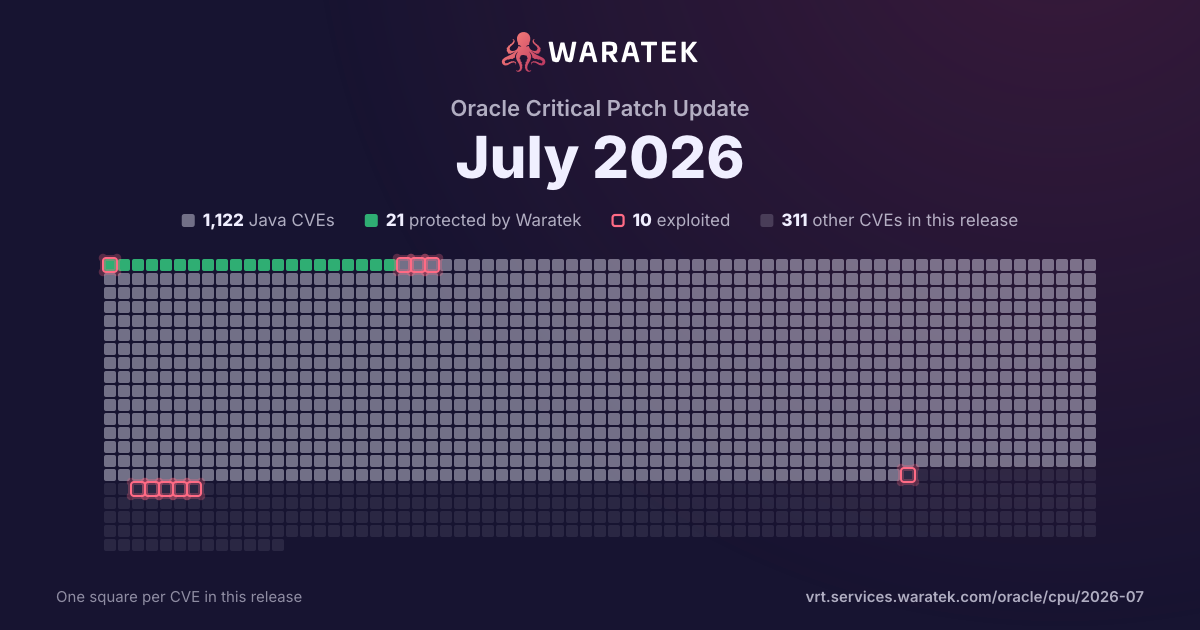
By status
21Protected by Waratek3Rule in development5Mitigation candidate1,095No exploit published13Outside Waratek scope296Not applicable
10Exploited, marked by the ring
No exploit published. For 968 of them, Oracle's security advisory is the source of public detail.
Protected by Waratek. Waratek RASP can block exploitation of these on systems that have not applied the patch yet.
Overview 20 matches · 7 in Waratek scope · 0 protected · 0 exploited · 0 CISA KEV · 2 public PoC · 0 EPSS ≥ 0.5
20matches
7in Waratek scope35.0%
0protected0.0%
0exploited0.0%
0CISA KEV0.0%
2public PoC10.0%
0EPSS ≥ 0.50.0%
Protected by Waratek
0
0.0%
Rule in development
0
0.0%
Mitigation candidate
1
5.0%
No exploit published
6
30.0%
Outside Waratek scope
0
0.0%
Not applicable
13
65.0%
Withdrawn CVE
0
0.0%
blocked by ARMR today
0
0.0%
partly blocked
0
0.0%
not blocked
20
100.0%
not established
0
0.0%
unrecorded
0
0.0%
Exploited
0
0.0%
Working exploit published
0
0.0%
Proof of concept only
20
100.0%
Forecast only
0
0.0%
No public exploit
0
0.0%
split by
peak 7 / quarter
Q1 201
Mitigation candidate1
Critical1
not blocked1
Proof of concept only1
Q2 200
Q3 200
Q4 200
Q1 210
Q2 210
Q3 210
Q4 210
Q1 221
Not applicable1
Critical1
not blocked1
Proof of concept only1
Q2 220
Q3 220
Q4 220
Q1 230
Q2 233
No exploit published3
High3
not blocked3
Proof of concept only3
Q3 231
No exploit published1
High1
not blocked1
Proof of concept only1
Q4 230
Q1 241
No exploit published1
High1
not blocked1
Proof of concept only1
Q2 242
Not applicable2
High2
not blocked2
Proof of concept only2
Q3 240
Q4 242
No exploit published1
Not applicable1
High1
Medium1
not blocked2
Proof of concept only2
Q1 252
Not applicable2
High1
Medium1
not blocked2
Proof of concept only2
Q2 250
Q3 257
Not applicable7
Medium4
Low3
not blocked7
Proof of concept only7
Q1 20Q3 20Q1 21Q3 21Q1 22Q3 22Q1 23Q3 23Q1 24Q3 24Q1 25Q3 25
| CVE | Severity | Published▾ | Status | Exploitation | Description |
|---|---|---|---|---|---|
| CVE-2025-58050 | Medium | 2025-08-27 | Not applicable | Proof of concept only | The PCRE2 library is a set of C functions that implement regular expression pattern matching. In version 10.45, a heap-buffer-overflow read vulnerability exists in the PCRE2 regular expression matching engine, specifically within the handling of the (*scs:...) (Scan SubString) verb when combined with (*ACCEPT) in src/pcre2_match.c. This vulnerability may potentially lead to information disclosure if the out-of-bounds data read during the memcmp affects the final match result in a way observable by the attacker. This issue has been resolved in version 10.46. |
| CVE-2025-8961 | Low | 2025-08-14 | Not applicable | Proof of concept only | A weakness has been identified in LibTIFF 4.7.0. This affects the function main of the file tiffcrop.c of the component tiffcrop. Executing manipulation can lead to memory corruption. The attack can only be executed locally. The exploit has been made available to the public and could be exploited. |
| CVE-2025-8837 | Low | 2025-08-11 | Not applicable | Proof of concept only | A vulnerability was identified in JasPer up to 4.2.5. This affects the function jpc_dec_dump of the file src/libjasper/jpc/jpc_dec.c of the component JPEG2000 File Handler. The manipulation leads to use after free. An attack has to be approached locally. The exploit has been disclosed to the public and may be used. The patch is named 8308060d3fbc1da10353ac8a95c8ea60eba9c25a. It is recommended to apply a patch to fix this issue. |
| CVE-2025-8177 | Medium | 2025-07-26 | Not applicable | Proof of concept only | A vulnerability was found in LibTIFF up to 4.7.0. It has been rated as critical. This issue affects the function setrow of the file tools/thumbnail.c. The manipulation leads to buffer overflow. An attack has to be approached locally. The patch is named e8c9d6c616b19438695fd829e58ae4fde5bfbc22. It is recommended to apply a patch to fix this issue. This vulnerability only affects products that are no longer supported by the maintainer. |
| CVE-2025-8176 | Low | 2025-07-26 | Not applicable | Proof of concept only | A vulnerability was found in LibTIFF up to 4.7.0. It has been declared as critical. This vulnerability affects the function get_histogram of the file tools/tiffmedian.c. The manipulation leads to use after free. The attack needs to be approached locally. The exploit has been disclosed to the public and may be used. The patch is identified as fe10872e53efba9cc36c66ac4ab3b41a839d5172. It is recommended to apply a patch to fix this issue. |
| CVE-2025-6491 | Medium | 2025-07-13 | Not applicable | Proof of concept only | In PHP versions:8.1.* before 8.1.33, 8.2.* before 8.2.29, 8.3.* before 8.3.23, 8.4.* before 8.4.10 when parsing XML data in SOAP extensions, overly large (>2Gb) XML namespace prefix may lead to null pointer dereference. This may lead to crashes and affect the availability of the target server. |
| CVE-2025-1220 | Medium | 2025-07-13 | Not applicable | Proof of concept only | In PHP versions:8.1.* before 8.1.33, 8.2.* before 8.2.29, 8.3.* before 8.3.23, 8.4.* before 8.4.10 some functions like fsockopen() lack validation that the hostname supplied does not contain null characters. This may lead to other functions like parse_url() treat the hostname in different way, thus opening way to security problems if the user code implements access checks before access using such functions. |
| CVE-2025-30153 | High | 2025-03-19 | Not applicable | Proof of concept only | kin-openapi is a Go project for handling OpenAPI files. Prior to 0.131.0, when validating a request with a multipart/form-data schema, if the OpenAPI schema allows it, an attacker can upload a crafted ZIP file (e.g., a ZIP bomb), causing the server to consume all available system memory. The root cause comes from the ZipFileBodyDecoder, which is registered automatically by the module (contrary to what the documentation says). This vulnerability is fixed in 0.131.0. |
| CVE-2025-26791 | Medium | 2025-02-14 | Not applicable | Proof of concept only | DOMPurify before 3.2.4 has an incorrect template literal regular expression, sometimes leading to mutation cross-site scripting (mXSS). |
| CVE-2024-27532 | High | 2024-11-08 | Not applicable | Proof of concept only | wasm-micro-runtime (aka WebAssembly Micro Runtime or WAMR) 06df58f is vulnerable to NULL Pointer Dereference in function `block_type_get_result_types. |
| CVE-2024-6763 | Medium | 2024-10-14 | No exploit published | Proof of concept only | Eclipse Jetty is a lightweight, highly scalable, Java-based web server and Servlet engine . It includes a utility class, HttpURI, for URI/URL parsing. The HttpURI class does insufficient validation on the authority segment of a URI. However the behaviour of HttpURI differs from the common browsers in how it handles a URI that would be considered invalid if fully validated against the RRC. Specifically HttpURI and the browser may differ on the value of the host extracted from an invalid URI and thus a combination of Jetty and a vulnerable browser may be vulnerable to a open redirect attack or to a SSRF attack if the URI is used after passing validation checks. |
| CVE-2024-36129 | High | 2024-06-05 | Not applicable | Proof of concept only | The OpenTelemetry Collector offers a vendor-agnostic implementation on how to receive, process and export telemetry data. An unsafe decompression vulnerability allows unauthenticated attackers to crash the collector via excessive memory consumption. OTel Collector version 0.102.1 fixes this issue. It is also fixed in the confighttp module version 0.102.0 and configgrpc module version 0.102.1. |
| CVE-2024-0406 | High | 2024-04-06 | Not applicable | Proof of concept only | A flaw was discovered in the mholt/archiver package. This flaw allows an attacker to create a specially crafted tar file, which, when unpacked, may allow access to restricted files or directories. This issue can allow the creation or overwriting of files with the user's or application's privileges using the library. |
| CVE-2024-24824 | High | 2024-02-07 | No exploit published | Proof of concept only | Graylog is a free and open log management platform. Starting in version 2.0.0 and prior to versions 5.1.11 and 5.2.4, arbitrary classes can be loaded and instantiated using a HTTP PUT request to the `/api/system/cluster_config/` endpoint. Graylog's cluster config system uses fully qualified class names as config keys. To validate the existence of the requested class before using them, Graylog loads the class using the class loader. If a user with the appropriate permissions performs the request, arbitrary classes with 1-arg String constructors can be instantiated. This will execute arbitrary code that is run during class instantiation. In the specific use case of `java.io.File`, the behavior of the internal web-server stack will lead to information exposure by including the entire file content in the response to the REST request. Versions 5.1.11 and 5.2.4 contain a fix for this issue. |
| CVE-2023-43642 | High | 2023-09-25 | No exploit published | Proof of concept only | snappy-java is a Java port of the snappy, a fast C++ compresser/decompresser developed by Google. The SnappyInputStream was found to be vulnerable to Denial of Service (DoS) attacks when decompressing data with a too large chunk size. Due to missing upper bound check on chunk length, an unrecoverable fatal error can occur. All versions of snappy-java including the latest released version 1.1.10.3 are vulnerable to this issue. A fix has been introduced in commit `9f8c3cf74` which will be included in the 1.1.10.4 release. Users are advised to upgrade. Users unable to upgrade should only accept compressed data from trusted sources. |
| CVE-2023-34455 | High | 2023-06-15 | No exploit published | Proof of concept only | snappy-java is a fast compressor/decompressor for Java. Due to use of an unchecked chunk length, an unrecoverable fatal error can occur in versions prior to 1.1.10.1. The code in the function hasNextChunk in the fileSnappyInputStream.java checks if a given stream has more chunks to read. It does that by attempting to read 4 bytes. If it wasn’t possible to read the 4 bytes, the function returns false. Otherwise, if 4 bytes were available, the code treats them as the length of the next chunk. In the case that the `compressed` variable is null, a byte array is allocated with the size given by the input data. Since the code doesn’t test the legality of the `chunkSize` variable, it is possible to pass a negative number (such as 0xFFFFFFFF which is -1), which will cause the code to raise a `java.lang.NegativeArraySizeException` exception. A worse case would happen when passing a huge positive value (such as 0x7FFFFFFF), which would raise the fatal `java.lang.OutOfMemoryError` error. Version 1.1.10.1 contains a patch for this issue. |
| CVE-2023-34454 | High | 2023-06-15 | No exploit published | Proof of concept only | snappy-java is a fast compressor/decompressor for Java. Due to unchecked multiplications, an integer overflow may occur in versions prior to 1.1.10.1, causing an unrecoverable fatal error. The function `compress(char[] input)` in the file `Snappy.java` receives an array of characters and compresses it. It does so by multiplying the length by 2 and passing it to the rawCompress` function. Since the length is not tested, the multiplication by two can cause an integer overflow and become negative. The rawCompress function then uses the received length and passes it to the natively compiled maxCompressedLength function, using the returned value to allocate a byte array. Since the maxCompressedLength function treats the length as an unsigned integer, it doesn’t care that it is negative, and it returns a valid value, which is casted to a signed integer by the Java engine. If the result is negative, a `java.lang.NegativeArraySizeException` exception will be raised while trying to allocate the array `buf`. On the other side, if the result is positive, the `buf` array will successfully be allocated, but its size might be too small to use for the compression, causing a fatal Access Violation error. The same issue exists also when using the `compress` functions that receive double, float, int, long and short, each using a different multiplier that may cause the same issue. The issue most likely won’t occur when using a byte array, since creating a byte array of size 0x80000000 (or any other negative value) is impossible in the first place. Version 1.1.10.1 contains a patch for this issue. |
| CVE-2023-34453 | High | 2023-06-15 | No exploit published | Proof of concept only | snappy-java is a fast compressor/decompressor for Java. Due to unchecked multiplications, an integer overflow may occur in versions prior to 1.1.10.1, causing a fatal error. The function `shuffle(int[] input)` in the file `BitShuffle.java` receives an array of integers and applies a bit shuffle on it. It does so by multiplying the length by 4 and passing it to the natively compiled shuffle function. Since the length is not tested, the multiplication by four can cause an integer overflow and become a smaller value than the true size, or even zero or negative. In the case of a negative value, a `java.lang.NegativeArraySizeException` exception will raise, which can crash the program. In a case of a value that is zero or too small, the code that afterwards references the shuffled array will assume a bigger size of the array, which might cause exceptions such as `java.lang.ArrayIndexOutOfBoundsException`. The same issue exists also when using the `shuffle` functions that receive a double, float, long and short, each using a different multiplier that may cause the same issue. Version 1.1.10.1 contains a patch for this vulnerability. |
| CVE-2022-25315 | Critical | 2022-02-18 | Not applicable | Proof of concept only | In Expat (aka libexpat) before 2.4.5, there is an integer overflow in storeRawNames. |
| CVE-2020-8840 | Critical | 2020-02-10 | Mitigation candidate | Proof of concept only | FasterXML jackson-databind 2.0.0 through 2.9.10.2 lacks certain xbean-reflect/JNDI blocking, as demonstrated by org.apache.xbean.propertyeditor.JndiConverter. |