
Oracle Critical Patch Update July 2026
Released July 2026 · Oracle's advisory ↗ · ← Security Patch Update, June 2026 · Security Patch Update, August 2026 →
1,433 CVEs in this release, one square each
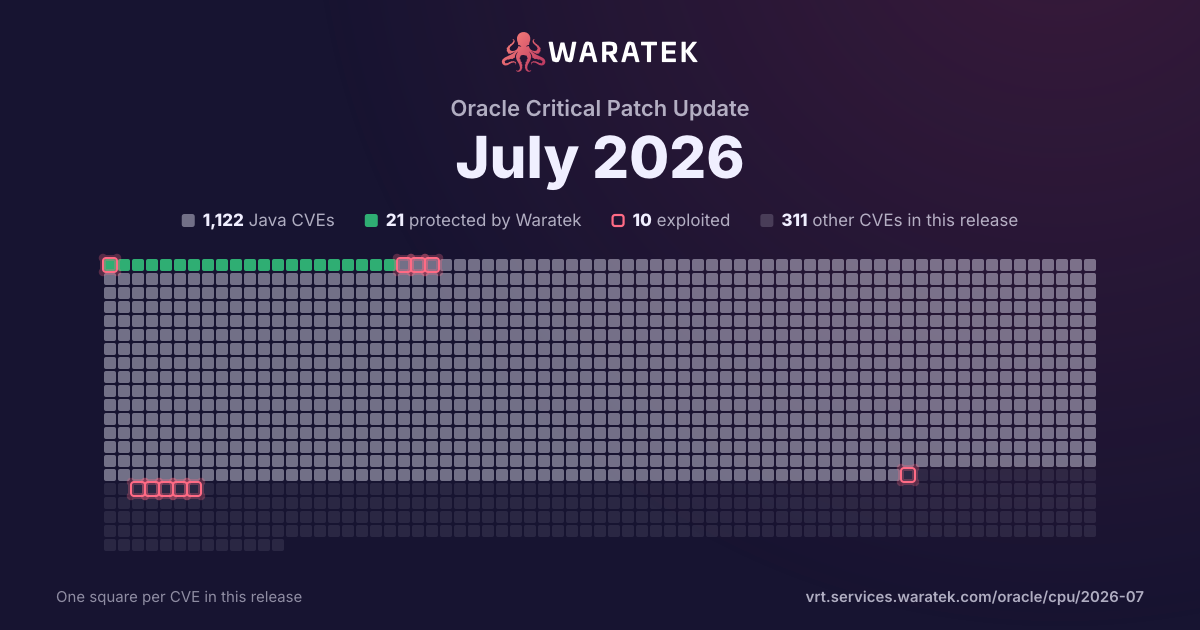
By status
21Protected by Waratek8Mitigation candidate1,095No exploit published13Outside Waratek scope296Not applicable
10Exploited, marked by the ring
No exploit published. For 968 of them, Oracle's security advisory is the source of public detail.
Protected by Waratek. Waratek RASP can block exploitation of these on systems that have not applied the patch yet.
Overview 11 matches · 1 protected · 0 exploited · 0 CISA KEV · 0 public PoC · 0 EPSS ≥ 0.5
Protected by Waratek
1
9.1%
Rule in development
0
0.0%
Mitigation candidate
0
0.0%
No exploit published
10
90.9%
blocked by ARMR today
1
9.1%
partly blocked
0
0.0%
not blocked
10
90.9%
not established
0
0.0%
unrecorded
0
0.0%
Exploited
0
0.0%
Working exploit published
0
0.0%
Proof of concept only
11
100.0%
Forecast only
0
0.0%
No public exploit
0
0.0%
split by
peak 5 / quarter
Q1 241
No exploit published1
High1
not blocked1
Proof of concept only1
Q2 240
Q3 240
Q4 240
Q1 250
Q2 250
Q3 250
Q4 253
No exploit published3
High3
not blocked3
Proof of concept only3
Q1 262
Protected by Waratek1
No exploit published1
High2
blocked by ARMR today1
not blocked1
Proof of concept only2
Q2 265
No exploit published5
High5
not blocked5
Proof of concept only5
Q1 24Q2 24Q3 24Q4 24Q1 25Q2 25Q3 25Q4 25Q1 26Q2 26
| CVE | Severity | Published▾ | Status | Exploitation | Description |
|---|---|---|---|---|---|
| CVE-2026-54512 | High | 2026-06-23 | No exploit published | Proof of concept only | jackson-databind contains the general-purpose data-binding functionality and tree-model for Jackson Data Processor. From 2.10.0 until 2.18.8, 2.21.4, and 3.1.4, jackson-databind's PolymorphicTypeValidator (PTV) is the primary safety mechanism guarding polymorphic deserialization. When polymorphic typing is enabled and a type identifier contains generic parameters (i.e. the type ID string contains <), DatabindContext._resolveAndValidateGeneric() validates only the raw container class name (the substring before <) against the configured PTV. If the container type is approved, the method parses the full canonical type string via TypeFactory.constructFromCanonical() and returns the fully parameterized type without ever validating the nested type arguments against the PTV. The nested type arguments are then resolved, instantiated, and populated as beans during deserialization. An attacker who controls the type ID can therefore place a denied class as a generic type parameter of an allowed container — for example java.util.ArrayList<com.evil.Gadget> when only java.util.ArrayList is allow-listed. The container passes the PTV check; com.evil.Gadget is loaded via Class.forName(name, true, loader), instantiated, and its properties are set from attacker-controlled JSON. This completely bypasses an explicitly configured PTV allow-list. This vulnerability is fixed in 2.18.8, 2.21.4, and 3.1.4. |
| CVE-2026-42587 | High | 2026-05-13 | No exploit published | Proof of concept only | Netty is an asynchronous, event-driven network application framework. Prior to 4.2.13.Final and 4.1.133.Final, HttpContentDecompressor accepts a maxAllocation parameter to limit decompression buffer size and prevent decompression bomb attacks. This limit is correctly enforced for gzip and deflate encodings via ZlibDecoder, but is silently ignored when the content encoding is br (Brotli), zstd, or snappy. An attacker can bypass the configured decompression limit by sending a compressed payload with Content-Encoding: br instead of Content-Encoding: gzip, causing unbounded memory allocation and out-of-memory denial of service. The same vulnerability exists in DelegatingDecompressorFrameListener for HTTP/2 connections. This vulnerability is fixed in 4.2.13.Final and 4.1.133.Final. |
| CVE-2026-42585 | High | 2026-05-13 | No exploit published | Proof of concept only | Netty is an asynchronous, event-driven network application framework. Prior to 4.2.13.Final and 4.1.133.Final, Netty incorrectly parses malformed Transfer-Encoding, enabling request smuggling attacks. This vulnerability is fixed in 4.2.13.Final and 4.1.133.Final. |
| CVE-2026-42583 | High | 2026-05-13 | No exploit published | Proof of concept only | Netty is an asynchronous, event-driven network application framework. Prior to 4.2.13.Final and 4.1.133.Final, Lz4FrameDecoder allocates a ByteBuf of size decompressedLength (up to 32 MB per block) before LZ4 runs. A peer only needs a 21-byte header plus compressedLength payload bytes - 22 bytes if compressedLength == 1 - to force that allocation. This vulnerability is fixed in 4.2.13.Final and 4.1.133.Final. |
| CVE-2026-42582 | High | 2026-05-13 | No exploit published | Proof of concept only | Netty is an asynchronous, event-driven network application framework. Prior to 4.2.13.Final, when decoding header blocks, the non-Huffman branch of io.netty.handler.codec.http3.QpackDecoder#decodeHuffmanEncodedLiteral may execute new byte[length] for a string literal before verifying that length bytes are actually present in the compressed field section. The wire encoding allows a very large length to be expressed in few bytes. There is no check that length <= in.readableBytes() before new byte[length]. This vulnerability is fixed in 4.2.13.Final. |
| CVE-2026-33870 | High | 2026-03-27 | No exploit published | Proof of concept only | Netty is an asynchronous, event-driven network application framework. In versions prior to 4.1.132.Final and 4.2.10.Final, Netty incorrectly parses quoted strings in HTTP/1.1 chunked transfer encoding extension values, enabling request smuggling attacks. Versions 4.1.132.Final and 4.2.10.Final fix the issue. |
| CVE-2026-21452 | High | 2026-01-02 | Protected by Waratek | Proof of concept only | MessagePack for Java is a serializer implementation for Java. A denial-of-service vulnerability exists in versions prior to 0.9.11 when deserializing .msgpack files containing EXT32 objects with attacker-controlled payload lengths. While MessagePack-Java parses extension headers lazily, it later trusts the declared EXT payload length when materializing the extension data. When ExtensionValue.getData() is invoked, the library attempts to allocate a byte array of the declared length without enforcing any upper bound. A malicious .msgpack file of only a few bytes can therefore trigger unbounded heap allocation, resulting in JVM heap exhaustion, process termination, or service unavailability. This vulnerability is triggered during model loading / deserialization, making it a model format vulnerability suitable for remote exploitation. The vulnerability enables a remote denial-of-service attack against applications that deserialize untrusted .msgpack model files using MessagePack for Java. A specially crafted but syntactically valid .msgpack file containing an EXT32 object with an attacker-controlled, excessively large payload length can trigger unbounded memory allocation during deserialization. When the model file is loaded, the library trusts the declared length metadata and attempts to allocate a byte array of that size, leading to rapid heap exhaustion, excessive garbage collection, or immediate JVM termination with an OutOfMemoryError. The attack requires no malformed bytes, user interaction, or elevated privileges and can be exploited remotely in real-world environments such as model registries, inference services, CI/CD pipelines, and cloud-based model hosting platforms that accept or fetch .msgpack artifacts. Because the malicious file is extremely small yet valid, it can bypass basic validation and scanning mechanisms, resulting in complete service unavailability and potential cascading failures in production systems. Version 0.9.11 fixes the vulnerability. |
| CVE-2024-29371 | High | 2025-12-17 | No exploit published | Proof of concept only | In jose4j before 0.9.6, an attacker can cause a Denial-of-Service (DoS) condition by crafting a malicious JSON Web Encryption (JWE) token with an exceptionally high compression ratio. When this token is processed by the server, it results in significant memory allocation and processing time during decompression. |
| CVE-2025-66021 | High | 2025-11-26 | No exploit published | Proof of concept only | OWASP Java HTML Sanitizer is a configureable HTML Sanitizer written in Java, allowing inclusion of HTML authored by third-parties in web applications while protecting against XSS. In version 20240325.1, OWASP java html sanitizer is vulnerable to XSS if HtmlPolicyBuilder allows noscript and style tags with allowTextIn inside the style tag. This could lead to XSS if the payload is crafted in such a way that it does not sanitise the CSS and allows tags which is not mentioned in HTML policy. At time of publication no known patch is available. |
| CVE-2025-9624 | High | 2025-11-25 | No exploit published | Proof of concept only | A vulnerability in OpenSearch allows attackers to cause Denial of Service (DoS) by submitting complex query_string inputs. This issue affects all OpenSearch versions between 3.0.0 and < 3.3.0 and OpenSearch < 2.19.4. |
| CVE-2024-24824 | High | 2024-02-07 | No exploit published | Proof of concept only | Graylog is a free and open log management platform. Starting in version 2.0.0 and prior to versions 5.1.11 and 5.2.4, arbitrary classes can be loaded and instantiated using a HTTP PUT request to the `/api/system/cluster_config/` endpoint. Graylog's cluster config system uses fully qualified class names as config keys. To validate the existence of the requested class before using them, Graylog loads the class using the class loader. If a user with the appropriate permissions performs the request, arbitrary classes with 1-arg String constructors can be instantiated. This will execute arbitrary code that is run during class instantiation. In the specific use case of `java.io.File`, the behavior of the internal web-server stack will lead to information exposure by including the entire file content in the response to the REST request. Versions 5.1.11 and 5.2.4 contain a fix for this issue. |