
Oracle Critical Patch Update July 2026
Released July 2026 · Oracle's advisory ↗ · ← Security Patch Update, June 2026 · Security Patch Update, August 2026 →
1,433 CVEs in this release, one square each
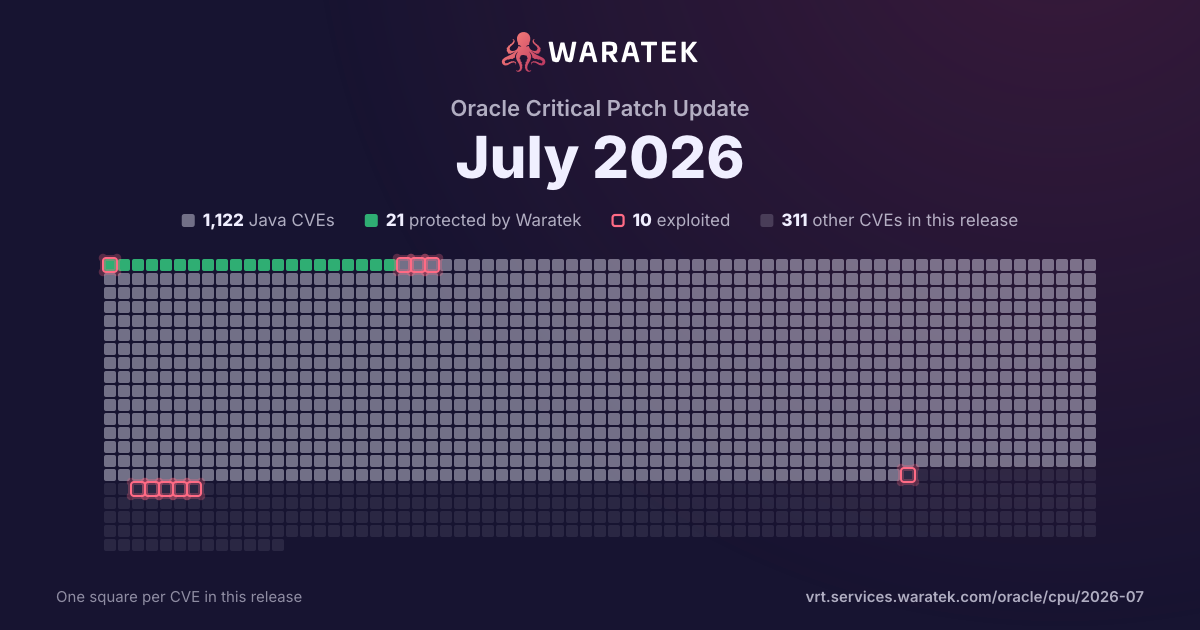
By status
21Protected by Waratek8Mitigation candidate1,093No exploit published16Outside Waratek scope295Not applicable
10Exploited, marked by the ring
No exploit published. For 971 of them, Oracle's security advisory is the source of public detail.
Protected by Waratek. Waratek RASP can block exploitation of these on systems that have not applied the patch yet.
Overview 7 matches · 3 in Waratek scope · 1 protected · 3 CISA KEV · 6 EPSS ≥ 0.5
Protected by Waratek
1
14.3%
Rule in development
0
0.0%
Mitigation candidate
2
28.6%
No exploit published
0
0.0%
Outside Waratek scope
1
14.3%
Not applicable
3
42.9%
Withdrawn CVE
0
0.0%
blocked by ARMR today
1
14.3%
partly blocked
0
0.0%
not blocked
6
85.7%
not established
0
0.0%
unrecorded
0
0.0%
Exploited
7
100.0%
Working exploit published
0
0.0%
Proof of concept only
0
0.0%
Forecast only
0
0.0%
No public exploit
0
0.0%
split by
peak 5 / quarter
Q3 211
Outside Waratek scope1
High1
not blocked1
Exploited1
Q4 210
Q1 220
Q2 220
Q3 220
Q4 220
Q1 230
Q2 230
Q3 230
Q4 230
Q1 240
Q2 240
Q3 240
Q4 240
Q1 250
Q2 251
Mitigation candidate1
High1
not blocked1
Exploited1
Q3 250
Q4 250
Q1 260
Q2 265
Protected by Waratek1
Mitigation candidate1
Not applicable3
High5
blocked by ARMR today1
not blocked4
Exploited5
Q4 21Q2 22Q4 22Q2 23Q4 23Q2 24Q4 24Q2 25Q4 25Q2 26
| CVE | Severity | Published▾ | Status | Exploitation | Description |
|---|---|---|---|---|---|
| CVE-2026-43500 | High | 2026-05-11 | Not applicable | Exploited | In the Linux kernel, the following vulnerability has been resolved: rxrpc: Also unshare DATA/RESPONSE packets when paged frags are present The DATA-packet handler in rxrpc_input_call_event() and the RESPONSE handler in rxrpc_verify_response() copy the skb to a linear one before calling into the security ops only when skb_cloned() is true. An skb that is not cloned but still carries externally-owned paged fragments (e.g. SKBFL_SHARED_FRAG set by splice() into a UDP socket via __ip_append_data, or a chained skb_has_frag_list()) falls through to the in-place decryption path, which binds the frag pages directly into the AEAD/skcipher SGL via skb_to_sgvec(). Extend the gate to also unshare when skb_has_frag_list() or skb_has_shared_frag() is true. This catches the splice-loopback vector and other externally-shared frag sources while preserving the zero-copy fast path for skbs whose frags are kernel-private (e.g. NIC page_pool RX, GRO). The OOM/trace handling already in place is reused. |
| CVE-2026-43284 | High | 2026-05-08 | Not applicable | Exploited | In the Linux kernel, the following vulnerability has been resolved: xfrm: esp: avoid in-place decrypt on shared skb frags MSG_SPLICE_PAGES can attach pages from a pipe directly to an skb. TCP marks such skbs with SKBFL_SHARED_FRAG after skb_splice_from_iter(), so later paths that may modify packet data can first make a private copy. The IPv4/IPv6 datagram append paths did not set this flag when splicing pages into UDP skbs. That leaves an ESP-in-UDP packet made from shared pipe pages looking like an ordinary uncloned nonlinear skb. ESP input then takes the no-COW fast path for uncloned skbs without a frag_list and decrypts in place over data that is not owned privately by the skb. Mark IPv4/IPv6 datagram splice frags with SKBFL_SHARED_FRAG, matching TCP. Also make ESP input fall back to skb_cow_data() when the flag is present, so ESP does not decrypt externally backed frags in place. Private nonlinear skb frags still use the existing fast path. This intentionally does not change ESP output. In esp_output_head(), the path that appends the ESP trailer to existing skb tailroom without calling skb_cow_data() is not reachable for nonlinear skbs: skb_tailroom() returns zero when skb->data_len is nonzero, while ESP tailen is positive. Thus ESP output will either use the separate destination-frag path or fall back to skb_cow_data(). |
| CVE-2026-40466 | High | 2026-04-24 | Mitigation candidate | Exploited | Improper Input Validation, Improper Control of Generation of Code ('Code Injection') vulnerability in Apache ActiveMQ Broker, Apache ActiveMQ All, Apache ActiveMQ. An authenticated attacker may bypass the fix in CVE-2026-34197 by adding a connector using an HTTP Discovery transport via BrokerView.addNetworkConnector or BrokerView.addConnector through Jolokia if the activemq-http module is on the classpath. A malicious HTTP endpoint can return a VM transport through the HTTP URI which will bypass the validation added in CVE-2026-34197. The attacker can then use the VM transport's brokerConfig parameter to load a remote Spring XML application context using ResourceXmlApplicationContext. Because Spring's ResourceXmlApplicationContext instantiates all singleton beans before the BrokerService validates the configuration, arbitrary code execution occurs on the broker's JVM through bean factory methods such as Runtime.exec(). This issue affects Apache ActiveMQ Broker: before 5.19.6, from 6.0.0 before 6.2.5; Apache ActiveMQ All: before 5.19.6, from 6.0.0 before 6.2.5; Apache ActiveMQ: before 5.19.6, from 6.0.0 before 6.2.5. Users are recommended to upgrade to version 5.19.6 or 6.2.5, which fixes the issue. |
| CVE-2026-31431 | High | 2026-04-22 | Not applicable | Exploited | In the Linux kernel, the following vulnerability has been resolved: crypto: algif_aead - Revert to operating out-of-place This mostly reverts commit 72548b093ee3 except for the copying of the associated data. There is no benefit in operating in-place in algif_aead since the source and destination come from different mappings. Get rid of all the complexity added for in-place operation and just copy the AD directly. |
| CVE-2026-34486 | High | 2026-04-09 | Protected by Waratek | Exploited | Missing Encryption of Sensitive Data vulnerability in Apache Tomcat due to the fix for CVE-2026-29146 allowing the bypass of the EncryptInterceptor. This issue affects Apache Tomcat: 11.0.20, 10.1.53, 9.0.116. Users are recommended to upgrade to version 11.0.21, 10.1.54 or 9.0.117, which fix the issue. |
| CVE-2025-27817 | High | 2025-06-10 | Mitigation candidate | Exploited | A possible arbitrary file read and SSRF vulnerability has been identified in Apache Kafka Client. Apache Kafka Clients accept configuration data for setting the SASL/OAUTHBEARER connection with the brokers, including "sasl.oauthbearer.token.endpoint.url" and "sasl.oauthbearer.jwks.endpoint.url". Apache Kafka allows clients to read an arbitrary file and return the content in the error log, or sending requests to an unintended location. In applications where Apache Kafka Clients configurations can be specified by an untrusted party, attackers may use the "sasl.oauthbearer.token.endpoint.url" and "sasl.oauthbearer.jwks.endpoint.url" configuratin to read arbitrary contents of the disk and environment variables or make requests to an unintended location. In particular, this flaw may be used in Apache Kafka Connect to escalate from REST API access to filesystem/environment/URL access, which may be undesirable in certain environments, including SaaS products. Since Apache Kafka 3.9.1/4.0.0, we have added a system property ("-Dorg.apache.kafka.sasl.oauthbearer.allowed.urls") to set the allowed urls in SASL JAAS configuration. In 3.9.1, it accepts all urls by default for backward compatibility. However in 4.0.0 and newer, the default value is empty list and users have to set the allowed urls explicitly. |
| CVE-2021-22555 | High | 2021-07-07 | Outside Waratek scope | Exploited | A heap out-of-bounds write affecting Linux since v2.6.19-rc1 was discovered in net/netfilter/x_tables.c. This allows an attacker to gain privileges or cause a DoS (via heap memory corruption) through user name space |