
Oracle Critical Patch Update July 2026
Released July 2026 · Oracle's advisory ↗ · ← Security Patch Update, June 2026 · Security Patch Update, August 2026 →
1,433 CVEs in this release, one square each
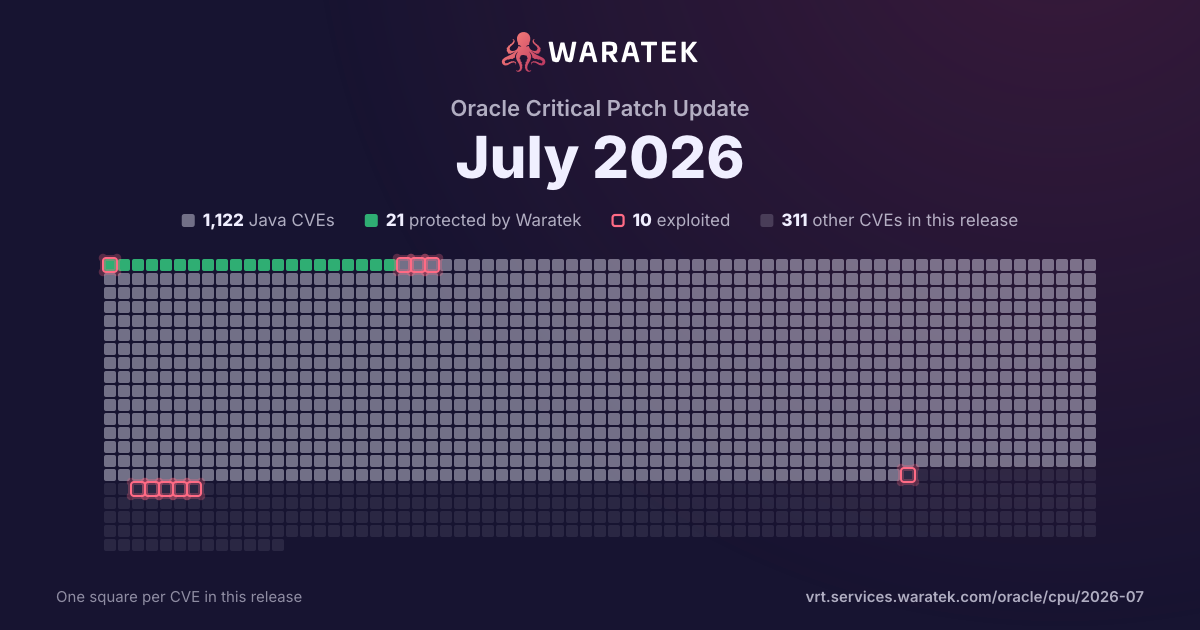
By status
21Protected by Waratek3Rule in development5Mitigation candidate1,095No exploit published13Outside Waratek scope296Not applicable
10Exploited, marked by the ring
No exploit published. For 968 of them, Oracle's security advisory is the source of public detail.
Protected by Waratek. Waratek RASP can block exploitation of these on systems that have not applied the patch yet.
Overview 39 matches · 6 protected · 2 exploited · 1 CISA KEV · 2 public PoC · 0 EPSS ≥ 0.5
Protected by Waratek
6
15.4%
Rule in development
1
2.6%
Mitigation candidate
1
2.6%
No exploit published
31
79.5%
blocked by ARMR today
6
15.4%
partly blocked
0
0.0%
not blocked
33
84.6%
not established
0
0.0%
unrecorded
0
0.0%
Exploited
2
5.1%
Working exploit published
0
0.0%
Proof of concept only
4
10.3%
Forecast only
0
0.0%
No public exploit
33
84.6%
split by
peak 15 / month
Apr 2615
Protected by Waratek3
Rule in development1
Mitigation candidate1
No exploit published10
High15
blocked by ARMR today3
not blocked12
Exploited2
No public exploit13
May 265
No exploit published5
High5
not blocked5
Proof of concept only3
No public exploit2
Jun 267
No exploit published7
High7
not blocked7
Proof of concept only1
No public exploit6
Jul 2612
Protected by Waratek3
No exploit published9
High12
blocked by ARMR today3
not blocked9
No public exploit12
Apr 26May 26Jun 26Jul 26
| CVE | Severity | Published▾ | Status | Exploitation | Description |
|---|---|---|---|---|---|
| CVE-2026-61226 | High | 2026-07-21 | No exploit published | No public exploit | Vulnerability in the Oracle Communications Converged Application Server product of Oracle Communications (component: RTP Proxy). The supported version that is affected is 8.3. Difficult to exploit vulnerability allows high privileged attacker with logon to the infrastructure where Oracle Communications Converged Application Server executes to compromise Oracle Communications Converged Application Server. While the vulnerability is in Oracle Communications Converged Application Server, attacks may significantly impact additional products (scope change). Successful attacks of this vulnerability can result in takeover of Oracle Communications Converged Application Server. CVSS 3.1 Base Score 7.5 (Confidentiality, Integrity and Availability impacts). CVSS Vector: (CVSS:3.1/AV:L/AC:H/PR:H/UI:N/S:C/C:H/I:H/A:H). |
| CVE-2026-61225 | High | 2026-07-21 | No exploit published | No public exploit | Vulnerability in the Oracle Communications Converged Application Server product of Oracle Communications (component: Core). Supported versions that are affected are 8.2 and 8.3. Difficult to exploit vulnerability allows unauthenticated attacker with network access via TCP/IP to compromise Oracle Communications Converged Application Server. Successful attacks of this vulnerability can result in takeover of Oracle Communications Converged Application Server. CVSS 3.1 Base Score 8.1 (Confidentiality, Integrity and Availability impacts). CVSS Vector: (CVSS:3.1/AV:N/AC:H/PR:N/UI:N/S:U/C:H/I:H/A:H). |
| CVE-2026-61224 | High | 2026-07-21 | No exploit published | No public exploit | Vulnerability in the Oracle Communications Converged Application Server product of Oracle Communications (component: Security). The supported version that is affected is 8.3. Difficult to exploit vulnerability allows high privileged attacker with network access via TLS to compromise Oracle Communications Converged Application Server. While the vulnerability is in Oracle Communications Converged Application Server, attacks may significantly impact additional products (scope change). Successful attacks of this vulnerability can result in takeover of Oracle Communications Converged Application Server. CVSS 3.1 Base Score 8.0 (Confidentiality, Integrity and Availability impacts). CVSS Vector: (CVSS:3.1/AV:N/AC:H/PR:H/UI:N/S:C/C:H/I:H/A:H). |
| CVE-2026-61127 | High | 2026-07-21 | No exploit published | No public exploit | Vulnerability in the Oracle Communications Service Catalog and Design product of Oracle Communications (component: Solution Designer). Supported versions that are affected are 8.0.0.7.0-8.3.0.2.0. Easily exploitable vulnerability allows low privileged attacker with network access via HTTP to compromise Oracle Communications Service Catalog and Design. Successful attacks of this vulnerability can result in takeover of Oracle Communications Service Catalog and Design. CVSS 3.1 Base Score 8.8 (Confidentiality, Integrity and Availability impacts). CVSS Vector: (CVSS:3.1/AV:N/AC:L/PR:L/UI:N/S:U/C:H/I:H/A:H). |
| CVE-2026-61126 | High | 2026-07-21 | No exploit published | No public exploit | Vulnerability in the Oracle Communications Billing and Revenue Management product of Oracle Communications (component: Platform). Supported versions that are affected are 15.0.0.0.0-15.0.1.0.0 and 15.1.0.0.0-15.2.0.0.0. Easily exploitable vulnerability allows low privileged attacker with logon to the infrastructure where Oracle Communications Billing and Revenue Management executes to compromise Oracle Communications Billing and Revenue Management. Successful attacks of this vulnerability can result in takeover of Oracle Communications Billing and Revenue Management. CVSS 3.1 Base Score 7.8 (Confidentiality, Integrity and Availability impacts). CVSS Vector: (CVSS:3.1/AV:L/AC:L/PR:L/UI:N/S:U/C:H/I:H/A:H). |
| CVE-2026-61095 | High | 2026-07-21 | No exploit published | No public exploit | Vulnerability in the Oracle Communications Unified Inventory Management product of Oracle Communications (component: Security). Supported versions that are affected are 7.5.0, 7.5.1, 7.6.0, 7.7.0, 7.8.0 and 8.0.1. Easily exploitable vulnerability allows low privileged attacker with network access via HTTP to compromise Oracle Communications Unified Inventory Management. Successful attacks of this vulnerability can result in unauthorized access to critical data or complete access to all Oracle Communications Unified Inventory Management accessible data as well as unauthorized update, insert or delete access to some of Oracle Communications Unified Inventory Management accessible data. CVSS 3.1 Base Score 7.1 (Confidentiality and Integrity impacts). CVSS Vector: (CVSS:3.1/AV:N/AC:L/PR:L/UI:N/S:U/C:H/I:L/A:N). |
| CVE-2026-61091 | High | 2026-07-21 | No exploit published | No public exploit | Vulnerability in the Oracle Communications Billing and Revenue Management product of Oracle Communications (component: BRM Server). Supported versions that are affected are 15.0.0.0.0, 15.0.1.0.0, 15.1.0.0.0 and 15.2.0.0.0. Easily exploitable vulnerability allows low privileged attacker with logon to the infrastructure where Oracle Communications Billing and Revenue Management executes to compromise Oracle Communications Billing and Revenue Management. Successful attacks of this vulnerability can result in takeover of Oracle Communications Billing and Revenue Management. CVSS 3.1 Base Score 7.8 (Confidentiality, Integrity and Availability impacts). CVSS Vector: (CVSS:3.1/AV:L/AC:L/PR:L/UI:N/S:U/C:H/I:H/A:H). |
| CVE-2026-61053 | High | 2026-07-21 | No exploit published | No public exploit | Vulnerability in the Oracle Communications BRM - Elastic Charging Engine product of Oracle Communications (component: Diameter Gateway and SDK). Supported versions that are affected are 15.0.0.0.0, 15.0.1.0.0, 15.1.0.0.0 and 15.2.0.0.0. Easily exploitable vulnerability allows low privileged attacker with logon to the infrastructure where Oracle Communications BRM - Elastic Charging Engine executes to compromise Oracle Communications BRM - Elastic Charging Engine. Successful attacks of this vulnerability can result in takeover of Oracle Communications BRM - Elastic Charging Engine. CVSS 3.1 Base Score 7.8 (Confidentiality, Integrity and Availability impacts). CVSS Vector: (CVSS:3.1/AV:L/AC:L/PR:L/UI:N/S:U/C:H/I:H/A:H). |
| CVE-2026-47063 | High | 2026-07-21 | Protected by Waratek | No public exploit | Vulnerability in the Oracle Java SE, Oracle GraalVM for JDK, Oracle GraalVM Enterprise Edition product of Oracle Java SE (component: Libraries). Supported versions that are affected are Oracle Java SE: 8u491, 8u491-perf, 11.0.31, 17.0.19, 21.0.11, 25.0.3, 26.0.1; Oracle GraalVM for JDK: 17.0.19 and 21.0.11; Oracle GraalVM Enterprise Edition: 21.3.18. Easily exploitable vulnerability allows unauthenticated attacker with network access via multiple protocols to compromise Oracle Java SE, Oracle GraalVM for JDK, Oracle GraalVM Enterprise Edition. Successful attacks of this vulnerability can result in unauthorized creation, deletion or modification access to critical data or all Oracle Java SE, Oracle GraalVM for JDK, Oracle GraalVM Enterprise Edition accessible data. Note: This vulnerability can be exploited by using APIs in the specified Component, e.g., through a web service which supplies data to the APIs. This vulnerability also applies to Java deployments, typically in clients running sandboxed Java Web Start applications or sandboxed Java applets, that load and run untrusted code (e.g., code that comes from the internet) and rely on the Java sandbox for security. CVSS 3.1 Base Score 7.5 (Integrity impacts). CVSS Vector: (CVSS:3.1/AV:N/AC:L/PR:N/UI:N/S:U/C:N/I:H/A:N). |
| CVE-2026-47058 | High | 2026-07-21 | Protected by Waratek | No public exploit | Vulnerability in Oracle Java SE (component: Scripting). Supported versions that are affected are Oracle Java SE: 8u491, 8u491-perf and 11.0.31. Difficult to exploit vulnerability allows unauthenticated attacker with network access via multiple protocols to compromise Oracle Java SE. Successful attacks of this vulnerability can result in unauthorized creation, deletion or modification access to critical data or all Oracle Java SE accessible data as well as unauthorized access to critical data or complete access to all Oracle Java SE accessible data. Note: This vulnerability can be exploited by using APIs in the specified Component, e.g., through a web service which supplies data to the APIs. This vulnerability also applies to Java deployments, typically in clients running sandboxed Java Web Start applications or sandboxed Java applets, that load and run untrusted code (e.g., code that comes from the internet) and rely on the Java sandbox for security. CVSS 3.1 Base Score 7.4 (Confidentiality and Integrity impacts). CVSS Vector: (CVSS:3.1/AV:N/AC:H/PR:N/UI:N/S:U/C:H/I:H/A:N). |
| CVE-2026-47057 | High | 2026-07-21 | Protected by Waratek | No public exploit | Vulnerability in Oracle Java SE (component: Scripting). Supported versions that are affected are Oracle Java SE: 8u491, 8u491-perf and 11.0.31. Easily exploitable vulnerability allows unauthenticated attacker with network access via multiple protocols to compromise Oracle Java SE. Successful attacks of this vulnerability can result in unauthorized ability to cause a hang or frequently repeatable crash (complete DOS) of Oracle Java SE. Note: This vulnerability can be exploited by using APIs in the specified Component, e.g., through a web service which supplies data to the APIs. This vulnerability also applies to Java deployments, typically in clients running sandboxed Java Web Start applications or sandboxed Java applets, that load and run untrusted code (e.g., code that comes from the internet) and rely on the Java sandbox for security. CVSS 3.1 Base Score 7.5 (Availability impacts). CVSS Vector: (CVSS:3.1/AV:N/AC:L/PR:N/UI:N/S:U/C:N/I:N/A:H). |
| CVE-2026-47007 | High | 2026-07-21 | No exploit published | No public exploit | Vulnerability in the Oracle Communications Pricing Design Center product of Oracle Communications (component: On-premise Deployment). Supported versions that are affected are 15.0.0.0.0, 15.0.1.0.0, 15.1.0.0.0 and 15.2.0.0.0. Easily exploitable vulnerability allows low privileged attacker with logon to the infrastructure where Oracle Communications Pricing Design Center executes to compromise Oracle Communications Pricing Design Center. While the vulnerability is in Oracle Communications Pricing Design Center, attacks may significantly impact additional products (scope change). Successful attacks of this vulnerability can result in unauthorized access to critical data or complete access to all Oracle Communications Pricing Design Center accessible data as well as unauthorized update, insert or delete access to some of Oracle Communications Pricing Design Center accessible data. CVSS 3.1 Base Score 7.3 (Confidentiality and Integrity impacts). CVSS Vector: (CVSS:3.1/AV:L/AC:L/PR:L/UI:N/S:C/C:H/I:L/A:N). |
| CVE-2026-54512 | High | 2026-06-23 | No exploit published | Proof of concept only | jackson-databind contains the general-purpose data-binding functionality and tree-model for Jackson Data Processor. From 2.10.0 until 2.18.8, 2.21.4, and 3.1.4, jackson-databind's PolymorphicTypeValidator (PTV) is the primary safety mechanism guarding polymorphic deserialization. When polymorphic typing is enabled and a type identifier contains generic parameters (i.e. the type ID string contains <), DatabindContext._resolveAndValidateGeneric() validates only the raw container class name (the substring before <) against the configured PTV. If the container type is approved, the method parses the full canonical type string via TypeFactory.constructFromCanonical() and returns the fully parameterized type without ever validating the nested type arguments against the PTV. The nested type arguments are then resolved, instantiated, and populated as beans during deserialization. An attacker who controls the type ID can therefore place a denied class as a generic type parameter of an allowed container — for example java.util.ArrayList<com.evil.Gadget> when only java.util.ArrayList is allow-listed. The container passes the PTV check; com.evil.Gadget is loaded via Class.forName(name, true, loader), instantiated, and its properties are set from attacker-controlled JSON. This completely bypasses an explicitly configured PTV allow-list. This vulnerability is fixed in 2.18.8, 2.21.4, and 3.1.4. |
| CVE-2026-41851 | High | 2026-06-09 | No exploit published | No public exploit | Applications which accept user-supplied Spring Expression Language (SpEL) expressions may be vulnerable to a Denial of Service (DoS) attack if the evaluation of a SpEL expression triggers unbounded cache growth. Affected versions: Spring Framework 7.0.0 through 7.0.7; 6.2.0 through 6.2.18; 6.1.0 through 6.1.27; 5.3.0 through 5.3.48. |
| CVE-2026-41850 | High | 2026-06-09 | No exploit published | No public exploit | Applications that evaluate user-supplied Spring Expression Language (SpEL) expressions are vulnerable to an Algorithmic Denial of Service (DoS). By providing a specially crafted expression, an attacker can trigger excessive resource consumption during evaluation, leading to application degradation or unavailability. Affected versions: Spring Framework 7.0.0 through 7.0.7; 6.2.0 through 6.2.18; 6.1.0 through 6.1.27; 5.3.0 through 5.3.48. |
| CVE-2026-41848 | High | 2026-06-09 | No exploit published | No public exploit | Applications may be vulnerable to a Regular Expression Denial of Service (ReDoS) attack if an attacker is able to provide a pattern which is then directly or indirectly supplied to one of the following methods in AntPathMatcher: match(String pattern, String path), matchStart(String pattern, String path), extractUriTemplateVariables(String pattern, String path). Affected versions: Spring Framework 7.0.0 through 7.0.7; 6.2.0 through 6.2.18; 6.1.0 through 6.1.27; 5.3.0 through 5.3.48. |
| CVE-2026-41845 | High | 2026-06-09 | No exploit published | No public exploit | Due to incorrect escaping, the use of JavaScriptUtils.javaScriptEscape() may lead to JavaScript code injection in the browser, potentially resulting in a cross-site scripting (XSS) vulnerability. Affected versions: Spring Framework 7.0.0 through 7.0.7; 6.2.0 through 6.2.18; 6.1.0 through 6.1.27; 5.3.0 through 5.3.48. |
| CVE-2026-41842 | High | 2026-06-09 | No exploit published | No public exploit | Spring MVC and WebFlux applications are vulnerable to Denial of Service (DoS) attacks when resolving static resources. Affected versions: Spring Framework 7.0.0 through 7.0.7; 6.2.0 through 6.2.18; 6.1.0 through 6.1.27; 5.3.0 through 5.3.48. |
| CVE-2026-41838 | High | 2026-06-09 | No exploit published | No public exploit | IDs for WebSocket sessions in the spring-websocket module are not cryptographically unpredictable, which may be possible to exploit in combination with inadequate authorization rules. Affected versions: Spring Framework 7.0.0 through 7.0.7; 6.2.0 through 6.2.18; 6.1.0 through 6.1.27; 5.3.0 through 5.3.48. |
| CVE-2026-44248 | High | 2026-05-13 | No exploit published | No public exploit | Netty is an asynchronous, event-driven network application framework. Prior to 4.2.13.Final and 4.1.133.Final, the MQTT 5 header Properties section is parsed and buffered before any message size limit is applied. Specifically, in MqttDecoder, the decodeVariableHeader() method is called before the bytesRemainingBeforeVariableHeader > maxBytesInMessage check. The decodeVariableHeader() can call other methods which will call decodeProperties(). Effectively, Netty does not apply any limits to the size of the properties being decoded. Additionally, because MqttDecoder extends ReplayingDecoder, Netty will repeatedly re-parse the enormous Properties sections and buffer the bytes in memory, until the entire thing parses to completion. This can cause high resource usage in both CPU and memory. This vulnerability is fixed in 4.2.13.Final and 4.1.133.Final. |
| CVE-2026-42587 | High | 2026-05-13 | No exploit published | Proof of concept only | Netty is an asynchronous, event-driven network application framework. Prior to 4.2.13.Final and 4.1.133.Final, HttpContentDecompressor accepts a maxAllocation parameter to limit decompression buffer size and prevent decompression bomb attacks. This limit is correctly enforced for gzip and deflate encodings via ZlibDecoder, but is silently ignored when the content encoding is br (Brotli), zstd, or snappy. An attacker can bypass the configured decompression limit by sending a compressed payload with Content-Encoding: br instead of Content-Encoding: gzip, causing unbounded memory allocation and out-of-memory denial of service. The same vulnerability exists in DelegatingDecompressorFrameListener for HTTP/2 connections. This vulnerability is fixed in 4.2.13.Final and 4.1.133.Final. |
| CVE-2026-42586 | High | 2026-05-13 | No exploit published | No public exploit | Netty is an asynchronous, event-driven network application framework. Prior to 4.2.13.Final and 4.1.133.Final, the Netty Redis codec encoder (RedisEncoder) writes user-controlled string content directly to the network output buffer without validating or sanitizing CRLF (\r\n) characters. Since the Redis Serialization Protocol (RESP) uses CRLF as the command/response delimiter, an attacker who can control the content of a Redis message can inject arbitrary Redis commands or forge fake responses. This vulnerability is fixed in 4.2.13.Final and 4.1.133.Final. |
| CVE-2026-42585 | High | 2026-05-13 | No exploit published | Proof of concept only | Netty is an asynchronous, event-driven network application framework. Prior to 4.2.13.Final and 4.1.133.Final, Netty incorrectly parses malformed Transfer-Encoding, enabling request smuggling attacks. This vulnerability is fixed in 4.2.13.Final and 4.1.133.Final. |
| CVE-2026-42583 | High | 2026-05-13 | No exploit published | Proof of concept only | Netty is an asynchronous, event-driven network application framework. Prior to 4.2.13.Final and 4.1.133.Final, Lz4FrameDecoder allocates a ByteBuf of size decompressedLength (up to 32 MB per block) before LZ4 runs. A peer only needs a 21-byte header plus compressedLength payload bytes - 22 bytes if compressedLength == 1 - to force that allocation. This vulnerability is fixed in 4.2.13.Final and 4.1.133.Final. |
| CVE-2026-42198 | High | 2026-04-29 | No exploit published | No public exploit | pgjdbc is an open source postgresql JDBC Driver. From version 42.2.0 to before version 42.7.11, pgjdbc is vulnerable to a client-side denial of service during SCRAM-SHA-256 authentication. A malicious server can instruct the driver to perform SCRAM authentication with a very large iteration count. With a large enough value, the client spends an unbounded amount of CPU time inside PBKDF2 before authentication can fail. A single attempt ties up a CPU core. Repeated or concurrent attempts exhaust client CPU and can wedge connection pools. In affected versions, loginTimeout did not fully mitigate this problem. When loginTimeout expired, the caller could stop waiting, but the worker thread performing the connection attempt could continue running and burning CPU inside the SCRAM PBKDF2 computation. This issue has been patched in version 42.7.11. |
| CVE-2026-40975 | High | 2026-04-28 | No exploit published | No public exploit | Values produced by ${random.value} are not suitable for use as secrets. ${random.uuid} is not affected. ${random.int} and ${random.long} should never be used for secrets as they are numeric values with a predictable range. Affected: Spring Boot 4.0.0–4.0.5 (fix 4.0.6), 3.5.0–3.5.13 (fix 3.5.14), 3.4.0–3.4.15 (fix 3.4.16), 3.3.0–3.3.18 (fix 3.3.19), 2.7.0–2.7.32 (fix 2.7.33); random value property source / weak PRNG for secrets. Versions that are no longer supported are also affected per vendor advisory. |
| CVE-2026-40973 | High | 2026-04-28 | No exploit published | No public exploit | A local attacker on the same host as the application may be able to take control of the directory used by `ApplicationTemp`. When `server.servlet.session.persistent` is set to `true` and the attack persists across application restarts, this may allow the attacker to read session information and hijack authenticated users or deploy a gadget chain and execute code as the application's user. Affected: Spring Boot 4.0.0–4.0.5 (fix 4.0.6), 3.5.0–3.5.13 (fix 3.5.14), 3.4.0–3.4.15 (fix 3.4.16), 3.3.0–3.3.18 (fix 3.3.19), 2.7.0–2.7.32 (fix 2.7.33); predictable temp directory / `ApplicationTemp` ownership verification. Versions that are no longer supported are also affected per vendor advisory. |
| CVE-2026-41044 | High | 2026-04-24 | No exploit published | No public exploit | Improper Input Validation, Improper Control of Generation of Code ('Code Injection') vulnerability in Apache ActiveMQ, Apache ActiveMQ Broker, Apache ActiveMQ All. An authenticated attacker can use the admin web console page to construct a malicious broker name that bypasses name validation to include an xbean binding that can be later used by a VM transport to load a remote Spring XML application. The attacker can then use the DestinationView mbean to send a message to trigger a VM transport creation that will reference this malicious broker name which can lead to loading the malicious Spring XML context file. Because Spring's ResourceXmlApplicationContext instantiates all singleton beans before the BrokerService validates the configuration, arbitrary code execution occurs on the broker's JVM through bean factory methods such as Runtime.exec(). This issue affects Apache ActiveMQ: before 5.19.6, from 6.0.0 before 6.2.5; Apache ActiveMQ Broker: before 5.19.6, from 6.0.0 before 6.2.5; Apache ActiveMQ All: before 5.19.6, from 6.0.0 before 6.2.5. Users are recommended to upgrade to version 6.2.5 or 5.19.6, which fixes the issue. |
| CVE-2026-40466 | High | 2026-04-24 | Rule in development | Exploited | Improper Input Validation, Improper Control of Generation of Code ('Code Injection') vulnerability in Apache ActiveMQ Broker, Apache ActiveMQ All, Apache ActiveMQ. An authenticated attacker may bypass the fix in CVE-2026-34197 by adding a connector using an HTTP Discovery transport via BrokerView.addNetworkConnector or BrokerView.addConnector through Jolokia if the activemq-http module is on the classpath. A malicious HTTP endpoint can return a VM transport through the HTTP URI which will bypass the validation added in CVE-2026-34197. The attacker can then use the VM transport's brokerConfig parameter to load a remote Spring XML application context using ResourceXmlApplicationContext. Because Spring's ResourceXmlApplicationContext instantiates all singleton beans before the BrokerService validates the configuration, arbitrary code execution occurs on the broker's JVM through bean factory methods such as Runtime.exec(). This issue affects Apache ActiveMQ Broker: before 5.19.6, from 6.0.0 before 6.2.5; Apache ActiveMQ All: before 5.19.6, from 6.0.0 before 6.2.5; Apache ActiveMQ: before 5.19.6, from 6.0.0 before 6.2.5. Users are recommended to upgrade to version 5.19.6 or 6.2.5, which fixes the issue. |
| CVE-2026-22754 | High | 2026-04-22 | No exploit published | No public exploit | Vulnerability in Spring Spring Security. If an application uses <sec:intercept-url servlet-path="/servlet-path" pattern="/endpoint/**"/> to define the servlet path for computing a path matcher, then the servlet path is not included and the related authorization rules are not exercised. This can lead to an authorization bypass.This issue affects Spring Security: from 7.0.0 through 7.0.4. |
| CVE-2026-22753 | High | 2026-04-22 | No exploit published | No public exploit | Vulnerability in Spring Spring Security. If an application is using securityMatchers(String) and a PathPatternRequestMatcher.Builder bean to prepend a servlet path, matching requests to that filter chain may fail and its related security components will not be exercised as intended by the application. This can lead to the authentication, authorization, and other security controls being rendered inactive on intended requests.This issue affects Spring Security: from 7.0.0 through 7.0.4. |
| CVE-2026-22747 | High | 2026-04-22 | No exploit published | No public exploit | Vulnerability in Spring Spring Security. SubjectX500PrincipalExtractor does not correctly handle certain malformed X.509 certificate CN values, which can lead to reading the wrong value for the username. In a carefully crafted certificate, this can lead to an attacker impersonating another user. This issue affects Spring Security: from 7.0.0 through 7.0.4. |
| CVE-2026-34282 | High | 2026-04-21 | Mitigation candidate | No public exploit | Vulnerability in the Oracle Java SE, Oracle GraalVM for JDK, Oracle GraalVM Enterprise Edition product of Oracle Java SE (component: Networking). Supported versions that are affected are Oracle Java SE: 8u481-perf, 11.0.30, 17.0.18, 21.0.10, 25.0.2, 26; Oracle GraalVM for JDK: 17.0.18 and 21.0.10; Oracle GraalVM Enterprise Edition: 21.3.17. Easily exploitable vulnerability allows unauthenticated attacker with network access via multiple protocols to compromise Oracle Java SE, Oracle GraalVM for JDK, Oracle GraalVM Enterprise Edition. Successful attacks of this vulnerability can result in unauthorized ability to cause a hang or frequently repeatable crash (complete DOS) of Oracle Java SE, Oracle GraalVM for JDK, Oracle GraalVM Enterprise Edition. Note: This vulnerability can be exploited by using APIs in the specified Component, e.g., through a web service which supplies data to the APIs. This vulnerability also applies to Java deployments, typically in clients running sandboxed Java Web Start applications or sandboxed Java applets, that load and run untrusted code (e.g., code that comes from the internet) and rely on the Java sandbox for security. CVSS 3.1 Base Score 7.5 (Availability impacts). CVSS Vector: (CVSS:3.1/AV:N/AC:L/PR:N/UI:N/S:U/C:N/I:N/A:H). |
| CVE-2026-22016 | High | 2026-04-21 | Protected by Waratek | No public exploit | Vulnerability in the Oracle Java SE, Oracle GraalVM for JDK, Oracle GraalVM Enterprise Edition product of Oracle Java SE (component: JAXP). Supported versions that are affected are Oracle Java SE: 8u481, 8u481-b50, 8u481-perf, 11.0.30, 17.0.18, 21.0.10, 25.0.2, 26; Oracle GraalVM for JDK: 17.0.18 and 21.0.10; Oracle GraalVM Enterprise Edition: 21.3.17. Easily exploitable vulnerability allows unauthenticated attacker with network access via multiple protocols to compromise Oracle Java SE, Oracle GraalVM for JDK, Oracle GraalVM Enterprise Edition. Successful attacks of this vulnerability can result in unauthorized access to critical data or complete access to all Oracle Java SE, Oracle GraalVM for JDK, Oracle GraalVM Enterprise Edition accessible data. Note: This vulnerability can be exploited by using APIs in the specified Component, e.g., through a web service which supplies data to the APIs. This vulnerability also applies to Java deployments, typically in clients running sandboxed Java Web Start applications or sandboxed Java applets, that load and run untrusted code (e.g., code that comes from the internet) and rely on the Java sandbox for security. CVSS 3.1 Base Score 7.5 (Confidentiality impacts). CVSS Vector: (CVSS:3.1/AV:N/AC:L/PR:N/UI:N/S:U/C:H/I:N/A:N). |
| CVE-2026-34487 | High | 2026-04-09 | No exploit published | No public exploit | Insertion of Sensitive Information into Log File vulnerability in the cloud membership for clustering component of Apache Tomcat exposed the Kubernetes bearer token. This issue affects Apache Tomcat: from 11.0.0-M1 through 11.0.20, from 10.1.0-M1 through 10.1.53, from 9.0.13 through 9.0.116. Users are recommended to upgrade to version 11.0.21, 10.1.54 or 9.0.117, which fix the issue. |
| CVE-2026-34486 | High | 2026-04-09 | Protected by Waratek | Exploited | Missing Encryption of Sensitive Data vulnerability in Apache Tomcat due to the fix for CVE-2026-29146 allowing the bypass of the EncryptInterceptor. This issue affects Apache Tomcat: 11.0.20, 10.1.53, 9.0.116. Users are recommended to upgrade to version 11.0.21, 10.1.54 or 9.0.117, which fix the issue. |
| CVE-2026-34483 | High | 2026-04-09 | No exploit published | No public exploit | Improper Encoding or Escaping of Output vulnerability in the JsonAccessLogValve component of Apache Tomcat. This issue affects Apache Tomcat: from 11.0.0-M1 through 11.0.20, from 10.1.0-M1 through 10.1.53, from 9.0.40 through 9.0.116. Users are recommended to upgrade to version 11.0.21, 10.1.54 or 9.0.117 , which fix the issue. |
| CVE-2026-5795 | High | 2026-04-08 | No exploit published | No public exploit | In Eclipse Jetty, the class JASPIAuthenticator initiates the authentication checks, which set two ThreadLocal variable. Upon returning from the initial checks, there are conditions that cause an early return from the JASPIAuthenticator code without clearing those ThreadLocals. A subsequent request using the same thread inherits the ThreadLocal values, leading to a broken access control and privilege escalation. |
| CVE-2026-35554 | High | 2026-04-07 | Protected by Waratek | No public exploit | A race condition in the Apache Kafka Java producer client’s buffer pool management can cause messages to be silently delivered to incorrect topics. When a produce batch expires due to delivery.timeout.ms while a network request containing that batch is still in flight, the batch’s ByteBuffer is prematurely deallocated and returned to the buffer pool. If a subsequent producer batch—potentially destined for a different topic—reuses this freed buffer before the original network request completes, the buffer contents may become corrupted. This can result in messages being delivered to unintended topics without any error being reported to the producer. Data Confidentiality: Messages intended for one topic may be delivered to a different topic, potentially exposing sensitive data to consumers who have access to the destination topic but not the intended source topic. Data Integrity: Consumers on the receiving topic may encounter unexpected or incompatible messages, leading to deserialization failures, processing errors, and corrupted downstream data. This issue affects Apache Kafka versions ≤ 3.9.1, ≤ 4.0.1, and ≤ 4.1.1. Kafka users are advised to upgrade to 3.9.2, 4.0.2, 4.1.2, 4.2.0, or later to address this vulnerability. |