
Oracle Critical Patch Update July 2026
Released July 2026 · Oracle's advisory ↗ · ← Security Patch Update, June 2026 · Security Patch Update, August 2026 →
1,433 CVEs in this release, one square each
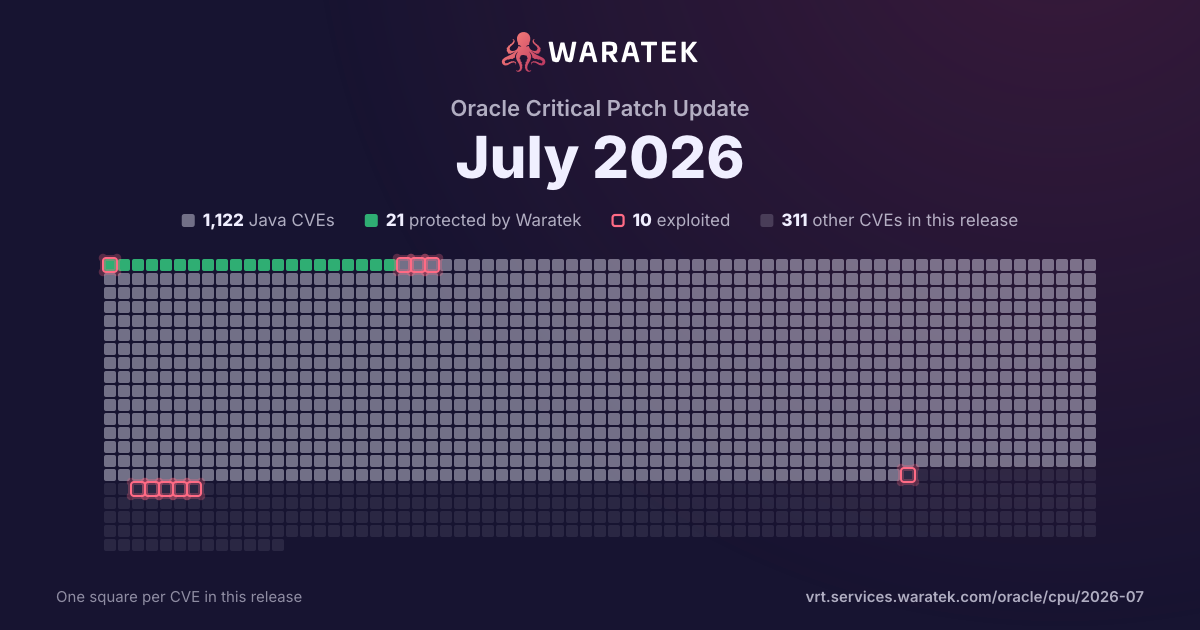
By status
21Protected by Waratek8Mitigation candidate1,093No exploit published16Outside Waratek scope295Not applicable
10Exploited, marked by the ring
No exploit published. For 971 of them, Oracle's security advisory is the source of public detail.
Protected by Waratek. Waratek RASP can block exploitation of these on systems that have not applied the patch yet.
Overview 83 matches · 50 in Waratek scope · 0 protected · 0 exploited · 0 CISA KEV · 0 public PoC · 0 EPSS ≥ 0.5
83matches
50in Waratek scope60.2%
0protected0.0%
0exploited0.0%
0CISA KEV0.0%
0public PoC0.0%
0EPSS ≥ 0.50.0%
Protected by Waratek
0
0.0%
Rule in development
0
0.0%
Mitigation candidate
0
0.0%
No exploit published
50
60.2%
Outside Waratek scope
6
7.2%
Not applicable
27
32.5%
Withdrawn CVE
0
0.0%
blocked by ARMR today
0
0.0%
partly blocked
0
0.0%
not blocked
83
100.0%
not established
0
0.0%
unrecorded
0
0.0%
Exploited
0
0.0%
Working exploit published
0
0.0%
Proof of concept only
5
6.0%
Forecast only
0
0.0%
No public exploit
78
94.0%
split by
peak 57 / month
Jul 252
Not applicable2
Low2
not blocked2
Proof of concept only1
No public exploit1
Aug 252
Not applicable2
Low2
not blocked2
Proof of concept only2
Sep 251
Not applicable1
Low1
not blocked1
No public exploit1
Oct 250
Nov 250
Dec 251
Not applicable1
Low1
not blocked1
No public exploit1
Jan 262
No exploit published1
Not applicable1
Low2
not blocked2
Proof of concept only1
No public exploit1
Feb 263
No exploit published1
Not applicable2
Low3
not blocked3
No public exploit3
Mar 263
No exploit published1
Not applicable2
Low3
not blocked3
No public exploit3
Apr 269
No exploit published3
Not applicable6
Low9
not blocked9
No public exploit9
May 261
No exploit published1
Low1
not blocked1
Proof of concept only1
Jun 262
Not applicable2
Low2
not blocked2
No public exploit2
Jul 2657
No exploit published43
Outside Waratek scope6
Not applicable8
Low57
not blocked57
No public exploit57
Jul 25Sep 25Nov 25Jan 26Mar 26May 26Jul 26
| CVE | Severity | Published▾ | Status | Exploitation | Description |
|---|---|---|---|---|---|
| CVE-2026-62508 | Low | 2026-07-21 | No exploit published | No public exploit | Vulnerability in the Oracle Time and Labor product of Oracle E-Business Suite (component: Internal Operations). Supported versions that are affected are 12.2.3-12.2.15. Difficult to exploit vulnerability allows low privileged attacker with network access via HTTP to compromise Oracle Time and Labor. Successful attacks of this vulnerability can result in unauthorized ability to cause a partial denial of service (partial DOS) of Oracle Time and Labor. CVSS 3.1 Base Score 3.1 (Availability impacts). CVSS Vector: (CVSS:3.1/AV:N/AC:H/PR:L/UI:N/S:U/C:N/I:N/A:L). |
| CVE-2026-61303 | Low | 2026-07-21 | No exploit published | No public exploit | Vulnerability in the Oracle EDI Gateway product of Oracle E-Business Suite (component: Internal Operations). Supported versions that are affected are 12.2.3-12.2.15. Difficult to exploit vulnerability allows high privileged attacker with logon to the infrastructure where Oracle EDI Gateway executes to compromise Oracle EDI Gateway. Successful attacks of this vulnerability can result in unauthorized read access to a subset of Oracle EDI Gateway accessible data. CVSS 3.1 Base Score 1.9 (Confidentiality impacts). CVSS Vector: (CVSS:3.1/AV:L/AC:H/PR:H/UI:N/S:U/C:L/I:N/A:N). |
| CVE-2026-61214 | Low | 2026-07-21 | No exploit published | No public exploit | Vulnerability in the Oracle HRMS (UK) product of Oracle E-Business Suite (component: UK Payroll). Supported versions that are affected are 12.2.3-12.2.15. Difficult to exploit vulnerability allows high privileged attacker with network access via HTTP to compromise Oracle HRMS (UK). Successful attacks of this vulnerability can result in unauthorized read access to a subset of Oracle HRMS (UK) accessible data. CVSS 3.1 Base Score 2.2 (Confidentiality impacts). CVSS Vector: (CVSS:3.1/AV:N/AC:H/PR:H/UI:N/S:U/C:L/I:N/A:N). |
| CVE-2026-61187 | Low | 2026-07-21 | No exploit published | No public exploit | Vulnerability in the Oracle Agile Engineering Data Management product of Oracle Supply Chain (component: Install). The supported version that is affected is 6.2.1. Easily exploitable vulnerability allows low privileged attacker with logon to the infrastructure where Oracle Agile Engineering Data Management executes to compromise Oracle Agile Engineering Data Management. Successful attacks require human interaction from a person other than the attacker. Successful attacks of this vulnerability can result in unauthorized ability to cause a partial denial of service (partial DOS) of Oracle Agile Engineering Data Management. CVSS 3.1 Base Score 2.8 (Availability impacts). CVSS Vector: (CVSS:3.1/AV:L/AC:L/PR:L/UI:R/S:U/C:N/I:N/A:L). |
| CVE-2026-61104 | Low | 2026-07-21 | No exploit published | No public exploit | Vulnerability in the PeopleSoft Enterprise CS Student Records product of Oracle PeopleSoft (component: Research Tracking). The supported version that is affected is 9.2.38. Difficult to exploit vulnerability allows unauthenticated attacker with network access via HTTP to compromise PeopleSoft Enterprise CS Student Records. Successful attacks of this vulnerability can result in unauthorized read access to a subset of PeopleSoft Enterprise CS Student Records accessible data. CVSS 3.1 Base Score 3.7 (Confidentiality impacts). CVSS Vector: (CVSS:3.1/AV:N/AC:H/PR:N/UI:N/S:U/C:L/I:N/A:N). |
| CVE-2026-61096 | Low | 2026-07-21 | Not applicable | No public exploit | Vulnerability in the MySQL Server, MySQL Cluster product of Oracle MySQL (component: Server: Pluggable Auth). Supported versions that are affected are MySQL Server: 8.4.0-8.4.10, 9.7.0-9.7.1; MySQL Cluster: 8.0.0-8.0.47, 8.4.0-8.4.10 and 9.7.0-9.7.1. Difficult to exploit vulnerability allows unauthenticated attacker with logon to the infrastructure where MySQL Server, MySQL Cluster executes to compromise MySQL Server, MySQL Cluster. Successful attacks of this vulnerability can result in unauthorized update, insert or delete access to some of MySQL Server, MySQL Cluster accessible data. CVSS 3.1 Base Score 2.9 (Integrity impacts). CVSS Vector: (CVSS:3.1/AV:L/AC:H/PR:N/UI:N/S:U/C:N/I:L/A:N). |
| CVE-2026-61081 | Low | 2026-07-21 | Not applicable | No public exploit | Vulnerability in the MySQL Server, MySQL Cluster product of Oracle MySQL (component: Server: Performance Schema). Supported versions that are affected are MySQL Server: 8.4.0-8.4.10, 9.7.0-9.7.1; MySQL Cluster: 8.0.0-8.0.47, 8.4.0-8.4.10 and 9.7.0-9.7.1. Easily exploitable vulnerability allows high privileged attacker with network access via multiple protocols to compromise MySQL Server, MySQL Cluster. Successful attacks of this vulnerability can result in unauthorized read access to a subset of MySQL Server, MySQL Cluster accessible data. CVSS 3.1 Base Score 2.7 (Confidentiality impacts). CVSS Vector: (CVSS:3.1/AV:N/AC:L/PR:H/UI:N/S:U/C:L/I:N/A:N). |
| CVE-2026-61071 | Low | 2026-07-21 | No exploit published | No public exploit | Vulnerability in the PeopleSoft Enterprise FIN Engineering Argentina product of Oracle PeopleSoft (component: Engineering). The supported version that is affected is 9.1. Difficult to exploit vulnerability allows high privileged attacker with network access via HTTP to compromise PeopleSoft Enterprise FIN Engineering Argentina. Successful attacks of this vulnerability can result in unauthorized update, insert or delete access to some of PeopleSoft Enterprise FIN Engineering Argentina accessible data as well as unauthorized read access to a subset of PeopleSoft Enterprise FIN Engineering Argentina accessible data. CVSS 3.1 Base Score 3.3 (Confidentiality and Integrity impacts). CVSS Vector: (CVSS:3.1/AV:N/AC:H/PR:H/UI:N/S:U/C:L/I:L/A:N). |
| CVE-2026-61048 | Low | 2026-07-21 | No exploit published | No public exploit | Vulnerability in the Oracle Inventory Optimization product of Oracle E-Business Suite (component: User Interface). Supported versions that are affected are 12.2.3-12.2.15. Difficult to exploit vulnerability allows low privileged attacker with network access via HTTP to compromise Oracle Inventory Optimization. Successful attacks of this vulnerability can result in unauthorized ability to cause a partial denial of service (partial DOS) of Oracle Inventory Optimization. CVSS 3.1 Base Score 3.1 (Availability impacts). CVSS Vector: (CVSS:3.1/AV:N/AC:H/PR:L/UI:N/S:U/C:N/I:N/A:L). |
| CVE-2026-61047 | Low | 2026-07-21 | No exploit published | No public exploit | Vulnerability in the Oracle Production Scheduling product of Oracle E-Business Suite (component: Internal Operations). Supported versions that are affected are 12.2.3-12.2.15. Difficult to exploit vulnerability allows high privileged attacker with logon to the infrastructure where Oracle Production Scheduling executes to compromise Oracle Production Scheduling. Successful attacks of this vulnerability can result in unauthorized update, insert or delete access to some of Oracle Production Scheduling accessible data. CVSS 3.1 Base Score 1.9 (Integrity impacts). CVSS Vector: (CVSS:3.1/AV:L/AC:H/PR:H/UI:N/S:U/C:N/I:L/A:N). |
| CVE-2026-61036 | Low | 2026-07-21 | No exploit published | No public exploit | Vulnerability in the Oracle HRMS (Norway) product of Oracle E-Business Suite (component: Norway Payroll). Supported versions that are affected are 12.2.3-12.2.15. Easily exploitable vulnerability allows high privileged attacker with network access via HTTP to compromise Oracle HRMS (Norway). Successful attacks of this vulnerability can result in unauthorized update, insert or delete access to some of Oracle HRMS (Norway) accessible data as well as unauthorized read access to a subset of Oracle HRMS (Norway) accessible data. CVSS 3.1 Base Score 3.8 (Confidentiality and Integrity impacts). CVSS Vector: (CVSS:3.1/AV:N/AC:L/PR:H/UI:N/S:U/C:L/I:L/A:N). |
| CVE-2026-61028 | Low | 2026-07-21 | No exploit published | No public exploit | Vulnerability in the Oracle Inventory Management product of Oracle E-Business Suite (component: Internal Operations). Supported versions that are affected are 12.2.3-12.2.15. Difficult to exploit vulnerability allows high privileged attacker with logon to the infrastructure where Oracle Inventory Management executes to compromise Oracle Inventory Management. Successful attacks of this vulnerability can result in unauthorized ability to cause a partial denial of service (partial DOS) of Oracle Inventory Management. CVSS 3.1 Base Score 1.9 (Availability impacts). CVSS Vector: (CVSS:3.1/AV:L/AC:H/PR:H/UI:N/S:U/C:N/I:N/A:L). |
| CVE-2026-61015 | Low | 2026-07-21 | No exploit published | No public exploit | Vulnerability in the Oracle Time and Labor product of Oracle E-Business Suite (component: Internal Operations). Supported versions that are affected are 12.2.3-12.2.15. Difficult to exploit vulnerability allows unauthenticated attacker with network access via HTTP to compromise Oracle Time and Labor. Successful attacks of this vulnerability can result in unauthorized read access to a subset of Oracle Time and Labor accessible data. CVSS 3.1 Base Score 3.7 (Confidentiality impacts). CVSS Vector: (CVSS:3.1/AV:N/AC:H/PR:N/UI:N/S:U/C:L/I:N/A:N). |
| CVE-2026-60950 | Low | 2026-07-21 | No exploit published | No public exploit | Vulnerability in the Oracle HRMS (Ireland) product of Oracle E-Business Suite (component: Internal Operations). Supported versions that are affected are 12.2.3-12.2.15. Difficult to exploit vulnerability allows high privileged attacker with network access via HTTP to compromise Oracle HRMS (Ireland). Successful attacks of this vulnerability can result in unauthorized read access to a subset of Oracle HRMS (Ireland) accessible data. CVSS 3.1 Base Score 2.2 (Confidentiality impacts). CVSS Vector: (CVSS:3.1/AV:N/AC:H/PR:H/UI:N/S:U/C:L/I:N/A:N). |
| CVE-2026-60939 | Low | 2026-07-21 | No exploit published | No public exploit | Vulnerability in the Oracle Project Contracts product of Oracle E-Business Suite (component: Internal Operations). Supported versions that are affected are 12.2.3-12.2.15. Difficult to exploit vulnerability allows low privileged attacker with network access via HTTP to compromise Oracle Project Contracts. Successful attacks of this vulnerability can result in unauthorized read access to a subset of Oracle Project Contracts accessible data. CVSS 3.1 Base Score 3.1 (Confidentiality impacts). CVSS Vector: (CVSS:3.1/AV:N/AC:H/PR:L/UI:N/S:U/C:L/I:N/A:N). |
| CVE-2026-60937 | Low | 2026-07-21 | No exploit published | No public exploit | Vulnerability in the Oracle Labor Distribution product of Oracle E-Business Suite (component: Internal Operations). Supported versions that are affected are 12.2.3-12.2.15. Difficult to exploit vulnerability allows low privileged attacker with network access via HTTP to compromise Oracle Labor Distribution. Successful attacks of this vulnerability can result in unauthorized update, insert or delete access to some of Oracle Labor Distribution accessible data. CVSS 3.1 Base Score 3.1 (Integrity impacts). CVSS Vector: (CVSS:3.1/AV:N/AC:H/PR:L/UI:N/S:U/C:N/I:L/A:N). |
| CVE-2026-60936 | Low | 2026-07-21 | No exploit published | No public exploit | Vulnerability in the Oracle Labor Distribution product of Oracle E-Business Suite (component: Internal Operations). Supported versions that are affected are 12.2.3-12.2.15. Difficult to exploit vulnerability allows low privileged attacker with network access via HTTP to compromise Oracle Labor Distribution. Successful attacks of this vulnerability can result in unauthorized ability to cause a partial denial of service (partial DOS) of Oracle Labor Distribution. CVSS 3.1 Base Score 3.1 (Availability impacts). CVSS Vector: (CVSS:3.1/AV:N/AC:H/PR:L/UI:N/S:U/C:N/I:N/A:L). |
| CVE-2026-60930 | Low | 2026-07-21 | No exploit published | No public exploit | Vulnerability in the Oracle Public Sector Financials product of Oracle E-Business Suite (component: Internal Operations). Supported versions that are affected are 12.2.3-12.2.15. Difficult to exploit vulnerability allows low privileged attacker with network access via HTTP to compromise Oracle Public Sector Financials. Successful attacks of this vulnerability can result in unauthorized read access to a subset of Oracle Public Sector Financials accessible data. CVSS 3.1 Base Score 3.1 (Confidentiality impacts). CVSS Vector: (CVSS:3.1/AV:N/AC:H/PR:L/UI:N/S:U/C:L/I:N/A:N). |
| CVE-2026-60929 | Low | 2026-07-21 | No exploit published | No public exploit | Vulnerability in the Oracle Public Sector Financials product of Oracle E-Business Suite (component: Internal Operations). Supported versions that are affected are 12.2.3-12.2.15. Difficult to exploit vulnerability allows low privileged attacker with network access via HTTP to compromise Oracle Public Sector Financials. Successful attacks of this vulnerability can result in unauthorized update, insert or delete access to some of Oracle Public Sector Financials accessible data. CVSS 3.1 Base Score 3.1 (Integrity impacts). CVSS Vector: (CVSS:3.1/AV:N/AC:H/PR:L/UI:N/S:U/C:N/I:L/A:N). |
| CVE-2026-60922 | Low | 2026-07-21 | No exploit published | No public exploit | Vulnerability in the Oracle iSupplier Portal product of Oracle E-Business Suite (component: Internal Operations). Supported versions that are affected are 12.2.3-12.2.15. Difficult to exploit vulnerability allows low privileged attacker with network access via HTTP to compromise Oracle iSupplier Portal. Successful attacks of this vulnerability can result in unauthorized read access to a subset of Oracle iSupplier Portal accessible data. CVSS 3.1 Base Score 3.1 (Confidentiality impacts). CVSS Vector: (CVSS:3.1/AV:N/AC:H/PR:L/UI:N/S:U/C:L/I:N/A:N). |
| CVE-2026-60919 | Low | 2026-07-21 | No exploit published | No public exploit | Vulnerability in the Oracle iSupplier Portal product of Oracle E-Business Suite (component: Internal Operations). Supported versions that are affected are 12.2.3-12.2.15. Difficult to exploit vulnerability allows unauthenticated attacker with network access via HTTP to compromise Oracle iSupplier Portal. Successful attacks of this vulnerability can result in unauthorized read access to a subset of Oracle iSupplier Portal accessible data. CVSS 3.1 Base Score 3.7 (Confidentiality impacts). CVSS Vector: (CVSS:3.1/AV:N/AC:H/PR:N/UI:N/S:U/C:L/I:N/A:N). |
| CVE-2026-60913 | Low | 2026-07-21 | No exploit published | No public exploit | Vulnerability in the Oracle Property Manager product of Oracle E-Business Suite (component: Internal Operations). Supported versions that are affected are 12.2.3-12.2.15. Difficult to exploit vulnerability allows high privileged attacker with logon to the infrastructure where Oracle Property Manager executes to compromise Oracle Property Manager. Successful attacks of this vulnerability can result in unauthorized read access to a subset of Oracle Property Manager accessible data. CVSS 3.1 Base Score 1.9 (Confidentiality impacts). CVSS Vector: (CVSS:3.1/AV:L/AC:H/PR:H/UI:N/S:U/C:L/I:N/A:N). |
| CVE-2026-60896 | Low | 2026-07-21 | No exploit published | No public exploit | Vulnerability in the Oracle Work in Process product of Oracle E-Business Suite (component: Internal Operations). Supported versions that are affected are 12.2.3-12.2.15. Difficult to exploit vulnerability allows low privileged attacker with logon to the infrastructure where Oracle Work in Process executes to compromise Oracle Work in Process. Successful attacks of this vulnerability can result in unauthorized read access to a subset of Oracle Work in Process accessible data and unauthorized ability to cause a partial denial of service (partial DOS) of Oracle Work in Process. CVSS 3.1 Base Score 3.6 (Confidentiality and Availability impacts). CVSS Vector: (CVSS:3.1/AV:L/AC:H/PR:L/UI:N/S:U/C:L/I:N/A:L). |
| CVE-2026-60891 | Low | 2026-07-21 | No exploit published | No public exploit | Vulnerability in the Oracle Work in Process product of Oracle E-Business Suite (component: Internal Operations). Supported versions that are affected are 12.2.3-12.2.15. Difficult to exploit vulnerability allows high privileged attacker with logon to the infrastructure where Oracle Work in Process executes to compromise Oracle Work in Process. Successful attacks of this vulnerability can result in unauthorized read access to a subset of Oracle Work in Process accessible data. CVSS 3.1 Base Score 1.9 (Confidentiality impacts). CVSS Vector: (CVSS:3.1/AV:L/AC:H/PR:H/UI:N/S:U/C:L/I:N/A:N). |
| CVE-2026-60847 | Low | 2026-07-21 | No exploit published | No public exploit | Vulnerability in the Oracle Order Entry product of Oracle E-Business Suite (component: Internal Operations). Supported versions that are affected are 12.2.3-12.2.15. Easily exploitable vulnerability allows high privileged attacker with logon to the infrastructure where Oracle Order Entry executes to compromise Oracle Order Entry. Successful attacks of this vulnerability can result in unauthorized update, insert or delete access to some of Oracle Order Entry accessible data and unauthorized ability to cause a partial denial of service (partial DOS) of Oracle Order Entry. CVSS 3.1 Base Score 3.4 (Integrity and Availability impacts). CVSS Vector: (CVSS:3.1/AV:L/AC:L/PR:H/UI:N/S:U/C:N/I:L/A:L). |
| CVE-2026-60804 | Low | 2026-07-21 | No exploit published | No public exploit | Vulnerability in the Oracle E-Business Intelligence product of Oracle E-Business Suite (component: Definition). Supported versions that are affected are 12.2.3-12.2.15. Difficult to exploit vulnerability allows high privileged attacker with network access via HTTP to compromise Oracle E-Business Intelligence. Successful attacks require human interaction from a person other than the attacker. Successful attacks of this vulnerability can result in unauthorized update, insert or delete access to some of Oracle E-Business Intelligence accessible data. CVSS 3.1 Base Score 2.0 (Integrity impacts). CVSS Vector: (CVSS:3.1/AV:N/AC:H/PR:H/UI:R/S:U/C:N/I:L/A:N). |
| CVE-2026-60628 | Low | 2026-07-21 | No exploit published | No public exploit | Vulnerability in the JD Edwards EnterpriseOne Tools product of Oracle JD Edwards (component: Installation Security). The supported version that is affected is 9.2.26.3. Difficult to exploit vulnerability allows unauthenticated attacker with access to the physical communication segment attached to the hardware where the JD Edwards EnterpriseOne Tools executes to compromise JD Edwards EnterpriseOne Tools. Successful attacks require human interaction from a person other than the attacker. Successful attacks of this vulnerability can result in unauthorized update, insert or delete access to some of JD Edwards EnterpriseOne Tools accessible data as well as unauthorized read access to a subset of JD Edwards EnterpriseOne Tools accessible data. CVSS 3.1 Base Score 3.7 (Confidentiality and Integrity impacts). CVSS Vector: (CVSS:3.1/AV:A/AC:H/PR:N/UI:R/S:U/C:L/I:L/A:N). |
| CVE-2026-60596 | Low | 2026-07-21 | No exploit published | No public exploit | Vulnerability in the PeopleSoft Enterprise FIN eSettlements product of Oracle PeopleSoft (component: eSettlements). The supported version that is affected is 9.2. Easily exploitable vulnerability allows high privileged attacker with logon to the infrastructure where PeopleSoft Enterprise FIN eSettlements executes to compromise PeopleSoft Enterprise FIN eSettlements. Successful attacks of this vulnerability can result in unauthorized read access to a subset of PeopleSoft Enterprise FIN eSettlements accessible data. CVSS 3.1 Base Score 2.3 (Confidentiality impacts). CVSS Vector: (CVSS:3.1/AV:L/AC:L/PR:H/UI:N/S:U/C:L/I:N/A:N). |
| CVE-2026-60405 | Low | 2026-07-21 | Not applicable | No public exploit | Vulnerability in the TimesTen In-Memory Database product of Oracle TimesTen In-Memory Database (component: Kubernetes Operator). The supported version that is affected is 26.1.1.1.0. Easily exploitable vulnerability allows low privileged attacker with logon to the infrastructure where TimesTen In-Memory Database executes to compromise TimesTen In-Memory Database. While the vulnerability is in TimesTen In-Memory Database, attacks may significantly impact additional products (scope change). Successful attacks of this vulnerability can result in unauthorized read access to a subset of TimesTen In-Memory Database accessible data. CVSS 3.1 Base Score 3.8 (Confidentiality impacts). CVSS Vector: (CVSS:3.1/AV:L/AC:L/PR:L/UI:N/S:C/C:L/I:N/A:N). |
| CVE-2026-60357 | Low | 2026-07-21 | No exploit published | No public exploit | Vulnerability in the Siebel CRM Integration product of Oracle Siebel CRM (component: Siebel Server Sync for Exchange). Supported versions that are affected are 17.0-26.5. Difficult to exploit vulnerability allows unauthenticated attacker with network access via HTTP to compromise Siebel CRM Integration. Successful attacks of this vulnerability can result in unauthorized update, insert or delete access to some of Siebel CRM Integration accessible data. CVSS 3.1 Base Score 3.7 (Integrity impacts). CVSS Vector: (CVSS:3.1/AV:N/AC:H/PR:N/UI:N/S:U/C:N/I:L/A:N). |
| CVE-2026-60354 | Low | 2026-07-21 | No exploit published | No public exploit | Vulnerability in the Oracle JDeveloper product of Oracle Fusion Middleware (component: Data Visualization Tools). Supported versions that are affected are 12.2.1.4.0 and 14.1.2.0.0. Difficult to exploit vulnerability allows unauthenticated attacker with network access via HTTP to compromise Oracle JDeveloper. Successful attacks of this vulnerability can result in unauthorized read access to a subset of Oracle JDeveloper accessible data. CVSS 3.1 Base Score 3.7 (Confidentiality impacts). CVSS Vector: (CVSS:3.1/AV:N/AC:H/PR:N/UI:N/S:U/C:L/I:N/A:N). |
| CVE-2026-60353 | Low | 2026-07-21 | No exploit published | No public exploit | Vulnerability in the Oracle JDeveloper product of Oracle Fusion Middleware (component: ADF Faces). Supported versions that are affected are 12.2.1.4.0 and 14.1.2.0.0. Difficult to exploit vulnerability allows low privileged attacker with network access via HTTP to compromise Oracle JDeveloper. Successful attacks of this vulnerability can result in unauthorized read access to a subset of Oracle JDeveloper accessible data. CVSS 3.1 Base Score 3.1 (Confidentiality impacts). CVSS Vector: (CVSS:3.1/AV:N/AC:H/PR:L/UI:N/S:U/C:L/I:N/A:N). |
| CVE-2026-60352 | Low | 2026-07-21 | No exploit published | No public exploit | Vulnerability in the Oracle JDeveloper product of Oracle Fusion Middleware (component: ADF Faces). Supported versions that are affected are 12.2.1.4.0 and 14.1.2.0.0. Difficult to exploit vulnerability allows unauthenticated attacker with network access via HTTP to compromise Oracle JDeveloper. Successful attacks of this vulnerability can result in unauthorized read access to a subset of Oracle JDeveloper accessible data. CVSS 3.1 Base Score 3.7 (Confidentiality impacts). CVSS Vector: (CVSS:3.1/AV:N/AC:H/PR:N/UI:N/S:U/C:L/I:N/A:N). |
| CVE-2026-60347 | Low | 2026-07-21 | No exploit published | No public exploit | Vulnerability in the JD Edwards EnterpriseOne Tools product of Oracle JD Edwards (component: Enterprise Infrastructure Security). The supported version that is affected is 9.2.26.3. Difficult to exploit vulnerability allows low privileged attacker with logon to the infrastructure where JD Edwards EnterpriseOne Tools executes to compromise JD Edwards EnterpriseOne Tools. Successful attacks of this vulnerability can result in unauthorized update, insert or delete access to some of JD Edwards EnterpriseOne Tools accessible data and unauthorized ability to cause a partial denial of service (partial DOS) of JD Edwards EnterpriseOne Tools. CVSS 3.1 Base Score 3.6 (Integrity and Availability impacts). CVSS Vector: (CVSS:3.1/AV:L/AC:H/PR:L/UI:N/S:U/C:N/I:L/A:L). |
| CVE-2026-60346 | Low | 2026-07-21 | No exploit published | No public exploit | Vulnerability in the JD Edwards EnterpriseOne Tools product of Oracle JD Edwards (component: Interoperability Security). The supported version that is affected is 9.2.26.3. Difficult to exploit vulnerability allows unauthenticated attacker with network access via JDENET to compromise JD Edwards EnterpriseOne Tools. Successful attacks of this vulnerability can result in unauthorized ability to cause a partial denial of service (partial DOS) of JD Edwards EnterpriseOne Tools. CVSS 3.1 Base Score 3.7 (Availability impacts). CVSS Vector: (CVSS:3.1/AV:N/AC:H/PR:N/UI:N/S:U/C:N/I:N/A:L). |
| CVE-2026-60339 | Low | 2026-07-21 | No exploit published | No public exploit | Vulnerability in the Oracle Project Manufacturing product of Oracle E-Business Suite (component: PJM Command Center). The supported version that is affected is V16. Difficult to exploit vulnerability allows low privileged attacker with network access via HTTP to compromise Oracle Project Manufacturing. Successful attacks of this vulnerability can result in unauthorized read access to a subset of Oracle Project Manufacturing accessible data. CVSS 3.1 Base Score 3.1 (Confidentiality impacts). CVSS Vector: (CVSS:3.1/AV:N/AC:H/PR:L/UI:N/S:U/C:L/I:N/A:N). |
| CVE-2026-60338 | Low | 2026-07-21 | No exploit published | No public exploit | Vulnerability in the Oracle Project Manufacturing product of Oracle E-Business Suite (component: PJM Command Center). The supported version that is affected is V16. Difficult to exploit vulnerability allows low privileged attacker with logon to the infrastructure where Oracle Project Manufacturing executes to compromise Oracle Project Manufacturing. Successful attacks of this vulnerability can result in unauthorized update, insert or delete access to some of Oracle Project Manufacturing accessible data and unauthorized ability to cause a partial denial of service (partial DOS) of Oracle Project Manufacturing. CVSS 3.1 Base Score 3.6 (Integrity and Availability impacts). CVSS Vector: (CVSS:3.1/AV:L/AC:H/PR:L/UI:N/S:U/C:N/I:L/A:L). |
| CVE-2026-60318 | Low | 2026-07-21 | No exploit published | No public exploit | Vulnerability in the Oracle Data Integrator product of Oracle Fusion Middleware (component: Patchset Assistant). Supported versions that are affected are 12.2.1.4.0 and 14.1.2.0.0. Easily exploitable vulnerability allows low privileged attacker with logon to the infrastructure where Oracle Data Integrator executes to compromise Oracle Data Integrator. Successful attacks of this vulnerability can result in unauthorized read access to a subset of Oracle Data Integrator accessible data. CVSS 3.1 Base Score 3.3 (Confidentiality impacts). CVSS Vector: (CVSS:3.1/AV:L/AC:L/PR:L/UI:N/S:U/C:L/I:N/A:N). |
| CVE-2026-60190 | Low | 2026-07-21 | Not applicable | No public exploit | Vulnerability in the MySQL Server, MySQL Cluster product of Oracle MySQL (component: Server: Replication). Supported versions that are affected are MySQL Server: 8.4.0-8.4.10, 9.7.0-9.7.1; MySQL Cluster: 8.0.0-8.0.47, 8.4.0-8.4.10 and 9.7.0-9.7.1. Difficult to exploit vulnerability allows high privileged attacker with network access via multiple protocols to compromise MySQL Server, MySQL Cluster. Successful attacks of this vulnerability can result in unauthorized ability to cause a partial denial of service (partial DOS) of MySQL Server, MySQL Cluster. CVSS 3.1 Base Score 2.2 (Availability impacts). CVSS Vector: (CVSS:3.1/AV:N/AC:H/PR:H/UI:N/S:U/C:N/I:N/A:L). |
| CVE-2026-60166 | Low | 2026-07-21 | Outside Waratek scope | No public exploit | Vulnerability in Oracle Java SE (component: JavaFX). The supported version that is affected is Oracle Java SE: 8u491. Difficult to exploit vulnerability allows unauthenticated attacker with network access via multiple protocols to compromise Oracle Java SE. Successful attacks require human interaction from a person other than the attacker. Successful attacks of this vulnerability can result in unauthorized read access to a subset of Oracle Java SE accessible data. Note: This vulnerability applies to Java deployments, typically in clients running sandboxed Java Web Start applications or sandboxed Java applets, that load and run untrusted code (e.g., code that comes from the internet) and rely on the Java sandbox for security. This vulnerability does not apply to Java deployments, typically in servers, that load and run only trusted code (e.g., code installed by an administrator). CVSS 3.1 Base Score 3.1 (Confidentiality impacts). CVSS Vector: (CVSS:3.1/AV:N/AC:H/PR:N/UI:R/S:U/C:L/I:N/A:N). |
| CVE-2026-60164 | Low | 2026-07-21 | Outside Waratek scope | No public exploit | Vulnerability in Oracle Java SE (component: JavaFX). The supported version that is affected is Oracle Java SE: 8u491. Difficult to exploit vulnerability allows unauthenticated attacker with network access via multiple protocols to compromise Oracle Java SE. Successful attacks require human interaction from a person other than the attacker. Successful attacks of this vulnerability can result in unauthorized read access to a subset of Oracle Java SE accessible data. Note: This vulnerability applies to Java deployments, typically in clients running sandboxed Java Web Start applications or sandboxed Java applets, that load and run untrusted code (e.g., code that comes from the internet) and rely on the Java sandbox for security. This vulnerability does not apply to Java deployments, typically in servers, that load and run only trusted code (e.g., code installed by an administrator). CVSS 3.1 Base Score 3.1 (Confidentiality impacts). CVSS Vector: (CVSS:3.1/AV:N/AC:H/PR:N/UI:R/S:U/C:L/I:N/A:N). |
| CVE-2026-60160 | Low | 2026-07-21 | Not applicable | No public exploit | Vulnerability in the Oracle VM VirtualBox product of Oracle Virtualization (component: Core). The supported version that is affected is 7.2.12. Easily exploitable vulnerability allows high privileged attacker with logon to the infrastructure where Oracle VM VirtualBox executes to compromise Oracle VM VirtualBox. While the vulnerability is in Oracle VM VirtualBox, attacks may significantly impact additional products (scope change). Successful attacks of this vulnerability can result in unauthorized read access to a subset of Oracle VM VirtualBox accessible data. CVSS 3.1 Base Score 3.2 (Confidentiality impacts). CVSS Vector: (CVSS:3.1/AV:L/AC:L/PR:H/UI:N/S:C/C:L/I:N/A:N). |
| CVE-2026-60144 | Low | 2026-07-21 | No exploit published | No public exploit | Vulnerability in the Oracle Workflow product of Oracle E-Business Suite (component: Workflow Notification Mailer). Supported versions that are affected are 12.2.3-12.2.15. Difficult to exploit vulnerability allows low privileged attacker with logon to the infrastructure where Oracle Workflow executes to compromise Oracle Workflow. Successful attacks of this vulnerability can result in unauthorized update, insert or delete access to some of Oracle Workflow accessible data and unauthorized ability to cause a partial denial of service (partial DOS) of Oracle Workflow. CVSS 3.1 Base Score 3.6 (Integrity and Availability impacts). CVSS Vector: (CVSS:3.1/AV:L/AC:H/PR:L/UI:N/S:U/C:N/I:L/A:L). |
| CVE-2026-47059 | Low | 2026-07-21 | Outside Waratek scope | No public exploit | Vulnerability in the Oracle Java SE, Oracle GraalVM for JDK, Oracle GraalVM Enterprise Edition product of Oracle Java SE (component: 2D). Supported versions that are affected are Oracle Java SE: 8u491, 8u491-perf, 11.0.31, 17.0.19, 21.0.11, 25.0.3, 26.0.1; Oracle GraalVM for JDK: 17.0.19 and 21.0.11; Oracle GraalVM Enterprise Edition: 21.3.18. Difficult to exploit vulnerability allows unauthenticated attacker with network access via multiple protocols to compromise Oracle Java SE, Oracle GraalVM for JDK, Oracle GraalVM Enterprise Edition. Successful attacks of this vulnerability can result in unauthorized ability to cause a partial denial of service (partial DOS) of Oracle Java SE, Oracle GraalVM for JDK, Oracle GraalVM Enterprise Edition. Note: This vulnerability applies to Java deployments, typically in clients running sandboxed Java Web Start applications or sandboxed Java applets, that load and run untrusted code (e.g., code that comes from the internet) and rely on the Java sandbox for security. This vulnerability does not apply to Java deployments, typically in servers, that load and run only trusted code (e.g., code installed by an administrator). CVSS 3.1 Base Score 3.7 (Availability impacts). CVSS Vector: (CVSS:3.1/AV:N/AC:H/PR:N/UI:N/S:U/C:N/I:N/A:L). |
| CVE-2026-47055 | Low | 2026-07-21 | Not applicable | No public exploit | Vulnerability in the Oracle VM VirtualBox product of Oracle Virtualization (component: Core). The supported version that is affected is 7.2.12. Easily exploitable vulnerability allows high privileged attacker with logon to the infrastructure where Oracle VM VirtualBox executes to compromise Oracle VM VirtualBox. While the vulnerability is in Oracle VM VirtualBox, attacks may significantly impact additional products (scope change). Successful attacks of this vulnerability can result in unauthorized update, insert or delete access to some of Oracle VM VirtualBox accessible data. CVSS 3.1 Base Score 3.2 (Integrity impacts). CVSS Vector: (CVSS:3.1/AV:L/AC:L/PR:H/UI:N/S:C/C:N/I:L/A:N). |
| CVE-2026-47043 | Low | 2026-07-21 | Not applicable | No public exploit | Vulnerability in the Oracle VM VirtualBox product of Oracle Virtualization (component: Core). The supported version that is affected is 7.2.12. Easily exploitable vulnerability allows high privileged attacker with logon to the infrastructure where Oracle VM VirtualBox executes to compromise Oracle VM VirtualBox. While the vulnerability is in Oracle VM VirtualBox, attacks may significantly impact additional products (scope change). Successful attacks of this vulnerability can result in unauthorized read access to a subset of Oracle VM VirtualBox accessible data. CVSS 3.1 Base Score 3.2 (Confidentiality impacts). CVSS Vector: (CVSS:3.1/AV:L/AC:L/PR:H/UI:N/S:C/C:L/I:N/A:N). |
| CVE-2026-47038 | Low | 2026-07-21 | Not applicable | No public exploit | Vulnerability in the RDBMS component of Oracle Database Server. Supported versions that are affected are 19.3-19.31, 21.3-21.22 and 23.4.0-23.26.2. Easily exploitable vulnerability allows high privileged attacker having None privilege with network access via Oracle Net to compromise RDBMS. Successful attacks of this vulnerability can result in unauthorized update, insert or delete access to some of RDBMS accessible data. CVSS 3.1 Base Score 2.7 (Integrity impacts). CVSS Vector: (CVSS:3.1/AV:N/AC:L/PR:H/UI:N/S:U/C:N/I:L/A:N). |
| CVE-2026-47035 | Low | 2026-07-21 | Outside Waratek scope | No public exploit | Vulnerability in Oracle Java SE (component: JavaFX). The supported version that is affected is Oracle Java SE: 8u491. Difficult to exploit vulnerability allows unauthenticated attacker with network access via multiple protocols to compromise Oracle Java SE. Successful attacks require human interaction from a person other than the attacker. Successful attacks of this vulnerability can result in unauthorized update, insert or delete access to some of Oracle Java SE accessible data. Note: This vulnerability applies to Java deployments, typically in clients running sandboxed Java Web Start applications or sandboxed Java applets, that load and run untrusted code (e.g., code that comes from the internet) and rely on the Java sandbox for security. This vulnerability does not apply to Java deployments, typically in servers, that load and run only trusted code (e.g., code installed by an administrator). CVSS 3.1 Base Score 3.1 (Integrity impacts). CVSS Vector: (CVSS:3.1/AV:N/AC:H/PR:N/UI:R/S:U/C:N/I:L/A:N). |
| CVE-2026-47034 | Low | 2026-07-21 | Outside Waratek scope | No public exploit | Vulnerability in Oracle Java SE (component: JavaFX). The supported version that is affected is Oracle Java SE: 8u491. Difficult to exploit vulnerability allows unauthenticated attacker with network access via multiple protocols to compromise Oracle Java SE. Successful attacks require human interaction from a person other than the attacker. Successful attacks of this vulnerability can result in unauthorized update, insert or delete access to some of Oracle Java SE accessible data. Note: This vulnerability applies to Java deployments, typically in clients running sandboxed Java Web Start applications or sandboxed Java applets, that load and run untrusted code (e.g., code that comes from the internet) and rely on the Java sandbox for security. This vulnerability does not apply to Java deployments, typically in servers, that load and run only trusted code (e.g., code installed by an administrator). CVSS 3.1 Base Score 3.1 (Integrity impacts). CVSS Vector: (CVSS:3.1/AV:N/AC:H/PR:N/UI:R/S:U/C:N/I:L/A:N). |
| CVE-2026-47032 | Low | 2026-07-21 | No exploit published | No public exploit | Vulnerability in the Siebel CRM End User product of Oracle Siebel CRM (component: Redwood UI). Supported versions that are affected are 24.4-26.3. Difficult to exploit vulnerability allows high privileged attacker with network access via HTTP to compromise Siebel CRM End User. Successful attacks require human interaction from a person other than the attacker and while the vulnerability is in Siebel CRM End User, attacks may significantly impact additional products (scope change). Successful attacks of this vulnerability can result in unauthorized ability to cause a partial denial of service (partial DOS) of Siebel CRM End User. CVSS 3.1 Base Score 2.6 (Availability impacts). CVSS Vector: (CVSS:3.1/AV:N/AC:H/PR:H/UI:R/S:C/C:N/I:N/A:L). |
| CVE-2026-47030 | Low | 2026-07-21 | Outside Waratek scope | No public exploit | Vulnerability in Oracle Java SE (component: JavaFX). The supported version that is affected is Oracle Java SE: 8u491. Difficult to exploit vulnerability allows unauthenticated attacker with network access via multiple protocols to compromise Oracle Java SE. Successful attacks require human interaction from a person other than the attacker. Successful attacks of this vulnerability can result in unauthorized update, insert or delete access to some of Oracle Java SE accessible data. Note: This vulnerability applies to Java deployments, typically in clients running sandboxed Java Web Start applications or sandboxed Java applets, that load and run untrusted code (e.g., code that comes from the internet) and rely on the Java sandbox for security. This vulnerability does not apply to Java deployments, typically in servers, that load and run only trusted code (e.g., code installed by an administrator). CVSS 3.1 Base Score 3.1 (Integrity impacts). CVSS Vector: (CVSS:3.1/AV:N/AC:H/PR:N/UI:R/S:U/C:N/I:L/A:N). |
| CVE-2026-47022 | Low | 2026-07-21 | No exploit published | No public exploit | Vulnerability in the GoldenGate Stream Analytics product of Oracle GoldenGate (component: Security). The supported version that is affected is 26.1.0.0.0. Easily exploitable vulnerability allows low privileged attacker with logon to the infrastructure where GoldenGate Stream Analytics executes to compromise GoldenGate Stream Analytics. Successful attacks of this vulnerability can result in unauthorized ability to cause a partial denial of service (partial DOS) of GoldenGate Stream Analytics. CVSS 3.1 Base Score 3.3 (Availability impacts). CVSS Vector: (CVSS:3.1/AV:L/AC:L/PR:L/UI:N/S:U/C:N/I:N/A:L). |
| CVE-2026-47016 | Low | 2026-07-21 | No exploit published | No public exploit | Vulnerability in the Siebel CRM Integration product of Oracle Siebel CRM (component: Event Publish and Subscribe). Supported versions that are affected are 17.0-26.4. Difficult to exploit vulnerability allows physical access to compromise Siebel CRM Integration. While the vulnerability is in Siebel CRM Integration, attacks may significantly impact additional products (scope change). Successful attacks of this vulnerability can result in unauthorized read access to a subset of Siebel CRM Integration accessible data. CVSS 3.1 Base Score 1.9 (Confidentiality impacts). CVSS Vector: (CVSS:3.1/AV:P/AC:H/PR:H/UI:N/S:C/C:L/I:N/A:N). |
| CVE-2026-47011 | Low | 2026-07-21 | No exploit published | No public exploit | Vulnerability in the Siebel CRM Deployment product of Oracle Siebel CRM (component: Application Interface). Supported versions that are affected are 17.0-26.4. Difficult to exploit vulnerability allows low privileged attacker with network access via HTTP to compromise Siebel CRM Deployment. Successful attacks require human interaction from a person other than the attacker. Successful attacks of this vulnerability can result in unauthorized read access to a subset of Siebel CRM Deployment accessible data. CVSS 3.1 Base Score 2.6 (Confidentiality impacts). CVSS Vector: (CVSS:3.1/AV:N/AC:H/PR:L/UI:R/S:U/C:L/I:N/A:N). |
| CVE-2026-47010 | Low | 2026-07-21 | No exploit published | No public exploit | Vulnerability in the Oracle Java SE, Oracle GraalVM for JDK, Oracle GraalVM Enterprise Edition product of Oracle Java SE (component: ImageIO). Supported versions that are affected are Oracle Java SE: 8u491, 8u491-perf, 11.0.31, 17.0.19, 21.0.11, 25.0.3, 26.0.1; Oracle GraalVM for JDK: 17.0.19 and 21.0.11; Oracle GraalVM Enterprise Edition: 21.3.18. Difficult to exploit vulnerability allows unauthenticated attacker with network access via multiple protocols to compromise Oracle Java SE, Oracle GraalVM for JDK, Oracle GraalVM Enterprise Edition. Successful attacks of this vulnerability can result in unauthorized update, insert or delete access to some of Oracle Java SE, Oracle GraalVM for JDK, Oracle GraalVM Enterprise Edition accessible data. Note: This vulnerability can be exploited by using APIs in the specified Component, e.g., through a web service which supplies data to the APIs. This vulnerability also applies to Java deployments, typically in clients running sandboxed Java Web Start applications or sandboxed Java applets, that load and run untrusted code (e.g., code that comes from the internet) and rely on the Java sandbox for security. CVSS 3.1 Base Score 3.7 (Integrity impacts). CVSS Vector: (CVSS:3.1/AV:N/AC:H/PR:N/UI:N/S:U/C:N/I:L/A:N). |
| CVE-2026-47000 | Low | 2026-07-21 | No exploit published | No public exploit | Vulnerability in the Oracle Enterprise Manager Base Platform product of Oracle Enterprise Manager (component: Security Framework). The supported version that is affected is 24.1. Easily exploitable vulnerability allows low privileged attacker with network access via HTTPS to compromise Oracle Enterprise Manager Base Platform. Successful attacks require human interaction from a person other than the attacker. Successful attacks of this vulnerability can result in unauthorized update, insert or delete access to some of Oracle Enterprise Manager Base Platform accessible data. CVSS 3.1 Base Score 3.5 (Integrity impacts). CVSS Vector: (CVSS:3.1/AV:N/AC:L/PR:L/UI:R/S:U/C:N/I:L/A:N). |
| CVE-2026-21953 | Low | 2026-07-21 | No exploit published | No public exploit | Vulnerability in the Oracle Retail Xstore Point of Service product of Oracle Retail Applications (component: Xstore Mobile). The supported version that is affected is 21.0.3. Easily exploitable vulnerability allows low privileged attacker with logon to the infrastructure where Oracle Retail Xstore Point of Service executes to compromise Oracle Retail Xstore Point of Service. Successful attacks of this vulnerability can result in unauthorized read access to a subset of Oracle Retail Xstore Point of Service accessible data. CVSS 3.1 Base Score 3.3 (Confidentiality impacts). CVSS Vector: (CVSS:3.1/AV:L/AC:L/PR:L/UI:N/S:U/C:L/I:N/A:N). |
| CVE-2026-42770 | Low | 2026-06-09 | Not applicable | No public exploit | Issue summary: When EVP_PKEY_derive_set_peer() is called with a DHX (X9.42) peer key, the peer key is not properly checked for the subgroup membership. Impact summary: A malicious peer which presents an X9.42 key carrying the victim's p and g parameters, a forged q = r (a small prime factor of the cofactor (p−1)/q_local), and a public value Y of order r can recover the victim's private key after a small number of key exchange attempts. When EVP_PKEY_derive_set_peer() is called with a DHX (X9.42) peer key, the subgroup membership check Y^q ≡ 1 (mod p) is performed using the peer's own q parameter, not the local key's q. The peer's domain parameters are then matched against the domain parameters of the private key, but the value of q is not compared. A malicious peer who presents an X9.42 key carrying the victim's p, g, a forged q = r (a small prime factor of the cofactor), and a public value Y of order r passes all checks. The shared secret then takes only r distinct values, leaking priv mod r. Repeating for each small-prime factor of the cofactor and combining via CRT recovers the full private key (Lim–Lee / small-subgroup-confinement attack). The realistic attack surface is narrow: principally CMP deployments with long-lived RA/CA DHX keys and bespoke enterprise or government applications using X9.42 DHX static keys with interactive protocols and therefore this issue was assigned Low severity. The FIPS modules in 4.0, 3.6, 3.5, 3.4, 3.1.2 and 3.0 are affected by this issue. |
| CVE-2026-42768 | Low | 2026-06-09 | Not applicable | No public exploit | Issue summary: The CMS_decrypt and PKCS7_decrypt functions are vulnerable to Bleichenbacher-style attack when an attacker is able to provide the CMS or S/MIME messages and observe the error code and/or decryption output. Impact summary: The Bleichenbacher-style attack allows an attacker to use the victim's vulnerable application as a way to decrypt or sign messages with the victim's private RSA key. The attack is possible in 2 variants. 1. The decryption API (CMS_decrypt(), PKCS7_decrypt()) is used without providing the recipient certificate. In this case OpenSSL iterates over every KeyTransRecipientInfo (KTRI) without stopping at the first success. An attacker who authors a message with two KTRI entries — the first one wrapping a real CEK under the victim's public key, the second with an arbitrary probe ciphertext — obtains opportunity to iterate the 2nd KTRI to get a valid PKCS#1 v1.5 padding if the error code of the application is available. That is a Bleichenbacher oracle (Bleichenbacher, CRYPTO '98): an adaptive-chosen-ciphertext side channel from which the attacker decrypts any RSA ciphertext to the victim's key or forges any PKCS#1 v1.5 signature under it. 2. When the decryption API (CMS_decrypt(), PKCS7_decrypt()) is provided with the recipient certificate, and the recipient is not found, a random key is substituted. An attacker who authors a message and is able to compare both error code and the result of the decryption, can mount a Bleichenbacher oracle. We are not aware of any applications that provide a remote attacker an opportunity to mount an attack described in these scenarios. We consider the existence of such application very unlikely, and for this reason this CVE has been evaluated as Low severity. To avoid these attacks, when RSA PKCS#1 v1.5 Key Transport is in use, the invoked EVP_PKEY_decrypt() will use the implicit rejection mechanism described in draft-irtf-cfrg-rsa-guidance. In previous OpenSSL releases the implicit rejection was explicitly disabled. The implicit rejection mechanism always returns a plaintext value, the symmetric key. This result is deterministic for the ciphertext and the private key. The length of the decryption result can happen to match the length of the key of the symmetric cipher that was used for the content encryption. When a certificate is not provided, the last RecipientInfo producing a key that looks valid will be used. It may cause getting garbage content on decryption. As a proper way to deal with this a recipient certificate has to be provided to identify the particular RecipientInfo for decryption. The FIPS modules in 4.0, 3.6, 3.5, and 3.4 are not affected by this issue, as CMS and S/MIME processing happens outside the OpenSSL FIPS module boundary. |
| CVE-2026-42578 | Low | 2026-05-13 | No exploit published | Proof of concept only | Netty is an asynchronous, event-driven network application framework. Prior to 4.2.13.Final and 4.1.133.Final, Netty's HttpProxyHandler constructs HTTP CONNECT requests with header validation explicitly disabled. The newInitialMessage() method creates headers using DefaultHttpHeadersFactory.headersFactory().withValidation(false), then adds user-provided outboundHeaders without any CRLF validation. This allows an attacker who can influence the outbound headers to inject arbitrary HTTP headers into the CONNECT request sent to the proxy server. This vulnerability is fixed in 4.2.13.Final and 4.1.133.Final. |
| CVE-2026-34268 | Low | 2026-04-21 | No exploit published | No public exploit | Vulnerability in the Oracle Java SE, Oracle GraalVM for JDK, Oracle GraalVM Enterprise Edition product of Oracle Java SE (component: Security). Supported versions that are affected are Oracle Java SE: 8u481, 8u481-b50, 8u481-perf, 11.0.30, 17.0.18, 21.0.10, 25.0.2, 26; Oracle GraalVM for JDK: 17.0.18 and 21.0.10; Oracle GraalVM Enterprise Edition: 21.3.17. Difficult to exploit vulnerability allows unauthenticated attacker with logon to the infrastructure where Oracle Java SE, Oracle GraalVM for JDK, Oracle GraalVM Enterprise Edition executes to compromise Oracle Java SE, Oracle GraalVM for JDK, Oracle GraalVM Enterprise Edition. Successful attacks of this vulnerability can result in unauthorized read access to a subset of Oracle Java SE, Oracle GraalVM for JDK, Oracle GraalVM Enterprise Edition accessible data. Note: This vulnerability can be exploited by using APIs in the specified Component, e.g., through a web service which supplies data to the APIs. This vulnerability also applies to Java deployments, typically in clients running sandboxed Java Web Start applications or sandboxed Java applets, that load and run untrusted code (e.g., code that comes from the internet) and rely on the Java sandbox for security. CVSS 3.1 Base Score 2.9 (Confidentiality impacts). CVSS Vector: (CVSS:3.1/AV:L/AC:H/PR:N/UI:N/S:U/C:L/I:N/A:N). |
| CVE-2026-22018 | Low | 2026-04-21 | No exploit published | No public exploit | Vulnerability in the Oracle Java SE, Oracle GraalVM for JDK, Oracle GraalVM Enterprise Edition product of Oracle Java SE (component: Libraries). Supported versions that are affected are Oracle Java SE: 8u481, 8u481-b50, 8u481-perf, 11.0.30, 17.0.18, 21.0.10, 25.0.2, 26; Oracle GraalVM for JDK: 17.0.18 and 21.0.10; Oracle GraalVM Enterprise Edition: 21.3.17. Difficult to exploit vulnerability allows unauthenticated attacker with network access via multiple protocols to compromise Oracle Java SE, Oracle GraalVM for JDK, Oracle GraalVM Enterprise Edition. Successful attacks of this vulnerability can result in unauthorized ability to cause a partial denial of service (partial DOS) of Oracle Java SE, Oracle GraalVM for JDK, Oracle GraalVM Enterprise Edition. Note: This vulnerability can be exploited by using APIs in the specified Component, e.g., through a web service which supplies data to the APIs. This vulnerability also applies to Java deployments, typically in clients running sandboxed Java Web Start applications or sandboxed Java applets, that load and run untrusted code (e.g., code that comes from the internet) and rely on the Java sandbox for security. CVSS 3.1 Base Score 3.7 (Availability impacts). CVSS Vector: (CVSS:3.1/AV:N/AC:H/PR:N/UI:N/S:U/C:N/I:N/A:L). |
| CVE-2026-22007 | Low | 2026-04-21 | No exploit published | No public exploit | Vulnerability in the Oracle Java SE, Oracle GraalVM for JDK, Oracle GraalVM Enterprise Edition product of Oracle Java SE (component: Security). Supported versions that are affected are Oracle Java SE: 8u481, 8u481-b50, 8u481-perf, 11.0.30, 17.0.18, 21.0.10, 25.0.2, 26; Oracle GraalVM for JDK: 17.0.18 and 21.0.10; Oracle GraalVM Enterprise Edition: 21.3.17. Difficult to exploit vulnerability allows unauthenticated attacker with logon to the infrastructure where Oracle Java SE, Oracle GraalVM for JDK, Oracle GraalVM Enterprise Edition executes to compromise Oracle Java SE, Oracle GraalVM for JDK, Oracle GraalVM Enterprise Edition. Successful attacks of this vulnerability can result in unauthorized read access to a subset of Oracle Java SE, Oracle GraalVM for JDK, Oracle GraalVM Enterprise Edition accessible data. Note: This vulnerability can be exploited by using APIs in the specified Component, e.g., through a web service which supplies data to the APIs. This vulnerability also applies to Java deployments, typically in clients running sandboxed Java Web Start applications or sandboxed Java applets, that load and run untrusted code (e.g., code that comes from the internet) and rely on the Java sandbox for security. CVSS 3.1 Base Score 2.9 (Confidentiality impacts). CVSS Vector: (CVSS:3.1/AV:L/AC:H/PR:N/UI:N/S:U/C:L/I:N/A:N). |
| CVE-2026-34520 | Low | 2026-04-01 | Not applicable | No public exploit | AIOHTTP is an asynchronous HTTP client/server framework for asyncio and Python. Prior to version 3.13.4, the C parser (the default for most installs) accepted null bytes and control characters in response headers. This issue has been patched in version 3.13.4. |
| CVE-2026-34519 | Low | 2026-04-01 | Not applicable | No public exploit | AIOHTTP is an asynchronous HTTP client/server framework for asyncio and Python. Prior to version 3.13.4, an attacker who controls the reason parameter when creating a Response may be able to inject extra headers or similar exploits. This issue has been patched in version 3.13.4. |
| CVE-2026-34518 | Low | 2026-04-01 | Not applicable | No public exploit | AIOHTTP is an asynchronous HTTP client/server framework for asyncio and Python. Prior to version 3.13.4, when following redirects to a different origin, aiohttp drops the Authorization header, but retains the Cookie and Proxy-Authorization headers. This issue has been patched in version 3.13.4. |
| CVE-2026-34517 | Low | 2026-04-01 | Not applicable | No public exploit | AIOHTTP is an asynchronous HTTP client/server framework for asyncio and Python. Prior to version 3.13.4, for some multipart form fields, aiohttp read the entire field into memory before checking client_max_size. This issue has been patched in version 3.13.4. |
| CVE-2026-34514 | Low | 2026-04-01 | Not applicable | No public exploit | AIOHTTP is an asynchronous HTTP client/server framework for asyncio and Python. Prior to version 3.13.4, an attacker who controls the content_type parameter in aiohttp could use this to inject extra headers or similar exploits. This issue has been patched in version 3.13.4. |
| CVE-2026-34513 | Low | 2026-04-01 | Not applicable | No public exploit | AIOHTTP is an asynchronous HTTP client/server framework for asyncio and Python. Prior to version 3.13.4, an unbounded DNS cache could result in excessive memory usage possibly resulting in a DoS situation. This issue has been patched in version 3.13.4. |
| CVE-2026-0968 | Low | 2026-03-26 | Not applicable | No public exploit | A flaw was found in libssh in which a malicious SFTP (SSH File Transfer Protocol) server can exploit this by sending a malformed 'longname' field within an `SSH_FXP_NAME` message during a file listing operation. This missing null check can lead to reading beyond allocated memory on the heap. This can cause unexpected behavior or lead to a denial of service (DoS) due to application crashes. |
| CVE-2026-0965 | Low | 2026-03-26 | Not applicable | No public exploit | A flaw was found in libssh where it can attempt to open arbitrary files during configuration parsing. A local attacker can exploit this by providing a malicious configuration file or when the system is misconfigured. This vulnerability could lead to a Denial of Service (DoS) by causing the system to try and access dangerous files, such as block devices or large system files, which can disrupt normal operations. |
| CVE-2026-22735 | Low | 2026-03-20 | No exploit published | No public exploit | Spring MVC and WebFlux applications are vulnerable to stream corruption when using Server-Sent Events (SSE). This issue affects Spring Foundation: from 7.0.0 through 7.0.5, from 6.2.0 through 6.2.16, from 6.1.0 through 6.1.25, from 5.3.0 through 5.3.46. |
| CVE-2026-1229 | Low | 2026-02-24 | Not applicable | No public exploit | The CombinedMult function in the CIRCL ecc/p384 package (secp384r1 curve) produces an incorrect value for specific inputs. The issue is fixed by using complete addition formulas. ECDH and ECDSA signing relying on this curve are not affected. The bug was fixed in v1.6.3 https://github.com/cloudflare/circl/releases/tag/v1.6.3 . |
| CVE-2026-27205 | Low | 2026-02-21 | Not applicable | No public exploit | Flask is a web server gateway interface (WSGI) web application framework. In versions 3.1.2 and below, when the session object is accessed, Flask should set the Vary: Cookie header., resulting in a Use of Cache Containing Sensitive Information vulnerability. The logic instructs caches not to cache the response, as it may contain information specific to a logged in user. This is handled in most cases, but some forms of access such as the Python in operator were overlooked. The severity and risk depend on the application being hosted behind a caching proxy that doesn't ignore responses with cookies, not setting a Cache-Control header to mark pages as private or non-cacheable, and accessing the session in a way that only touches keys without reading values or mutating the session. The issue has been fixed in version 3.1.3. |
| CVE-2026-23901 | Low | 2026-02-10 | No exploit published | No public exploit | Observable Timing Discrepancy vulnerability in Apache Shiro. This issue affects Apache Shiro: from 1.*, 2.* before 2.0.7. Users are recommended to upgrade to version 2.0.7 or later, which fixes the issue. Prior to Shiro 2.0.7, code paths for non-existent vs. existing users are different enough, that a brute-force attack may be able to tell, by timing the requests only, determine if the request failed because of a non-existent user vs. wrong password. The most likely attack vector is a local attack only. Shiro security model https://shiro.apache.org/security-model.html#username_enumeration discusses this as well. Typically, brute force attack can be mitigated at the infrastructure level. |
| CVE-2026-1225 | Low | 2026-01-22 | No exploit published | No public exploit | ACE vulnerability in configuration file processing by QOS.CH logback-core up to and including version 1.5.24 in Java applications, allows an attacker to instantiate classes already present on the class path by compromising an existing logback configuration file. The instantiation of a potentially malicious Java class requires that said class is present on the user's class-path. In addition, the attacker must have write access to a configuration file. However, after successful instantiation, the instance is very likely to be discarded with no further ado. |
| CVE-2025-15224 | Low | 2026-01-08 | Not applicable | Proof of concept only | When doing SSH-based transfers using either SCP or SFTP, and asked to do public key authentication, curl would wrongly still ask and authenticate using a locally running SSH agent. |
| CVE-2025-13837 | Low | 2025-12-01 | Not applicable | No public exploit | When loading a plist file, the plistlib module reads data in size specified by the file itself, meaning a malicious file can cause OOM and DoS issues |
| CVE-2025-58767 | Low | 2025-09-17 | Not applicable | No public exploit | REXML is an XML toolkit for Ruby. The REXML gems from 3.3.3 to 3.4.1 has a DoS vulnerability when parsing XML containing multiple XML declarations. If you need to parse untrusted XMLs, you may be impacted to these vulnerabilities. The REXML gem 3.4.2 or later include the patches to fix these vulnerabilities. |
| CVE-2025-8961 | Low | 2025-08-14 | Not applicable | Proof of concept only | A weakness has been identified in LibTIFF 4.7.0. This affects the function main of the file tiffcrop.c of the component tiffcrop. Executing manipulation can lead to memory corruption. The attack can only be executed locally. The exploit has been made available to the public and could be exploited. |
| CVE-2025-8837 | Low | 2025-08-11 | Not applicable | Proof of concept only | A vulnerability was identified in JasPer up to 4.2.5. This affects the function jpc_dec_dump of the file src/libjasper/jpc/jpc_dec.c of the component JPEG2000 File Handler. The manipulation leads to use after free. An attack has to be approached locally. The exploit has been disclosed to the public and may be used. The patch is named 8308060d3fbc1da10353ac8a95c8ea60eba9c25a. It is recommended to apply a patch to fix this issue. |
| CVE-2025-8176 | Low | 2025-07-26 | Not applicable | Proof of concept only | A vulnerability was found in LibTIFF up to 4.7.0. It has been declared as critical. This vulnerability affects the function get_histogram of the file tools/tiffmedian.c. The manipulation leads to use after free. The attack needs to be approached locally. The exploit has been disclosed to the public and may be used. The patch is identified as fe10872e53efba9cc36c66ac4ab3b41a839d5172. It is recommended to apply a patch to fix this issue. |
| CVE-2025-4878 | Low | 2025-07-22 | Not applicable | No public exploit | A vulnerability was found in libssh, where an uninitialized variable exists under certain conditions in the privatekey_from_file() function. This flaw can be triggered if the file specified by the filename doesn't exist and may lead to possible signing failures or heap corruption. |