
Oracle Critical Patch Update April 2026
Released April 2026 · Oracle's advisory ↗ · ← Critical Patch Update, January 2026 · Security Patch Update, May 2026 →
421 CVEs in this release, one square each
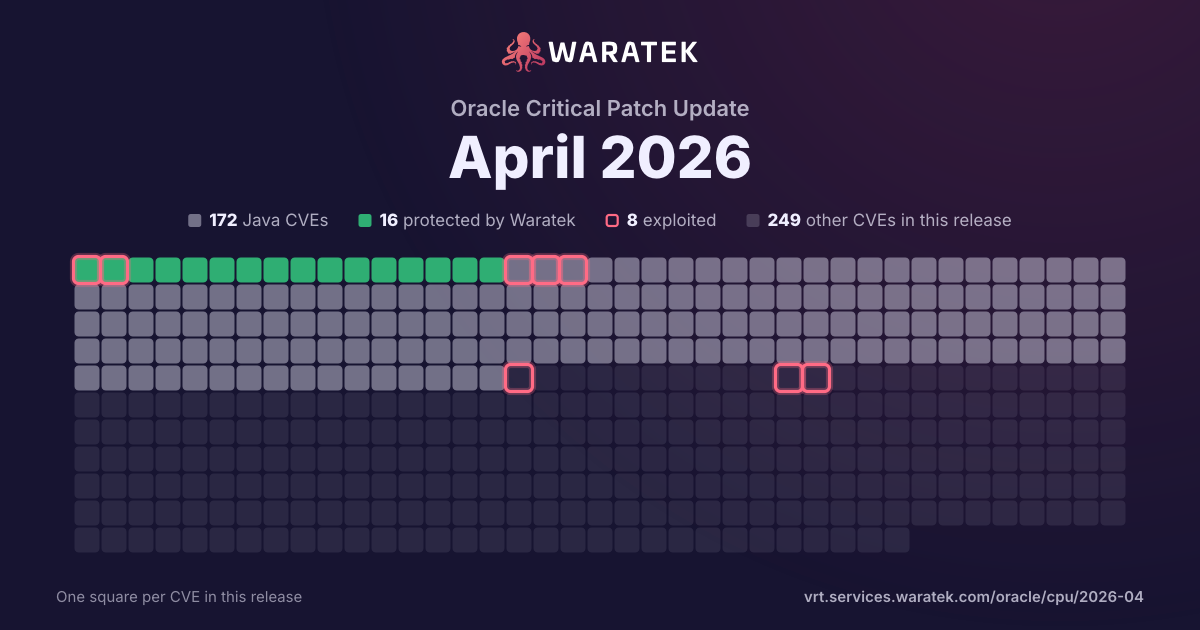
By status
16Protected by Waratek4Mitigation candidate152No exploit published10Outside Waratek scope239Not applicable
8Exploited, marked by the ring
No exploit published. For 51 of them, Oracle's security advisory is the source of public detail.
Protected by Waratek. Waratek RASP can block exploitation of these on systems that have not applied the patch yet.
Overview 7 matches · 4 protected · 4 exploited · 1 CISA KEV · 4 EPSS ≥ 0.5
Protected by Waratek
4
57.1%
Rule in development
0
0.0%
Mitigation candidate
3
42.9%
No exploit published
0
0.0%
blocked by ARMR today
4
57.1%
partly blocked
0
0.0%
not blocked
3
42.9%
not established
0
0.0%
unrecorded
0
0.0%
Exploited
4
57.1%
Working exploit published
1
14.3%
Proof of concept only
2
28.6%
Forecast only
0
0.0%
No public exploit
0
0.0%
split by
peak 2 / quarter
Q4 211
Protected by Waratek1
Critical1
blocked by ARMR today1
Exploited1
Q1 221
Protected by Waratek1
Critical1
blocked by ARMR today1
Proof of concept only1
Q2 220
Q3 220
Q4 220
Q1 230
Q2 230
Q3 230
Q4 230
Q1 240
Q2 240
Q3 240
Q4 240
Q1 251
Mitigation candidate1
Medium1
not blocked1
Exploited1
Q2 252
Protected by Waratek1
Mitigation candidate1
Critical1
High1
blocked by ARMR today1
not blocked1
Exploited1
Proof of concept only1
Q3 252
Protected by Waratek1
Mitigation candidate1
Medium2
blocked by ARMR today1
not blocked1
Exploited1
Working exploit published1
Q1 22Q3 22Q1 23Q3 23Q1 24Q3 24Q1 25Q3 25
| CVE | Severity | Published▾ | Status | Exploitation | Description |
|---|---|---|---|---|---|
| CVE-2025-59474 | Medium | 2025-09-17 | Mitigation candidate | Exploited | Jenkins 2.527 and earlier, LTS 2.516.2 and earlier does not perform a permission check in the sidepanel of a page intentionally accessible to users lacking Overall/Read permission, allowing attackers without Overall/Read permission to list agent names through its sidepanel executors widget. |
| CVE-2025-41242 | Medium | 2025-08-18 | Protected by Waratek | Working exploit published | Spring Framework MVC applications can be vulnerable to a “Path Traversal Vulnerability” when deployed on a non-compliant Servlet container. An application can be vulnerable when all the following are true: * the application is deployed as a WAR or with an embedded Servlet container * the Servlet container does not reject suspicious sequences https://jakarta.ee/specifications/servlet/6.1/jakarta-servlet-spec-6.1.html#uri-path-canonicalization * the application serves static resources https://docs.spring.io/spring-framework/reference/web/webmvc/mvc-config/static-resources.html#page-title with Spring resource handling We have verified that applications deployed on Apache Tomcat or Eclipse Jetty are not vulnerable, as long as default security features are not disabled in the configuration. Because we cannot check exploits against all Servlet containers and configuration variants, we strongly recommend upgrading your application. |
| CVE-2025-27817 | High | 2025-06-10 | Mitigation candidate | Exploited | A possible arbitrary file read and SSRF vulnerability has been identified in Apache Kafka Client. Apache Kafka Clients accept configuration data for setting the SASL/OAUTHBEARER connection with the brokers, including "sasl.oauthbearer.token.endpoint.url" and "sasl.oauthbearer.jwks.endpoint.url". Apache Kafka allows clients to read an arbitrary file and return the content in the error log, or sending requests to an unintended location. In applications where Apache Kafka Clients configurations can be specified by an untrusted party, attackers may use the "sasl.oauthbearer.token.endpoint.url" and "sasl.oauthbearer.jwks.endpoint.url" configuratin to read arbitrary contents of the disk and environment variables or make requests to an unintended location. In particular, this flaw may be used in Apache Kafka Connect to escalate from REST API access to filesystem/environment/URL access, which may be undesirable in certain environments, including SaaS products. Since Apache Kafka 3.9.1/4.0.0, we have added a system property ("-Dorg.apache.kafka.sasl.oauthbearer.allowed.urls") to set the allowed urls in SASL JAAS configuration. In 3.9.1, it accepts all urls by default for backward compatibility. However in 4.0.0 and newer, the default value is empty list and users have to set the allowed urls explicitly. |
| CVE-2025-30065 | Critical | 2025-04-01 | Protected by Waratek | Proof of concept only | Schema parsing in the parquet-avro module of Apache Parquet 1.15.0 and previous versions allows bad actors to execute arbitrary code Users are recommended to upgrade to version 1.15.1, which fixes the issue. |
| CVE-2025-27636 | Medium | 2025-03-09 | Mitigation candidate | Exploited | Bypass/Injection vulnerability in Apache Camel components under particular conditions. This issue affects Apache Camel: from 4.10.0 through <= 4.10.1, from 4.8.0 through <= 4.8.4, from 3.10.0 through <= 3.22.3. Users are recommended to upgrade to version 4.10.2 for 4.10.x LTS, 4.8.5 for 4.8.x LTS and 3.22.4 for 3.x releases. This vulnerability is present in Camel's default incoming header filter, that allows an attacker to include Camel specific headers that for some Camel components can alter the behaviours such as the camel-bean component, to call another method on the bean, than was coded in the application. In the camel-jms component, then a malicious header can be used to send the message to another queue (on the same broker) than was coded in the application. This could also be seen by using the camel-exec component The attacker would need to inject custom headers, such as HTTP protocols. So if you have Camel applications that are directly connected to the internet via HTTP, then an attacker could include malicious HTTP headers in the HTTP requests that are send to the Camel application. All the known Camel HTTP component such as camel-servlet, camel-jetty, camel-undertow, camel-platform-http, and camel-netty-http would be vulnerable out of the box. In these conditions an attacker could be able to forge a Camel header name and make the bean component invoking other methods in the same bean. In terms of usage of the default header filter strategy the list of components using that is: * camel-activemq * camel-activemq6 * camel-amqp * camel-aws2-sqs * camel-azure-servicebus * camel-cxf-rest * camel-cxf-soap * camel-http * camel-jetty * camel-jms * camel-kafka * camel-knative * camel-mail * camel-nats * camel-netty-http * camel-platform-http * camel-rest * camel-sjms * camel-spring-rabbitmq * camel-stomp * camel-tahu * camel-undertow * camel-xmpp The vulnerability arises due to a bug in the default filtering mechanism that only blocks headers starting with "Camel", "camel", or "org.apache.camel.". Mitigation: You can easily work around this in your Camel applications by removing the headers in your Camel routes. There are many ways of doing this, also globally or per route. This means you could use the removeHeaders EIP, to filter out anything like "cAmel, cAMEL" etc, or in general everything not starting with "Camel", "camel" or "org.apache.camel.". |
| CVE-2022-23305 | Critical | 2022-01-18 | Protected by Waratek | Proof of concept only | By design, the JDBCAppender in Log4j 1.2.x accepts an SQL statement as a configuration parameter where the values to be inserted are converters from PatternLayout. The message converter, %m, is likely to always be included. This allows attackers to manipulate the SQL by entering crafted strings into input fields or headers of an application that are logged allowing unintended SQL queries to be executed. Note this issue only affects Log4j 1.x when specifically configured to use the JDBCAppender, which is not the default. Beginning in version 2.0-beta8, the JDBCAppender was re-introduced with proper support for parameterized SQL queries and further customization over the columns written to in logs. Apache Log4j 1.2 reached end of life in August 2015. Users should upgrade to Log4j 2 as it addresses numerous other issues from the previous versions. |
| CVE-2021-45046 | Critical | 2021-12-14 | Protected by Waratek | Exploited | It was found that the fix to address CVE-2021-44228 in Apache Log4j 2.15.0 was incomplete in certain non-default configurations. This could allows attackers with control over Thread Context Map (MDC) input data when the logging configuration uses a non-default Pattern Layout with either a Context Lookup (for example, $${ctx:loginId}) or a Thread Context Map pattern (%X, %mdc, or %MDC) to craft malicious input data using a JNDI Lookup pattern resulting in an information leak and remote code execution in some environments and local code execution in all environments. Log4j 2.16.0 (Java 8) and 2.12.2 (Java 7) fix this issue by removing support for message lookup patterns and disabling JNDI functionality by default. |