
Oracle Critical Patch Update April 2026
Released April 2026 · Oracle's advisory ↗ · ← Critical Patch Update, January 2026 · Security Patch Update, May 2026 →
421 CVEs in this release, one square each
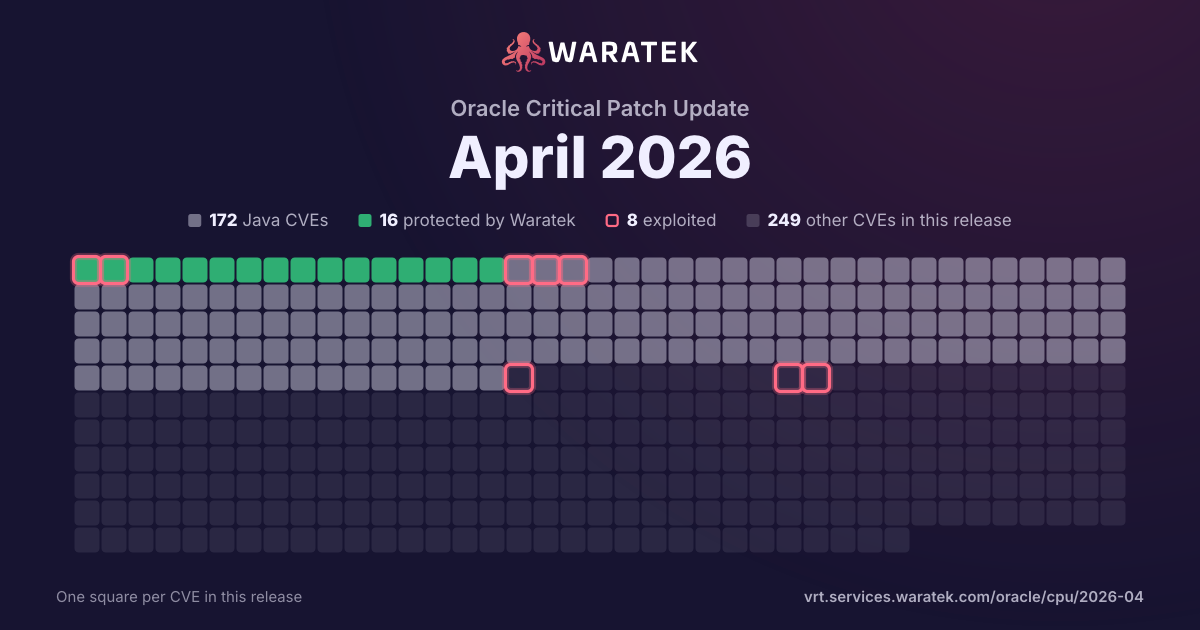
By status
16Protected by Waratek4Mitigation candidate152No exploit published10Outside Waratek scope239Not applicable
8Exploited, marked by the ring
No exploit published. For 51 of them, Oracle's security advisory is the source of public detail.
Protected by Waratek. Waratek RASP can block exploitation of these on systems that have not applied the patch yet.
Overview 239 matches · 0 in Waratek scope · 0 protected · 2 exploited · 0 CISA KEV · 7 public PoC · 4 EPSS ≥ 0.5
239matches
0in Waratek scope0.0%
0protected0.0%
2exploited0.8%
0CISA KEV0.0%
7public PoC2.9%
4EPSS ≥ 0.51.7%
Protected by Waratek
0
0.0%
Rule in development
0
0.0%
Mitigation candidate
0
0.0%
No exploit published
0
0.0%
Outside Waratek scope
0
0.0%
Not applicable
239
100.0%
Withdrawn CVE
0
0.0%
blocked by ARMR today
0
0.0%
partly blocked
0
0.0%
not blocked
239
100.0%
not established
0
0.0%
unrecorded
0
0.0%
split by
peak 109 / quarter
Q1 241
Not applicable1
Medium1
not blocked1
No public exploit1
Q2 243
Not applicable3
Critical1
High1
Medium1
not blocked3
Proof of concept only1
No public exploit2
Q3 241
Not applicable1
High1
not blocked1
Exploited1
Q4 240
Q1 255
Not applicable5
High4
Medium1
not blocked5
Proof of concept only3
No public exploit2
Q2 258
Not applicable8
High4
Medium4
not blocked8
Proof of concept only1
No public exploit7
Q3 2532
Not applicable32
Critical1
High13
Medium14
Low4
not blocked32
Working exploit published2
Proof of concept only7
No public exploit23
Q4 2536
Not applicable36
Critical3
High16
Medium16
Low1
not blocked36
Exploited1
Proof of concept only4
No public exploit31
Q1 26109
Not applicable109
Critical12
High54
Medium39
Low4
not blocked109
Proof of concept only9
No public exploit100
Q2 2644
Not applicable44
High8
Medium32
Low4
not blocked44
Proof of concept only1
No public exploit43
Q1 24Q2 24Q3 24Q4 24Q1 25Q2 25Q3 25Q4 25Q1 26Q2 26
| CVE | Severity | Published▾ | Status | Exploitation | Description |
|---|---|---|---|---|---|
| CVE-2026-20608 | High | 2026-02-11 | Not applicable | No public exploit | This issue was addressed through improved state management. This issue is fixed in Safari 26.3, iOS 18.7.5 and iPadOS 18.7.5, iOS 26.3 and iPadOS 26.3, macOS Tahoe 26.3, visionOS 26.3. Processing maliciously crafted web content may lead to an unexpected process crash. |
| CVE-2026-26007 | High | 2026-02-10 | Not applicable | No public exploit | cryptography is a package designed to expose cryptographic primitives and recipes to Python developers. Prior to 46.0.5, the public_key_from_numbers (or EllipticCurvePublicNumbers.public_key()), EllipticCurvePublicNumbers.public_key(), load_der_public_key() and load_pem_public_key() functions do not verify that the point belongs to the expected prime-order subgroup of the curve. This missing validation allows an attacker to provide a public key point P from a small-order subgroup. This can lead to security issues in various situations, such as the most commonly used signature verification (ECDSA) and shared key negotiation (ECDH). When the victim computes the shared secret as S = [victim_private_key]P via ECDH, this leaks information about victim_private_key mod (small_subgroup_order). For curves with cofactor > 1, this reveals the least significant bits of the private key. When these weak public keys are used in ECDSA , it's easy to forge signatures on the small subgroup. Only SECT curves are impacted by this. This vulnerability is fixed in 46.0.5. |
| CVE-2026-25646 | High | 2026-02-10 | Not applicable | Proof of concept only | LIBPNG is a reference library for use in applications that read, create, and manipulate PNG (Portable Network Graphics) raster image files. Prior to 1.6.55, an out-of-bounds read vulnerability exists in the png_set_quantize() API function. When the function is called with no histogram and the number of colors in the palette is more than twice the maximum supported by the user's display, certain palettes will cause the function to enter into an infinite loop that reads past the end of an internal heap-allocated buffer. The images that trigger this vulnerability are valid per the PNG specification. This vulnerability is fixed in 1.6.55. |
| CVE-2025-68121 | Critical | 2026-02-05 | Not applicable | No public exploit | During session resumption in crypto/tls, if the underlying Config has its ClientCAs or RootCAs fields mutated between the initial handshake and the resumed handshake, the resumed handshake may succeed when it should have failed. This may happen when a user calls Config.Clone and mutates the returned Config, or uses Config.GetConfigForClient. This can cause a client to resume a session with a server that it would not have resumed with during the initial handshake, or cause a server to resume a session with a client that it would not have resumed with during the initial handshake. |
| CVE-2025-61732 | High | 2026-02-05 | Not applicable | No public exploit | A discrepancy between how Go and C/C++ comments were parsed allowed for code smuggling into the resulting cgo binary. |
| CVE-2026-1642 | High | 2026-02-04 | Not applicable | No public exploit | A vulnerability exists in NGINX OSS and NGINX Plus when configured to proxy to upstream Transport Layer Security (TLS) servers. An attacker with a man-in-the-middle (MITM) position on the upstream server side—along with conditions beyond the attacker's control—may be able to inject plain text data into the response from an upstream proxied server. Note: Software versions which have reached End of Technical Support (EoTS) are not evaluated. |
| CVE-2026-24512 | High | 2026-02-03 | Not applicable | No public exploit | A security issue was discovered in ingress-nginx where the `rules.http.paths.path` Ingress field can be used to inject configuration into nginx. This can lead to arbitrary code execution in the context of the ingress-nginx controller, and disclosure of Secrets accessible to the controller. (Note that in the default installation, the controller can access all Secrets cluster-wide.) |
| CVE-2026-25210 | High | 2026-01-30 | Not applicable | No public exploit | In libexpat before 2.7.4, the doContent function does not properly determine the buffer size bufSize because there is no integer overflow check for tag buffer reallocation. |
| CVE-2026-22796 | Medium | 2026-01-27 | Not applicable | No public exploit | Issue summary: A type confusion vulnerability exists in the signature verification of signed PKCS#7 data where an ASN1_TYPE union member is accessed without first validating the type, causing an invalid or NULL pointer dereference when processing malformed PKCS#7 data. Impact summary: An application performing signature verification of PKCS#7 data or calling directly the PKCS7_digest_from_attributes() function can be caused to dereference an invalid or NULL pointer when reading, resulting in a Denial of Service. The function PKCS7_digest_from_attributes() accesses the message digest attribute value without validating its type. When the type is not V_ASN1_OCTET_STRING, this results in accessing invalid memory through the ASN1_TYPE union, causing a crash. Exploiting this vulnerability requires an attacker to provide a malformed signed PKCS#7 to an application that verifies it. The impact of the exploit is just a Denial of Service, the PKCS7 API is legacy and applications should be using the CMS API instead. For these reasons the issue was assessed as Low severity. The FIPS modules in 3.5, 3.4, 3.3 and 3.0 are not affected by this issue, as the PKCS#7 parsing implementation is outside the OpenSSL FIPS module boundary. OpenSSL 3.6, 3.5, 3.4, 3.3, 3.0, 1.1.1 and 1.0.2 are vulnerable to this issue. |
| CVE-2026-22795 | Medium | 2026-01-27 | Not applicable | No public exploit | Issue summary: An invalid or NULL pointer dereference can happen in an application processing a malformed PKCS#12 file. Impact summary: An application processing a malformed PKCS#12 file can be caused to dereference an invalid or NULL pointer on memory read, resulting in a Denial of Service. A type confusion vulnerability exists in PKCS#12 parsing code where an ASN1_TYPE union member is accessed without first validating the type, causing an invalid pointer read. The location is constrained to a 1-byte address space, meaning any attempted pointer manipulation can only target addresses between 0x00 and 0xFF. This range corresponds to the zero page, which is unmapped on most modern operating systems and will reliably result in a crash, leading only to a Denial of Service. Exploiting this issue also requires a user or application to process a maliciously crafted PKCS#12 file. It is uncommon to accept untrusted PKCS#12 files in applications as they are usually used to store private keys which are trusted by definition. For these reasons, the issue was assessed as Low severity. The FIPS modules in 3.5, 3.4, 3.3 and 3.0 are not affected by this issue, as the PKCS12 implementation is outside the OpenSSL FIPS module boundary. OpenSSL 3.6, 3.5, 3.4, 3.3, 3.0 and 1.1.1 are vulnerable to this issue. OpenSSL 1.0.2 is not affected by this issue. |
| CVE-2025-69421 | High | 2026-01-27 | Not applicable | No public exploit | Issue summary: Processing a malformed PKCS#12 file can trigger a NULL pointer dereference in the PKCS12_item_decrypt_d2i_ex() function. Impact summary: A NULL pointer dereference can trigger a crash which leads to Denial of Service for an application processing PKCS#12 files. The PKCS12_item_decrypt_d2i_ex() function does not check whether the oct parameter is NULL before dereferencing it. When called from PKCS12_unpack_p7encdata() with a malformed PKCS#12 file, this parameter can be NULL, causing a crash. The vulnerability is limited to Denial of Service and cannot be escalated to achieve code execution or memory disclosure. Exploiting this issue requires an attacker to provide a malformed PKCS#12 file to an application that processes it. For that reason the issue was assessed as Low severity according to our Security Policy. The FIPS modules in 3.6, 3.5, 3.4, 3.3 and 3.0 are not affected by this issue, as the PKCS#12 implementation is outside the OpenSSL FIPS module boundary. OpenSSL 3.6, 3.5, 3.4, 3.3, 3.0, 1.1.1 and 1.0.2 are vulnerable to this issue. |
| CVE-2025-69420 | High | 2026-01-27 | Not applicable | No public exploit | Issue summary: A type confusion vulnerability exists in the TimeStamp Response verification code where an ASN1_TYPE union member is accessed without first validating the type, causing an invalid or NULL pointer dereference when processing a malformed TimeStamp Response file. Impact summary: An application calling TS_RESP_verify_response() with a malformed TimeStamp Response can be caused to dereference an invalid or NULL pointer when reading, resulting in a Denial of Service. The functions ossl_ess_get_signing_cert() and ossl_ess_get_signing_cert_v2() access the signing cert attribute value without validating its type. When the type is not V_ASN1_SEQUENCE, this results in accessing invalid memory through the ASN1_TYPE union, causing a crash. Exploiting this vulnerability requires an attacker to provide a malformed TimeStamp Response to an application that verifies timestamp responses. The TimeStamp protocol (RFC 3161) is not widely used and the impact of the exploit is just a Denial of Service. For these reasons the issue was assessed as Low severity. The FIPS modules in 3.5, 3.4, 3.3 and 3.0 are not affected by this issue, as the TimeStamp Response implementation is outside the OpenSSL FIPS module boundary. OpenSSL 3.6, 3.5, 3.4, 3.3, 3.0 and 1.1.1 are vulnerable to this issue. OpenSSL 1.0.2 is not affected by this issue. |
| CVE-2025-69419 | High | 2026-01-27 | Not applicable | No public exploit | Issue summary: Calling PKCS12_get_friendlyname() function on a maliciously crafted PKCS#12 file with a BMPString (UTF-16BE) friendly name containing non-ASCII BMP code point can trigger a one byte write before the allocated buffer. Impact summary: The out-of-bounds write can cause a memory corruption which can have various consequences including a Denial of Service. The OPENSSL_uni2utf8() function performs a two-pass conversion of a PKCS#12 BMPString (UTF-16BE) to UTF-8. In the second pass, when emitting UTF-8 bytes, the helper function bmp_to_utf8() incorrectly forwards the remaining UTF-16 source byte count as the destination buffer capacity to UTF8_putc(). For BMP code points above U+07FF, UTF-8 requires three bytes, but the forwarded capacity can be just two bytes. UTF8_putc() then returns -1, and this negative value is added to the output length without validation, causing the length to become negative. The subsequent trailing NUL byte is then written at a negative offset, causing write outside of heap allocated buffer. The vulnerability is reachable via the public PKCS12_get_friendlyname() API when parsing attacker-controlled PKCS#12 files. While PKCS12_parse() uses a different code path that avoids this issue, PKCS12_get_friendlyname() directly invokes the vulnerable function. Exploitation requires an attacker to provide a malicious PKCS#12 file to be parsed by the application and the attacker can just trigger a one zero byte write before the allocated buffer. For that reason the issue was assessed as Low severity according to our Security Policy. The FIPS modules in 3.6, 3.5, 3.4, 3.3 and 3.0 are not affected by this issue, as the PKCS#12 implementation is outside the OpenSSL FIPS module boundary. OpenSSL 3.6, 3.5, 3.4, 3.3, 3.0 and 1.1.1 are vulnerable to this issue. OpenSSL 1.0.2 is not affected by this issue. |
| CVE-2025-69418 | Medium | 2026-01-27 | Not applicable | No public exploit | Issue summary: When using the low-level OCB API directly with AES-NI or<br>other hardware-accelerated code paths, inputs whose length is not a multiple<br>of 16 bytes can leave the final partial block unencrypted and unauthenticated.<br><br>Impact summary: The trailing 1-15 bytes of a message may be exposed in<br>cleartext on encryption and are not covered by the authentication tag,<br>allowing an attacker to read or tamper with those bytes without detection.<br><br>The low-level OCB encrypt and decrypt routines in the hardware-accelerated<br>stream path process full 16-byte blocks but do not advance the input/output<br>pointers. The subsequent tail-handling code then operates on the original<br>base pointers, effectively reprocessing the beginning of the buffer while<br>leaving the actual trailing bytes unprocessed. The authentication checksum<br>also excludes the true tail bytes.<br><br>However, typical OpenSSL consumers using EVP are not affected because the<br>higher-level EVP and provider OCB implementations split inputs so that full<br>blocks and trailing partial blocks are processed in separate calls, avoiding<br>the problematic code path. Additionally, TLS does not use OCB ciphersuites.<br>The vulnerability only affects applications that call the low-level<br>CRYPTO_ocb128_encrypt() or CRYPTO_ocb128_decrypt() functions directly with<br>non-block-aligned lengths in a single call on hardware-accelerated builds.<br>For these reasons the issue was assessed as Low severity.<br><br>The FIPS modules in 3.6, 3.5, 3.4, 3.3, 3.2, 3.1 and 3.0 are not affected<br>by this issue, as OCB mode is not a FIPS-approved algorithm.<br><br>OpenSSL 3.6, 3.5, 3.4, 3.3, 3.0 and 1.1.1 are vulnerable to this issue.<br><br>OpenSSL 1.0.2 is not affected by this issue. |
| CVE-2025-68160 | Medium | 2026-01-27 | Not applicable | No public exploit | Issue summary: Writing large, newline-free data into a BIO chain using the line-buffering filter where the next BIO performs short writes can trigger a heap-based out-of-bounds write. Impact summary: This out-of-bounds write can cause memory corruption which typically results in a crash, leading to Denial of Service for an application. The line-buffering BIO filter (BIO_f_linebuffer) is not used by default in TLS/SSL data paths. In OpenSSL command-line applications, it is typically only pushed onto stdout/stderr on VMS systems. Third-party applications that explicitly use this filter with a BIO chain that can short-write and that write large, newline-free data influenced by an attacker would be affected. However, the circumstances where this could happen are unlikely to be under attacker control, and BIO_f_linebuffer is unlikely to be handling non-curated data controlled by an attacker. For that reason the issue was assessed as Low severity. The FIPS modules in 3.6, 3.5, 3.4, 3.3 and 3.0 are not affected by this issue, as the BIO implementation is outside the OpenSSL FIPS module boundary. OpenSSL 3.6, 3.5, 3.4, 3.3, 3.0, 1.1.1 and 1.0.2 are vulnerable to this issue. |
| CVE-2025-66199 | Medium | 2026-01-27 | Not applicable | No public exploit | Issue summary: A TLS 1.3 connection using certificate compression can be forced to allocate a large buffer before decompression without checking against the configured certificate size limit. Impact summary: An attacker can cause per-connection memory allocations of up to approximately 22 MiB and extra CPU work, potentially leading to service degradation or resource exhaustion (Denial of Service). In affected configurations, the peer-supplied uncompressed certificate length from a CompressedCertificate message is used to grow a heap buffer prior to decompression. This length is not bounded by the max_cert_list setting, which otherwise constrains certificate message sizes. An attacker can exploit this to cause large per-connection allocations followed by handshake failure. No memory corruption or information disclosure occurs. This issue only affects builds where TLS 1.3 certificate compression is compiled in (i.e., not OPENSSL_NO_COMP_ALG) and at least one compression algorithm (brotli, zlib, or zstd) is available, and where the compression extension is negotiated. Both clients receiving a server CompressedCertificate and servers in mutual TLS scenarios receiving a client CompressedCertificate are affected. Servers that do not request client certificates are not vulnerable to client-initiated attacks. Users can mitigate this issue by setting SSL_OP_NO_RX_CERTIFICATE_COMPRESSION to disable receiving compressed certificates. The FIPS modules in 3.6, 3.5, 3.4 and 3.3 are not affected by this issue, as the TLS implementation is outside the OpenSSL FIPS module boundary. OpenSSL 3.6, 3.5, 3.4 and 3.3 are vulnerable to this issue. OpenSSL 3.0, 1.1.1 and 1.0.2 are not affected by this issue. |
| CVE-2025-15469 | Medium | 2026-01-27 | Not applicable | No public exploit | Issue summary: The 'openssl dgst' command-line tool silently truncates input data to 16MB when using one-shot signing algorithms and reports success instead of an error. Impact summary: A user signing or verifying files larger than 16MB with one-shot algorithms (such as Ed25519, Ed448, or ML-DSA) may believe the entire file is authenticated while trailing data beyond 16MB remains unauthenticated. When the 'openssl dgst' command is used with algorithms that only support one-shot signing (Ed25519, Ed448, ML-DSA-44, ML-DSA-65, ML-DSA-87), the input is buffered with a 16MB limit. If the input exceeds this limit, the tool silently truncates to the first 16MB and continues without signaling an error, contrary to what the documentation states. This creates an integrity gap where trailing bytes can be modified without detection if both signing and verification are performed using the same affected codepath. The issue affects only the command-line tool behavior. Verifiers that process the full message using library APIs will reject the signature, so the risk primarily affects workflows that both sign and verify with the affected 'openssl dgst' command. Streaming digest algorithms for 'openssl dgst' and library users are unaffected. The FIPS modules in 3.5 and 3.6 are not affected by this issue, as the command-line tools are outside the OpenSSL FIPS module boundary. OpenSSL 3.5 and 3.6 are vulnerable to this issue. OpenSSL 3.4, 3.3, 3.0, 1.1.1 and 1.0.2 are not affected by this issue. |
| CVE-2025-15468 | Medium | 2026-01-27 | Not applicable | No public exploit | Issue summary: If an application using the SSL_CIPHER_find() function in a QUIC protocol client or server receives an unknown cipher suite from the peer, a NULL dereference occurs. Impact summary: A NULL pointer dereference leads to abnormal termination of the running process causing Denial of Service. Some applications call SSL_CIPHER_find() from the client_hello_cb callback on the cipher ID received from the peer. If this is done with an SSL object implementing the QUIC protocol, NULL pointer dereference will happen if the examined cipher ID is unknown or unsupported. As it is not very common to call this function in applications using the QUIC protocol and the worst outcome is Denial of Service, the issue was assessed as Low severity. The vulnerable code was introduced in the 3.2 version with the addition of the QUIC protocol support. The FIPS modules in 3.6, 3.5, 3.4 and 3.3 are not affected by this issue, as the QUIC implementation is outside the OpenSSL FIPS module boundary. OpenSSL 3.6, 3.5, 3.4 and 3.3 are vulnerable to this issue. OpenSSL 3.0, 1.1.1 and 1.0.2 are not affected by this issue. |
| CVE-2025-15467 | Critical | 2026-01-27 | Not applicable | Proof of concept only | Issue summary: Parsing CMS AuthEnvelopedData or EnvelopedData message with maliciously crafted AEAD parameters can trigger a stack buffer overflow. Impact summary: A stack buffer overflow may lead to a crash, causing Denial of Service, or potentially remote code execution. When parsing CMS (Auth)EnvelopedData structures that use AEAD ciphers such as AES-GCM, the IV (Initialization Vector) encoded in the ASN.1 parameters is copied into a fixed-size stack buffer without verifying that its length fits the destination. An attacker can supply a crafted CMS message with an oversized IV, causing a stack-based out-of-bounds write before any authentication or tag verification occurs. Applications and services that parse untrusted CMS or PKCS#7 content using AEAD ciphers (e.g., S/MIME (Auth)EnvelopedData with AES-GCM) are vulnerable. Because the overflow occurs prior to authentication, no valid key material is required to trigger it. While exploitability to remote code execution depends on platform and toolchain mitigations, the stack-based write primitive represents a severe risk. The FIPS modules in 3.6, 3.5, 3.4, 3.3 and 3.0 are not affected by this issue, as the CMS implementation is outside the OpenSSL FIPS module boundary. OpenSSL 3.6, 3.5, 3.4, 3.3 and 3.0 are vulnerable to this issue. OpenSSL 1.1.1 and 1.0.2 are not affected by this issue. |
| CVE-2025-11187 | Medium | 2026-01-27 | Not applicable | Proof of concept only | Issue summary: PBMAC1 parameters in PKCS#12 files are missing validation which can trigger a stack-based buffer overflow, invalid pointer or NULL pointer dereference during MAC verification. Impact summary: The stack buffer overflow or NULL pointer dereference may cause a crash leading to Denial of Service for an application that parses untrusted PKCS#12 files. The buffer overflow may also potentially enable code execution depending on platform mitigations. When verifying a PKCS#12 file that uses PBMAC1 for the MAC, the PBKDF2 salt and keylength parameters from the file are used without validation. If the value of keylength exceeds the size of the fixed stack buffer used for the derived key (64 bytes), the key derivation will overflow the buffer. The overflow length is attacker-controlled. Also, if the salt parameter is not an OCTET STRING type this can lead to invalid or NULL pointer dereference. Exploiting this issue requires a user or application to process a maliciously crafted PKCS#12 file. It is uncommon to accept untrusted PKCS#12 files in applications as they are usually used to store private keys which are trusted by definition. For this reason the issue was assessed as Moderate severity. The FIPS modules in 3.6, 3.5 and 3.4 are not affected by this issue, as PKCS#12 processing is outside the OpenSSL FIPS module boundary. OpenSSL 3.6, 3.5 and 3.4 are vulnerable to this issue. OpenSSL 3.3, 3.0, 1.1.1 and 1.0.2 are not affected by this issue as they do not support PBMAC1 in PKCS#12. |
| CVE-2025-27821 | High | 2026-01-26 | Not applicable | No public exploit | Out-of-bounds Write vulnerability in Apache Hadoop HDFS native client. This issue affects Apache Hadoop: from 3.2.0 before 3.4.2. Users are recommended to upgrade to version 3.4.2, which fixes the issue. |
| CVE-2026-24515 | Low | 2026-01-23 | Not applicable | No public exploit | In libexpat before 2.7.4, XML_ExternalEntityParserCreate does not copy unknown encoding handler user data. |
| CVE-2026-21939 | High | 2026-01-20 | Not applicable | No public exploit | Vulnerability in the SQLcl component of Oracle Database Server. Supported versions that are affected are 23.4.0-23.26.0. Difficult to exploit vulnerability allows unauthenticated attacker with logon to the infrastructure where SQLcl executes to compromise SQLcl. Successful attacks require human interaction from a person other than the attacker. Successful attacks of this vulnerability can result in takeover of SQLcl. CVSS 3.1 Base Score 7.0 (Confidentiality, Integrity and Availability impacts). CVSS Vector: (CVSS:3.1/AV:L/AC:H/PR:N/UI:R/S:U/C:H/I:H/A:H). |
| CVE-2026-21637 | High | 2026-01-20 | Not applicable | No public exploit | A flaw in Node.js TLS error handling allows remote attackers to crash or exhaust resources of a TLS server when `pskCallback` or `ALPNCallback` are in use. Synchronous exceptions thrown during these callbacks bypass standard TLS error handling paths (tlsClientError and error), causing either immediate process termination or silent file descriptor leaks that eventually lead to denial of service. Because these callbacks process attacker-controlled input during the TLS handshake, a remote client can repeatedly trigger the issue. This vulnerability affects TLS servers using PSK or ALPN callbacks across Node.js versions where these callbacks throw without being safely wrapped. |
| CVE-2026-21636 | Critical | 2026-01-20 | Not applicable | No public exploit | A flaw in Node.js's permission model allows Unix Domain Socket (UDS) connections to bypass network restrictions when `--permission` is enabled. Even without `--allow-net`, attacker-controlled inputs (such as URLs or socketPath options) can connect to arbitrary local sockets via net, tls, or undici/fetch. This breaks the intended security boundary of the permission model and enables access to privileged local services, potentially leading to privilege escalation, data exposure, or local code execution. * The issue affects users of the Node.js permission model on version v25. In the moment of this vulnerability, network permissions (`--allow-net`) are still in the experimental phase. |
| CVE-2025-59466 | High | 2026-01-20 | Not applicable | No public exploit | We have identified a bug in Node.js error handling where "Maximum call stack size exceeded" errors become uncatchable when `async_hooks.createHook()` is enabled. Instead of reaching `process.on('uncaughtException')`, the process terminates, making the crash unrecoverable. Applications that rely on `AsyncLocalStorage` (v22, v20) or `async_hooks.createHook()` (v24, v22, v20) become vulnerable to denial-of-service crashes triggered by deep recursion under specific conditions. |
| CVE-2025-59465 | High | 2026-01-20 | Not applicable | No public exploit | A malformed `HTTP/2 HEADERS` frame with oversized, invalid `HPACK` data can cause Node.js to crash by triggering an unhandled `TLSSocket` error `ECONNRESET`. Instead of safely closing the connection, the process crashes, enabling a remote denial of service. This primarily affects applications that do not attach explicit error handlers to secure sockets, for example: ``` server.on('secureConnection', socket => { socket.on('error', err => { console.log(err) }) }) ``` |
| CVE-2025-55132 | Medium | 2026-01-20 | Not applicable | No public exploit | A flaw in Node.js's permission model allows a file's access and modification timestamps to be changed via `futimes()` even when the process has only read permissions. Unlike `utimes()`, `futimes()` does not apply the expected write-permission checks, which means file metadata can be modified in read-only directories. This behavior could be used to alter timestamps in ways that obscure activity, reducing the reliability of logs. This vulnerability affects users of the permission model on Node.js v20, v22, v24, and v25. |
| CVE-2025-55131 | High | 2026-01-20 | Not applicable | No public exploit | A flaw in Node.js's buffer allocation logic can expose uninitialized memory when allocations are interrupted, when using the `vm` module with the timeout option. Under specific timing conditions, buffers allocated with `Buffer.alloc` and other `TypedArray` instances like `Uint8Array` may contain leftover data from previous operations, allowing in-process secrets like tokens or passwords to leak or causing data corruption. While exploitation typically requires precise timing or in-process code execution, it can become remotely exploitable when untrusted input influences workload and timeouts, leading to potential confidentiality and integrity impact. |
| CVE-2025-55130 | Critical | 2026-01-20 | Not applicable | No public exploit | A flaw in Node.js’s Permissions model allows attackers to bypass `--allow-fs-read` and `--allow-fs-write` restrictions using crafted relative symlink paths. By chaining directories and symlinks, a script granted access only to the current directory can escape the allowed path and read sensitive files. This breaks the expected isolation guarantees and enables arbitrary file read/write, leading to potential system compromise. This vulnerability affects users of the permission model on Node.js v20, v22, v24, and v25. |
| CVE-2026-23490 | High | 2026-01-16 | Not applicable | Proof of concept only | pyasn1 is a generic ASN.1 library for Python. Prior to 0.6.2, a Denial-of-Service issue has been found that leads to memory exhaustion from malformed RELATIVE-OID with excessive continuation octets. This vulnerability is fixed in 0.6.2. |
| CVE-2026-0915 | High | 2026-01-15 | Not applicable | Proof of concept only | Calling getnetbyaddr or getnetbyaddr_r with a configured nsswitch.conf that specifies the library's DNS backend for networks and queries for a zero-valued network in the GNU C Library version 2.0 to version 2.42 can leak stack contents to the configured DNS resolver. |
| CVE-2026-0861 | High | 2026-01-14 | Not applicable | No public exploit | Passing too large an alignment to the memalign suite of functions (memalign, posix_memalign, aligned_alloc) in the GNU C Library version 2.30 to 2.42 may result in an integer overflow, which could consequently result in a heap corruption. Note that the attacker must have control over both, the size as well as the alignment arguments of the memalign function to be able to exploit this. The size parameter must be close enough to PTRDIFF_MAX so as to overflow size_t along with the large alignment argument. This limits the malicious inputs for the alignment for memalign to the range [1<<62+ 1, 1<<63] and exactly 1<<63 for posix_memalign and aligned_alloc. Typically the alignment argument passed to such functions is a known constrained quantity (e.g. page size, block size, struct sizes) and is not attacker controlled, because of which this may not be easily exploitable in practice. An application bug could potentially result in the input alignment being too large, e.g. due to a different buffer overflow or integer overflow in the application or its dependent libraries, but that is again an uncommon usage pattern given typical sources of alignments. |
| CVE-2026-22801 | High | 2026-01-12 | Not applicable | No public exploit | LIBPNG is a reference library for use in applications that read, create, and manipulate PNG (Portable Network Graphics) raster image files. From 1.6.26 to 1.6.53, there is an integer truncation in the libpng simplified write API functions png_write_image_16bit and png_write_image_8bit causes heap buffer over-read when the caller provides a negative row stride (for bottom-up image layouts) or a stride exceeding 65535 bytes. The bug was introduced in libpng 1.6.26 (October 2016) by casts added to silence compiler warnings on 16-bit systems. This vulnerability is fixed in 1.6.54. |
| CVE-2026-22695 | High | 2026-01-12 | Not applicable | No public exploit | LIBPNG is a reference library for use in applications that read, create, and manipulate PNG (Portable Network Graphics) raster image files. From 1.6.51 to 1.6.53, there is a heap buffer over-read in the libpng simplified API function png_image_finish_read when processing interlaced 16-bit PNGs with 8-bit output format and non-minimal row stride. This is a regression introduced by the fix for CVE-2025-65018. This vulnerability is fixed in 1.6.54. |
| CVE-2025-14279 | High | 2026-01-12 | Not applicable | No public exploit | MLFlow versions up to and including 3.4.0 are vulnerable to DNS rebinding attacks due to a lack of Origin header validation in the MLFlow REST server. This vulnerability allows malicious websites to bypass Same-Origin Policy protections and execute unauthorized calls against REST endpoints. An attacker can query, update, and delete experiments via the affected endpoints, leading to potential data exfiltration, destruction, or manipulation. The issue is resolved in version 3.5.0. |
| CVE-2025-15224 | Low | 2026-01-08 | Not applicable | Proof of concept only | When doing SSH-based transfers using either SCP or SFTP, and asked to do public key authentication, curl would wrongly still ask and authenticate using a locally running SSH agent. |
| CVE-2025-15079 | Medium | 2026-01-08 | Not applicable | Proof of concept only | When doing SSH-based transfers using either SCP or SFTP, and setting the known_hosts file, libcurl could still mistakenly accept connecting to hosts *not present* in the specified file if they were added as recognized in the libssh *global* known_hosts file. |
| CVE-2025-14819 | Medium | 2026-01-08 | Not applicable | No public exploit | When doing TLS related transfers with reused easy or multi handles and altering the `CURLSSLOPT_NO_PARTIALCHAIN` option, libcurl could accidentally reuse a CA store cached in memory for which the partial chain option was reversed. Contrary to the user's wishes and expectations. This could make libcurl find and accept a trust chain that it otherwise would not. |
| CVE-2025-14524 | Medium | 2026-01-08 | Not applicable | No public exploit | When an OAuth2 bearer token is used for an HTTP(S) transfer, and that transfer performs a cross-protocol redirect to a second URL that uses an IMAP, LDAP, POP3 or SMTP scheme, curl might wrongly pass on the bearer token to the new target host. |
| CVE-2025-14017 | Medium | 2026-01-08 | Not applicable | No public exploit | When doing multi-threaded LDAPS transfers (LDAP over TLS) with libcurl, changing TLS options in one thread would inadvertently change them globally and therefore possibly also affect other concurrently setup transfers. Disabling certificate verification for a specific transfer could unintentionally disable the feature for other threads as well. |
| CVE-2025-13034 | Medium | 2026-01-08 | Not applicable | No public exploit | When using `CURLOPT_PINNEDPUBLICKEY` option with libcurl or `--pinnedpubkey` with the curl tool, curl should check the public key of the server certificate to verify the peer. This check was skipped in a certain condition that would then make curl allow the connection without performing the proper check, thus not noticing a possible impostor. To skip this check, the connection had to be done with QUIC with ngtcp2 built to use GnuTLS and the user had to explicitly disable the standard certificate verification. |
| CVE-2026-22184 | Medium | 2026-01-07 | Not applicable | Proof of concept only | zlib versions up to and including 1.3.1.2 include a global buffer overflow in the untgz utility located under contrib/untgz. The vulnerability is limited to the standalone demonstration utility and does not affect the core zlib compression library. The flaw occurs when a user executes the untgz command with an excessively long archive name supplied via the command line, leading to an out-of-bounds write in a fixed-size global buffer. |
| CVE-2026-21441 | High | 2026-01-07 | Not applicable | No public exploit | urllib3 is an HTTP client library for Python. urllib3's streaming API is designed for the efficient handling of large HTTP responses by reading the content in chunks, rather than loading the entire response body into memory at once. urllib3 can perform decoding or decompression based on the HTTP `Content-Encoding` header (e.g., `gzip`, `deflate`, `br`, or `zstd`). When using the streaming API, the library decompresses only the necessary bytes, enabling partial content consumption. Starting in version 1.22 and prior to version 2.6.3, for HTTP redirect responses, the library would read the entire response body to drain the connection and decompress the content unnecessarily. This decompression occurred even before any read methods were called, and configured read limits did not restrict the amount of decompressed data. As a result, there was no safeguard against decompression bombs. A malicious server could exploit this to trigger excessive resource consumption on the client. Applications and libraries are affected when they stream content from untrusted sources by setting `preload_content=False` when they do not disable redirects. Users should upgrade to at least urllib3 v2.6.3, in which the library does not decode content of redirect responses when `preload_content=False`. If upgrading is not immediately possible, disable redirects by setting `redirect=False` for requests to untrusted source. |
| CVE-2025-13151 | High | 2026-01-07 | Not applicable | No public exploit | Stack-based buffer overflow in libtasn1 version: v4.20.0. The function fails to validate the size of input data resulting in a buffer overflow in asn1_expend_octet_string. |
| CVE-2025-69230 | Low | 2026-01-06 | Not applicable | No public exploit | AIOHTTP is an asynchronous HTTP client/server framework for asyncio and Python. In versions 3.13.2 and below, reading multiple invalid cookies can lead to a logging storm. If the cookies attribute is accessed in an application, then an attacker may be able to trigger a storm of warning-level logs using a specially crafted Cookie header. This issue is fixed in 3.13.3. |
| CVE-2025-69229 | Medium | 2026-01-06 | Not applicable | No public exploit | AIOHTTP is an asynchronous HTTP client/server framework for asyncio and Python. In versions 3.13.2 and below, handling of chunked messages can result in excessive blocking CPU usage when receiving a large number of chunks. If an application makes use of the request.read() method in an endpoint, it may be possible for an attacker to cause the server to spend a moderate amount of blocking CPU time (e.g. 1 second) while processing the request. This could potentially lead to DoS as the server would be unable to handle other requests during that time. This issue is fixed in version 3.13.3. |
| CVE-2025-69228 | Medium | 2026-01-06 | Not applicable | No public exploit | AIOHTTP is an asynchronous HTTP client/server framework for asyncio and Python. Versions 3.13.2 and below allow a request to be crafted in such a way that an AIOHTTP server's memory fills up uncontrollably during processing. If an application includes a handler that uses the Request.post() method, an attacker may be able to freeze the server by exhausting the memory. This issue is fixed in version 3.13.3. |
| CVE-2025-69227 | Medium | 2026-01-06 | Not applicable | No public exploit | AIOHTTP is an asynchronous HTTP client/server framework for asyncio and Python. Versions 3.13.2 and below allow for an infinite loop to occur when assert statements are bypassed, resulting in a DoS attack when processing a POST body. If optimizations are enabled (-O or PYTHONOPTIMIZE=1), and the application includes a handler that uses the Request.post() method, then an attacker may be able to execute a DoS attack with a specially crafted message. This issue is fixed in version 3.13.3. |
| CVE-2025-69225 | Low | 2026-01-06 | Not applicable | No public exploit | AIOHTTP is an asynchronous HTTP client/server framework for asyncio and Python. Versions 3.13.2 and below contain parser logic which allows non-ASCII decimals to be present in the Range header. There is no known impact, but there is the possibility that there's a method to exploit a request smuggling vulnerability. This issue is fixed in version 3.13.3. |
| CVE-2025-69226 | Medium | 2026-01-05 | Not applicable | No public exploit | AIOHTTP is an asynchronous HTTP client/server framework for asyncio and Python. Versions 3.13.2 and below enable an attacker to ascertain the existence of absolute path components through the path normalization logic for static files meant to prevent path traversal. If an application uses web.static() (not recommended for production deployments), it may be possible for an attacker to ascertain the existence of path components. This issue is fixed in version 3.13.3. |
| CVE-2025-69224 | Medium | 2026-01-05 | Not applicable | No public exploit | AIOHTTP is an asynchronous HTTP client/server framework for asyncio and Python. Versions 3.13.2 and below of the Python HTTP parser may allow a request smuggling attack with the presence of non-ASCII characters. If a pure Python version of AIOHTTP is installed (i.e. without the usual C extensions) or AIOHTTP_NO_EXTENSIONS is enabled, then an attacker may be able to execute a request smuggling attack to bypass certain firewalls or proxy protections. This issue is fixed in version 3.13.3. |
| CVE-2025-69223 | High | 2026-01-05 | Not applicable | No public exploit | AIOHTTP is an asynchronous HTTP client/server framework for asyncio and Python. Versions 3.13.2 and below allow a zip bomb to be used to execute a DoS against the AIOHTTP server. An attacker may be able to send a compressed request that when decompressed by AIOHTTP could exhaust the host's memory. This issue is fixed in version 3.13.3. |
| CVE-2025-68431 | High | 2025-12-29 | Not applicable | No public exploit | libheif is an HEIF and AVIF file format decoder and encoder. Prior to version 1.21.0, a crafted HEIF that exercises the overlay image item path triggers a heap buffer over-read in `HeifPixelImage::overlay()`. The function computes a negative row length (likely from an unclipped overlay rectangle or invalid offsets), which then underflows when converted to `size_t` and is passed to `memcpy`, causing a very large read past the end of the source plane and a crash. Version 1.21.0 contains a patch. As a workaround, avoid decoding images using `iovl` overlay boxes. |
| CVE-2025-15284 | Medium | 2025-12-29 | Not applicable | No public exploit | Improper Input Validation vulnerability in qs (parse modules) allows HTTP DoS.This issue affects qs: < 6.14.1. Summary The arrayLimit option in qs did not enforce limits for bracket notation (a[]=1&a[]=2), only for indexed notation (a[0]=1). This is a consistency bug; arrayLimit should apply uniformly across all array notations. Note: The default parameterLimit of 1000 effectively mitigates the DoS scenario originally described. With default options, bracket notation cannot produce arrays larger than parameterLimit regardless of arrayLimit, because each a[]=valueconsumes one parameter slot. The severity has been reduced accordingly. Details The arrayLimit option only checked limits for indexed notation (a[0]=1&a[1]=2) but did not enforce it for bracket notation (a[]=1&a[]=2). Vulnerable code (lib/parse.js:159-162): if (root === '[]' && options.parseArrays) { obj = utils.combine([], leaf); // No arrayLimit check } Working code (lib/parse.js:175): else if (index <= options.arrayLimit) { // Limit checked here obj = []; obj[index] = leaf; } The bracket notation handler at line 159 uses utils.combine([], leaf) without validating against options.arrayLimit, while indexed notation at line 175 checks index <= options.arrayLimit before creating arrays. PoC const qs = require('qs'); const result = qs.parse('a[]=1&a[]=2&a[]=3&a[]=4&a[]=5&a[]=6', { arrayLimit: 5 }); console.log(result.a.length); // Output: 6 (should be max 5) Note on parameterLimit interaction: The original advisory's "DoS demonstration" claimed a length of 10,000, but parameterLimit (default: 1000) caps parsing to 1,000 parameters. With default options, the actual output is 1,000, not 10,000. Impact Consistency bug in arrayLimit enforcement. With default parameterLimit, the practical DoS risk is negligible since parameterLimit already caps the total number of parsed parameters (and thus array elements from bracket notation). The risk increases only when parameterLimit is explicitly set to a very high value. |
| CVE-2025-68973 | High | 2025-12-28 | Not applicable | Proof of concept only | In GnuPG before 2.4.9, armor_filter in g10/armor.c has two increments of an index variable where one is intended, leading to an out-of-bounds write for crafted input. (For ExtendedLTS, 2.2.51 and later are fixed versions.) |
| CVE-2025-68615 | Critical | 2025-12-23 | Not applicable | No public exploit | net-snmp is a SNMP application library, tools and daemon. Prior to versions 5.9.5 and 5.10.pre2, a specially crafted packet to an net-snmp snmptrapd daemon can cause a buffer overflow and the daemon to crash. This issue has been patched in versions 5.9.5 and 5.10.pre2. |
| CVE-2025-66471 | High | 2025-12-05 | Not applicable | No public exploit | urllib3 is a user-friendly HTTP client library for Python. Starting in version 1.0 and prior to 2.6.0, the Streaming API improperly handles highly compressed data. urllib3's streaming API is designed for the efficient handling of large HTTP responses by reading the content in chunks, rather than loading the entire response body into memory at once. When streaming a compressed response, urllib3 can perform decoding or decompression based on the HTTP Content-Encoding header (e.g., gzip, deflate, br, or zstd). The library must read compressed data from the network and decompress it until the requested chunk size is met. Any resulting decompressed data that exceeds the requested amount is held in an internal buffer for the next read operation. The decompression logic could cause urllib3 to fully decode a small amount of highly compressed data in a single operation. This can result in excessive resource consumption (high CPU usage and massive memory allocation for the decompressed data. |
| CVE-2025-66418 | High | 2025-12-05 | Not applicable | No public exploit | urllib3 is a user-friendly HTTP client library for Python. Starting in version 1.24 and prior to 2.6.0, the number of links in the decompression chain was unbounded allowing a malicious server to insert a virtually unlimited number of compression steps leading to high CPU usage and massive memory allocation for the decompressed data. This vulnerability is fixed in 2.6.0. |
| CVE-2025-66200 | Medium | 2025-12-05 | Not applicable | No public exploit | mod_userdir+suexec bypass via AllowOverride FileInfo vulnerability in Apache HTTP Server. Users with access to use the RequestHeader directive in htaccess can cause some CGI scripts to run under an unexpected userid. This issue affects Apache HTTP Server: from 2.4.7 through 2.4.65. Users are recommended to upgrade to version 2.4.66, which fixes the issue. |
| CVE-2025-65082 | Medium | 2025-12-05 | Not applicable | No public exploit | Improper Neutralization of Escape, Meta, or Control Sequences vulnerability in Apache HTTP Server through environment variables set via the Apache configuration unexpectedly superseding variables calculated by the server for CGI programs. This issue affects Apache HTTP Server from 2.4.0 through 2.4.65. Users are recommended to upgrade to version 2.4.66 which fixes the issue. |
| CVE-2025-59775 | High | 2025-12-05 | Not applicable | No public exploit | Server-Side Request Forgery (SSRF) vulnerability in Apache HTTP Server on Windows with AllowEncodedSlashes On and MergeSlashes Off allows to potentially leak NTLM hashes to a malicious server via SSRF and malicious requests or content Users are recommended to upgrade to version 2.4.66, which fixes the issue. |
| CVE-2025-58098 | High | 2025-12-05 | Not applicable | No public exploit | Apache HTTP Server 2.4.65 and earlier with Server Side Includes (SSI) enabled and mod_cgid (but not mod_cgi) passes the shell-escaped query string to #exec cmd="..." directives. This issue affects Apache HTTP Server before 2.4.66. Users are recommended to upgrade to version 2.4.66, which fixes the issue. |
| CVE-2025-55753 | High | 2025-12-05 | Not applicable | No public exploit | An integer overflow in the case of failed ACME certificate renewal leads, after a number of failures (~30 days in default configurations), to the backoff timer becoming 0. Attempts to renew the certificate then are repeated without delays until it succeeds. This issue affects Apache HTTP Server: from 2.4.30 before 2.4.66. Users are recommended to upgrade to version 2.4.66, which fixes the issue. |
| CVE-2025-14104 | Medium | 2025-12-05 | Not applicable | No public exploit | A flaw was found in util-linux. This vulnerability allows a heap buffer overread when processing 256-byte usernames, specifically within the `setpwnam()` function, affecting SUID (Set User ID) login-utils utilities writing to the password database. |
| CVE-2025-61727 | Medium | 2025-12-03 | Not applicable | No public exploit | An excluded subdomain constraint in a certificate chain does not restrict the usage of wildcard SANs in the leaf certificate. For example a constraint that excludes the subdomain test.example.com does not prevent a leaf certificate from claiming the SAN *.example.com. |
| CVE-2025-61729 | High | 2025-12-02 | Not applicable | No public exploit | Within HostnameError.Error(), when constructing an error string, there is no limit to the number of hosts that will be printed out. Furthermore, the error string is constructed by repeated string concatenation, leading to quadratic runtime. Therefore, a certificate provided by a malicious actor can result in excessive resource consumption. |
| CVE-2025-13601 | High | 2025-11-26 | Not applicable | No public exploit | A heap-based buffer overflow problem was found in glib through an incorrect calculation of buffer size in the g_escape_uri_string() function. If the string to escape contains a very large number of unacceptable characters (which would need escaping), the calculation of the length of the escaped string could overflow, leading to a potential write off the end of the newly allocated string. |
| CVE-2025-65018 | High | 2025-11-25 | Not applicable | Proof of concept only | LIBPNG is a reference library for use in applications that read, create, and manipulate PNG (Portable Network Graphics) raster image files. From version 1.6.0 to before 1.6.51, there is a heap buffer overflow vulnerability in the libpng simplified API function png_image_finish_read when processing 16-bit interlaced PNGs with 8-bit output format. Attacker-crafted interlaced PNG files cause heap writes beyond allocated buffer bounds. This issue has been patched in version 1.6.51. |
| CVE-2025-64720 | High | 2025-11-25 | Not applicable | Proof of concept only | LIBPNG is a reference library for use in applications that read, create, and manipulate PNG (Portable Network Graphics) raster image files. From version 1.6.0 to before 1.6.51, an out-of-bounds read vulnerability exists in png_image_read_composite when processing palette images with PNG_FLAG_OPTIMIZE_ALPHA enabled. The palette compositing code in png_init_read_transformations incorrectly applies background compositing during premultiplication, violating the invariant component ≤ alpha × 257 required by the simplified PNG API. This issue has been patched in version 1.6.51. |
| CVE-2025-64506 | Medium | 2025-11-25 | Not applicable | No public exploit | LIBPNG is a reference library for use in applications that read, create, and manipulate PNG (Portable Network Graphics) raster image files. From version 1.6.0 to before 1.6.51, a heap buffer over-read vulnerability exists in libpng's png_write_image_8bit function when processing 8-bit images through the simplified write API with convert_to_8bit enabled. The vulnerability affects 8-bit grayscale+alpha, RGB/RGBA, and images with incomplete row data. A conditional guard incorrectly allows 8-bit input to enter code expecting 16-bit input, causing reads up to 2 bytes beyond allocated buffer boundaries. This issue has been patched in version 1.6.51. |
| CVE-2025-64505 | Medium | 2025-11-25 | Not applicable | No public exploit | LIBPNG is a reference library for use in applications that read, create, and manipulate PNG (Portable Network Graphics) raster image files. Prior to version 1.6.51, a heap buffer over-read vulnerability exists in libpng's png_do_quantize function when processing PNG files with malformed palette indices. The vulnerability occurs when palette_lookup array bounds are not validated against externally-supplied image data, allowing an attacker to craft a PNG file with out-of-range palette indices that trigger out-of-bounds memory access. This issue has been patched in version 1.6.51. |
| CVE-2025-58181 | Medium | 2025-11-19 | Not applicable | No public exploit | SSH servers parsing GSSAPI authentication requests do not validate the number of mechanisms specified in the request, allowing an attacker to cause unbounded memory consumption. |
| CVE-2025-47914 | Medium | 2025-11-19 | Not applicable | No public exploit | SSH Agent servers do not validate the size of messages when processing new identity requests, which may cause the program to panic if the message is malformed due to an out of bounds read. |
| CVE-2025-31948 | Medium | 2025-11-11 | Not applicable | No public exploit | Improper input validation for some Intel(R) oneAPI Math Kernel Library before version 2025.2 within Ring 3: User Applications may allow a denial of service. Unprivileged software adversary with an authenticated user combined with a low complexity attack may enable denial of service. This result may potentially occur via local access when attack requirements are not present without special internal knowledge and requires no user interaction. The potential vulnerability may impact the confidentiality (none), integrity (none) and availability (low) of the vulnerable system, resulting in subsequent system confidentiality (none), integrity (none) and availability (none) impacts. |
| CVE-2025-43457 | High | 2025-11-04 | Not applicable | No public exploit | A use-after-free issue was addressed with improved memory management. This issue is fixed in Safari 26.1, iOS 26.1 and iPadOS 26.1, macOS Tahoe 26.1, visionOS 26.1, watchOS 26.1. Processing maliciously crafted web content may lead to an unexpected Safari crash. |
| CVE-2025-61725 | High | 2025-10-29 | Not applicable | No public exploit | The ParseAddress function constructs domain-literal address components through repeated string concatenation. When parsing large domain-literal components, this can cause excessive CPU consumption. |
| CVE-2025-61724 | Medium | 2025-10-29 | Not applicable | No public exploit | The Reader.ReadResponse function constructs a response string through repeated string concatenation of lines. When the number of lines in a response is large, this can cause excessive CPU consumption. |
| CVE-2025-61723 | High | 2025-10-29 | Not applicable | No public exploit | The processing time for parsing some invalid inputs scales non-linearly with respect to the size of the input. This affects programs which parse untrusted PEM inputs. |
| CVE-2025-58189 | Medium | 2025-10-29 | Not applicable | No public exploit | When Conn.Handshake fails during ALPN negotiation the error contains attacker controlled information (the ALPN protocols sent by the client) which is not escaped. |
| CVE-2025-58188 | High | 2025-10-29 | Not applicable | No public exploit | Validating certificate chains which contain DSA public keys can cause programs to panic, due to a interface cast that assumes they implement the Equal method. This affects programs which validate arbitrary certificate chains. |
| CVE-2025-58187 | High | 2025-10-29 | Not applicable | No public exploit | Due to the design of the name constraint checking algorithm, the processing time of some inputs scale non-linearly with respect to the size of the certificate. This affects programs which validate arbitrary certificate chains. |
| CVE-2025-58186 | Medium | 2025-10-29 | Not applicable | No public exploit | Despite HTTP headers having a default limit of 1MB, the number of cookies that can be parsed does not have a limit. By sending a lot of very small cookies such as "a=;", an attacker can make an HTTP server allocate a large amount of structs, causing large memory consumption. |
| CVE-2025-58185 | Medium | 2025-10-29 | Not applicable | No public exploit | Parsing a maliciously crafted DER payload could allocate large amounts of memory, causing memory exhaustion. |
| CVE-2025-58183 | Medium | 2025-10-29 | Not applicable | No public exploit | tar.Reader does not set a maximum size on the number of sparse region data blocks in GNU tar pax 1.0 sparse files. A maliciously-crafted archive containing a large number of sparse regions can cause a Reader to read an unbounded amount of data from the archive into memory. When reading from a compressed source, a small compressed input can result in large allocations. |
| CVE-2025-47912 | Medium | 2025-10-29 | Not applicable | No public exploit | The Parse function permits values other than IPv6 addresses to be included in square brackets within the host component of a URL. RFC 3986 permits IPv6 addresses to be included within the host component, enclosed within square brackets. For example: "http://[::1]/". IPv4 addresses and hostnames must not appear within square brackets. Parse did not enforce this requirement. |
| CVE-2025-11201 | Critical | 2025-10-29 | Not applicable | Exploited | MLflow Tracking Server Model Creation Directory Traversal Remote Code Execution Vulnerability. This vulnerability allows remote attackers to execute arbitrary code on affected installations of MLflow Tracking Server. Authentication is not required to exploit this vulnerability. The specific flaw exists within the handling of model file paths. The issue results from the lack of proper validation of a user-supplied path prior to using it in file operations. An attacker can leverage this vulnerability to execute code in the context of the service account. Was ZDI-CAN-26921. |
| CVE-2025-11200 | Critical | 2025-10-29 | Not applicable | No public exploit | MLflow Weak Password Requirements Authentication Bypass Vulnerability. This vulnerability allows remote attackers to bypass authentication on affected installations of MLflow. Authentication is not required to exploit this vulnerability. The specific flaw exists within the handling of passwords. The issue results from weak password requirements. An attacker can leverage this vulnerability to bypass authentication on the system. Was ZDI-CAN-26916. |
| CVE-2025-61984 | Low | 2025-10-06 | Not applicable | Proof of concept only | ssh in OpenSSH before 10.1 allows control characters in usernames that originate from certain possibly untrusted sources, potentially leading to code execution when a ProxyCommand is used. The untrusted sources are the command line and %-sequence expansion of a configuration file. (A configuration file that provides a complete literal username is not categorized as an untrusted source.) |
| CVE-2025-9232 | Medium | 2025-09-30 | Not applicable | No public exploit | Issue summary: An application using the OpenSSL HTTP client API functions may trigger an out-of-bounds read if the 'no_proxy' environment variable is set and the host portion of the authority component of the HTTP URL is an IPv6 address. Impact summary: An out-of-bounds read can trigger a crash which leads to Denial of Service for an application. The OpenSSL HTTP client API functions can be used directly by applications but they are also used by the OCSP client functions and CMP (Certificate Management Protocol) client implementation in OpenSSL. However the URLs used by these implementations are unlikely to be controlled by an attacker. In this vulnerable code the out of bounds read can only trigger a crash. Furthermore the vulnerability requires an attacker-controlled URL to be passed from an application to the OpenSSL function and the user has to have a 'no_proxy' environment variable set. For the aforementioned reasons the issue was assessed as Low severity. The vulnerable code was introduced in the following patch releases: 3.0.16, 3.1.8, 3.2.4, 3.3.3, 3.4.0 and 3.5.0. The FIPS modules in 3.5, 3.4, 3.3, 3.2, 3.1 and 3.0 are not affected by this issue, as the HTTP client implementation is outside the OpenSSL FIPS module boundary. |
| CVE-2025-9231 | Medium | 2025-09-30 | Not applicable | No public exploit | Issue summary: A timing side-channel which could potentially allow remote recovery of the private key exists in the SM2 algorithm implementation on 64 bit ARM platforms. Impact summary: A timing side-channel in SM2 signature computations on 64 bit ARM platforms could allow recovering the private key by an attacker.. While remote key recovery over a network was not attempted by the reporter, timing measurements revealed a timing signal which may allow such an attack. OpenSSL does not directly support certificates with SM2 keys in TLS, and so this CVE is not relevant in most TLS contexts. However, given that it is possible to add support for such certificates via a custom provider, coupled with the fact that in such a custom provider context the private key may be recoverable via remote timing measurements, we consider this to be a Moderate severity issue. The FIPS modules in 3.5, 3.4, 3.3, 3.2, 3.1 and 3.0 are not affected by this issue, as SM2 is not an approved algorithm. |
| CVE-2025-9230 | Critical | 2025-09-30 | Not applicable | No public exploit | Issue summary: An application trying to decrypt CMS messages encrypted using password based encryption can trigger an out-of-bounds read and write. Impact summary: This out-of-bounds read may trigger a crash which leads to Denial of Service for an application. The out-of-bounds write can cause a memory corruption which can have various consequences including a Denial of Service or Execution of attacker-supplied code. Although the consequences of a successful exploit of this vulnerability could be severe, the probability that the attacker would be able to perform it is low. Besides, password based (PWRI) encryption support in CMS messages is very rarely used. For that reason the issue was assessed as Moderate severity according to our Security Policy. The FIPS modules in 3.5, 3.4, 3.3, 3.2, 3.1 and 3.0 are not affected by this issue, as the CMS implementation is outside the OpenSSL FIPS module boundary. |
| CVE-2025-26333 | High | 2025-09-25 | Not applicable | No public exploit | Dell BSAFE Crypto-J generates an error message that includes sensitive information about its environment and associated data. A remote attacker could potentially exploit this vulnerability, leading to information exposure. |
| CVE-2025-8869 | Medium | 2025-09-24 | Not applicable | No public exploit | When extracting a tar archive pip may not check symbolic links point into the extraction directory if the tarfile module doesn't implement PEP 706. Note that upgrading pip to a "fixed" version for this vulnerability doesn't fix all known vulnerabilities that are remediated by using a Python version that implements PEP 706. Note that this is a vulnerability in pip's fallback implementation of tar extraction for Python versions that don't implement PEP 706 and therefore are not secure to all vulnerabilities in the Python 'tarfile' module. If you're using a Python version that implements PEP 706 then pip doesn't use the "vulnerable" fallback code. Mitigations include upgrading to a version of pip that includes the fix, upgrading to a Python version that implements PEP 706 (Python >=3.9.17, >=3.10.12, >=3.11.4, or >=3.12), applying the linked patch, or inspecting source distributions (sdists) before installation as is already a best-practice. |
| CVE-2025-9900 | High | 2025-09-23 | Not applicable | Proof of concept only | A flaw was found in Libtiff. This vulnerability is a "write-what-where" condition, triggered when the library processes a specially crafted TIFF image file. By providing an abnormally large image height value in the file's metadata, an attacker can trick the library into writing attacker-controlled color data to an arbitrary memory location. This memory corruption can be exploited to cause a denial of service (application crash) or to achieve arbitrary code execution with the permissions of the user. |
| CVE-2025-47910 | Medium | 2025-09-22 | Not applicable | No public exploit | When using http.CrossOriginProtection, the AddInsecureBypassPattern method can unexpectedly bypass more requests than intended. CrossOriginProtection then skips validation, but forwards the original request path, which may be served by a different handler without the intended security protections. |
| CVE-2025-9086 | High | 2025-09-12 | Not applicable | No public exploit | 1. A cookie is set using the `secure` keyword for `https://target` 2. curl is redirected to or otherwise made to speak with `http://target` (same hostname, but using clear text HTTP) using the same cookie set 3. The same cookie name is set - but with only a slash as path (`path="/"`). Since this site is not secure, the cookie *should* be ignored. 4. A bug in the path comparison logic makes curl read outside a heap buffer boundary The bug either causes a crash or it potentially makes the comparison come to the wrong conclusion and lets the clear-text site override the contents of the secure cookie, contrary to expectations and depending on the memory contents immediately following the single-byte allocation that holds the path. The presumed and correct behavior would be to plainly ignore the second set of the cookie since it was already set as secure on a secure host so overriding it on an insecure host should not be okay. |
| CVE-2025-58754 | High | 2025-09-12 | Not applicable | Proof of concept only | Axios is a promise based HTTP client for the browser and Node.js. When Axios starting in version 0.28.0 and prior to versions 0.30.2 and 1.12.0 runs on Node.js and is given a URL with the `data:` scheme, it does not perform HTTP. Instead, its Node http adapter decodes the entire payload into memory (`Buffer`/`Blob`) and returns a synthetic 200 response. This path ignores `maxContentLength` / `maxBodyLength` (which only protect HTTP responses), so an attacker can supply a very large `data:` URI and cause the process to allocate unbounded memory and crash (DoS), even if the caller requested `responseType: 'stream'`. Versions 0.30.2 and 1.12.0 contain a patch for the issue. |
| CVE-2025-10148 | Medium | 2025-09-12 | Not applicable | No public exploit | curl's WebSocket code did not update the 32-bit mask pattern for each new outgoing frame as the specification says. Instead it used a fixed mask that persisted and was used throughout the entire connection. A predictable mask pattern allows for a malicious server to induce traffic between the two communicating parties that could be interpreted by an involved proxy (configured or transparent) as genuine, real, HTTP traffic with content and thereby poison its cache. That cached poisoned content could then be served to all users of that proxy. |
| CVE-2025-58050 | Medium | 2025-08-27 | Not applicable | Proof of concept only | The PCRE2 library is a set of C functions that implement regular expression pattern matching. In version 10.45, a heap-buffer-overflow read vulnerability exists in the PCRE2 regular expression matching engine, specifically within the handling of the (*scs:...) (Scan SubString) verb when combined with (*ACCEPT) in src/pcre2_match.c. This vulnerability may potentially lead to information disclosure if the out-of-bounds data read during the memcmp affects the final match result in a way observable by the attacker. This issue has been resolved in version 10.46. |