
Oracle Critical Patch Update April 2026
Released April 2026 · Oracle's advisory ↗ · ← Critical Patch Update, January 2026 · Security Patch Update, May 2026 →
421 CVEs in this release, one square each
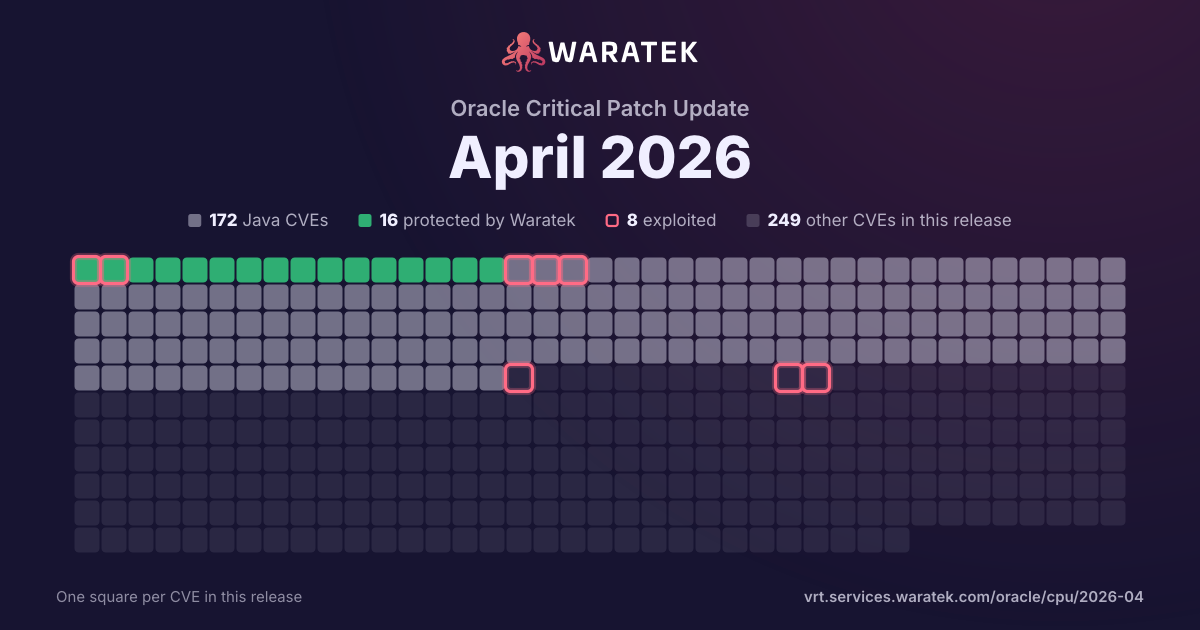
By status
16Protected by Waratek4Mitigation candidate152No exploit published10Outside Waratek scope239Not applicable
8Exploited, marked by the ring
No exploit published. For 51 of them, Oracle's security advisory is the source of public detail.
Protected by Waratek. Waratek RASP can block exploitation of these on systems that have not applied the patch yet.
Overview 421 matches · 172 in Waratek scope · 16 protected · 8 exploited · 1 CISA KEV · 15 public PoC · 11 EPSS ≥ 0.5
421matches
172in Waratek scope40.9%
16protected3.8%
8exploited1.9%
1CISA KEV0.2%
15public PoC3.6%
11EPSS ≥ 0.52.6%
Protected by Waratek
16
3.8%
Rule in development
0
0.0%
Mitigation candidate
4
1.0%
No exploit published
152
36.1%
Outside Waratek scope
10
2.4%
Not applicable
239
56.8%
Withdrawn CVE
0
0.0%
blocked by ARMR today
16
3.8%
partly blocked
0
0.0%
not blocked
405
96.2%
not established
0
0.0%
unrecorded
0
0.0%
split by
peak 130 / quarter
Q4 201
Protected by Waratek1
Medium1
blocked by ARMR today1
No public exploit1
Q1 211
No exploit published1
High1
not blocked1
No public exploit1
Q2 211
No exploit published1
Medium1
not blocked1
No public exploit1
Q3 210
Q4 211
Protected by Waratek1
Critical1
blocked by ARMR today1
Exploited1
Q1 223
Protected by Waratek3
Critical1
High2
blocked by ARMR today3
Proof of concept only1
Forecast only2
Q2 221
No exploit published1
High1
not blocked1
No public exploit1
Q3 222
No exploit published2
High2
not blocked2
No public exploit2
Q4 224
Protected by Waratek1
No exploit published3
Critical1
High3
blocked by ARMR today1
not blocked3
Proof of concept only3
No public exploit1
Q1 232
Protected by Waratek1
No exploit published1
High2
blocked by ARMR today1
not blocked1
Exploited1
Proof of concept only1
Q2 235
No exploit published5
High2
Medium3
not blocked5
Proof of concept only1
No public exploit4
Q3 233
No exploit published3
Critical1
High2
not blocked3
No public exploit3
Q4 234
No exploit published3
Outside Waratek scope1
Critical2
Medium2
not blocked4
Exploited1
Proof of concept only1
No public exploit2
Q1 245
No exploit published4
Not applicable1
Critical1
High1
Medium3
not blocked5
Proof of concept only1
No public exploit4
Q2 248
No exploit published4
Outside Waratek scope1
Not applicable3
Critical2
High4
Medium2
not blocked8
Proof of concept only1
No public exploit7
Q3 245
No exploit published4
Not applicable1
Critical1
High4
not blocked5
Exploited1
No public exploit4
Q4 246
Protected by Waratek1
No exploit published4
Outside Waratek scope1
Critical2
Medium4
blocked by ARMR today1
not blocked5
Proof of concept only2
No public exploit4
Q1 259
Mitigation candidate1
No exploit published3
Not applicable5
High6
Medium3
not blocked9
Exploited1
Proof of concept only5
No public exploit3
Q2 2522
Protected by Waratek2
Mitigation candidate1
No exploit published11
Not applicable8
Critical1
High13
Medium7
Low1
blocked by ARMR today2
not blocked20
Exploited1
Proof of concept only4
No public exploit17
Q3 2549
Protected by Waratek1
Mitigation candidate1
No exploit published14
Outside Waratek scope1
Not applicable32
Critical2
High17
Medium25
Low5
blocked by ARMR today1
not blocked48
Exploited1
Working exploit published3
Proof of concept only9
No public exploit36
Q4 2556
Protected by Waratek1
No exploit published18
Outside Waratek scope1
Not applicable36
Critical5
High23
Medium26
Low2
blocked by ARMR today1
not blocked55
Exploited1
Proof of concept only8
No public exploit47
Q1 26130
Protected by Waratek3
No exploit published16
Outside Waratek scope2
Not applicable109
Critical15
High67
Medium43
Low5
blocked by ARMR today3
not blocked127
Proof of concept only14
No public exploit116
Q2 26103
Protected by Waratek1
Mitigation candidate1
No exploit published54
Outside Waratek scope3
Not applicable44
Critical5
High22
Medium67
Low9
blocked by ARMR today1
not blocked102
Proof of concept only2
No public exploit101
Q4 20Q2 21Q4 21Q2 22Q4 22Q2 23Q4 23Q2 24Q4 24Q2 25Q4 25Q2 26
| CVE | Severity | Published▾ | Status | Exploitation | Description |
|---|---|---|---|---|---|
| CVE-2026-21998 | Medium | 2026-04-21 | Not applicable | No public exploit | Vulnerability in the MySQL Server product of Oracle MySQL (component: Server: Optimizer). Supported versions that are affected are 8.0.0-8.0.45, 8.4.0-8.4.8 and 9.0.0-9.6.0. Easily exploitable vulnerability allows high privileged attacker with network access via multiple protocols to compromise MySQL Server. Successful attacks of this vulnerability can result in unauthorized ability to cause a hang or frequently repeatable crash (complete DOS) of MySQL Server. CVSS 3.1 Base Score 4.9 (Availability impacts). CVSS Vector: (CVSS:3.1/AV:N/AC:L/PR:H/UI:N/S:U/C:N/I:N/A:H). |
| CVE-2026-21997 | High | 2026-04-21 | No exploit published | No public exploit | Vulnerability in the Oracle Life Sciences Empirica Signal product of Oracle Life Science Applications (component: Common Core). Supported versions that are affected are 9.2.1-9.2.3. Easily exploitable vulnerability allows low privileged attacker with network access via HTTP to compromise Oracle Life Sciences Empirica Signal. While the vulnerability is in Oracle Life Sciences Empirica Signal, attacks may significantly impact additional products (scope change). Successful attacks of this vulnerability can result in unauthorized creation, deletion or modification access to critical data or all Oracle Life Sciences Empirica Signal accessible data as well as unauthorized read access to a subset of Oracle Life Sciences Empirica Signal accessible data. CVSS 3.1 Base Score 8.5 (Confidentiality and Integrity impacts). CVSS Vector: (CVSS:3.1/AV:N/AC:L/PR:L/UI:N/S:C/C:L/I:H/A:N). |
| CVE-2026-31790 | High | 2026-04-07 | Not applicable | No public exploit | Issue summary: Applications using RSASVE key encapsulation to establish a secret encryption key can send contents of an uninitialized memory buffer to a malicious peer. Impact summary: The uninitialized buffer might contain sensitive data from the previous execution of the application process which leads to sensitive data leakage to an attacker. RSA_public_encrypt() returns the number of bytes written on success and -1 on error. The affected code tests only whether the return value is non-zero. As a result, if RSA encryption fails, encapsulation can still return success to the caller, set the output lengths, and leave the caller to use the contents of the ciphertext buffer as if a valid KEM ciphertext had been produced. If applications use EVP_PKEY_encapsulate() with RSA/RSASVE on an attacker-supplied invalid RSA public key without first validating that key, then this may cause stale or uninitialized contents of the caller-provided ciphertext buffer to be disclosed to the attacker in place of the KEM ciphertext. As a workaround calling EVP_PKEY_public_check() or EVP_PKEY_public_check_quick() before EVP_PKEY_encapsulate() will mitigate the issue. The FIPS modules in 3.6, 3.5, 3.4, 3.3, 3.1 and 3.0 are affected by this issue. |
| CVE-2026-33870 | High | 2026-03-27 | No exploit published | Proof of concept only | Netty is an asynchronous, event-driven network application framework. In versions prior to 4.1.132.Final and 4.2.10.Final, Netty incorrectly parses quoted strings in HTTP/1.1 chunked transfer encoding extension values, enabling request smuggling attacks. Versions 4.1.132.Final and 4.2.10.Final fix the issue. |
| CVE-2026-33013 | High | 2026-03-20 | No exploit published | Proof of concept only | Micronaut Framework is a JVM-based full stack Java framework designed for building modular, easily testable JVM applications. Versions prior to both 4.10.16 and 3.10.5 do not correctly handle descending array index order during form-urlencoded body binding in theJsonBeanPropertyBinder::expandArrayToThreshold, which allows remote attackers to cause a DoS (non-terminating loop, CPU exhaustion, and OutOfMemoryError) via crafted indexed form parameters (e.g., authors[1].name followed by authors[0].name). This issue has been fixed in versions 4.10.16 and 3.10.5. |
| CVE-2026-30936 | Medium | 2026-03-10 | Not applicable | No public exploit | ImageMagick is free and open-source software used for editing and manipulating digital images. Prior to versions 7.1.2-16 and 6.9.13-41, a crafted image could cause an out of bounds heap write inside the WaveletDenoiseImage method. When processing a crafted image with the -wavelet-denoise operation an out of bounds write can occur. This vulnerability is fixed in 7.1.2-16 and 6.9.13-41. |
| CVE-2026-30935 | Medium | 2026-03-10 | Not applicable | No public exploit | ImageMagick is free and open-source software used for editing and manipulating digital images. Prior to versions 7.1.2-16, BilateralBlurImage contains a heap buffer over-read caused by an incorrect conversion. When processing a crafted image with the -bilateral-blur operation an out of bounds read can occur. This vulnerability is fixed in 7.1.2-16. |
| CVE-2026-30931 | High | 2026-03-10 | Not applicable | No public exploit | ImageMagick is free and open-source software used for editing and manipulating digital images. Prior to versions 7.1.2-16, a heap-based buffer overflow in the UHDR encoder can happen due to truncation of a value and it would allow an out of bounds write. This vulnerability is fixed in 7.1.2-16. |
| CVE-2026-30929 | High | 2026-03-10 | Not applicable | No public exploit | ImageMagick is free and open-source software used for editing and manipulating digital images. Prior to versions 7.1.2-16 and 6.9.13-41, MagnifyImage uses a fixed-size stack buffer. When using a specific image it is possible to overflow this buffer and corrupt the stack. This vulnerability is fixed in 7.1.2-16 and 6.9.13-41. |
| CVE-2026-30883 | High | 2026-03-10 | Not applicable | No public exploit | ImageMagick is free and open-source software used for editing and manipulating digital images. Prior to versions 7.1.2-16 and 6.9.13-41, an extremely large image profile could result in a heap overflow when encoding a PNG image. This vulnerability is fixed in 7.1.2-16 and 6.9.13-41. |
| CVE-2026-28693 | High | 2026-03-10 | Not applicable | No public exploit | ImageMagick is free and open-source software used for editing and manipulating digital images. Prior to versions 7.1.2-16 and 6.9.13-41, an integer overflow in DIB coder can result in out of bounds read or write. This vulnerability is fixed in 7.1.2-16 and 6.9.13-41. |
| CVE-2026-28692 | Medium | 2026-03-10 | Not applicable | No public exploit | ImageMagick is free and open-source software used for editing and manipulating digital images. Prior to versions 7.1.2-16 and 6.9.13-41, MAT decoder uses 32-bit arithmetic due to incorrect parenthesization resulting in a heap over-read. This vulnerability is fixed in 7.1.2-16 and 6.9.13-41. |
| CVE-2026-28691 | High | 2026-03-10 | Not applicable | No public exploit | ImageMagick is free and open-source software used for editing and manipulating digital images. Prior to versions 7.1.2-16 and 6.9.13-41, an uninitialized pointer dereference vulnerability exists in the JBIG decoder due to a missing check. This vulnerability is fixed in 7.1.2-16 and 6.9.13-41. |
| CVE-2026-28690 | Medium | 2026-03-10 | Not applicable | No public exploit | ImageMagick is free and open-source software used for editing and manipulating digital images. Prior to versions 7.1.2-16 and 6.9.13-41, a stack buffer overflow vulnerability exists in the MNG encoder. There is a bounds checks missing that could corrupting the stack with attacker-controlled data. This vulnerability is fixed in 7.1.2-16 and 6.9.13-41. |
| CVE-2026-28689 | Medium | 2026-03-10 | Not applicable | No public exploit | ImageMagick is free and open-source software used for editing and manipulating digital images. Prior to versions 7.1.2-16 and 6.9.13-41, domain="path" authorization is checked before final file open/use. A symlink swap between check-time and use-time bypasses policy-denied read/write. This vulnerability is fixed in 7.1.2-16 and 6.9.13-41. |
| CVE-2026-28688 | Medium | 2026-03-10 | Not applicable | No public exploit | ImageMagick is free and open-source software used for editing and manipulating digital images. Prior to versions 7.1.2-16 and 6.9.13-41, a heap-use-after-free vulnerability exists in the MSL encoder, where a cloned image is destroyed twice. The MSL coder does not support writing MSL so the write capability has been removed. This vulnerability is fixed in 7.1.2-16 and 6.9.13-41. |
| CVE-2026-28687 | Medium | 2026-03-10 | Not applicable | No public exploit | ImageMagick is free and open-source software used for editing and manipulating digital images. Prior to versions 7.1.2-16 and 6.9.13-41, a heap use-after-free vulnerability in ImageMagick's MSL decoder allows an attacker to trigger access to freed memory by crafting an MSL file. This vulnerability is fixed in 7.1.2-16 and 6.9.13-41. |
| CVE-2026-28686 | Medium | 2026-03-10 | Not applicable | No public exploit | ImageMagick is free and open-source software used for editing and manipulating digital images. Prior to versions 7.1.2-16 and 6.9.13-41, A heap-buffer-overflow vulnerability exists in the PCL encode due to an undersized output buffer allocation. This vulnerability is fixed in 7.1.2-16 and 6.9.13-41. |
| CVE-2026-28494 | High | 2026-03-10 | Not applicable | No public exploit | ImageMagick is free and open-source software used for editing and manipulating digital images. Prior to versions 7.1.2-16 and 6.9.13-41, a stack buffer overflow exists in ImageMagick's morphology kernel parsing functions. User-controlled kernel strings exceeding a buffer are copied into fixed-size stack buffers via memcpy without bounds checking, resulting in stack corruption. This vulnerability is fixed in 7.1.2-16 and 6.9.13-41. |
| CVE-2026-28493 | Medium | 2026-03-10 | Not applicable | No public exploit | ImageMagick is free and open-source software used for editing and manipulating digital images. Prior to versions 7.1.2-16, an integer overflow vulnerability exists in the SIXEL decoer. The vulnerability allows an attacker to perform an out of bounds via a specially crafted image. This vulnerability is fixed in 7.1.2-16. |
| CVE-2026-3288 | High | 2026-03-09 | Not applicable | Proof of concept only | A security issue was discovered in ingress-nginx where the `nginx.ingress.kubernetes.io/rewrite-target` Ingress annotation can be used to inject configuration into nginx. This can lead to arbitrary code execution in the context of the ingress-nginx controller, and disclosure of Secrets accessible to the controller. (Note that in the default installation, the controller can access all Secrets cluster-wide.) |
| CVE-2025-11143 | Medium | 2026-03-05 | No exploit published | No public exploit | The Jetty URI parser has some key differences to other common parsers when evaluating invalid or unusual URIs. Differential parsing of URIs in systems using multiple components may result in security by-pass. For example a component that enforces a black list may interpret the URIs differently from one that generates a response. At the very least, differential parsing may divulge implementation details. |
| CVE-2026-23865 | Medium | 2026-03-02 | Not applicable | No public exploit | An integer overflow in the tt_var_load_item_variation_store function of the Freetype library in versions 2.13.2 and 2.13.3 may allow for an out of bounds read operation when parsing HVAR/VVAR/MVAR tables in OpenType variable fonts. This issue is fixed in version 2.14.2. |
| CVE-2026-27830 | High | 2026-02-26 | Protected by Waratek | No public exploit | c3p0, a JDBC Connection pooling library, is vulnerable to attack via maliciously crafted Java-serialized objects and `javax.naming.Reference` instances. Several c3p0 `ConnectionPoolDataSource` implementations have a property called `userOverridesAsString` which conceptually represents a `Map<String,Map<String,String>>`. Prior to v0.12.0, that property was maintained as a hex-encoded serialized object. Any attacker able to reset this property, on an existing `ConnectionPoolDataSource` or via maliciously crafted serialized objects or `javax.naming.Reference` instances could be tailored execute unexpected code on the application's `CLASSPATH`. The danger of this vulnerability was strongly magnified by vulnerabilities in c3p0's main dependency, mchange-commons-java. This library includes code that mirrors early implementations of JNDI functionality, including ungated support for remote `factoryClassLocation` values. Attackers could set c3p0's `userOverridesAsString` hex-encoded serialized objects that include objects "indirectly serialized" via JNDI references. Deserialization of those objects and dereferencing of the embedded `javax.naming.Reference` objects could provoke download and execution of malicious code from a remote `factoryClassLocation`. Although hazard presented by c3p0's vulnerabilites are exarcerbated by vulnerabilities in mchange-commons-java, use of Java-serialized-object hex as the format for a writable Java-Bean property, of objects that may be exposed across JNDI interfaces, represents a serious independent fragility. The `userOverridesAsString` property of c3p0 `ConnectionPoolDataSource` classes has been reimplemented to use a safe CSV-based format, rather than rely upon potentially dangerous Java object deserialization. c3p0-0.12.0+ and above depend upon mchange-commons-java 0.4.0+, which gates support for remote `factoryClassLocation` values by configuration parameters that default to restrictive values. c3p0 additionally enforces the new mchange-commons-java `com.mchange.v2.naming.nameGuardClassName` to prevent injection of unexpected, potentially remote JNDI names. There is no supported workaround for versions of c3p0 prior to 0.12.0. |
| CVE-2026-27799 | Medium | 2026-02-26 | Not applicable | No public exploit | ImageMagick is free and open-source software used for editing and manipulating digital images. Prior to versions 7.1.2-15 and 6.9.13-40, a heap buffer over-read vulnerability exists in the DJVU image format handler. The vulnerability occurs due to integer truncation when calculating the stride (row size) for pixel buffer allocation. The stride calculation overflows a 32-bit signed integer, resulting in an out-of-bounds memory reads. Versions 7.1.2-15 and 6.9.13-40 contain a patch. |
| CVE-2026-27798 | High | 2026-02-26 | Not applicable | No public exploit | ImageMagick is free and open-source software used for editing and manipulating digital images. Prior to versions 7.1.2-15 and 6.9.13-40, a heap buffer over-read vulnerability occurs when processing an image with small dimension using the `-wavelet-denoise` operator. Versions 7.1.2-15 and 6.9.13-40 contain a patch. |
| CVE-2026-27727 | High | 2026-02-25 | Protected by Waratek | Proof of concept only | mchange-commons-java, a library that provides Java utilities, includes code that mirrors early implementations of JNDI functionality, including support for remote `factoryClassLocation` values, by which code can be downloaded and invoked within a running application. If an attacker can provoke an application to read a maliciously crafted `jaxax.naming.Reference` or serialized object, they can provoke the download and execution of malicious code. Implementations of this functionality within the JDK were disabled by default behind a System property that defaults to `false`, `com.sun.jndi.ldap.object.trustURLCodebase`. However, since mchange-commons-java includes an independent implementation of JNDI derefencing, libraries (such as c3p0) that resolve references via that implementation could be provoked to download and execute malicious code even after the JDK was hardened. Mirroring the JDK patch, mchange-commons-java's JNDI functionality is gated by configuration parameters that default to restrictive values starting in version 0.4.0. No known workarounds are available. Versions prior to 0.4.0 should be avoided on application CLASSPATHs. |
| CVE-2026-26983 | Medium | 2026-02-24 | Not applicable | No public exploit | ImageMagick is free and open-source software used for editing and manipulating digital images. Prior to versions 7.1.2-15 and 6.9.13-40, the MSL interpreter crashes when processing a invalid `<map>` element that causes it to use an image after it has been freed. Versions 7.1.2-15 and 6.9.13-40 contain a patch. |
| CVE-2026-26284 | Critical | 2026-02-24 | Not applicable | No public exploit | ImageMagick is free and open-source software used for editing and manipulating digital images. Prior to versions 7.1.2-15 and 6.9.13-40, ImageMagick lacks proper boundary checking when processing Huffman-coded data from PCD (Photo CD) files. The decoder contains an function that has an incorrect initialization that could cause an out of bounds read. Versions 7.1.2-15 and 6.9.13-40 contain a patch. |
| CVE-2026-26283 | High | 2026-02-24 | Not applicable | No public exploit | ImageMagick is free and open-source software used for editing and manipulating digital images. Prior to versions 7.1.2-15 and 6.9.13-40, a `continue` statement in the JPEG extent binary search loop in the jpeg encoder causes an infinite loop when writing persistently fails. An attacker can trigger a 100% CPU consumption and process hang (Denial of Service) with a crafted image. Versions 7.1.2-15 and 6.9.13-40 contain a patch. |
| CVE-2026-26066 | High | 2026-02-24 | Not applicable | No public exploit | ImageMagick is free and open-source software used for editing and manipulating digital images. Prior to versions 7.1.2-15 and 6.9.13-40, a crafted profile contain invalid IPTC data may cause an infinite loop when writing it with `IPTCTEXT`. Versions 7.1.2-15 and 6.9.13-40 contain a patch. |
| CVE-2026-25989 | High | 2026-02-24 | Not applicable | No public exploit | ImageMagick is free and open-source software used for editing and manipulating digital images. Prior to versions 7.1.2-15 and 6.9.13-40, a crafted SVG file can cause a denial of service. An off-by-one boundary check (`>` instead of `>=`) that allows bypass the guard and reach an undefined `(size_t)` cast. Versions 7.1.2-15 and 6.9.13-40 contain a patch. |
| CVE-2026-25988 | High | 2026-02-24 | Not applicable | No public exploit | ImageMagick is free and open-source software used for editing and manipulating digital images. Prior to versions 7.1.2-15 and 6.9.13-40, sometimes msl.c fails to update the stack index, so an image is stored in the wrong slot and never freed on error, causing leaks. Versions 7.1.2-15 and 6.9.13-40 contain a patch. |
| CVE-2026-25987 | Critical | 2026-02-24 | Not applicable | No public exploit | ImageMagick is free and open-source software used for editing and manipulating digital images. Prior to versions 7.1.2-15 and 6.9.13-40, a heap buffer over-read vulnerability exists in the MAP image decoder when processing crafted MAP files, potentially leading to crashes or unintended memory disclosure during image decoding. Versions 7.1.2-15 and 6.9.13-40 contain a patch. |
| CVE-2026-25986 | Critical | 2026-02-24 | Not applicable | No public exploit | ImageMagick is free and open-source software used for editing and manipulating digital images. Prior to versions 7.1.2-15 and 6.9.13-40, a heap buffer overflow write vulnerability exists in ReadYUVImage() (coders/yuv.c) when processing malicious YUV 4:2:2 (NoInterlace) images. The pixel-pair loop writes one pixel beyond the allocated row buffer. Versions 7.1.2-15 and 6.9.13-40 contain a patch. |
| CVE-2026-25985 | High | 2026-02-24 | Not applicable | No public exploit | ImageMagick is free and open-source software used for editing and manipulating digital images. Prior to versions 7.1.2-15 and 6.9.13-40, a crafted SVG file containing an malicious element causes ImageMagick to attempt to allocate ~674 GB of memory, leading to an out-of-memory abort. Versions 7.1.2-15 and 6.9.13-40 contain a patch. |
| CVE-2026-25983 | Critical | 2026-02-24 | Not applicable | No public exploit | ImageMagick is free and open-source software used for editing and manipulating digital images. Prior to versions 7.1.2-15 and 6.9.13-40, a crafted MSL script triggers a heap-use-after-free. The operation element handler replaces and frees the image while the parser continues reading from it, leading to a UAF in ReadBlobString during further parsing. Versions 7.1.2-15 and 6.9.13-40 contain a patch. |
| CVE-2026-25982 | Medium | 2026-02-24 | Not applicable | No public exploit | ImageMagick is free and open-source software used for editing and manipulating digital images. Prior to versions 7.1.2-15 and 6.9.13-40, a heap out-of-bounds read vulnerability exists in the `coders/dcm.c` module. When processing DICOM files with a specific configuration, the decoder loop incorrectly reads bytes per iteration. This causes the function to read past the end of the allocated buffer, potentially leading to a Denial of Service (crash) or Information Disclosure (leaking heap memory into the image). Versions 7.1.2-15 and 6.9.13-40 contain a patch. |
| CVE-2026-25971 | Critical | 2026-02-24 | Not applicable | No public exploit | ImageMagick is free and open-source software used for editing and manipulating digital images. Prior to versions 7.1.2-15 and 6.9.13-40, Magick fails to check for circular references between two MSLs, leading to a stack overflow. Versions 7.1.2-15 and 6.9.13-40 contain a patch. |
| CVE-2026-25970 | High | 2026-02-24 | Not applicable | No public exploit | ImageMagick is free and open-source software used for editing and manipulating digital images. Prior to versions 7.1.2-15 and 6.9.13-40, a signed integer overflow vulnerability in ImageMagick's SIXEL decoder allows an attacker to trigger memory corruption and denial of service when processing a maliciously crafted SIXEL image file. The vulnerability occurs during buffer reallocation operations where pointer arithmetic using signed 32-bit integers overflows. Versions 7.1.2-15 and 6.9.13-40 contain a patch. |
| CVE-2026-25969 | High | 2026-02-24 | Not applicable | No public exploit | ImageMagick is free and open-source software used for editing and manipulating digital images. Prior to version 7.1.2-15, a memory leak exists in `coders/ashlar.c`. The `WriteASHLARImage` allocates a structure. However, when an exception is thrown, the allocated memory is not properly released, resulting in a potential memory leak. Version 7.1.2-15 contains a patch. |
| CVE-2026-25968 | Critical | 2026-02-24 | Not applicable | No public exploit | ImageMagick is free and open-source software used for editing and manipulating digital images. Prior to versions 7.1.2-15 and 6.9.13-40, a stack buffer overflow occurs when processing the an attribute in msl.c. A long value overflows a fixed-size stack buffer, leading to memory corruption. Versions 7.1.2-15 and 6.9.13-40 contain a patch. |
| CVE-2026-25967 | High | 2026-02-24 | Not applicable | No public exploit | ImageMagick is free and open-source software used for editing and manipulating digital images. Prior to version 7.1.2-15, a stack-based buffer overflow exists in the ImageMagick FTXT image reader. A crafted FTXT file can cause out-of-bounds writes on the stack, leading to a crash. Version 7.1.2-15 contains a patch. |
| CVE-2026-25966 | High | 2026-02-24 | Not applicable | No public exploit | ImageMagick is free and open-source software used for editing and manipulating digital images. The shipped "secure" security policy includes a rule intended to prevent reading/writing from standard streams. However, ImageMagick also supports fd:<n> pseudo-filenames (e.g., fd:0, fd:1). Prior to versions 7.1.2-15 and 6.9.13-40, this path form is not blocked by the secure policy templates, and therefore bypasses the protection goal of "no stdin/stdout." Versions 7.1.2-15 and 6.9.13-40 contain a patch by including a change to the more secure policies by default. As a workaround, add the change to one's security policy manually. |
| CVE-2026-25965 | High | 2026-02-24 | Not applicable | No public exploit | ImageMagick is free and open-source software used for editing and manipulating digital images. Prior to versions 7.1.2-15 and 6.9.13-40, ImageMagick’s path security policy is enforced on the raw filename string before the filesystem resolves it. As a result, a policy rule such as /etc/* can be bypassed by a path traversal. The OS resolves the traversal and opens the sensitive file, but the policy matcher only sees the unnormalized path and therefore allows the read. This enables local file disclosure (LFI) even when policy-secure.xml is applied. Actions to prevent reading from files have been taken in versions .7.1.2-15 and 6.9.13-40 But it make sure writing is also not possible the following should be added to one's policy. This will also be included in ImageMagick's more secure policies by default. |
| CVE-2026-25898 | Critical | 2026-02-24 | Not applicable | No public exploit | ImageMagick is free and open-source software used for editing and manipulating digital images. Prior to versions 7.1.2-15 and 6.9.13-40, the UIL and XPM image encoder do not validate the pixel index value returned by `GetPixelIndex()` before using it as an array subscript. In HDRI builds, `Quantum` is a floating-point type, so pixel index values can be negative. An attacker can craft an image with negative pixel index values to trigger a global buffer overflow read during conversion, leading to information disclosure or a process crash. Versions 7.1.2-15 and 6.9.13-40 contain a patch. |
| CVE-2026-25897 | Critical | 2026-02-24 | Not applicable | No public exploit | ImageMagick is free and open-source software used for editing and manipulating digital images. Prior to versions 7.1.2-15 and 6.9.13-40, an Integer Overflow vulnerability exists in the sun decoder. On 32-bit systems/builds, a carefully crafted image can lead to an out of bounds heap write. Versions 7.1.2-15 and 6.9.13-40 contain a patch. |
| CVE-2026-25799 | High | 2026-02-24 | Not applicable | No public exploit | ImageMagick is free and open-source software used for editing and manipulating digital images. Prior to versions 7.1.2-15 and 6.9.13-40, a logic error in YUV sampling factor validation allows an invalid sampling factor to bypass checks and trigger a division-by-zero during image loading, resulting in a reliable denial-of-service. Versions 7.1.2-15 and 6.9.13-40 contain a patch. |
| CVE-2026-25798 | High | 2026-02-24 | Not applicable | No public exploit | ImageMagick is free and open-source software used for editing and manipulating digital images. Prior to versions 7.1.2-15 and 6.9.13-40, a NULL pointer dereference in ClonePixelCacheRepository allows a remote attacker to crash any application linked against ImageMagick by supplying a crafted image file, resulting in denial of service. Versions 7.1.2-15 and 6.9.13-40 contain a patch. |
| CVE-2026-25797 | Medium | 2026-02-24 | Not applicable | No public exploit | ImageMagick is free and open-source software used for editing and manipulating digital images. Prior to versions 7.1.2-15 and 6.9.13-40, the ps coders, responsible for writing PostScript files, fails to sanitize the input before writing it into the PostScript header. An attacker can provide a malicous file and inject arbitrary PostScript code. When the resulting file is processed by a printer or a viewer (like Ghostscript), the injected code is interpreted and executed. The html encoder does not properly escape strings that are written to in the html document. An attacker can provide a malicious file and injection arbitrary html code. Versions 7.1.2-15 and 6.9.13-40 contain a patch. |
| CVE-2026-25796 | High | 2026-02-24 | Not applicable | No public exploit | ImageMagick is free and open-source software used for editing and manipulating digital images. Prior to versions 7.1.2-15 and 6.9.13-40, in `ReadSTEGANOImage()` (`coders/stegano.c`), the `watermark` Image object is not freed on three early-return paths, resulting in a definite memory leak (~13.5KB+ per invocation) that can be exploited for denial of service. Versions 7.1.2-15 and 6.9.13-40 contain a patch. |
| CVE-2026-25795 | High | 2026-02-24 | Not applicable | No public exploit | ImageMagick is free and open-source software used for editing and manipulating digital images. Prior to versions 7.1.2-15 and 6.9.13-40, in `ReadSFWImage()` (`coders/sfw.c`), when temporary file creation fails, `read_info` is destroyed before its `filename` member is accessed, causing a NULL pointer dereference and crash. Versions 7.1.2-15 and 6.9.13-40 contain a patch. |
| CVE-2026-25794 | High | 2026-02-24 | Not applicable | No public exploit | ImageMagick is free and open-source software used for editing and manipulating digital images. `WriteUHDRImage` in `coders/uhdr.c` uses `int` arithmetic to compute the pixel buffer size. Prior to version 7.1.2-15, when image dimensions are large, the multiplication overflows 32-bit `int`, causing an undersized heap allocation followed by an out-of-bounds write. This can crash the process or potentially lead to an out of bounds heap write. Version 7.1.2-15 contains a patch. |
| CVE-2026-25638 | Medium | 2026-02-24 | Not applicable | No public exploit | ImageMagick is free and open-source software used for editing and manipulating digital images. Prior to versions 7.1.2-15 and 6.9.13-40, memory leak exists in `coders/msl.c`. In the `WriteMSLImage` function of the `msl.c` file, resources are allocated. But the function returns early without releasing these allocated resources. Versions 7.1.2-15 and 6.9.13-40 contain a patch. |
| CVE-2026-25637 | Medium | 2026-02-24 | Not applicable | No public exploit | ImageMagick is free and open-source software used for editing and manipulating digital images. Prior to version 7.1.2-15, a memory leak in the ASHLAR image writer allows an attacker to exhaust process memory by providing a crafted image that results in small objects that are allocated but never freed. Version 7.1.2-15 contains a patch. |
| CVE-2026-25576 | Medium | 2026-02-24 | Not applicable | No public exploit | ImageMagick is free and open-source software used for editing and manipulating digital images. Prior to versions 7.1.2-15 and 6.9.13-40, a heap buffer over-read vulnerability exists in multiple raw image format handles. The vulnerability occurs when processing images with -extract dimensions larger than -size dimensions, causing out-of-bounds memory reads from a heap-allocated buffer. Versions 7.1.2-15 and 6.9.13-40 contain a patch. |
| CVE-2026-24485 | High | 2026-02-24 | Not applicable | No public exploit | ImageMagick is free and open-source software used for editing and manipulating digital images. Prior to versions 7.1.2-15 and 6.9.13-40, when a PCD file does not contain a valid Sync marker, the DecodeImage() function becomes trapped in an infinite loop while searching for the Sync marker, causing the program to become unresponsive and continuously consume CPU resources, ultimately leading to system resource exhaustion and denial of service. Versions 7.1.2-15 and 6.9.13-40 contain a patch. |
| CVE-2026-24484 | Medium | 2026-02-24 | Not applicable | No public exploit | ImageMagick is free and open-source software used for editing and manipulating digital images. Prior to versions 7.1.2-15 and 6.9.13-40, Magick fails to check for multi-layer nested mvg conversions to svg, leading to DoS. Versions 7.1.2-15 and 6.9.13-40 contain a patch. |
| CVE-2026-24481 | High | 2026-02-24 | Not applicable | No public exploit | ImageMagick is free and open-source software used for editing and manipulating digital images. Prior to versions 7.1.2-15 and 6.9.13-40, a heap information disclosure vulnerability exists in ImageMagick's PSD (Adobe Photoshop) format handler. When processing a maliciously crafted PSD file containing ZIP-compressed layer data that decompresses to less than the expected size, uninitialized heap memory is leaked into the output image. Versions 7.1.2-15 and 6.9.13-40 contain a patch. |
| CVE-2026-27100 | Medium | 2026-02-18 | No exploit published | No public exploit | Jenkins 2.550 and earlier, LTS 2.541.1 and earlier accepts Run Parameter values that refer to builds the user submitting the build does not have access to, allowing attackers with Item/Build and Item/Configure permission to obtain information about the existence of jobs, the existence of builds, and if a specified build exists, its display name. |
| CVE-2026-27099 | High | 2026-02-18 | No exploit published | No public exploit | Jenkins 2.483 through 2.550 (both inclusive), LTS 2.492.1 through 2.541.1 (both inclusive) does not escape the user-provided description of the "Mark temporarily offline" offline cause, resulting in a stored cross-site scripting (XSS) vulnerability exploitable by attackers with Agent/Configure or Agent/Disconnect permission. |
| CVE-2026-24734 | High | 2026-02-17 | No exploit published | No public exploit | Improper Input Validation vulnerability in Apache Tomcat Native, Apache Tomcat. When using an OCSP responder, Tomcat Native (and Tomcat's FFM port of the Tomcat Native code) did not complete verification or freshness checks on the OCSP response which could allow certificate revocation to be bypassed. This issue affects Apache Tomcat Native: from 1.3.0 through 1.3.4, from 2.0.0 through 2.0.11; Apache Tomcat: from 11.0.0-M1 through 11.0.17, from 10.1.0-M7 through 10.1.51, from 9.0.83 through 9.0.114. The following versions were EOL at the time the CVE was created but are known to be affected: from 1.1.23 through 1.1.34, from 1.2.0 through 1.2.39. Older EOL versions are not affected. Apache Tomcat Native users are recommended to upgrade to versions 1.3.5 or later or 2.0.12 or later, which fix the issue. Apache Tomcat users are recommended to upgrade to versions 11.0.18 or later, 10.1.52 or later or 9.0.115 or later which fix the issue. |
| CVE-2026-24733 | Medium | 2026-02-17 | No exploit published | No public exploit | Improper Input Validation vulnerability in Apache Tomcat. Tomcat did not limit HTTP/0.9 requests to the GET method. If a security constraint was configured to allow HEAD requests to a URI but deny GET requests, the user could bypass that constraint on GET requests by sending a (specification invalid) HEAD request using HTTP/0.9. This issue affects Apache Tomcat: from 11.0.0-M1 through 11.0.14, from 10.1.0-M1 through 10.1.49, from 9.0.0.M1 through 9.0.112. Older, EOL versions are also affected. Users are recommended to upgrade to version 11.0.15 or later, 10.1.50 or later or 9.0.113 or later, which fixes the issue. |
| CVE-2025-66614 | Critical | 2026-02-17 | No exploit published | No public exploit | Improper Input Validation vulnerability. This issue affects Apache Tomcat: from 11.0.0-M1 through 11.0.14, from 10.1.0-M1 through 10.1.49, from 9.0.0-M1 through 9.0.112. The following versions were EOL at the time the CVE was created but are known to be affected: 8.5.0 through 8.5.100. Older EOL versions are not affected. Tomcat did not validate that the host name provided via the SNI extension was the same as the host name provided in the HTTP host header field. If Tomcat was configured with more than one virtual host and the TLS configuration for one of those hosts did not require client certificate authentication but another one did, it was possible for a client to bypass the client certificate authentication by sending different host names in the SNI extension and the HTTP host header field. The vulnerability only applies if client certificate authentication is only enforced at the Connector. It does not apply if client certificate authentication is enforced at the web application. Users are recommended to upgrade to version 11.0.15 or later, 10.1.50 or later or 9.0.113 or later, which fix the issue. |
| CVE-2025-33042 | High | 2026-02-13 | No exploit published | No public exploit | Improper Control of Generation of Code ('Code Injection') vulnerability in Apache Avro Java SDK when generating specific records from untrusted Avro schemas. This issue affects Apache Avro Java SDK: all versions through 1.11.4 and version 1.12.0. Users are recommended to upgrade to version 1.12.1 or 1.11.5, which fix the issue. |
| CVE-2026-25990 | High | 2026-02-11 | Not applicable | No public exploit | Pillow is a Python imaging library. From 10.3.0 to before 12.1.1, an out-of-bounds write may be triggered when loading a specially crafted PSD image. This vulnerability is fixed in 12.1.1. |
| CVE-2026-20676 | Medium | 2026-02-11 | Not applicable | No public exploit | This issue was addressed through improved state management. This issue is fixed in Safari 26.3, iOS 26.3 and iPadOS 26.3, macOS Tahoe 26.3, visionOS 26.3. A website may be able to track users through Safari web extensions. |
| CVE-2026-20652 | High | 2026-02-11 | Outside Waratek scope | No public exploit | The issue was addressed with improved memory handling. This issue is fixed in Safari 26.3, iOS 18.7.5 and iPadOS 18.7.5, iOS 26.3 and iPadOS 26.3, macOS Tahoe 26.3, visionOS 26.3. A remote attacker may be able to cause a denial-of-service. |
| CVE-2026-20644 | High | 2026-02-11 | Not applicable | No public exploit | The issue was addressed with improved memory handling. This issue is fixed in Safari 26.3, iOS 18.7.5 and iPadOS 18.7.5, iOS 26.3 and iPadOS 26.3, macOS Tahoe 26.3, visionOS 26.3. Processing maliciously crafted web content may lead to an unexpected process crash. |
| CVE-2026-20636 | High | 2026-02-11 | Not applicable | No public exploit | The issue was addressed with improved memory handling. This issue is fixed in Safari 26.3, iOS 26.3 and iPadOS 26.3, macOS Tahoe 26.3, visionOS 26.3. Processing maliciously crafted web content may lead to an unexpected process crash. |
| CVE-2026-20635 | High | 2026-02-11 | Not applicable | No public exploit | The issue was addressed with improved memory handling. This issue is fixed in Safari 26.3, iOS 18.7.5 and iPadOS 18.7.5, iOS 26.3 and iPadOS 26.3, macOS Tahoe 26.3, tvOS 26.3, visionOS 26.3, watchOS 26.3. Processing maliciously crafted web content may lead to an unexpected process crash. |
| CVE-2026-20608 | High | 2026-02-11 | Not applicable | No public exploit | This issue was addressed through improved state management. This issue is fixed in Safari 26.3, iOS 18.7.5 and iPadOS 18.7.5, iOS 26.3 and iPadOS 26.3, macOS Tahoe 26.3, visionOS 26.3. Processing maliciously crafted web content may lead to an unexpected process crash. |
| CVE-2026-26007 | High | 2026-02-10 | Not applicable | No public exploit | cryptography is a package designed to expose cryptographic primitives and recipes to Python developers. Prior to 46.0.5, the public_key_from_numbers (or EllipticCurvePublicNumbers.public_key()), EllipticCurvePublicNumbers.public_key(), load_der_public_key() and load_pem_public_key() functions do not verify that the point belongs to the expected prime-order subgroup of the curve. This missing validation allows an attacker to provide a public key point P from a small-order subgroup. This can lead to security issues in various situations, such as the most commonly used signature verification (ECDSA) and shared key negotiation (ECDH). When the victim computes the shared secret as S = [victim_private_key]P via ECDH, this leaks information about victim_private_key mod (small_subgroup_order). For curves with cofactor > 1, this reveals the least significant bits of the private key. When these weak public keys are used in ECDSA , it's easy to forge signatures on the small subgroup. Only SECT curves are impacted by this. This vulnerability is fixed in 46.0.5. |
| CVE-2026-25646 | High | 2026-02-10 | Not applicable | Proof of concept only | LIBPNG is a reference library for use in applications that read, create, and manipulate PNG (Portable Network Graphics) raster image files. Prior to 1.6.55, an out-of-bounds read vulnerability exists in the png_set_quantize() API function. When the function is called with no histogram and the number of colors in the palette is more than twice the maximum supported by the user's display, certain palettes will cause the function to enter into an infinite loop that reads past the end of an internal heap-allocated buffer. The images that trigger this vulnerability are valid per the PNG specification. This vulnerability is fixed in 1.6.55. |
| CVE-2026-23901 | Low | 2026-02-10 | No exploit published | No public exploit | Observable Timing Discrepancy vulnerability in Apache Shiro. This issue affects Apache Shiro: from 1.*, 2.* before 2.0.7. Users are recommended to upgrade to version 2.0.7 or later, which fixes the issue. Prior to Shiro 2.0.7, code paths for non-existent vs. existing users are different enough, that a brute-force attack may be able to tell, by timing the requests only, determine if the request failed because of a non-existent user vs. wrong password. The most likely attack vector is a local attack only. Shiro security model https://shiro.apache.org/security-model.html#username_enumeration discusses this as well. Typically, brute force attack can be mitigated at the infrastructure level. |
| CVE-2026-23903 | Medium | 2026-02-09 | No exploit published | No public exploit | Authentication Bypass by Alternate Name vulnerability in Apache Shiro. This issue affects Apache Shiro: before 2.0.7. Users are recommended to upgrade to version 2.0.7, which fixes the issue. The issue only effects static files. If static files are served from a case-insensitive filesystem, such as default macOS setup, static files may be accessed by varying the case of the filename in the request. If only lower-case (common default) filters are present in Shiro, they may be bypassed this way. Shiro 2.1.0 and later has a new parameters to remediate this issue shiro.ini: filterChainResolver.caseInsensitive = true application.properties: shiro.caseInsensitive=true Shiro 3.0.0 and later makes this the default in shiro.ini-based configurations. Shiro 3.0.1 and later makes this the default in all configurations, including programmatic and Spring / Spring Boot. |
| CVE-2025-68121 | Critical | 2026-02-05 | Not applicable | No public exploit | During session resumption in crypto/tls, if the underlying Config has its ClientCAs or RootCAs fields mutated between the initial handshake and the resumed handshake, the resumed handshake may succeed when it should have failed. This may happen when a user calls Config.Clone and mutates the returned Config, or uses Config.GetConfigForClient. This can cause a client to resume a session with a server that it would not have resumed with during the initial handshake, or cause a server to resume a session with a client that it would not have resumed with during the initial handshake. |
| CVE-2025-61732 | High | 2026-02-05 | Not applicable | No public exploit | A discrepancy between how Go and C/C++ comments were parsed allowed for code smuggling into the resulting cgo binary. |
| CVE-2026-1642 | High | 2026-02-04 | Not applicable | No public exploit | A vulnerability exists in NGINX OSS and NGINX Plus when configured to proxy to upstream Transport Layer Security (TLS) servers. An attacker with a man-in-the-middle (MITM) position on the upstream server side—along with conditions beyond the attacker's control—may be able to inject plain text data into the response from an upstream proxied server. Note: Software versions which have reached End of Technical Support (EoTS) are not evaluated. |
| CVE-2026-24512 | High | 2026-02-03 | Not applicable | No public exploit | A security issue was discovered in ingress-nginx where the `rules.http.paths.path` Ingress field can be used to inject configuration into nginx. This can lead to arbitrary code execution in the context of the ingress-nginx controller, and disclosure of Secrets accessible to the controller. (Note that in the default installation, the controller can access all Secrets cluster-wide.) |
| CVE-2026-25210 | High | 2026-01-30 | Not applicable | No public exploit | In libexpat before 2.7.4, the doContent function does not properly determine the buffer size bufSize because there is no integer overflow check for tag buffer reallocation. |
| CVE-2024-4027 | High | 2026-01-30 | No exploit published | No public exploit | A flaw was found in Undertow. Servlets using a method that calls HttpServletRequestImpl.getParameterNames() can cause an OutOfMemoryError when the client sends a request with large parameter names. This issue can be exploited by an unauthorized user to cause a remote denial-of-service (DoS) attack. |
| CVE-2026-22796 | Medium | 2026-01-27 | Not applicable | No public exploit | Issue summary: A type confusion vulnerability exists in the signature verification of signed PKCS#7 data where an ASN1_TYPE union member is accessed without first validating the type, causing an invalid or NULL pointer dereference when processing malformed PKCS#7 data. Impact summary: An application performing signature verification of PKCS#7 data or calling directly the PKCS7_digest_from_attributes() function can be caused to dereference an invalid or NULL pointer when reading, resulting in a Denial of Service. The function PKCS7_digest_from_attributes() accesses the message digest attribute value without validating its type. When the type is not V_ASN1_OCTET_STRING, this results in accessing invalid memory through the ASN1_TYPE union, causing a crash. Exploiting this vulnerability requires an attacker to provide a malformed signed PKCS#7 to an application that verifies it. The impact of the exploit is just a Denial of Service, the PKCS7 API is legacy and applications should be using the CMS API instead. For these reasons the issue was assessed as Low severity. The FIPS modules in 3.5, 3.4, 3.3 and 3.0 are not affected by this issue, as the PKCS#7 parsing implementation is outside the OpenSSL FIPS module boundary. OpenSSL 3.6, 3.5, 3.4, 3.3, 3.0, 1.1.1 and 1.0.2 are vulnerable to this issue. |
| CVE-2026-22795 | Medium | 2026-01-27 | Not applicable | No public exploit | Issue summary: An invalid or NULL pointer dereference can happen in an application processing a malformed PKCS#12 file. Impact summary: An application processing a malformed PKCS#12 file can be caused to dereference an invalid or NULL pointer on memory read, resulting in a Denial of Service. A type confusion vulnerability exists in PKCS#12 parsing code where an ASN1_TYPE union member is accessed without first validating the type, causing an invalid pointer read. The location is constrained to a 1-byte address space, meaning any attempted pointer manipulation can only target addresses between 0x00 and 0xFF. This range corresponds to the zero page, which is unmapped on most modern operating systems and will reliably result in a crash, leading only to a Denial of Service. Exploiting this issue also requires a user or application to process a maliciously crafted PKCS#12 file. It is uncommon to accept untrusted PKCS#12 files in applications as they are usually used to store private keys which are trusted by definition. For these reasons, the issue was assessed as Low severity. The FIPS modules in 3.5, 3.4, 3.3 and 3.0 are not affected by this issue, as the PKCS12 implementation is outside the OpenSSL FIPS module boundary. OpenSSL 3.6, 3.5, 3.4, 3.3, 3.0 and 1.1.1 are vulnerable to this issue. OpenSSL 1.0.2 is not affected by this issue. |
| CVE-2025-69421 | High | 2026-01-27 | Not applicable | No public exploit | Issue summary: Processing a malformed PKCS#12 file can trigger a NULL pointer dereference in the PKCS12_item_decrypt_d2i_ex() function. Impact summary: A NULL pointer dereference can trigger a crash which leads to Denial of Service for an application processing PKCS#12 files. The PKCS12_item_decrypt_d2i_ex() function does not check whether the oct parameter is NULL before dereferencing it. When called from PKCS12_unpack_p7encdata() with a malformed PKCS#12 file, this parameter can be NULL, causing a crash. The vulnerability is limited to Denial of Service and cannot be escalated to achieve code execution or memory disclosure. Exploiting this issue requires an attacker to provide a malformed PKCS#12 file to an application that processes it. For that reason the issue was assessed as Low severity according to our Security Policy. The FIPS modules in 3.6, 3.5, 3.4, 3.3 and 3.0 are not affected by this issue, as the PKCS#12 implementation is outside the OpenSSL FIPS module boundary. OpenSSL 3.6, 3.5, 3.4, 3.3, 3.0, 1.1.1 and 1.0.2 are vulnerable to this issue. |
| CVE-2025-69420 | High | 2026-01-27 | Not applicable | No public exploit | Issue summary: A type confusion vulnerability exists in the TimeStamp Response verification code where an ASN1_TYPE union member is accessed without first validating the type, causing an invalid or NULL pointer dereference when processing a malformed TimeStamp Response file. Impact summary: An application calling TS_RESP_verify_response() with a malformed TimeStamp Response can be caused to dereference an invalid or NULL pointer when reading, resulting in a Denial of Service. The functions ossl_ess_get_signing_cert() and ossl_ess_get_signing_cert_v2() access the signing cert attribute value without validating its type. When the type is not V_ASN1_SEQUENCE, this results in accessing invalid memory through the ASN1_TYPE union, causing a crash. Exploiting this vulnerability requires an attacker to provide a malformed TimeStamp Response to an application that verifies timestamp responses. The TimeStamp protocol (RFC 3161) is not widely used and the impact of the exploit is just a Denial of Service. For these reasons the issue was assessed as Low severity. The FIPS modules in 3.5, 3.4, 3.3 and 3.0 are not affected by this issue, as the TimeStamp Response implementation is outside the OpenSSL FIPS module boundary. OpenSSL 3.6, 3.5, 3.4, 3.3, 3.0 and 1.1.1 are vulnerable to this issue. OpenSSL 1.0.2 is not affected by this issue. |
| CVE-2025-69419 | High | 2026-01-27 | Not applicable | No public exploit | Issue summary: Calling PKCS12_get_friendlyname() function on a maliciously crafted PKCS#12 file with a BMPString (UTF-16BE) friendly name containing non-ASCII BMP code point can trigger a one byte write before the allocated buffer. Impact summary: The out-of-bounds write can cause a memory corruption which can have various consequences including a Denial of Service. The OPENSSL_uni2utf8() function performs a two-pass conversion of a PKCS#12 BMPString (UTF-16BE) to UTF-8. In the second pass, when emitting UTF-8 bytes, the helper function bmp_to_utf8() incorrectly forwards the remaining UTF-16 source byte count as the destination buffer capacity to UTF8_putc(). For BMP code points above U+07FF, UTF-8 requires three bytes, but the forwarded capacity can be just two bytes. UTF8_putc() then returns -1, and this negative value is added to the output length without validation, causing the length to become negative. The subsequent trailing NUL byte is then written at a negative offset, causing write outside of heap allocated buffer. The vulnerability is reachable via the public PKCS12_get_friendlyname() API when parsing attacker-controlled PKCS#12 files. While PKCS12_parse() uses a different code path that avoids this issue, PKCS12_get_friendlyname() directly invokes the vulnerable function. Exploitation requires an attacker to provide a malicious PKCS#12 file to be parsed by the application and the attacker can just trigger a one zero byte write before the allocated buffer. For that reason the issue was assessed as Low severity according to our Security Policy. The FIPS modules in 3.6, 3.5, 3.4, 3.3 and 3.0 are not affected by this issue, as the PKCS#12 implementation is outside the OpenSSL FIPS module boundary. OpenSSL 3.6, 3.5, 3.4, 3.3, 3.0 and 1.1.1 are vulnerable to this issue. OpenSSL 1.0.2 is not affected by this issue. |
| CVE-2025-69418 | Medium | 2026-01-27 | Not applicable | No public exploit | Issue summary: When using the low-level OCB API directly with AES-NI or<br>other hardware-accelerated code paths, inputs whose length is not a multiple<br>of 16 bytes can leave the final partial block unencrypted and unauthenticated.<br><br>Impact summary: The trailing 1-15 bytes of a message may be exposed in<br>cleartext on encryption and are not covered by the authentication tag,<br>allowing an attacker to read or tamper with those bytes without detection.<br><br>The low-level OCB encrypt and decrypt routines in the hardware-accelerated<br>stream path process full 16-byte blocks but do not advance the input/output<br>pointers. The subsequent tail-handling code then operates on the original<br>base pointers, effectively reprocessing the beginning of the buffer while<br>leaving the actual trailing bytes unprocessed. The authentication checksum<br>also excludes the true tail bytes.<br><br>However, typical OpenSSL consumers using EVP are not affected because the<br>higher-level EVP and provider OCB implementations split inputs so that full<br>blocks and trailing partial blocks are processed in separate calls, avoiding<br>the problematic code path. Additionally, TLS does not use OCB ciphersuites.<br>The vulnerability only affects applications that call the low-level<br>CRYPTO_ocb128_encrypt() or CRYPTO_ocb128_decrypt() functions directly with<br>non-block-aligned lengths in a single call on hardware-accelerated builds.<br>For these reasons the issue was assessed as Low severity.<br><br>The FIPS modules in 3.6, 3.5, 3.4, 3.3, 3.2, 3.1 and 3.0 are not affected<br>by this issue, as OCB mode is not a FIPS-approved algorithm.<br><br>OpenSSL 3.6, 3.5, 3.4, 3.3, 3.0 and 1.1.1 are vulnerable to this issue.<br><br>OpenSSL 1.0.2 is not affected by this issue. |
| CVE-2025-68160 | Medium | 2026-01-27 | Not applicable | No public exploit | Issue summary: Writing large, newline-free data into a BIO chain using the line-buffering filter where the next BIO performs short writes can trigger a heap-based out-of-bounds write. Impact summary: This out-of-bounds write can cause memory corruption which typically results in a crash, leading to Denial of Service for an application. The line-buffering BIO filter (BIO_f_linebuffer) is not used by default in TLS/SSL data paths. In OpenSSL command-line applications, it is typically only pushed onto stdout/stderr on VMS systems. Third-party applications that explicitly use this filter with a BIO chain that can short-write and that write large, newline-free data influenced by an attacker would be affected. However, the circumstances where this could happen are unlikely to be under attacker control, and BIO_f_linebuffer is unlikely to be handling non-curated data controlled by an attacker. For that reason the issue was assessed as Low severity. The FIPS modules in 3.6, 3.5, 3.4, 3.3 and 3.0 are not affected by this issue, as the BIO implementation is outside the OpenSSL FIPS module boundary. OpenSSL 3.6, 3.5, 3.4, 3.3, 3.0, 1.1.1 and 1.0.2 are vulnerable to this issue. |
| CVE-2025-66199 | Medium | 2026-01-27 | Not applicable | No public exploit | Issue summary: A TLS 1.3 connection using certificate compression can be forced to allocate a large buffer before decompression without checking against the configured certificate size limit. Impact summary: An attacker can cause per-connection memory allocations of up to approximately 22 MiB and extra CPU work, potentially leading to service degradation or resource exhaustion (Denial of Service). In affected configurations, the peer-supplied uncompressed certificate length from a CompressedCertificate message is used to grow a heap buffer prior to decompression. This length is not bounded by the max_cert_list setting, which otherwise constrains certificate message sizes. An attacker can exploit this to cause large per-connection allocations followed by handshake failure. No memory corruption or information disclosure occurs. This issue only affects builds where TLS 1.3 certificate compression is compiled in (i.e., not OPENSSL_NO_COMP_ALG) and at least one compression algorithm (brotli, zlib, or zstd) is available, and where the compression extension is negotiated. Both clients receiving a server CompressedCertificate and servers in mutual TLS scenarios receiving a client CompressedCertificate are affected. Servers that do not request client certificates are not vulnerable to client-initiated attacks. Users can mitigate this issue by setting SSL_OP_NO_RX_CERTIFICATE_COMPRESSION to disable receiving compressed certificates. The FIPS modules in 3.6, 3.5, 3.4 and 3.3 are not affected by this issue, as the TLS implementation is outside the OpenSSL FIPS module boundary. OpenSSL 3.6, 3.5, 3.4 and 3.3 are vulnerable to this issue. OpenSSL 3.0, 1.1.1 and 1.0.2 are not affected by this issue. |
| CVE-2025-15469 | Medium | 2026-01-27 | Not applicable | No public exploit | Issue summary: The 'openssl dgst' command-line tool silently truncates input data to 16MB when using one-shot signing algorithms and reports success instead of an error. Impact summary: A user signing or verifying files larger than 16MB with one-shot algorithms (such as Ed25519, Ed448, or ML-DSA) may believe the entire file is authenticated while trailing data beyond 16MB remains unauthenticated. When the 'openssl dgst' command is used with algorithms that only support one-shot signing (Ed25519, Ed448, ML-DSA-44, ML-DSA-65, ML-DSA-87), the input is buffered with a 16MB limit. If the input exceeds this limit, the tool silently truncates to the first 16MB and continues without signaling an error, contrary to what the documentation states. This creates an integrity gap where trailing bytes can be modified without detection if both signing and verification are performed using the same affected codepath. The issue affects only the command-line tool behavior. Verifiers that process the full message using library APIs will reject the signature, so the risk primarily affects workflows that both sign and verify with the affected 'openssl dgst' command. Streaming digest algorithms for 'openssl dgst' and library users are unaffected. The FIPS modules in 3.5 and 3.6 are not affected by this issue, as the command-line tools are outside the OpenSSL FIPS module boundary. OpenSSL 3.5 and 3.6 are vulnerable to this issue. OpenSSL 3.4, 3.3, 3.0, 1.1.1 and 1.0.2 are not affected by this issue. |
| CVE-2025-15468 | Medium | 2026-01-27 | Not applicable | No public exploit | Issue summary: If an application using the SSL_CIPHER_find() function in a QUIC protocol client or server receives an unknown cipher suite from the peer, a NULL dereference occurs. Impact summary: A NULL pointer dereference leads to abnormal termination of the running process causing Denial of Service. Some applications call SSL_CIPHER_find() from the client_hello_cb callback on the cipher ID received from the peer. If this is done with an SSL object implementing the QUIC protocol, NULL pointer dereference will happen if the examined cipher ID is unknown or unsupported. As it is not very common to call this function in applications using the QUIC protocol and the worst outcome is Denial of Service, the issue was assessed as Low severity. The vulnerable code was introduced in the 3.2 version with the addition of the QUIC protocol support. The FIPS modules in 3.6, 3.5, 3.4 and 3.3 are not affected by this issue, as the QUIC implementation is outside the OpenSSL FIPS module boundary. OpenSSL 3.6, 3.5, 3.4 and 3.3 are vulnerable to this issue. OpenSSL 3.0, 1.1.1 and 1.0.2 are not affected by this issue. |
| CVE-2025-15467 | Critical | 2026-01-27 | Not applicable | Proof of concept only | Issue summary: Parsing CMS AuthEnvelopedData or EnvelopedData message with maliciously crafted AEAD parameters can trigger a stack buffer overflow. Impact summary: A stack buffer overflow may lead to a crash, causing Denial of Service, or potentially remote code execution. When parsing CMS (Auth)EnvelopedData structures that use AEAD ciphers such as AES-GCM, the IV (Initialization Vector) encoded in the ASN.1 parameters is copied into a fixed-size stack buffer without verifying that its length fits the destination. An attacker can supply a crafted CMS message with an oversized IV, causing a stack-based out-of-bounds write before any authentication or tag verification occurs. Applications and services that parse untrusted CMS or PKCS#7 content using AEAD ciphers (e.g., S/MIME (Auth)EnvelopedData with AES-GCM) are vulnerable. Because the overflow occurs prior to authentication, no valid key material is required to trigger it. While exploitability to remote code execution depends on platform and toolchain mitigations, the stack-based write primitive represents a severe risk. The FIPS modules in 3.6, 3.5, 3.4, 3.3 and 3.0 are not affected by this issue, as the CMS implementation is outside the OpenSSL FIPS module boundary. OpenSSL 3.6, 3.5, 3.4, 3.3 and 3.0 are vulnerable to this issue. OpenSSL 1.1.1 and 1.0.2 are not affected by this issue. |
| CVE-2025-11187 | Medium | 2026-01-27 | Not applicable | Proof of concept only | Issue summary: PBMAC1 parameters in PKCS#12 files are missing validation which can trigger a stack-based buffer overflow, invalid pointer or NULL pointer dereference during MAC verification. Impact summary: The stack buffer overflow or NULL pointer dereference may cause a crash leading to Denial of Service for an application that parses untrusted PKCS#12 files. The buffer overflow may also potentially enable code execution depending on platform mitigations. When verifying a PKCS#12 file that uses PBMAC1 for the MAC, the PBKDF2 salt and keylength parameters from the file are used without validation. If the value of keylength exceeds the size of the fixed stack buffer used for the derived key (64 bytes), the key derivation will overflow the buffer. The overflow length is attacker-controlled. Also, if the salt parameter is not an OCTET STRING type this can lead to invalid or NULL pointer dereference. Exploiting this issue requires a user or application to process a maliciously crafted PKCS#12 file. It is uncommon to accept untrusted PKCS#12 files in applications as they are usually used to store private keys which are trusted by definition. For this reason the issue was assessed as Moderate severity. The FIPS modules in 3.6, 3.5 and 3.4 are not affected by this issue, as PKCS#12 processing is outside the OpenSSL FIPS module boundary. OpenSSL 3.6, 3.5 and 3.4 are vulnerable to this issue. OpenSSL 3.3, 3.0, 1.1.1 and 1.0.2 are not affected by this issue as they do not support PBMAC1 in PKCS#12. |
| CVE-2025-27821 | High | 2026-01-26 | Not applicable | No public exploit | Out-of-bounds Write vulnerability in Apache Hadoop HDFS native client. This issue affects Apache Hadoop: from 3.2.0 before 3.4.2. Users are recommended to upgrade to version 3.4.2, which fixes the issue. |
| CVE-2026-24515 | Low | 2026-01-23 | Not applicable | No public exploit | In libexpat before 2.7.4, XML_ExternalEntityParserCreate does not copy unknown encoding handler user data. |
| CVE-2026-22444 | High | 2026-01-21 | No exploit published | No public exploit | The "create core" API of Apache Solr 8.6 through 9.10.0 lacks sufficient input validation on some API parameters, which can cause Solr to check the existence of and attempt to read file-system paths that should be disallowed by Solr's "allowPaths" security setting https://https://solr.apache.org/guide/solr/latest/configuration-guide/configuring-solr-xml.html#the-solr-element . These read-only accesses can allow users to create cores using unexpected configsets if any are accessible via the filesystem. On Windows systems configured to allow UNC paths this can additionally cause disclosure of NTLM "user" hashes. Solr deployments are subject to this vulnerability if they meet the following criteria: * Solr is running in its "standalone" mode. * Solr's "allowPath" setting is being used to restrict file access to certain directories. * Solr's "create core" API is exposed and accessible to untrusted users. This can happen if Solr's RuleBasedAuthorizationPlugin https://solr.apache.org/guide/solr/latest/deployment-guide/rule-based-authorization-plugin.html is disabled, or if it is enabled but the "core-admin-edit" predefined permission (or an equivalent custom permission) is given to low-trust (i.e. non-admin) user roles. Users can mitigate this by enabling Solr's RuleBasedAuthorizationPlugin (if disabled) and configuring a permission-list that prevents untrusted users from creating new Solr cores. Users should also upgrade to Apache Solr 9.10.1 or greater, which contain fixes for this issue. |
| CVE-2026-22022 | High | 2026-01-21 | No exploit published | No public exploit | Deployments of Apache Solr 5.3.0 through 9.10.0 that rely on Solr's "Rule Based Authorization Plugin" are vulnerable to allowing unauthorized access to certain Solr APIs, due to insufficiently strict input validation in those components. Only deployments that meet all of the following criteria are impacted by this vulnerability: * Use of Solr's "RuleBasedAuthorizationPlugin" * A RuleBasedAuthorizationPlugin config (see security.json) that specifies multiple "roles" * A RuleBasedAuthorizationPlugin permission list (see security.json) that uses one or more of the following pre-defined permission rules: "config-read", "config-edit", "schema-read", "metrics-read", or "security-read". * A RuleBasedAuthorizationPlugin permission list that doesn't define the "all" pre-defined permission * A networking setup that allows clients to make unfiltered network requests to Solr. (i.e. user-submitted HTTP/HTTPS requests reach Solr as-is, unmodified or restricted by any intervening proxy or gateway) Users can mitigate this vulnerability by ensuring that their RuleBasedAuthorizationPlugin configuration specifies the "all" pre-defined permission and associates the permission with an "admin" or other privileged role. Users can also upgrade to a Solr version outside of the impacted range, such as the recently released Solr 9.10.1. |
| CVE-2026-21969 | Critical | 2026-01-20 | No exploit published | No public exploit | Vulnerability in the Oracle Agile Product Lifecycle Management for Process product of Oracle Supply Chain (component: Supplier Portal). The supported version that is affected is 6.2.4. Easily exploitable vulnerability allows unauthenticated attacker with network access via HTTP to compromise Oracle Agile Product Lifecycle Management for Process. Successful attacks of this vulnerability can result in takeover of Oracle Agile Product Lifecycle Management for Process. CVSS 3.1 Base Score 9.8 (Confidentiality, Integrity and Availability impacts). CVSS Vector: (CVSS:3.1/AV:N/AC:L/PR:N/UI:N/S:U/C:H/I:H/A:H). |
| CVE-2026-21945 | High | 2026-01-20 | Outside Waratek scope | No public exploit | Vulnerability in the Oracle Java SE, Oracle GraalVM for JDK, Oracle GraalVM Enterprise Edition product of Oracle Java SE (component: Security). Supported versions that are affected are Oracle Java SE: 8u471, 8u471-b50, 8u471-perf, 11.0.29, 17.0.17, 21.0.9, 25.0.1; Oracle GraalVM for JDK: 17.0.17 and 21.0.9; Oracle GraalVM Enterprise Edition: 21.3.16. Easily exploitable vulnerability allows unauthenticated attacker with network access via multiple protocols to compromise Oracle Java SE, Oracle GraalVM for JDK, Oracle GraalVM Enterprise Edition. Successful attacks of this vulnerability can result in unauthorized ability to cause a hang or frequently repeatable crash (complete DOS) of Oracle Java SE, Oracle GraalVM for JDK, Oracle GraalVM Enterprise Edition. Note: This vulnerability applies to Java deployments, typically in clients running sandboxed Java Web Start applications or sandboxed Java applets, that load and run untrusted code (e.g., code that comes from the internet) and rely on the Java sandbox for security. This vulnerability does not apply to Java deployments, typically in servers, that load and run only trusted code (e.g., code installed by an administrator). CVSS 3.1 Base Score 7.5 (Availability impacts). CVSS Vector: (CVSS:3.1/AV:N/AC:L/PR:N/UI:N/S:U/C:N/I:N/A:H). |