
Oracle Critical Patch Update April 2026
Released April 2026 · Oracle's advisory ↗ · ← Critical Patch Update, January 2026 · Security Patch Update, May 2026 →
421 CVEs in this release, one square each
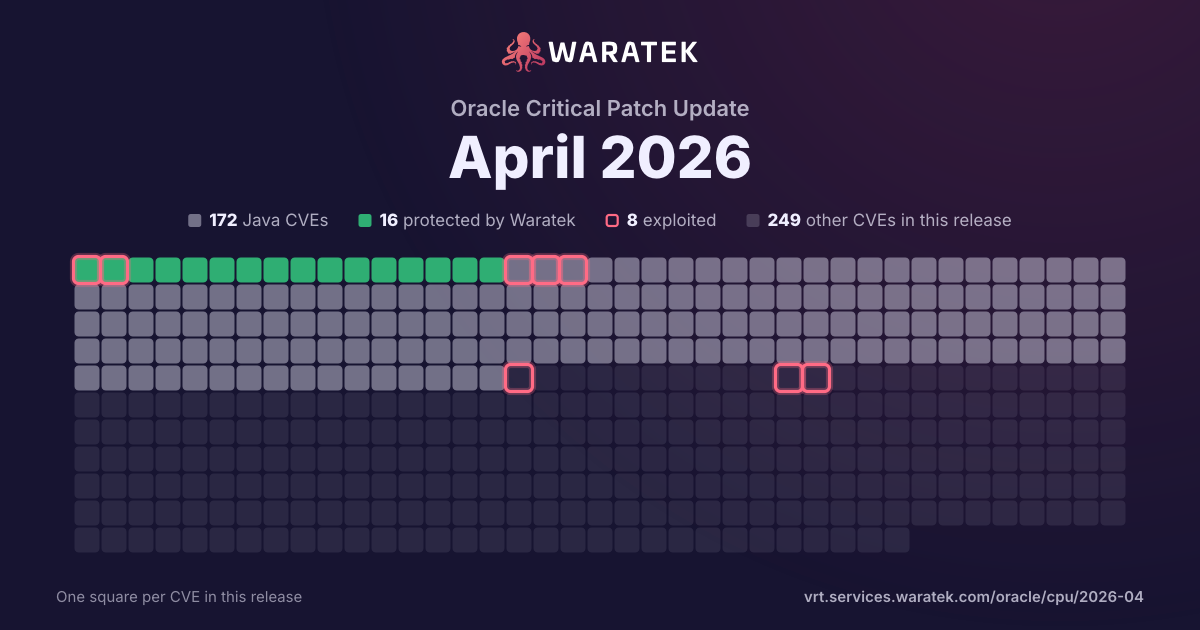
By status
16Protected by Waratek4Mitigation candidate152No exploit published10Outside Waratek scope239Not applicable
8Exploited, marked by the ring
No exploit published. For 51 of them, Oracle's security advisory is the source of public detail.
Protected by Waratek. Waratek RASP can block exploitation of these on systems that have not applied the patch yet.
Overview 20 matches · 0 protected · 0 exploited · 0 CISA KEV · 0 public PoC · 0 EPSS ≥ 0.5
20matches
0protected0.0%
0exploited0.0%
0CISA KEV0.0%
0public PoC0.0%
0EPSS ≥ 0.50.0%
Protected by Waratek
0
0.0%
Rule in development
0
0.0%
Mitigation candidate
0
0.0%
No exploit published
20
100.0%
blocked by ARMR today
0
0.0%
partly blocked
0
0.0%
not blocked
20
100.0%
not established
0
0.0%
unrecorded
0
0.0%
Exploited
0
0.0%
Working exploit published
0
0.0%
Proof of concept only
20
100.0%
Forecast only
0
0.0%
No public exploit
0
0.0%
split by
peak 3 / quarter
Q4 222
No exploit published2
High2
not blocked2
Proof of concept only2
Q1 231
No exploit published1
High1
not blocked1
Proof of concept only1
Q2 231
No exploit published1
High1
not blocked1
Proof of concept only1
Q3 230
Q4 231
No exploit published1
Medium1
not blocked1
Proof of concept only1
Q1 241
No exploit published1
Medium1
not blocked1
Proof of concept only1
Q2 240
Q3 240
Q4 241
No exploit published1
Medium1
not blocked1
Proof of concept only1
Q1 252
No exploit published2
High1
Medium1
not blocked2
Proof of concept only2
Q2 252
No exploit published2
High1
Medium1
not blocked2
Proof of concept only2
Q3 252
No exploit published2
Medium2
not blocked2
Proof of concept only2
Q4 253
No exploit published3
High1
Medium2
not blocked3
Proof of concept only3
Q1 263
No exploit published3
Critical1
High2
not blocked3
Proof of concept only3
Q2 261
No exploit published1
High1
not blocked1
Proof of concept only1
Q4 22Q2 23Q4 23Q2 24Q4 24Q2 25Q4 25Q2 26
| CVE | Severity | Published▾ | Status | Exploitation | Description |
|---|---|---|---|---|---|
| CVE-2026-34305 | High | 2026-04-21 | No exploit published | Proof of concept only | Vulnerability in the Oracle WebLogic Server product of Oracle Fusion Middleware (component: Web Services). Supported versions that are affected are 12.2.1.4.0, 14.1.1.0.0, 14.1.2.0.0 and 15.1.1.0.0. Easily exploitable vulnerability allows unauthenticated attacker with network access via HTTP to compromise Oracle WebLogic Server. Successful attacks of this vulnerability can result in unauthorized access to critical data or complete access to all Oracle WebLogic Server accessible data. CVSS 3.1 Base Score 7.5 (Confidentiality impacts). CVSS Vector: (CVSS:3.1/AV:N/AC:L/PR:N/UI:N/S:U/C:H/I:N/A:N). |
| CVE-2026-33870 | High | 2026-03-27 | No exploit published | Proof of concept only | Netty is an asynchronous, event-driven network application framework. In versions prior to 4.1.132.Final and 4.2.10.Final, Netty incorrectly parses quoted strings in HTTP/1.1 chunked transfer encoding extension values, enabling request smuggling attacks. Versions 4.1.132.Final and 4.2.10.Final fix the issue. |
| CVE-2026-33013 | High | 2026-03-20 | No exploit published | Proof of concept only | Micronaut Framework is a JVM-based full stack Java framework designed for building modular, easily testable JVM applications. Versions prior to both 4.10.16 and 3.10.5 do not correctly handle descending array index order during form-urlencoded body binding in theJsonBeanPropertyBinder::expandArrayToThreshold, which allows remote attackers to cause a DoS (non-terminating loop, CPU exhaustion, and OutOfMemoryError) via crafted indexed form parameters (e.g., authors[1].name followed by authors[0].name). This issue has been fixed in versions 4.10.16 and 3.10.5. |
| CVE-2025-12543 | Critical | 2026-01-07 | No exploit published | Proof of concept only | A flaw was found in the Undertow HTTP server core, which is used in WildFly, JBoss EAP, and other Java applications. The Undertow library fails to properly validate the Host header in incoming HTTP requests.As a result, requests containing malformed or malicious Host headers are processed without rejection, enabling attackers to poison caches, perform internal network scans, or hijack user sessions. |
| CVE-2024-29371 | High | 2025-12-17 | No exploit published | Proof of concept only | In jose4j before 0.9.6, an attacker can cause a Denial-of-Service (DoS) condition by crafting a malicious JSON Web Encryption (JWE) token with an exceptionally high compression ratio. When this token is processed by the server, it results in significant memory allocation and processing time during decompression. |
| CVE-2025-67735 | Medium | 2025-12-16 | No exploit published | Proof of concept only | Netty is an asynchronous, event-driven network application framework. In versions prior to 4.1.129.Final and 4.2.8.Final, the `io.netty.handler.codec.http.HttpRequestEncoder` has a CRLF injection with the request URI when constructing a request. This leads to request smuggling when `HttpRequestEncoder` is used without proper sanitization of the URI. Any application / framework using `HttpRequestEncoder` can be subject to be abused to perform request smuggling using CRLF injection. Versions 4.1.129.Final and 4.2.8.Final fix the issue. |
| CVE-2024-31573 | Medium | 2025-10-17 | No exploit published | Proof of concept only | XMLUnit for Java before 2.10.0, in the default configuration, might allow code execution via an untrusted stylesheet (used for an XSLT transformation), because XSLT extension functions are enabled. |
| CVE-2025-58057 | Medium | 2025-09-04 | No exploit published | Proof of concept only | Netty is an asynchronous event-driven network application framework for rapid development of maintainable high performance protocol servers & clients. In netty-codec-compression versions 4.1.124.Final and below, and netty-codec versions 4.2.4.Final and below, when supplied with specially crafted input, BrotliDecoder and certain other decompression decoders will allocate a large number of reachable byte buffers, which can lead to denial of service. BrotliDecoder.decompress has no limit in how often it calls pull, decompressing data 64K bytes at a time. The buffers are saved in the output list, and remain reachable until OOM is hit. This is fixed in versions 4.1.125.Final of netty-codec and 4.2.5.Final of netty-codec-compression. |
| CVE-2025-53864 | Medium | 2025-07-11 | No exploit published | Proof of concept only | Connect2id Nimbus JOSE + JWT 10.0.x before 10.0.2 and 9.37.x before 9.37.4 allows a remote attacker to cause a denial of service via a deeply nested JSON object supplied in a JWT claim set, because of uncontrolled recursion. NOTE: this is independent of the Gson 2.11.0 issue because the Connect2id product could have checked the JSON object nesting depth, regardless of what limits (if any) were imposed by Gson. |
| CVE-2025-35036 | Medium | 2025-06-03 | No exploit published | Proof of concept only | Hibernate Validator before 6.2.0 and 7.0.0, by default and depending how it is used, may interpolate user-supplied input in a constraint violation message with Expression Language. This could allow an attacker to access sensitive information or execute arbitrary Java code. Hibernate Validator as of 6.2.0 and 7.0.0 no longer interpolates custom constraint violation messages with Expression Language and strongly recommends not allowing user-supplied input in constraint violation messages. CVE-2020-5245 and CVE-2025-4428 are examples of related, downstream vulnerabilities involving Expression Language intepolation of user-supplied data. |
| CVE-2025-48734 | High | 2025-05-28 | No exploit published | Proof of concept only | Improper Access Control vulnerability in Apache Commons. A special BeanIntrospector class was added in version 1.9.2. This can be used to stop attackers from using the declared class property of Java enum objects to get access to the classloader. However this protection was not enabled by default. PropertyUtilsBean (and consequently BeanUtilsBean) now disallows declared class level property access by default. Releases 1.11.0 and 2.0.0-M2 address a potential security issue when accessing enum properties in an uncontrolled way. If an application using Commons BeanUtils passes property paths from an external source directly to the getProperty() method of PropertyUtilsBean, an attacker can access the enum’s class loader via the “declaredClass” property available on all Java “enum” objects. Accessing the enum’s “declaredClass” allows remote attackers to access the ClassLoader and execute arbitrary code. The same issue exists with PropertyUtilsBean.getNestedProperty(). Starting in versions 1.11.0 and 2.0.0-M2 a special BeanIntrospector suppresses the “declaredClass” property. Note that this new BeanIntrospector is enabled by default, but you can disable it to regain the old behavior; see section 2.5 of the user's guide and the unit tests. This issue affects Apache Commons BeanUtils 1.x before 1.11.0, and 2.x before 2.0.0-M2.Users of the artifact commons-beanutils:commons-beanutils 1.x are recommended to upgrade to version 1.11.0, which fixes the issue. Users of the artifact org.apache.commons:commons-beanutils2 2.x are recommended to upgrade to version 2.0.0-M2, which fixes the issue. |
| CVE-2025-25193 | Medium | 2025-02-10 | No exploit published | Proof of concept only | Netty, an asynchronous, event-driven network application framework, has a vulnerability in versions up to and including 4.1.118.Final. An unsafe reading of environment file could potentially cause a denial of service in Netty. When loaded on an Windows application, Netty attempts to load a file that does not exist. If an attacker creates such a large file, the Netty application crash. A similar issue was previously reported as CVE-2024-47535. This issue was fixed, but the fix was incomplete in that null-bytes were not counted against the input limit. Commit d1fbda62d3a47835d3fb35db8bd42ecc205a5386 contains an updated fix. |
| CVE-2025-24970 | High | 2025-02-10 | No exploit published | Proof of concept only | Netty, an asynchronous, event-driven network application framework, has a vulnerability starting in version 4.1.91.Final and prior to version 4.1.118.Final. When a special crafted packet is received via SslHandler it doesn't correctly handle validation of such a packet in all cases which can lead to a native crash. Version 4.1.118.Final contains a patch. As workaround its possible to either disable the usage of the native SSLEngine or change the code manually. |
| CVE-2024-47535 | Medium | 2024-11-12 | No exploit published | Proof of concept only | Netty is an asynchronous event-driven network application framework for rapid development of maintainable high performance protocol servers & clients. An unsafe reading of environment file could potentially cause a denial of service in Netty. When loaded on an Windows application, Netty attempts to load a file that does not exist. If an attacker creates such a large file, the Netty application crashes. This vulnerability is fixed in 4.1.115. |
| CVE-2023-51775 | Medium | 2024-02-29 | No exploit published | Proof of concept only | The jose4j component before 0.9.4 for Java allows attackers to cause a denial of service (CPU consumption) via a large p2c (aka PBES2 Count) value. |
| CVE-2023-46750 | Medium | 2023-12-14 | No exploit published | Proof of concept only | URL Redirection to Untrusted Site ('Open Redirect') vulnerability when "form" authentication is used in Apache Shiro. Mitigation: Update to Apache Shiro 1.13.0+ or 2.0.0-alpha-4+. |
| CVE-2023-34453 | High | 2023-06-15 | No exploit published | Proof of concept only | snappy-java is a fast compressor/decompressor for Java. Due to unchecked multiplications, an integer overflow may occur in versions prior to 1.1.10.1, causing a fatal error. The function `shuffle(int[] input)` in the file `BitShuffle.java` receives an array of integers and applies a bit shuffle on it. It does so by multiplying the length by 4 and passing it to the natively compiled shuffle function. Since the length is not tested, the multiplication by four can cause an integer overflow and become a smaller value than the true size, or even zero or negative. In the case of a negative value, a `java.lang.NegativeArraySizeException` exception will raise, which can crash the program. In a case of a value that is zero or too small, the code that afterwards references the shuffled array will assume a bigger size of the array, which might cause exceptions such as `java.lang.ArrayIndexOutOfBoundsException`. The same issue exists also when using the `shuffle` functions that receive a double, float, long and short, each using a different multiplier that may cause the same issue. Version 1.1.10.1 contains a patch for this vulnerability. |
| CVE-2023-1436 | High | 2023-03-22 | No exploit published | Proof of concept only | An infinite recursion is triggered in Jettison when constructing a JSONArray from a Collection that contains a self-reference in one of its elements. This leads to a StackOverflowError exception being thrown. |
| CVE-2022-45693 | High | 2022-12-13 | No exploit published | Proof of concept only | Jettison before v1.5.2 was discovered to contain a stack overflow via the map parameter. This vulnerability allows attackers to cause a Denial of Service (DoS) via a crafted string. |
| CVE-2022-45688 | High | 2022-12-13 | No exploit published | Proof of concept only | A stack overflow in the XML.toJSONObject component of hutool-json v5.8.10 allows attackers to cause a Denial of Service (DoS) via crafted JSON or XML data. |