
Oracle Critical Patch Update April 2026
Released April 2026 · Oracle's advisory ↗ · ← Critical Patch Update, January 2026 · Security Patch Update, May 2026 →
421 CVEs in this release, one square each
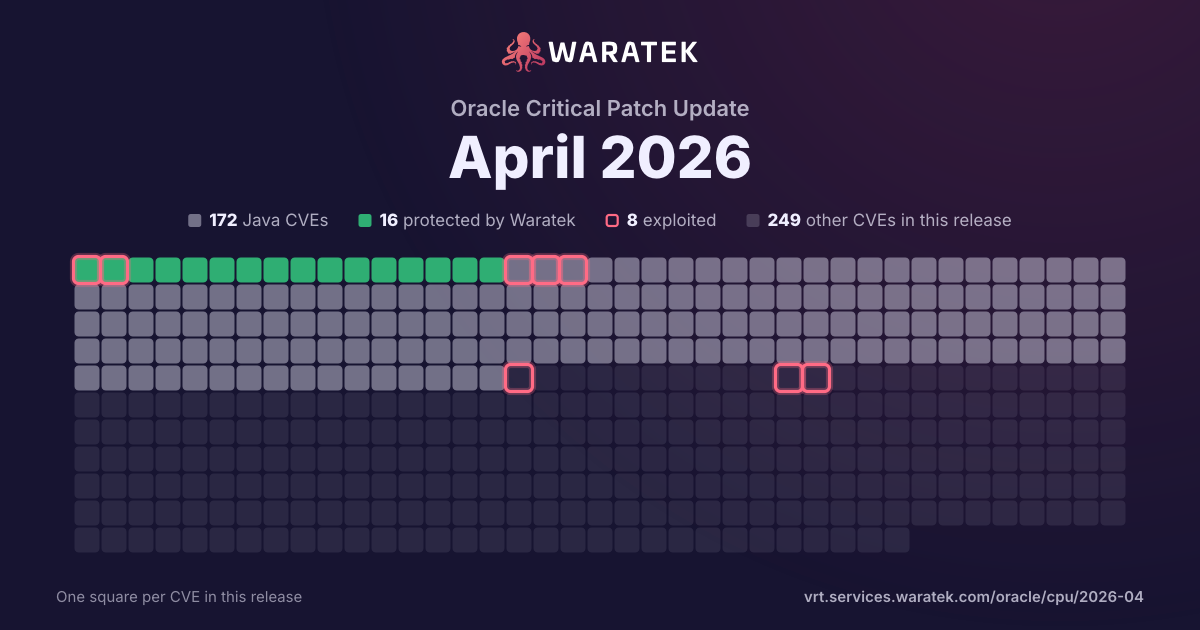
By status
13Protected by Waratek1Rule in development3Mitigation candidate157No exploit published6Outside Waratek scope241Not applicable
8Exploited, marked by the ring
No exploit published. For 51 of them, Oracle's security advisory is the source of public detail.
Protected by Waratek. Waratek RASP can block exploitation of these on systems that have not applied the patch yet.
Overview 23 matches · 16 in Waratek scope · 3 protected · 0 exploited · 0 CISA KEV · 2 public PoC · 1 EPSS ≥ 0.5
23matches
16in Waratek scope69.6%
3protected13.0%
0exploited0.0%
0CISA KEV0.0%
2public PoC8.7%
1EPSS ≥ 0.54.3%
Protected by Waratek
3
13.0%
Rule in development
0
0.0%
Mitigation candidate
0
0.0%
No exploit published
13
56.5%
Outside Waratek scope
0
0.0%
Not applicable
7
30.4%
Withdrawn CVE
0
0.0%
blocked by ARMR today
3
13.0%
partly blocked
0
0.0%
not blocked
20
87.0%
not established
0
0.0%
unrecorded
0
0.0%
Exploited
0
0.0%
Working exploit published
0
0.0%
Proof of concept only
23
100.0%
Forecast only
0
0.0%
No public exploit
0
0.0%
split by
peak 5 / quarter
Q1 221
Protected by Waratek1
Critical1
blocked by ARMR today1
Proof of concept only1
Q2 220
Q3 220
Q4 223
Protected by Waratek1
No exploit published2
Critical1
High2
blocked by ARMR today1
not blocked2
Proof of concept only3
Q1 231
No exploit published1
High1
not blocked1
Proof of concept only1
Q2 231
No exploit published1
High1
not blocked1
Proof of concept only1
Q3 230
Q4 231
No exploit published1
Medium1
not blocked1
Proof of concept only1
Q1 241
No exploit published1
Medium1
not blocked1
Proof of concept only1
Q2 241
Not applicable1
Medium1
not blocked1
Proof of concept only1
Q3 240
Q4 242
No exploit published2
Medium2
not blocked2
Proof of concept only2
Q1 255
No exploit published2
Not applicable3
High3
Medium2
not blocked5
Proof of concept only5
Q2 254
Protected by Waratek1
No exploit published2
Not applicable1
Critical1
High1
Medium2
blocked by ARMR today1
not blocked3
Proof of concept only4
Q3 253
No exploit published1
Not applicable2
Medium2
Low1
not blocked3
Proof of concept only3
Q1 22Q3 22Q1 23Q3 23Q1 24Q3 24Q1 25Q3 25
| CVE | Severity | Published▾ | Status | Exploitation | Description |
|---|---|---|---|---|---|
| CVE-2025-8177 | Medium | 2025-07-26 | Not applicable | Proof of concept only | A vulnerability was found in LibTIFF up to 4.7.0. It has been rated as critical. This issue affects the function setrow of the file tools/thumbnail.c. The manipulation leads to buffer overflow. An attack has to be approached locally. The patch is named e8c9d6c616b19438695fd829e58ae4fde5bfbc22. It is recommended to apply a patch to fix this issue. This vulnerability only affects products that are no longer supported by the maintainer. |
| CVE-2025-8176 | Low | 2025-07-26 | Not applicable | Proof of concept only | A vulnerability was found in LibTIFF up to 4.7.0. It has been declared as critical. This vulnerability affects the function get_histogram of the file tools/tiffmedian.c. The manipulation leads to use after free. The attack needs to be approached locally. The exploit has been disclosed to the public and may be used. The patch is identified as fe10872e53efba9cc36c66ac4ab3b41a839d5172. It is recommended to apply a patch to fix this issue. |
| CVE-2025-53864 | Medium | 2025-07-11 | No exploit published | Proof of concept only | Connect2id Nimbus JOSE + JWT 10.0.x before 10.0.2 and 9.37.x before 9.37.4 allows a remote attacker to cause a denial of service via a deeply nested JSON object supplied in a JWT claim set, because of uncontrolled recursion. NOTE: this is independent of the Gson 2.11.0 issue because the Connect2id product could have checked the JSON object nesting depth, regardless of what limits (if any) were imposed by Gson. |
| CVE-2025-35036 | Medium | 2025-06-03 | No exploit published | Proof of concept only | Hibernate Validator before 6.2.0 and 7.0.0, by default and depending how it is used, may interpolate user-supplied input in a constraint violation message with Expression Language. This could allow an attacker to access sensitive information or execute arbitrary Java code. Hibernate Validator as of 6.2.0 and 7.0.0 no longer interpolates custom constraint violation messages with Expression Language and strongly recommends not allowing user-supplied input in constraint violation messages. CVE-2020-5245 and CVE-2025-4428 are examples of related, downstream vulnerabilities involving Expression Language intepolation of user-supplied data. |
| CVE-2025-48734 | High | 2025-05-28 | No exploit published | Proof of concept only | Improper Access Control vulnerability in Apache Commons. A special BeanIntrospector class was added in version 1.9.2. This can be used to stop attackers from using the declared class property of Java enum objects to get access to the classloader. However this protection was not enabled by default. PropertyUtilsBean (and consequently BeanUtilsBean) now disallows declared class level property access by default. Releases 1.11.0 and 2.0.0-M2 address a potential security issue when accessing enum properties in an uncontrolled way. If an application using Commons BeanUtils passes property paths from an external source directly to the getProperty() method of PropertyUtilsBean, an attacker can access the enum’s class loader via the “declaredClass” property available on all Java “enum” objects. Accessing the enum’s “declaredClass” allows remote attackers to access the ClassLoader and execute arbitrary code. The same issue exists with PropertyUtilsBean.getNestedProperty(). Starting in versions 1.11.0 and 2.0.0-M2 a special BeanIntrospector suppresses the “declaredClass” property. Note that this new BeanIntrospector is enabled by default, but you can disable it to regain the old behavior; see section 2.5 of the user's guide and the unit tests. This issue affects Apache Commons BeanUtils 1.x before 1.11.0, and 2.x before 2.0.0-M2.Users of the artifact commons-beanutils:commons-beanutils 1.x are recommended to upgrade to version 1.11.0, which fixes the issue. Users of the artifact org.apache.commons:commons-beanutils2 2.x are recommended to upgrade to version 2.0.0-M2, which fixes the issue. |
| CVE-2025-29482 | Medium | 2025-04-07 | Not applicable | Proof of concept only | Buffer Overflow vulnerability in libheif 1.19.7 allows a local attacker to execute arbitrary code via the SAO (Sample Adaptive Offset) processing of libde265. |
| CVE-2025-30065 | Critical | 2025-04-01 | Protected by Waratek | Proof of concept only | Schema parsing in the parquet-avro module of Apache Parquet 1.15.0 and previous versions allows bad actors to execute arbitrary code Users are recommended to upgrade to version 1.15.1, which fixes the issue. |
| CVE-2025-0453 | High | 2025-03-20 | Not applicable | Proof of concept only | In mlflow/mlflow version 2.17.2, the `/graphql` endpoint is vulnerable to a denial of service attack. An attacker can create large batches of queries that repeatedly request all runs from a given experiment. This can tie up all the workers allocated by MLFlow, rendering the application unable to respond to other requests. This vulnerability is due to uncontrolled resource consumption. |
| CVE-2025-26791 | Medium | 2025-02-14 | Not applicable | Proof of concept only | DOMPurify before 3.2.4 has an incorrect template literal regular expression, sometimes leading to mutation cross-site scripting (mXSS). |
| CVE-2025-25193 | Medium | 2025-02-10 | No exploit published | Proof of concept only | Netty, an asynchronous, event-driven network application framework, has a vulnerability in versions up to and including 4.1.118.Final. An unsafe reading of environment file could potentially cause a denial of service in Netty. When loaded on an Windows application, Netty attempts to load a file that does not exist. If an attacker creates such a large file, the Netty application crash. A similar issue was previously reported as CVE-2024-47535. This issue was fixed, but the fix was incomplete in that null-bytes were not counted against the input limit. Commit d1fbda62d3a47835d3fb35db8bd42ecc205a5386 contains an updated fix. |
| CVE-2025-24970 | High | 2025-02-10 | No exploit published | Proof of concept only | Netty, an asynchronous, event-driven network application framework, has a vulnerability starting in version 4.1.91.Final and prior to version 4.1.118.Final. When a special crafted packet is received via SslHandler it doesn't correctly handle validation of such a packet in all cases which can lead to a native crash. Version 4.1.118.Final contains a patch. As workaround its possible to either disable the usage of the native SSLEngine or change the code manually. |
| CVE-2025-0725 | High | 2025-02-05 | Not applicable | Proof of concept only | When libcurl is asked to perform automatic gzip decompression of content-encoded HTTP responses with the `CURLOPT_ACCEPT_ENCODING` option, **using zlib 1.2.0.3 or older**, an attacker-controlled integer overflow would make libcurl perform a buffer overflow. |
| CVE-2024-47535 | Medium | 2024-11-12 | No exploit published | Proof of concept only | Netty is an asynchronous event-driven network application framework for rapid development of maintainable high performance protocol servers & clients. An unsafe reading of environment file could potentially cause a denial of service in Netty. When loaded on an Windows application, Netty attempts to load a file that does not exist. If an attacker creates such a large file, the Netty application crashes. This vulnerability is fixed in 4.1.115. |
| CVE-2024-6763 | Medium | 2024-10-14 | No exploit published | Proof of concept only | Eclipse Jetty is a lightweight, highly scalable, Java-based web server and Servlet engine . It includes a utility class, HttpURI, for URI/URL parsing. The HttpURI class does insufficient validation on the authority segment of a URI. However the behaviour of HttpURI differs from the common browsers in how it handles a URI that would be considered invalid if fully validated against the RRC. Specifically HttpURI and the browser may differ on the value of the host extracted from an invalid URI and thus a combination of Jetty and a vulnerable browser may be vulnerable to a open redirect attack or to a SSRF attack if the URI is used after passing validation checks. |
| CVE-2024-24789 | Medium | 2024-06-05 | Not applicable | Proof of concept only | The archive/zip package's handling of certain types of invalid zip files differs from the behavior of most zip implementations. This misalignment could be exploited to create an zip file with contents that vary depending on the implementation reading the file. The archive/zip package now rejects files containing these errors. |
| CVE-2023-51775 | Medium | 2024-02-29 | No exploit published | Proof of concept only | The jose4j component before 0.9.4 for Java allows attackers to cause a denial of service (CPU consumption) via a large p2c (aka PBES2 Count) value. |
| CVE-2023-46750 | Medium | 2023-12-14 | No exploit published | Proof of concept only | URL Redirection to Untrusted Site ('Open Redirect') vulnerability when "form" authentication is used in Apache Shiro. Mitigation: Update to Apache Shiro 1.13.0+ or 2.0.0-alpha-4+. |
| CVE-2023-34453 | High | 2023-06-15 | No exploit published | Proof of concept only | snappy-java is a fast compressor/decompressor for Java. Due to unchecked multiplications, an integer overflow may occur in versions prior to 1.1.10.1, causing a fatal error. The function `shuffle(int[] input)` in the file `BitShuffle.java` receives an array of integers and applies a bit shuffle on it. It does so by multiplying the length by 4 and passing it to the natively compiled shuffle function. Since the length is not tested, the multiplication by four can cause an integer overflow and become a smaller value than the true size, or even zero or negative. In the case of a negative value, a `java.lang.NegativeArraySizeException` exception will raise, which can crash the program. In a case of a value that is zero or too small, the code that afterwards references the shuffled array will assume a bigger size of the array, which might cause exceptions such as `java.lang.ArrayIndexOutOfBoundsException`. The same issue exists also when using the `shuffle` functions that receive a double, float, long and short, each using a different multiplier that may cause the same issue. Version 1.1.10.1 contains a patch for this vulnerability. |
| CVE-2023-1436 | High | 2023-03-22 | No exploit published | Proof of concept only | An infinite recursion is triggered in Jettison when constructing a JSONArray from a Collection that contains a self-reference in one of its elements. This leads to a StackOverflowError exception being thrown. |
| CVE-2022-45693 | High | 2022-12-13 | No exploit published | Proof of concept only | Jettison before v1.5.2 was discovered to contain a stack overflow via the map parameter. This vulnerability allows attackers to cause a Denial of Service (DoS) via a crafted string. |
| CVE-2022-45688 | High | 2022-12-13 | No exploit published | Proof of concept only | A stack overflow in the XML.toJSONObject component of hutool-json v5.8.10 allows attackers to cause a Denial of Service (DoS) via crafted JSON or XML data. |
| CVE-2022-45047 | Critical | 2022-11-16 | Protected by Waratek | Proof of concept only | Class org.apache.sshd.server.keyprovider.SimpleGeneratorHostKeyProvider in Apache MINA SSHD <= 2.9.1 uses Java deserialization to load a serialized java.security.PrivateKey. The class is one of several implementations that an implementor using Apache MINA SSHD can choose for loading the host keys of an SSH server. |
| CVE-2022-23305 | Critical | 2022-01-18 | Protected by Waratek | Proof of concept only | By design, the JDBCAppender in Log4j 1.2.x accepts an SQL statement as a configuration parameter where the values to be inserted are converters from PatternLayout. The message converter, %m, is likely to always be included. This allows attackers to manipulate the SQL by entering crafted strings into input fields or headers of an application that are logged allowing unintended SQL queries to be executed. Note this issue only affects Log4j 1.x when specifically configured to use the JDBCAppender, which is not the default. Beginning in version 2.0-beta8, the JDBCAppender was re-introduced with proper support for parameterized SQL queries and further customization over the columns written to in logs. Apache Log4j 1.2 reached end of life in August 2015. Users should upgrade to Log4j 2 as it addresses numerous other issues from the previous versions. |