
Oracle Critical Patch Update April 2026
Released April 2026 · Oracle's advisory ↗ · ← Critical Patch Update, January 2026 · Security Patch Update, May 2026 →
421 CVEs in this release, one square each
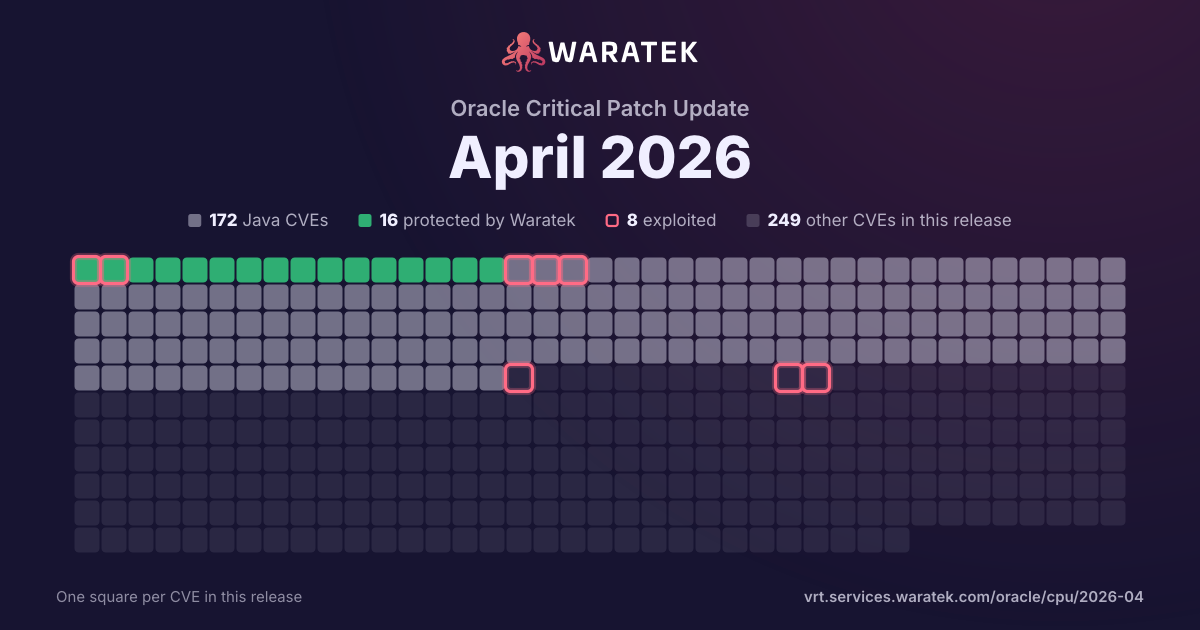
By status
16Protected by Waratek4Mitigation candidate154No exploit published6Outside Waratek scope241Not applicable
8Exploited, marked by the ring
No exploit published. For 51 of them, Oracle's security advisory is the source of public detail.
Protected by Waratek. Waratek RASP can block exploitation of these on systems that have not applied the patch yet.
Overview 6 matches · 0 protected · 0 exploited · 0 CISA KEV · 0 public PoC · 0 EPSS ≥ 0.5
6matches
0protected0.0%
0exploited0.0%
0CISA KEV0.0%
0public PoC0.0%
0EPSS ≥ 0.50.0%
Protected by Waratek
0
0.0%
Rule in development
0
0.0%
Mitigation candidate
0
0.0%
No exploit published
6
100.0%
blocked by ARMR today
0
0.0%
partly blocked
0
0.0%
not blocked
6
100.0%
not established
0
0.0%
unrecorded
0
0.0%
Exploited
0
0.0%
Working exploit published
0
0.0%
Proof of concept only
6
100.0%
Forecast only
0
0.0%
No public exploit
0
0.0%
split by
peak 2 / quarter
Q4 231
No exploit published1
Medium1
not blocked1
Proof of concept only1
Q1 241
No exploit published1
Medium1
not blocked1
Proof of concept only1
Q2 240
Q3 240
Q4 242
No exploit published2
Medium2
not blocked2
Proof of concept only2
Q1 251
No exploit published1
Medium1
not blocked1
Proof of concept only1
Q2 251
No exploit published1
Medium1
not blocked1
Proof of concept only1
Q4 23Q1 24Q2 24Q3 24Q4 24Q1 25Q2 25
| CVE | Severity | Published▾ | Status | Exploitation | Description |
|---|---|---|---|---|---|
| CVE-2025-35036 | Medium | 2025-06-03 | No exploit published | Proof of concept only | Hibernate Validator before 6.2.0 and 7.0.0, by default and depending how it is used, may interpolate user-supplied input in a constraint violation message with Expression Language. This could allow an attacker to access sensitive information or execute arbitrary Java code. Hibernate Validator as of 6.2.0 and 7.0.0 no longer interpolates custom constraint violation messages with Expression Language and strongly recommends not allowing user-supplied input in constraint violation messages. CVE-2020-5245 and CVE-2025-4428 are examples of related, downstream vulnerabilities involving Expression Language intepolation of user-supplied data. |
| CVE-2025-25193 | Medium | 2025-02-10 | No exploit published | Proof of concept only | Netty, an asynchronous, event-driven network application framework, has a vulnerability in versions up to and including 4.1.118.Final. An unsafe reading of environment file could potentially cause a denial of service in Netty. When loaded on an Windows application, Netty attempts to load a file that does not exist. If an attacker creates such a large file, the Netty application crash. A similar issue was previously reported as CVE-2024-47535. This issue was fixed, but the fix was incomplete in that null-bytes were not counted against the input limit. Commit d1fbda62d3a47835d3fb35db8bd42ecc205a5386 contains an updated fix. |
| CVE-2024-47535 | Medium | 2024-11-12 | No exploit published | Proof of concept only | Netty is an asynchronous event-driven network application framework for rapid development of maintainable high performance protocol servers & clients. An unsafe reading of environment file could potentially cause a denial of service in Netty. When loaded on an Windows application, Netty attempts to load a file that does not exist. If an attacker creates such a large file, the Netty application crashes. This vulnerability is fixed in 4.1.115. |
| CVE-2024-6763 | Medium | 2024-10-14 | No exploit published | Proof of concept only | Eclipse Jetty is a lightweight, highly scalable, Java-based web server and Servlet engine . It includes a utility class, HttpURI, for URI/URL parsing. The HttpURI class does insufficient validation on the authority segment of a URI. However the behaviour of HttpURI differs from the common browsers in how it handles a URI that would be considered invalid if fully validated against the RRC. Specifically HttpURI and the browser may differ on the value of the host extracted from an invalid URI and thus a combination of Jetty and a vulnerable browser may be vulnerable to a open redirect attack or to a SSRF attack if the URI is used after passing validation checks. |
| CVE-2023-51775 | Medium | 2024-02-29 | No exploit published | Proof of concept only | The jose4j component before 0.9.4 for Java allows attackers to cause a denial of service (CPU consumption) via a large p2c (aka PBES2 Count) value. |
| CVE-2023-46750 | Medium | 2023-12-14 | No exploit published | Proof of concept only | URL Redirection to Untrusted Site ('Open Redirect') vulnerability when "form" authentication is used in Apache Shiro. Mitigation: Update to Apache Shiro 1.13.0+ or 2.0.0-alpha-4+. |