
Oracle Critical Patch Update April 2026
Released April 2026 · Oracle's advisory ↗ · ← Critical Patch Update, January 2026 · Security Patch Update, May 2026 →
421 CVEs in this release, one square each
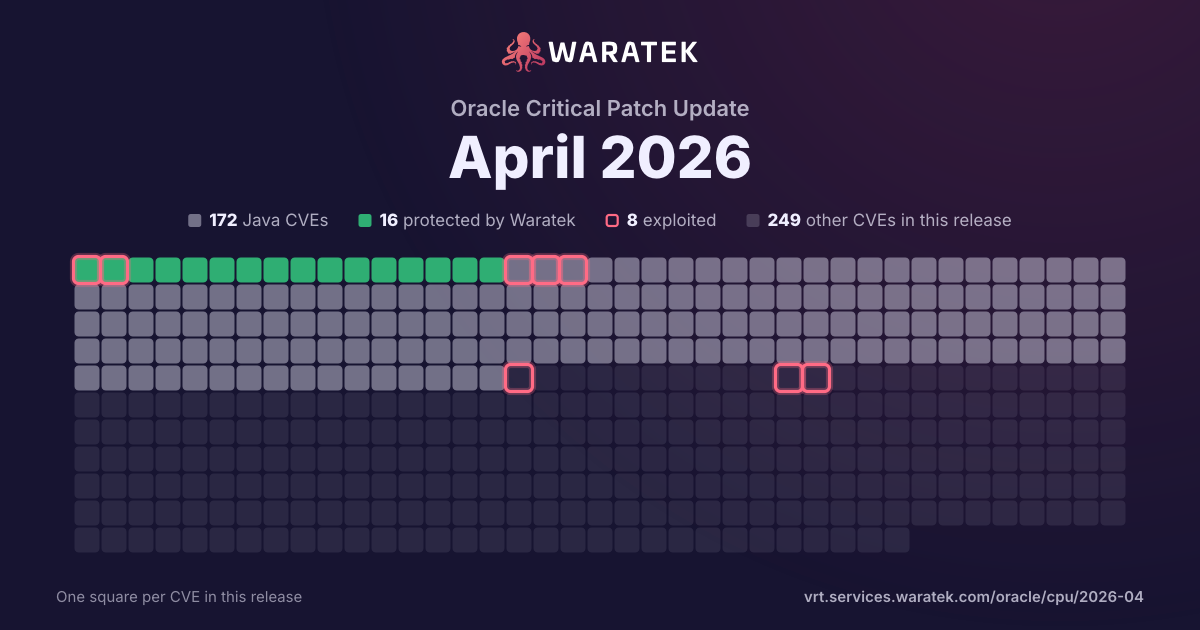
By status
13Protected by Waratek1Rule in development3Mitigation candidate157No exploit published6Outside Waratek scope241Not applicable
8Exploited, marked by the ring
No exploit published. For 51 of them, Oracle's security advisory is the source of public detail.
Protected by Waratek. Waratek RASP can block exploitation of these on systems that have not applied the patch yet.
Overview 9 matches · 0 protected · 0 exploited · 0 CISA KEV · 0 public PoC · 0 EPSS ≥ 0.5
9matches
0protected0.0%
0exploited0.0%
0CISA KEV0.0%
0public PoC0.0%
0EPSS ≥ 0.50.0%
Protected by Waratek
0
0.0%
Rule in development
0
0.0%
Mitigation candidate
0
0.0%
No exploit published
9
100.0%
blocked by ARMR today
0
0.0%
partly blocked
0
0.0%
not blocked
9
100.0%
not established
0
0.0%
unrecorded
0
0.0%
Exploited
0
0.0%
Working exploit published
0
0.0%
Proof of concept only
1
11.1%
Forecast only
0
0.0%
No public exploit
8
88.9%
split by
peak 4 / month
Aug 252
No exploit published2
High2
not blocked2
No public exploit2
Sep 252
No exploit published2
High2
not blocked2
No public exploit2
Oct 250
Nov 250
Dec 250
Jan 260
Feb 261
No exploit published1
High1
not blocked1
No public exploit1
Mar 260
Apr 264
No exploit published4
High4
not blocked4
Proof of concept only1
No public exploit3
Aug 25Sep 25Oct 25Nov 25Dec 25Jan 26Feb 26Mar 26Apr 26
| CVE | Severity | Published▾ | Status | Exploitation | Description |
|---|---|---|---|---|---|
| CVE-2026-35243 | High | 2026-04-21 | No exploit published | No public exploit | Vulnerability in the Oracle Application Development Framework (ADF) product of Oracle Fusion Middleware (component: ADF Faces). Supported versions that are affected are 12.2.1.4.0 and 14.1.2.0.0. Easily exploitable vulnerability allows low privileged attacker with logon to the infrastructure where Oracle Application Development Framework (ADF) executes to compromise Oracle Application Development Framework (ADF). Successful attacks of this vulnerability can result in takeover of Oracle Application Development Framework (ADF). CVSS 3.1 Base Score 7.8 (Confidentiality, Integrity and Availability impacts). CVSS Vector: (CVSS:3.1/AV:L/AC:L/PR:L/UI:N/S:U/C:H/I:H/A:H). |
| CVE-2026-34305 | High | 2026-04-21 | No exploit published | Proof of concept only | Vulnerability in the Oracle WebLogic Server product of Oracle Fusion Middleware (component: Web Services). Supported versions that are affected are 12.2.1.4.0, 14.1.1.0.0, 14.1.2.0.0 and 15.1.1.0.0. Easily exploitable vulnerability allows unauthenticated attacker with network access via HTTP to compromise Oracle WebLogic Server. Successful attacks of this vulnerability can result in unauthorized access to critical data or complete access to all Oracle WebLogic Server accessible data. CVSS 3.1 Base Score 7.5 (Confidentiality impacts). CVSS Vector: (CVSS:3.1/AV:N/AC:L/PR:N/UI:N/S:U/C:H/I:N/A:N). |
| CVE-2026-34292 | High | 2026-04-21 | No exploit published | No public exploit | Vulnerability in the Oracle WebLogic Server product of Oracle Fusion Middleware (component: Core). Supported versions that are affected are 12.2.1.4.0 and 14.1.1.0.0. Easily exploitable vulnerability allows high privileged attacker with network access via HTTP to compromise Oracle WebLogic Server. Successful attacks of this vulnerability can result in takeover of Oracle WebLogic Server. CVSS 3.1 Base Score 7.2 (Confidentiality, Integrity and Availability impacts). CVSS Vector: (CVSS:3.1/AV:N/AC:L/PR:H/UI:N/S:U/C:H/I:H/A:H). |
| CVE-2026-34290 | High | 2026-04-21 | No exploit published | No public exploit | Vulnerability in the Oracle Identity Manager Connector product of Oracle Fusion Middleware (component: Core). The supported version that is affected is 12.2.1.4.0. Easily exploitable vulnerability allows unauthenticated attacker with network access via TCP to compromise Oracle Identity Manager Connector. Successful attacks of this vulnerability can result in unauthorized ability to cause a hang or frequently repeatable crash (complete DOS) of Oracle Identity Manager Connector. CVSS 3.1 Base Score 7.5 (Availability impacts). CVSS Vector: (CVSS:3.1/AV:N/AC:L/PR:N/UI:N/S:U/C:N/I:N/A:H). |
| CVE-2025-33042 | High | 2026-02-13 | No exploit published | No public exploit | Improper Control of Generation of Code ('Code Injection') vulnerability in Apache Avro Java SDK when generating specific records from untrusted Avro schemas. This issue affects Apache Avro Java SDK: all versions through 1.11.4 and version 1.12.0. Users are recommended to upgrade to version 1.12.1 or 1.11.5, which fix the issue. |
| CVE-2025-41249 | High | 2025-09-16 | No exploit published | No public exploit | The Spring Framework annotation detection mechanism may not correctly resolve annotations on methods within type hierarchies with a parameterized super type with unbounded generics. This can be an issue if such annotations are used for authorization decisions. Your application may be affected by this if you are using Spring Security's @EnableMethodSecurity feature. You are not affected by this if you are not using @EnableMethodSecurity or if you do not use security annotations on methods in generic superclasses or generic interfaces. This CVE is published in conjunction with CVE-2025-41248 https://spring.io/security/cve-2025-41248 . |
| CVE-2025-41248 | High | 2025-09-16 | No exploit published | No public exploit | The Spring Security annotation detection mechanism may not correctly resolve annotations on methods within type hierarchies with a parameterized super type with unbounded generics. This can be an issue when using @PreAuthorize and other method security annotations, resulting in an authorization bypass. Your application may be affected by this if you are using Spring Security's @EnableMethodSecurity feature. You are not affected by this if you are not using @EnableMethodSecurity or if you do not use security annotations on methods in generic superclasses or generic interfaces. This CVE is published in conjunction with CVE-2025-41249 https://spring.io/security/cve-2025-41249 . |
| CVE-2025-5115 | High | 2025-08-20 | No exploit published | No public exploit | In Eclipse Jetty, versions <=9.4.57, <=10.0.25, <=11.0.25, <=12.0.21, <=12.1.0.alpha2, an HTTP/2 client may trigger the server to send RST_STREAM frames, for example by sending frames that are malformed or that should not be sent in a particular stream state, therefore forcing the server to consume resources such as CPU and memory. For example, a client can open a stream and then send WINDOW_UPDATE frames with window size increment of 0, which is illegal. Per specification https://www.rfc-editor.org/rfc/rfc9113.html#name-window_update , the server should send a RST_STREAM frame. The client can now open another stream and send another bad WINDOW_UPDATE, therefore causing the server to consume more resources than necessary, as this case does not exceed the max number of concurrent streams, yet the client is able to create an enormous amount of streams in a short period of time. The attack can be performed with other conditions (for example, a DATA frame for a closed stream) that cause the server to send a RST_STREAM frame. Links: * https://github.com/jetty/jetty.project/security/advisories/GHSA-mmxm-8w33-wc4h |
| CVE-2025-55163 | High | 2025-08-13 | No exploit published | No public exploit | Netty is an asynchronous, event-driven network application framework. Prior to versions 4.1.124.Final and 4.2.4.Final, Netty is vulnerable to MadeYouReset DDoS. This is a logical vulnerability in the HTTP/2 protocol, that uses malformed HTTP/2 control frames in order to break the max concurrent streams limit - which results in resource exhaustion and distributed denial of service. This issue has been patched in versions 4.1.124.Final and 4.2.4.Final. |