
Oracle Critical Patch Update April 2026
Released April 2026 · Oracle's advisory ↗ · ← Critical Patch Update, January 2026 · Security Patch Update, May 2026 →
421 CVEs in this release, one square each
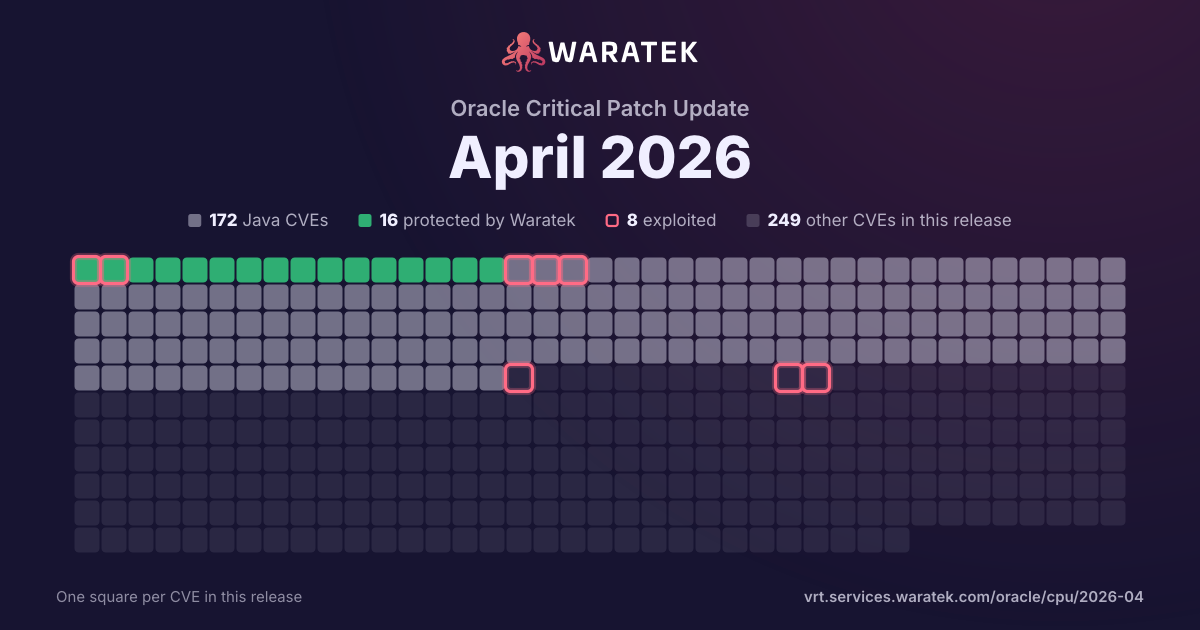
By status
13Protected by Waratek1Rule in development3Mitigation candidate157No exploit published6Outside Waratek scope241Not applicable
8Exploited, marked by the ring
No exploit published. For 51 of them, Oracle's security advisory is the source of public detail.
Protected by Waratek. Waratek RASP can block exploitation of these on systems that have not applied the patch yet.
Overview 10 matches · 0 protected · 0 exploited · 0 CISA KEV · 0 public PoC · 0 EPSS ≥ 0.5
10matches
0protected0.0%
0exploited0.0%
0CISA KEV0.0%
0public PoC0.0%
0EPSS ≥ 0.50.0%
Protected by Waratek
0
0.0%
Rule in development
0
0.0%
Mitigation candidate
0
0.0%
No exploit published
10
100.0%
blocked by ARMR today
0
0.0%
partly blocked
0
0.0%
not blocked
10
100.0%
not established
0
0.0%
unrecorded
0
0.0%
Exploited
0
0.0%
Working exploit published
0
0.0%
Proof of concept only
0
0.0%
Forecast only
0
0.0%
No public exploit
10
100.0%
split by
peak 3 / quarter
Q2 211
No exploit published1
Medium1
not blocked1
No public exploit1
Q3 210
Q4 210
Q1 220
Q2 220
Q3 220
Q4 220
Q1 230
Q2 233
No exploit published3
High1
Medium2
not blocked3
No public exploit3
Q3 232
No exploit published2
Critical1
High1
not blocked2
No public exploit2
Q4 232
No exploit published2
Critical2
not blocked2
No public exploit2
Q1 240
Q2 240
Q3 242
No exploit published2
High2
not blocked2
No public exploit2
Q3 21Q1 22Q3 22Q1 23Q3 23Q1 24Q3 24
| CVE | Severity | Published▾ | Status | Exploitation | Description |
|---|---|---|---|---|---|
| CVE-2024-41172 | High | 2024-07-19 | No exploit published | No public exploit | In versions of Apache CXF before 3.6.4 and 4.0.5 (3.5.x and lower versions are not impacted), a CXF HTTP client conduit may prevent HTTPClient instances from being garbage collected and it is possible that memory consumption will continue to increase, eventually causing the application to run out of memory |
| CVE-2024-32007 | High | 2024-07-19 | No exploit published | No public exploit | An improper input validation of the p2c parameter in the Apache CXF JOSE code before 4.0.5, 3.6.4 and 3.5.9 allows an attacker to perform a denial of service attack by specifying a large value for this parameter in a token. |
| CVE-2022-46337 | Critical | 2023-11-20 | No exploit published | No public exploit | A cleverly devised username might bypass LDAP authentication checks. In LDAP-authenticated Derby installations, this could let an attacker fill up the disk by creating junk Derby databases. In LDAP-authenticated Derby installations, this could also allow the attacker to execute malware which was visible to and executable by the account which booted the Derby server. In LDAP-protected databases which weren't also protected by SQL GRANT/REVOKE authorization, this vulnerability could also let an attacker view and corrupt sensitive data and run sensitive database functions and procedures. Mitigation: Users should upgrade to Java 21 and Derby 10.17.1.0. Alternatively, users who wish to remain on older Java versions should build their own Derby distribution from one of the release families to which the fix was backported: 10.16, 10.15, and 10.14. Those are the releases which correspond, respectively, with Java LTS versions 17, 11, and 8. |
| CVE-2023-44981 | Critical | 2023-10-11 | No exploit published | No public exploit | Authorization Bypass Through User-Controlled Key vulnerability in Apache ZooKeeper. If SASL Quorum Peer authentication is enabled in ZooKeeper (quorum.auth.enableSasl=true), the authorization is done by verifying that the instance part in SASL authentication ID is listed in zoo.cfg server list. The instance part in SASL auth ID is optional and if it's missing, like 'eve@EXAMPLE.COM', the authorization check will be skipped. As a result an arbitrary endpoint could join the cluster and begin propagating counterfeit changes to the leader, essentially giving it complete read-write access to the data tree. Quorum Peer authentication is not enabled by default. Users are recommended to upgrade to version 3.9.1, 3.8.3, 3.7.2, which fixes the issue. Alternately ensure the ensemble election/quorum communication is protected by a firewall as this will mitigate the issue. See the documentation for more details on correct cluster administration. |
| CVE-2023-34034 | Critical | 2023-07-19 | No exploit published | No public exploit | Using "**" as a pattern in Spring Security configuration for WebFlux creates a mismatch in pattern matching between Spring Security and Spring WebFlux, and the potential for a security bypass. |
| CVE-2023-34035 | High | 2023-07-18 | No exploit published | No public exploit | Spring Security versions 5.8 prior to 5.8.5, 6.0 prior to 6.0.5, and 6.1 prior to 6.1.2 could be susceptible to authorization rule misconfiguration if the application uses requestMatchers(String) and multiple servlets, one of them being Spring MVC’s DispatcherServlet. (DispatcherServlet is a Spring MVC component that maps HTTP endpoints to methods on @Controller-annotated classes.) Specifically, an application is vulnerable when all of the following are true: * Spring MVC is on the classpath * Spring Security is securing more than one servlet in a single application (one of them being Spring MVC’s DispatcherServlet) * The application uses requestMatchers(String) to refer to endpoints that are not Spring MVC endpoints An application is not vulnerable if any of the following is true: * The application does not have Spring MVC on the classpath * The application secures no servlets other than Spring MVC’s DispatcherServlet * The application uses requestMatchers(String) only for Spring MVC endpoints |
| CVE-2023-2976 | High | 2023-06-14 | No exploit published | No public exploit | Use of Java's default temporary directory for file creation in `FileBackedOutputStream` in Google Guava versions 1.0 to 31.1 on Unix systems and Android Ice Cream Sandwich allows other users and apps on the machine with access to the default Java temporary directory to be able to access the files created by the class. Even though the security vulnerability is fixed in version 32.0.0, we recommend using version 32.0.1 as version 32.0.0 breaks some functionality under Windows. |
| CVE-2023-20862 | Medium | 2023-04-19 | No exploit published | No public exploit | In Spring Security, versions 5.7.x prior to 5.7.8, versions 5.8.x prior to 5.8.3, and versions 6.0.x prior to 6.0.3, the logout support does not properly clean the security context if using serialized versions. Additionally, it is not possible to explicitly save an empty security context to the HttpSessionSecurityContextRepository. This vulnerability can keep users authenticated even after they performed logout. Users of affected versions should apply the following mitigation. 5.7.x users should upgrade to 5.7.8. 5.8.x users should upgrade to 5.8.3. 6.0.x users should upgrade to 6.0.3. |
| CVE-2023-20863 | Medium | 2023-04-13 | No exploit published | No public exploit | In spring framework versions prior to 5.2.24 release+ ,5.3.27+ and 6.0.8+ , it is possible for a user to provide a specially crafted SpEL expression that may cause a denial-of-service (DoS) condition. |
| CVE-2021-28168 | Medium | 2021-04-22 | No exploit published | No public exploit | Eclipse Jersey 2.28 to 2.33 and Eclipse Jersey 3.0.0 to 3.0.1 contains a local information disclosure vulnerability. This is due to the use of the File.createTempFile which creates a file inside of the system temporary directory with the permissions: -rw-r--r--. Thus the contents of this file are viewable by all other users locally on the system. As such, if the contents written is security sensitive, it can be disclosed to other local users. |