
Oracle Critical Patch Update January 2026
Released January 2026 · Oracle's advisory ↗ · ← Critical Patch Update, October 2025 · Critical Patch Update, April 2026 →
219 CVEs in this release, one square each
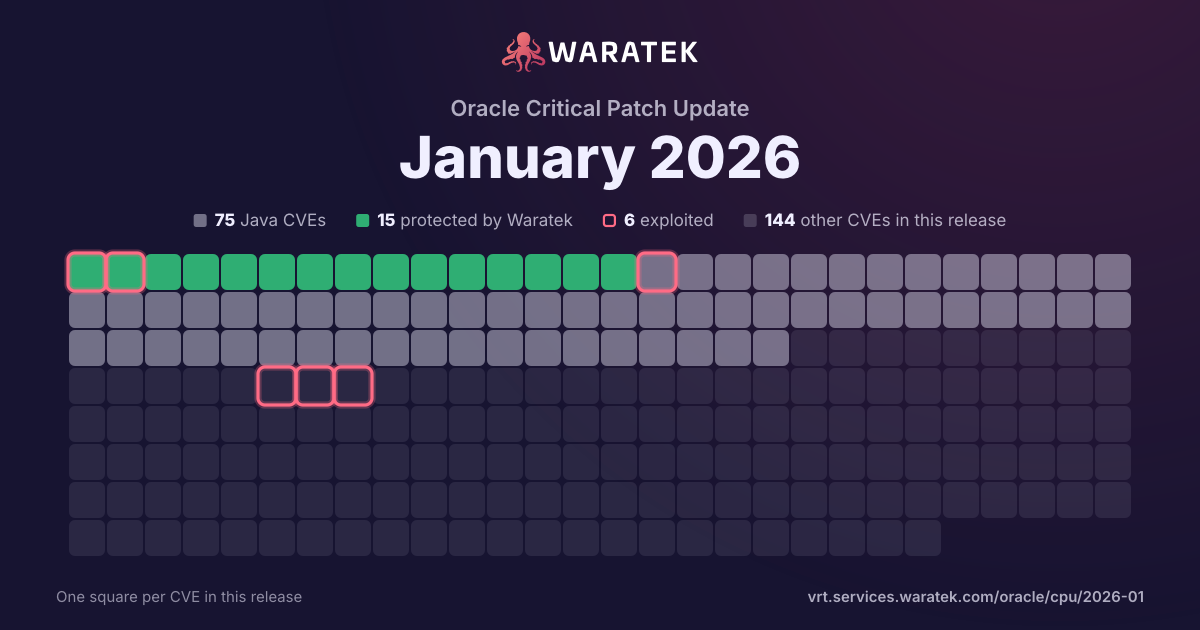
By status
15Protected by Waratek2Mitigation candidate62No exploit published11Outside Waratek scope129Not applicable
6Exploited, marked by the ring
No exploit published. For 27 of them, Oracle's security advisory is the source of public detail.
Protected by Waratek. Waratek RASP can block exploitation of these on systems that have not applied the patch yet.
Overview 9 matches · 0 protected · 1 exploited · 0 CISA KEV · 2 public PoC · 1 EPSS ≥ 0.5
Protected by Waratek
0
0.0%
Rule in development
0
0.0%
Mitigation candidate
2
22.2%
No exploit published
7
77.8%
blocked by ARMR today
0
0.0%
partly blocked
0
0.0%
not blocked
9
100.0%
not established
0
0.0%
unrecorded
0
0.0%
split by
peak 4 / month
Apr 251
No exploit published1
Medium1
not blocked1
No public exploit1
May 254
Mitigation candidate1
No exploit published3
High2
Medium1
Low1
not blocked4
Working exploit published1
Proof of concept only1
No public exploit2
Jun 254
Mitigation candidate1
No exploit published3
High3
Medium1
not blocked4
Exploited1
No public exploit3
Apr 25May 25Jun 25
| CVE | Severity | Published▾ | Status | Exploitation | Description |
|---|---|---|---|---|---|
| CVE-2025-52999 | High | 2025-06-25 | No exploit published | No public exploit | jackson-core contains core low-level incremental ("streaming") parser and generator abstractions used by Jackson Data Processor. In versions prior to 2.15.0, if a user parses an input file and it has deeply nested data, Jackson could end up throwing a StackoverflowError if the depth is particularly large. jackson-core 2.15.0 contains a configurable limit for how deep Jackson will traverse in an input document, defaulting to an allowable depth of 1000. jackson-core will throw a StreamConstraintsException if the limit is reached. jackson-databind also benefits from this change because it uses jackson-core to parse JSON inputs. As a workaround, users should avoid parsing input files from untrusted sources. |
| CVE-2025-48976 | High | 2025-06-16 | No exploit published | No public exploit | Allocation of resources for multipart headers with insufficient limits enabled a DoS vulnerability in Apache Commons FileUpload. This issue affects Apache Commons FileUpload: from 1.0 before 1.6; from 2.0.0-M1 before 2.0.0-M4. Users are recommended to upgrade to versions 1.6 or 2.0.0-M4, which fix the issue. |
| CVE-2025-41234 | Medium | 2025-06-12 | No exploit published | No public exploit | Description In Spring Framework, versions 6.0.x as of 6.0.5, versions 6.1.x and 6.2.x, an application is vulnerable to a reflected file download (RFD) attack when it sets a “Content-Disposition” header with a non-ASCII charset, where the filename attribute is derived from user-supplied input. Specifically, an application is vulnerable when all the following are true: * The header is prepared with org.springframework.http.ContentDisposition. * The filename is set via ContentDisposition.Builder#filename(String, Charset). * The value for the filename is derived from user-supplied input. * The application does not sanitize the user-supplied input. * The downloaded content of the response is injected with malicious commands by the attacker (see RFD paper reference for details). An application is not vulnerable if any of the following is true: * The application does not set a “Content-Disposition” response header. * The header is not prepared with org.springframework.http.ContentDisposition. * The filename is set via one of: * ContentDisposition.Builder#filename(String), or * ContentDisposition.Builder#filename(String, ASCII) * The filename is not derived from user-supplied input. * The filename is derived from user-supplied input but sanitized by the application. * The attacker cannot inject malicious content in the downloaded content of the response. Affected Spring Products and VersionsSpring Framework: * 6.2.0 - 6.2.7 * 6.1.0 - 6.1.20 * 6.0.5 - 6.0.28 * Older, unsupported versions are not affected MitigationUsers of affected versions should upgrade to the corresponding fixed version. Affected version(s)Fix versionAvailability6.2.x6.2.8OSS6.1.x6.1.21OSS6.0.x6.0.29 Commercial https://enterprise.spring.io/ No further mitigation steps are necessary. CWE-113 in `Content-Disposition` handling in VMware Spring Framework versions 6.0.5 to 6.2.7 allows remote attackers to launch Reflected File Download (RFD) attacks via unsanitized user input in `ContentDisposition.Builder#filename(String, Charset)` with non-ASCII charsets. |
| CVE-2025-27817 | High | 2025-06-10 | Mitigation candidate | Exploited | A possible arbitrary file read and SSRF vulnerability has been identified in Apache Kafka Client. Apache Kafka Clients accept configuration data for setting the SASL/OAUTHBEARER connection with the brokers, including "sasl.oauthbearer.token.endpoint.url" and "sasl.oauthbearer.jwks.endpoint.url". Apache Kafka allows clients to read an arbitrary file and return the content in the error log, or sending requests to an unintended location. In applications where Apache Kafka Clients configurations can be specified by an untrusted party, attackers may use the "sasl.oauthbearer.token.endpoint.url" and "sasl.oauthbearer.jwks.endpoint.url" configuratin to read arbitrary contents of the disk and environment variables or make requests to an unintended location. In particular, this flaw may be used in Apache Kafka Connect to escalate from REST API access to filesystem/environment/URL access, which may be undesirable in certain environments, including SaaS products. Since Apache Kafka 3.9.1/4.0.0, we have added a system property ("-Dorg.apache.kafka.sasl.oauthbearer.allowed.urls") to set the allowed urls in SASL JAAS configuration. In 3.9.1, it accepts all urls by default for backward compatibility. However in 4.0.0 and newer, the default value is empty list and users have to set the allowed urls explicitly. |
| CVE-2025-48734 | High | 2025-05-28 | No exploit published | Proof of concept only | Improper Access Control vulnerability in Apache Commons. A special BeanIntrospector class was added in version 1.9.2. This can be used to stop attackers from using the declared class property of Java enum objects to get access to the classloader. However this protection was not enabled by default. PropertyUtilsBean (and consequently BeanUtilsBean) now disallows declared class level property access by default. Releases 1.11.0 and 2.0.0-M2 address a potential security issue when accessing enum properties in an uncontrolled way. If an application using Commons BeanUtils passes property paths from an external source directly to the getProperty() method of PropertyUtilsBean, an attacker can access the enum’s class loader via the “declaredClass” property available on all Java “enum” objects. Accessing the enum’s “declaredClass” allows remote attackers to access the ClassLoader and execute arbitrary code. The same issue exists with PropertyUtilsBean.getNestedProperty(). Starting in versions 1.11.0 and 2.0.0-M2 a special BeanIntrospector suppresses the “declaredClass” property. Note that this new BeanIntrospector is enabled by default, but you can disable it to regain the old behavior; see section 2.5 of the user's guide and the unit tests. This issue affects Apache Commons BeanUtils 1.x before 1.11.0, and 2.x before 2.0.0-M2.Users of the artifact commons-beanutils:commons-beanutils 1.x are recommended to upgrade to version 1.11.0, which fixes the issue. Users of the artifact org.apache.commons:commons-beanutils2 2.x are recommended to upgrade to version 2.0.0-M2, which fixes the issue. |
| CVE-2025-22233 | Low | 2025-05-16 | No exploit published | No public exploit | CVE-2024-38820 ensured Locale-independent, lowercase conversion for both the configured disallowedFields patterns and for request parameter names. However, there are still cases where it is possible to bypass the disallowedFields checks. Affected Spring Products and Versions Spring Framework: * 6.2.0 - 6.2.6 * 6.1.0 - 6.1.19 * 6.0.0 - 6.0.27 * 5.3.0 - 5.3.42 * Older, unsupported versions are also affected Mitigation Users of affected versions should upgrade to the corresponding fixed version. Affected version(s)Fix Version Availability 6.2.x 6.2.7 OSS6.1.x 6.1.20 OSS6.0.x 6.0.28 Commercial https://enterprise.spring.io/ 5.3.x 5.3.43 Commercial https://enterprise.spring.io/ No further mitigation steps are necessary. Generally, we recommend using a dedicated model object with properties only for data binding, or using constructor binding since constructor arguments explicitly declare what to bind together with turning off setter binding through the declarativeBinding flag. See the Model Design section in the reference documentation. For setting binding, prefer the use of allowedFields (an explicit list) over disallowedFields. Credit This issue was responsibly reported by the TERASOLUNA Framework Development Team from NTT DATA Group Corporation. |
| CVE-2024-13009 | High | 2025-05-08 | No exploit published | No public exploit | In Eclipse Jetty versions 9.4.0 to 9.4.56 a buffer can be incorrectly released when confronted with a gzip error when inflating a request body. This can result in corrupted and/or inadvertent sharing of data between requests. |
| CVE-2025-27533 | Medium | 2025-05-07 | Mitigation candidate | Working exploit published | Memory Allocation with Excessive Size Value vulnerability in Apache ActiveMQ. During unmarshalling of OpenWire commands the size value of buffers was not properly validated which could lead to excessive memory allocation and be exploited to cause a denial of service (DoS) by depleting process memory, thereby affecting applications and services that rely on the availability of the ActiveMQ broker when not using mutual TLS connections. This issue affects Apache ActiveMQ: from 6.0.0 before 6.1.6, from 5.18.0 before 5.18.7, from 5.17.0 before 5.17.7, before 5.16.8. ActiveMQ 5.19.0 is not affected. Users are recommended to upgrade to version 6.1.6+, 5.19.0+, 5.18.7+, 5.17.7, or 5.16.8 or which fixes the issue. Existing users may implement mutual TLS to mitigate the risk on affected brokers. |
| CVE-2025-31672 | Medium | 2025-04-09 | No exploit published | No public exploit | Improper Input Validation vulnerability in Apache POI. The issue affects the parsing of OOXML format files like xlsx, docx and pptx. These file formats are basically zip files and it is possible for malicious users to add zip entries with duplicate names (including the path) in the zip. In this case, products reading the affected file could read different data because 1 of the zip entries with the duplicate name is selected over another but different products may choose a different zip entry. This issue affects Apache POI poi-ooxml before 5.4.0. poi-ooxml 5.4.0 has a check that throws an exception if zip entries with duplicate file names are found in the input file. Users are recommended to upgrade to version poi-ooxml 5.4.0, which fixes the issue. Please read https://poi.apache.org/security.html for recommendations about how to use the POI libraries securely. |