
Oracle Critical Patch Update January 2026
Released January 2026 · Oracle's advisory ↗ · ← Critical Patch Update, October 2025 · Critical Patch Update, April 2026 →
219 CVEs in this release, one square each
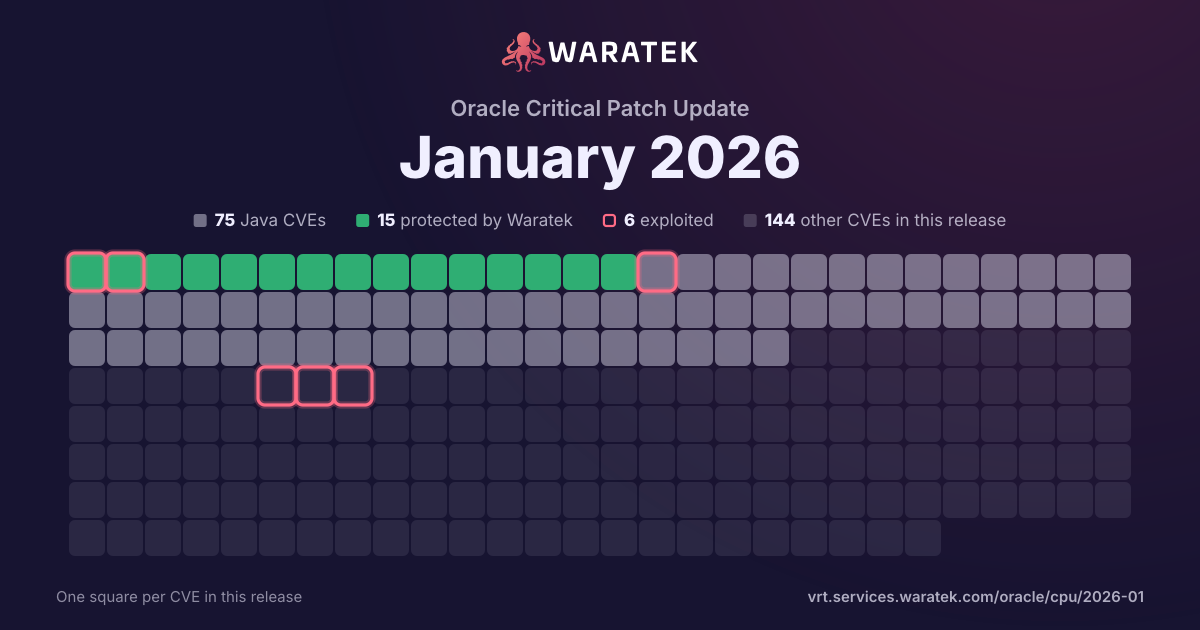
By status
15Protected by Waratek2Mitigation candidate58No exploit published14Outside Waratek scope130Not applicable
6Exploited, marked by the ring
No exploit published. For 26 of them, Oracle's security advisory is the source of public detail.
Protected by Waratek. Waratek RASP can block exploitation of these on systems that have not applied the patch yet.
Overview 219 matches · 75 in Waratek scope · 15 protected · 6 exploited · 2 CISA KEV · 17 public PoC · 6 EPSS ≥ 0.5
219matches
75in Waratek scope34.2%
15protected6.8%
6exploited2.7%
2CISA KEV0.9%
17public PoC7.8%
6EPSS ≥ 0.52.7%
Protected by Waratek
15
6.8%
Rule in development
0
0.0%
Mitigation candidate
2
0.9%
No exploit published
58
26.5%
Outside Waratek scope
14
6.4%
Not applicable
130
59.4%
Withdrawn CVE
0
0.0%
blocked by ARMR today
15
6.8%
partly blocked
0
0.0%
not blocked
204
93.2%
not established
0
0.0%
unrecorded
0
0.0%
split by
peak 129 / year
20181
Protected by Waratek1
High1
blocked by ARMR today1
No public exploit1
20190
20201
Protected by Waratek1
Critical1
blocked by ARMR today1
No public exploit1
20214
Protected by Waratek4
Critical2
High1
Medium1
blocked by ARMR today4
Exploited1
No public exploit3
20222
Protected by Waratek1
Not applicable1
Critical1
Medium1
blocked by ARMR today1
not blocked1
Proof of concept only1
No public exploit1
20237
Not applicable7
High4
Medium3
not blocked7
No public exploit7
20249
Protected by Waratek1
No exploit published2
Outside Waratek scope1
Not applicable5
Critical2
High1
Medium6
blocked by ARMR today1
not blocked8
Proof of concept only1
No public exploit8
2025129
Protected by Waratek7
Mitigation candidate2
No exploit published29
Outside Waratek scope9
Not applicable82
Critical10
High61
Medium48
Low10
blocked by ARMR today7
not blocked122
Exploited4
Working exploit published8
Proof of concept only29
No public exploit88
202666
No exploit published27
Outside Waratek scope4
Not applicable35
Critical2
High19
Medium41
Low4
not blocked66
Exploited1
No public exploit65
201820192020202120222023202420252026
| CVE | Severity | Published▾ | Status | Exploitation | Description |
|---|---|---|---|---|---|
| CVE-2024-47554 | Medium | 2024-10-03 | No exploit published | No public exploit | Uncontrolled Resource Consumption vulnerability in Apache Commons IO. The org.apache.commons.io.input.XmlStreamReader class may excessively consume CPU resources when processing maliciously crafted input. This issue affects Apache Commons IO: from 2.0 before 2.14.0. Users are recommended to upgrade to version 2.14.0 or later, which fixes the issue. |
| CVE-2024-43796 | Medium | 2024-09-10 | Not applicable | No public exploit | Express.js minimalist web framework for node. In express < 4.20.0, passing untrusted user input - even after sanitizing it - to response.redirect() may execute untrusted code. This issue is patched in express 4.20.0. |
| CVE-2024-23807 | Critical | 2024-02-29 | Not applicable | No public exploit | The Apache Xerces C++ XML parser on versions 3.0.0 before 3.2.5 contains a use-after-free error triggered during the scanning of external DTDs. Users are recommended to upgrade to version 3.2.5 which fixes the issue, or mitigate the issue by disabling DTD processing. This can be accomplished via the DOM using a standard parser feature, or via SAX using the XERCES_DISABLE_DTD environment variable. This issue has been disclosed before as CVE-2018-1311, but unfortunately that advisory incorrectly stated the issue would be fixed in version 3.2.3 or 3.2.4. |
| CVE-2023-29081 | Medium | 2024-01-26 | Not applicable | No public exploit | A vulnerability has been reported in Suite Setups built with versions prior to InstallShield 2023 R2. This vulnerability may allow locally authenticated users to cause a Denial of Service (DoS) condition when handling move operations on local, temporary folders. |
| CVE-2023-4154 | High | 2023-11-07 | Not applicable | No public exploit | A design flaw was found in Samba's DirSync control implementation, which exposes passwords and secrets in Active Directory to privileged users and Read-Only Domain Controllers (RODCs). This flaw allows RODCs and users possessing the GET_CHANGES right to access all attributes, including sensitive secrets and passwords. Even in a default setup, RODC DC accounts, which should only replicate some passwords, can gain access to all domain secrets, including the vital krbtgt, effectively eliminating the RODC / DC distinction. Furthermore, the vulnerability fails to account for error conditions (fail open), like out-of-memory situations, potentially granting access to secret attributes, even under low-privileged attacker influence. |
| CVE-2023-42669 | Medium | 2023-11-06 | Not applicable | No public exploit | A vulnerability was found in Samba's "rpcecho" development server, a non-Windows RPC server used to test Samba's DCE/RPC stack elements. This vulnerability stems from an RPC function that can be blocked indefinitely. The issue arises because the "rpcecho" service operates with only one worker in the main RPC task, allowing calls to the "rpcecho" server to be blocked for a specified time, causing service disruptions. This disruption is triggered by a "sleep()" call in the "dcesrv_echo_TestSleep()" function under specific conditions. Authenticated users or attackers can exploit this vulnerability to make calls to the "rpcecho" server, requesting it to block for a specified duration, effectively disrupting most services and leading to a complete denial of service on the AD DC. The DoS affects all other services as "rpcecho" runs in the main RPC task. |
| CVE-2023-42670 | Medium | 2023-11-03 | Not applicable | No public exploit | A flaw was found in Samba. It is susceptible to a vulnerability where multiple incompatible RPC listeners can be initiated, causing disruptions in the AD DC service. When Samba's RPC server experiences a high load or unresponsiveness, servers intended for non-AD DC purposes (for example, NT4-emulation "classic DCs") can erroneously start and compete for the same unix domain sockets. This issue leads to partial query responses from the AD DC, causing issues such as "The procedure number is out of range" when using tools like Active Directory Users. This flaw allows an attacker to disrupt AD DC services. |
| CVE-2023-4091 | Medium | 2023-11-03 | Not applicable | No public exploit | A vulnerability was discovered in Samba, where the flaw allows SMB clients to truncate files, even with read-only permissions when the Samba VFS module "acl_xattr" is configured with "acl_xattr:ignore system acls = yes". The SMB protocol allows opening files when the client requests read-only access but then implicitly truncates the opened file to 0 bytes if the client specifies a separate OVERWRITE create disposition request. The issue arises in configurations that bypass kernel file system permissions checks, relying solely on Samba's permissions. |
| CVE-2023-1393 | High | 2023-03-30 | Not applicable | No public exploit | A flaw was found in X.Org Server Overlay Window. A Use-After-Free may lead to local privilege escalation. If a client explicitly destroys the compositor overlay window (aka COW), the Xserver would leave a dangling pointer to that window in the CompScreen structure, which will trigger a use-after-free later. |
| CVE-2022-41342 | High | 2023-02-06 | Not applicable | No public exploit | Improper buffer restrictions in the Intel(R) C++ Compiler Classic before version 2021.7.1 for some Intel(R) oneAPI Toolkits before version 2022.3.1 may allow a privileged user to potentially enable escalation of privilege via local access. |
| CVE-2022-40196 | High | 2023-02-06 | Not applicable | No public exploit | Improper access control in the Intel(R) oneAPI DPC++/C++ Compiler before version 2022.2.1 and Intel C++ Compiler Classic before version 2021.7.1 for some Intel(R) oneAPI Toolkits before version 2022.3.1 may allow an authenticated user to potentially enable escalation of privilege via local access. |
| CVE-2022-45047 | Critical | 2022-11-16 | Protected by Waratek | Proof of concept only | Class org.apache.sshd.server.keyprovider.SimpleGeneratorHostKeyProvider in Apache MINA SSHD <= 2.9.1 uses Java deserialization to load a serialized java.security.PrivateKey. The class is one of several implementations that an implementor using Apache MINA SSHD can choose for loading the host keys of an SSH server. |
| CVE-2022-23395 | Medium | 2022-03-02 | Not applicable | No public exploit | jQuery Cookie 1.4.1 is affected by prototype pollution, which can lead to DOM cross-site scripting (XSS). |
| CVE-2021-45105 | Medium | 2021-12-18 | Protected by Waratek | Exploited | Apache Log4j2 versions 2.0-alpha1 through 2.16.0 (excluding 2.12.3 and 2.3.1) did not protect from uncontrolled recursion from self-referential lookups. This allows an attacker with control over Thread Context Map data to cause a denial of service when a crafted string is interpreted. This issue was fixed in Log4j 2.17.0, 2.12.3, and 2.3.1. |
| CVE-2021-43113 | Critical | 2021-12-15 | Protected by Waratek | No public exploit | iTextPDF in iText 7 and up to (excluding 4.4.13.3) 7.1.17 allows command injection via a CompareTool filename that is mishandled on the gs (aka Ghostscript) command line in GhostscriptHelper.java. |
| CVE-2021-33813 | High | 2021-06-16 | Protected by Waratek | No public exploit | An XXE issue in SAXBuilder in JDOM through 2.0.6 allows attackers to cause a denial of service via a crafted HTTP request. |
| CVE-2021-23926 | Critical | 2021-01-14 | Protected by Waratek | No public exploit | The XML parsers used by XMLBeans up to version 2.6.0 did not set the properties needed to protect the user from malicious XML input. Vulnerabilities include possibilities for XML Entity Expansion attacks. Affects XMLBeans up to and including v2.6.0. |
| CVE-2020-10683 | Critical | 2020-05-01 | Protected by Waratek | No public exploit | dom4j before 2.0.3 and 2.1.x before 2.1.3 allows external DTDs and External Entities by default, which might enable XXE attacks. However, there is popular external documentation from OWASP showing how to enable the safe, non-default behavior in any application that uses dom4j. |
| CVE-2018-1000632 | High | 2018-08-20 | Protected by Waratek | No public exploit | dom4j version prior to version 2.1.1 contains a CWE-91: XML Injection vulnerability in Class: Element. Methods: addElement, addAttribute that can result in an attacker tampering with XML documents through XML injection. This attack appear to be exploitable via an attacker specifying attributes or elements in the XML document. This vulnerability appears to have been fixed in 2.1.1 or later. |