
Oracle Critical Patch Update January 2026
Released January 2026 · Oracle's advisory ↗ · ← Critical Patch Update, October 2025 · Critical Patch Update, April 2026 →
219 CVEs in this release, one square each
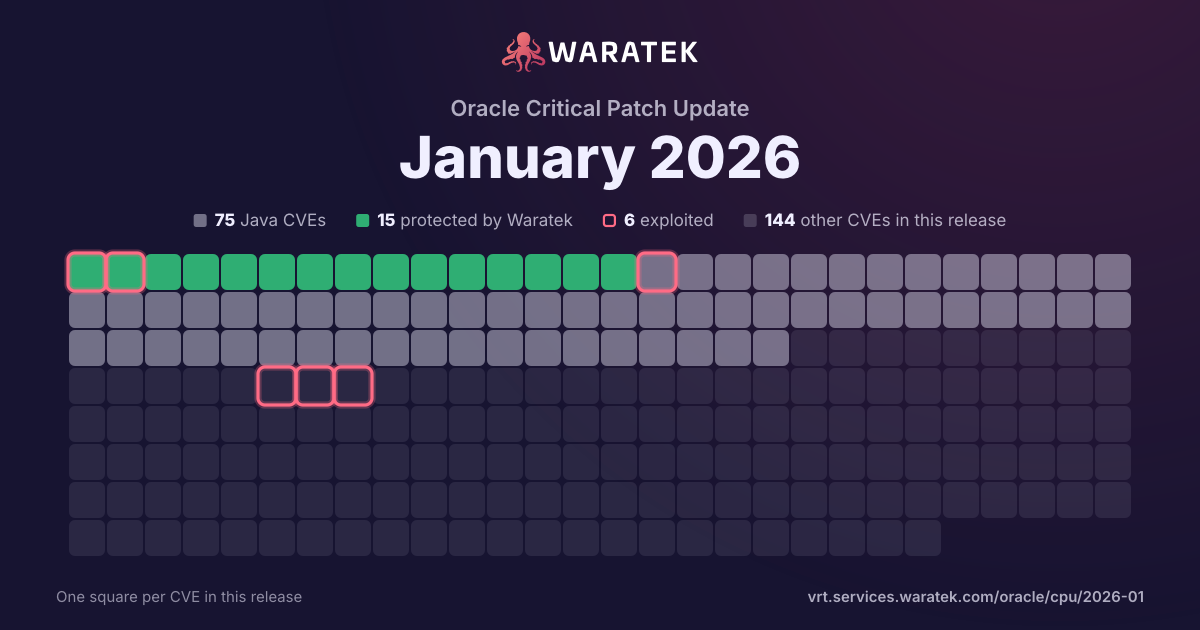
By status
14Protected by Waratek1Rule in development1Mitigation candidate63No exploit published11Outside Waratek scope129Not applicable
6Exploited, marked by the ring
No exploit published. For 26 of them, Oracle's security advisory is the source of public detail.
Protected by Waratek. Waratek RASP can block exploitation of these on systems that have not applied the patch yet.
Overview 6 matches · 0 protected · 0 exploited · 0 CISA KEV · 0 public PoC · 0 EPSS ≥ 0.5
6matches
0protected0.0%
0exploited0.0%
0CISA KEV0.0%
0public PoC0.0%
0EPSS ≥ 0.50.0%
Protected by Waratek
0
0.0%
Rule in development
0
0.0%
Mitigation candidate
0
0.0%
No exploit published
6
100.0%
blocked by ARMR today
0
0.0%
partly blocked
0
0.0%
not blocked
6
100.0%
not established
0
0.0%
unrecorded
0
0.0%
Exploited
0
0.0%
Working exploit published
0
0.0%
Proof of concept only
4
66.7%
Forecast only
0
0.0%
No public exploit
2
33.3%
split by
peak 2 / month
Oct 242
No exploit published2
Medium2
not blocked2
Proof of concept only1
No public exploit1
Nov 240
Dec 240
Jan 250
Feb 252
No exploit published2
High1
Medium1
not blocked2
Proof of concept only2
Mar 250
Apr 250
May 252
No exploit published2
High1
Low1
not blocked2
Proof of concept only1
No public exploit1
Oct 24Nov 24Dec 24Jan 25Feb 25Mar 25Apr 25May 25
| CVE | Severity | Published▾ | Status | Exploitation | Description |
|---|---|---|---|---|---|
| CVE-2025-48734 | High | 2025-05-28 | No exploit published | Proof of concept only | Improper Access Control vulnerability in Apache Commons. A special BeanIntrospector class was added in version 1.9.2. This can be used to stop attackers from using the declared class property of Java enum objects to get access to the classloader. However this protection was not enabled by default. PropertyUtilsBean (and consequently BeanUtilsBean) now disallows declared class level property access by default. Releases 1.11.0 and 2.0.0-M2 address a potential security issue when accessing enum properties in an uncontrolled way. If an application using Commons BeanUtils passes property paths from an external source directly to the getProperty() method of PropertyUtilsBean, an attacker can access the enum’s class loader via the “declaredClass” property available on all Java “enum” objects. Accessing the enum’s “declaredClass” allows remote attackers to access the ClassLoader and execute arbitrary code. The same issue exists with PropertyUtilsBean.getNestedProperty(). Starting in versions 1.11.0 and 2.0.0-M2 a special BeanIntrospector suppresses the “declaredClass” property. Note that this new BeanIntrospector is enabled by default, but you can disable it to regain the old behavior; see section 2.5 of the user's guide and the unit tests. This issue affects Apache Commons BeanUtils 1.x before 1.11.0, and 2.x before 2.0.0-M2.Users of the artifact commons-beanutils:commons-beanutils 1.x are recommended to upgrade to version 1.11.0, which fixes the issue. Users of the artifact org.apache.commons:commons-beanutils2 2.x are recommended to upgrade to version 2.0.0-M2, which fixes the issue. |
| CVE-2025-22233 | Low | 2025-05-16 | No exploit published | No public exploit | CVE-2024-38820 ensured Locale-independent, lowercase conversion for both the configured disallowedFields patterns and for request parameter names. However, there are still cases where it is possible to bypass the disallowedFields checks. Affected Spring Products and Versions Spring Framework: * 6.2.0 - 6.2.6 * 6.1.0 - 6.1.19 * 6.0.0 - 6.0.27 * 5.3.0 - 5.3.42 * Older, unsupported versions are also affected Mitigation Users of affected versions should upgrade to the corresponding fixed version. Affected version(s)Fix Version Availability 6.2.x 6.2.7 OSS6.1.x 6.1.20 OSS6.0.x 6.0.28 Commercial https://enterprise.spring.io/ 5.3.x 5.3.43 Commercial https://enterprise.spring.io/ No further mitigation steps are necessary. Generally, we recommend using a dedicated model object with properties only for data binding, or using constructor binding since constructor arguments explicitly declare what to bind together with turning off setter binding through the declarativeBinding flag. See the Model Design section in the reference documentation. For setting binding, prefer the use of allowedFields (an explicit list) over disallowedFields. Credit This issue was responsibly reported by the TERASOLUNA Framework Development Team from NTT DATA Group Corporation. |
| CVE-2025-25193 | Medium | 2025-02-10 | No exploit published | Proof of concept only | Netty, an asynchronous, event-driven network application framework, has a vulnerability in versions up to and including 4.1.118.Final. An unsafe reading of environment file could potentially cause a denial of service in Netty. When loaded on an Windows application, Netty attempts to load a file that does not exist. If an attacker creates such a large file, the Netty application crash. A similar issue was previously reported as CVE-2024-47535. This issue was fixed, but the fix was incomplete in that null-bytes were not counted against the input limit. Commit d1fbda62d3a47835d3fb35db8bd42ecc205a5386 contains an updated fix. |
| CVE-2024-57699 | High | 2025-02-05 | No exploit published | Proof of concept only | A security issue was found in Netplex Json-smart 2.5.0 through 2.5.1. When loading a specially crafted JSON input, containing a large number of ’{’, a stack exhaustion can be trigger, which could allow an attacker to cause a Denial of Service (DoS). This issue exists because of an incomplete fix for CVE-2023-1370. |
| CVE-2024-6763 | Medium | 2024-10-14 | No exploit published | Proof of concept only | Eclipse Jetty is a lightweight, highly scalable, Java-based web server and Servlet engine . It includes a utility class, HttpURI, for URI/URL parsing. The HttpURI class does insufficient validation on the authority segment of a URI. However the behaviour of HttpURI differs from the common browsers in how it handles a URI that would be considered invalid if fully validated against the RRC. Specifically HttpURI and the browser may differ on the value of the host extracted from an invalid URI and thus a combination of Jetty and a vulnerable browser may be vulnerable to a open redirect attack or to a SSRF attack if the URI is used after passing validation checks. |
| CVE-2024-47554 | Medium | 2024-10-03 | No exploit published | No public exploit | Uncontrolled Resource Consumption vulnerability in Apache Commons IO. The org.apache.commons.io.input.XmlStreamReader class may excessively consume CPU resources when processing maliciously crafted input. This issue affects Apache Commons IO: from 2.0 before 2.14.0. Users are recommended to upgrade to version 2.14.0 or later, which fixes the issue. |