
Oracle Critical Patch Update January 2026
Released January 2026 · Oracle's advisory ↗ · ← Critical Patch Update, October 2025 · Critical Patch Update, April 2026 →
219 CVEs in this release, one square each
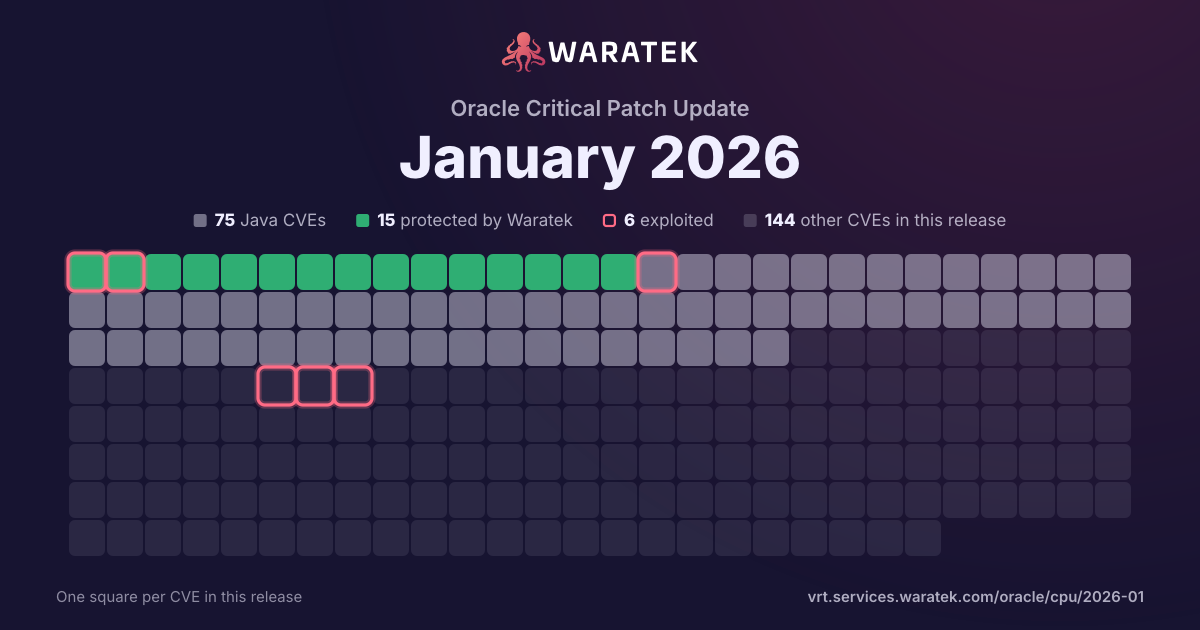
By status
14Protected by Waratek1Rule in development1Mitigation candidate63No exploit published11Outside Waratek scope129Not applicable
6Exploited, marked by the ring
No exploit published. For 26 of them, Oracle's security advisory is the source of public detail.
Protected by Waratek. Waratek RASP can block exploitation of these on systems that have not applied the patch yet.
Overview 9 matches · 2 protected · 0 exploited · 0 CISA KEV · 0 public PoC · 0 EPSS ≥ 0.5
Protected by Waratek
2
22.2%
Rule in development
0
0.0%
Mitigation candidate
0
0.0%
No exploit published
7
77.8%
blocked by ARMR today
2
22.2%
partly blocked
0
0.0%
not blocked
7
77.8%
not established
0
0.0%
unrecorded
0
0.0%
Exploited
0
0.0%
Working exploit published
0
0.0%
Proof of concept only
0
0.0%
Forecast only
0
0.0%
No public exploit
9
100.0%
split by
peak 3 / quarter
Q2 201
Protected by Waratek1
Critical1
blocked by ARMR today1
No public exploit1
Q3 200
Q4 200
Q1 210
Q2 210
Q3 210
Q4 210
Q1 220
Q2 220
Q3 220
Q4 220
Q1 230
Q2 230
Q3 230
Q4 230
Q1 240
Q2 240
Q3 240
Q4 242
Protected by Waratek1
No exploit published1
Critical1
Medium1
blocked by ARMR today1
not blocked1
No public exploit2
Q1 250
Q2 253
No exploit published3
High1
Medium1
Low1
not blocked3
No public exploit3
Q3 253
No exploit published3
Medium3
not blocked3
No public exploit3
Q3 20Q1 21Q3 21Q1 22Q3 22Q1 23Q3 23Q1 24Q3 24Q1 25Q3 25
| CVE | Severity | Published▾ | Status | Exploitation | Description |
|---|---|---|---|---|---|
| CVE-2025-7962 | Medium | 2025-07-21 | No exploit published | No public exploit | In Jakarta Mail versions prior to 2.0.2 it is possible to perform an SMTP Injection by utilizing the \r and \n UTF-8 characters to separate different messages. |
| CVE-2025-48795 | Medium | 2025-07-15 | No exploit published | No public exploit | Apache CXF stores large stream based messages as temporary files on the local filesystem. A bug was introduced which means that the entire temporary file is read into memory and then logged. An attacker might be able to exploit this to cause a denial of service attack by causing an out of memory exception. In addition, it is possible to configure CXF to encrypt temporary files to prevent sensitive credentials from being cached unencrypted on the local filesystem, however this bug means that the cached files are written out to logs unencrypted. Users are recommended to upgrade to versions 3.5.11, 3.6.6, 4.0.7 or 4.1.1, which fixes this issue. |
| CVE-2025-48924 | Medium | 2025-07-11 | No exploit published | No public exploit | Uncontrolled Recursion vulnerability in Apache Commons Lang. This issue affects Apache Commons Lang: Starting with commons-lang:commons-lang 2.0 to 2.6, and, from org.apache.commons:commons-lang3 3.0 before 3.18.0. The methods ClassUtils.getClass(...) can throw StackOverflowError on very long inputs. Because an Error is usually not handled by applications and libraries, a StackOverflowError could cause an application to stop. Users are recommended to upgrade to version 3.18.0, which fixes the issue. |
| CVE-2025-48976 | High | 2025-06-16 | No exploit published | No public exploit | Allocation of resources for multipart headers with insufficient limits enabled a DoS vulnerability in Apache Commons FileUpload. This issue affects Apache Commons FileUpload: from 1.0 before 1.6; from 2.0.0-M1 before 2.0.0-M4. Users are recommended to upgrade to versions 1.6 or 2.0.0-M4, which fix the issue. |
| CVE-2025-41234 | Medium | 2025-06-12 | No exploit published | No public exploit | Description In Spring Framework, versions 6.0.x as of 6.0.5, versions 6.1.x and 6.2.x, an application is vulnerable to a reflected file download (RFD) attack when it sets a “Content-Disposition” header with a non-ASCII charset, where the filename attribute is derived from user-supplied input. Specifically, an application is vulnerable when all the following are true: * The header is prepared with org.springframework.http.ContentDisposition. * The filename is set via ContentDisposition.Builder#filename(String, Charset). * The value for the filename is derived from user-supplied input. * The application does not sanitize the user-supplied input. * The downloaded content of the response is injected with malicious commands by the attacker (see RFD paper reference for details). An application is not vulnerable if any of the following is true: * The application does not set a “Content-Disposition” response header. * The header is not prepared with org.springframework.http.ContentDisposition. * The filename is set via one of: * ContentDisposition.Builder#filename(String), or * ContentDisposition.Builder#filename(String, ASCII) * The filename is not derived from user-supplied input. * The filename is derived from user-supplied input but sanitized by the application. * The attacker cannot inject malicious content in the downloaded content of the response. Affected Spring Products and VersionsSpring Framework: * 6.2.0 - 6.2.7 * 6.1.0 - 6.1.20 * 6.0.5 - 6.0.28 * Older, unsupported versions are not affected MitigationUsers of affected versions should upgrade to the corresponding fixed version. Affected version(s)Fix versionAvailability6.2.x6.2.8OSS6.1.x6.1.21OSS6.0.x6.0.29 Commercial https://enterprise.spring.io/ No further mitigation steps are necessary. CWE-113 in `Content-Disposition` handling in VMware Spring Framework versions 6.0.5 to 6.2.7 allows remote attackers to launch Reflected File Download (RFD) attacks via unsanitized user input in `ContentDisposition.Builder#filename(String, Charset)` with non-ASCII charsets. |
| CVE-2025-22233 | Low | 2025-05-16 | No exploit published | No public exploit | CVE-2024-38820 ensured Locale-independent, lowercase conversion for both the configured disallowedFields patterns and for request parameter names. However, there are still cases where it is possible to bypass the disallowedFields checks. Affected Spring Products and Versions Spring Framework: * 6.2.0 - 6.2.6 * 6.1.0 - 6.1.19 * 6.0.0 - 6.0.27 * 5.3.0 - 5.3.42 * Older, unsupported versions are also affected Mitigation Users of affected versions should upgrade to the corresponding fixed version. Affected version(s)Fix Version Availability 6.2.x 6.2.7 OSS6.1.x 6.1.20 OSS6.0.x 6.0.28 Commercial https://enterprise.spring.io/ 5.3.x 5.3.43 Commercial https://enterprise.spring.io/ No further mitigation steps are necessary. Generally, we recommend using a dedicated model object with properties only for data binding, or using constructor binding since constructor arguments explicitly declare what to bind together with turning off setter binding through the declarativeBinding flag. See the Model Design section in the reference documentation. For setting binding, prefer the use of allowedFields (an explicit list) over disallowedFields. Credit This issue was responsibly reported by the TERASOLUNA Framework Development Team from NTT DATA Group Corporation. |
| CVE-2024-52046 | Critical | 2024-12-25 | Protected by Waratek | No public exploit | The ObjectSerializationDecoder in Apache MINA uses Java’s native deserialization protocol to process incoming serialized data but lacks the necessary security checks and defenses. This vulnerability allows attackers to exploit the deserialization process by sending specially crafted malicious serialized data, potentially leading to remote code execution (RCE) attacks. This issue affects MINA core versions 2.0.X, 2.1.X and 2.2.X, and will be fixed by the releases 2.0.27, 2.1.10 and 2.2.4. It's also important to note that an application using MINA core library will only be affected if the IoBuffer#getObject() method is called, and this specific method is potentially called when adding a ProtocolCodecFilter instance using the ObjectSerializationCodecFactory class in the filter chain. If your application is specifically using those classes, you have to upgrade to the latest version of MINA core library. Upgrading will not be enough: you also need to explicitly allow the classes the decoder will accept in the ObjectSerializationDecoder instance, using one of the three new methods: /** * Accept class names where the supplied ClassNameMatcher matches for * deserialization, unless they are otherwise rejected. * * @param classNameMatcher the matcher to use */ public void accept(ClassNameMatcher classNameMatcher) /** * Accept class names that match the supplied pattern for * deserialization, unless they are otherwise rejected. * * @param pattern standard Java regexp */ public void accept(Pattern pattern) /** * Accept the wildcard specified classes for deserialization, * unless they are otherwise rejected. * * @param patterns Wildcard file name patterns as defined by * {@link org.apache.commons.io.FilenameUtils#wildcardMatch(String, String) FilenameUtils.wildcardMatch} */ public void accept(String... patterns) By default, the decoder will reject *all* classes that will be present in the incoming data. Note: The FtpServer, SSHd and Vysper sub-project are not affected by this issue. |
| CVE-2024-47554 | Medium | 2024-10-03 | No exploit published | No public exploit | Uncontrolled Resource Consumption vulnerability in Apache Commons IO. The org.apache.commons.io.input.XmlStreamReader class may excessively consume CPU resources when processing maliciously crafted input. This issue affects Apache Commons IO: from 2.0 before 2.14.0. Users are recommended to upgrade to version 2.14.0 or later, which fixes the issue. |
| CVE-2020-10683 | Critical | 2020-05-01 | Protected by Waratek | No public exploit | dom4j before 2.0.3 and 2.1.x before 2.1.3 allows external DTDs and External Entities by default, which might enable XXE attacks. However, there is popular external documentation from OWASP showing how to enable the safe, non-default behavior in any application that uses dom4j. |