
Oracle Critical Patch Update January 2026
Released January 2026 · Oracle's advisory ↗ · ← Critical Patch Update, October 2025 · Critical Patch Update, April 2026 →
219 CVEs in this release, one square each
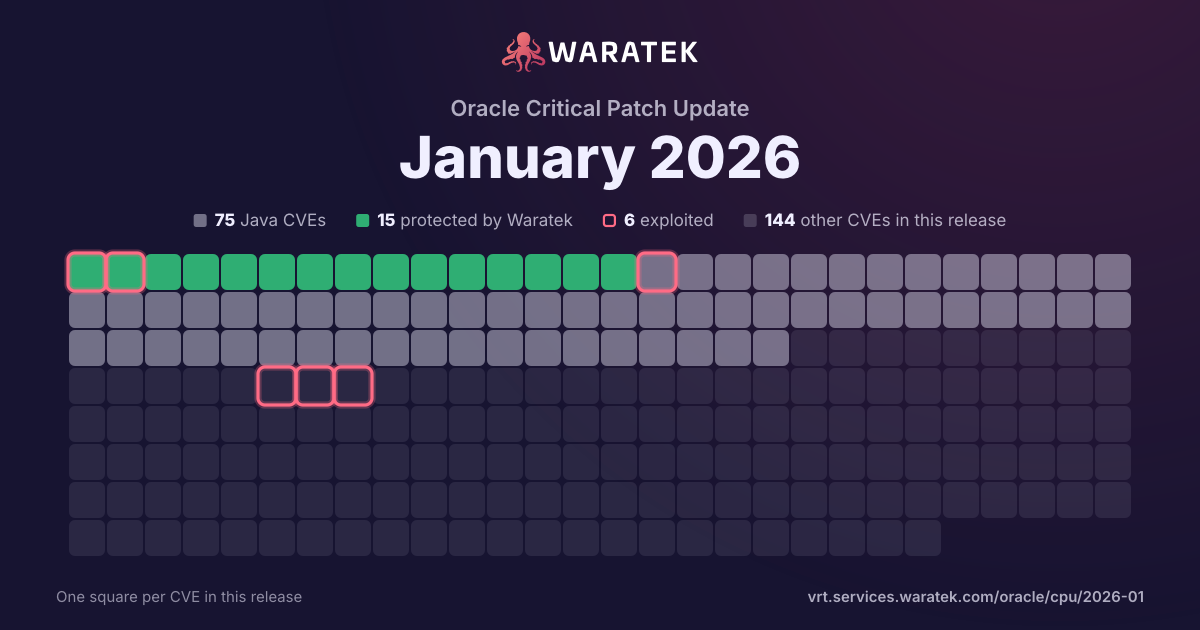
By status
14Protected by Waratek1Rule in development1Mitigation candidate63No exploit published11Outside Waratek scope129Not applicable
6Exploited, marked by the ring
No exploit published. For 26 of them, Oracle's security advisory is the source of public detail.
Protected by Waratek. Waratek RASP can block exploitation of these on systems that have not applied the patch yet.
Overview 11 matches · 0 protected · 0 exploited · 0 CISA KEV · 0 public PoC · 0 EPSS ≥ 0.5
11matches
0protected0.0%
0exploited0.0%
0CISA KEV0.0%
0public PoC0.0%
0EPSS ≥ 0.50.0%
Protected by Waratek
0
0.0%
Rule in development
0
0.0%
Mitigation candidate
0
0.0%
No exploit published
11
100.0%
blocked by ARMR today
0
0.0%
partly blocked
0
0.0%
not blocked
11
100.0%
not established
0
0.0%
unrecorded
0
0.0%
Exploited
0
0.0%
Working exploit published
0
0.0%
Proof of concept only
0
0.0%
Forecast only
0
0.0%
No public exploit
11
100.0%
split by
peak 4 / month
Aug 254
No exploit published4
High3
Medium1
not blocked4
No public exploit4
Sep 253
No exploit published3
High2
Low1
not blocked3
No public exploit3
Oct 251
No exploit published1
Medium1
not blocked1
No public exploit1
Nov 251
No exploit published1
Critical1
not blocked1
No public exploit1
Dec 252
No exploit published2
High1
Medium1
not blocked2
No public exploit2
Aug 25Sep 25Oct 25Nov 25Dec 25
| CVE | Severity | Published▾ | Status | Exploitation | Description |
|---|---|---|---|---|---|
| CVE-2025-68161 | Medium | 2025-12-18 | No exploit published | No public exploit | The Socket Appender in Apache Log4j Core versions 2.0-beta9 through 2.25.2 does not perform TLS hostname verification of the peer certificate, even when the verifyHostName https://logging.apache.org/log4j/2.x/manual/appenders/network.html#SslConfiguration-attr-verifyHostName configuration attribute or the log4j2.sslVerifyHostName https://logging.apache.org/log4j/2.x/manual/systemproperties.html#log4j2.sslVerifyHostName system property is set to true. This issue may allow a man-in-the-middle attacker to intercept or redirect log traffic under the following conditions: * The attacker is able to intercept or redirect network traffic between the client and the log receiver. * The attacker can present a server certificate issued by a certification authority trusted by the Socket Appender’s configured trust store (or by the default Java trust store if no custom trust store is configured). Users are advised to upgrade to Apache Log4j Core version 2.25.3, which addresses this issue. As an alternative mitigation, the Socket Appender may be configured to use a private or restricted trust root to limit the set of trusted certificates. |
| CVE-2025-66566 | High | 2025-12-05 | No exploit published | No public exploit | yawkat LZ4 Java provides LZ4 compression for Java. Insufficient clearing of the output buffer in Java-based decompressor implementations in lz4-java 1.10.0 and earlier allows remote attackers to read previous buffer contents via crafted compressed input. In applications where the output buffer is reused without being cleared, this may lead to disclosure of sensitive data. JNI-based implementations are not affected. This vulnerability is fixed in 1.10.1. |
| CVE-2025-12383 | Critical | 2025-11-18 | No exploit published | No public exploit | In Eclipse Jersey versions 2.45, 3.0.16, 3.1.9 a race condition can cause ignoring of critical SSL configurations - such as mutual authentication, custom key/trust stores, and other security settings. This issue may result in SSLHandshakeException under normal circumstances, but under certain conditions, it could lead to unauthorized trust in insecure servers (see PoC) |
| CVE-2025-61795 | Medium | 2025-10-27 | No exploit published | No public exploit | Improper Resource Shutdown or Release vulnerability in Apache Tomcat. If an error occurred (including exceeding limits) during the processing of a multipart upload, temporary copies of the uploaded parts written to disc were not cleaned up immediately but left for the garbage collection process to delete. Depending on JVM settings, application memory usage and application load, it was possible that space for the temporary copies of uploaded parts would be filled faster than GC cleared it, leading to a DoS. This issue affects Apache Tomcat: from 11.0.0-M1 through 11.0.11, from 10.1.0-M1 through 10.1.46, from 9.0.0.M1 through 9.0.109. The following versions were EOL at the time the CVE was created but are known to be affected: 8.5.0 though 8.5.100. Other, older, EOL versions may also be affected. Users are recommended to upgrade to version 11.0.12 or later, 10.1.47 or later or 9.0.110 or later which fixes the issue. |
| CVE-2025-41249 | High | 2025-09-16 | No exploit published | No public exploit | The Spring Framework annotation detection mechanism may not correctly resolve annotations on methods within type hierarchies with a parameterized super type with unbounded generics. This can be an issue if such annotations are used for authorization decisions. Your application may be affected by this if you are using Spring Security's @EnableMethodSecurity feature. You are not affected by this if you are not using @EnableMethodSecurity or if you do not use security annotations on methods in generic superclasses or generic interfaces. This CVE is published in conjunction with CVE-2025-41248 https://spring.io/security/cve-2025-41248 . |
| CVE-2025-41248 | High | 2025-09-16 | No exploit published | No public exploit | The Spring Security annotation detection mechanism may not correctly resolve annotations on methods within type hierarchies with a parameterized super type with unbounded generics. This can be an issue when using @PreAuthorize and other method security annotations, resulting in an authorization bypass. Your application may be affected by this if you are using Spring Security's @EnableMethodSecurity feature. You are not affected by this if you are not using @EnableMethodSecurity or if you do not use security annotations on methods in generic superclasses or generic interfaces. This CVE is published in conjunction with CVE-2025-41249 https://spring.io/security/cve-2025-41249 . |
| CVE-2025-58056 | Low | 2025-09-03 | No exploit published | No public exploit | Netty is an asynchronous event-driven network application framework for development of maintainable high performance protocol servers and clients. In versions 4.1.124.Final, and 4.2.0.Alpha3 through 4.2.4.Final, Netty incorrectly accepts standalone newline characters (LF) as a chunk-size line terminator, regardless of a preceding carriage return (CR), instead of requiring CRLF per HTTP/1.1 standards. When combined with reverse proxies that parse LF differently (treating it as part of the chunk extension), attackers can craft requests that the proxy sees as one request but Netty processes as two, enabling request smuggling attacks. This is fixed in versions 4.1.125.Final and 4.2.5.Final. |
| CVE-2025-5115 | High | 2025-08-20 | No exploit published | No public exploit | In Eclipse Jetty, versions <=9.4.57, <=10.0.25, <=11.0.25, <=12.0.21, <=12.1.0.alpha2, an HTTP/2 client may trigger the server to send RST_STREAM frames, for example by sending frames that are malformed or that should not be sent in a particular stream state, therefore forcing the server to consume resources such as CPU and memory. For example, a client can open a stream and then send WINDOW_UPDATE frames with window size increment of 0, which is illegal. Per specification https://www.rfc-editor.org/rfc/rfc9113.html#name-window_update , the server should send a RST_STREAM frame. The client can now open another stream and send another bad WINDOW_UPDATE, therefore causing the server to consume more resources than necessary, as this case does not exceed the max number of concurrent streams, yet the client is able to create an enormous amount of streams in a short period of time. The attack can be performed with other conditions (for example, a DATA frame for a closed stream) that cause the server to send a RST_STREAM frame. Links: * https://github.com/jetty/jetty.project/security/advisories/GHSA-mmxm-8w33-wc4h |
| CVE-2025-8916 | Medium | 2025-08-13 | No exploit published | No public exploit | Allocation of Resources Without Limits or Throttling vulnerability in Legion of the Bouncy Castle Inc. BC Java bcpkix on All (API modules), Legion of the Bouncy Castle Inc. BC Java bcprov on All (API modules), Legion of the Bouncy Castle Inc. BCPKIX FIPS bcpkix-fips on All (API modules) allows Excessive Allocation. This vulnerability is associated with program files https://github.Com/bcgit/bc-java/blob/main/pkix/src/main/java/org/bouncycastle/pkix/jcajce/PKIXCertPathReviewer.Java, https://github.Com/bcgit/bc-java/blob/main/prov/src/main/java/org/bouncycastle/x509/PKIXCertPathReviewer.Java. This issue affects BC Java: from 1.44 through 1.78; BC Java: from 1.44 through 1.78; BCPKIX FIPS: from 1.0.0 through 1.0.7, from 2.0.0 through 2.0.7. |
| CVE-2025-55163 | High | 2025-08-13 | No exploit published | No public exploit | Netty is an asynchronous, event-driven network application framework. Prior to versions 4.1.124.Final and 4.2.4.Final, Netty is vulnerable to MadeYouReset DDoS. This is a logical vulnerability in the HTTP/2 protocol, that uses malformed HTTP/2 control frames in order to break the max concurrent streams limit - which results in resource exhaustion and distributed denial of service. This issue has been patched in versions 4.1.124.Final and 4.2.4.Final. |
| CVE-2025-48989 | High | 2025-08-13 | No exploit published | No public exploit | Improper Resource Shutdown or Release vulnerability in Apache Tomcat made Tomcat vulnerable to the made you reset attack. This issue affects Apache Tomcat: from 11.0.0-M1 through 11.0.9, from 10.1.0-M1 through 10.1.43 and from 9.0.0.M1 through 9.0.107. Older, EOL versions may also be affected. Users are recommended to upgrade to one of versions 11.0.10, 10.1.44 or 9.0.108 which fix the issue. |