
Oracle Critical Patch Update October 2025
Released October 2025 · Oracle's advisory ↗ · ← Critical Patch Update, July 2025 · Critical Patch Update, January 2026 →
234 CVEs in this release, one square each
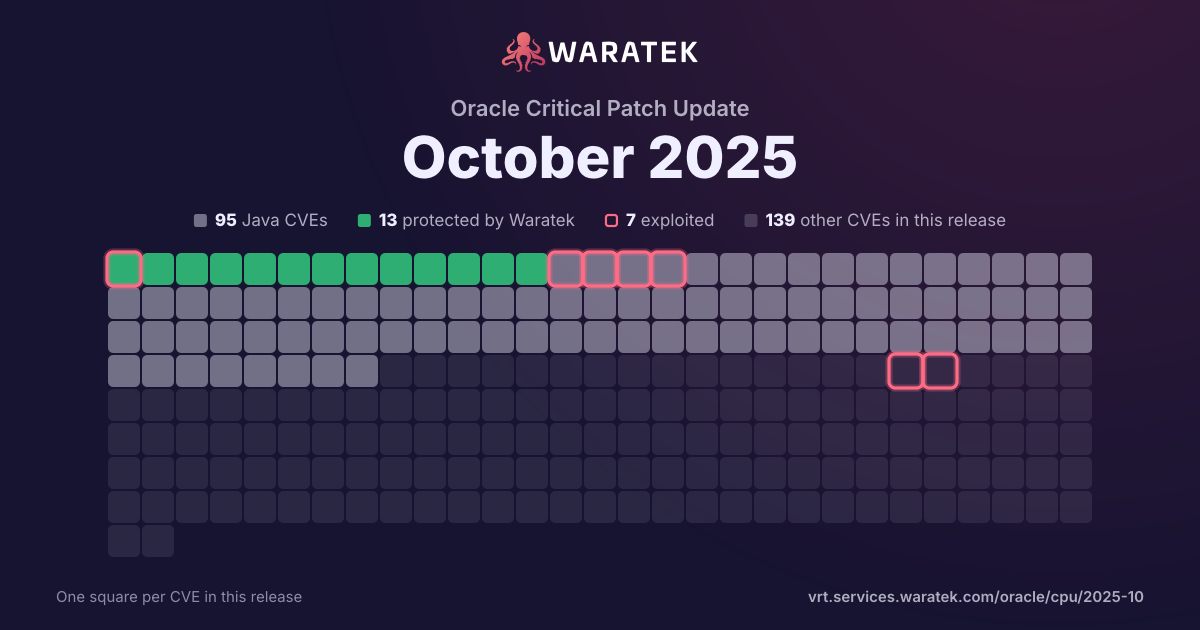
By status
11Protected by Waratek1Rule in development5Mitigation candidate87No exploit published4Outside Waratek scope126Not applicable
7Exploited, marked by the ring
No exploit published. For 37 of them, Oracle's security advisory is the source of public detail.
Protected by Waratek. Waratek RASP can block exploitation of these on systems that have not applied the patch yet.
Overview 11 matches · 5 in Waratek scope · 1 protected · 0 exploited · 0 CISA KEV · 0 public PoC · 0 EPSS ≥ 0.5
11matches
5in Waratek scope45.5%
1protected9.1%
0exploited0.0%
0CISA KEV0.0%
0public PoC0.0%
0EPSS ≥ 0.50.0%
Protected by Waratek
1
9.1%
Rule in development
0
0.0%
Mitigation candidate
0
0.0%
No exploit published
4
36.4%
Outside Waratek scope
1
9.1%
Not applicable
5
45.5%
Withdrawn CVE
0
0.0%
blocked by ARMR today
1
9.1%
partly blocked
0
0.0%
not blocked
10
90.9%
not established
0
0.0%
unrecorded
0
0.0%
Exploited
0
0.0%
Working exploit published
0
0.0%
Proof of concept only
11
100.0%
Forecast only
0
0.0%
No public exploit
0
0.0%
split by
peak 4 / quarter
Q2 211
Not applicable1
Medium1
not blocked1
Proof of concept only1
Q3 210
Q4 210
Q1 220
Q2 220
Q3 220
Q4 220
Q1 230
Q2 231
Not applicable1
Medium1
not blocked1
Proof of concept only1
Q3 230
Q4 230
Q1 241
Outside Waratek scope1
Medium1
not blocked1
Proof of concept only1
Q2 240
Q3 241
Not applicable1
Medium1
not blocked1
Proof of concept only1
Q4 240
Q1 253
No exploit published3
High2
Medium1
not blocked3
Proof of concept only3
Q2 254
Protected by Waratek1
No exploit published1
Not applicable2
High3
Medium1
blocked by ARMR today1
not blocked3
Proof of concept only4
Q2 21Q4 21Q2 22Q4 22Q2 23Q4 23Q2 24Q4 24Q2 25
| CVE | Severity | Published▾ | Status | Exploitation | Description |
|---|---|---|---|---|---|
| CVE-2025-48734 | High | 2025-05-28 | No exploit published | Proof of concept only | Improper Access Control vulnerability in Apache Commons. A special BeanIntrospector class was added in version 1.9.2. This can be used to stop attackers from using the declared class property of Java enum objects to get access to the classloader. However this protection was not enabled by default. PropertyUtilsBean (and consequently BeanUtilsBean) now disallows declared class level property access by default. Releases 1.11.0 and 2.0.0-M2 address a potential security issue when accessing enum properties in an uncontrolled way. If an application using Commons BeanUtils passes property paths from an external source directly to the getProperty() method of PropertyUtilsBean, an attacker can access the enum’s class loader via the “declaredClass” property available on all Java “enum” objects. Accessing the enum’s “declaredClass” allows remote attackers to access the ClassLoader and execute arbitrary code. The same issue exists with PropertyUtilsBean.getNestedProperty(). Starting in versions 1.11.0 and 2.0.0-M2 a special BeanIntrospector suppresses the “declaredClass” property. Note that this new BeanIntrospector is enabled by default, but you can disable it to regain the old behavior; see section 2.5 of the user's guide and the unit tests. This issue affects Apache Commons BeanUtils 1.x before 1.11.0, and 2.x before 2.0.0-M2.Users of the artifact commons-beanutils:commons-beanutils 1.x are recommended to upgrade to version 1.11.0, which fixes the issue. Users of the artifact org.apache.commons:commons-beanutils2 2.x are recommended to upgrade to version 2.0.0-M2, which fixes the issue. |
| CVE-2025-4949 | Medium | 2025-05-21 | Protected by Waratek | Proof of concept only | In Eclipse JGit versions 7.2.0.202503040940-r and older, the ManifestParser class used by the repo command and the AmazonS3 class used to implement the experimental amazons3 git transport protocol allowing to store git pack files in an Amazon S3 bucket, are vulnerable to XML External Entity (XXE) attacks when parsing XML files. This vulnerability can lead to information disclosure, denial of service, and other security issues. |
| CVE-2025-32415 | High | 2025-04-17 | Not applicable | Proof of concept only | In libxml2 before 2.13.8 and 2.14.x before 2.14.2, xmlSchemaIDCFillNodeTables in xmlschemas.c has a heap-based buffer under-read. To exploit this, a crafted XML document must be validated against an XML schema with certain identity constraints, or a crafted XML schema must be used. |
| CVE-2025-32414 | High | 2025-04-08 | Not applicable | Proof of concept only | In libxml2 before 2.13.8 and 2.14.x before 2.14.2, out-of-bounds memory access can occur in the Python API (Python bindings) because of an incorrect return value. This occurs in xmlPythonFileRead and xmlPythonFileReadRaw because of a difference between bytes and characters. |
| CVE-2025-25193 | Medium | 2025-02-10 | No exploit published | Proof of concept only | Netty, an asynchronous, event-driven network application framework, has a vulnerability in versions up to and including 4.1.118.Final. An unsafe reading of environment file could potentially cause a denial of service in Netty. When loaded on an Windows application, Netty attempts to load a file that does not exist. If an attacker creates such a large file, the Netty application crash. A similar issue was previously reported as CVE-2024-47535. This issue was fixed, but the fix was incomplete in that null-bytes were not counted against the input limit. Commit d1fbda62d3a47835d3fb35db8bd42ecc205a5386 contains an updated fix. |
| CVE-2025-24970 | High | 2025-02-10 | No exploit published | Proof of concept only | Netty, an asynchronous, event-driven network application framework, has a vulnerability starting in version 4.1.91.Final and prior to version 4.1.118.Final. When a special crafted packet is received via SslHandler it doesn't correctly handle validation of such a packet in all cases which can lead to a native crash. Version 4.1.118.Final contains a patch. As workaround its possible to either disable the usage of the native SSLEngine or change the code manually. |
| CVE-2024-57699 | High | 2025-02-05 | No exploit published | Proof of concept only | A security issue was found in Netplex Json-smart 2.5.0 through 2.5.1. When loading a specially crafted JSON input, containing a large number of ’{’, a stack exhaustion can be trigger, which could allow an attacker to cause a Denial of Service (DoS). This issue exists because of an incomplete fix for CVE-2023-1370. |
| CVE-2024-6923 | Medium | 2024-08-01 | Not applicable | Proof of concept only | There is a MEDIUM severity vulnerability affecting CPython. The email module didn’t properly quote newlines for email headers when serializing an email message allowing for header injection when an email is serialized. |
| CVE-2024-26462 | Medium | 2024-02-29 | Outside Waratek scope | Proof of concept only | Kerberos 5 (aka krb5) 1.21.2 contains a memory leak vulnerability in /krb5/src/kdc/ndr.c. |
| CVE-2023-26554 | Medium | 2023-04-11 | Not applicable | Proof of concept only | mstolfp in libntp/mstolfp.c in NTP 4.2.8p15 has an out-of-bounds write when adding a '\0' character. An adversary may be able to attack a client ntpq process, but cannot attack ntpd. |
| CVE-2021-22897 | Medium | 2021-06-11 | Not applicable | Proof of concept only | curl 7.61.0 through 7.76.1 suffers from exposure of data element to wrong session due to a mistake in the code for CURLOPT_SSL_CIPHER_LIST when libcurl is built to use the Schannel TLS library. The selected cipher set was stored in a single "static" variable in the library, which has the surprising side-effect that if an application sets up multiple concurrent transfers, the last one that sets the ciphers will accidentally control the set used by all transfers. In a worst-case scenario, this weakens transport security significantly. |