
Oracle Critical Patch Update October 2025
Released October 2025 · Oracle's advisory ↗ · ← Critical Patch Update, July 2025 · Critical Patch Update, January 2026 →
234 CVEs in this release, one square each
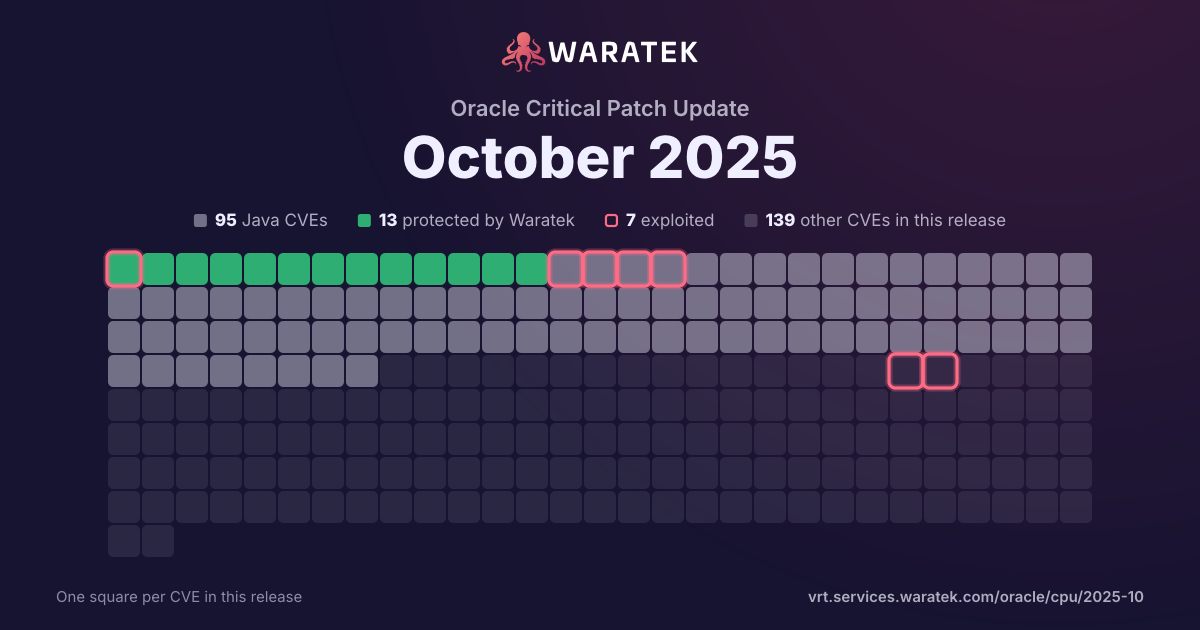
By status
13Protected by Waratek5Mitigation candidate77No exploit published15Outside Waratek scope124Not applicable
7Exploited, marked by the ring
No exploit published. For 36 of them, Oracle's security advisory is the source of public detail.
Protected by Waratek. Waratek RASP can block exploitation of these on systems that have not applied the patch yet.
Overview 16 matches · 7 in Waratek scope · 3 protected · 3 exploited · 1 CISA KEV · 2 public PoC · 2 EPSS ≥ 0.5
16matches
7in Waratek scope43.8%
3protected18.8%
3exploited18.8%
1CISA KEV6.2%
2public PoC12.5%
2EPSS ≥ 0.512.5%
Protected by Waratek
3
18.8%
Rule in development
0
0.0%
Mitigation candidate
2
12.5%
No exploit published
2
12.5%
Outside Waratek scope
3
18.8%
Not applicable
6
37.5%
Withdrawn CVE
0
0.0%
blocked by ARMR today
3
18.8%
partly blocked
0
0.0%
not blocked
11
68.8%
not established
2
12.5%
unrecorded
0
0.0%
Exploited
3
18.8%
Working exploit published
0
0.0%
Proof of concept only
1
6.2%
Forecast only
1
6.2%
No public exploit
11
68.8%
split by
peak 4 / quarter
Q3 211
Outside Waratek scope1
Critical1
not blocked1
Forecast only1
Q4 210
Q1 220
Q2 220
Q3 220
Q4 220
Q1 230
Q2 230
Q3 230
Q4 231
Not applicable1
Critical1
not blocked1
No public exploit1
Q1 241
Not applicable1
Critical1
not blocked1
No public exploit1
Q2 241
Not applicable1
Critical1
not blocked1
No public exploit1
Q3 240
Q4 243
Protected by Waratek1
No exploit published1
Outside Waratek scope1
Critical3
blocked by ARMR today1
not blocked2
No public exploit3
Q1 251
Protected by Waratek1
Critical1
blocked by ARMR today1
No public exploit1
Q2 254
Outside Waratek scope1
Not applicable3
Critical4
not blocked4
Proof of concept only1
No public exploit3
Q3 250
Q4 254
Protected by Waratek1
Mitigation candidate2
No exploit published1
Critical4
blocked by ARMR today1
not blocked1
not established2
Exploited3
No public exploit1
Q4 21Q2 22Q4 22Q2 23Q4 23Q2 24Q4 24Q2 25Q4 25
| CVE | Severity | Published▾ | Status | Exploitation | Description |
|---|---|---|---|---|---|
| CVE-2025-62481 | Critical | 2025-10-21 | Mitigation candidate | Exploited | Vulnerability in the Oracle Marketing product of Oracle E-Business Suite (component: Marketing Administration). Supported versions that are affected are 12.2.3-12.2.14. Easily exploitable vulnerability allows unauthenticated attacker with network access via HTTP to compromise Oracle Marketing. Successful attacks of this vulnerability can result in takeover of Oracle Marketing. CVSS 3.1 Base Score 9.8 (Confidentiality, Integrity and Availability impacts). CVSS Vector: (CVSS:3.1/AV:N/AC:L/PR:N/UI:N/S:U/C:H/I:H/A:H). |
| CVE-2025-61757 | Critical | 2025-10-21 | Protected by Waratek | Exploited | Vulnerability in the Identity Manager product of Oracle Fusion Middleware (component: REST WebServices). Supported versions that are affected are 12.2.1.4.0 and 14.1.2.1.0. Easily exploitable vulnerability allows unauthenticated attacker with network access via HTTP to compromise Identity Manager. Successful attacks of this vulnerability can result in takeover of Identity Manager. CVSS 3.1 Base Score 9.8 (Confidentiality, Integrity and Availability impacts). CVSS Vector: (CVSS:3.1/AV:N/AC:L/PR:N/UI:N/S:U/C:H/I:H/A:H). |
| CVE-2025-53072 | Critical | 2025-10-21 | Mitigation candidate | Exploited | Vulnerability in the Oracle Marketing product of Oracle E-Business Suite (component: Marketing Administration). Supported versions that are affected are 12.2.3-12.2.14. Easily exploitable vulnerability allows unauthenticated attacker with network access via HTTP to compromise Oracle Marketing. Successful attacks of this vulnerability can result in takeover of Oracle Marketing. CVSS 3.1 Base Score 9.8 (Confidentiality, Integrity and Availability impacts). CVSS Vector: (CVSS:3.1/AV:N/AC:L/PR:N/UI:N/S:U/C:H/I:H/A:H). |
| CVE-2025-53037 | Critical | 2025-10-21 | No exploit published | No public exploit | Vulnerability in the Oracle Financial Services Analytical Applications Infrastructure product of Oracle Financial Services Applications (component: Platform). Supported versions that are affected are 8.0.7.9, 8.0.8.7 and 8.1.2.5. Easily exploitable vulnerability allows unauthenticated attacker with network access via HTTP to compromise Oracle Financial Services Analytical Applications Infrastructure. Successful attacks of this vulnerability can result in takeover of Oracle Financial Services Analytical Applications Infrastructure. CVSS 3.1 Base Score 9.8 (Confidentiality, Integrity and Availability impacts). CVSS Vector: (CVSS:3.1/AV:N/AC:L/PR:N/UI:N/S:U/C:H/I:H/A:H). |
| CVE-2025-49796 | Critical | 2025-06-16 | Not applicable | No public exploit | A vulnerability was found in libxml2. Processing certain sch:name elements from the input XML file can trigger a memory corruption issue. This flaw allows an attacker to craft a malicious XML input file that can lead libxml to crash, resulting in a denial of service or other possible undefined behavior due to sensitive data being corrupted in memory. |
| CVE-2025-49794 | Critical | 2025-06-16 | Not applicable | No public exploit | A use-after-free vulnerability was found in libxml2. This issue occurs when parsing XPath elements under certain circumstances when the XML schematron has the <sch:name path="..."/> schema elements. This flaw allows a malicious actor to craft a malicious XML document used as input for libxml, resulting in the program's crash using libxml or other possible undefined behaviors. |
| CVE-2025-4517 | Critical | 2025-06-03 | Not applicable | Proof of concept only | Allows arbitrary filesystem writes outside the extraction directory during extraction with filter="data". You are affected by this vulnerability if using the tarfile module to extract untrusted tar archives using TarFile.extractall() or TarFile.extract() using the filter= parameter with a value of "data" or "tar". See the tarfile extraction filters documentation https://docs.python.org/3/library/tarfile.html#tarfile-extraction-filter for more information. Note that for Python 3.14 or later the default value of filter= changed from "no filtering" to `"data", so if you are relying on this new default behavior then your usage is also affected. Note that none of these vulnerabilities significantly affect the installation of source distributions which are tar archives as source distributions already allow arbitrary code execution during the build process. However when evaluating source distributions it's important to avoid installing source distributions with suspicious links. |
| CVE-2025-31651 | Critical | 2025-04-28 | Outside Waratek scope | No public exploit | Improper Neutralization of Escape, Meta, or Control Sequences vulnerability in Apache Tomcat. For a subset of unlikely rewrite rule configurations, it was possible for a specially crafted request to bypass some rewrite rules. If those rewrite rules effectively enforced security constraints, those constraints could be bypassed. This issue affects Apache Tomcat: from 11.0.0-M1 through 11.0.5, from 10.1.0-M1 through 10.1.39, from 9.0.0.M1 through 9.0.102. The following versions were EOL at the time the CVE was created but are known to be affected: 8.5.0 though 8.5.100. Other, older, EOL versions may also be affected. Users are recommended to upgrade to version [FIXED_VERSION], which fixes the issue. |
| CVE-2024-52577 | Critical | 2025-02-14 | Protected by Waratek | No public exploit | In Apache Ignite versions from 2.6.0 and before 2.17.0, configured Class Serialization Filters are ignored for some Ignite endpoints. The vulnerability could be exploited if an attacker manually crafts an Ignite message containing a vulnerable object whose class is present in the Ignite server classpath and sends it to Ignite server endpoints. Deserialization of such a message by the Ignite server may result in the execution of arbitrary code on the Apache Ignite server side. |
| CVE-2024-52046 | Critical | 2024-12-25 | Protected by Waratek | No public exploit | The ObjectSerializationDecoder in Apache MINA uses Java’s native deserialization protocol to process incoming serialized data but lacks the necessary security checks and defenses. This vulnerability allows attackers to exploit the deserialization process by sending specially crafted malicious serialized data, potentially leading to remote code execution (RCE) attacks. This issue affects MINA core versions 2.0.X, 2.1.X and 2.2.X, and will be fixed by the releases 2.0.27, 2.1.10 and 2.2.4. It's also important to note that an application using MINA core library will only be affected if the IoBuffer#getObject() method is called, and this specific method is potentially called when adding a ProtocolCodecFilter instance using the ObjectSerializationCodecFactory class in the filter chain. If your application is specifically using those classes, you have to upgrade to the latest version of MINA core library. Upgrading will not be enough: you also need to explicitly allow the classes the decoder will accept in the ObjectSerializationDecoder instance, using one of the three new methods: /** * Accept class names where the supplied ClassNameMatcher matches for * deserialization, unless they are otherwise rejected. * * @param classNameMatcher the matcher to use */ public void accept(ClassNameMatcher classNameMatcher) /** * Accept class names that match the supplied pattern for * deserialization, unless they are otherwise rejected. * * @param pattern standard Java regexp */ public void accept(Pattern pattern) /** * Accept the wildcard specified classes for deserialization, * unless they are otherwise rejected. * * @param patterns Wildcard file name patterns as defined by * {@link org.apache.commons.io.FilenameUtils#wildcardMatch(String, String) FilenameUtils.wildcardMatch} */ public void accept(String... patterns) By default, the decoder will reject *all* classes that will be present in the incoming data. Note: The FtpServer, SSHd and Vysper sub-project are not affected by this issue. |
| CVE-2024-52533 | Critical | 2024-11-11 | Outside Waratek scope | No public exploit | gio/gsocks4aproxy.c in GNOME GLib before 2.82.1 has an off-by-one error and resultant buffer overflow because SOCKS4_CONN_MSG_LEN is not sufficient for a trailing '\0' character. |
| CVE-2024-51504 | Critical | 2024-11-07 | No exploit published | No public exploit | When using IPAuthenticationProvider in ZooKeeper Admin Server there is a possibility of Authentication Bypass by Spoofing -- this only impacts IP based authentication implemented in ZooKeeper Admin Server. Default configuration of client's IP address detection in IPAuthenticationProvider, which uses HTTP request headers, is weak and allows an attacker to bypass authentication via spoofing client's IP address in request headers. Default configuration honors X-Forwarded-For HTTP header to read client's IP address. X-Forwarded-For request header is mainly used by proxy servers to identify the client and can be easily spoofed by an attacker pretending that the request comes from a different IP address. Admin Server commands, such as snapshot and restore arbitrarily can be executed on successful exploitation which could potentially lead to information leakage or service availability issues. Users are recommended to upgrade to version 3.9.3, which fixes this issue. |
| CVE-2024-37371 | Critical | 2024-06-28 | Not applicable | No public exploit | In MIT Kerberos 5 (aka krb5) before 1.21.3, an attacker can cause invalid memory reads during GSS message token handling by sending message tokens with invalid length fields. |
| CVE-2024-23807 | Critical | 2024-02-29 | Not applicable | No public exploit | The Apache Xerces C++ XML parser on versions 3.0.0 before 3.2.5 contains a use-after-free error triggered during the scanning of external DTDs. Users are recommended to upgrade to version 3.2.5 which fixes the issue, or mitigate the issue by disabling DTD processing. This can be accomplished via the DOM using a standard parser feature, or via SAX using the XERCES_DISABLE_DTD environment variable. This issue has been disclosed before as CVE-2018-1311, but unfortunately that advisory incorrectly stated the issue would be fixed in version 3.2.3 or 3.2.4. |
| CVE-2023-45853 | Critical | 2023-10-14 | Not applicable | No public exploit | MiniZip in zlib through 1.3 has an integer overflow and resultant heap-based buffer overflow in zipOpenNewFileInZip4_64 via a long filename, comment, or extra field. NOTE: MiniZip is not a supported part of the zlib product. NOTE: pyminizip through 0.2.6 is also vulnerable because it bundles an affected zlib version, and exposes the applicable MiniZip code through its compress API. |
| CVE-2021-3711 | Critical | 2021-08-24 | Outside Waratek scope | Forecast only | In order to decrypt SM2 encrypted data an application is expected to call the API function EVP_PKEY_decrypt(). Typically an application will call this function twice. The first time, on entry, the "out" parameter can be NULL and, on exit, the "outlen" parameter is populated with the buffer size required to hold the decrypted plaintext. The application can then allocate a sufficiently sized buffer and call EVP_PKEY_decrypt() again, but this time passing a non-NULL value for the "out" parameter. A bug in the implementation of the SM2 decryption code means that the calculation of the buffer size required to hold the plaintext returned by the first call to EVP_PKEY_decrypt() can be smaller than the actual size required by the second call. This can lead to a buffer overflow when EVP_PKEY_decrypt() is called by the application a second time with a buffer that is too small. A malicious attacker who is able present SM2 content for decryption to an application could cause attacker chosen data to overflow the buffer by up to a maximum of 62 bytes altering the contents of other data held after the buffer, possibly changing application behaviour or causing the application to crash. The location of the buffer is application dependent but is typically heap allocated. Fixed in OpenSSL 1.1.1l (Affected 1.1.1-1.1.1k). |