
Oracle Critical Patch Update July 2025
Released July 2025 · Oracle's advisory ↗ · ← Critical Patch Update, April 2025 · Critical Patch Update, October 2025 →
196 CVEs in this release, one square each
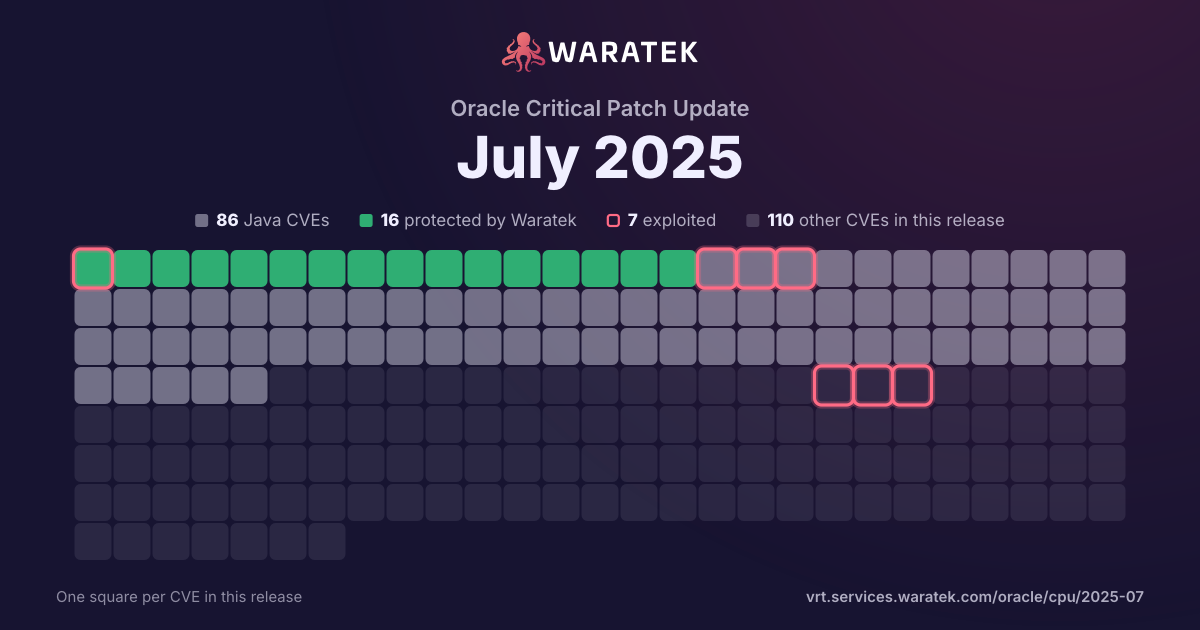
By status
16Protected by Waratek4Mitigation candidate69No exploit published7Outside Waratek scope100Not applicable
7Exploited, marked by the ring
No exploit published. For 30 of them, Oracle's security advisory is the source of public detail.
Protected by Waratek. Waratek RASP can block exploitation of these on systems that have not applied the patch yet.
Overview 12 matches · 0 protected · 1 exploited · 0 CISA KEV · 2 public PoC · 1 EPSS ≥ 0.5
Protected by Waratek
0
0.0%
Rule in development
0
0.0%
Mitigation candidate
2
16.7%
No exploit published
10
83.3%
blocked by ARMR today
0
0.0%
partly blocked
0
0.0%
not blocked
12
100.0%
not established
0
0.0%
unrecorded
0
0.0%
split by
peak 5 / month
Apr 255
No exploit published5
Critical1
High1
Medium3
not blocked5
No public exploit5
May 252
Mitigation candidate1
No exploit published1
High1
Medium1
not blocked2
Working exploit published1
Proof of concept only1
Jun 255
Mitigation candidate1
No exploit published4
High5
not blocked5
Exploited1
No public exploit4
Apr 25May 25Jun 25
| CVE | Severity | Published▾ | Status | Exploitation | Description |
|---|---|---|---|---|---|
| CVE-2025-49125 | High | 2025-06-16 | No exploit published | No public exploit | Authentication Bypass Using an Alternate Path or Channel vulnerability in Apache Tomcat. When using PreResources or PostResources mounted other than at the root of the web application, it was possible to access those resources via an unexpected path. That path was likely not to be protected by the same security constraints as the expected path, allowing those security constraints to be bypassed. This issue affects Apache Tomcat: from 11.0.0-M1 through 11.0.7, from 10.1.0-M1 through 10.1.41, from 9.0.0.M1 through 9.0.105. The following versions were EOL at the time the CVE was created but are known to be affected: 8.5.0 through 8.5.100. Other, older, EOL versions may also be affected. Users are recommended to upgrade to version 11.0.8, 10.1.42 or 9.0.106, which fix the issue. |
| CVE-2025-49124 | High | 2025-06-16 | No exploit published | No public exploit | Untrusted Search Path vulnerability in Apache Tomcat installer for Windows. During installation, the Tomcat installer for Windows used icacls.exe without specifying a full path. This issue affects Apache Tomcat: from 11.0.0-M1 through 11.0.7, from 10.1.0 through 10.1.41, from 9.0.23 through 9.0.105. The following versions were EOL at the time the CVE was created but are known to be affected: 8.5.0 through 8.5.100 and 7.0.95 through 7.0.109. Other EOL versions may also be affected. Users are recommended to upgrade to version 11.0.8, 10.1.42 or 9.0.106, which fix the issue. |
| CVE-2025-48988 | High | 2025-06-16 | No exploit published | No public exploit | Allocation of Resources Without Limits or Throttling vulnerability in Apache Tomcat. This issue affects Apache Tomcat: from 11.0.0-M1 through 11.0.7, from 10.1.0-M1 through 10.1.41, from 9.0.0.M1 through 9.0.105. The following versions were EOL at the time the CVE was created but are known to be affected: 8.5.0 though 8.5.100. Other, older, EOL versions may also be affected. Users are recommended to upgrade to version 11.0.8, 10.1.42 or 9.0.106, which fix the issue. |
| CVE-2025-49146 | High | 2025-06-11 | No exploit published | No public exploit | pgjdbc is an open source postgresql JDBC Driver. From 42.7.4 and until 42.7.7, when the PostgreSQL JDBC driver is configured with channel binding set to required (default value is prefer), the driver would incorrectly allow connections to proceed with authentication methods that do not support channel binding (such as password, MD5, GSS, or SSPI authentication). This could allow a man-in-the-middle attacker to intercept connections that users believed were protected by channel binding requirements. This vulnerability is fixed in 42.7.7. |
| CVE-2025-27817 | High | 2025-06-10 | Mitigation candidate | Exploited | A possible arbitrary file read and SSRF vulnerability has been identified in Apache Kafka Client. Apache Kafka Clients accept configuration data for setting the SASL/OAUTHBEARER connection with the brokers, including "sasl.oauthbearer.token.endpoint.url" and "sasl.oauthbearer.jwks.endpoint.url". Apache Kafka allows clients to read an arbitrary file and return the content in the error log, or sending requests to an unintended location. In applications where Apache Kafka Clients configurations can be specified by an untrusted party, attackers may use the "sasl.oauthbearer.token.endpoint.url" and "sasl.oauthbearer.jwks.endpoint.url" configuratin to read arbitrary contents of the disk and environment variables or make requests to an unintended location. In particular, this flaw may be used in Apache Kafka Connect to escalate from REST API access to filesystem/environment/URL access, which may be undesirable in certain environments, including SaaS products. Since Apache Kafka 3.9.1/4.0.0, we have added a system property ("-Dorg.apache.kafka.sasl.oauthbearer.allowed.urls") to set the allowed urls in SASL JAAS configuration. In 3.9.1, it accepts all urls by default for backward compatibility. However in 4.0.0 and newer, the default value is empty list and users have to set the allowed urls explicitly. |
| CVE-2025-48734 | High | 2025-05-28 | No exploit published | Proof of concept only | Improper Access Control vulnerability in Apache Commons. A special BeanIntrospector class was added in version 1.9.2. This can be used to stop attackers from using the declared class property of Java enum objects to get access to the classloader. However this protection was not enabled by default. PropertyUtilsBean (and consequently BeanUtilsBean) now disallows declared class level property access by default. Releases 1.11.0 and 2.0.0-M2 address a potential security issue when accessing enum properties in an uncontrolled way. If an application using Commons BeanUtils passes property paths from an external source directly to the getProperty() method of PropertyUtilsBean, an attacker can access the enum’s class loader via the “declaredClass” property available on all Java “enum” objects. Accessing the enum’s “declaredClass” allows remote attackers to access the ClassLoader and execute arbitrary code. The same issue exists with PropertyUtilsBean.getNestedProperty(). Starting in versions 1.11.0 and 2.0.0-M2 a special BeanIntrospector suppresses the “declaredClass” property. Note that this new BeanIntrospector is enabled by default, but you can disable it to regain the old behavior; see section 2.5 of the user's guide and the unit tests. This issue affects Apache Commons BeanUtils 1.x before 1.11.0, and 2.x before 2.0.0-M2.Users of the artifact commons-beanutils:commons-beanutils 1.x are recommended to upgrade to version 1.11.0, which fixes the issue. Users of the artifact org.apache.commons:commons-beanutils2 2.x are recommended to upgrade to version 2.0.0-M2, which fixes the issue. |
| CVE-2025-27533 | Medium | 2025-05-07 | Mitigation candidate | Working exploit published | Memory Allocation with Excessive Size Value vulnerability in Apache ActiveMQ. During unmarshalling of OpenWire commands the size value of buffers was not properly validated which could lead to excessive memory allocation and be exploited to cause a denial of service (DoS) by depleting process memory, thereby affecting applications and services that rely on the availability of the ActiveMQ broker when not using mutual TLS connections. This issue affects Apache ActiveMQ: from 6.0.0 before 6.1.6, from 5.18.0 before 5.18.7, from 5.17.0 before 5.17.7, before 5.16.8. ActiveMQ 5.19.0 is not affected. Users are recommended to upgrade to version 6.1.6+, 5.19.0+, 5.18.7+, 5.17.7, or 5.16.8 or which fixes the issue. Existing users may implement mutual TLS to mitigate the risk on affected brokers. |
| CVE-2025-31651 | Critical | 2025-04-28 | No exploit published | No public exploit | Improper Neutralization of Escape, Meta, or Control Sequences vulnerability in Apache Tomcat. For a subset of unlikely rewrite rule configurations, it was possible for a specially crafted request to bypass some rewrite rules. If those rewrite rules effectively enforced security constraints, those constraints could be bypassed. This issue affects Apache Tomcat: from 11.0.0-M1 through 11.0.5, from 10.1.0-M1 through 10.1.39, from 9.0.0.M1 through 9.0.102. The following versions were EOL at the time the CVE was created but are known to be affected: 8.5.0 though 8.5.100. Other, older, EOL versions may also be affected. Users are recommended to upgrade to version [FIXED_VERSION], which fixes the issue. |
| CVE-2025-27820 | High | 2025-04-24 | No exploit published | No public exploit | A bug in PSL validation logic in Apache HttpClient 5.4.x disables domain checks, affecting cookie management and host name verification. Discovered by the Apache HttpClient team. Fixed in the 5.4.3 release |
| CVE-2025-31672 | Medium | 2025-04-09 | No exploit published | No public exploit | Improper Input Validation vulnerability in Apache POI. The issue affects the parsing of OOXML format files like xlsx, docx and pptx. These file formats are basically zip files and it is possible for malicious users to add zip entries with duplicate names (including the path) in the zip. In this case, products reading the affected file could read different data because 1 of the zip entries with the duplicate name is selected over another but different products may choose a different zip entry. This issue affects Apache POI poi-ooxml before 5.4.0. poi-ooxml 5.4.0 has a check that throws an exception if zip entries with duplicate file names are found in the input file. Users are recommended to upgrade to version poi-ooxml 5.4.0, which fixes the issue. Please read https://poi.apache.org/security.html for recommendations about how to use the POI libraries securely. |
| CVE-2025-31721 | Medium | 2025-04-02 | No exploit published | No public exploit | A missing permission check in Jenkins 2.503 and earlier, LTS 2.492.2 and earlier allows attackers with Computer/Create permission but without Computer/Configure permission to copy an agent, gaining access to encrypted secrets in its configuration. |
| CVE-2025-31720 | Medium | 2025-04-02 | No exploit published | No public exploit | A missing permission check in Jenkins 2.503 and earlier, LTS 2.492.2 and earlier allows attackers with Computer/Create permission but without Computer/Extended Read permission to copy an agent, gaining access to its configuration. |