
Oracle Critical Patch Update July 2025
Released July 2025 · Oracle's advisory ↗ · ← Critical Patch Update, April 2025 · Critical Patch Update, October 2025 →
196 CVEs in this release, one square each
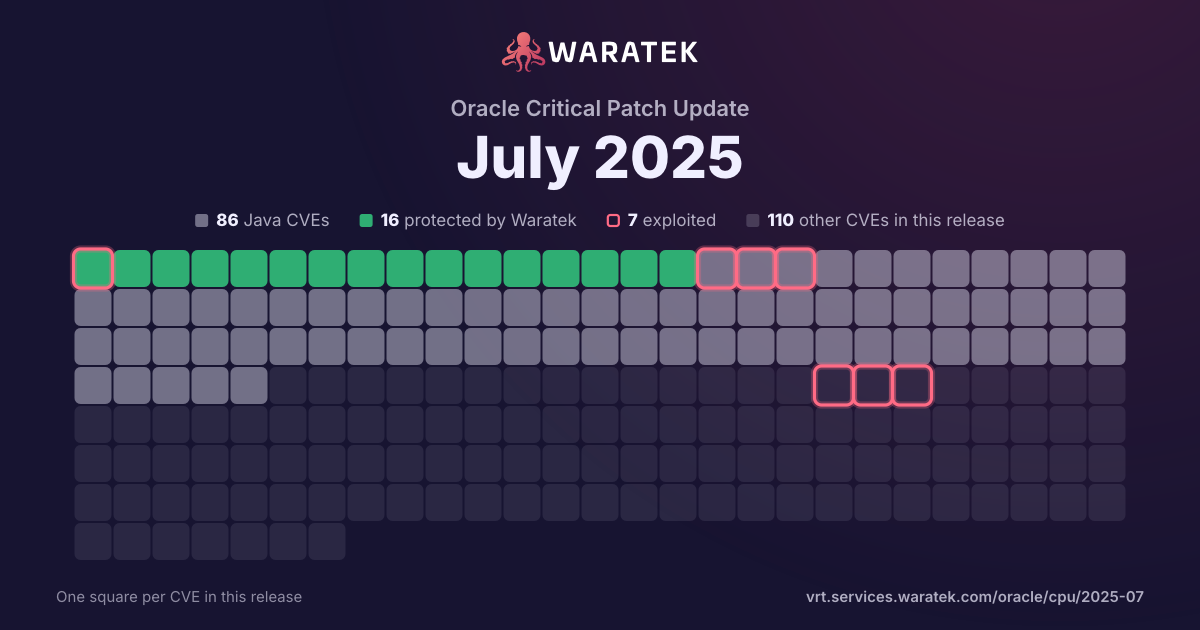
By status
16Protected by Waratek4Mitigation candidate66No exploit published14Outside Waratek scope96Not applicable
7Exploited, marked by the ring
No exploit published. For 31 of them, Oracle's security advisory is the source of public detail.
Protected by Waratek. Waratek RASP can block exploitation of these on systems that have not applied the patch yet.
Overview 23 matches · 8 in Waratek scope · 2 protected · 0 exploited · 0 CISA KEV · 2 public PoC · 1 EPSS ≥ 0.5
23matches
8in Waratek scope34.8%
2protected8.7%
0exploited0.0%
0CISA KEV0.0%
2public PoC8.7%
1EPSS ≥ 0.54.3%
Protected by Waratek
2
8.7%
Rule in development
0
0.0%
Mitigation candidate
0
0.0%
No exploit published
6
26.1%
Outside Waratek scope
1
4.3%
Not applicable
14
60.9%
Withdrawn CVE
0
0.0%
blocked by ARMR today
2
8.7%
partly blocked
0
0.0%
not blocked
21
91.3%
not established
0
0.0%
unrecorded
0
0.0%
Exploited
0
0.0%
Working exploit published
0
0.0%
Proof of concept only
23
100.0%
Forecast only
0
0.0%
No public exploit
0
0.0%
split by
peak 9 / quarter
Q3 221
Protected by Waratek1
High1
blocked by ARMR today1
Proof of concept only1
Q4 221
No exploit published1
High1
not blocked1
Proof of concept only1
Q1 231
No exploit published1
High1
not blocked1
Proof of concept only1
Q2 230
Q3 230
Q4 230
Q1 241
No exploit published1
High1
not blocked1
Proof of concept only1
Q2 240
Q3 241
Not applicable1
High1
not blocked1
Proof of concept only1
Q4 241
Outside Waratek scope1
Medium1
not blocked1
Proof of concept only1
Q1 259
No exploit published2
Not applicable7
Critical1
High5
Medium3
not blocked9
Proof of concept only9
Q2 258
Protected by Waratek1
No exploit published1
Not applicable6
Critical1
High4
Medium2
Low1
blocked by ARMR today1
not blocked7
Proof of concept only8
Q3 22Q4 22Q1 23Q2 23Q3 23Q4 23Q1 24Q2 24Q3 24Q4 24Q1 25Q2 25
| CVE | Severity | Published▾ | Status | Exploitation | Description |
|---|---|---|---|---|---|
| CVE-2025-5399 | High | 2025-06-07 | Not applicable | Proof of concept only | Due to a mistake in libcurl's WebSocket code, a malicious server can send a particularly crafted packet which makes libcurl get trapped in an endless busy-loop. There is no other way for the application to escape or exit this loop other than killing the thread/process. This might be used to DoS libcurl-using application. |
| CVE-2025-4598 | Medium | 2025-05-30 | Not applicable | Proof of concept only | A vulnerability was found in systemd-coredump. This flaw allows an attacker to force a SUID process to crash and replace it with a non-SUID binary to access the original's privileged process coredump, allowing the attacker to read sensitive data, such as /etc/shadow content, loaded by the original process. A SUID binary or process has a special type of permission, which allows the process to run with the file owner's permissions, regardless of the user executing the binary. This allows the process to access more restricted data than unprivileged users or processes would be able to. An attacker can leverage this flaw by forcing a SUID process to crash and force the Linux kernel to recycle the process PID before systemd-coredump can analyze the /proc/pid/auxv file. If the attacker wins the race condition, they gain access to the original's SUID process coredump file. They can read sensitive content loaded into memory by the original binary, affecting data confidentiality. |
| CVE-2025-48734 | High | 2025-05-28 | No exploit published | Proof of concept only | Improper Access Control vulnerability in Apache Commons. A special BeanIntrospector class was added in version 1.9.2. This can be used to stop attackers from using the declared class property of Java enum objects to get access to the classloader. However this protection was not enabled by default. PropertyUtilsBean (and consequently BeanUtilsBean) now disallows declared class level property access by default. Releases 1.11.0 and 2.0.0-M2 address a potential security issue when accessing enum properties in an uncontrolled way. If an application using Commons BeanUtils passes property paths from an external source directly to the getProperty() method of PropertyUtilsBean, an attacker can access the enum’s class loader via the “declaredClass” property available on all Java “enum” objects. Accessing the enum’s “declaredClass” allows remote attackers to access the ClassLoader and execute arbitrary code. The same issue exists with PropertyUtilsBean.getNestedProperty(). Starting in versions 1.11.0 and 2.0.0-M2 a special BeanIntrospector suppresses the “declaredClass” property. Note that this new BeanIntrospector is enabled by default, but you can disable it to regain the old behavior; see section 2.5 of the user's guide and the unit tests. This issue affects Apache Commons BeanUtils 1.x before 1.11.0, and 2.x before 2.0.0-M2.Users of the artifact commons-beanutils:commons-beanutils 1.x are recommended to upgrade to version 1.11.0, which fixes the issue. Users of the artifact org.apache.commons:commons-beanutils2 2.x are recommended to upgrade to version 2.0.0-M2, which fixes the issue. |
| CVE-2025-23165 | Low | 2025-05-19 | Not applicable | Proof of concept only | In Node.js, the `ReadFileUtf8` internal binding leaks memory due to a corrupted pointer in `uv_fs_s.file`: a UTF-16 path buffer is allocated but subsequently overwritten when the file descriptor is set. This results in an unrecoverable memory leak on every call. Repeated use can cause unbounded memory growth, leading to a denial of service. Impact: * This vulnerability affects APIs relying on `ReadFileUtf8` on Node.js release lines: v20 and v22. |
| CVE-2025-32415 | High | 2025-04-17 | Not applicable | Proof of concept only | In libxml2 before 2.13.8 and 2.14.x before 2.14.2, xmlSchemaIDCFillNodeTables in xmlschemas.c has a heap-based buffer under-read. To exploit this, a crafted XML document must be validated against an XML schema with certain identity constraints, or a crafted XML schema must be used. |
| CVE-2025-32414 | High | 2025-04-08 | Not applicable | Proof of concept only | In libxml2 before 2.13.8 and 2.14.x before 2.14.2, out-of-bounds memory access can occur in the Python API (Python bindings) because of an incorrect return value. This occurs in xmlPythonFileRead and xmlPythonFileReadRaw because of a difference between bytes and characters. |
| CVE-2025-29482 | Medium | 2025-04-07 | Not applicable | Proof of concept only | Buffer Overflow vulnerability in libheif 1.19.7 allows a local attacker to execute arbitrary code via the SAO (Sample Adaptive Offset) processing of libde265. |
| CVE-2025-30065 | Critical | 2025-04-01 | Protected by Waratek | Proof of concept only | Schema parsing in the parquet-avro module of Apache Parquet 1.15.0 and previous versions allows bad actors to execute arbitrary code Users are recommended to upgrade to version 1.15.1, which fixes the issue. |
| CVE-2024-8176 | High | 2025-03-14 | Not applicable | Proof of concept only | A stack overflow vulnerability exists in the libexpat library due to the way it handles recursive entity expansion in XML documents. When parsing an XML document with deeply nested entity references, libexpat can be forced to recurse indefinitely, exhausting the stack space and causing a crash. This issue could lead to denial of service (DoS) or, in some cases, exploitable memory corruption, depending on the environment and library usage. |
| CVE-2024-55549 | High | 2025-03-14 | Not applicable | Proof of concept only | xsltGetInheritedNsList in libxslt before 1.1.43 has a use-after-free issue related to exclusion of result prefixes. |
| CVE-2025-26791 | Medium | 2025-02-14 | Not applicable | Proof of concept only | DOMPurify before 3.2.4 has an incorrect template literal regular expression, sometimes leading to mutation cross-site scripting (mXSS). |
| CVE-2025-25193 | Medium | 2025-02-10 | No exploit published | Proof of concept only | Netty, an asynchronous, event-driven network application framework, has a vulnerability in versions up to and including 4.1.118.Final. An unsafe reading of environment file could potentially cause a denial of service in Netty. When loaded on an Windows application, Netty attempts to load a file that does not exist. If an attacker creates such a large file, the Netty application crash. A similar issue was previously reported as CVE-2024-47535. This issue was fixed, but the fix was incomplete in that null-bytes were not counted against the input limit. Commit d1fbda62d3a47835d3fb35db8bd42ecc205a5386 contains an updated fix. |
| CVE-2025-24970 | High | 2025-02-10 | No exploit published | Proof of concept only | Netty, an asynchronous, event-driven network application framework, has a vulnerability starting in version 4.1.91.Final and prior to version 4.1.118.Final. When a special crafted packet is received via SslHandler it doesn't correctly handle validation of such a packet in all cases which can lead to a native crash. Version 4.1.118.Final contains a patch. As workaround its possible to either disable the usage of the native SSLEngine or change the code manually. |
| CVE-2025-0725 | High | 2025-02-05 | Not applicable | Proof of concept only | When libcurl is asked to perform automatic gzip decompression of content-encoded HTTP responses with the `CURLOPT_ACCEPT_ENCODING` option, **using zlib 1.2.0.3 or older**, an attacker-controlled integer overflow would make libcurl perform a buffer overflow. |
| CVE-2024-57699 | High | 2025-02-05 | Not applicable | Proof of concept only | A security issue was found in Netplex Json-smart 2.5.0 through 2.5.1. When loading a specially crafted JSON input, containing a large number of ’{’, a stack exhaustion can be trigger, which could allow an attacker to cause a Denial of Service (DoS). This issue exists because of an incomplete fix for CVE-2023-1370. |
| CVE-2025-0395 | Medium | 2025-01-22 | Not applicable | Proof of concept only | When the assert() function in the GNU C Library versions 2.13 to 2.40 fails, it does not allocate enough space for the assertion failure message string and size information, which may lead to a buffer overflow if the message string size aligns to page size. |
| CVE-2025-23016 | Critical | 2025-01-10 | Not applicable | Proof of concept only | FastCGI fcgi2 (aka fcgi) 2.x through 2.4.4 has an integer overflow (and resultant heap-based buffer overflow) via crafted nameLen or valueLen values in data to the IPC socket. This occurs in ReadParams in fcgiapp.c. |
| CVE-2024-6763 | Medium | 2024-10-14 | Outside Waratek scope | Proof of concept only | Eclipse Jetty is a lightweight, highly scalable, Java-based web server and Servlet engine . It includes a utility class, HttpURI, for URI/URL parsing. The HttpURI class does insufficient validation on the authority segment of a URI. However the behaviour of HttpURI differs from the common browsers in how it handles a URI that would be considered invalid if fully validated against the RRC. Specifically HttpURI and the browser may differ on the value of the host extracted from an invalid URI and thus a combination of Jetty and a vulnerable browser may be vulnerable to a open redirect attack or to a SSRF attack if the URI is used after passing validation checks. |
| CVE-2024-7592 | High | 2024-08-19 | Not applicable | Proof of concept only | There is a LOW severity vulnerability affecting CPython, specifically the 'http.cookies' standard library module. When parsing cookies that contained backslashes for quoted characters in the cookie value, the parser would use an algorithm with quadratic complexity, resulting in excess CPU resources being used while parsing the value. |
| CVE-2024-22201 | High | 2024-02-26 | No exploit published | Proof of concept only | Jetty is a Java based web server and servlet engine. An HTTP/2 SSL connection that is established and TCP congested will be leaked when it times out. An attacker can cause many connections to end up in this state, and the server may run out of file descriptors, eventually causing the server to stop accepting new connections from valid clients. The vulnerability is patched in 9.4.54, 10.0.20, 11.0.20, and 12.0.6. |
| CVE-2023-1436 | High | 2023-03-22 | No exploit published | Proof of concept only | An infinite recursion is triggered in Jettison when constructing a JSONArray from a Collection that contains a self-reference in one of its elements. This leads to a StackOverflowError exception being thrown. |
| CVE-2022-45693 | High | 2022-12-13 | No exploit published | Proof of concept only | Jettison before v1.5.2 was discovered to contain a stack overflow via the map parameter. This vulnerability allows attackers to cause a Denial of Service (DoS) via a crafted string. |
| CVE-2022-34169 | High | 2022-07-19 | Protected by Waratek | Proof of concept only | The Apache Xalan Java XSLT library is vulnerable to an integer truncation issue when processing malicious XSLT stylesheets. This can be used to corrupt Java class files generated by the internal XSLTC compiler and execute arbitrary Java bytecode. Users are recommended to update to version 2.7.3 or later. Note: Java runtimes (such as OpenJDK) include repackaged copies of Xalan. |