
Oracle Critical Patch Update July 2025
Released July 2025 · Oracle's advisory ↗ · ← Critical Patch Update, April 2025 · Critical Patch Update, October 2025 →
196 CVEs in this release, one square each
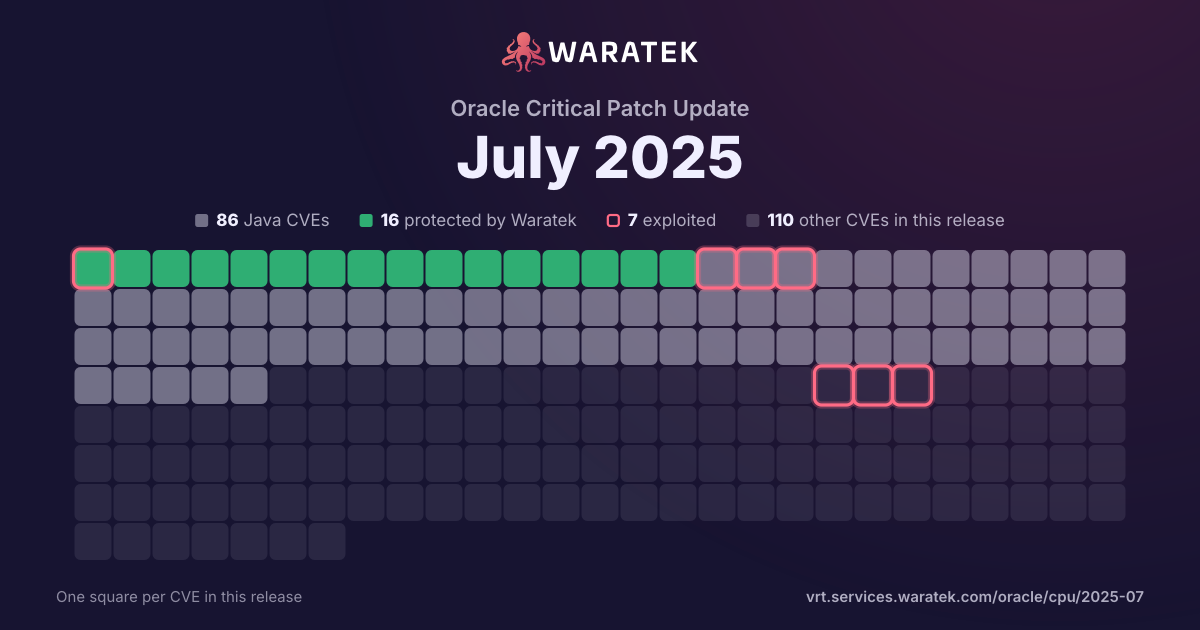
By status
11Protected by Waratek1Rule in development4Mitigation candidate73No exploit published7Outside Waratek scope100Not applicable
7Exploited, marked by the ring
No exploit published. For 26 of them, Oracle's security advisory is the source of public detail.
Protected by Waratek. Waratek RASP can block exploitation of these on systems that have not applied the patch yet.
Overview 4 matches · 3 protected · 1 exploited · 1 CISA KEV · 1 EPSS ≥ 0.5
Protected by Waratek
3
75.0%
Rule in development
0
0.0%
Mitigation candidate
1
25.0%
No exploit published
0
0.0%
blocked by ARMR today
3
75.0%
partly blocked
0
0.0%
not blocked
1
25.0%
not established
0
0.0%
unrecorded
0
0.0%
Exploited
1
25.0%
Working exploit published
2
50.0%
Proof of concept only
1
25.0%
Forecast only
0
0.0%
No public exploit
0
0.0%
split by
peak 1 / month
Dec 241
Protected by Waratek1
High1
blocked by ARMR today1
Working exploit published1
Jan 250
Feb 250
Mar 251
Protected by Waratek1
Critical1
blocked by ARMR today1
Exploited1
Apr 251
Protected by Waratek1
Critical1
blocked by ARMR today1
Proof of concept only1
May 251
Mitigation candidate1
Medium1
not blocked1
Working exploit published1
Dec 24Jan 25Feb 25Mar 25Apr 25May 25
| CVE | Severity | Published▾ | Status | Exploitation | Description |
|---|---|---|---|---|---|
| CVE-2025-27533 | Medium | 2025-05-07 | Mitigation candidate | Working exploit published | Memory Allocation with Excessive Size Value vulnerability in Apache ActiveMQ. During unmarshalling of OpenWire commands the size value of buffers was not properly validated which could lead to excessive memory allocation and be exploited to cause a denial of service (DoS) by depleting process memory, thereby affecting applications and services that rely on the availability of the ActiveMQ broker when not using mutual TLS connections. This issue affects Apache ActiveMQ: from 6.0.0 before 6.1.6, from 5.18.0 before 5.18.7, from 5.17.0 before 5.17.7, before 5.16.8. ActiveMQ 5.19.0 is not affected. Users are recommended to upgrade to version 6.1.6+, 5.19.0+, 5.18.7+, 5.17.7, or 5.16.8 or which fixes the issue. Existing users may implement mutual TLS to mitigate the risk on affected brokers. |
| CVE-2025-30065 | Critical | 2025-04-01 | Protected by Waratek | Proof of concept only | Schema parsing in the parquet-avro module of Apache Parquet 1.15.0 and previous versions allows bad actors to execute arbitrary code Users are recommended to upgrade to version 1.15.1, which fixes the issue. |
| CVE-2025-24813 | Critical | 2025-03-10 | Protected by Waratek | Exploited | Path Equivalence: 'file.Name' (Internal Dot) leading to Remote Code Execution and/or Information disclosure and/or malicious content added to uploaded files via write enabled Default Servlet in Apache Tomcat. This issue affects Apache Tomcat: from 11.0.0-M1 through 11.0.2, from 10.1.0-M1 through 10.1.34, from 9.0.0.M1 through 9.0.98. The following versions were EOL at the time the CVE was created but are known to be affected: 8.5.0 though 8.5.100. Other, older, EOL versions may also be affected. If all of the following were true, a malicious user was able to view security sensitive files and/or inject content into those files: - writes enabled for the default servlet (disabled by default) - support for partial PUT (enabled by default) - a target URL for security sensitive uploads that was a sub-directory of a target URL for public uploads - attacker knowledge of the names of security sensitive files being uploaded - the security sensitive files also being uploaded via partial PUT If all of the following were true, a malicious user was able to perform remote code execution: - writes enabled for the default servlet (disabled by default) - support for partial PUT (enabled by default) - application was using Tomcat's file based session persistence with the default storage location - application included a library that may be leveraged in a deserialization attack Users are recommended to upgrade to version 11.0.3, 10.1.35 or 9.0.99, which fixes the issue. |
| CVE-2024-38819 | High | 2024-12-19 | Protected by Waratek | Working exploit published | Applications serving static resources through the functional web frameworks WebMvc.fn or WebFlux.fn are vulnerable to path traversal attacks. An attacker can craft malicious HTTP requests and obtain any file on the file system that is also accessible to the process in which the Spring application is running. |