
Oracle Critical Patch Update July 2025
Released July 2025 · Oracle's advisory ↗ · ← Critical Patch Update, April 2025 · Critical Patch Update, October 2025 →
196 CVEs in this release, one square each
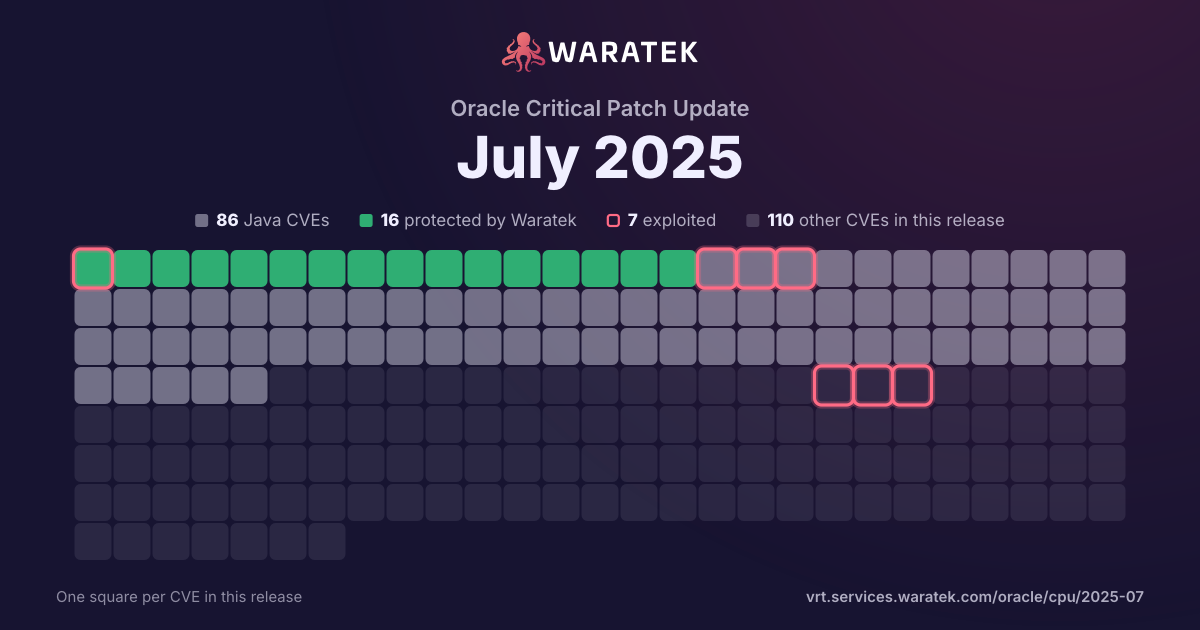
By status
16Protected by Waratek4Mitigation candidate66No exploit published14Outside Waratek scope96Not applicable
7Exploited, marked by the ring
No exploit published. For 31 of them, Oracle's security advisory is the source of public detail.
Protected by Waratek. Waratek RASP can block exploitation of these on systems that have not applied the patch yet.
Overview 15 matches · 0 protected · 0 exploited · 0 CISA KEV · 1 public PoC · 0 EPSS ≥ 0.5
Protected by Waratek
0
0.0%
Rule in development
0
0.0%
Mitigation candidate
1
6.7%
No exploit published
14
93.3%
blocked by ARMR today
0
0.0%
partly blocked
0
0.0%
not blocked
15
100.0%
not established
0
0.0%
unrecorded
0
0.0%
Exploited
0
0.0%
Working exploit published
1
6.7%
Proof of concept only
1
6.7%
Forecast only
0
0.0%
No public exploit
13
86.7%
split by
peak 5 / quarter
Q4 231
No exploit published1
Medium1
not blocked1
No public exploit1
Q1 241
No exploit published1
Medium1
not blocked1
No public exploit1
Q2 240
Q3 240
Q4 245
No exploit published5
Medium5
not blocked5
No public exploit5
Q1 252
No exploit published2
Medium2
not blocked2
Proof of concept only1
No public exploit1
Q2 252
Mitigation candidate1
No exploit published1
Medium2
not blocked2
Working exploit published1
No public exploit1
Q3 254
No exploit published4
Medium4
not blocked4
No public exploit4
Q4 23Q1 24Q2 24Q3 24Q4 24Q1 25Q2 25Q3 25
| CVE | Severity | Published▾ | Status | Exploitation | Description |
|---|---|---|---|---|---|
| CVE-2025-50073 | Medium | 2025-07-15 | No exploit published | No public exploit | Vulnerability in the Oracle WebLogic Server product of Oracle Fusion Middleware (component: Web Container). Supported versions that are affected are 12.2.1.4.0, 14.1.1.0.0 and 14.1.2.0.0. Easily exploitable vulnerability allows unauthenticated attacker with network access via HTTP to compromise Oracle WebLogic Server. Successful attacks require human interaction from a person other than the attacker and while the vulnerability is in Oracle WebLogic Server, attacks may significantly impact additional products (scope change). Successful attacks of this vulnerability can result in unauthorized update, insert or delete access to some of Oracle WebLogic Server accessible data as well as unauthorized read access to a subset of Oracle WebLogic Server accessible data. CVSS 3.1 Base Score 6.1 (Confidentiality and Integrity impacts). CVSS Vector: (CVSS:3.1/AV:N/AC:L/PR:N/UI:R/S:C/C:L/I:L/A:N). |
| CVE-2025-50072 | Medium | 2025-07-15 | No exploit published | No public exploit | Vulnerability in the Oracle WebLogic Server product of Oracle Fusion Middleware (component: Core). Supported versions that are affected are 12.2.1.4.0, 14.1.1.0.0 and 14.1.2.0.0. Easily exploitable vulnerability allows unauthenticated attacker with logon to the infrastructure where Oracle WebLogic Server executes to compromise Oracle WebLogic Server. Successful attacks of this vulnerability can result in unauthorized update, insert or delete access to some of Oracle WebLogic Server accessible data. CVSS 3.1 Base Score 4.0 (Integrity impacts). CVSS Vector: (CVSS:3.1/AV:L/AC:L/PR:N/UI:N/S:U/C:N/I:L/A:N). |
| CVE-2025-50064 | Medium | 2025-07-15 | No exploit published | No public exploit | Vulnerability in the Oracle WebLogic Server product of Oracle Fusion Middleware (component: Core). Supported versions that are affected are 12.2.1.4.0, 14.1.1.0.0 and 14.1.2.0.0. Easily exploitable vulnerability allows high privileged attacker with network access via HTTP to compromise Oracle WebLogic Server. Successful attacks require human interaction from a person other than the attacker and while the vulnerability is in Oracle WebLogic Server, attacks may significantly impact additional products (scope change). Successful attacks of this vulnerability can result in unauthorized update, insert or delete access to some of Oracle WebLogic Server accessible data as well as unauthorized read access to a subset of Oracle WebLogic Server accessible data. CVSS 3.1 Base Score 4.8 (Confidentiality and Integrity impacts). CVSS Vector: (CVSS:3.1/AV:N/AC:L/PR:H/UI:R/S:C/C:L/I:L/A:N). |
| CVE-2025-30753 | Medium | 2025-07-15 | No exploit published | No public exploit | Vulnerability in the Oracle WebLogic Server product of Oracle Fusion Middleware (component: Core). Supported versions that are affected are 12.2.1.4.0, 14.1.1.0.0 and 14.1.2.0.0. Easily exploitable vulnerability allows low privileged attacker with network access via HTTP to compromise Oracle WebLogic Server. Successful attacks of this vulnerability can result in unauthorized ability to cause a hang or frequently repeatable crash (complete DOS) of Oracle WebLogic Server. CVSS 3.1 Base Score 6.5 (Availability impacts). CVSS Vector: (CVSS:3.1/AV:N/AC:L/PR:L/UI:N/S:U/C:N/I:N/A:H). |
| CVE-2025-27533 | Medium | 2025-05-07 | Mitigation candidate | Working exploit published | Memory Allocation with Excessive Size Value vulnerability in Apache ActiveMQ. During unmarshalling of OpenWire commands the size value of buffers was not properly validated which could lead to excessive memory allocation and be exploited to cause a denial of service (DoS) by depleting process memory, thereby affecting applications and services that rely on the availability of the ActiveMQ broker when not using mutual TLS connections. This issue affects Apache ActiveMQ: from 6.0.0 before 6.1.6, from 5.18.0 before 5.18.7, from 5.17.0 before 5.17.7, before 5.16.8. ActiveMQ 5.19.0 is not affected. Users are recommended to upgrade to version 6.1.6+, 5.19.0+, 5.18.7+, 5.17.7, or 5.16.8 or which fixes the issue. Existing users may implement mutual TLS to mitigate the risk on affected brokers. |
| CVE-2025-31672 | Medium | 2025-04-09 | No exploit published | No public exploit | Improper Input Validation vulnerability in Apache POI. The issue affects the parsing of OOXML format files like xlsx, docx and pptx. These file formats are basically zip files and it is possible for malicious users to add zip entries with duplicate names (including the path) in the zip. In this case, products reading the affected file could read different data because 1 of the zip entries with the duplicate name is selected over another but different products may choose a different zip entry. This issue affects Apache POI poi-ooxml before 5.4.0. poi-ooxml 5.4.0 has a check that throws an exception if zip entries with duplicate file names are found in the input file. Users are recommended to upgrade to version poi-ooxml 5.4.0, which fixes the issue. Please read https://poi.apache.org/security.html for recommendations about how to use the POI libraries securely. |
| CVE-2025-30474 | Medium | 2025-03-23 | No exploit published | No public exploit | Exposure of Sensitive Information to an Unauthorized Actor vulnerability in Apache Commons VFS. The FtpFileObject class can throw an exception when a file is not found, revealing the original URI in its message, which may include a password. The fix is to mask the password in the exception message This issue affects Apache Commons VFS: before 2.10.0. Users are recommended to upgrade to version 2.10.0, which fixes the issue. |
| CVE-2025-25193 | Medium | 2025-02-10 | No exploit published | Proof of concept only | Netty, an asynchronous, event-driven network application framework, has a vulnerability in versions up to and including 4.1.118.Final. An unsafe reading of environment file could potentially cause a denial of service in Netty. When loaded on an Windows application, Netty attempts to load a file that does not exist. If an attacker creates such a large file, the Netty application crash. A similar issue was previously reported as CVE-2024-47535. This issue was fixed, but the fix was incomplete in that null-bytes were not counted against the input limit. Commit d1fbda62d3a47835d3fb35db8bd42ecc205a5386 contains an updated fix. |
| CVE-2024-12798 | Medium | 2024-12-19 | No exploit published | No public exploit | ACE vulnerability in JaninoEventEvaluator by QOS.CH logback-core upto including version 0.1 to 1.3.14 and 1.4.0 to 1.5.12 in Java applications allows attacker to execute arbitrary code by compromising an existing logback configuration file or by injecting an environment variable before program execution. Malicious logback configuration files can allow the attacker to execute arbitrary code using the JaninoEventEvaluator extension. A successful attack requires the user to have write access to a configuration file. Alternatively, the attacker could inject a malicious environment variable pointing to a malicious configuration file. In both cases, the attack requires existing privilege. |
| CVE-2024-38828 | Medium | 2024-11-18 | No exploit published | No public exploit | Spring MVC controller methods with an @RequestBody byte[] method parameter are vulnerable to a DoS attack. |
| CVE-2024-38820 | Medium | 2024-10-18 | No exploit published | No public exploit | The fix for CVE-2022-22968 made disallowedFields patterns in DataBinder case insensitive. However, String.toLowerCase() has some Locale dependent exceptions that could potentially result in fields not protected as expected. |
| CVE-2024-8184 | Medium | 2024-10-14 | No exploit published | No public exploit | There exists a security vulnerability in Jetty's ThreadLimitHandler.getRemote() which can be exploited by unauthorized users to cause remote denial-of-service (DoS) attack. By repeatedly sending crafted requests, attackers can trigger OutofMemory errors and exhaust the server's memory. |
| CVE-2024-47554 | Medium | 2024-10-03 | No exploit published | No public exploit | Uncontrolled Resource Consumption vulnerability in Apache Commons IO. The org.apache.commons.io.input.XmlStreamReader class may excessively consume CPU resources when processing maliciously crafted input. This issue affects Apache Commons IO: from 2.0 before 2.14.0. Users are recommended to upgrade to version 2.14.0 or later, which fixes the issue. |
| CVE-2024-26308 | Medium | 2024-02-19 | No exploit published | No public exploit | Allocation of Resources Without Limits or Throttling vulnerability in Apache Commons Compress.This issue affects Apache Commons Compress: from 1.21 before 1.26. Users are recommended to upgrade to version 1.26, which fixes the issue. |
| CVE-2023-44483 | Medium | 2023-10-20 | No exploit published | No public exploit | All versions of Apache Santuario - XML Security for Java prior to 2.2.6, 2.3.4, and 3.0.3, when using the JSR 105 API, are vulnerable to an issue where a private key may be disclosed in log files when generating an XML Signature and logging with debug level is enabled. Users are recommended to upgrade to version 2.2.6, 2.3.4, or 3.0.3, which fixes this issue. |