
Oracle Critical Patch Update April 2025
Released April 2025 · Oracle's advisory ↗ · ← Critical Patch Update, January 2025 · Critical Patch Update, July 2025 →
255 CVEs in this release, one square each
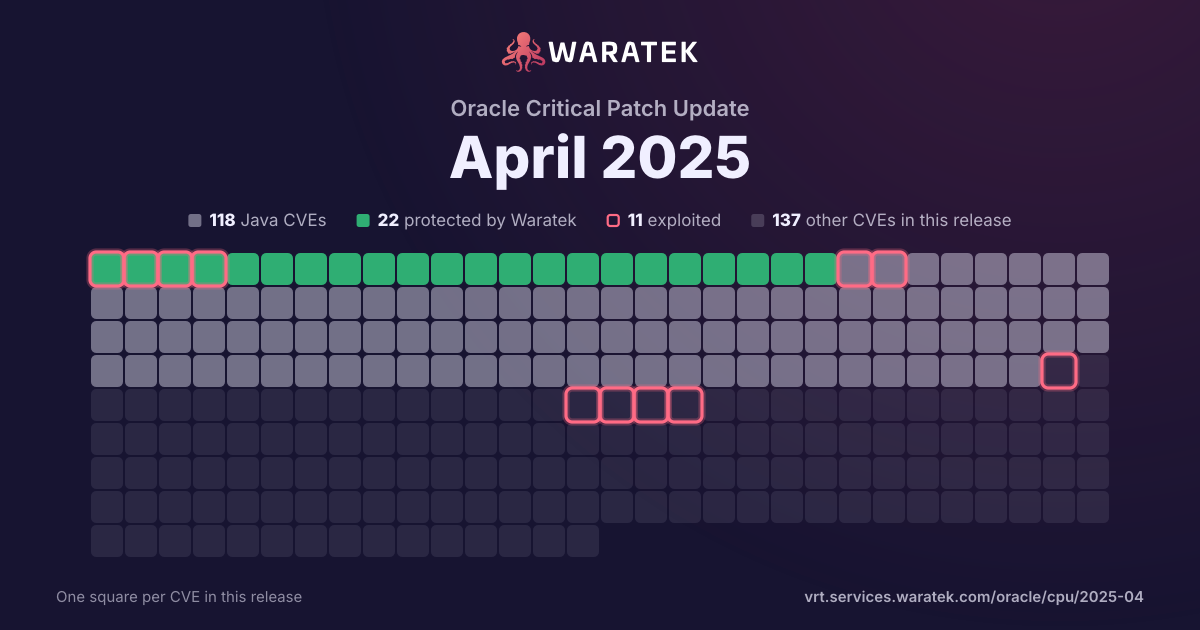
By status
22Protected by Waratek8Mitigation candidate88No exploit published16Outside Waratek scope121Not applicable
11Exploited, marked by the ring
No exploit published. For 33 of them, Oracle's security advisory is the source of public detail.
Protected by Waratek. Waratek RASP can block exploitation of these on systems that have not applied the patch yet.
Overview 80 matches · 0 in Waratek scope · 0 protected · 1 exploited · 1 CISA KEV · 1 public PoC · 0 EPSS ≥ 0.5
80matches
0in Waratek scope0.0%
0protected0.0%
1exploited1.2%
1CISA KEV1.2%
1public PoC1.2%
0EPSS ≥ 0.50.0%
Protected by Waratek
0
0.0%
Rule in development
0
0.0%
Mitigation candidate
0
0.0%
No exploit published
0
0.0%
Outside Waratek scope
0
0.0%
Not applicable
80
100.0%
Withdrawn CVE
0
0.0%
blocked by ARMR today
0
0.0%
partly blocked
0
0.0%
not blocked
80
100.0%
not established
0
0.0%
unrecorded
0
0.0%
Exploited
1
1.2%
Working exploit published
0
0.0%
Proof of concept only
12
15.0%
Forecast only
0
0.0%
No public exploit
67
83.8%
split by
peak 33 / quarter
Q3 231
Not applicable1
Medium1
not blocked1
No public exploit1
Q4 230
Q1 243
Not applicable3
Medium3
not blocked3
No public exploit3
Q2 245
Not applicable5
Medium5
not blocked5
Proof of concept only1
No public exploit4
Q3 2410
Not applicable10
Medium10
not blocked10
Proof of concept only1
No public exploit9
Q4 2420
Not applicable20
Medium20
not blocked20
Exploited1
Proof of concept only8
No public exploit11
Q1 258
Not applicable8
Medium8
not blocked8
Proof of concept only2
No public exploit6
Q2 2533
Not applicable33
Medium33
not blocked33
No public exploit33
Q3 23Q4 23Q1 24Q2 24Q3 24Q4 24Q1 25Q2 25
| CVE | Severity | Published▾ | Status | Exploitation | Description |
|---|---|---|---|---|---|
| CVE-2025-30733 | Medium | 2025-04-15 | Not applicable | No public exploit | Vulnerability in the RDBMS Listener component of Oracle Database Server. Supported versions that are affected are 19.3-19.26, 21.3-21.17 and 23.4-23.7. Easily exploitable vulnerability allows unauthenticated attacker with network access via Oracle Net to compromise RDBMS Listener. Successful attacks require human interaction from a person other than the attacker. Successful attacks of this vulnerability can result in unauthorized access to critical data or complete access to all RDBMS Listener accessible data. CVSS 3.1 Base Score 6.5 (Confidentiality impacts). CVSS Vector: (CVSS:3.1/AV:N/AC:L/PR:N/UI:R/S:U/C:H/I:N/A:N). |
| CVE-2025-30725 | Medium | 2025-04-15 | Not applicable | No public exploit | Vulnerability in the Oracle VM VirtualBox product of Oracle Virtualization (component: Core). The supported version that is affected is 7.1.6. Difficult to exploit vulnerability allows high privileged attacker with logon to the infrastructure where Oracle VM VirtualBox executes to compromise Oracle VM VirtualBox. While the vulnerability is in Oracle VM VirtualBox, attacks may significantly impact additional products (scope change). Successful attacks of this vulnerability can result in unauthorized ability to cause a hang or frequently repeatable crash (complete DOS) of Oracle VM VirtualBox as well as unauthorized update, insert or delete access to some of Oracle VM VirtualBox accessible data and unauthorized read access to a subset of Oracle VM VirtualBox accessible data. CVSS 3.1 Base Score 6.7 (Confidentiality, Integrity and Availability impacts). CVSS Vector: (CVSS:3.1/AV:L/AC:H/PR:H/UI:N/S:C/C:L/I:L/A:H). |
| CVE-2025-30721 | Medium | 2025-04-15 | Not applicable | No public exploit | Vulnerability in the MySQL Server product of Oracle MySQL (component: Server: UDF). Supported versions that are affected are 8.0.0-8.0.41, 8.4.0-8.4.4 and 9.0.0-9.2.0. Difficult to exploit vulnerability allows high privileged attacker with logon to the infrastructure where MySQL Server executes to compromise MySQL Server. Successful attacks require human interaction from a person other than the attacker. Successful attacks of this vulnerability can result in unauthorized ability to cause a hang or frequently repeatable crash (complete DOS) of MySQL Server. CVSS 3.1 Base Score 4.0 (Availability impacts). CVSS Vector: (CVSS:3.1/AV:L/AC:H/PR:H/UI:R/S:U/C:N/I:N/A:H). |
| CVE-2025-30719 | Medium | 2025-04-15 | Not applicable | No public exploit | Vulnerability in the Oracle VM VirtualBox product of Oracle Virtualization (component: Core). The supported version that is affected is 7.1.6. Easily exploitable vulnerability allows low privileged attacker with logon to the infrastructure where Oracle VM VirtualBox executes to compromise Oracle VM VirtualBox. Successful attacks of this vulnerability can result in unauthorized ability to cause a hang or frequently repeatable crash (complete DOS) of Oracle VM VirtualBox and unauthorized read access to a subset of Oracle VM VirtualBox accessible data. CVSS 3.1 Base Score 6.1 (Confidentiality and Availability impacts). CVSS Vector: (CVSS:3.1/AV:L/AC:L/PR:L/UI:N/S:U/C:L/I:N/A:H). |
| CVE-2025-30715 | Medium | 2025-04-15 | Not applicable | No public exploit | Vulnerability in the MySQL Server product of Oracle MySQL (component: Server: Components Services). Supported versions that are affected are 8.0.0-8.0.41, 8.4.0-8.4.4 and 9.0.0-9.2.0. Easily exploitable vulnerability allows high privileged attacker with network access via multiple protocols to compromise MySQL Server. Successful attacks of this vulnerability can result in unauthorized ability to cause a hang or frequently repeatable crash (complete DOS) of MySQL Server. CVSS 3.1 Base Score 4.9 (Availability impacts). CVSS Vector: (CVSS:3.1/AV:N/AC:L/PR:H/UI:N/S:U/C:N/I:N/A:H). |
| CVE-2025-30714 | Medium | 2025-04-15 | Not applicable | No public exploit | Vulnerability in the MySQL Connectors product of Oracle MySQL (component: Connector/Python). Supported versions that are affected are 9.0.0-9.2.0. Difficult to exploit vulnerability allows low privileged attacker with network access via multiple protocols to compromise MySQL Connectors. Successful attacks require human interaction from a person other than the attacker. Successful attacks of this vulnerability can result in unauthorized access to critical data or complete access to all MySQL Connectors accessible data. CVSS 3.1 Base Score 4.8 (Confidentiality impacts). CVSS Vector: (CVSS:3.1/AV:N/AC:H/PR:L/UI:R/S:U/C:H/I:N/A:N). |
| CVE-2025-30710 | Medium | 2025-04-15 | Not applicable | No public exploit | Vulnerability in the MySQL Cluster product of Oracle MySQL (component: Cluster: NDBCluster Plugin). Supported versions that are affected are 8.0.0-8.0.41, 8.4.0-8.4.4 and 9.0.0-9.2.0. Easily exploitable vulnerability allows high privileged attacker with network access via multiple protocols to compromise MySQL Cluster. Successful attacks of this vulnerability can result in unauthorized ability to cause a hang or frequently repeatable crash (complete DOS) of MySQL Cluster. CVSS 3.1 Base Score 4.9 (Availability impacts). CVSS Vector: (CVSS:3.1/AV:N/AC:L/PR:H/UI:N/S:U/C:N/I:N/A:H). |
| CVE-2025-30705 | Medium | 2025-04-15 | Not applicable | No public exploit | Vulnerability in the MySQL Server product of Oracle MySQL (component: Server: PS). Supported versions that are affected are 8.0.0-8.0.41, 8.4.0-8.4.4 and 9.0.0-9.2.0. Easily exploitable vulnerability allows high privileged attacker with network access via multiple protocols to compromise MySQL Server. Successful attacks of this vulnerability can result in unauthorized ability to cause a hang or frequently repeatable crash (complete DOS) of MySQL Server. CVSS 3.1 Base Score 4.9 (Availability impacts). CVSS Vector: (CVSS:3.1/AV:N/AC:L/PR:H/UI:N/S:U/C:N/I:N/A:H). |
| CVE-2025-30704 | Medium | 2025-04-15 | Not applicable | No public exploit | Vulnerability in the MySQL Server product of Oracle MySQL (component: Server: Components Services). Supported versions that are affected are 8.0.0-8.0.41, 8.4.0-8.4.4 and 9.0.0-9.2.0. Difficult to exploit vulnerability allows high privileged attacker with network access via multiple protocols to compromise MySQL Server. Successful attacks of this vulnerability can result in unauthorized ability to cause a hang or frequently repeatable crash (complete DOS) of MySQL Server. CVSS 3.1 Base Score 4.4 (Availability impacts). CVSS Vector: (CVSS:3.1/AV:N/AC:H/PR:H/UI:N/S:U/C:N/I:N/A:H). |
| CVE-2025-30702 | Medium | 2025-04-15 | Not applicable | No public exploit | Vulnerability in the Fleet Patching and amp; Provisioning component of Oracle Database Server. Supported versions that are affected are 19.3-19.26. Easily exploitable vulnerability allows unauthenticated attacker with network access via HTTP to compromise Fleet Patching and amp; Provisioning. Successful attacks of this vulnerability can result in unauthorized read access to a subset of Fleet Patching and amp; Provisioning accessible data. CVSS 3.1 Base Score 5.3 (Confidentiality impacts). CVSS Vector: (CVSS:3.1/AV:N/AC:L/PR:N/UI:N/S:U/C:L/I:N/A:N). |
| CVE-2025-30699 | Medium | 2025-04-15 | Not applicable | No public exploit | Vulnerability in the MySQL Server product of Oracle MySQL (component: Server: Stored Procedure). Supported versions that are affected are 8.0.0-8.0.41, 8.4.0-8.4.4 and 9.0.0-9.2.0. Easily exploitable vulnerability allows high privileged attacker with network access via multiple protocols to compromise MySQL Server. Successful attacks of this vulnerability can result in unauthorized ability to cause a hang or frequently repeatable crash (complete DOS) of MySQL Server. CVSS 3.1 Base Score 4.9 (Availability impacts). CVSS Vector: (CVSS:3.1/AV:N/AC:L/PR:H/UI:N/S:U/C:N/I:N/A:H). |
| CVE-2025-30696 | Medium | 2025-04-15 | Not applicable | No public exploit | Vulnerability in the MySQL Server product of Oracle MySQL (component: Server: PS). Supported versions that are affected are 8.0.0-8.0.41, 8.4.0-8.4.4 and 9.0.0-9.2.0. Easily exploitable vulnerability allows high privileged attacker with network access via multiple protocols to compromise MySQL Server. Successful attacks of this vulnerability can result in unauthorized ability to cause a hang or frequently repeatable crash (complete DOS) of MySQL Server. CVSS 3.1 Base Score 4.9 (Availability impacts). CVSS Vector: (CVSS:3.1/AV:N/AC:L/PR:H/UI:N/S:U/C:N/I:N/A:H). |
| CVE-2025-30695 | Medium | 2025-04-15 | Not applicable | No public exploit | Vulnerability in the MySQL Server product of Oracle MySQL (component: InnoDB). Supported versions that are affected are 8.0.0-8.0.41, 8.4.0-8.4.4 and 9.0.0-9.2.0. Easily exploitable vulnerability allows high privileged attacker with network access via multiple protocols to compromise MySQL Server. Successful attacks of this vulnerability can result in unauthorized ability to cause a hang or frequently repeatable crash (complete DOS) of MySQL Server as well as unauthorized update, insert or delete access to some of MySQL Server accessible data. CVSS 3.1 Base Score 5.5 (Integrity and Availability impacts). CVSS Vector: (CVSS:3.1/AV:N/AC:L/PR:H/UI:N/S:U/C:N/I:L/A:H). |
| CVE-2025-30694 | Medium | 2025-04-15 | Not applicable | No public exploit | Vulnerability in the XML Database component of Oracle Database Server. Supported versions that are affected are 19.3-19.26, 21.3-21.17 and 23.4-23.7. Easily exploitable vulnerability allows low privileged attacker having User Account privilege with network access via HTTP to compromise XML Database. Successful attacks require human interaction from a person other than the attacker and while the vulnerability is in XML Database, attacks may significantly impact additional products (scope change). Successful attacks of this vulnerability can result in unauthorized update, insert or delete access to some of XML Database accessible data as well as unauthorized read access to a subset of XML Database accessible data. CVSS 3.1 Base Score 5.4 (Confidentiality and Integrity impacts). CVSS Vector: (CVSS:3.1/AV:N/AC:L/PR:L/UI:R/S:C/C:L/I:L/A:N). |
| CVE-2025-30693 | Medium | 2025-04-15 | Not applicable | No public exploit | Vulnerability in the MySQL Server product of Oracle MySQL (component: InnoDB). Supported versions that are affected are 8.0.0-8.0.41, 8.4.0-8.4.4 and 9.0.0-9.2.0. Easily exploitable vulnerability allows high privileged attacker with network access via multiple protocols to compromise MySQL Server. Successful attacks of this vulnerability can result in unauthorized ability to cause a hang or frequently repeatable crash (complete DOS) of MySQL Server as well as unauthorized update, insert or delete access to some of MySQL Server accessible data. CVSS 3.1 Base Score 5.5 (Integrity and Availability impacts). CVSS Vector: (CVSS:3.1/AV:N/AC:L/PR:H/UI:N/S:U/C:N/I:L/A:H). |
| CVE-2025-30689 | Medium | 2025-04-15 | Not applicable | No public exploit | Vulnerability in the MySQL Server product of Oracle MySQL (component: Server: Optimizer). Supported versions that are affected are 8.0.0-8.0.41, 8.4.0-8.4.4 and 9.0.0-9.2.0. Easily exploitable vulnerability allows high privileged attacker with network access via multiple protocols to compromise MySQL Server. Successful attacks of this vulnerability can result in unauthorized ability to cause a hang or frequently repeatable crash (complete DOS) of MySQL Server. CVSS 3.1 Base Score 4.9 (Availability impacts). CVSS Vector: (CVSS:3.1/AV:N/AC:L/PR:H/UI:N/S:U/C:N/I:N/A:H). |
| CVE-2025-30688 | Medium | 2025-04-15 | Not applicable | No public exploit | Vulnerability in the MySQL Server product of Oracle MySQL (component: Server: Optimizer). Supported versions that are affected are 8.0.0-8.0.41, 8.4.0-8.4.4 and 9.0.0-9.2.0. Easily exploitable vulnerability allows low privileged attacker with network access via multiple protocols to compromise MySQL Server. Successful attacks of this vulnerability can result in unauthorized ability to cause a hang or frequently repeatable crash (complete DOS) of MySQL Server. CVSS 3.1 Base Score 6.5 (Availability impacts). CVSS Vector: (CVSS:3.1/AV:N/AC:L/PR:L/UI:N/S:U/C:N/I:N/A:H). |
| CVE-2025-30687 | Medium | 2025-04-15 | Not applicable | No public exploit | Vulnerability in the MySQL Server product of Oracle MySQL (component: Server: Optimizer). Supported versions that are affected are 8.0.0-8.0.41, 8.4.0-8.4.4 and 9.0.0-9.2.0. Easily exploitable vulnerability allows low privileged attacker with network access via multiple protocols to compromise MySQL Server. Successful attacks of this vulnerability can result in unauthorized ability to cause a hang or frequently repeatable crash (complete DOS) of MySQL Server. CVSS 3.1 Base Score 6.5 (Availability impacts). CVSS Vector: (CVSS:3.1/AV:N/AC:L/PR:L/UI:N/S:U/C:N/I:N/A:H). |
| CVE-2025-30685 | Medium | 2025-04-15 | Not applicable | No public exploit | Vulnerability in the MySQL Server product of Oracle MySQL (component: Server: Replication). Supported versions that are affected are 8.0.0-8.0.41, 8.4.0-8.4.4 and 9.0.0-9.2.0. Easily exploitable vulnerability allows high privileged attacker with network access via multiple protocols to compromise MySQL Server. Successful attacks of this vulnerability can result in unauthorized ability to cause a hang or frequently repeatable crash (complete DOS) of MySQL Server. CVSS 3.1 Base Score 4.9 (Availability impacts). CVSS Vector: (CVSS:3.1/AV:N/AC:L/PR:H/UI:N/S:U/C:N/I:N/A:H). |
| CVE-2025-30684 | Medium | 2025-04-15 | Not applicable | No public exploit | Vulnerability in the MySQL Server product of Oracle MySQL (component: Server: Replication). Supported versions that are affected are 8.0.0-8.0.41, 8.4.0-8.4.4 and 9.0.0-9.2.0. Easily exploitable vulnerability allows high privileged attacker with network access via multiple protocols to compromise MySQL Server. Successful attacks of this vulnerability can result in unauthorized ability to cause a hang or frequently repeatable crash (complete DOS) of MySQL Server. CVSS 3.1 Base Score 4.9 (Availability impacts). CVSS Vector: (CVSS:3.1/AV:N/AC:L/PR:H/UI:N/S:U/C:N/I:N/A:H). |
| CVE-2025-30683 | Medium | 2025-04-15 | Not applicable | No public exploit | Vulnerability in the MySQL Server product of Oracle MySQL (component: Server: Replication). Supported versions that are affected are 8.0.0-8.0.41, 8.4.0-8.4.4 and 9.0.0-9.2.0. Easily exploitable vulnerability allows high privileged attacker with network access via multiple protocols to compromise MySQL Server. Successful attacks of this vulnerability can result in unauthorized ability to cause a hang or frequently repeatable crash (complete DOS) of MySQL Server. CVSS 3.1 Base Score 4.9 (Availability impacts). CVSS Vector: (CVSS:3.1/AV:N/AC:L/PR:H/UI:N/S:U/C:N/I:N/A:H). |
| CVE-2025-30682 | Medium | 2025-04-15 | Not applicable | No public exploit | Vulnerability in the MySQL Server product of Oracle MySQL (component: Server: Optimizer). Supported versions that are affected are 8.0.0-8.0.41, 8.4.0-8.4.4 and 9.0.0-9.2.0. Easily exploitable vulnerability allows low privileged attacker with network access via multiple protocols to compromise MySQL Server. Successful attacks of this vulnerability can result in unauthorized ability to cause a hang or frequently repeatable crash (complete DOS) of MySQL Server. CVSS 3.1 Base Score 6.5 (Availability impacts). CVSS Vector: (CVSS:3.1/AV:N/AC:L/PR:L/UI:N/S:U/C:N/I:N/A:H). |
| CVE-2025-21588 | Medium | 2025-04-15 | Not applicable | No public exploit | Vulnerability in the MySQL Server product of Oracle MySQL (component: Server: DML). Supported versions that are affected are 8.4.0-8.4.4 and 9.0.0-9.2.0. Easily exploitable vulnerability allows high privileged attacker with network access via multiple protocols to compromise MySQL Server. Successful attacks of this vulnerability can result in unauthorized ability to cause a hang or frequently repeatable crash (complete DOS) of MySQL Server. CVSS 3.1 Base Score 4.9 (Availability impacts). CVSS Vector: (CVSS:3.1/AV:N/AC:L/PR:H/UI:N/S:U/C:N/I:N/A:H). |
| CVE-2025-21585 | Medium | 2025-04-15 | Not applicable | No public exploit | Vulnerability in the MySQL Server product of Oracle MySQL (component: Server: Optimizer). Supported versions that are affected are 8.0.0-8.0.41, 8.4.0-8.4.4 and 9.0.0-9.2.0. Easily exploitable vulnerability allows high privileged attacker with network access via multiple protocols to compromise MySQL Server. Successful attacks of this vulnerability can result in unauthorized ability to cause a hang or frequently repeatable crash (complete DOS) of MySQL Server. CVSS 3.1 Base Score 4.9 (Availability impacts). CVSS Vector: (CVSS:3.1/AV:N/AC:L/PR:H/UI:N/S:U/C:N/I:N/A:H). |
| CVE-2025-21584 | Medium | 2025-04-15 | Not applicable | No public exploit | Vulnerability in the MySQL Server product of Oracle MySQL (component: Server: DDL). Supported versions that are affected are 8.0.0-8.0.41, 8.4.0-8.4.4 and 9.0.0-9.2.0. Easily exploitable vulnerability allows high privileged attacker with network access via multiple protocols to compromise MySQL Server. Successful attacks of this vulnerability can result in unauthorized ability to cause a hang or frequently repeatable crash (complete DOS) of MySQL Server. CVSS 3.1 Base Score 4.9 (Availability impacts). CVSS Vector: (CVSS:3.1/AV:N/AC:L/PR:H/UI:N/S:U/C:N/I:N/A:H). |
| CVE-2025-21583 | Medium | 2025-04-15 | Not applicable | No public exploit | Vulnerability in the MySQL Server product of Oracle MySQL (component: Server: DDL). Supported versions that are affected are 8.4.0 and 9.0.0. Easily exploitable vulnerability allows high privileged attacker with network access via multiple protocols to compromise MySQL Server. Successful attacks of this vulnerability can result in unauthorized ability to cause a hang or frequently repeatable crash (complete DOS) of MySQL Server. CVSS 3.1 Base Score 4.9 (Availability impacts). CVSS Vector: (CVSS:3.1/AV:N/AC:L/PR:H/UI:N/S:U/C:N/I:N/A:H). |
| CVE-2025-21581 | Medium | 2025-04-15 | Not applicable | No public exploit | Vulnerability in the MySQL Server product of Oracle MySQL (component: Server: Optimizer). Supported versions that are affected are 8.0.0-8.0.41, 8.4.0-8.4.4 and 9.0.0-9.2.0. Easily exploitable vulnerability allows high privileged attacker with network access via multiple protocols to compromise MySQL Server. Successful attacks of this vulnerability can result in unauthorized ability to cause a hang or frequently repeatable crash (complete DOS) of MySQL Server. CVSS 3.1 Base Score 4.9 (Availability impacts). CVSS Vector: (CVSS:3.1/AV:N/AC:L/PR:H/UI:N/S:U/C:N/I:N/A:H). |
| CVE-2025-21580 | Medium | 2025-04-15 | Not applicable | No public exploit | Vulnerability in the MySQL Server product of Oracle MySQL (component: Server: DML). Supported versions that are affected are 8.0.0-8.0.41, 8.4.0-8.4.4 and 9.0.0-9.2.0. Easily exploitable vulnerability allows high privileged attacker with network access via multiple protocols to compromise MySQL Server. Successful attacks of this vulnerability can result in unauthorized ability to cause a hang or frequently repeatable crash (complete DOS) of MySQL Server. CVSS 3.1 Base Score 4.9 (Availability impacts). CVSS Vector: (CVSS:3.1/AV:N/AC:L/PR:H/UI:N/S:U/C:N/I:N/A:H). |
| CVE-2025-21579 | Medium | 2025-04-15 | Not applicable | No public exploit | Vulnerability in the MySQL Server product of Oracle MySQL (component: Server: Options). Supported versions that are affected are 8.0.0-8.0.41, 8.4.0-8.4.4 and 9.0.0-9.2.0. Easily exploitable vulnerability allows high privileged attacker with network access via multiple protocols to compromise MySQL Server. Successful attacks of this vulnerability can result in unauthorized ability to cause a hang or frequently repeatable crash (complete DOS) of MySQL Server. CVSS 3.1 Base Score 4.9 (Availability impacts). CVSS Vector: (CVSS:3.1/AV:N/AC:L/PR:H/UI:N/S:U/C:N/I:N/A:H). |
| CVE-2025-21578 | Medium | 2025-04-15 | Not applicable | No public exploit | Vulnerability in Oracle Secure Backup (component: General). Supported versions that are affected are 12.1.0.1, 12.1.0.2, 12.1.0.3, 18.1.0.0, 18.1.0.1 and 18.1.0.2. Easily exploitable vulnerability allows high privileged attacker with logon to the infrastructure where Oracle Secure Backup executes to compromise Oracle Secure Backup. Successful attacks of this vulnerability can result in takeover of Oracle Secure Backup. CVSS 3.1 Base Score 6.7 (Confidentiality, Integrity and Availability impacts). CVSS Vector: (CVSS:3.1/AV:L/AC:L/PR:H/UI:N/S:U/C:H/I:H/A:H). |
| CVE-2025-21577 | Medium | 2025-04-15 | Not applicable | No public exploit | Vulnerability in the MySQL Server product of Oracle MySQL (component: InnoDB). Supported versions that are affected are 8.0.0-8.0.41, 8.4.0-8.4.4 and 9.0.0-9.2.0. Easily exploitable vulnerability allows low privileged attacker with network access via multiple protocols to compromise MySQL Server. Successful attacks of this vulnerability can result in unauthorized ability to cause a hang or frequently repeatable crash (complete DOS) of MySQL Server. CVSS 3.1 Base Score 6.5 (Availability impacts). CVSS Vector: (CVSS:3.1/AV:N/AC:L/PR:L/UI:N/S:U/C:N/I:N/A:H). |
| CVE-2025-21575 | Medium | 2025-04-15 | Not applicable | No public exploit | Vulnerability in the MySQL Server product of Oracle MySQL (component: Server: Parser). Supported versions that are affected are 8.0.0-8.0.41, 8.4.0-8.4.4 and 9.0.0-9.2.0. Easily exploitable vulnerability allows low privileged attacker with network access via multiple protocols to compromise MySQL Server. Successful attacks of this vulnerability can result in unauthorized ability to cause a hang or frequently repeatable crash (complete DOS) of MySQL Server. CVSS 3.1 Base Score 6.5 (Availability impacts). CVSS Vector: (CVSS:3.1/AV:N/AC:L/PR:L/UI:N/S:U/C:N/I:N/A:H). |
| CVE-2025-21574 | Medium | 2025-04-15 | Not applicable | No public exploit | Vulnerability in the MySQL Server product of Oracle MySQL (component: Server: Parser). Supported versions that are affected are 8.0.0-8.0.41, 8.4.0-8.4.4 and 9.0.0-9.2.0. Easily exploitable vulnerability allows low privileged attacker with network access via multiple protocols to compromise MySQL Server. Successful attacks of this vulnerability can result in unauthorized ability to cause a hang or frequently repeatable crash (complete DOS) of MySQL Server. CVSS 3.1 Base Score 6.5 (Availability impacts). CVSS Vector: (CVSS:3.1/AV:N/AC:L/PR:L/UI:N/S:U/C:N/I:N/A:H). |
| CVE-2025-27789 | Medium | 2025-03-11 | Not applicable | Proof of concept only | Babel is a compiler for writing next generation JavaScript. When using versions of Babel prior to 7.26.10 and 8.0.0-alpha.17 to compile regular expression named capturing groups, Babel will generate a polyfill for the `.replace` method that has quadratic complexity on some specific replacement pattern strings (i.e. the second argument passed to `.replace`). Generated code is vulnerable if all the following conditions are true: Using Babel to compile regular expression named capturing groups, using the `.replace` method on a regular expression that contains named capturing groups, and the code using untrusted strings as the second argument of `.replace`. This problem has been fixed in `@babel/helpers` and `@babel/runtime` 7.26.10 and 8.0.0-alpha.17. It's likely that individual users do not directly depend on `@babel/helpers`, and instead depend on `@babel/core` (which itself depends on `@babel/helpers`). Upgrading to `@babel/core` 7.26.10 is not required, but it guarantees use of a new enough `@babel/helpers` version. Note that just updating Babel dependencies is not enough; one will also need to re-compile the code. No known workarounds are available. |
| CVE-2025-27516 | Medium | 2025-03-05 | Not applicable | No public exploit | Jinja is an extensible templating engine. Prior to 3.1.6, an oversight in how the Jinja sandboxed environment interacts with the |attr filter allows an attacker that controls the content of a template to execute arbitrary Python code. To exploit the vulnerability, an attacker needs to control the content of a template. Whether that is the case depends on the type of application using Jinja. This vulnerability impacts users of applications which execute untrusted templates. Jinja's sandbox does catch calls to str.format and ensures they don't escape the sandbox. However, it's possible to use the |attr filter to get a reference to a string's plain format method, bypassing the sandbox. After the fix, the |attr filter no longer bypasses the environment's attribute lookup. This vulnerability is fixed in 3.1.6. |
| CVE-2025-23085 | Medium | 2025-02-07 | Not applicable | No public exploit | A memory leak could occur when a remote peer abruptly closes the socket without sending a GOAWAY notification. Additionally, if an invalid header was detected by nghttp2, causing the connection to be terminated by the peer, the same leak was triggered. This flaw could lead to increased memory consumption and potential denial of service under certain conditions. This vulnerability affects HTTP/2 Server users on Node.js v18.x, v20.x, v22.x and v23.x. |
| CVE-2025-23084 | Medium | 2025-01-28 | Not applicable | No public exploit | A vulnerability has been identified in Node.js, specifically affecting the handling of drive names in the Windows environment. Certain Node.js functions do not treat drive names as special on Windows. As a result, although Node.js assumes a relative path, it actually refers to the root directory. On Windows, a path that does not start with the file separator is treated as relative to the current directory. This vulnerability affects Windows users of `path.join` API. |
| CVE-2025-24162 | Medium | 2025-01-27 | Not applicable | No public exploit | This issue was addressed through improved state management. This issue is fixed in Safari 18.3, iOS 18.3 and iPadOS 18.3, macOS Sequoia 15.3, tvOS 18.3, visionOS 2.3, watchOS 11.3. Processing maliciously crafted web content may lead to an unexpected process crash. |
| CVE-2025-24158 | Medium | 2025-01-27 | Not applicable | No public exploit | The issue was addressed with improved memory handling. This issue is fixed in Safari 18.3, iOS 18.3 and iPadOS 18.3, macOS Sequoia 15.3, tvOS 18.3, visionOS 2.3, watchOS 11.3. Processing web content may lead to a denial-of-service. |
| CVE-2025-24143 | Medium | 2025-01-27 | Not applicable | No public exploit | The issue was addressed with improved access restrictions to the file system. This issue is fixed in Safari 18.3, iOS 18.3 and iPadOS 18.3, macOS Sequoia 15.3, visionOS 2.3. A maliciously crafted webpage may be able to fingerprint the user. |
| CVE-2025-23022 | Medium | 2025-01-10 | Not applicable | Proof of concept only | FreeType 2.8.1 has a signed integer overflow in cf2_doFlex in cff/cf2intrp.c. |
| CVE-2024-56326 | Medium | 2024-12-23 | Not applicable | No public exploit | Jinja is an extensible templating engine. Prior to 3.1.5, An oversight in how the Jinja sandboxed environment detects calls to str.format allows an attacker that controls the content of a template to execute arbitrary Python code. To exploit the vulnerability, an attacker needs to control the content of a template. Whether that is the case depends on the type of application using Jinja. This vulnerability impacts users of applications which execute untrusted templates. Jinja's sandbox does catch calls to str.format and ensures they don't escape the sandbox. However, it's possible to store a reference to a malicious string's format method, then pass that to a filter that calls it. No such filters are built-in to Jinja, but could be present through custom filters in an application. After the fix, such indirect calls are also handled by the sandbox. This vulnerability is fixed in 3.1.5. |
| CVE-2024-56201 | Medium | 2024-12-23 | Not applicable | No public exploit | Jinja is an extensible templating engine. In versions on the 3.x branch prior to 3.1.5, a bug in the Jinja compiler allows an attacker that controls both the content and filename of a template to execute arbitrary Python code, regardless of if Jinja's sandbox is used. To exploit the vulnerability, an attacker needs to control both the filename and the contents of a template. Whether that is the case depends on the type of application using Jinja. This vulnerability impacts users of applications which execute untrusted templates where the template author can also choose the template filename. This vulnerability is fixed in 3.1.5. |
| CVE-2024-54502 | Medium | 2024-12-12 | Not applicable | No public exploit | The issue was addressed with improved checks. This issue is fixed in Safari 18.2, iOS 18.2 and iPadOS 18.2, iPadOS 17.7.6, macOS Sequoia 15.2, tvOS 18.2, visionOS 2.2, watchOS 11.2. Processing maliciously crafted web content may lead to an unexpected process crash. |
| CVE-2024-47778 | Medium | 2024-12-12 | Not applicable | Proof of concept only | GStreamer is a library for constructing graphs of media-handling components. An OOB-read vulnerability has been discovered in gst_wavparse_adtl_chunk within gstwavparse.c. This vulnerability arises due to insufficient validation of the size parameter, which can exceed the bounds of the data buffer. As a result, an OOB read occurs in the following while loop. This vulnerability can result in reading up to 4GB of process memory or potentially causing a segmentation fault (SEGV) when accessing invalid memory. This vulnerability is fixed in 1.24.10. |
| CVE-2024-47777 | Medium | 2024-12-12 | Not applicable | Proof of concept only | GStreamer is a library for constructing graphs of media-handling components. An OOB-read vulnerability has been identified in the gst_wavparse_smpl_chunk function within gstwavparse.c. This function attempts to read 4 bytes from the data + 12 offset without checking if the size of the data buffer is sufficient. If the buffer is too small, the function reads beyond its bounds. This vulnerability may result in reading 4 bytes out of the boundaries of the data buffer. This vulnerability is fixed in 1.24.10. |
| CVE-2024-47776 | Medium | 2024-12-12 | Not applicable | Proof of concept only | GStreamer is a library for constructing graphs of media-handling components. An OOB-read has been discovered in gst_wavparse_cue_chunk within gstwavparse.c. The vulnerability happens due to a discrepancy between the size of the data buffer and the size value provided to the function. This mismatch causes the comparison if (size < 4 + ncues * 24) to fail in some cases, allowing the subsequent loop to access beyond the bounds of the data buffer. The root cause of this discrepancy stems from a miscalculation when clipping the chunk size based on upstream data size. This vulnerability allows reading beyond the bounds of the data buffer, potentially leading to a crash (denial of service) or the leak of sensitive data. This vulnerability is fixed in 1.24.10. |
| CVE-2024-47775 | Medium | 2024-12-12 | Not applicable | Proof of concept only | GStreamer is a library for constructing graphs of media-handling components. An OOB-read vulnerability has been found in the parse_ds64 function within gstwavparse.c. The parse_ds64 function does not check that the buffer buf contains sufficient data before attempting to read from it, doing multiple GST_READ_UINT32_LE operations without performing boundary checks. This can lead to an OOB-read when buf is smaller than expected. This vulnerability allows reading beyond the bounds of the data buffer, potentially leading to a crash (denial of service) or the leak of sensitive data. This vulnerability is fixed in 1.24.10. |
| CVE-2024-47597 | Medium | 2024-12-12 | Not applicable | Proof of concept only | GStreamer is a library for constructing graphs of media-handling components. An OOB-read has been detected in the function qtdemux_parse_samples within qtdemux.c. This issue arises when the function qtdemux_parse_samples reads data beyond the boundaries of the stream->stco buffer. The following code snippet shows the call to qt_atom_parser_get_offset_unchecked, which leads to the OOB-read when parsing the provided GHSL-2024-245_crash1.mp4 file. This issue may lead to read up to 8 bytes out-of-bounds. This vulnerability is fixed in 1.24.10. |
| CVE-2024-47596 | Medium | 2024-12-12 | Not applicable | Proof of concept only | GStreamer is a library for constructing graphs of media-handling components. An OOB-read has been discovered in the qtdemux_parse_svq3_stsd_data function within qtdemux.c. In the FOURCC_SMI_ case, seqh_size is read from the input file without proper validation. If seqh_size is greater than the remaining size of the data buffer, it can lead to an OOB-read in the following call to gst_buffer_fill, which internally uses memcpy. This vulnerability can result in reading up to 4GB of process memory or potentially causing a segmentation fault (SEGV) when accessing invalid memory. This vulnerability is fixed in 1.24.10. |
| CVE-2024-47546 | Medium | 2024-12-12 | Not applicable | Proof of concept only | GStreamer is a library for constructing graphs of media-handling components. An integer underflow has been detected in extract_cc_from_data function within qtdemux.c. In the FOURCC_c708 case, the subtraction atom_length - 8 may result in an underflow if atom_length is less than 8. When that subtraction underflows, *cclen ends up being a large number, and then cclen is passed to g_memdup2 leading to an out-of-bounds (OOB) read. This vulnerability is fixed in 1.24.10. |
| CVE-2024-47545 | Medium | 2024-12-12 | Not applicable | Proof of concept only | GStreamer is a library for constructing graphs of media-handling components. An integer underflow has been detected in qtdemux_parse_trak function within qtdemux.c. During the strf parsing case, the subtraction size -= 40 can lead to a negative integer overflow if it is less than 40. If this happens, the subsequent call to gst_buffer_fill will invoke memcpy with a large tocopy size, resulting in an OOB-read. This vulnerability is fixed in 1.24.10. |
| CVE-2024-47544 | Medium | 2024-12-12 | Not applicable | No public exploit | GStreamer is a library for constructing graphs of media-handling components. The function qtdemux_parse_sbgp in qtdemux.c is affected by a null dereference vulnerability. This vulnerability is fixed in 1.24.10. |
| CVE-2024-11612 | Medium | 2024-11-22 | Not applicable | No public exploit | 7-Zip CopyCoder Infinite Loop Denial-of-Service Vulnerability. This vulnerability allows remote attackers to create a denial-of-service condition on affected installations of 7-Zip. Interaction with this library is required to exploit this vulnerability but attack vectors may vary depending on the implementation. The specific flaw exists within the processing of streams. The issue results from a logic error that can lead to an infinite loop. An attacker can leverage this vulnerability to create a denial-of-service condition on the system. Was ZDI-CAN-24307. |
| CVE-2024-44309 | Medium | 2024-11-20 | Not applicable | Exploited | A cookie management issue was addressed with improved state management. This issue is fixed in Safari 18.1.1, iOS 17.7.2 and iPadOS 17.7.2, iOS 18.1.1 and iPadOS 18.1.1, macOS Sequoia 15.1.1, visionOS 2.1.1. Processing maliciously crafted web content may lead to a cross site scripting attack. Apple is aware of a report that this issue may have been actively exploited on Intel-based Mac systems. |
| CVE-2024-9902 | Medium | 2024-11-06 | Not applicable | No public exploit | A flaw was found in Ansible. The ansible-core `user` module can allow an unprivileged user to silently create or replace the contents of any file on any system path and take ownership of it when a privileged user executes the `user` module against the unprivileged user's home directory. If the unprivileged user has traversal permissions on the directory containing the exploited target file, they retain full control over the contents of the file as its owner. |
| CVE-2024-9681 | Medium | 2024-11-06 | Not applicable | No public exploit | When curl is asked to use HSTS, the expiry time for a subdomain might overwrite a parent domain's cache entry, making it end sooner or later than otherwise intended. This affects curl using applications that enable HSTS and use URLs with the insecure `HTTP://` scheme and perform transfers with hosts like `x.example.com` as well as `example.com` where the first host is a subdomain of the second host. (The HSTS cache either needs to have been populated manually or there needs to have been previous HTTPS accesses done as the cache needs to have entries for the domains involved to trigger this problem.) When `x.example.com` responds with `Strict-Transport-Security:` headers, this bug can make the subdomain's expiry timeout *bleed over* and get set for the parent domain `example.com` in curl's HSTS cache. The result of a triggered bug is that HTTP accesses to `example.com` get converted to HTTPS for a different period of time than what was asked for by the origin server. If `example.com` for example stops supporting HTTPS at its expiry time, curl might then fail to access `http://example.com` until the (wrongly set) timeout expires. This bug can also expire the parent's entry *earlier*, thus making curl inadvertently switch back to insecure HTTP earlier than otherwise intended. |
| CVE-2024-44296 | Medium | 2024-10-28 | Not applicable | No public exploit | The issue was addressed with improved checks. This issue is fixed in Safari 18.1, iOS 17.7.1 and iPadOS 17.7.1, iOS 18.1 and iPadOS 18.1, macOS Sequoia 15.1, tvOS 18.1, visionOS 2.1, watchOS 11.1. Processing maliciously crafted web content may prevent Content Security Policy from being enforced. |
| CVE-2024-44244 | Medium | 2024-10-28 | Not applicable | No public exploit | A memory corruption issue was addressed with improved input validation. This issue is fixed in Safari 18.1, iOS 18.1 and iPadOS 18.1, macOS Sequoia 15.1, tvOS 18.1, visionOS 2.1, watchOS 11.1. Processing maliciously crafted web content may lead to an unexpected process crash. |
| CVE-2024-49767 | Medium | 2024-10-25 | Not applicable | No public exploit | Werkzeug is a Web Server Gateway Interface web application library. Applications using `werkzeug.formparser.MultiPartParser` corresponding to a version of Werkzeug prior to 3.0.6 to parse `multipart/form-data` requests (e.g. all flask applications) are vulnerable to a relatively simple but effective resource exhaustion (denial of service) attack. A specifically crafted form submission request can cause the parser to allocate and block 3 to 8 times the upload size in main memory. There is no upper limit; a single upload at 1 Gbit/s can exhaust 32 GB of RAM in less than 60 seconds. Werkzeug version 3.0.6 fixes this issue. |
| CVE-2024-44185 | Medium | 2024-10-24 | Not applicable | No public exploit | The issue was addressed with improved checks. This issue is fixed in Safari 17.6, iOS 17.6 and iPadOS 17.6, macOS Sonoma 14.6, tvOS 17.6, visionOS 1.3, watchOS 10.6. Processing maliciously crafted web content may lead to an unexpected process crash. |
| CVE-2024-45613 | Medium | 2024-09-25 | Not applicable | No public exploit | CKEditor 5 is a JavaScript rich-text editor. Starting in version 40.0.0 and prior to version 43.1.1, a Cross-Site Scripting (XSS) vulnerability is present in the CKEditor 5 clipboard package. This vulnerability could be triggered by a specific user action, leading to unauthorized JavaScript code execution, if the attacker managed to insert a malicious content into the editor, which might happen with a very specific editor configuration. This vulnerability only affects installations where the Block Toolbar plugin is enabled and either the General HTML Support (with a configuration that permits unsafe markup) or the HTML Embed plugin is also enabled. A fix for the problem is available in version 43.1.1. As a workaround, one may disable the block toolbar plugin. |
| CVE-2024-44187 | Medium | 2024-09-17 | Not applicable | No public exploit | A cross-origin issue existed with "iframe" elements. This was addressed with improved tracking of security origins. This issue is fixed in Safari 18, iOS 18 and iPadOS 18, macOS Sequoia 15, tvOS 18, visionOS 2, watchOS 11. A malicious website may exfiltrate data cross-origin. |
| CVE-2024-40866 | Medium | 2024-09-17 | Not applicable | No public exploit | The issue was addressed with improved UI. This issue is fixed in Safari 18, macOS Sequoia 15. Visiting a malicious website may lead to address bar spoofing. |
| CVE-2024-8775 | Medium | 2024-09-14 | Not applicable | No public exploit | A flaw was found in Ansible, where sensitive information stored in Ansible Vault files can be exposed in plaintext during the execution of a playbook. This occurs when using tasks such as include_vars to load vaulted variables without setting the no_log: true parameter, resulting in sensitive data being printed in the playbook output or logs. This can lead to the unintentional disclosure of secrets like passwords or API keys, compromising security and potentially allowing unauthorized access or actions. |
| CVE-2024-43796 | Medium | 2024-09-10 | Not applicable | No public exploit | Express.js minimalist web framework for node. In express < 4.20.0, passing untrusted user input - even after sanitizing it - to response.redirect() may execute untrusted code. This issue is patched in express 4.20.0. |
| CVE-2023-49582 | Medium | 2024-08-26 | Not applicable | No public exploit | Lax permissions set by the Apache Portable Runtime library on Unix platforms would allow local users read access to named shared memory segments, potentially revealing sensitive application data. This issue does not affect non-Unix platforms, or builds with APR_USE_SHMEM_SHMGET=1 (apr.h) Users are recommended to upgrade to APR version 1.7.5, which fixes this issue. |
| CVE-2024-42367 | Medium | 2024-08-12 | Not applicable | No public exploit | aiohttp is an asynchronous HTTP client/server framework for asyncio and Python. In versions on the 3.10 branch prior to version 3.10.2, static routes which contain files with compressed variants (`.gz` or `.br` extension) are vulnerable to path traversal outside the root directory if those variants are symbolic links. The server protects static routes from path traversal outside the root directory when `follow_symlinks=False` (default). It does this by resolving the requested URL to an absolute path and then checking that path relative to the root. However, these checks are not performed when looking for compressed variants in the `FileResponse` class, and symbolic links are then automatically followed when performing the `Path.stat()` and `Path.open()` to send the file. Version 3.10.2 contains a patch for the issue. |
| CVE-2024-7264 | Medium | 2024-07-31 | Not applicable | No public exploit | libcurl's ASN1 parser code has the `GTime2str()` function, used for parsing an ASN.1 Generalized Time field. If given an syntactically incorrect field, the parser might end up using -1 for the length of the *time fraction*, leading to a `strlen()` getting performed on a pointer to a heap buffer area that is not (purposely) null terminated. This flaw most likely leads to a crash, but can also lead to heap contents getting returned to the application when [CURLINFO_CERTINFO](https://curl.se/libcurl/c/CURLINFO_CERTINFO.html) is used. |
| CVE-2024-40725 | Medium | 2024-07-18 | Not applicable | Proof of concept only | A partial fix for CVE-2024-39884 in the core of Apache HTTP Server 2.4.61 ignores some use of the legacy content-type based configuration of handlers. "AddType" and similar configuration, under some circumstances where files are requested indirectly, result in source code disclosure of local content. For example, PHP scripts may be served instead of interpreted. Users are recommended to upgrade to version 2.4.62, which fixes this issue. |
| CVE-2024-39884 | Medium | 2024-07-04 | Not applicable | No public exploit | A regression in the core of Apache HTTP Server 2.4.60 ignores some use of the legacy content-type based configuration of handlers. "AddType" and similar configuration, under some circumstances where files are requested indirectly, result in source code disclosure of local content. For example, PHP scripts may be served instead of interpreted. Users are recommended to upgrade to version 2.4.61, which fixes this issue. |
| CVE-2024-38357 | Medium | 2024-06-19 | Not applicable | No public exploit | TinyMCE is an open source rich text editor. A cross-site scripting (XSS) vulnerability was discovered in TinyMCE’s content parsing code. This allowed specially crafted noscript elements containing malicious code to be executed when that content was loaded into the editor. This vulnerability has been patched in TinyMCE 7.2.0, TinyMCE 6.8.4 and TinyMCE 5.11.0 LTS by ensuring that content within noscript elements are properly parsed. Users are advised to upgrade. There are no known workarounds for this vulnerability. |
| CVE-2024-5206 | Medium | 2024-06-06 | Not applicable | Proof of concept only | A sensitive data leakage vulnerability was identified in scikit-learn's TfidfVectorizer, specifically in versions up to and including 1.4.1.post1, which was fixed in version 1.5.0. The vulnerability arises from the unexpected storage of all tokens present in the training data within the `stop_words_` attribute, rather than only storing the subset of tokens required for the TF-IDF technique to function. This behavior leads to the potential leakage of sensitive information, as the `stop_words_` attribute could contain tokens that were meant to be discarded and not stored, such as passwords or keys. The impact of this vulnerability varies based on the nature of the data being processed by the vectorizer. |
| CVE-2024-35195 | Medium | 2024-05-20 | Not applicable | No public exploit | Requests is a HTTP library. Prior to 2.32.0, when making requests through a Requests `Session`, if the first request is made with `verify=False` to disable cert verification, all subsequent requests to the same host will continue to ignore cert verification regardless of changes to the value of `verify`. This behavior will continue for the lifecycle of the connection in the connection pool. This vulnerability is fixed in 2.32.0. |
| CVE-2024-34064 | Medium | 2024-05-06 | Not applicable | No public exploit | Jinja is an extensible templating engine. The `xmlattr` filter in affected versions of Jinja accepts keys containing non-attribute characters. XML/HTML attributes cannot contain spaces, `/`, `>`, or `=`, as each would then be interpreted as starting a separate attribute. If an application accepts keys (as opposed to only values) as user input, and renders these in pages that other users see as well, an attacker could use this to inject other attributes and perform XSS. The fix for CVE-2024-22195 only addressed spaces but not other characters. Accepting keys as user input is now explicitly considered an unintended use case of the `xmlattr` filter, and code that does so without otherwise validating the input should be flagged as insecure, regardless of Jinja version. Accepting _values_ as user input continues to be safe. This vulnerability is fixed in 3.1.4. |
| CVE-2024-28219 | Medium | 2024-04-03 | Not applicable | No public exploit | In _imagingcms.c in Pillow before 10.3.0, a buffer overflow exists because strcpy is used instead of strncpy. |
| CVE-2024-28835 | Medium | 2024-03-21 | Not applicable | No public exploit | A flaw has been discovered in GnuTLS where an application crash can be induced when attempting to verify a specially crafted .pem bundle using the "certtool --verify-chain" command. |
| CVE-2024-28834 | Medium | 2024-03-21 | Not applicable | No public exploit | A flaw was found in GnuTLS. The Minerva attack is a cryptographic vulnerability that exploits deterministic behavior in systems like GnuTLS, leading to side-channel leaks. In specific scenarios, such as when using the GNUTLS_PRIVKEY_FLAG_REPRODUCIBLE flag, it can result in a noticeable step in nonce size from 513 to 512 bits, exposing a potential timing side-channel. |
| CVE-2023-5388 | Medium | 2024-03-19 | Not applicable | No public exploit | NSS was susceptible to a timing side-channel attack when performing RSA decryption. This attack could potentially allow an attacker to recover the private data. This vulnerability affects Firefox < 124, Firefox ESR < 115.9, and Thunderbird < 115.9. |
| CVE-2023-25399 | Medium | 2023-07-05 | Not applicable | No public exploit | A refcounting issue which leads to potential memory leak was discovered in scipy commit 8627df31ab in Py_FindObjects() function. Note: This is disputed as a bug and not a vulnerability. SciPy is not designed to be exposed to untrusted users or data directly. |