
Oracle Critical Patch Update April 2025
Released April 2025 · Oracle's advisory ↗ · ← Critical Patch Update, January 2025 · Critical Patch Update, July 2025 →
255 CVEs in this release, one square each
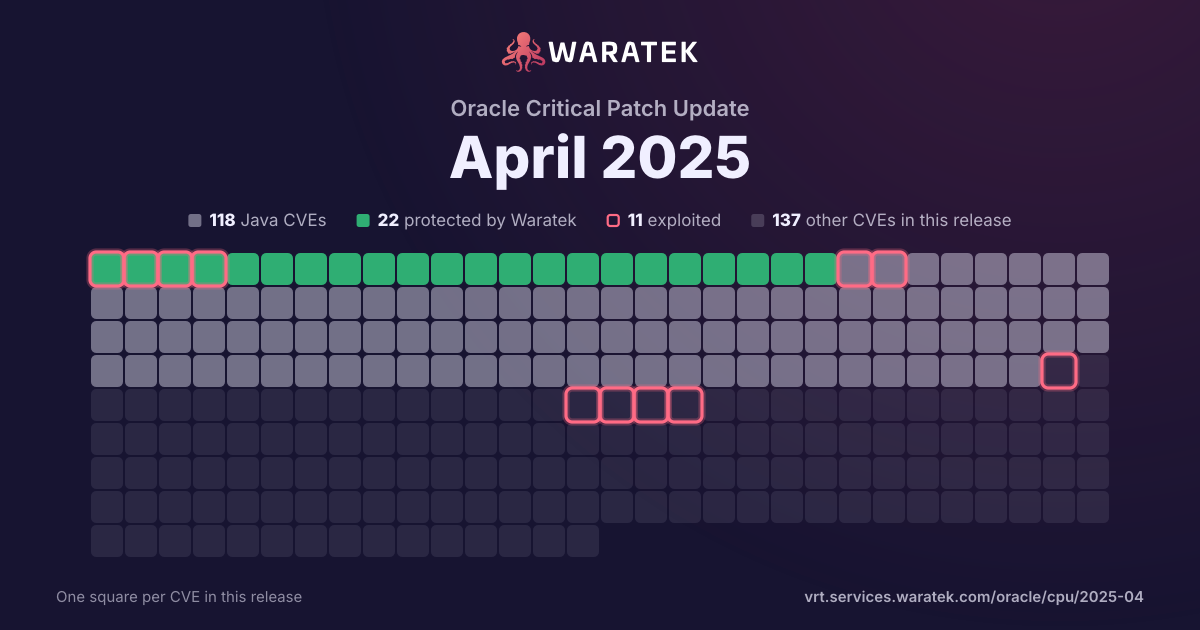
By status
22Protected by Waratek8Mitigation candidate88No exploit published16Outside Waratek scope121Not applicable
11Exploited, marked by the ring
No exploit published. For 33 of them, Oracle's security advisory is the source of public detail.
Protected by Waratek. Waratek RASP can block exploitation of these on systems that have not applied the patch yet.
Overview 6 matches · 0 in Waratek scope · 0 protected · 1 exploited · 0 CISA KEV · 1 public PoC · 1 EPSS ≥ 0.5
6matches
0in Waratek scope0.0%
0protected0.0%
1exploited16.7%
0CISA KEV0.0%
1public PoC16.7%
1EPSS ≥ 0.516.7%
Protected by Waratek
0
0.0%
Rule in development
0
0.0%
Mitigation candidate
0
0.0%
No exploit published
0
0.0%
Outside Waratek scope
0
0.0%
Not applicable
6
100.0%
Withdrawn CVE
0
0.0%
blocked by ARMR today
0
0.0%
partly blocked
0
0.0%
not blocked
6
100.0%
not established
0
0.0%
unrecorded
0
0.0%
Exploited
1
16.7%
Working exploit published
0
0.0%
Proof of concept only
0
0.0%
Forecast only
0
0.0%
No public exploit
5
83.3%
split by
peak 2 / month
Feb 242
Not applicable2
Critical2
not blocked2
No public exploit2
Mar 240
Apr 240
May 240
Jun 240
Jul 242
Not applicable2
Critical2
not blocked2
No public exploit2
Aug 240
Sep 240
Oct 240
Nov 240
Dec 241
Not applicable1
Critical1
not blocked1
No public exploit1
Jan 250
Feb 250
Mar 251
Not applicable1
Critical1
not blocked1
Exploited1
Mar 24May 24Jul 24Sep 24Nov 24Jan 25Mar 25
| CVE | Severity | Published▾ | Status | Exploitation | Description |
|---|---|---|---|---|---|
| CVE-2025-1974 | Critical | 2025-03-25 | Not applicable | Exploited | A security issue was discovered in Kubernetes where under certain conditions, an unauthenticated attacker with access to the pod network can achieve arbitrary code execution in the context of the ingress-nginx controller. This can lead to disclosure of Secrets accessible to the controller. (Note that in the default installation, the controller can access all Secrets cluster-wide.) |
| CVE-2024-54534 | Critical | 2024-12-12 | Not applicable | No public exploit | The issue was addressed with improved memory handling. This issue is fixed in Safari 18.2, iOS 18.2 and iPadOS 18.2, iPadOS 17.7.6, macOS Sequoia 15.2, tvOS 18.2, visionOS 2.2, watchOS 11.2. Processing maliciously crafted web content may lead to memory corruption. |
| CVE-2024-38476 | Critical | 2024-07-01 | Not applicable | No public exploit | Vulnerability in core of Apache HTTP Server 2.4.59 and earlier are vulnerably to information disclosure, SSRF or local script execution via backend applications whose response headers are malicious or exploitable. Users are recommended to upgrade to version 2.4.60, which fixes this issue. |
| CVE-2024-38474 | Critical | 2024-07-01 | Not applicable | No public exploit | Substitution encoding issue in mod_rewrite in Apache HTTP Server 2.4.59 and earlier allows attacker to execute scripts in directories permitted by the configuration but not directly reachable by any URL or source disclosure of scripts meant to only to be executed as CGI. Users are recommended to upgrade to version 2.4.60, which fixes this issue. Some RewriteRules that capture and substitute unsafely will now fail unless rewrite flag "UnsafeAllow3F" is specified. |
| CVE-2024-23807 | Critical | 2024-02-29 | Not applicable | No public exploit | The Apache Xerces C++ XML parser on versions 3.0.0 before 3.2.5 contains a use-after-free error triggered during the scanning of external DTDs. Users are recommended to upgrade to version 3.2.5 which fixes the issue, or mitigate the issue by disabling DTD processing. This can be accomplished via the DOM using a standard parser feature, or via SAX using the XERCES_DISABLE_DTD environment variable. This issue has been disclosed before as CVE-2018-1311, but unfortunately that advisory incorrectly stated the issue would be fixed in version 3.2.3 or 3.2.4. |
| CVE-2022-34381 | Critical | 2024-02-02 | Not applicable | No public exploit | Dell BSAFE SSL-J version 7.0 and all versions prior to 6.5, and Dell BSAFE Crypto-J versions prior to 6.2.6.1 contain an unmaintained third-party component vulnerability. An unauthenticated remote attacker could potentially exploit this vulnerability, leading to the compromise of the impacted system. This is a Critical vulnerability and Dell recommends customers to upgrade at the earliest opportunity. |