
Oracle Critical Patch Update April 2025
Released April 2025 · Oracle's advisory ↗ · ← Critical Patch Update, January 2025 · Critical Patch Update, July 2025 →
255 CVEs in this release, one square each
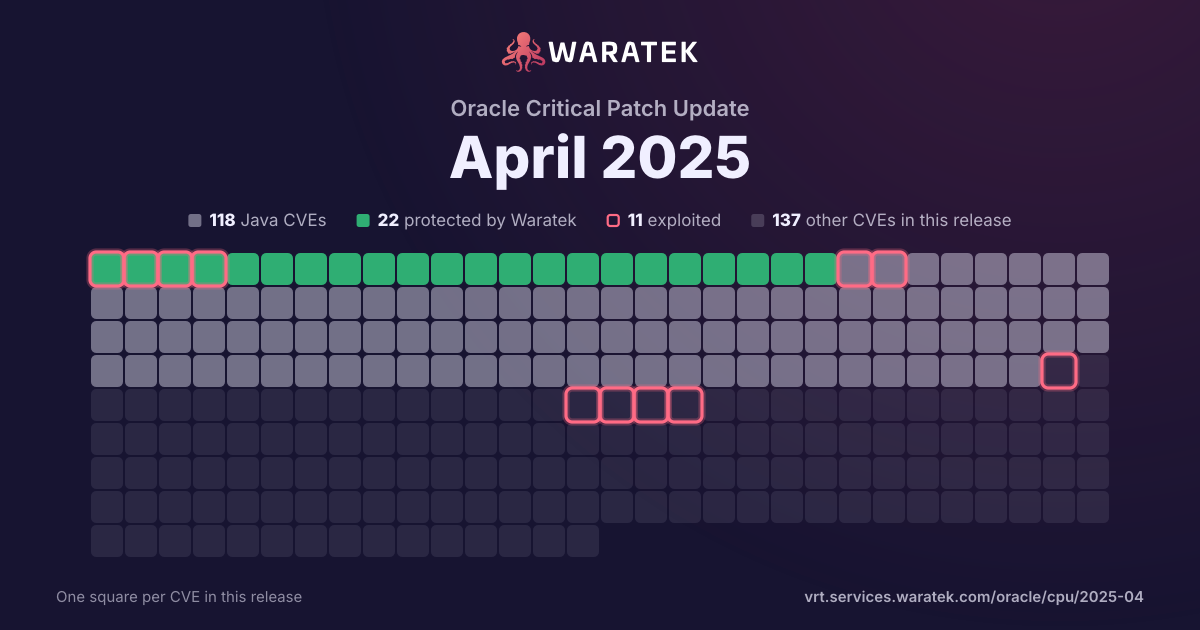
By status
23Protected by Waratek9Mitigation candidate93No exploit published3Outside Waratek scope127Not applicable
11Exploited, marked by the ring
No exploit published. For 34 of them, Oracle's security advisory is the source of public detail.
Protected by Waratek. Waratek RASP can block exploitation of these on systems that have not applied the patch yet.
Overview 9 matches · 3 in Waratek scope · 1 protected · 1 exploited · 0 CISA KEV · 1 public PoC · 1 EPSS ≥ 0.5
9matches
3in Waratek scope33.3%
1protected11.1%
1exploited11.1%
0CISA KEV0.0%
1public PoC11.1%
1EPSS ≥ 0.511.1%
Protected by Waratek
1
11.1%
Rule in development
0
0.0%
Mitigation candidate
0
0.0%
No exploit published
2
22.2%
Outside Waratek scope
0
0.0%
Not applicable
6
66.7%
Withdrawn CVE
0
0.0%
blocked by ARMR today
1
11.1%
partly blocked
0
0.0%
not blocked
8
88.9%
not established
0
0.0%
unrecorded
0
0.0%
Exploited
1
11.1%
Working exploit published
0
0.0%
Proof of concept only
0
0.0%
Forecast only
1
11.1%
No public exploit
7
77.8%
| CVE | Severity | Published▾ | Status | Exploitation | Description |
|---|---|---|---|---|---|
| CVE-2024-47197 | High | 2024-09-26 | No exploit published | No public exploit | Exposure of Sensitive Information to an Unauthorized Actor, Insecure Storage of Sensitive Information vulnerability in Maven Archetype Plugin. This issue affects Maven Archetype Plugin: from 3.2.1 before 3.3.0. Users are recommended to upgrade to version 3.3.0, which fixes the issue. Archetype integration testing creates a file called ./target/classes/archetype-it/archetype-settings.xml This file contains all the content from the users ~/.m2/settings.xml file, which often contains information they do not want to publish. We expect that on many developer machines, this also contains credentials. When the user runs mvn verify again (without a mvn clean), this file becomes part of the final artifact. If a developer were to publish this into Maven Central or any other remote repository (whether as a release or a snapshot) their credentials would be published without them knowing. |
| CVE-2024-45613 | Medium | 2024-09-25 | Not applicable | No public exploit | CKEditor 5 is a JavaScript rich-text editor. Starting in version 40.0.0 and prior to version 43.1.1, a Cross-Site Scripting (XSS) vulnerability is present in the CKEditor 5 clipboard package. This vulnerability could be triggered by a specific user action, leading to unauthorized JavaScript code execution, if the attacker managed to insert a malicious content into the editor, which might happen with a very specific editor configuration. This vulnerability only affects installations where the Block Toolbar plugin is enabled and either the General HTML Support (with a configuration that permits unsafe markup) or the HTML Embed plugin is also enabled. A fix for the problem is available in version 43.1.1. As a workaround, one may disable the block toolbar plugin. |
| CVE-2024-7254 | High | 2024-09-19 | No exploit published | No public exploit | Any project that parses untrusted Protocol Buffers data containing an arbitrary number of nested groups / series of SGROUP tags can corrupted by exceeding the stack limit i.e. StackOverflow. Parsing nested groups as unknown fields with DiscardUnknownFieldsParser or Java Protobuf Lite parser, or against Protobuf map fields, creates unbounded recursions that can be abused by an attacker. |
| CVE-2024-44187 | Medium | 2024-09-17 | Not applicable | No public exploit | A cross-origin issue existed with "iframe" elements. This was addressed with improved tracking of security origins. This issue is fixed in Safari 18, iOS 18 and iPadOS 18, macOS Sequoia 15, tvOS 18, visionOS 2, watchOS 11. A malicious website may exfiltrate data cross-origin. |
| CVE-2024-40866 | Medium | 2024-09-17 | Not applicable | No public exploit | The issue was addressed with improved UI. This issue is fixed in Safari 18, macOS Sequoia 15. Visiting a malicious website may lead to address bar spoofing. |
| CVE-2024-8775 | Medium | 2024-09-14 | Not applicable | No public exploit | A flaw was found in Ansible, where sensitive information stored in Ansible Vault files can be exposed in plaintext during the execution of a playbook. This occurs when using tasks such as include_vars to load vaulted variables without setting the no_log: true parameter, resulting in sensitive data being printed in the playbook output or logs. This can lead to the unintentional disclosure of secrets like passwords or API keys, compromising security and potentially allowing unauthorized access or actions. |
| CVE-2024-38816 | High | 2024-09-13 | Protected by Waratek | Exploited | Applications serving static resources through the functional web frameworks WebMvc.fn or WebFlux.fn are vulnerable to path traversal attacks. An attacker can craft malicious HTTP requests and obtain any file on the file system that is also accessible to the process in which the Spring application is running. Specifically, an application is vulnerable when both of the following are true: * the web application uses RouterFunctions to serve static resources * resource handling is explicitly configured with a FileSystemResource location However, malicious requests are blocked and rejected when any of the following is true: * the Spring Security HTTP Firewall https://docs.spring.io/spring-security/reference/servlet/exploits/firewall.html is in use * the application runs on Tomcat or Jetty |
| CVE-2024-43796 | Medium | 2024-09-10 | Not applicable | No public exploit | Express.js minimalist web framework for node. In express < 4.20.0, passing untrusted user input - even after sanitizing it - to response.redirect() may execute untrusted code. This issue is patched in express 4.20.0. |
| CVE-2024-6119 | High | 2024-09-03 | Not applicable | Forecast only | Issue summary: Applications performing certificate name checks (e.g., TLS clients checking server certificates) may attempt to read an invalid memory address resulting in abnormal termination of the application process. Impact summary: Abnormal termination of an application can a cause a denial of service. Applications performing certificate name checks (e.g., TLS clients checking server certificates) may attempt to read an invalid memory address when comparing the expected name with an `otherName` subject alternative name of an X.509 certificate. This may result in an exception that terminates the application program. Note that basic certificate chain validation (signatures, dates, ...) is not affected, the denial of service can occur only when the application also specifies an expected DNS name, Email address or IP address. TLS servers rarely solicit client certificates, and even when they do, they generally don't perform a name check against a reference identifier (expected identity), but rather extract the presented identity after checking the certificate chain. So TLS servers are generally not affected and the severity of the issue is Moderate. The FIPS modules in 3.3, 3.2, 3.1 and 3.0 are not affected by this issue. |