
Oracle Critical Patch Update April 2025
Released April 2025 · Oracle's advisory ↗ · ← Critical Patch Update, January 2025 · Critical Patch Update, July 2025 →
255 CVEs in this release, one square each
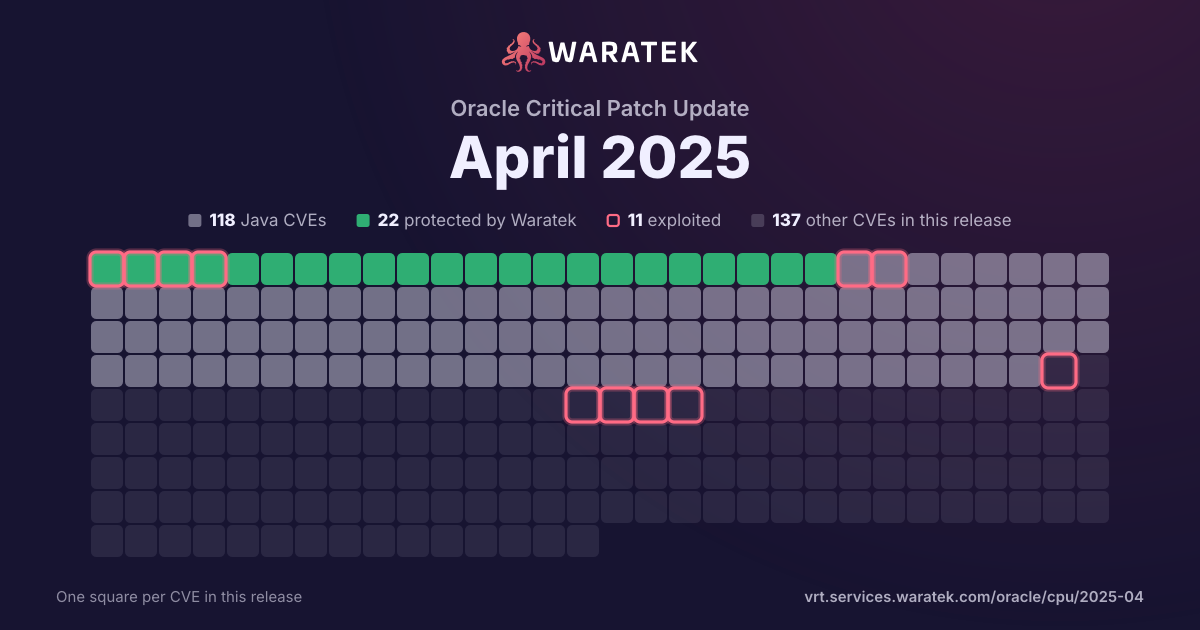
By status
22Protected by Waratek8Mitigation candidate88No exploit published16Outside Waratek scope121Not applicable
11Exploited, marked by the ring
No exploit published. For 33 of them, Oracle's security advisory is the source of public detail.
Protected by Waratek. Waratek RASP can block exploitation of these on systems that have not applied the patch yet.
Overview 121 matches · 0 in Waratek scope · 0 protected · 4 exploited · 3 CISA KEV · 5 public PoC · 2 EPSS ≥ 0.5
121matches
0in Waratek scope0.0%
0protected0.0%
4exploited3.3%
3CISA KEV2.5%
5public PoC4.1%
2EPSS ≥ 0.51.7%
Protected by Waratek
0
0.0%
Rule in development
0
0.0%
Mitigation candidate
0
0.0%
No exploit published
0
0.0%
Outside Waratek scope
0
0.0%
Not applicable
121
100.0%
Withdrawn CVE
0
0.0%
blocked by ARMR today
0
0.0%
partly blocked
0
0.0%
not blocked
121
100.0%
not established
0
0.0%
unrecorded
0
0.0%
Exploited
4
3.3%
Working exploit published
0
0.0%
Proof of concept only
19
15.7%
Forecast only
0
0.0%
No public exploit
98
81.0%
split by
peak 42 / quarter
Q4 221
Not applicable1
High1
not blocked1
Proof of concept only1
Q1 230
Q2 230
Q3 231
Not applicable1
Medium1
not blocked1
No public exploit1
Q4 232
Not applicable2
High1
Low1
not blocked2
No public exploit2
Q1 246
Not applicable6
Critical2
High1
Medium3
not blocked6
Proof of concept only1
No public exploit5
Q2 246
Not applicable6
High1
Medium5
not blocked6
Proof of concept only1
No public exploit5
Q3 2414
Not applicable14
Critical2
High2
Medium10
not blocked14
Proof of concept only2
No public exploit12
Q4 2431
Not applicable31
Critical1
High9
Medium20
Low1
not blocked31
Exploited2
Proof of concept only10
No public exploit19
Q1 2518
Not applicable18
Critical1
High9
Medium8
not blocked18
Exploited2
Proof of concept only3
No public exploit13
Q2 2542
Not applicable42
High6
Medium33
Low3
not blocked42
Proof of concept only1
No public exploit41
Q4 22Q1 23Q2 23Q3 23Q4 23Q1 24Q2 24Q3 24Q4 24Q1 25Q2 25
| CVE | Severity | Published▾ | Status | Exploitation | Description |
|---|---|---|---|---|---|
| CVE-2024-40725 | Medium | 2024-07-18 | Not applicable | Proof of concept only | A partial fix for CVE-2024-39884 in the core of Apache HTTP Server 2.4.61 ignores some use of the legacy content-type based configuration of handlers. "AddType" and similar configuration, under some circumstances where files are requested indirectly, result in source code disclosure of local content. For example, PHP scripts may be served instead of interpreted. Users are recommended to upgrade to version 2.4.62, which fixes this issue. |
| CVE-2024-39884 | Medium | 2024-07-04 | Not applicable | No public exploit | A regression in the core of Apache HTTP Server 2.4.60 ignores some use of the legacy content-type based configuration of handlers. "AddType" and similar configuration, under some circumstances where files are requested indirectly, result in source code disclosure of local content. For example, PHP scripts may be served instead of interpreted. Users are recommended to upgrade to version 2.4.61, which fixes this issue. |
| CVE-2024-39573 | High | 2024-07-01 | Not applicable | No public exploit | Potential SSRF in mod_rewrite in Apache HTTP Server 2.4.59 and earlier allows an attacker to cause unsafe RewriteRules to unexpectedly setup URL's to be handled by mod_proxy. Users are recommended to upgrade to version 2.4.60, which fixes this issue. |
| CVE-2024-38476 | Critical | 2024-07-01 | Not applicable | No public exploit | Vulnerability in core of Apache HTTP Server 2.4.59 and earlier are vulnerably to information disclosure, SSRF or local script execution via backend applications whose response headers are malicious or exploitable. Users are recommended to upgrade to version 2.4.60, which fixes this issue. |
| CVE-2024-38474 | Critical | 2024-07-01 | Not applicable | No public exploit | Substitution encoding issue in mod_rewrite in Apache HTTP Server 2.4.59 and earlier allows attacker to execute scripts in directories permitted by the configuration but not directly reachable by any URL or source disclosure of scripts meant to only to be executed as CGI. Users are recommended to upgrade to version 2.4.60, which fixes this issue. Some RewriteRules that capture and substitute unsafely will now fail unless rewrite flag "UnsafeAllow3F" is specified. |
| CVE-2024-38357 | Medium | 2024-06-19 | Not applicable | No public exploit | TinyMCE is an open source rich text editor. A cross-site scripting (XSS) vulnerability was discovered in TinyMCE’s content parsing code. This allowed specially crafted noscript elements containing malicious code to be executed when that content was loaded into the editor. This vulnerability has been patched in TinyMCE 7.2.0, TinyMCE 6.8.4 and TinyMCE 5.11.0 LTS by ensuring that content within noscript elements are properly parsed. Users are advised to upgrade. There are no known workarounds for this vulnerability. |
| CVE-2024-5206 | Medium | 2024-06-06 | Not applicable | Proof of concept only | A sensitive data leakage vulnerability was identified in scikit-learn's TfidfVectorizer, specifically in versions up to and including 1.4.1.post1, which was fixed in version 1.5.0. The vulnerability arises from the unexpected storage of all tokens present in the training data within the `stop_words_` attribute, rather than only storing the subset of tokens required for the TF-IDF technique to function. This behavior leads to the potential leakage of sensitive information, as the `stop_words_` attribute could contain tokens that were meant to be discarded and not stored, such as passwords or keys. The impact of this vulnerability varies based on the nature of the data being processed by the vectorizer. |
| CVE-2024-35195 | Medium | 2024-05-20 | Not applicable | No public exploit | Requests is a HTTP library. Prior to 2.32.0, when making requests through a Requests `Session`, if the first request is made with `verify=False` to disable cert verification, all subsequent requests to the same host will continue to ignore cert verification regardless of changes to the value of `verify`. This behavior will continue for the lifecycle of the connection in the connection pool. This vulnerability is fixed in 2.32.0. |
| CVE-2024-34064 | Medium | 2024-05-06 | Not applicable | No public exploit | Jinja is an extensible templating engine. The `xmlattr` filter in affected versions of Jinja accepts keys containing non-attribute characters. XML/HTML attributes cannot contain spaces, `/`, `>`, or `=`, as each would then be interpreted as starting a separate attribute. If an application accepts keys (as opposed to only values) as user input, and renders these in pages that other users see as well, an attacker could use this to inject other attributes and perform XSS. The fix for CVE-2024-22195 only addressed spaces but not other characters. Accepting keys as user input is now explicitly considered an unintended use case of the `xmlattr` filter, and code that does so without otherwise validating the input should be flagged as insecure, regardless of Jinja version. Accepting _values_ as user input continues to be safe. This vulnerability is fixed in 3.1.4. |
| CVE-2024-1135 | High | 2024-04-16 | Not applicable | No public exploit | Gunicorn fails to properly validate Transfer-Encoding headers, leading to HTTP Request Smuggling (HRS) vulnerabilities. By crafting requests with conflicting Transfer-Encoding headers, attackers can bypass security restrictions and access restricted endpoints. This issue is due to Gunicorn's handling of Transfer-Encoding headers, where it incorrectly processes requests with multiple, conflicting Transfer-Encoding headers, treating them as chunked regardless of the final encoding specified. This vulnerability allows for a range of attacks including cache poisoning, session manipulation, and data exposure. |
| CVE-2024-28219 | Medium | 2024-04-03 | Not applicable | No public exploit | In _imagingcms.c in Pillow before 10.3.0, a buffer overflow exists because strcpy is used instead of strncpy. |
| CVE-2024-28835 | Medium | 2024-03-21 | Not applicable | No public exploit | A flaw has been discovered in GnuTLS where an application crash can be induced when attempting to verify a specially crafted .pem bundle using the "certtool --verify-chain" command. |
| CVE-2024-28834 | Medium | 2024-03-21 | Not applicable | No public exploit | A flaw was found in GnuTLS. The Minerva attack is a cryptographic vulnerability that exploits deterministic behavior in systems like GnuTLS, leading to side-channel leaks. In specific scenarios, such as when using the GNUTLS_PRIVKEY_FLAG_REPRODUCIBLE flag, it can result in a noticeable step in nonce size from 513 to 512 bits, exposing a potential timing side-channel. |
| CVE-2023-5388 | Medium | 2024-03-19 | Not applicable | No public exploit | NSS was susceptible to a timing side-channel attack when performing RSA decryption. This attack could potentially allow an attacker to recover the private data. This vulnerability affects Firefox < 124, Firefox ESR < 115.9, and Thunderbird < 115.9. |
| CVE-2024-23807 | Critical | 2024-02-29 | Not applicable | No public exploit | The Apache Xerces C++ XML parser on versions 3.0.0 before 3.2.5 contains a use-after-free error triggered during the scanning of external DTDs. Users are recommended to upgrade to version 3.2.5 which fixes the issue, or mitigate the issue by disabling DTD processing. This can be accomplished via the DOM using a standard parser feature, or via SAX using the XERCES_DISABLE_DTD environment variable. This issue has been disclosed before as CVE-2018-1311, but unfortunately that advisory incorrectly stated the issue would be fixed in version 3.2.3 or 3.2.4. |
| CVE-2024-22243 | High | 2024-02-23 | Not applicable | Proof of concept only | Applications that use UriComponentsBuilder to parse an externally provided URL (e.g. through a query parameter) AND perform validation checks on the host of the parsed URL may be vulnerable to a open redirect https://cwe.mitre.org/data/definitions/601.html attack or to a SSRF attack if the URL is used after passing validation checks. |
| CVE-2022-34381 | Critical | 2024-02-02 | Not applicable | No public exploit | Dell BSAFE SSL-J version 7.0 and all versions prior to 6.5, and Dell BSAFE Crypto-J versions prior to 6.2.6.1 contain an unmaintained third-party component vulnerability. An unauthenticated remote attacker could potentially exploit this vulnerability, leading to the compromise of the impacted system. This is a Critical vulnerability and Dell recommends customers to upgrade at the earliest opportunity. |
| CVE-2023-38546 | Low | 2023-10-18 | Not applicable | No public exploit | This flaw allows an attacker to insert cookies at will into a running program using libcurl, if the specific series of conditions are met. libcurl performs transfers. In its API, an application creates "easy handles" that are the individual handles for single transfers. libcurl provides a function call that duplicates en easy handle called [curl_easy_duphandle](https://curl.se/libcurl/c/curl_easy_duphandle.html). If a transfer has cookies enabled when the handle is duplicated, the cookie-enable state is also cloned - but without cloning the actual cookies. If the source handle did not read any cookies from a specific file on disk, the cloned version of the handle would instead store the file name as `none` (using the four ASCII letters, no quotes). Subsequent use of the cloned handle that does not explicitly set a source to load cookies from would then inadvertently load cookies from a file named `none` - if such a file exists and is readable in the current directory of the program using libcurl. And if using the correct file format of course. |
| CVE-2023-37536 | High | 2023-10-11 | Not applicable | No public exploit | An integer overflow in xerces-c++ 3.2.3 in BigFix Platform allows remote attackers to cause out-of-bound access via HTTP request. |
| CVE-2023-25399 | Medium | 2023-07-05 | Not applicable | No public exploit | A refcounting issue which leads to potential memory leak was discovered in scipy commit 8627df31ab in Py_FindObjects() function. Note: This is disputed as a bug and not a vulnerability. SciPy is not designed to be exposed to untrusted users or data directly. |
| CVE-2022-3786 | High | 2022-11-01 | Not applicable | Proof of concept only | A buffer overrun can be triggered in X.509 certificate verification, specifically in name constraint checking. Note that this occurs after certificate chain signature verification and requires either a CA to have signed a malicious certificate or for an application to continue certificate verification despite failure to construct a path to a trusted issuer. An attacker can craft a malicious email address in a certificate to overflow an arbitrary number of bytes containing the `.' character (decimal 46) on the stack. This buffer overflow could result in a crash (causing a denial of service). In a TLS client, this can be triggered by connecting to a malicious server. In a TLS server, this can be triggered if the server requests client authentication and a malicious client connects. |