
Oracle Critical Patch Update April 2025
Released April 2025 · Oracle's advisory ↗ · ← Critical Patch Update, January 2025 · Critical Patch Update, July 2025 →
255 CVEs in this release, one square each
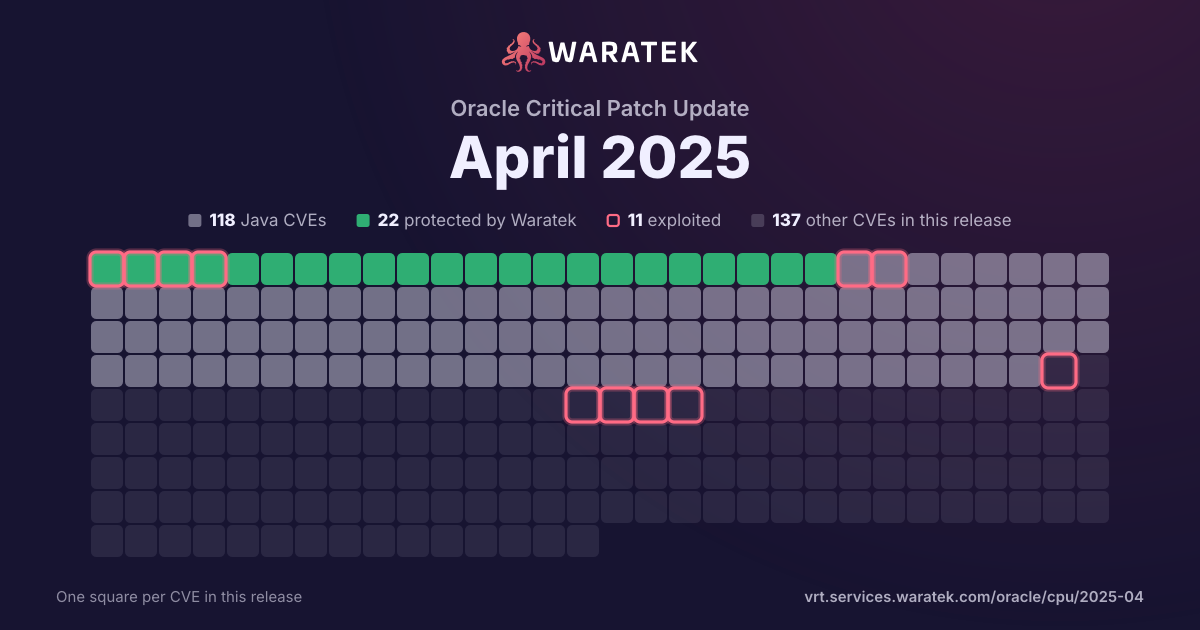
By status
22Protected by Waratek8Mitigation candidate94No exploit published3Outside Waratek scope128Not applicable
11Exploited, marked by the ring
No exploit published. For 29 of them, Oracle's security advisory is the source of public detail.
Protected by Waratek. Waratek RASP can block exploitation of these on systems that have not applied the patch yet.
Overview 30 matches · 13 in Waratek scope · 4 protected · 0 exploited · 0 CISA KEV · 10 public PoC · 0 EPSS ≥ 0.5
30matches
13in Waratek scope43.3%
4protected13.3%
0exploited0.0%
0CISA KEV0.0%
10public PoC33.3%
0EPSS ≥ 0.50.0%
Protected by Waratek
4
13.3%
Rule in development
0
0.0%
Mitigation candidate
5
16.7%
No exploit published
4
13.3%
Outside Waratek scope
0
0.0%
Not applicable
17
56.7%
Withdrawn CVE
0
0.0%
blocked by ARMR today
4
13.3%
partly blocked
0
0.0%
not blocked
26
86.7%
not established
0
0.0%
unrecorded
0
0.0%
Exploited
0
0.0%
Working exploit published
0
0.0%
Proof of concept only
30
100.0%
Forecast only
0
0.0%
No public exploit
0
0.0%
split by
peak 14 / quarter
Q1 201
Protected by Waratek1
Critical1
blocked by ARMR today1
Proof of concept only1
Q2 201
Mitigation candidate1
High1
not blocked1
Proof of concept only1
Q3 200
Q4 200
Q1 210
Q2 210
Q3 210
Q4 211
Not applicable1
Medium1
not blocked1
Proof of concept only1
Q1 220
Q2 220
Q3 221
Protected by Waratek1
Medium1
blocked by ARMR today1
Proof of concept only1
Q4 222
Protected by Waratek1
Not applicable1
Critical1
High1
blocked by ARMR today1
not blocked1
Proof of concept only2
Q1 231
No exploit published1
High1
not blocked1
Proof of concept only1
Q2 230
Q3 231
Mitigation candidate1
Medium1
not blocked1
Proof of concept only1
Q4 230
Q1 243
Mitigation candidate2
No exploit published1
High2
Medium1
not blocked3
Proof of concept only3
Q2 241
Not applicable1
Medium1
not blocked1
Proof of concept only1
Q3 243
Protected by Waratek1
Not applicable2
High2
Medium1
blocked by ARMR today1
not blocked2
Proof of concept only3
Q4 2414
Mitigation candidate1
No exploit published2
Not applicable11
Critical1
High1
Medium11
Low1
not blocked14
Proof of concept only14
Q1 251
Not applicable1
Medium1
not blocked1
Proof of concept only1
Q1 20Q3 20Q1 21Q3 21Q1 22Q3 22Q1 23Q3 23Q1 24Q3 24Q1 25
| CVE | Severity | Published▾ | Status | Exploitation | Description |
|---|---|---|---|---|---|
| CVE-2025-23022 | Medium | 2025-01-10 | Not applicable | Proof of concept only | FreeType 2.8.1 has a signed integer overflow in cf2_doFlex in cff/cf2intrp.c. |
| CVE-2024-50379 | Critical | 2024-12-17 | Mitigation candidate | Proof of concept only | Time-of-check Time-of-use (TOCTOU) Race Condition vulnerability during JSP compilation in Apache Tomcat permits an RCE on case insensitive file systems when the default servlet is enabled for write (non-default configuration). This issue affects Apache Tomcat: from 11.0.0-M1 through 11.0.1, from 10.1.0-M1 through 10.1.33, from 9.0.0.M1 through 9.0.97. The following versions were EOL at the time the CVE was created but are known to be affected: 8.5.0 though 8.5.100. Other, older, EOL versions may also be affected. Users are recommended to upgrade to version 11.0.2, 10.1.34 or 9.0.98, which fixes the issue. |
| CVE-2024-47778 | Medium | 2024-12-12 | Not applicable | Proof of concept only | GStreamer is a library for constructing graphs of media-handling components. An OOB-read vulnerability has been discovered in gst_wavparse_adtl_chunk within gstwavparse.c. This vulnerability arises due to insufficient validation of the size parameter, which can exceed the bounds of the data buffer. As a result, an OOB read occurs in the following while loop. This vulnerability can result in reading up to 4GB of process memory or potentially causing a segmentation fault (SEGV) when accessing invalid memory. This vulnerability is fixed in 1.24.10. |
| CVE-2024-47777 | Medium | 2024-12-12 | Not applicable | Proof of concept only | GStreamer is a library for constructing graphs of media-handling components. An OOB-read vulnerability has been identified in the gst_wavparse_smpl_chunk function within gstwavparse.c. This function attempts to read 4 bytes from the data + 12 offset without checking if the size of the data buffer is sufficient. If the buffer is too small, the function reads beyond its bounds. This vulnerability may result in reading 4 bytes out of the boundaries of the data buffer. This vulnerability is fixed in 1.24.10. |
| CVE-2024-47776 | Medium | 2024-12-12 | Not applicable | Proof of concept only | GStreamer is a library for constructing graphs of media-handling components. An OOB-read has been discovered in gst_wavparse_cue_chunk within gstwavparse.c. The vulnerability happens due to a discrepancy between the size of the data buffer and the size value provided to the function. This mismatch causes the comparison if (size < 4 + ncues * 24) to fail in some cases, allowing the subsequent loop to access beyond the bounds of the data buffer. The root cause of this discrepancy stems from a miscalculation when clipping the chunk size based on upstream data size. This vulnerability allows reading beyond the bounds of the data buffer, potentially leading to a crash (denial of service) or the leak of sensitive data. This vulnerability is fixed in 1.24.10. |
| CVE-2024-47775 | Medium | 2024-12-12 | Not applicable | Proof of concept only | GStreamer is a library for constructing graphs of media-handling components. An OOB-read vulnerability has been found in the parse_ds64 function within gstwavparse.c. The parse_ds64 function does not check that the buffer buf contains sufficient data before attempting to read from it, doing multiple GST_READ_UINT32_LE operations without performing boundary checks. This can lead to an OOB-read when buf is smaller than expected. This vulnerability allows reading beyond the bounds of the data buffer, potentially leading to a crash (denial of service) or the leak of sensitive data. This vulnerability is fixed in 1.24.10. |
| CVE-2024-47597 | Medium | 2024-12-12 | Not applicable | Proof of concept only | GStreamer is a library for constructing graphs of media-handling components. An OOB-read has been detected in the function qtdemux_parse_samples within qtdemux.c. This issue arises when the function qtdemux_parse_samples reads data beyond the boundaries of the stream->stco buffer. The following code snippet shows the call to qt_atom_parser_get_offset_unchecked, which leads to the OOB-read when parsing the provided GHSL-2024-245_crash1.mp4 file. This issue may lead to read up to 8 bytes out-of-bounds. This vulnerability is fixed in 1.24.10. |
| CVE-2024-47596 | Medium | 2024-12-12 | Not applicable | Proof of concept only | GStreamer is a library for constructing graphs of media-handling components. An OOB-read has been discovered in the qtdemux_parse_svq3_stsd_data function within qtdemux.c. In the FOURCC_SMI_ case, seqh_size is read from the input file without proper validation. If seqh_size is greater than the remaining size of the data buffer, it can lead to an OOB-read in the following call to gst_buffer_fill, which internally uses memcpy. This vulnerability can result in reading up to 4GB of process memory or potentially causing a segmentation fault (SEGV) when accessing invalid memory. This vulnerability is fixed in 1.24.10. |
| CVE-2024-47546 | Medium | 2024-12-12 | Not applicable | Proof of concept only | GStreamer is a library for constructing graphs of media-handling components. An integer underflow has been detected in extract_cc_from_data function within qtdemux.c. In the FOURCC_c708 case, the subtraction atom_length - 8 may result in an underflow if atom_length is less than 8. When that subtraction underflows, *cclen ends up being a large number, and then cclen is passed to g_memdup2 leading to an out-of-bounds (OOB) read. This vulnerability is fixed in 1.24.10. |
| CVE-2024-47545 | Medium | 2024-12-12 | Not applicable | Proof of concept only | GStreamer is a library for constructing graphs of media-handling components. An integer underflow has been detected in qtdemux_parse_trak function within qtdemux.c. During the strf parsing case, the subtraction size -= 40 can lead to a negative integer overflow if it is less than 40. If this happens, the subsequent call to gst_buffer_fill will invoke memcpy with a large tocopy size, resulting in an OOB-read. This vulnerability is fixed in 1.24.10. |
| CVE-2024-11053 | Low | 2024-12-11 | Not applicable | Proof of concept only | When asked to both use a `.netrc` file for credentials and to follow HTTP redirects, curl could leak the password used for the first host to the followed-to host under certain circumstances. This flaw only manifests itself if the netrc file has an entry that matches the redirect target hostname but the entry either omits just the password or omits both login and password. |
| CVE-2024-47535 | Medium | 2024-11-12 | No exploit published | Proof of concept only | Netty is an asynchronous event-driven network application framework for rapid development of maintainable high performance protocol servers & clients. An unsafe reading of environment file could potentially cause a denial of service in Netty. When loaded on an Windows application, Netty attempts to load a file that does not exist. If an attacker creates such a large file, the Netty application crashes. This vulnerability is fixed in 4.1.115. |
| CVE-2024-21538 | High | 2024-11-08 | Not applicable | Proof of concept only | Versions of the package cross-spawn before 6.0.6, from 7.0.0 and before 7.0.5 are vulnerable to Regular Expression Denial of Service (ReDoS) due to improper input sanitization. An attacker can increase the CPU usage and crash the program by crafting a very large and well crafted string. |
| CVE-2024-50602 | Medium | 2024-10-27 | Not applicable | Proof of concept only | An issue was discovered in libexpat before 2.6.4. There is a crash within the XML_ResumeParser function because XML_StopParser can stop/suspend an unstarted parser. |
| CVE-2024-6763 | Medium | 2024-10-14 | No exploit published | Proof of concept only | Eclipse Jetty is a lightweight, highly scalable, Java-based web server and Servlet engine . It includes a utility class, HttpURI, for URI/URL parsing. The HttpURI class does insufficient validation on the authority segment of a URI. However the behaviour of HttpURI differs from the common browsers in how it handles a URI that would be considered invalid if fully validated against the RRC. Specifically HttpURI and the browser may differ on the value of the host extracted from an invalid URI and thus a combination of Jetty and a vulnerable browser may be vulnerable to a open redirect attack or to a SSRF attack if the URI is used after passing validation checks. |
| CVE-2024-39338 | High | 2024-08-12 | Not applicable | Proof of concept only | axios 1.7.2 allows SSRF via unexpected behavior where requests for path relative URLs get processed as protocol relative URLs. |
| CVE-2024-43044 | High | 2024-08-07 | Protected by Waratek | Proof of concept only | Jenkins 2.470 and earlier, LTS 2.452.3 and earlier allows agent processes to read arbitrary files from the Jenkins controller file system by using the `ClassLoaderProxy#fetchJar` method in the Remoting library. |
| CVE-2024-40725 | Medium | 2024-07-18 | Not applicable | Proof of concept only | A partial fix for CVE-2024-39884 in the core of Apache HTTP Server 2.4.61 ignores some use of the legacy content-type based configuration of handlers. "AddType" and similar configuration, under some circumstances where files are requested indirectly, result in source code disclosure of local content. For example, PHP scripts may be served instead of interpreted. Users are recommended to upgrade to version 2.4.62, which fixes this issue. |
| CVE-2024-5206 | Medium | 2024-06-06 | Not applicable | Proof of concept only | A sensitive data leakage vulnerability was identified in scikit-learn's TfidfVectorizer, specifically in versions up to and including 1.4.1.post1, which was fixed in version 1.5.0. The vulnerability arises from the unexpected storage of all tokens present in the training data within the `stop_words_` attribute, rather than only storing the subset of tokens required for the TF-IDF technique to function. This behavior leads to the potential leakage of sensitive information, as the `stop_words_` attribute could contain tokens that were meant to be discarded and not stored, such as passwords or keys. The impact of this vulnerability varies based on the nature of the data being processed by the vectorizer. |
| CVE-2024-29025 | Medium | 2024-03-25 | No exploit published | Proof of concept only | Netty is an asynchronous event-driven network application framework for rapid development of maintainable high performance protocol servers & clients. The `HttpPostRequestDecoder` can be tricked to accumulate data. While the decoder can store items on the disk if configured so, there are no limits to the number of fields the form can have, an attacher can send a chunked post consisting of many small fields that will be accumulated in the `bodyListHttpData` list. The decoder cumulates bytes in the `undecodedChunk` buffer until it can decode a field, this field can cumulate data without limits. This vulnerability is fixed in 4.1.108.Final. |
| CVE-2024-24549 | High | 2024-03-13 | Mitigation candidate | Proof of concept only | Denial of Service due to improper input validation vulnerability for HTTP/2 requests in Apache Tomcat. When processing an HTTP/2 request, if the request exceeded any of the configured limits for headers, the associated HTTP/2 stream was not reset until after all of the headers had been processed.This issue affects Apache Tomcat: from 11.0.0-M1 through 11.0.0-M16, from 10.1.0-M1 through 10.1.18, from 9.0.0-M1 through 9.0.85, from 8.5.0 through 8.5.98. Other, older, EOL versions may also be affected. Users are recommended to upgrade to version 11.0.0-M17, 10.1.19, 9.0.86 or 8.5.99 which fix the issue. |
| CVE-2024-22243 | High | 2024-02-23 | Mitigation candidate | Proof of concept only | Applications that use UriComponentsBuilder to parse an externally provided URL (e.g. through a query parameter) AND perform validation checks on the host of the parsed URL may be vulnerable to a open redirect https://cwe.mitre.org/data/definitions/601.html attack or to a SSRF attack if the URL is used after passing validation checks. |
| CVE-2023-41080 | Medium | 2023-08-25 | Mitigation candidate | Proof of concept only | URL Redirection to Untrusted Site ('Open Redirect') vulnerability in FORM authentication feature Apache Tomcat.This issue affects Apache Tomcat: from 11.0.0-M1 through 11.0.0-M10, from 10.1.0-M1 through 10.0.12, from 9.0.0-M1 through 9.0.79 and from 8.5.0 through 8.5.92. Older, EOL versions may also be affected. The vulnerability is limited to the ROOT (default) web application. |
| CVE-2023-1370 | High | 2023-03-22 | No exploit published | Proof of concept only | [Json-smart](https://netplex.github.io/json-smart/) is a performance focused, JSON processor lib. When reaching a ‘[‘ or ‘{‘ character in the JSON input, the code parses an array or an object respectively. It was discovered that the code does not have any limit to the nesting of such arrays or objects. Since the parsing of nested arrays and objects is done recursively, nesting too many of them can cause a stack exhaustion (stack overflow) and crash the software. |
| CVE-2022-45047 | Critical | 2022-11-16 | Protected by Waratek | Proof of concept only | Class org.apache.sshd.server.keyprovider.SimpleGeneratorHostKeyProvider in Apache MINA SSHD <= 2.9.1 uses Java deserialization to load a serialized java.security.PrivateKey. The class is one of several implementations that an implementor using Apache MINA SSHD can choose for loading the host keys of an SSH server. |
| CVE-2022-3786 | High | 2022-11-01 | Not applicable | Proof of concept only | A buffer overrun can be triggered in X.509 certificate verification, specifically in name constraint checking. Note that this occurs after certificate chain signature verification and requires either a CA to have signed a malicious certificate or for an application to continue certificate verification despite failure to construct a path to a trusted issuer. An attacker can craft a malicious email address in a certificate to overflow an arbitrary number of bytes containing the `.' character (decimal 46) on the stack. This buffer overflow could result in a crash (causing a denial of service). In a TLS client, this can be triggered by connecting to a malicious server. In a TLS server, this can be triggered if the server requests client authentication and a malicious client connects. |
| CVE-2022-36033 | Medium | 2022-08-29 | Protected by Waratek | Proof of concept only | jsoup is a Java HTML parser, built for HTML editing, cleaning, scraping, and cross-site scripting (XSS) safety. jsoup may incorrectly sanitize HTML including `javascript:` URL expressions, which could allow XSS attacks when a reader subsequently clicks that link. If the non-default `SafeList.preserveRelativeLinks` option is enabled, HTML including `javascript:` URLs that have been crafted with control characters will not be sanitized. If the site that this HTML is published on does not set a Content Security Policy, an XSS attack is then possible. This issue is patched in jsoup 1.15.3. Users should upgrade to this version. Additionally, as the unsanitized input may have been persisted, old content should be cleaned again using the updated version. To remediate this issue without immediately upgrading: - disable `SafeList.preserveRelativeLinks`, which will rewrite input URLs as absolute URLs - ensure an appropriate [Content Security Policy](https://developer.mozilla.org/en-US/docs/Web/HTTP/CSP) is defined. (This should be used regardless of upgrading, as a defence-in-depth best practice.) |
| CVE-2021-41184 | Medium | 2021-10-26 | Not applicable | Proof of concept only | jQuery-UI is the official jQuery user interface library. Prior to version 1.13.0, accepting the value of the `of` option of the `.position()` util from untrusted sources may execute untrusted code. The issue is fixed in jQuery UI 1.13.0. Any string value passed to the `of` option is now treated as a CSS selector. A workaround is to not accept the value of the `of` option from untrusted sources. |
| CVE-2020-11996 | High | 2020-06-26 | Mitigation candidate | Proof of concept only | A specially crafted sequence of HTTP/2 requests sent to Apache Tomcat 10.0.0-M1 to 10.0.0-M5, 9.0.0.M1 to 9.0.35 and 8.5.0 to 8.5.55 could trigger high CPU usage for several seconds. If a sufficient number of such requests were made on concurrent HTTP/2 connections, the server could become unresponsive. |
| CVE-2016-1000027 | Critical | 2020-01-02 | Protected by Waratek | Proof of concept only | Pivotal Spring Framework through 5.3.16 suffers from a potential remote code execution (RCE) issue if used for Java deserialization of untrusted data. Depending on how the library is implemented within a product, this issue may or not occur, and authentication may be required. NOTE: the vendor's position is that untrusted data is not an intended use case. The product's behavior will not be changed because some users rely on deserialization of trusted data. |