
Oracle Critical Patch Update April 2025
Released April 2025 · Oracle's advisory ↗ · ← Critical Patch Update, January 2025 · Critical Patch Update, July 2025 →
255 CVEs in this release, one square each
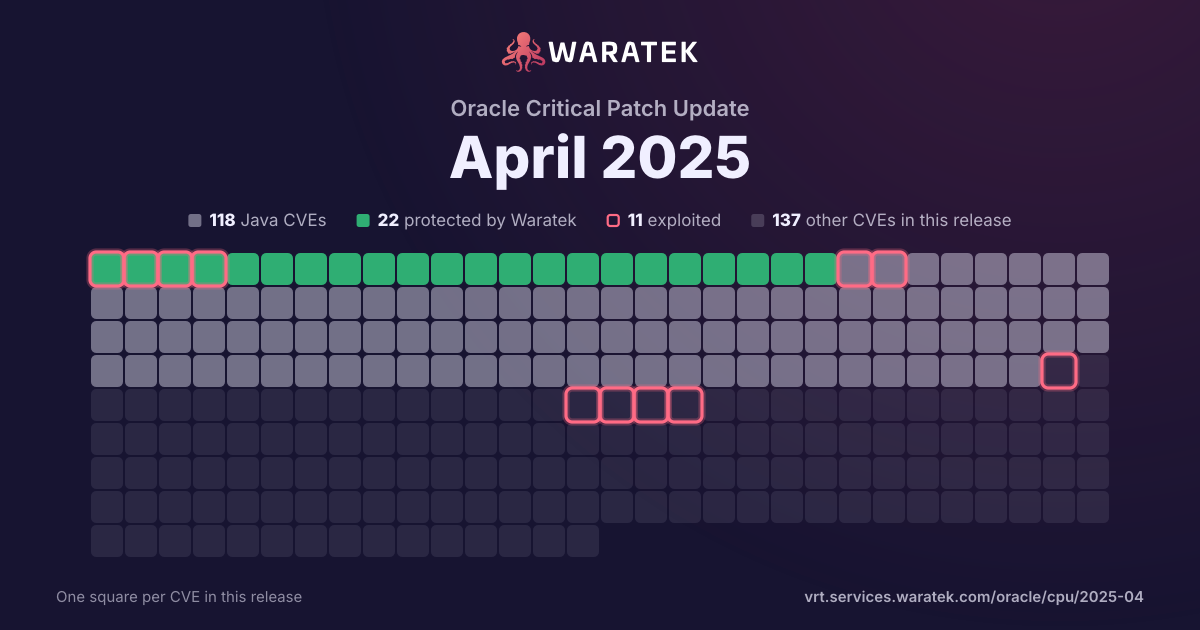
By status
22Protected by Waratek8Mitigation candidate88No exploit published16Outside Waratek scope121Not applicable
11Exploited, marked by the ring
No exploit published. For 33 of them, Oracle's security advisory is the source of public detail.
Protected by Waratek. Waratek RASP can block exploitation of these on systems that have not applied the patch yet.
Overview 5 matches · 3 in Waratek scope · 2 protected · 3 CISA KEV · 3 public PoC · 1 EPSS ≥ 0.5
Protected by Waratek
2
40.0%
Rule in development
0
0.0%
Mitigation candidate
1
20.0%
No exploit published
0
0.0%
Outside Waratek scope
0
0.0%
Not applicable
2
40.0%
Withdrawn CVE
0
0.0%
blocked by ARMR today
2
40.0%
partly blocked
0
0.0%
not blocked
3
60.0%
not established
0
0.0%
unrecorded
0
0.0%
Exploited
5
100.0%
Working exploit published
0
0.0%
Proof of concept only
0
0.0%
Forecast only
0
0.0%
No public exploit
0
0.0%
split by
peak 1 / quarter
Q1 231
Protected by Waratek1
High1
blocked by ARMR today1
Exploited1
Q2 230
Q3 230
Q4 231
Mitigation candidate1
High1
not blocked1
Exploited1
Q1 240
Q2 240
Q3 241
Protected by Waratek1
High1
blocked by ARMR today1
Exploited1
Q4 241
Not applicable1
High1
not blocked1
Exploited1
Q1 251
Not applicable1
High1
not blocked1
Exploited1
Q1 23Q2 23Q3 23Q4 23Q1 24Q2 24Q3 24Q4 24Q1 25
| CVE | Severity | Published▾ | Status | Exploitation | Description |
|---|---|---|---|---|---|
| CVE-2025-27363 | High | 2025-03-11 | Not applicable | Exploited | An out of bounds write exists in FreeType versions 2.13.0 and below (newer versions of FreeType are not vulnerable) when attempting to parse font subglyph structures related to TrueType GX and variable font files. The vulnerable code assigns a signed short value to an unsigned long and then adds a static value causing it to wrap around and allocate too small of a heap buffer. The code then writes up to 6 signed long integers out of bounds relative to this buffer. This may result in arbitrary code execution. This vulnerability may have been exploited in the wild. |
| CVE-2024-44308 | High | 2024-11-20 | Not applicable | Exploited | The issue was addressed with improved checks. This issue is fixed in Safari 18.1.1, iOS 17.7.2 and iPadOS 17.7.2, iOS 18.1.1 and iPadOS 18.1.1, macOS Sequoia 15.1.1, visionOS 2.1.1. Processing maliciously crafted web content may lead to arbitrary code execution. Apple is aware of a report that this issue may have been actively exploited on Intel-based Mac systems. |
| CVE-2024-38816 | High | 2024-09-13 | Protected by Waratek | Exploited | Applications serving static resources through the functional web frameworks WebMvc.fn or WebFlux.fn are vulnerable to path traversal attacks. An attacker can craft malicious HTTP requests and obtain any file on the file system that is also accessible to the process in which the Spring application is running. Specifically, an application is vulnerable when both of the following are true: * the web application uses RouterFunctions to serve static resources * resource handling is explicitly configured with a FileSystemResource location However, malicious requests are blocked and rejected when any of the following is true: * the Spring Security HTTP Firewall https://docs.spring.io/spring-security/reference/servlet/exploits/firewall.html is in use * the application runs on Tomcat or Jetty |
| CVE-2023-44487 | High | 2023-10-10 | Mitigation candidate | Exploited | The HTTP/2 protocol allows a denial of service (server resource consumption) because request cancellation can reset many streams quickly, as exploited in the wild in August through October 2023. |
| CVE-2023-26464 | High | 2023-03-10 | Protected by Waratek | Exploited | ** UNSUPPORTED WHEN ASSIGNED ** When using the Chainsaw or SocketAppender components with Log4j 1.x on JRE less than 1.7, an attacker that manages to cause a logging entry involving a specially-crafted (ie, deeply nested) hashmap or hashtable (depending on which logging component is in use) to be processed could exhaust the available memory in the virtual machine and achieve Denial of Service when the object is deserialized. This issue affects Apache Log4j before 2. Affected users are recommended to update to Log4j 2.x. NOTE: This vulnerability only affects products that are no longer supported by the maintainer. |