
Oracle Critical Patch Update April 2025
Released April 2025 · Oracle's advisory ↗ · ← Critical Patch Update, January 2025 · Critical Patch Update, July 2025 →
255 CVEs in this release, one square each
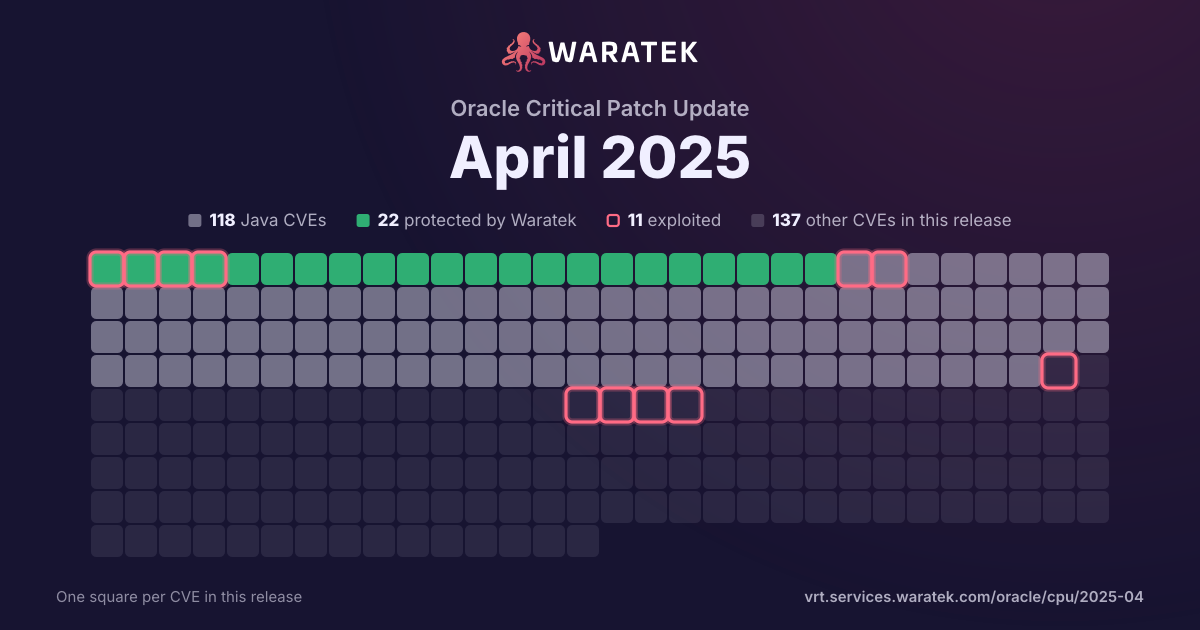
By status
22Protected by Waratek8Mitigation candidate88No exploit published16Outside Waratek scope121Not applicable
11Exploited, marked by the ring
No exploit published. For 33 of them, Oracle's security advisory is the source of public detail.
Protected by Waratek. Waratek RASP can block exploitation of these on systems that have not applied the patch yet.
Overview 7 matches · 2 in Waratek scope · 0 protected · 4 CISA KEV · 4 public PoC · 3 EPSS ≥ 0.5
Protected by Waratek
0
0.0%
Rule in development
0
0.0%
Mitigation candidate
2
28.6%
No exploit published
0
0.0%
Outside Waratek scope
1
14.3%
Not applicable
4
57.1%
Withdrawn CVE
0
0.0%
blocked by ARMR today
0
0.0%
partly blocked
0
0.0%
not blocked
7
100.0%
not established
0
0.0%
unrecorded
0
0.0%
Exploited
7
100.0%
Working exploit published
0
0.0%
Proof of concept only
0
0.0%
Forecast only
0
0.0%
No public exploit
0
0.0%
split by
peak 2 / month
Oct 231
Mitigation candidate1
High1
not blocked1
Exploited1
Nov 230
Dec 231
Outside Waratek scope1
Medium1
not blocked1
Exploited1
Jan 240
Feb 240
Mar 240
Apr 240
May 240
Jun 240
Jul 240
Aug 240
Sep 240
Oct 240
Nov 242
Not applicable2
High1
Medium1
not blocked2
Exploited2
Dec 241
Mitigation candidate1
Critical1
not blocked1
Exploited1
Jan 250
Feb 250
Mar 252
Not applicable2
Critical1
High1
not blocked2
Exploited2
Nov 23Jan 24Mar 24May 24Jul 24Sep 24Nov 24Jan 25Mar 25
| CVE | Severity | Published▾ | Status | Exploitation | Description |
|---|---|---|---|---|---|
| CVE-2025-1974 | Critical | 2025-03-25 | Not applicable | Exploited | A security issue was discovered in Kubernetes where under certain conditions, an unauthenticated attacker with access to the pod network can achieve arbitrary code execution in the context of the ingress-nginx controller. This can lead to disclosure of Secrets accessible to the controller. (Note that in the default installation, the controller can access all Secrets cluster-wide.) |
| CVE-2025-27363 | High | 2025-03-11 | Not applicable | Exploited | An out of bounds write exists in FreeType versions 2.13.0 and below (newer versions of FreeType are not vulnerable) when attempting to parse font subglyph structures related to TrueType GX and variable font files. The vulnerable code assigns a signed short value to an unsigned long and then adds a static value causing it to wrap around and allocate too small of a heap buffer. The code then writes up to 6 signed long integers out of bounds relative to this buffer. This may result in arbitrary code execution. This vulnerability may have been exploited in the wild. |
| CVE-2024-56337 | Critical | 2024-12-20 | Mitigation candidate | Exploited | Time-of-check Time-of-use (TOCTOU) Race Condition vulnerability in Apache Tomcat. This issue affects Apache Tomcat: from 11.0.0-M1 through 11.0.1, from 10.1.0-M1 through 10.1.33, from 9.0.0.M1 through 9.0.97. The following versions were EOL at the time the CVE was created but are known to be affected: 8.5.0 though 8.5.100. Other, older, EOL versions may also be affected. The mitigation for CVE-2024-50379 was incomplete. Users running Tomcat on a case insensitive file system with the default servlet write enabled (readonly initialisation parameter set to the non-default value of false) may need additional configuration to fully mitigate CVE-2024-50379 depending on which version of Java they are using with Tomcat: - running on Java 8 or Java 11: the system property sun.io.useCanonCaches must be explicitly set to false (it defaults to true) - running on Java 17: the system property sun.io.useCanonCaches, if set, must be set to false (it defaults to false) - running on Java 21 onwards: no further configuration is required (the system property and the problematic cache have been removed) Tomcat 11.0.3, 10.1.35 and 9.0.99 onwards will include checks that sun.io.useCanonCaches is set appropriately before allowing the default servlet to be write enabled on a case insensitive file system. Tomcat will also set sun.io.useCanonCaches to false by default where it can. |
| CVE-2024-44309 | Medium | 2024-11-20 | Not applicable | Exploited | A cookie management issue was addressed with improved state management. This issue is fixed in Safari 18.1.1, iOS 17.7.2 and iPadOS 17.7.2, iOS 18.1.1 and iPadOS 18.1.1, macOS Sequoia 15.1.1, visionOS 2.1.1. Processing maliciously crafted web content may lead to a cross site scripting attack. Apple is aware of a report that this issue may have been actively exploited on Intel-based Mac systems. |
| CVE-2024-44308 | High | 2024-11-20 | Not applicable | Exploited | The issue was addressed with improved checks. This issue is fixed in Safari 18.1.1, iOS 17.7.2 and iPadOS 17.7.2, iOS 18.1.1 and iPadOS 18.1.1, macOS Sequoia 15.1.1, visionOS 2.1.1. Processing maliciously crafted web content may lead to arbitrary code execution. Apple is aware of a report that this issue may have been actively exploited on Intel-based Mac systems. |
| CVE-2023-48795 | Medium | 2023-12-18 | Outside Waratek scope | Exploited | The SSH transport protocol with certain OpenSSH extensions, found in OpenSSH before 9.6 and other products, allows remote attackers to bypass integrity checks such that some packets are omitted (from the extension negotiation message), and a client and server may consequently end up with a connection for which some security features have been downgraded or disabled, aka a Terrapin attack. This occurs because the SSH Binary Packet Protocol (BPP), implemented by these extensions, mishandles the handshake phase and mishandles use of sequence numbers. For example, there is an effective attack against SSH's use of ChaCha20-Poly1305 (and CBC with Encrypt-then-MAC). The bypass occurs in chacha20-poly1305@openssh.com and (if CBC is used) the -etm@openssh.com MAC algorithms. This also affects Maverick Synergy Java SSH API before 3.1.0-SNAPSHOT, Dropbear through 2022.83, Ssh before 5.1.1 in Erlang/OTP, PuTTY before 0.80, AsyncSSH before 2.14.2, golang.org/x/crypto before 0.17.0, libssh before 0.10.6, libssh2 through 1.11.0, Thorn Tech SFTP Gateway before 3.4.6, Tera Term before 5.1, Paramiko before 3.4.0, jsch before 0.2.15, SFTPGo before 2.5.6, Netgate pfSense Plus through 23.09.1, Netgate pfSense CE through 2.7.2, HPN-SSH through 18.2.0, ProFTPD before 1.3.8b (and before 1.3.9rc2), ORYX CycloneSSH before 2.3.4, NetSarang XShell 7 before Build 0144, CrushFTP before 10.6.0, ConnectBot SSH library before 2.2.22, Apache MINA sshd through 2.11.0, sshj through 0.37.0, TinySSH through 20230101, trilead-ssh2 6401, LANCOM LCOS and LANconfig, FileZilla before 3.66.4, Nova before 11.8, PKIX-SSH before 14.4, SecureCRT before 9.4.3, Transmit5 before 5.10.4, Win32-OpenSSH before 9.5.0.0p1-Beta, WinSCP before 6.2.2, Bitvise SSH Server before 9.32, Bitvise SSH Client before 9.33, KiTTY through 0.76.1.13, the net-ssh gem 7.2.0 for Ruby, the mscdex ssh2 module before 1.15.0 for Node.js, the thrussh library before 0.35.1 for Rust, and the Russh crate before 0.40.2 for Rust. |
| CVE-2023-44487 | High | 2023-10-10 | Mitigation candidate | Exploited | The HTTP/2 protocol allows a denial of service (server resource consumption) because request cancellation can reset many streams quickly, as exploited in the wild in August through October 2023. |