
Oracle Critical Patch Update April 2025
Released April 2025 · Oracle's advisory ↗ · ← Critical Patch Update, January 2025 · Critical Patch Update, July 2025 →
255 CVEs in this release, one square each
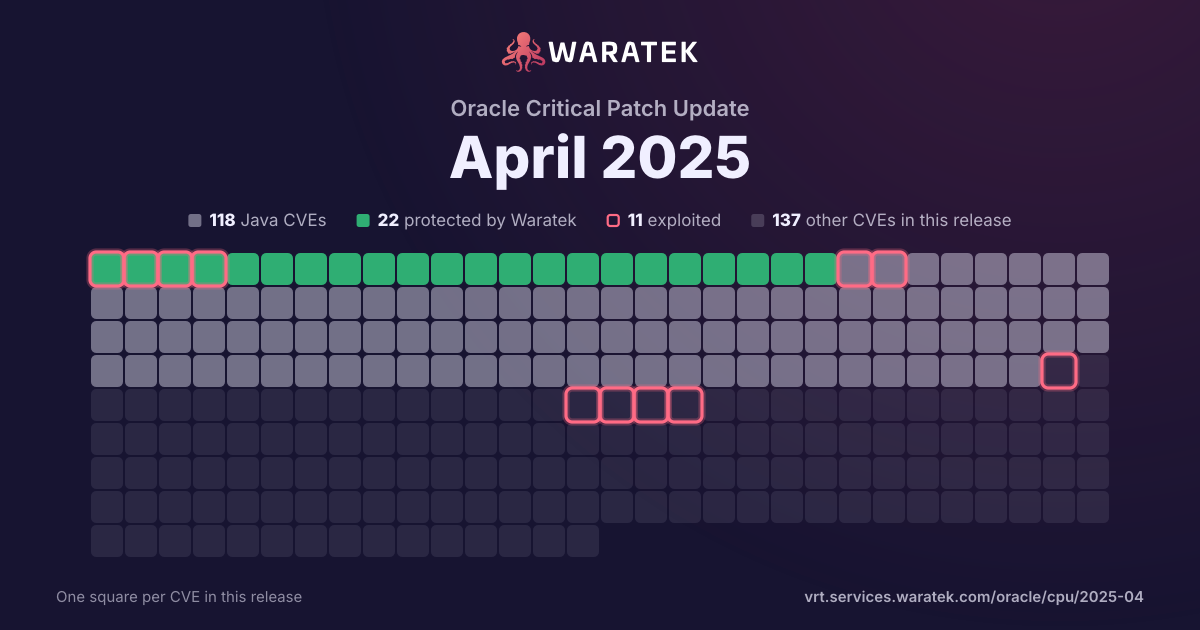
By status
22Protected by Waratek8Mitigation candidate88No exploit published16Outside Waratek scope121Not applicable
11Exploited, marked by the ring
No exploit published. For 33 of them, Oracle's security advisory is the source of public detail.
Protected by Waratek. Waratek RASP can block exploitation of these on systems that have not applied the patch yet.
Overview 4 matches · 0 protected · 1 exploited · 1 CISA KEV · 2 public PoC
Protected by Waratek
0
0.0%
Rule in development
0
0.0%
Mitigation candidate
2
50.0%
No exploit published
2
50.0%
blocked by ARMR today
0
0.0%
partly blocked
0
0.0%
not blocked
4
100.0%
not established
0
0.0%
unrecorded
0
0.0%
Exploited
1
25.0%
Working exploit published
1
25.0%
Proof of concept only
0
0.0%
Forecast only
2
50.0%
No public exploit
0
0.0%
split by
peak 1 / quarter
Q3 201
Mitigation candidate1
High1
not blocked1
Working exploit published1
Q4 201
No exploit published1
Medium1
not blocked1
Forecast only1
Q1 210
Q2 210
Q3 211
No exploit published1
Medium1
not blocked1
Forecast only1
Q4 210
Q1 220
Q2 220
Q3 220
Q4 220
Q1 230
Q2 230
Q3 230
Q4 231
Mitigation candidate1
High1
not blocked1
Exploited1
Q4 20Q2 21Q4 21Q2 22Q4 22Q2 23Q4 23
| CVE | Severity | Published▾ | Status | Exploitation | Description |
|---|---|---|---|---|---|
| CVE-2023-44487 | High | 2023-10-10 | Mitigation candidate | Exploited | The HTTP/2 protocol allows a denial of service (server resource consumption) because request cancellation can reset many streams quickly, as exploited in the wild in August through October 2023. |
| CVE-2021-33037 | Medium | 2021-07-12 | No exploit published | Forecast only | Apache Tomcat 10.0.0-M1 to 10.0.6, 9.0.0.M1 to 9.0.46 and 8.5.0 to 8.5.66 did not correctly parse the HTTP transfer-encoding request header in some circumstances leading to the possibility to request smuggling when used with a reverse proxy. Specifically: - Tomcat incorrectly ignored the transfer encoding header if the client declared it would only accept an HTTP/1.0 response; - Tomcat honoured the identify encoding; and - Tomcat did not ensure that, if present, the chunked encoding was the final encoding. |
| CVE-2020-13943 | Medium | 2020-10-12 | No exploit published | Forecast only | If an HTTP/2 client connecting to Apache Tomcat 10.0.0-M1 to 10.0.0-M7, 9.0.0.M1 to 9.0.37 or 8.5.0 to 8.5.57 exceeded the agreed maximum number of concurrent streams for a connection (in violation of the HTTP/2 protocol), it was possible that a subsequent request made on that connection could contain HTTP headers - including HTTP/2 pseudo headers - from a previous request rather than the intended headers. This could lead to users seeing responses for unexpected resources. |
| CVE-2020-13935 | High | 2020-07-14 | Mitigation candidate | Working exploit published | The payload length in a WebSocket frame was not correctly validated in Apache Tomcat 10.0.0-M1 to 10.0.0-M6, 9.0.0.M1 to 9.0.36, 8.5.0 to 8.5.56 and 7.0.27 to 7.0.104. Invalid payload lengths could trigger an infinite loop. Multiple requests with invalid payload lengths could lead to a denial of service. |